



Active Noise and Vibration Control System Market
Active Noise and Vibration Control System Market Size, Share, Insights, Competitive Landscape, and Forecast 2026 to 2033
Active Noise and Vibration Control System Market Size and Trend Analysis
How Fast Is the Active Noise and Vibration Control System Market Growing?
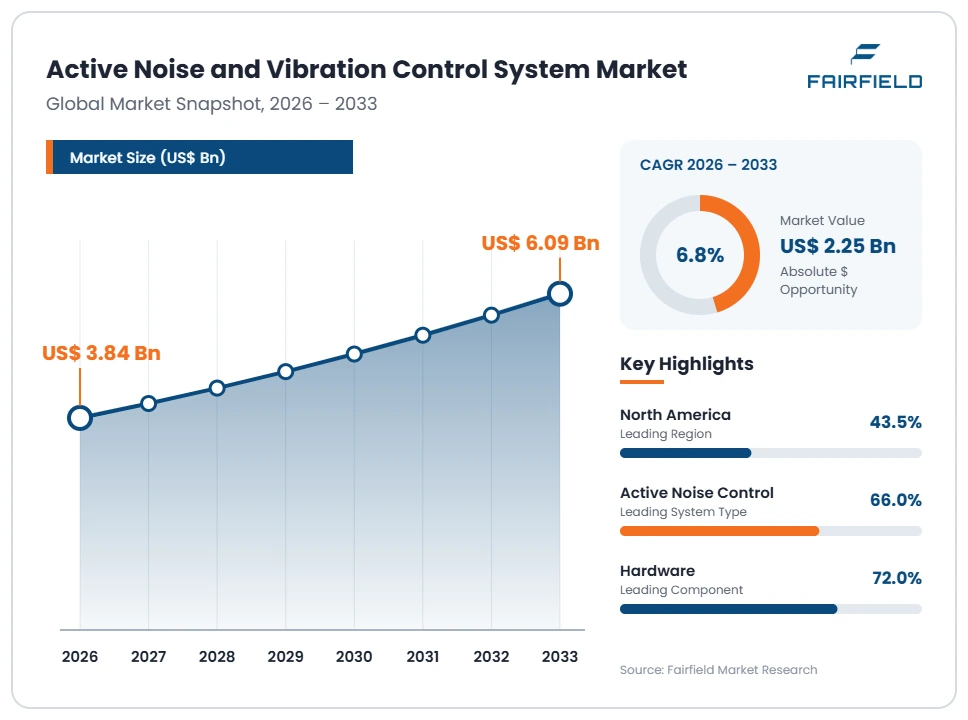
The global active noise and vibration control (ANVC) system market size is expected to be valued at US$ 3.84 billion in 2026 and projected to reach US$ 6.09 billion by 2033, growing at a CAGR of 6.8% between 2026 and 2033.
Between 2020 and 2025, the market grew at a CAGR of about 4.9%, as aircraft deliveries fell sharply during the pandemic and then recovered, while automakers added noise cancellation to quieter electric vehicles. ANVC systems use sensors, controllers, and actuators or loudspeakers to measure unwanted sound or vibration and create an opposite signal that cancels it. Unlike passive insulation, they work best at low frequencies and add little weight. Three factors now drive growth: demand for quieter cabin noise levels in aircraft, helicopters, and business jets, the shift to electric vehicles, where the lack of engine sound makes road and wind noise more noticeable, and stricter limits on noise and vibration exposure for crews. The market is shifting toward digital, software-based active noise cancellation, road noise cancellation in cars, and lighter active vibration control systems. In December 2025, ZF announced new active noise reduction software for vehicle chassis, which it presented at CES 2026.
Key Report Takeaways
- By System Type: Active Noise Control held 66.0% share in 2026, while Active Vibration Control is projected to expand at a 7.9% CAGR through 2033, driven by helicopter, turboprop, and electric aircraft demand for smoother rides.
- By Component: Hardware held 72.0% share in 2026, while Software is projected to expand at a 9.1% CAGR through 2033, driven by adaptive algorithms, AI-based tuning, and over-the-air updates in vehicles and aircraft.
- By Platform: Commercial Aviation held 56.0% share in 2026, while Automotive is projected to expand at an 8.8% CAGR through 2033, driven by road noise cancellation in electric and premium vehicles.
- By Region: North America held 43.5% share in 2026, while Asia Pacific is projected to expand at an 8.6% CAGR through 2033, driven by aircraft production, electric vehicles, and fleet growth in China, India, Japan, and South Korea.
Global Active Noise and Vibration Control System Market Trends and Insights
Drivers Impact Analysis
Two drivers carry the strongest influence on ANVC system demand during the forecast period.
| Driver | Impact on CAGR Forecast | Geographic Relevance | Impact Timeline |
| Passenger comfort and aircraft fleet growth | High | Global | Long term (≥4 years) |
| Electric vehicle adoption and lightweighting | High | Asia Pacific, Europe, North America | Medium term (2–4 years) |
Passenger Comfort Is Driving the Active Noise and Vibration Control System Market
Demand for passenger comfort and aircraft fleet growth is the strongest driver of the ANVC system market. Airlines and jet owners want quieter cabins.
The mechanism is competition on comfort and rising aircraft production. Propeller aircraft, helicopters, and some jets generate strong low-frequency cabin noise and vibration that passive insulation struggles to block without adding heavy materials. ANVC systems use microphones or accelerometers to detect noise and vibration, then drive loudspeakers or actuators to cancel them. Business jet makers market quiet cabins as a premium feature. Airlines want to reduce passenger fatigue on long flights. Air travel has returned to record levels, and Airbus and Boeing have large order backlogs that support new aircraft deliveries. Helicopter operators use active vibration control to protect crews and equipment. These factors create steady demand from original equipment and retrofit programs.
Electric Vehicles Are Expanding the Active Noise and Vibration Control System Market
Electric vehicle adoption and lightweighting are expanding the ANVC system market. Quiet electric motors expose other noises.
The cause is the shift away from combustion engines. Without engine noise to mask them, road, tire, and wind noises become more noticeable in electric vehicles. Heavy batteries and large wheels can increase road noise. Carmakers use road noise cancellation systems that read vibration from the chassis and play canceling sound through the car’s speakers. These systems reduce the need for heavy sound-deadening materials, which helps extend battery range. Hyundai Motor, Jaguar Land Rover, and other brands have adopted the technology with partners such as Harman, Bose, Silentium, and Analog Devices. These trends add a large new market beyond aviation, with high-volume orders tied to popular vehicle models.
Restraints Impact Analysis
Two restraints limit how quickly the ANVC system market grows.
| Restraint | Impact on CAGR Forecast | Geographic Relevance | Impact Timeline |
| High costs and complex certification | Medium | North America, Europe | Medium term (2–4 years) |
| Technical limits at higher frequencies | Medium | Global | Long term (≥4 years) |
High Costs and Certification Slow the Active Noise and Vibration Control System Market
High costs and complex certification slow the ANVC system market. Adding ANVC to aircraft is expensive and time-consuming.
The specific causes are aviation safety rules and system complexity. Every new system installed on an aircraft must be certified by aviation authorities such as the Federal Aviation Administration and the European Union Aviation Safety Agency, which can take years and cost millions of dollars. Retrofit installations take aircraft out of service for days or weeks. ANVC systems require many sensors, wiring, and computing power. Airlines with tight budgets may choose cheaper passive solutions. Aircraft supply chain delays have slowed new deliveries. In cars, adding sensors and processing raises costs for budget models. These factors limit adoption in cost-sensitive segments. Smaller airlines and older fleets are especially unlikely to invest in retrofits.
Technical Limits Restrict the Active Noise and Vibration Control System Market
Technical limits at higher frequencies restrict the ANVC system market. Active systems cannot cancel all noises.
The underlying causes are physics and processing limits. Active noise cancellation works best on low-frequency, predictable sounds such as engine hum, propeller noise, and road rumble. Higher-frequency and random noises are harder to cancel and still need passive insulation. Systems must react in milliseconds, which requires fast processors and well-placed sensors. Poor tuning can create unpleasant sounds. Performance can vary across seats and conditions. Integrating ANVC with audio and other vehicle systems requires engineering work. These limits mean ANVC complements rather than replaces passive materials. Suppliers are working on more efficient algorithms, more sensors, and better speaker placement to extend the range of frequencies that can be controlled. Combining active systems with lightweight passive treatments gives the best overall result in most cabins.
Market Opportunities
Electric and Advanced Air Mobility Open a Fast-Growth Revenue Pool
Electric and advanced air mobility opens a fast-growth revenue pool in the ANVC system market. New aircraft types must be quiet to win public acceptance.
ANVC suppliers can capture this opportunity. Electric vertical take-off and landing aircraft, often called air taxis, plan to fly over cities, where noise rules will be strict. Hybrid-electric and electric regional aircraft with propellers face cabin noise and vibration challenges. Drones used for delivery also need quieter operation. Designers can build ANVC into new platforms from the start, lowering integration costs. Military programs need active noise cancellation in pilot helmets; Insta and Saab expanded their collaboration on helmet noise reduction in March 2025. Suppliers that partner early with new aircraft makers can secure long-term contracts for the life of each program.
Software-Defined Vehicles Create an Automotive Revenue Pool
Software-defined vehicles create an automotive revenue pool in the ANVC system market. Cars now use central computers that can run noise control software.
Software and chip companies can capture this opportunity. Modern vehicles have powerful audio processors and many speakers, so road noise cancellation can be added mainly through software and sensors. ZF is developing active noise reduction software that cuts tire noise by more than 3 decibels, with plans to reach 10 decibels. Over-the-air updates allow carmakers to improve noise control after sale. Engine order cancellation and personal sound zones add features. Software licensing creates recurring revenue for suppliers. Chip makers such as Analog Devices supply audio processors and sensors designed for noise control, which lowers the hardware cost of adding the feature to mid-priced cars.
Segment Analysis
- By System Type: Active Noise Control Leads While Active Vibration Control Grows Fastest
Active Noise Control held 66.0% share in 2026. Active noise cancellation systems use microphones and loudspeakers to reduce low-frequency sound in aircraft cabins, cars, and headsets. Ultra PCS, Terma, Bose, and Harman are leading suppliers.
Active Vibration Control is the fastest-growing system type, expanding at a 7.9% CAGR through 2033. Active vibration control systems use force generators and actuators to cancel vibration in helicopters, turboprops, and machinery, improving comfort and reducing fatigue on structures. Parker Hannifin, through its LORD business, Moog, and Hutchinson are key suppliers. For the market, vibration control growth supports rotorcraft and new aircraft. Industrial uses, such as precision machinery and semiconductor tools, also adopt active vibration isolation.
- By Component: Hardware Leads While Software Grows Fastest
Hardware held 72.0% share in 2026. Sensors, microphones, accelerometers, controllers, amplifiers, loudspeakers, and actuators make up most system costs.
Software is the fastest-growing component, expanding at a 9.1% CAGR through 2033. Adaptive algorithms continuously adjust cancellation signals as conditions change, and AI-based tuning shortens development time. Software can run on existing vehicle audio processors. For the market, software growth raises margins. Hardware remains essential, especially in aircraft, where systems use dozens of microphones and multiple actuators or tuned force generators installed in the fuselage and frames. Lighter, more efficient actuators are a key focus of development because every kilogram matters in aviation. In cars, accelerometers on the suspension and microphones in the headliner feed signals to the audio amplifier.
- By Platform: Commercial Aviation Leads While Automotive Grows Fastest
Commercial Aviation held 56.0% share in 2026. Turboprops, regional jets, and wide-body aircraft use ANVC to reduce cabin noise and vibration.
Automotive is the fastest-growing platform, expanding at an 8.8% CAGR through 2033. Electric and premium cars use road noise cancellation and engine order cancellation. Business and general aviation, military aviation, helicopters, marine, and industrial machinery are other platforms. For the market, automotive growth broadens demand. Business jets use ANVC as a premium comfort feature, while military aircraft and helicopters use it to protect crews from hearing damage and fatigue. Marine applications include yachts and naval ships, where vibration control reduces noise and improves stealth. Industrial users apply active systems to large fans, compressors, and sensitive manufacturing equipment.
Geography Analysis
- Which Region Is Leading the Active Noise and Vibration Control System Market?
North America is leading the ANVC system market with a 43.5% share in 2026. The United States has the world’s largest aerospace industry, including Boeing, business jet makers, and helicopter manufacturers, as well as major defense programs. Parker Hannifin, Moog, and Bose are based in the country. Canada has a strong business jet and turboprop industry. Several air taxi developers are based in the United States and need quiet designs to meet city noise rules. Key barriers include certification costs and aircraft supply chain delays. One change shaping the region is electric aircraft and air taxi programs.
- Europe Builds the Active Noise and Vibration Control System Market Through Aerospace and Automotive
Europe is a major ANVC system market. France, Germany, the United Kingdom, Sweden, and Denmark host Airbus, helicopter makers, and premium carmakers. Hutchinson in France, Terma in Denmark, and ZF in Germany are key industry players. Premium carmakers in Germany and the United Kingdom, including Jaguar Land Rover, have adopted road noise cancellation in electric and luxury models. Helicopter makers in France and Italy use active vibration control in their aircraft. Key barriers include high costs and strict certification. One opportunity is electric vehicles, which are spreading fast across the region.
- Which Region Is Growing Fastest in the Active Noise and Vibration Control System Market?
Asia Pacific is growing fastest in the ANVC system market at an 8.6% CAGR through 2033. China is the largest electric vehicle market and is developing its own commercial aircraft, while India has fast-growing airlines. Japan and South Korea have advanced automotive and electronics industries, and Hyundai Motor pioneered road noise cancellation. India is building aircraft maintenance and repair capacity to serve its growing fleet. Chinese carmakers compete strongly on cabin quietness in premium electric models. Key barriers include local competition and price pressure. One change shaping the region is EV adoption, which raises demand for road noise cancellation.
- Latin America Grows the Active Noise and Vibration Control System Market Through Aircraft Production
Latin America is a growing ANVC system market. Brazil is home to Embraer, a major regional jet and business jet maker, and the Brazilian Air Force flies Gripen fighters with noise reduction helmets. Embraer’s E-Jets and business jets compete on cabin comfort, which supports demand for noise and vibration solutions from global suppliers. Airlines in Mexico, Colombia, and Chile operate growing fleets of turboprops and regional jets. Electric vehicle sales are rising in Brazil and Mexico, mainly from imported Chinese brands. Key barriers include tight budgets and currency swings. One opportunity is regional jets and turboprops used on short routes.
- Middle East & Africa Expands the Active Noise and Vibration Control System Market Through Fleet Growth
Middle East & Africa is an emerging ANVC system market. Airlines in the United Arab Emirates, Qatar, and Saudi Arabia operate large fleets and value premium cabins. Business jet use is high in the region, and wealthy owners demand very quiet cabins. Saudi Arabia is building a local aerospace industry and plans to make helicopters and aircraft parts. Electric vehicle adoption is starting to grow in the United Arab Emirates. South Africa has an established defense and aviation sector. Key barriers include limited local manufacturing and engineering capacity. One opportunity is retrofits of business jets and helicopters.
Competitive Landscape
The ANVC system market is moderately concentrated. Parker Hannifin, Moog, Ultra PCS, Hutchinson, and Terma lead in aerospace systems, while Harman, Bose, Silentium, Analog Devices, and ZF lead in automotive noise control. Bosch General Aviation Technology and Sensata Technologies supply components and systems.
Companies compete on noise reduction performance, weight, reliability, certification experience, cost, and integration support. Long aircraft programs create lasting relationships, because once a supplier’s system is certified on a platform, it often stays for decades. In automotive, audio companies and chip makers compete to supply road noise cancellation, and carmakers increasingly bring software in-house. Startups such as Silentium license algorithms to tier-one suppliers. Defense programs value proven reliability and security.
Strategic moves show how competition is changing. In March 2025, Insta and Saab expanded work on helmet noise reduction. In November 2025, ASI Global and Tata Projects signed a memorandum on noise- and vibration-compliant aircraft hangars in India. In December 2025, ZF announced active noise reduction software. These moves show competition shifting toward software-based noise control, military aviation programs, and new aviation infrastructure in fast-growing markets such as India, where fleets are expanding quickly.
Three themes shape vendor strategy. First, companies are developing software. Second, they are targeting electric vehicle programs. Third, they are partnering with aircraft makers early in new programs. Vendors that combine strong algorithms, lightweight hardware, and certification know-how are best placed to win share.
Recent Industry Developments
- December 2025: ZF announced active noise reduction software that cuts in-cabin tire noise by more than 3 decibels, presented at CES 2026 – advances software-based road noise cancellation.
- November 2025: ASI Global and Tata Projects signed a memorandum to develop noise- and vibration-compliant maintenance hangars in India – supports aviation infrastructure growth in Asia Pacific.
- March 2025: Insta and Saab expanded their collaboration on the Insta active noise reduction system for a future fighter helmet – extends active noise cancellation in military aviation.
Companies Covered in the Report
- Parker Hannifin
- Moog
- Ultra PCS
- Hutchinson
- Terma
- Bosch General Aviation Technology
- Harman
- Bose
- Silentium
- Analog Devices
- ZF
- Sensata Technologies
Active Noise and Vibration Control System Market Report Scope
| Metric | Value |
| Study Period | 2020–2033 |
| Market Size 2026 | US$ 3.84 Billion |
| Market Size 2033 | US$ 6.09 Billion |
| CAGR 2026–2033 | 6.8% |
| Absolute Dollar Opportunity | US$ 2.25 Billion |
| Largest Market | North America |
| Fastest-Growing Market | Asia Pacific |
| Market Concentration | Moderate |
| Major Players | Parker Hannifin, Moog, Ultra PCS, Hutchinson, Terma |
Active Noise and Vibration Control System Market Segmentation
System Type
- Active Noise Control
- Active Vibration Control
Component
- Hardware
- Software
Platform
- Commercial Aviation
- Business & General Aviation
- Military Aviation
- Helicopters
- Automotive
- Marine
- Industrial
Regions
- North America
- Europe
- Asia Pacific
- Latin America
- Middle East & Africa
- Executive Summary
- Global Active Noise and Vibration Control (ANVC) System Market Snapshot
- Future Projections
- Key Report Takeaways
- Regional Snapshot
- Market Overview
- Market Definition and Report Scope
- Historical Trends 2020–2025
- Market Dynamics
- Drivers
- Passenger Comfort Is Driving the ANVC System Market
- Electric Vehicles Are Expanding the ANVC System Market
- Restraints
- High Costs and Certification Slow the ANVC System Market
- Technical Limits Restrict the ANVC System Market
- Market Opportunities
- Electric and Advanced Air Mobility Open a Fast-Growth Revenue Pool
- Software-Defined Vehicles Create an Automotive Revenue Pool
- Drivers
- Global Active Noise and Vibration Control (ANVC) System Market Outlook, 2020-2033
- Global Active Noise and Vibration Control (ANVC) System Market Outlook, by System Type, Value (US$ Billion), 2020-2033
- Active Noise Control
- Active Vibration Control
- Global Active Noise and Vibration Control (ANVC) System Market Outlook, by Component, Value (US$ Billion), 2020-2033
- Hardware
- Software
- Global Active Noise and Vibration Control (ANVC) System Market Outlook, by Platform, Value (US$ Billion), 2020-2033
- Commercial Aviation
- Business & General Aviation
- Military Aviation
- Helicopters
- Automotive
- Marine
- Industrial
- Global Active Noise and Vibration Control (ANVC) System Market Outlook, by Region, Value (US$ Billion), 2020-2033
- North America
- Europe
- Asia Pacific
- Latin America
- Middle East & Africa
- Global Active Noise and Vibration Control (ANVC) System Market Outlook, by System Type, Value (US$ Billion), 2020-2033
- North America Active Noise and Vibration Control (ANVC) System Market Outlook, 2020-2033
- North America Active Noise and Vibration Control (ANVC) System Market Outlook, by System Type, Value (US$ Billion), 2020-2033
- Active Noise Control
- Active Vibration Control
- North America Active Noise and Vibration Control (ANVC) System Market Outlook, by Component, Value (US$ Billion), 2020-2033
- Hardware
- Software
- North America Active Noise and Vibration Control (ANVC) System Market Outlook, by Platform, Value (US$ Billion), 2020-2033
- Commercial Aviation
- Business & General Aviation
- Military Aviation
- Helicopters
- Automotive
- Marine
- Industrial
- North America Active Noise and Vibration Control (ANVC) System Market Outlook, by Country, Value (US$ Billion), 2020-2033
- United States Active Noise and Vibration Control (ANVC) System Market Outlook, by System Type, 2020-2033
- United States Active Noise and Vibration Control (ANVC) System Market Outlook, by Component, 2020-2033
- United States Active Noise and Vibration Control (ANVC) System Market Outlook, by Platform, 2020-2033
- Canada Active Noise and Vibration Control (ANVC) System Market Outlook, by System Type, 2020-2033
- Canada Active Noise and Vibration Control (ANVC) System Market Outlook, by Component, 2020-2033
- Canada Active Noise and Vibration Control (ANVC) System Market Outlook, by Platform, 2020-2033
- North America Active Noise and Vibration Control (ANVC) System Market Outlook, by System Type, Value (US$ Billion), 2020-2033
- Europe Active Noise and Vibration Control (ANVC) System Market Outlook, 2020-2033
- Europe Active Noise and Vibration Control (ANVC) System Market Outlook, by System Type, Value (US$ Billion), 2020-2033
- Active Noise Control
- Active Vibration Control
- Europe Active Noise and Vibration Control (ANVC) System Market Outlook, by Component, Value (US$ Billion), 2020-2033
- Hardware
- Software
- Europe Active Noise and Vibration Control (ANVC) System Market Outlook, by Platform, Value (US$ Billion), 2020-2033
- Commercial Aviation
- Business & General Aviation
- Military Aviation
- Helicopters
- Automotive
- Marine
- Industrial
- Europe Active Noise and Vibration Control (ANVC) System Market Outlook, by Country, Value (US$ Billion), 2020-2033
- France Active Noise and Vibration Control (ANVC) System Market Outlook, by System Type, 2020-2033
- France Active Noise and Vibration Control (ANVC) System Market Outlook, by Component, 2020-2033
- France Active Noise and Vibration Control (ANVC) System Market Outlook, by Platform, 2020-2033
- Germany Active Noise and Vibration Control (ANVC) System Market Outlook, by System Type, 2020-2033
- Germany Active Noise and Vibration Control (ANVC) System Market Outlook, by Component, 2020-2033
- Germany Active Noise and Vibration Control (ANVC) System Market Outlook, by Platform, 2020-2033
- United Kingdom Active Noise and Vibration Control (ANVC) System Market Outlook, by System Type, 2020-2033
- United Kingdom Active Noise and Vibration Control (ANVC) System Market Outlook, by Component, 2020-2033
- United Kingdom Active Noise and Vibration Control (ANVC) System Market Outlook, by Platform, 2020-2033
- Sweden Active Noise and Vibration Control (ANVC) System Market Outlook, by System Type, 2020-2033
- Sweden Active Noise and Vibration Control (ANVC) System Market Outlook, by Component, 2020-2033
- Sweden Active Noise and Vibration Control (ANVC) System Market Outlook, by Platform, 2020-2033
- Denmark Active Noise and Vibration Control (ANVC) System Market Outlook, by System Type, 2020-2033
- Denmark Active Noise and Vibration Control (ANVC) System Market Outlook, by Component, 2020-2033
- Denmark Active Noise and Vibration Control (ANVC) System Market Outlook, by Platform, 2020-2033
- Italy Active Noise and Vibration Control (ANVC) System Market Outlook, by System Type, 2020-2033
- Italy Active Noise and Vibration Control (ANVC) System Market Outlook, by Component, 2020-2033
- Italy Active Noise and Vibration Control (ANVC) System Market Outlook, by Platform, 2020-2033
- Europe Active Noise and Vibration Control (ANVC) System Market Outlook, by System Type, Value (US$ Billion), 2020-2033
- Asia Pacific Active Noise and Vibration Control (ANVC) System Market Outlook, 2020-2033
- Asia Pacific Active Noise and Vibration Control (ANVC) System Market Outlook, by System Type, Value (US$ Billion), 2020-2033
- Active Noise Control
- Active Vibration Control
- Asia Pacific Active Noise and Vibration Control (ANVC) System Market Outlook, by Component, Value (US$ Billion), 2020-2033
- Hardware
- Software
- Asia Pacific Active Noise and Vibration Control (ANVC) System Market Outlook, by Platform, Value (US$ Billion), 2020-2033
- Commercial Aviation
- Business & General Aviation
- Military Aviation
- Helicopters
- Automotive
- Marine
- Industrial
- Asia Pacific Active Noise and Vibration Control (ANVC) System Market Outlook, by Country, Value (US$ Billion), 2020-2033
- China Active Noise and Vibration Control (ANVC) System Market Outlook, by System Type, 2020-2033
- China Active Noise and Vibration Control (ANVC) System Market Outlook, by Component, 2020-2033
- China Active Noise and Vibration Control (ANVC) System Market Outlook, by Platform, 2020-2033
- India Active Noise and Vibration Control (ANVC) System Market Outlook, by System Type, 2020-2033
- India Active Noise and Vibration Control (ANVC) System Market Outlook, by Component, 2020-2033
- India Active Noise and Vibration Control (ANVC) System Market Outlook, by Platform, 2020-2033
- Japan Active Noise and Vibration Control (ANVC) System Market Outlook, by System Type, 2020-2033
- Japan Active Noise and Vibration Control (ANVC) System Market Outlook, by Component, 2020-2033
- Japan Active Noise and Vibration Control (ANVC) System Market Outlook, by Platform, 2020-2033
- South Korea Active Noise and Vibration Control (ANVC) System Market Outlook, by System Type, 2020-2033
- South Korea Active Noise and Vibration Control (ANVC) System Market Outlook, by Component, 2020-2033
- South Korea Active Noise and Vibration Control (ANVC) System Market Outlook, by Platform, 2020-2033
- Asia Pacific Active Noise and Vibration Control (ANVC) System Market Outlook, by System Type, Value (US$ Billion), 2020-2033
- Latin America Active Noise and Vibration Control (ANVC) System Market Outlook, 2020-2033
- Latin America Active Noise and Vibration Control (ANVC) System Market Outlook, by System Type, Value (US$ Billion), 2020-2033
- Active Noise Control
- Active Vibration Control
- Latin America Active Noise and Vibration Control (ANVC) System Market Outlook, by Component, Value (US$ Billion), 2020-2033
- Hardware
- Software
- Latin America Active Noise and Vibration Control (ANVC) System Market Outlook, by Platform, Value (US$ Billion), 2020-2033
- Commercial Aviation
- Business & General Aviation
- Military Aviation
- Helicopters
- Automotive
- Marine
- Industrial
- Latin America Active Noise and Vibration Control (ANVC) System Market Outlook, by Country, Value (US$ Billion), 2020-2033
- Brazil Active Noise and Vibration Control (ANVC) System Market Outlook, by System Type, 2020-2033
- Brazil Active Noise and Vibration Control (ANVC) System Market Outlook, by Component, 2020-2033
- Brazil Active Noise and Vibration Control (ANVC) System Market Outlook, by Platform, 2020-2033
- Mexico Active Noise and Vibration Control (ANVC) System Market Outlook, by System Type, 2020-2033
- Mexico Active Noise and Vibration Control (ANVC) System Market Outlook, by Component, 2020-2033
- Mexico Active Noise and Vibration Control (ANVC) System Market Outlook, by Platform, 2020-2033
- Colombia Active Noise and Vibration Control (ANVC) System Market Outlook, by System Type, 2020-2033
- Colombia Active Noise and Vibration Control (ANVC) System Market Outlook, by Component, 2020-2033
- Colombia Active Noise and Vibration Control (ANVC) System Market Outlook, by Platform, 2020-2033
- Chile Active Noise and Vibration Control (ANVC) System Market Outlook, by System Type, 2020-2033
- Chile Active Noise and Vibration Control (ANVC) System Market Outlook, by Component, 2020-2033
- Chile Active Noise and Vibration Control (ANVC) System Market Outlook, by Platform, 2020-2033
- Latin America Active Noise and Vibration Control (ANVC) System Market Outlook, by System Type, Value (US$ Billion), 2020-2033
- Middle East & Africa Active Noise and Vibration Control (ANVC) System Market Outlook, 2020-2033
- Middle East & Africa Active Noise and Vibration Control (ANVC) System Market Outlook, by System Type, Value (US$ Billion), 2020-2033
- Active Noise Control
- Active Vibration Control
- Middle East & Africa Active Noise and Vibration Control (ANVC) System Market Outlook, by Component, Value (US$ Billion), 2020-2033
- Hardware
- Software
- Middle East & Africa Active Noise and Vibration Control (ANVC) System Market Outlook, by Platform, Value (US$ Billion), 2020-2033
- Commercial Aviation
- Business & General Aviation
- Military Aviation
- Helicopters
- Automotive
- Marine
- Industrial
- Middle East & Africa Active Noise and Vibration Control (ANVC) System Market Outlook, by Country, Value (US$ Billion), 2020-2033
- United Arab Emirates Active Noise and Vibration Control (ANVC) System Market Outlook, by System Type, 2020-2033
- United Arab Emirates Active Noise and Vibration Control (ANVC) System Market Outlook, by Component, 2020-2033
- United Arab Emirates Active Noise and Vibration Control (ANVC) System Market Outlook, by Platform, 2020-2033
- Qatar Active Noise and Vibration Control (ANVC) System Market Outlook, by System Type, 2020-2033
- Qatar Active Noise and Vibration Control (ANVC) System Market Outlook, by Component, 2020-2033
- Qatar Active Noise and Vibration Control (ANVC) System Market Outlook, by Platform, 2020-2033
- Saudi Arabia Active Noise and Vibration Control (ANVC) System Market Outlook, by System Type, 2020-2033
- Saudi Arabia Active Noise and Vibration Control (ANVC) System Market Outlook, by Component, 2020-2033
- Saudi Arabia Active Noise and Vibration Control (ANVC) System Market Outlook, by Platform, 2020-2033
- South Africa Active Noise and Vibration Control (ANVC) System Market Outlook, by System Type, 2020-2033
- South Africa Active Noise and Vibration Control (ANVC) System Market Outlook, by Component, 2020-2033
- South Africa Active Noise and Vibration Control (ANVC) System Market Outlook, by Platform, 2020-2033
- Middle East & Africa Active Noise and Vibration Control (ANVC) System Market Outlook, by System Type, Value (US$ Billion), 2020-2033
- Competitive Landscape
- Market Concentration and Industry Leaders
- Competitive Differentiation
- Strategic Moves and Market Direction
- Recent Industry Developments
- Company Profiles
- Parker Hannifin
- Moog
- Ultra PCS
- Hutchinson
- Terma
- Bosch General Aviation Technology
- Harman
- Bose
- Silentium
- Analog Devices
- ZF
- Sensata Technologies
- Appendix
- Research Methodology
- Report Assumptions
- Acronyms and Abbreviations
System Type
- Active Noise Control
- Active Vibration Control
Component
- Hardware
- Software
Platform
- Commercial Aviation
- Business & General Aviation
- Military Aviation
- Helicopters
- Automotive
- Marine
- Industrial
Regions
- North America
- Europe
- Asia Pacific
- Latin America
- Middle East & Africa
Our Research Methodology
Considering the volatility of business today, traditional approaches to strategizing a game plan can be unfruitful if not detrimental. True ambiguity is no way to determine a forecast. A myriad of predetermined factors must be accounted for such as the degree of risk involved, the magnitude of circumstances, as well as conditions or consequences that are not known or unpredictable. To circumvent binary views that cast uncertainty, the application of market research intelligence to strategically posture, move, and enable actionable outcomes is necessary.
View Methodology
Quality Assured
Rigorous Validation Process

Confidentiality Assured
End-to-end Data Security

Custom Research Services
Tailored To Your Objectives
FAQs
The ANVC system market is valued at US$ 3.84 billion in 2026, led by active noise control and North America.
The market is projected to reach US$ 6.09 billion by 2033, growing at a 6.8% CAGR and adding US$ 2.25 billion.
Automotive is growing fastest at an 8.8% CAGR through 2033, driven by road noise cancellation in electric and premium vehicles.
Asia Pacific is growing fastest at an 8.6% CAGR through 2033, driven by aircraft production and electric vehicles in China and India.
North America holds the largest share at 43.5% in 2026, supported by the world’s largest aerospace and defense industry.
Related Reports
Used Vehicle Market Size, Share, Insights, Competitive Landscape, and Forecast 2026 to 2033
The global used vehicle market is valued at US$1.7 trillion in 2026, reaching US$2.6 trillion by 2033, growing at a 6.3% CAGR
Logistics Market Size, Share, Insights, Competitive Landscape, and Forecast 2026 to 2033
The global logistics market is valued at US$3.7 trillion in 2026, reaching US$6.1 trillion by 2033, growing at a 7.4% CAGR
Hypercar Market Size, Share, Insights, Competitive Landscape, and Forecast 2026 to 2033
The global hypercar market is valued at US$18.1 billion in 2026, reaching US$60.8 billion by 2033, growing at an 18.9% CAGR
High Speed Rail Market Size, Share, Insights, Competitive Landscape, and Forecast 2026 to 2033
The global high speed rail market is valued at US$185.0 billion in 2026, reaching US$268.0 billion by 2033, growing at a 5.4% CAGR
Farm Tire Market Size, Share, Insights, Competitive Landscape, and Forecast 2026 to 2033
The global farm tire market is valued at US$5.9 billion in 2026, reaching US$9.4 billion by 2033, growing at a 6.9% CAGR
Cold Chain Logistics Market Size, Share, Insights, Competitive Landscape, and Forecast 2026 to 2033
The Cold Chain Logistics Market is set to grow from US$ 412.3 billion in 2026 to US$ 976.0 billion by 2033 at a 13.1% CAGR. Explore key segments.