



Advanced Aerial Mobility Market
Advanced Aerial Mobility Market Size, Share, Insights, Competitive Landscape, and Forecast 2026 to 2033
Advanced Aerial Mobility Market Size and Trend Analysis
How Fast Is the Advanced Aerial Mobility Market Growing?
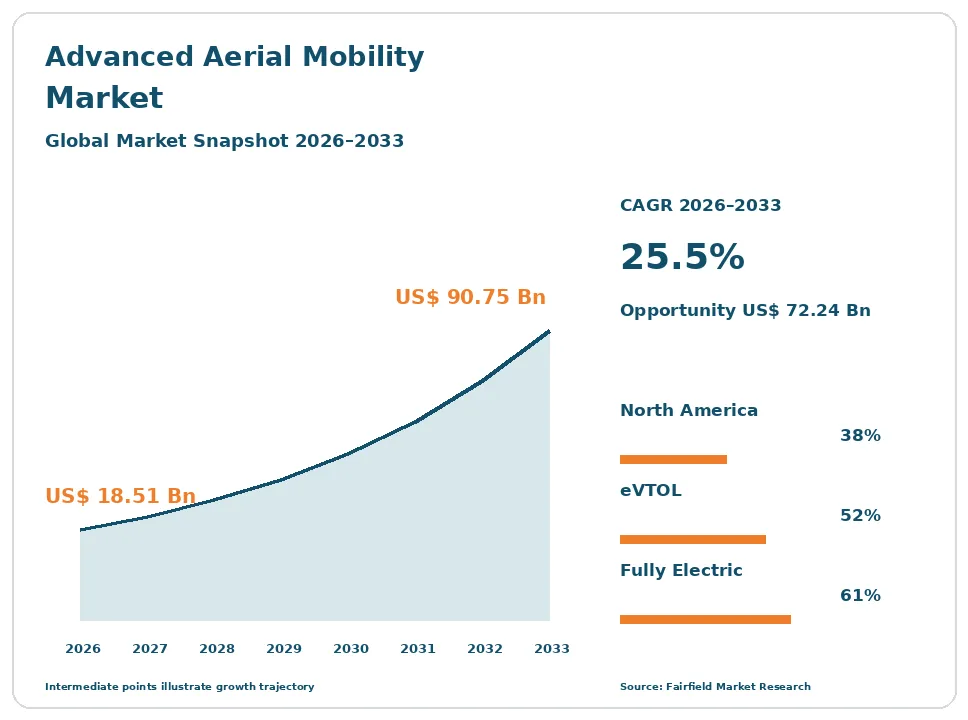
The global advanced aerial mobility market size is expected to be valued at US$ 18.51 billion in 2026 and projected to reach US$ 90.75 billion by 2033, growing at a CAGR of 25.5% between 2026 and 2033.
Between 2020 and 2025, the market grew rapidly from a small base, as investors poured billions into eVTOL developers, regulators wrote the first rules for powered-lift aircraft, and drone delivery services expanded in the United States and China. Advanced aerial mobility covers new types of aircraft and services that move people and goods through low-altitude airspace, including electric vertical take-off and landing aircraft, electric short take-off aircraft, autonomous cargo drones, and supporting vertiport and charging infrastructure. Three factors now drive growth: urban congestion that makes air taxi travel attractive, demand for fast, low-emission cargo and medical delivery, and government support for the low-altitude economy, especially in China and the United Arab Emirates. The market is shifting from prototypes to certified commercial operations, with urban air mobility services starting in a few cities. In June 2025, Joby Aviation completed piloted eVTOL flights in Dubai and delivered its first aircraft there ahead of passenger service planned for 2026.
Key Report Takeaways
- By Aircraft Type: eVTOL held 52.0% share in 2026, while Autonomous Cargo Drones are projected to expand at a 29.6% CAGR through 2033, driven by e-commerce, medical supply, and industrial delivery networks needing fast, low-cost transport.
- By Propulsion: Fully Electric held 61.0% share in 2026, while Hydrogen Fuel Cell is projected to expand at a 31.2% CAGR through 2033, driven by longer-range regional missions and heavier cargo payload requirements.
- By Application: Urban Air Mobility held 44.0% share in 2026, while Logistics & Cargo Delivery is projected to expand at a 28.9% CAGR through 2033, driven by drone delivery of parcels, food, and medical supplies.
- By Region: North America held 38.0% share in 2026, while Asia Pacific is projected to expand at a 28.4% CAGR through 2033, driven by China’s low-altitude economy policies, EHang operations, and programs in Japan and South Korea.
Global Advanced Aerial Mobility Market Trends and Insights
Drivers Impact Analysis
| Driver | Impact on CAGR Forecast | Geographic Relevance | Impact Timeline |
| Urban congestion and demand for faster travel | High | North America, Asia Pacific, Middle East & Africa | Long term (≥4 years) |
| Government support and regulatory progress | High | Global | Medium term (2-4 years) |
Two drivers carry the strongest influence on advanced aerial mobility demand during the forecast period.
Urban Congestion Is Driving the Advanced Aerial Mobility Market
Urban congestion and demand for faster travel are the strongest driver of the advanced aerial mobility market. Air taxis can turn long road trips into short flights.
The mechanism is time savings in crowded cities. Traffic in cities such as Dubai, New York, Los Angeles, Shanghai, São Paulo, and Mumbai can turn short distances into hour-long trips. An air taxi flight from Dubai International Airport to Palm Jumeirah is expected to take about 12 minutes, compared with around 45 minutes by car. Electric aircraft are quieter and cleaner than helicopters, which makes city operations more acceptable. Airlines such as United Airlines and Delta Air Lines see air taxis as a way to connect airports with city centers. Over time, larger fleets and autonomy could lower fares. These factors support strong long-term demand for urban air mobility services.
Government Support Is Expanding the Advanced Aerial Mobility Market
Government support and regulatory progress are expanding the advanced aerial mobility market. Clear rules make commercial operations possible.
The cause is active policy work by aviation authorities and governments. The U.S. Federal Aviation Administration finalized rules for training and operating powered-lift aircraft in October 2024, a key step toward certification. China’s Civil Aviation Administration issued the world’s first eVTOL air operator certificates to EHang operators in March 2025. China has made the low-altitude economy a national priority, with local governments funding infrastructure. Dubai’s Roads and Transport Authority granted Joby Aviation exclusive air taxi rights for six years. Japan, South Korea, Saudi Arabia, and Europe are running pilot programs. Public funding for vertiport construction and airspace management adds momentum. These policies reduce risk for investors and operators.
Restraints Impact Analysis
| Restraint | Impact on CAGR Forecast | Geographic Relevance | Impact Timeline |
| Certification delays and high development costs | High | North America, Europe | Medium term (2-4 years) |
| Battery limits, infrastructure gaps, and public acceptance | Medium | Global | Long term (≥4 years) |
Two restraints limit how quickly the advanced aerial mobility market grows.
Certification Delays Slow the Advanced Aerial Mobility Market
Certification delays and high development costs slow the advanced aerial mobility market. New aircraft must meet strict safety standards.
The specific causes are novel technology and long approval processes. eVTOL aircraft use new designs, electric propulsion, and fly-by-wire controls that regulators have never certified at scale, so type certification can take many years. Developers spend billions of dollars before earning revenue, and several startups, including some in Europe, have run out of money or entered insolvency. Supply chains for batteries, motors, and avionics are still immature. Production lines must be built and certified. Insurance and pilot training requirements add costs. These factors delay commercial launches and push timelines back, which has hurt investor confidence in parts of the sector. Companies with strong backing from carmakers, airlines, or aerospace groups are better placed to survive long development cycles.
Infrastructure and Acceptance Gaps Restrict the Advanced Aerial Mobility Market
Battery limits, infrastructure gaps, and public acceptance restrict the advanced aerial mobility market. Aircraft and services need more than just certification.
The underlying causes are technical and social limits. Current batteries limit range and payload, so most eVTOL aircraft are designed for trips under 100 miles with few passengers. Cities lack vertiport sites, charging stations, and air traffic systems for many low-altitude flights. Building infrastructure requires land, permits, and grid upgrades. Residents worry about noise, safety, and privacy, especially with drones. High early fares limit services to wealthy customers. Weather can disrupt operations. These limits slow scaling beyond pilot routes. Improvements in battery energy density, faster charging, and quieter rotor designs are expected over the forecast period, but they will take time to reach certified aircraft. Early services will likely focus on a small number of premium routes, such as airport links, before wider networks become practical.
Market Opportunities
Cargo and Medical Drone Delivery Open a Fast-Growth Revenue Pool
Cargo and medical drone delivery open a fast-growth revenue pool in the advanced aerial mobility market. Moving goods is easier to scale than moving people.
Drone makers and logistics companies can capture this opportunity. Cargo drones face fewer safety barriers than passenger aircraft and can operate with remote pilots or autonomy. Zipline delivers medical supplies in several countries and food and retail orders in the United States. Amazon Prime Air, Wing, and Matternet run delivery services, and retailers are partnering with drone operators. Larger cargo drones and electric short take-off aircraft can move freight between warehouses and remote sites. Rules for flights beyond visual line of sight are expanding in many countries. Companies with proven safety records can grow quickly and expand to new cities.
Vertiports and Digital Infrastructure Create an Enabling Revenue Pool
Vertiport construction and digital airspace systems create an enabling revenue pool in the advanced aerial mobility market. Every route needs ground and digital infrastructure.
Infrastructure developers, airports, and software firms can capture this opportunity. Vertiports at airports, rooftops, and transport hubs each require design, construction, charging, and passenger facilities. Dubai has started vertiport construction at sites including Dubai International Airport and Palm Jumeirah. Uncrewed traffic management software safely coordinates many low-altitude flights at once. Charging networks need grid connections and energy storage. Real estate developers see vertiports as premium amenities. Companies that build standard, scalable infrastructure can earn long-term revenue. Airports are especially attractive locations because they already have aviation infrastructure, passenger flows, and security, and many have signed agreements with air taxi developers to plan landing sites.
Segment Analysis
By Aircraft Type: eVTOL Leads While Autonomous Cargo Drones Grow Fastest
eVTOL held 52.0% share in 2026. Electric vertical take-off and landing aircraft are the core of air taxi services and attract the largest investments. Joby Aviation, Archer Aviation, EHang, Wisk Aero, Eve Air Mobility, and Vertical Aerospace are leading developers, and many have large conditional orders from airlines and operators.
Autonomous Cargo Drones are the fastest-growing aircraft type, expanding at a 29.6% CAGR through 2033. Drone delivery of parcels, food, and medicine is scaling faster than passenger services because of lower regulatory barriers. Electric short take-off aircraft, such as Beta Technologies’ designs, serve cargo and regional routes. For the market, cargo growth adds early revenue while passenger services mature and gain public trust.
By Propulsion: Fully Electric Leads While Hydrogen Fuel Cell Grows Fastest
Fully Electric held 61.0% share in 2026. Battery-electric aircraft are quiet, emit no direct emissions, and are simpler to maintain, which makes them ideal for short urban trips.
Hydrogen Fuel Cell is the fastest-growing propulsion type, expanding at a 31.2% CAGR through 2033. Hydrogen offers more energy per kilogram than batteries, enabling longer regional flights and heavier cargo. Hybrid-electric designs combine engines and batteries for extra range. For the market, hydrogen growth opens regional mobility, though refueling infrastructure is still limited. Developers in Germany, the United States, and the United Kingdom are testing hydrogen-electric aircraft for regional routes. Hybrid-electric systems are seen as a bridge technology while battery and hydrogen systems improve.
By Application: Urban Air Mobility Leads While Logistics & Cargo Delivery Grows Fastest
Urban Air Mobility held 44.0% share in 2026. Air taxi services, airport shuttles, and sightseeing flights in cities are the main focus of passenger aircraft developers.
Logistics & Cargo Delivery is the fastest-growing application, expanding at a 28.9% CAGR through 2033. Retailers, healthcare providers, and logistics firms use drones and cargo aircraft for fast deliveries. Regional air mobility, emergency medical services, search and rescue, and defense are other applications. For the market, cargo growth diversifies revenue. Emergency medical services can use eVTOL aircraft to reach patients faster than ground ambulances and at lower cost than helicopters. Defense agencies fund eVTOL and cargo drone programs for logistics and casualty evacuation, giving developers early contracts and testing opportunities. Tourism flights are an early niche in China and the United Arab Emirates.
Geography Analysis
Which Region Is Leading the Advanced Aerial Mobility Market?
North America is leading the advanced aerial mobility market with a 38.0% share in 2026. The United States has the most well-funded developers, including Joby Aviation, Archer Aviation, Beta Technologies, and Wisk Aero, strong venture capital, and Federal Aviation Administration rules for powered-lift aircraft. Zipline, Wing, and Amazon Prime Air lead in drone delivery. Canada has drone delivery programs. Major airlines have placed orders or invested in developers. Key barriers include slow certification and high development costs. One change shaping the region is early air taxi routes planned around major airports such as New York and Los Angeles.
Europe Builds the Advanced Aerial Mobility Market Through Regulation and Industry
Europe is a major advanced aerial mobility market. The European Union Aviation Safety Agency has published detailed rules for eVTOL certification and operations. Germany, the United Kingdom, and France host developers such as Vertical Aerospace and suppliers including Airbus. Some well-known startups have faced financial difficulties, and several have entered insolvency or restructured. Airports in France, Italy, and the United Kingdom have tested vertiport concepts and demonstration flights with eVTOL aircraft. Key barriers include funding, public concerns about noise, and complex national airspace rules. One opportunity is regional air mobility connecting smaller cities and islands.
Which Region Is Growing Fastest in the Advanced Aerial Mobility Market?
Asia Pacific is growing fastest in the advanced aerial mobility market at a 28.4% CAGR through 2033. China treats the low-altitude economy as a national priority, and EHang holds the first eVTOL air operator certificates. Japan and South Korea run air taxi demonstration programs, and India is exploring routes in Bengaluru and Mumbai. Many Chinese cities are building low-altitude flight infrastructure, and companies such as AutoFlight and XPeng AeroHT are developing aircraft. Key barriers include airspace rules and safety concerns. One change shaping the region is commercial sightseeing flights, which are building operating experience and public familiarity.
Latin America Grows the Advanced Aerial Mobility Market Through Urban Demand
Latin America is a growing advanced aerial mobility market. Brazil has one of the world’s largest helicopter fleets in São Paulo, and Eve Air Mobility, backed by Embraer, is developing an eVTOL. Mexico is exploring services between airports and business districts. Helicopter operators in Brazil already run busy urban shuttle flights and see eVTOL aircraft as a cheaper, quieter replacement. Drone delivery pilots for retail and medical supplies are also running in Chile and Colombia. Key barriers include limited funding, infrastructure costs, and regulatory approval timelines. One opportunity is city routes in highly congested metropolitan areas.
Middle East & Africa Expands the Advanced Aerial Mobility Market Through Early Launches
Middle East & Africa is an emerging advanced aerial mobility market. The United Arab Emirates is among the first to plan commercial air taxi services, with Joby Aviation in Dubai and Archer Aviation in Abu Dhabi. Saudi Arabia is planning services for new city projects and tourism destinations. Governments in the region offer strong public funding, clear political support, and fast regulatory processes. Rwanda, Ghana, and Nigeria use Zipline drones to deliver blood and medical supplies. Key barriers include high costs and hot climates that affect battery performance. One opportunity is tourism flights and premium airport transfers.
Competitive Landscape
The advanced aerial mobility market is moderately concentrated. Joby Aviation, Archer Aviation, and EHang are leading air taxi developers, while Beta Technologies, Wisk Aero, Eve Air Mobility, and Vertical Aerospace follow. Zipline, Wing, and Amazon Prime Air lead in drone delivery, and Airbus, Boeing, and Embraer support the sector.
Companies compete on certification progress, aircraft performance, funding, partnerships, and manufacturing readiness. Partnerships with airlines and governments matter, because they provide orders, routes, and regulatory support. Carmakers such as Toyota, Hyundai, and Stellantis have invested in developers to gain manufacturing know-how. Chinese developers benefit from strong state support and fast domestic approvals. Drone delivery companies compete on safety, range, and cost per delivery. Infrastructure providers are forming alliances with developers.
Strategic moves show how competition is changing. In October 2024, the Federal Aviation Administration finalized powered-lift rules. In March 2025, EHang operators received the first eVTOL air operator certificates. In June 2025, Joby Aviation completed piloted flights in Dubai. These moves show competition shifting toward commercial launches, with the first paid passenger services expected in the United Arab Emirates and China, while North America and Europe continue certification work.
Three themes shape vendor strategy. First, companies are seeking certification. Second, they are launching first services in the United Arab Emirates. Third, they are building production lines and supply chains. Vendors that combine certified aircraft, strong funding, and launch partners are best placed to win share.
Advanced Aerial Mobility Market Industry Leaders
- Joby Aviation
- Archer Aviation
- EHang
- Beta Technologies
- Wisk Aero
Recent Industry Developments
- June 2025: Joby Aviation completed piloted vertical take-off and wingborne flights in Dubai and delivered its first aircraft to the United Arab Emirates, targeting first passengers in 2026 - advances commercial air taxi service.
- March 2025: China’s Civil Aviation Administration issued the world’s first eVTOL air operator certificates to EHang operators for sightseeing flights in Guangzhou and Hefei - enables commercial eVTOL operations.
- October 2024: The U.S. Federal Aviation Administration finalized rules for training and operating powered-lift aircraft - creates a framework for urban air mobility in the United States.
Companies Covered in the Report
- Joby Aviation
- Archer Aviation
- EHang
- Beta Technologies
- Wisk Aero
- Eve Air Mobility
- Vertical Aerospace
- Zipline
- Wing
- Airbus
- Boeing
- Embraer
Advanced Aerial Mobility Market Report Scope
This report covers advanced aerial mobility aircraft and services, including eVTOL, eSTOL, autonomous cargo drones, and other aircraft, powered by fully electric, hybrid-electric, and hydrogen fuel cell systems, for urban air mobility, regional air mobility, logistics and cargo delivery, emergency medical services, search and rescue, and other applications. The base year is 2025, and the forecast period runs from 2026 to 2033. All values are expressed in US$ Billion.
Advanced Aerial Mobility Market Segmentation
Aircraft Type
- eVTOL
- eSTOL
- Autonomous Cargo Drones
- Others
Propulsion
- Fully Electric
- Hybrid-Electric
- Hydrogen Fuel Cell
Application
- Urban Air Mobility
- Regional Air Mobility
- Logistics & Cargo Delivery
- Emergency Medical Services
- Search & Rescue
- Others
Regions
- North America
- Europe
- Asia Pacific
- Latin America
- Middle East & Africa
Key Questions Answered in the Report
How big is the advanced aerial mobility market in 2026?
The advanced aerial mobility market is valued at US$ 18.51 billion in 2026, led by eVTOL aircraft and North America.
What is the advanced aerial mobility market forecast to 2033?
The market is projected to reach US$ 90.75 billion by 2033, growing at a 25.5% CAGR and adding US$ 72.24 billion.
Which aircraft type is growing fastest in the advanced aerial mobility market?
Autonomous cargo drones are growing fastest at a 29.6% CAGR through 2033, driven by parcel, food, and medical delivery networks.
Which region is growing fastest in the advanced aerial mobility market?
Asia Pacific is growing fastest at a 28.4% CAGR through 2033, driven by China’s low-altitude economy and EHang commercial operations.
Which region holds the largest advanced aerial mobility market share?
North America holds the largest share at 38.0% in 2026, supported by well-funded developers and new powered-lift rules.
1. Executive Summary
1.1. Global Advanced Aerial Mobility Market Snapshot
1.2. Future Projections
1.3. Key Report Takeaways
1.4. Regional Snapshot
2. Market Overview
2.1. Market Definition and Report Scope
2.2. Historical Trends 2020–2025
2.3. Market Dynamics
2.3.1. Drivers
2.3.1.1. Urban Congestion Is Driving the Advanced Aerial Mobility Market
2.3.1.2. Government Support Is Expanding the Advanced Aerial Mobility Market
2.3.2. Restraints
2.3.2.1. Certification Delays Slow the Advanced Aerial Mobility Market
2.3.2.2. Infrastructure and Acceptance Gaps Restrict the Advanced Aerial Mobility Market
2.3.3. Market Opportunities
2.3.3.1. Cargo and Medical Drone Delivery Open a Fast-Growth Revenue Pool
2.3.3.2. Vertiports and Digital Infrastructure Create an Enabling Revenue Pool
3. Global Advanced Aerial Mobility Market Outlook, 2020-2033
3.1. Global Advanced Aerial Mobility Market Outlook, by Aircraft Type, Value (US$ Billion), 2020-2033
3.1.1. eVTOL
3.1.2. eSTOL
3.1.3. Autonomous Cargo Drones
3.1.4. Others
3.2. Global Advanced Aerial Mobility Market Outlook, by Propulsion, Value (US$ Billion), 2020-2033
3.2.1. Fully Electric
3.2.2. Hybrid-Electric
3.2.3. Hydrogen Fuel Cell
3.3. Global Advanced Aerial Mobility Market Outlook, by Application, Value (US$ Billion), 2020-2033
3.3.1. Urban Air Mobility
3.3.2. Regional Air Mobility
3.3.3. Logistics & Cargo Delivery
3.3.4. Emergency Medical Services
3.3.5. Search & Rescue
3.3.6. Others
3.4. Global Advanced Aerial Mobility Market Outlook, by Region, Value (US$ Billion), 2020-2033
3.4.1. North America
3.4.2. Europe
3.4.3. Asia Pacific
3.4.4. Latin America
3.4.5. Middle East & Africa
4. North America Advanced Aerial Mobility Market Outlook, 2020-2033
4.1. North America Advanced Aerial Mobility Market Outlook, by Aircraft Type, Value (US$ Billion), 2020-2033
4.1.1. eVTOL
4.1.2. eSTOL
4.1.3. Autonomous Cargo Drones
4.1.4. Others
4.2. North America Advanced Aerial Mobility Market Outlook, by Propulsion, Value (US$ Billion), 2020-2033
4.2.1. Fully Electric
4.2.2. Hybrid-Electric
4.2.3. Hydrogen Fuel Cell
4.3. North America Advanced Aerial Mobility Market Outlook, by Application, Value (US$ Billion), 2020-2033
4.3.1. Urban Air Mobility
4.3.2. Regional Air Mobility
4.3.3. Logistics & Cargo Delivery
4.3.4. Emergency Medical Services
4.3.5. Search & Rescue
4.3.6. Others
4.4. North America Advanced Aerial Mobility Market Outlook, by Country, Value (US$ Billion), 2020-2033
4.4.1. United States Advanced Aerial Mobility Market Outlook, by Aircraft Type, 2020-2033
4.4.2. United States Advanced Aerial Mobility Market Outlook, by Propulsion, 2020-2033
4.4.3. United States Advanced Aerial Mobility Market Outlook, by Application, 2020-2033
4.4.4. Canada Advanced Aerial Mobility Market Outlook, by Aircraft Type, 2020-2033
4.4.5. Canada Advanced Aerial Mobility Market Outlook, by Propulsion, 2020-2033
4.4.6. Canada Advanced Aerial Mobility Market Outlook, by Application, 2020-2033
5. Europe Advanced Aerial Mobility Market Outlook, 2020-2033
5.1. Europe Advanced Aerial Mobility Market Outlook, by Aircraft Type, Value (US$ Billion), 2020-2033
5.1.1. eVTOL
5.1.2. eSTOL
5.1.3. Autonomous Cargo Drones
5.1.4. Others
5.2. Europe Advanced Aerial Mobility Market Outlook, by Propulsion, Value (US$ Billion), 2020-2033
5.2.1. Fully Electric
5.2.2. Hybrid-Electric
5.2.3. Hydrogen Fuel Cell
5.3. Europe Advanced Aerial Mobility Market Outlook, by Application, Value (US$ Billion), 2020-2033
5.3.1. Urban Air Mobility
5.3.2. Regional Air Mobility
5.3.3. Logistics & Cargo Delivery
5.3.4. Emergency Medical Services
5.3.5. Search & Rescue
5.3.6. Others
5.4. Europe Advanced Aerial Mobility Market Outlook, by Country, Value (US$ Billion), 2020-2033
5.4.1. Germany Advanced Aerial Mobility Market Outlook, by Aircraft Type, 2020-2033
5.4.2. Germany Advanced Aerial Mobility Market Outlook, by Propulsion, 2020-2033
5.4.3. Germany Advanced Aerial Mobility Market Outlook, by Application, 2020-2033
5.4.4. United Kingdom Advanced Aerial Mobility Market Outlook, by Aircraft Type, 2020-2033
5.4.5. United Kingdom Advanced Aerial Mobility Market Outlook, by Propulsion, 2020-2033
5.4.6. United Kingdom Advanced Aerial Mobility Market Outlook, by Application, 2020-2033
5.4.7. France Advanced Aerial Mobility Market Outlook, by Aircraft Type, 2020-2033
5.4.8. France Advanced Aerial Mobility Market Outlook, by Propulsion, 2020-2033
5.4.9. France Advanced Aerial Mobility Market Outlook, by Application, 2020-2033
5.4.10. Italy Advanced Aerial Mobility Market Outlook, by Aircraft Type, 2020-2033
5.4.11. Italy Advanced Aerial Mobility Market Outlook, by Propulsion, 2020-2033
5.4.12. Italy Advanced Aerial Mobility Market Outlook, by Application, 2020-2033
6. Asia Pacific Advanced Aerial Mobility Market Outlook, 2020-2033
6.1. Asia Pacific Advanced Aerial Mobility Market Outlook, by Aircraft Type, Value (US$ Billion), 2020-2033
6.1.1. eVTOL
6.1.2. eSTOL
6.1.3. Autonomous Cargo Drones
6.1.4. Others
6.2. Asia Pacific Advanced Aerial Mobility Market Outlook, by Propulsion, Value (US$ Billion), 2020-2033
6.2.1. Fully Electric
6.2.2. Hybrid-Electric
6.2.3. Hydrogen Fuel Cell
6.3. Asia Pacific Advanced Aerial Mobility Market Outlook, by Application, Value (US$ Billion), 2020-2033
6.3.1. Urban Air Mobility
6.3.2. Regional Air Mobility
6.3.3. Logistics & Cargo Delivery
6.3.4. Emergency Medical Services
6.3.5. Search & Rescue
6.3.6. Others
6.4. Asia Pacific Advanced Aerial Mobility Market Outlook, by Country, Value (US$ Billion), 2020-2033
6.4.1. China Advanced Aerial Mobility Market Outlook, by Aircraft Type, 2020-2033
6.4.2. China Advanced Aerial Mobility Market Outlook, by Propulsion, 2020-2033
6.4.3. China Advanced Aerial Mobility Market Outlook, by Application, 2020-2033
6.4.4. Japan Advanced Aerial Mobility Market Outlook, by Aircraft Type, 2020-2033
6.4.5. Japan Advanced Aerial Mobility Market Outlook, by Propulsion, 2020-2033
6.4.6. Japan Advanced Aerial Mobility Market Outlook, by Application, 2020-2033
6.4.7. South Korea Advanced Aerial Mobility Market Outlook, by Aircraft Type, 2020-2033
6.4.8. South Korea Advanced Aerial Mobility Market Outlook, by Propulsion, 2020-2033
6.4.9. South Korea Advanced Aerial Mobility Market Outlook, by Application, 2020-2033
6.4.10. India Advanced Aerial Mobility Market Outlook, by Aircraft Type, 2020-2033
6.4.11. India Advanced Aerial Mobility Market Outlook, by Propulsion, 2020-2033
6.4.12. India Advanced Aerial Mobility Market Outlook, by Application, 2020-2033
7. Latin America Advanced Aerial Mobility Market Outlook, 2020-2033
7.1. Latin America Advanced Aerial Mobility Market Outlook, by Aircraft Type, Value (US$ Billion), 2020-2033
7.1.1. eVTOL
7.1.2. eSTOL
7.1.3. Autonomous Cargo Drones
7.1.4. Others
7.2. Latin America Advanced Aerial Mobility Market Outlook, by Propulsion, Value (US$ Billion), 2020-2033
7.2.1. Fully Electric
7.2.2. Hybrid-Electric
7.2.3. Hydrogen Fuel Cell
7.3. Latin America Advanced Aerial Mobility Market Outlook, by Application, Value (US$ Billion), 2020-2033
7.3.1. Urban Air Mobility
7.3.2. Regional Air Mobility
7.3.3. Logistics & Cargo Delivery
7.3.4. Emergency Medical Services
7.3.5. Search & Rescue
7.3.6. Others
7.4. Latin America Advanced Aerial Mobility Market Outlook, by Country, Value (US$ Billion), 2020-2033
7.4.1. Brazil Advanced Aerial Mobility Market Outlook, by Aircraft Type, 2020-2033
7.4.2. Brazil Advanced Aerial Mobility Market Outlook, by Propulsion, 2020-2033
7.4.3. Brazil Advanced Aerial Mobility Market Outlook, by Application, 2020-2033
7.4.4. Mexico Advanced Aerial Mobility Market Outlook, by Aircraft Type, 2020-2033
7.4.5. Mexico Advanced Aerial Mobility Market Outlook, by Propulsion, 2020-2033
7.4.6. Mexico Advanced Aerial Mobility Market Outlook, by Application, 2020-2033
7.4.7. Chile Advanced Aerial Mobility Market Outlook, by Aircraft Type, 2020-2033
7.4.8. Chile Advanced Aerial Mobility Market Outlook, by Propulsion, 2020-2033
7.4.9. Chile Advanced Aerial Mobility Market Outlook, by Application, 2020-2033
7.4.10. Colombia Advanced Aerial Mobility Market Outlook, by Aircraft Type, 2020-2033
7.4.11. Colombia Advanced Aerial Mobility Market Outlook, by Propulsion, 2020-2033
7.4.12. Colombia Advanced Aerial Mobility Market Outlook, by Application, 2020-2033
8. Middle East & Africa Advanced Aerial Mobility Market Outlook, 2020-2033
8.1. Middle East & Africa Advanced Aerial Mobility Market Outlook, by Aircraft Type, Value (US$ Billion), 2020-2033
8.1.1. eVTOL
8.1.2. eSTOL
8.1.3. Autonomous Cargo Drones
8.1.4. Others
8.2. Middle East & Africa Advanced Aerial Mobility Market Outlook, by Propulsion, Value (US$ Billion), 2020-2033
8.2.1. Fully Electric
8.2.2. Hybrid-Electric
8.2.3. Hydrogen Fuel Cell
8.3. Middle East & Africa Advanced Aerial Mobility Market Outlook, by Application, Value (US$ Billion), 2020-2033
8.3.1. Urban Air Mobility
8.3.2. Regional Air Mobility
8.3.3. Logistics & Cargo Delivery
8.3.4. Emergency Medical Services
8.3.5. Search & Rescue
8.3.6. Others
8.4. Middle East & Africa Advanced Aerial Mobility Market Outlook, by Country, Value (US$ Billion), 2020-2033
8.4.1. United Arab Emirates Advanced Aerial Mobility Market Outlook, by Aircraft Type, 2020-2033
8.4.2. United Arab Emirates Advanced Aerial Mobility Market Outlook, by Propulsion, 2020-2033
8.4.3. United Arab Emirates Advanced Aerial Mobility Market Outlook, by Application, 2020-2033
8.4.4. Saudi Arabia Advanced Aerial Mobility Market Outlook, by Aircraft Type, 2020-2033
8.4.5. Saudi Arabia Advanced Aerial Mobility Market Outlook, by Propulsion, 2020-2033
8.4.6. Saudi Arabia Advanced Aerial Mobility Market Outlook, by Application, 2020-2033
8.4.7. Rwanda Advanced Aerial Mobility Market Outlook, by Aircraft Type, 2020-2033
8.4.8. Rwanda Advanced Aerial Mobility Market Outlook, by Propulsion, 2020-2033
8.4.9. Rwanda Advanced Aerial Mobility Market Outlook, by Application, 2020-2033
8.4.10. Ghana Advanced Aerial Mobility Market Outlook, by Aircraft Type, 2020-2033
8.4.11. Ghana Advanced Aerial Mobility Market Outlook, by Propulsion, 2020-2033
8.4.12. Ghana Advanced Aerial Mobility Market Outlook, by Application, 2020-2033
8.4.13. Nigeria Advanced Aerial Mobility Market Outlook, by Aircraft Type, 2020-2033
8.4.14. Nigeria Advanced Aerial Mobility Market Outlook, by Propulsion, 2020-2033
8.4.15. Nigeria Advanced Aerial Mobility Market Outlook, by Application, 2020-2033
9. Competitive Landscape
9.1. Market Concentration and Industry Leaders
9.2. Competitive Differentiation
9.3. Strategic Moves and Market Direction
9.4. Recent Industry Developments
9.5. Company Profiles
9.5.1. Joby Aviation
9.5.2. Archer Aviation
9.5.3. EHang
9.5.4. Beta Technologies
9.5.5. Wisk Aero
9.5.6. Eve Air Mobility
9.5.7. Vertical Aerospace
9.5.8. Zipline
9.5.9. Wing
9.5.10. Airbus
9.5.11. Boeing
9.5.12. Embraer
10. Appendix
10.1. Research Methodology
10.2. Report Assumptions
10.3. Acronyms and Abbreviations
| Aircraft Type | eVTOL, eSTOL, Autonomous Cargo Drones, Others |
| Propulsion | Fully Electric, Hybrid-Electric, Hydrogen Fuel Cell |
| Application | Urban Air Mobility, Regional Air Mobility, Logistics & Cargo Delivery, Emergency Medical Services, Search & Rescue, Others |
| Regions | North America, Europe, Asia Pacific, Latin America, Middle East & Africa |
Our Research Methodology
Considering the volatility of business today, traditional approaches to strategizing a game plan can be unfruitful if not detrimental. True ambiguity is no way to determine a forecast. A myriad of predetermined factors must be accounted for such as the degree of risk involved, the magnitude of circumstances, as well as conditions or consequences that are not known or unpredictable. To circumvent binary views that cast uncertainty, the application of market research intelligence to strategically posture, move, and enable actionable outcomes is necessary.
View Methodology
Quality Assured
Rigorous Validation Process

Confidentiality Assured
End-to-end Data Security

Custom Research Services
Tailored To Your Objectives
FAQs
The advanced aerial mobility market is valued at US$ 18.51 billion in 2026, led by eVTOL aircraft and North America.
The market is projected to reach US$ 90.75 billion by 2033, growing at a 25.5% CAGR and adding US$ 72.24 billion.
Autonomous cargo drones are growing fastest at a 29.6% CAGR through 2033, driven by parcel, food, and medical delivery networks.
Asia Pacific is growing fastest at a 28.4% CAGR through 2033, driven by China’s low-altitude economy and EHang commercial operations.
North America holds the largest share at 38.0% in 2026, supported by well-funded developers and new powered-lift rules.
Related Reports
Smart Oil Dipstick Market Size, Share, Insights, Competitive Landscape, and Forecast 2026 to 2033
Smart Oil Dipstick Market is projected to rise from US$ 4.03 billion in 2026 to US$ 13.02 billion by 2033 at an 18.2% CAGR. Explore key uses and trends.
Rail Glazing Market Size, Share, Insights, Competitive Landscape, and Forecast 2026 to 2033
Rail Glazing Market is projected to grow from US$ 2.37 billion in 2026 to US$ 3.56 billion by 2033 at a 6.0% CAGR. Explore materials and applications.
Passenger Vehicle ADAS Market Size, Share, Insights, Competitive Landscape, and Forecast 2026 to 2033
Passenger Vehicle ADAS Market is set to grow from US$ 36.7 billion in 2026 to US$ 115.5 billion by 2033 at a 17.8% CAGR. Explore sensors and trends.
Container Fleet Market Size, Share, Insights, Competitive Landscape, and Forecast 2026 to 2033
Explore the container fleet market, projected to reach US$ 26.8 billion by 2033 at a 5.4% CAGR, with container types, ownership and regional insights.
Micro-mobility Charging Infrastructure Market Size, Share, Insights, Competitive Landscape, and Forecast 2026 to 2033
The global micro-mobility charging infrastructure market is valued at US$9.06 billion in 2026, reaching US$34.02 billion by 2033, growing at a 20.8% CAGR
eCTOL Aircraft Market Size, Share, Insights, Competitive Landscape, and Forecast 2026 to 2033
Explore the eCTOL aircraft market, projected to reach US$ 11.14 billion by 2033 at a 10.6% CAGR, with propulsion, application and regional insights.