



Agricultural Haying and Forage Machinery Market
Agricultural Haying and Forage Machinery Market Size, Share, Insights, Competitive Landscape, and Forecast 2026 to 2033
Agricultural Haying and Forage Machinery Market Analysis, 2026–2033
Agricultural Haying and Forage Machinery Market
Agricultural Haying and Forage Machinery Market Size, Share, Insights, Competitive Landscape, and Forecast 2026 to 2033
Agricultural Haying and Forage Machinery Market Size and Trend Analysis
How Fast Is the Agricultural Haying and Forage Machinery Market Growing?
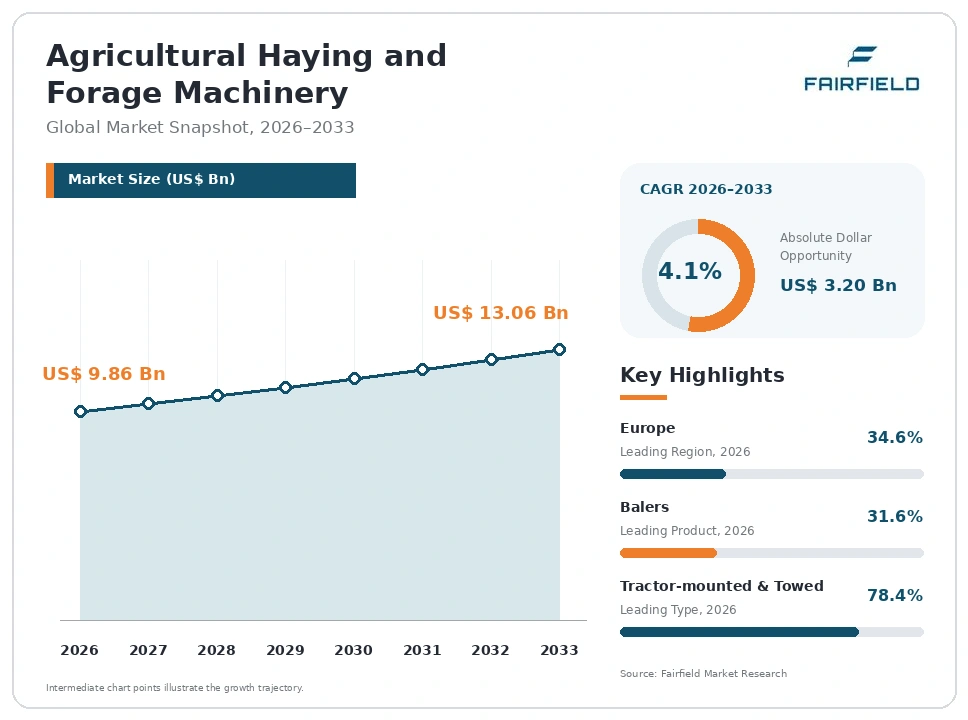
The global agricultural haying and forage machinery market size is expected to be valued at US$ 9.86 billion in 2026 and projected to reach US$ 13.06 billion by 2033, growing at a CAGR of 4.1% between 2026 and 2033.
Between 2020 and 2025, the market grew at a CAGR of about 3.5%, as strong dairy and beef prices supported equipment buying in 2021 and 2022, followed by a slowdown in 2024 and 2025 when farm incomes fell and interest rates rose. Three factors now drive growth: rising global demand for milk and meat, which needs high-quality silage and hay, labor shortages on livestock farms, and the replacement of older machines with more efficient models. The market is shifting toward high-capacity round balers with bale weighing and moisture sensing, wider mower conditioners, larger self-propelled forage harvesters, and precision agriculture tools that link machines to farm management software.
Key Report Takeaways
- By Product: Balers held 31.6% share in 2026, while Bale Wrappers are projected to expand at a 5.6% CAGR through 2033, driven by baled silage use on small and mid-sized dairy farms.
- By Operation: Semi-automatic held 41.8% share in 2026, while Automatic is projected to expand at a 6.3% CAGR through 2033, driven by sensors, automation, and labor shortages.
- By Type: Tractor-mounted & Towed held 78.4% share in 2026, while Self-propelled is projected to expand at a 5.2% CAGR through 2033, driven by large dairy operations and contractors needing high capacity.
- By Region: Europe held 34.6% share in 2026, while Asia Pacific is projected to expand at a 5.7% CAGR through 2033, driven by dairy expansion and mechanization in China and India.
Global Agricultural Haying and Forage Machinery Market Trends and Insights
Drivers Impact Analysis
Two drivers carry the strongest influence on haying and forage machinery demand during the forecast period.
| Driver | Impact on CAGR Forecast | Geographic Relevance | Impact Timeline |
| Rising demand for milk, meat, and quality feed | High | Asia Pacific, Europe, North America | Long term (≥4 years) |
| Labor shortages and farm consolidation | High | North America, Europe | Medium term (2-4 years) |
Rising Livestock Feed Demand Is Driving the Agricultural Haying and Forage Machinery Market
Rising demand for milk, meat, and quality feed is the strongest driver of the agricultural haying and forage machinery market. Dairy and beef cattle, sheep, and horses depend on hay and silage for much of their diet.
The mechanism is growing livestock production and higher feed quality standards. Global milk output keeps rising, especially in India, China, Pakistan, and Brazil, and large dairy farms in North America and Europe need consistent, high-quality forage. Well-harvested forage improves milk yield and animal health while reducing the need for purchased feed. Timely cutting, quick drying, and fast baling or chopping preserve nutrients, which requires efficient machines. China is building large modern dairy farms that need complete forage equipment fleets. Horse owners and smallholders also buy small balers and mowers. These factors support steady demand for mowers, rakes, tedders, balers, and forage harvesters.
Labor Shortages and Consolidation Are Expanding the Agricultural Haying and Forage Machinery Market
Labor shortages and farm consolidation are expanding the agricultural haying and forage machinery market. Fewer workers must harvest more hectares in short weather windows.
The cause is changing farm structure and workforce. Farms in North America and Europe are becoming larger, while farm labor is harder to find and more expensive. Contractors who harvest for many farms need high-capacity machines that work long hours. Wider mowers, high-speed round balers with net wrap and automatic tying, and large self-propelled forage harvesters reduce the number of operators needed. Automation features such as auto-steering, bale weighing, moisture sensors, and automatic setting adjustments make machines easier to run. Manufacturers such as John Deere, Case IH, New Holland, and Vermeer launched new balers with these features in 2025. These trends raise demand for larger, more advanced machines.
Restraints Impact Analysis
Two restraints limit how quickly the agricultural haying and forage machinery market grows.
| Restraint | Impact on CAGR Forecast | Geographic Relevance | Impact Timeline |
| High equipment costs and weak farm incomes | High | North America, Europe, Latin America | Short term (≤2 years) |
| Seasonal use and weather dependence | Medium | Global | Medium term (2-4 years) |
High Costs and Weak Farm Incomes Slow the Agricultural Haying and Forage Machinery Market
High equipment costs and weak farm incomes slow the agricultural haying and forage machinery market. Modern haying equipment represents a large investment for livestock farmers.
The specific causes are rising machine prices and pressure on farm profits. Prices for balers, forage harvesters, and mowers have risen sharply since 2021 due to steel, component, and labor costs. A large self-propelled forage harvester can cost more than US$ 700,000. Lower milk and crop prices in 2024 and 2025 reduced farm incomes, and higher interest rates increased financing costs. Major manufacturers reported lower equipment sales and cut production during this period. Tariffs on steel and imported components add further costs. Many small farms keep older machines longer or use contractors instead of buying. These factors delay purchases and reduce sales in weak years.
Seasonal Use and Weather Dependence Restrict the Agricultural Haying and Forage Machinery Market
Seasonal use and weather dependence restrict the agricultural haying and forage machinery market. Haying machines are used for only a few weeks each year.
The underlying causes are crop cycles and climate variability. Machines sit idle for most of the year, making it harder for farmers to justify buying new equipment. Droughts reduce grass growth and hay yields, lowering harvest needs, while wet weather can ruin cut hay. Climate change has made weather less predictable in many regions. Smaller farms may share equipment through cooperatives or hire contractors. Used equipment markets offer cheaper alternatives, and online auctions make older balers and mowers easy to find. Repair and spare parts availability during short harvest windows is critical, and breakdowns can be costly. These factors limit new machine sales and favor rental and contracting.
Market Opportunities
Precision Forage Harvesting and Automation Open a Technology Revenue Pool
Precision agriculture and automation in forage harvesting open a technology revenue pool in the agricultural haying and forage machinery market. Farmers want data to improve forage quality and efficiency.
Equipment makers and technology firms can capture this opportunity. Near-infrared sensors on forage harvesters measure dry matter and nutrients in real time, allowing automatic chop length and additive adjustments. Bale weighing and moisture sensors help farmers manage feed inventory and sales. Telematics and connected platforms such as John Deere Operations Center and CLAAS connected services record yields and machine performance. Autonomous and semi-autonomous features reduce operator workload. Vermeer launched a self-propelled baler with automatic tie and eject in 2025. Software subscriptions and data services create recurring revenue. Dealers with strong technical support and training can sell premium machines at higher margins.
Asia Pacific Dairy Growth and Small Farm Mechanization Create a Volume Revenue Pool
Asia Pacific dairy growth and small farm mechanization create a volume revenue pool in the agricultural haying and forage machinery market. Many farms in the region still harvest forage by hand.
Manufacturers with affordable, compact machines can capture this opportunity. China has built large dairy farms and promotes forage crops such as alfalfa and silage corn to reduce feed imports. India has the world’s largest dairy herd, mostly on small farms that could use compact mowers, small balers, and silage baling machines. New Holland launched a 100+ hp tractor for forage and baling operations in India in 2024. Government subsidies for farm machinery in China and India support purchases. Local manufacturing and dealer networks help reduce costs. Baled silage and wrapping offer simple ways for small farms to preserve feed.
Segment Analysis
By Product: Balers Lead While Bale Wrappers Grow Fastest
Balers held 31.6% share in 2026. Round balers and square balers compress hay, straw, and silage into bales that are easy to store, transport, and sell. Large square balers serve commercial hay producers and exporters, while round balers are popular on livestock farms. John Deere, Case IH, New Holland, Vermeer, Krone, CLAAS, and Kuhn all offer baler lines. Mowers, mower conditioners, rakes, tedders, and forage harvesters form other major products.
Bale Wrappers are the fastest-growing product, expanding at a 5.6% CAGR through 2033. Wrappers seal round or square bales in plastic film to make baled silage, preserving high-moisture forage with less weather risk. Combined baler-wrappers save time and labor. Baled silage is popular on small and mid-sized farms in Europe, Asia Pacific, and Latin America. For the market, wrapper growth supports flexible silage making.
By Operation: Semi-automatic Leads While Automatic Grows Fastest
Semi-automatic held 41.8% share in 2026. Semi-automatic machines combine operator control with automated functions such as tying, wrapping, and hydraulic adjustments. They suit most mid-sized farms and offer a balance between cost and productivity. Manual machines remain common on small farms in developing countries.
Automatic is the fastest-growing operation type, expanding at a 6.3% CAGR through 2033. Fully automatic machines adjust settings using sensors and software, with features such as automatic bale ejection, crop flow control, and auto-steering. They reduce operator skill needs and fatigue during long harvest days. Contractors and large farms value automation for consistent quality, and precision agriculture links let automatic machines record yield and moisture data. For the market, automatic growth raises value per machine.
By Type: Tractor-mounted & Towed Lead While Self-propelled Grows Fastest
Tractor-mounted & Towed held 78.4% share in 2026. Most haying equipment, including mowers, rakes, tedders, and balers, is pulled or mounted on tractors, letting farmers use one tractor for many tasks. These machines are more affordable and flexible. Wide trailed mowers and high-speed balers increase productivity.
Self-propelled is the fastest-growing type, expanding at a 5.2% CAGR through 2033. Self-propelled forage harvesters, mowers, and balers offer high capacity for large dairy farms and contractors. CLAAS, John Deere, Krone, and New Holland lead in self-propelled forage harvesters. These machines carry advanced sensors, crop processors, and automation, and contractors often use them across many farms. For the market, self-propelled growth adds high-value sales.
Geography Analysis
North America Advances the Agricultural Haying and Forage Machinery Market Through Large Operations
North America is a major agricultural haying and forage machinery market with large dairy, beef, and hay export industries. The United States produces large volumes of alfalfa and grass hay, with exports to China, Japan, and the Middle East & Africa region. John Deere, AGCO, CNH Industrial, and Vermeer are based or have major operations in the region. Large dairy farms in California, Wisconsin, and Idaho use self-propelled forage harvesters. Canada has strong hay and cattle sectors. Weak farm incomes in 2024 and 2025 reduced equipment sales. One change shaping the region is precision forage harvesting.
Which Region Is Leading the Agricultural Haying and Forage Machinery Market?
Europe is leading the agricultural haying and forage machinery market with a 34.6% share in 2026. Germany, France, Ireland, the United Kingdom, the Netherlands, and Poland have large dairy and beef sectors that rely on grass silage and hay. The region hosts leading makers CLAAS and Krone in Germany, Kuhn in France, and Pöttinger in Austria. CLAAS and John Deere together hold more than 35% of the global market. Baled silage and contractor services are common. One change shaping the region is the adoption of wider mowers and high-capacity balers.
Which Region Is Growing Fastest in the Agricultural Haying and Forage Machinery Market?
Asia Pacific is growing fastest in the agricultural haying and forage machinery market at a 5.7% CAGR through 2033. China accounts for more than 60% of the regional market and is building large modern dairy farms with complete forage fleets. India has the world’s largest dairy herd and is starting to mechanize forage harvesting. Australia and New Zealand have large pasture-based dairy and beef industries that use advanced haying equipment. Japan and South Korea import hay but also harvest local forage. Government machinery subsidies and local assembly by Kubota, CLAAS, and New Holland lower costs for buyers. One opportunity is affordable compact balers and wrappers for small farms.
Latin America Grows the Agricultural Haying and Forage Machinery Market Through Livestock Production
Latin America is a growing agricultural haying and forage machinery market. Brazil and Argentina are major beef producers, and both have growing dairy sectors that use silage corn and grass silage. Mexico has large dairy farms in the north. Feedlot expansion increases demand for silage harvesting, and contractors in Brazil run fleets of self-propelled forage harvesters to serve large farms. Chile and Uruguay have pasture-based dairy sectors that use baled silage. John Deere, AGCO, and CNH Industrial have local factories and dealer networks. Key barriers include currency swings, high interest rates, and financing costs. One opportunity is silage equipment for feedlots and dairies.
Middle East & Africa Builds the Agricultural Haying and Forage Machinery Market
Middle East & Africa is an emerging agricultural haying and forage machinery market. Saudi Arabia and the United Arab Emirates have large dairy companies such as Almarai but limit local forage growing due to water scarcity, relying on imports. South Africa and Kenya have growing dairy sectors. Egypt grows berseem clover for forage, and Morocco is expanding alfalfa and silage corn production for dairy herds. Large farms in Saudi Arabia have shifted forage growing abroad, which limits local machinery demand. Key barriers include water limits, small farms, and limited dealer networks. One opportunity is compact balers and wrappers for smallholder dairy.
Competitive Landscape
The agricultural haying and forage machinery market is moderately concentrated. CLAAS and John Deere hold more than 35% of the market, while CNH Industrial, through Case IH and New Holland, AGCO, through Fendt and Massey Ferguson, Krone, Kuhn, Vermeer, Kubota, Pöttinger, and many regional makers compete.
Companies compete on capacity, reliability, crop quality, automation, dealer networks, and price. Strong dealer support during short harvest windows is critical, because a broken baler or harvester can cost a farmer a full cut of hay. Full-line makers such as John Deere, CNH Industrial, and AGCO sell tractors and haying tools together, often with financing packages. Specialists such as Krone, Kuhn, Pöttinger, and Vermeer compete with deep product ranges and strong reputations for mowers, rakes, and balers. Regional makers in Italy, Turkey, China, and India compete on price for small farms.
Strategic moves show how competition is changing. In June 2024, New Holland launched the WORKMASTER 105 tractor for forage operations in India. In October 2024, CLAAS introduced new hay tools for 2025. In August 2025, John Deere, Case IH, New Holland, and Vermeer launched new balers and hay tools for 2026. These moves show competition shifting toward smarter, higher-capacity machines.
Three themes shape vendor strategy. First, companies are adding sensors, telematics, and precision agriculture data features. Second, they are increasing machine width, speed, and capacity for contractors. Third, they are expanding dealer networks and local production in Asia Pacific.
Agricultural Haying and Forage Machinery Market Industry Leaders
- CLAAS
- John Deere
- CNH Industrial
- AGCO
- Krone
Recent Industry Developments
- August 2025: Vermeer launched the ZR-2200 self-propelled baler with automatic tie and eject, plus new rakes - raises productivity for hay producers.
- August 2025: John Deere launched the V452M round baler with moisture sensors and bale scales linked to Operations Center - adds data features for 2026.
- October 2024: CLAAS announced new hay tools available in 2025 - expands its mower, rake, and tedder range.
- June 2024: New Holland launched the WORKMASTER 105 tractor for forage and baling in India - supports mechanization in a fast-growing market.
Companies Covered in the Report
- CLAAS
- John Deere
- CNH Industrial
- AGCO
- Krone
- Kuhn Group
- Vermeer
- Kubota (Kverneland)
- Pöttinger
- Kongskilde
- Morra Group
- Tonutti-Wolagri
Agricultural Haying and Forage Machinery Market Report Scope
This report covers agricultural haying and forage machinery, including mowers and mower conditioners, tedders, rakes, balers, bale wrappers, and forage harvesters, in manual, semi-automatic, and automatic operation, and tractor-mounted, towed, and self-propelled types, used for hay, silage, and straw production. It excludes tractors sold separately and bale handling equipment. The base year is 2025, and the forecast period runs from 2026 to 2033. All values are expressed in US$ Billion.
Product
- Mowers & Mower Conditioners
- Tedders & Rakes
- Balers
- Bale Wrappers
- Forage Harvesters
Operation
- Manual
- Semi-automatic
- Automatic
Type
- Tractor-mounted & Towed
- Self-propelled
Regions
- North America
- Europe
- Asia Pacific
- Latin America
- Middle East & Africa
Key Questions Answered in the Report
How big is the agricultural haying and forage machinery market in 2026?
The agricultural haying and forage machinery market is valued at US$ 9.86 billion in 2026, led by balers for hay and silage.
What is the agricultural haying and forage machinery market forecast to 2033?
The market is projected to reach US$ 13.06 billion by 2033, growing at a 4.1% CAGR and adding US$ 3.20 billion.
Which product is growing fastest in haying and forage machinery?
Bale Wrappers are growing fastest at a 5.6% CAGR through 2033, driven by baled silage use on small and mid-sized dairy farms.
Which region is growing fastest in the haying and forage machinery market?
Asia Pacific is growing fastest at a 5.7% CAGR through 2033, driven by dairy expansion and mechanization in China and India.
Which region holds the largest haying and forage machinery market share?
Europe holds the largest share at 34.6% in 2026, supported by large dairy sectors and leading makers in Germany and France.
1. Executive Summary
1.1. Global Agricultural Haying and Forage Machinery Market Snapshot
1.2. Future Projections
1.3. Key Report Takeaways
1.4. Regional Snapshot
2. Market Overview
2.1. Market Definition and Report Scope
2.2. Historical Trends 2020–2025
2.3. Market Dynamics
2.3.1. Drivers
2.3.1.1. Rising Livestock Feed Demand Is Driving the Agricultural Haying and Forage Machinery Market
2.3.1.2. Labor Shortages and Consolidation Are Expanding the Agricultural Haying and Forage Machinery Market
2.3.2. Restraints
2.3.2.1. High Costs and Weak Farm Incomes Slow the Agricultural Haying and Forage Machinery Market
2.3.2.2. Seasonal Use and Weather Dependence Restrict the Agricultural Haying and Forage Machinery Market
2.3.3. Market Opportunities
2.3.3.1. Precision Forage Harvesting and Automation Open a Technology Revenue Pool
2.3.3.2. Asia Pacific Dairy Growth and Small Farm Mechanization Create a Volume Revenue Pool
3. Global Agricultural Haying and Forage Machinery Market Outlook, 2020-2033
3.1. Global Agricultural Haying and Forage Machinery Market Outlook, by Product, Value (US$ Billion), 2020-2033
3.1.1. Mowers & Mower Conditioners
3.1.2. Tedders & Rakes
3.1.3. Balers
3.1.4. Bale Wrappers
3.1.5. Forage Harvesters
3.2. Global Agricultural Haying and Forage Machinery Market Outlook, by Operation, Value (US$ Billion), 2020-2033
3.2.1. Manual
3.2.2. Semi-automatic
3.2.3. Automatic
3.3. Global Agricultural Haying and Forage Machinery Market Outlook, by Type, Value (US$ Billion), 2020-2033
3.3.1. Tractor-mounted & Towed
3.3.2. Self-propelled
3.4. Global Agricultural Haying and Forage Machinery Market Outlook, by Region, Value (US$ Billion), 2020-2033
3.4.1. North America
3.4.2. Europe
3.4.3. Asia Pacific
3.4.4. Latin America
3.4.5. Middle East & Africa
4. North America Agricultural Haying and Forage Machinery Market Outlook, 2020-2033
4.1. North America Agricultural Haying and Forage Machinery Market Outlook, by Product, Value (US$ Billion), 2020-2033
4.1.1. Mowers & Mower Conditioners
4.1.2. Tedders & Rakes
4.1.3. Balers
4.1.4. Bale Wrappers
4.1.5. Forage Harvesters
4.2. North America Agricultural Haying and Forage Machinery Market Outlook, by Operation, Value (US$ Billion), 2020-2033
4.2.1. Manual
4.2.2. Semi-automatic
4.2.3. Automatic
4.3. North America Agricultural Haying and Forage Machinery Market Outlook, by Type, Value (US$ Billion), 2020-2033
4.3.1. Tractor-mounted & Towed
4.3.2. Self-propelled
4.4. North America Agricultural Haying and Forage Machinery Market Outlook, by Country, Value (US$ Billion), 2020-2033
4.4.1. United States Agricultural Haying and Forage Machinery Market Outlook, by Product, 2020-2033
4.4.2. United States Agricultural Haying and Forage Machinery Market Outlook, by Operation, 2020-2033
4.4.3. United States Agricultural Haying and Forage Machinery Market Outlook, by Type, 2020-2033
4.4.4. Canada Agricultural Haying and Forage Machinery Market Outlook, by Product, 2020-2033
4.4.5. Canada Agricultural Haying and Forage Machinery Market Outlook, by Operation, 2020-2033
4.4.6. Canada Agricultural Haying and Forage Machinery Market Outlook, by Type, 2020-2033
5. Europe Agricultural Haying and Forage Machinery Market Outlook, 2020-2033
5.1. Europe Agricultural Haying and Forage Machinery Market Outlook, by Product, Value (US$ Billion), 2020-2033
5.1.1. Mowers & Mower Conditioners
5.1.2. Tedders & Rakes
5.1.3. Balers
5.1.4. Bale Wrappers
5.1.5. Forage Harvesters
5.2. Europe Agricultural Haying and Forage Machinery Market Outlook, by Operation, Value (US$ Billion), 2020-2033
5.2.1. Manual
5.2.2. Semi-automatic
5.2.3. Automatic
5.3. Europe Agricultural Haying and Forage Machinery Market Outlook, by Type, Value (US$ Billion), 2020-2033
5.3.1. Tractor-mounted & Towed
5.3.2. Self-propelled
5.4. Europe Agricultural Haying and Forage Machinery Market Outlook, by Country, Value (US$ Billion), 2020-2033
5.4.1. Germany Agricultural Haying and Forage Machinery Market Outlook, by Product, 2020-2033
5.4.2. Germany Agricultural Haying and Forage Machinery Market Outlook, by Operation, 2020-2033
5.4.3. Germany Agricultural Haying and Forage Machinery Market Outlook, by Type, 2020-2033
5.4.4. France Agricultural Haying and Forage Machinery Market Outlook, by Product, 2020-2033
5.4.5. France Agricultural Haying and Forage Machinery Market Outlook, by Operation, 2020-2033
5.4.6. France Agricultural Haying and Forage Machinery Market Outlook, by Type, 2020-2033
5.4.7. Ireland Agricultural Haying and Forage Machinery Market Outlook, by Product, 2020-2033
5.4.8. Ireland Agricultural Haying and Forage Machinery Market Outlook, by Operation, 2020-2033
5.4.9. Ireland Agricultural Haying and Forage Machinery Market Outlook, by Type, 2020-2033
5.4.10. United Kingdom Agricultural Haying and Forage Machinery Market Outlook, by Product, 2020-2033
5.4.11. United Kingdom Agricultural Haying and Forage Machinery Market Outlook, by Operation, 2020-2033
5.4.12. United Kingdom Agricultural Haying and Forage Machinery Market Outlook, by Type, 2020-2033
5.4.13. Netherlands Agricultural Haying and Forage Machinery Market Outlook, by Product, 2020-2033
5.4.14. Netherlands Agricultural Haying and Forage Machinery Market Outlook, by Operation, 2020-2033
5.4.15. Netherlands Agricultural Haying and Forage Machinery Market Outlook, by Type, 2020-2033
5.4.16. Poland Agricultural Haying and Forage Machinery Market Outlook, by Product, 2020-2033
5.4.17. Poland Agricultural Haying and Forage Machinery Market Outlook, by Operation, 2020-2033
5.4.18. Poland Agricultural Haying and Forage Machinery Market Outlook, by Type, 2020-2033
5.4.19. Austria Agricultural Haying and Forage Machinery Market Outlook, by Product, 2020-2033
5.4.20. Austria Agricultural Haying and Forage Machinery Market Outlook, by Operation, 2020-2033
5.4.21. Austria Agricultural Haying and Forage Machinery Market Outlook, by Type, 2020-2033
6. Asia Pacific Agricultural Haying and Forage Machinery Market Outlook, 2020-2033
6.1. Asia Pacific Agricultural Haying and Forage Machinery Market Outlook, by Product, Value (US$ Billion), 2020-2033
6.1.1. Mowers & Mower Conditioners
6.1.2. Tedders & Rakes
6.1.3. Balers
6.1.4. Bale Wrappers
6.1.5. Forage Harvesters
6.2. Asia Pacific Agricultural Haying and Forage Machinery Market Outlook, by Operation, Value (US$ Billion), 2020-2033
6.2.1. Manual
6.2.2. Semi-automatic
6.2.3. Automatic
6.3. Asia Pacific Agricultural Haying and Forage Machinery Market Outlook, by Type, Value (US$ Billion), 2020-2033
6.3.1. Tractor-mounted & Towed
6.3.2. Self-propelled
6.4. Asia Pacific Agricultural Haying and Forage Machinery Market Outlook, by Country, Value (US$ Billion), 2020-2033
6.4.1. China Agricultural Haying and Forage Machinery Market Outlook, by Product, 2020-2033
6.4.2. China Agricultural Haying and Forage Machinery Market Outlook, by Operation, 2020-2033
6.4.3. China Agricultural Haying and Forage Machinery Market Outlook, by Type, 2020-2033
6.4.4. India Agricultural Haying and Forage Machinery Market Outlook, by Product, 2020-2033
6.4.5. India Agricultural Haying and Forage Machinery Market Outlook, by Operation, 2020-2033
6.4.6. India Agricultural Haying and Forage Machinery Market Outlook, by Type, 2020-2033
6.4.7. Australia Agricultural Haying and Forage Machinery Market Outlook, by Product, 2020-2033
6.4.8. Australia Agricultural Haying and Forage Machinery Market Outlook, by Operation, 2020-2033
6.4.9. Australia Agricultural Haying and Forage Machinery Market Outlook, by Type, 2020-2033
6.4.10. New Zealand Agricultural Haying and Forage Machinery Market Outlook, by Product, 2020-2033
6.4.11. New Zealand Agricultural Haying and Forage Machinery Market Outlook, by Operation, 2020-2033
6.4.12. New Zealand Agricultural Haying and Forage Machinery Market Outlook, by Type, 2020-2033
6.4.13. Japan Agricultural Haying and Forage Machinery Market Outlook, by Product, 2020-2033
6.4.14. Japan Agricultural Haying and Forage Machinery Market Outlook, by Operation, 2020-2033
6.4.15. Japan Agricultural Haying and Forage Machinery Market Outlook, by Type, 2020-2033
6.4.16. South Korea Agricultural Haying and Forage Machinery Market Outlook, by Product, 2020-2033
6.4.17. South Korea Agricultural Haying and Forage Machinery Market Outlook, by Operation, 2020-2033
6.4.18. South Korea Agricultural Haying and Forage Machinery Market Outlook, by Type, 2020-2033
7. Latin America Agricultural Haying and Forage Machinery Market Outlook, 2020-2033
7.1. Latin America Agricultural Haying and Forage Machinery Market Outlook, by Product, Value (US$ Billion), 2020-2033
7.1.1. Mowers & Mower Conditioners
7.1.2. Tedders & Rakes
7.1.3. Balers
7.1.4. Bale Wrappers
7.1.5. Forage Harvesters
7.2. Latin America Agricultural Haying and Forage Machinery Market Outlook, by Operation, Value (US$ Billion), 2020-2033
7.2.1. Manual
7.2.2. Semi-automatic
7.2.3. Automatic
7.3. Latin America Agricultural Haying and Forage Machinery Market Outlook, by Type, Value (US$ Billion), 2020-2033
7.3.1. Tractor-mounted & Towed
7.3.2. Self-propelled
7.4. Latin America Agricultural Haying and Forage Machinery Market Outlook, by Country, Value (US$ Billion), 2020-2033
7.4.1. Brazil Agricultural Haying and Forage Machinery Market Outlook, by Product, 2020-2033
7.4.2. Brazil Agricultural Haying and Forage Machinery Market Outlook, by Operation, 2020-2033
7.4.3. Brazil Agricultural Haying and Forage Machinery Market Outlook, by Type, 2020-2033
7.4.4. Argentina Agricultural Haying and Forage Machinery Market Outlook, by Product, 2020-2033
7.4.5. Argentina Agricultural Haying and Forage Machinery Market Outlook, by Operation, 2020-2033
7.4.6. Argentina Agricultural Haying and Forage Machinery Market Outlook, by Type, 2020-2033
7.4.7. Mexico Agricultural Haying and Forage Machinery Market Outlook, by Product, 2020-2033
7.4.8. Mexico Agricultural Haying and Forage Machinery Market Outlook, by Operation, 2020-2033
7.4.9. Mexico Agricultural Haying and Forage Machinery Market Outlook, by Type, 2020-2033
7.4.10. Chile Agricultural Haying and Forage Machinery Market Outlook, by Product, 2020-2033
7.4.11. Chile Agricultural Haying and Forage Machinery Market Outlook, by Operation, 2020-2033
7.4.12. Chile Agricultural Haying and Forage Machinery Market Outlook, by Type, 2020-2033
7.4.13. Uruguay Agricultural Haying and Forage Machinery Market Outlook, by Product, 2020-2033
7.4.14. Uruguay Agricultural Haying and Forage Machinery Market Outlook, by Operation, 2020-2033
7.4.15. Uruguay Agricultural Haying and Forage Machinery Market Outlook, by Type, 2020-2033
8. Middle East & Africa Agricultural Haying and Forage Machinery Market Outlook, 2020-2033
8.1. Middle East & Africa Agricultural Haying and Forage Machinery Market Outlook, by Product, Value (US$ Billion), 2020-2033
8.1.1. Mowers & Mower Conditioners
8.1.2. Tedders & Rakes
8.1.3. Balers
8.1.4. Bale Wrappers
8.1.5. Forage Harvesters
8.2. Middle East & Africa Agricultural Haying and Forage Machinery Market Outlook, by Operation, Value (US$ Billion), 2020-2033
8.2.1. Manual
8.2.2. Semi-automatic
8.2.3. Automatic
8.3. Middle East & Africa Agricultural Haying and Forage Machinery Market Outlook, by Type, Value (US$ Billion), 2020-2033
8.3.1. Tractor-mounted & Towed
8.3.2. Self-propelled
8.4. Middle East & Africa Agricultural Haying and Forage Machinery Market Outlook, by Country, Value (US$ Billion), 2020-2033
8.4.1. Saudi Arabia Agricultural Haying and Forage Machinery Market Outlook, by Product, 2020-2033
8.4.2. Saudi Arabia Agricultural Haying and Forage Machinery Market Outlook, by Operation, 2020-2033
8.4.3. Saudi Arabia Agricultural Haying and Forage Machinery Market Outlook, by Type, 2020-2033
8.4.4. United Arab Emirates Agricultural Haying and Forage Machinery Market Outlook, by Product, 2020-2033
8.4.5. United Arab Emirates Agricultural Haying and Forage Machinery Market Outlook, by Operation, 2020-2033
8.4.6. United Arab Emirates Agricultural Haying and Forage Machinery Market Outlook, by Type, 2020-2033
8.4.7. South Africa Agricultural Haying and Forage Machinery Market Outlook, by Product, 2020-2033
8.4.8. South Africa Agricultural Haying and Forage Machinery Market Outlook, by Operation, 2020-2033
8.4.9. South Africa Agricultural Haying and Forage Machinery Market Outlook, by Type, 2020-2033
8.4.10. Kenya Agricultural Haying and Forage Machinery Market Outlook, by Product, 2020-2033
8.4.11. Kenya Agricultural Haying and Forage Machinery Market Outlook, by Operation, 2020-2033
8.4.12. Kenya Agricultural Haying and Forage Machinery Market Outlook, by Type, 2020-2033
8.4.13. Egypt Agricultural Haying and Forage Machinery Market Outlook, by Product, 2020-2033
8.4.14. Egypt Agricultural Haying and Forage Machinery Market Outlook, by Operation, 2020-2033
8.4.15. Egypt Agricultural Haying and Forage Machinery Market Outlook, by Type, 2020-2033
8.4.16. Morocco Agricultural Haying and Forage Machinery Market Outlook, by Product, 2020-2033
8.4.17. Morocco Agricultural Haying and Forage Machinery Market Outlook, by Operation, 2020-2033
8.4.18. Morocco Agricultural Haying and Forage Machinery Market Outlook, by Type, 2020-2033
9. Competitive Landscape
9.1. Market Concentration and Industry Leaders
9.2. Competitive Differentiation
9.3. Strategic Moves and Market Direction
9.4. Recent Industry Developments
9.5. Company Profiles
9.5.1. CLAAS
9.5.2. John Deere
9.5.3. CNH Industrial
9.5.4. AGCO
9.5.5. Krone
9.5.6. Kuhn Group
9.5.7. Vermeer
9.5.8. Kubota (Kverneland)
9.5.9. Pöttinger
9.5.10. Kongskilde
9.5.11. Morra Group
9.5.12. Tonutti-Wolagri
10. Appendix
10.1. Research Methodology
10.2. Report Assumptions
10.3. Acronyms and Abbreviations
| Segment | Categories |
|---|---|
| Product | Mowers & Mower Conditioners, Tedders & Rakes, Balers, Bale Wrappers, Forage Harvesters |
| Operation | Manual, Semi-automatic, Automatic |
| Type | Tractor-mounted & Towed, Self-propelled |
| Regions | North America, Europe, Asia Pacific, Latin America, Middle East & Africa |
Our Research Methodology
Considering the volatility of business today, traditional approaches to strategizing a game plan can be unfruitful if not detrimental. True ambiguity is no way to determine a forecast. A myriad of predetermined factors must be accounted for such as the degree of risk involved, the magnitude of circumstances, as well as conditions or consequences that are not known or unpredictable. To circumvent binary views that cast uncertainty, the application of market research intelligence to strategically posture, move, and enable actionable outcomes is necessary.
View Methodology
Quality Assured
Rigorous Validation Process

Confidentiality Assured
End-to-end Data Security

Custom Research Services
Tailored To Your Objectives
FAQs
The agricultural haying and forage machinery market is valued at US$ 9.86 billion in 2026, led by balers for hay and silage.
The market is projected to reach US$ 13.06 billion by 2033, growing at a 4.1% CAGR and adding US$ 3.20 billion.
Bale Wrappers are growing fastest at a 5.6% CAGR through 2033, driven by baled silage use on small and mid-sized dairy farms.
Asia Pacific is growing fastest at a 5.7% CAGR through 2033, driven by dairy expansion and mechanization in China and India.
Europe holds the largest share at 34.6% in 2026, supported by large dairy sectors and leading makers in Germany and France.
Related Reports
Piping and Fittings Market Size, Share, Insights, Competitive Landscape, and Forecast 2026 to 2033
The global piping and fittings market is valued at US$186.0 billion in 2026, reaching US$258.0 billion by 2033, growing at a 4.8% CAGR
Laser Retroreflector Array Market Size, Share, Insights, Competitive Landscape, and Forecast 2026 to 2033
The laser retroreflector array market is forecast to grow from US$ 818.1 million in 2026 to US$ 1,505.3 million by 2033 at a 9.1% CAGR.
Electromagnetic Weapons Market Size, Share, Insights, Competitive Landscape, and Forecast 2026 to 2033
The electromagnetic weapons market is forecast to grow from US$ 1.30 billion in 2026 to US$ 5.11 billion by 2033 at a 21.6% CAGR.
Agricultural Pumps Market Size, Share, Insights, Competitive Landscape, and Forecast 2026 to 2033
The global agricultural pumps market is valued at US$12.22 billion in 2026, reaching US$18.26 billion by 2033, growing at a 5.9% CAGR
Spinning Machinery Market Size, Share, Insights, Competitive Landscape, and Forecast 2026 to 2033
The global spinning machinery market is valued at US$6.8 billion in 2026, reaching US$8.6 billion by 2033, growing at a 3.4% CAGR
Plastic Injection Molding Machine Market Size, Share, Insights, Competitive Landscape, and Forecast 2026 to 2033
The global plastic injection molding machine market is valued at US$13.4 billion in 2026, reaching US$18.2 billion by 2033, growing at a 4.5% CAGR