



AI in Personalized Nutrition Market
AI in Personalized Nutrition Market
Market Overview
AI in personalized nutrition applies artificial intelligence to analyze individual biological, behavioral, and lifestyle data, including genetic profiles, microbiome composition, and continuous glucose response, to generate individualized dietary recommendations that move beyond generic nutrition guidance toward precision approaches tailored to each person's unique physiology. As consumer interest in data-driven wellness has grown alongside advancing capability in biomarker testing and AI-driven data interpretation, personalized nutrition platforms have evolved from simple dietary tracking tools toward sophisticated systems incorporating multiple biological data streams.
Demand growth through the 2026-2033 window is closely tied to growing consumer interest in precision, individualized approaches to nutrition and wellness beyond generic dietary guidance, expanding accessibility and declining cost of genetic and microbiome testing supporting broader personalized nutrition platform adoption, and continued AI algorithm advancement improving the accuracy and practical utility of personalized dietary recommendations. Growing corporate wellness program interest in personalized nutrition as an employee health benefit continues to expand the market beyond direct-to-consumer adoption alone.
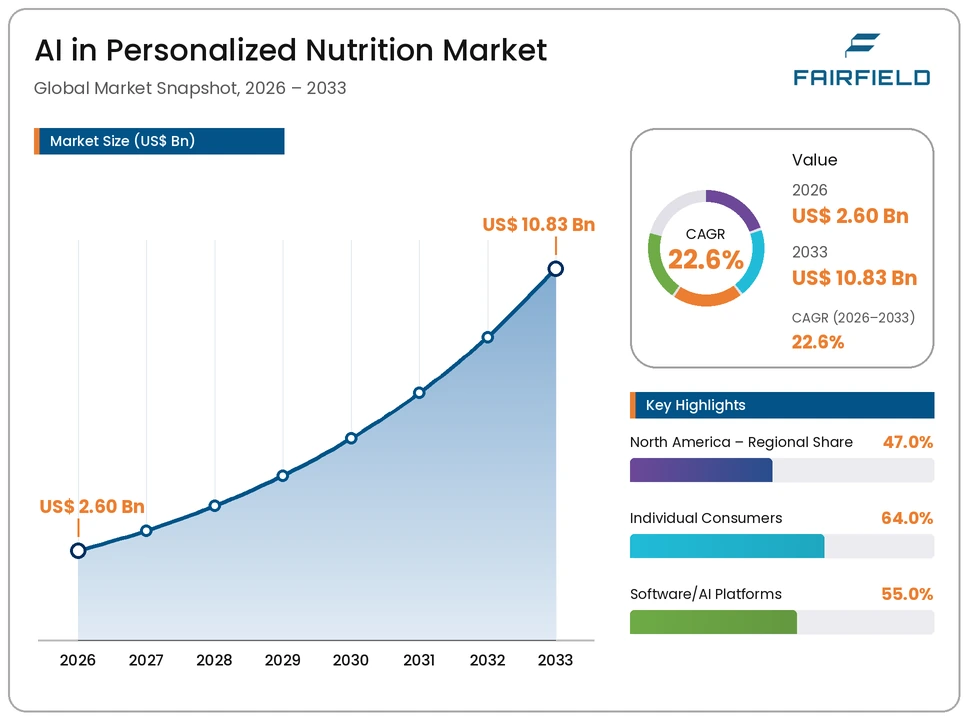
The market is valued at USD 2.60 Billion in 2026, with platform providers directing substantial investment toward improved AI algorithms and expanded biomarker integration that strengthens the personalization and practical utility of dietary recommendations. By 2033, the market is forecast to reach USD 10.83 Billion, reflecting rapid growth across established individual consumer applications alongside accelerating corporate wellness program adoption.
Key Highlights
- The global AI in personalized nutrition market is valued at USD 2.60 Billion in 2026 and is projected to reach USD 10.83 Billion by 2033, expanding at a CAGR of 22.6% across the 2026-2033 forecast period.
- Software/AI Platforms lead the component segment with a 55.0% share in 2026, equivalent to USD 1.43 Billion.
- Individual Consumers remain the dominant end-user segment, accounting for 64.0% of global demand, or USD 1.66 Billion, in 2026.
- North America commands the largest regional share at 47.0% of the global market in 2026.
- Corporate wellness program adoption is emerging as the fastest-growing end-user segment through 2033.
Market Dynamics
- Key Growth Drivers
Growth in the AI in personalized nutrition market is driven primarily by growing consumer interest in precision, individualized wellness approaches, as consumers increasingly seek dietary guidance tailored to their unique biological and metabolic characteristics rather than generic, population-level nutrition recommendations.
A second driver is expanding accessibility and declining cost of genetic and microbiome testing, as these previously specialized and expensive testing capabilities have become increasingly accessible to mainstream consumers, supporting broader adoption of biomarker-informed personalized nutrition platforms.
- Key Restraints
The scientific validation of certain personalized nutrition approaches, particularly those based on genetic testing for dietary recommendations, remains an area of ongoing research, creating some skepticism among nutrition scientists and healthcare providers regarding the evidence base for specific personalization claims.
Additionally, the cost of comprehensive biomarker testing and ongoing platform subscriptions creates an affordability barrier for broader consumer adoption, particularly for the most sophisticated, multi-biomarker personalized nutrition offerings.
- Market Opportunities
The expansion of corporate wellness program adoption presents a substantial opportunity, as employers increasingly seek differentiated, science-based wellness benefits to support employee health, creating a growing institutional purchaser base for personalized nutrition platforms beyond individual consumer adoption.
A second opportunity lies in continued AI algorithm advancement that improves the accuracy and practical utility of personalized dietary recommendations across an expanding range of biomarkers and health goals. Companies that successfully advance this algorithmic sophistication stand to differentiate their offerings and build stronger consumer trust and engagement.
Segmentation Analysis
- By Component
Software/AI Platforms lead the component segment, accounting for 55.0% of global market value in 2026, equivalent to USD 1.43 Billion. Their leadership reflects the central role of AI-driven analysis and recommendation software in translating biological data into actionable dietary guidance. Services represent a significant, established component category. Testing Kits (DNA/Microbiome) represent the fastest-growing component category through 2033, driven by expanding consumer interest in biomarker-informed personalization.
- By End User
Individual Consumers form the leading end-user segment, representing 64.0% of global demand in 2026, or USD 1.66 Billion, reflecting strong direct-to-consumer demand for personalized dietary guidance. Healthcare Providers & Clinics represent a significant, established end-user category. Corporate Wellness Programs represent the fastest-growing end-user category, propelled by growing employer interest in differentiated, science-based wellness benefits.
Regional Insights
North America holds the largest regional share, at 47.0% of the global market in 2026, equivalent to USD 1.22 Billion. The region's leadership reflects strong consumer wellness technology adoption and substantial investment in personalized nutrition platform development across the United States and Canada.
Europe accounts for 27.0% of the global market in 2026, valued at USD 0.70 Billion. Demand is supported by growing consumer interest in precision nutrition and expanding biomarker testing accessibility across major European markets.
Asia Pacific represents 20.0% of the global market in 2026, or USD 0.52 Billion. Growth is underpinned by rising health consciousness and expanding personalized wellness technology adoption across China, Japan, and South Korea.
Latin America contributes 3.0% of the global market in 2026, equivalent to USD 0.08 Billion. Growth remains at an early stage, tied to gradual personalized nutrition platform adoption in Brazil and Mexico.
Middle East & Africa holds 3.0% of the global market in 2026, valued at USD 0.08 Billion. Growth remains limited, tied to early-stage regional adoption of personalized wellness technology.
Competitive Landscape
The global AI in personalized nutrition market is fragmented, with a mix of dedicated personalized nutrition startups, genetic and microbiome testing companies, and broader digital health platforms competing for consumer and institutional adoption. Competition centers on AI algorithm sophistication and recommendation accuracy, breadth of biomarker testing integration, and the ability to build sustained user engagement translating recommendations into behavior change. Companies are increasingly differentiating through expanded scientific validation rather than competing on testing breadth alone.
Key Market Players
- Nutrigenomix Inc.
- ZOE Global Limited
- DayTwo, Inc.
- Viome Life Sciences, Inc.
- Segterra, Inc.
- Season Health, Inc.
- Suggestic, Inc.
- Zipongo, Inc.
- PlateJoy, Inc.
- Noom, Inc.
Market Segmentation
By Component
- Software/AI Platforms
- Testing Kits (DNA/Microbiome)
- Services
By End User
- Individual Consumers
- Healthcare Providers & Clinics
- Corporate Wellness Programs
- Others
By Personalization Basis
- Genetic Data
- Microbiome & Biomarker Data
By Geography
- North America
- Europe
- Asia Pacific
- Latin America
- Middle East & Africa
- Executive Summary
- Global AI in Personalized Nutrition Market Snapshot
- Future Projections
- Key Market Trends
- Regional Snapshot, by Value, 2026
- Analyst Recommendations
- Market Overview
- Market Definitions and Segmentations
- Market Dynamics
- Drivers
- Restraints
- Market Opportunities
- Value Chain Analysis
- COVID-19 Impact Analysis
- Porter's Five Forces Analysis
- Impact of Russia-Ukraine Conflict
- PESTLE Analysis
- Regulatory Analysis
- Price Trend Analysis
- Current Prices and Future Projections, 2025-2033
- Price Impact Factors
- Global AI in Personalized Nutrition Market Outlook, 2020 - 2033
- Global AI in Personalized Nutrition Market Outlook, by Component, Value (US$ Bn), 2020-2033
- Software/AI Platforms
- Testing Kits (DNA/Microbiome)
- Services
- Global AI in Personalized Nutrition Market Outlook, by End User, Value (US$ Bn), 2020-2033
- Individual Consumers
- Healthcare Providers & Clinics
- Corporate Wellness Programs
- Others
- Global AI in Personalized Nutrition Market Outlook, by Personalization Basis, Value (US$ Bn), 2020-2033
- Genetic Data
- Microbiome & Biomarker Data
- Global AI in Personalized Nutrition Market Outlook, by Region, Value (US$ Bn), 2020-2033
- North America
- Europe
- Asia Pacific
- Latin America
- Middle East & Africa
- Global AI in Personalized Nutrition Market Outlook, by Component, Value (US$ Bn), 2020-2033
- North America AI in Personalized Nutrition Market Outlook, 2020 - 2033
- North America AI in Personalized Nutrition Market Outlook, by Component, Value (US$ Bn), 2020-2033
- Software/AI Platforms
- Testing Kits (DNA/Microbiome)
- Services
- North America AI in Personalized Nutrition Market Outlook, by End User, Value (US$ Bn), 2020-2033
- Individual Consumers
- Healthcare Providers & Clinics
- Corporate Wellness Programs
- Others
- North America AI in Personalized Nutrition Market Outlook, by Personalization Basis, Value (US$ Bn), 2020-2033
- Genetic Data
- Microbiome & Biomarker Data
- North America AI in Personalized Nutrition Market Outlook, by Country, Value (US$ Bn), 2020-2033
- U.S. AI in Personalized Nutrition Market Outlook, by Component, 2020-2033
- U.S. AI in Personalized Nutrition Market Outlook, by End User, 2020-2033
- U.S. AI in Personalized Nutrition Market Outlook, by Personalization Basis, 2020-2033
- Canada AI in Personalized Nutrition Market Outlook, by Component, 2020-2033
- Canada AI in Personalized Nutrition Market Outlook, by End User, 2020-2033
- Canada AI in Personalized Nutrition Market Outlook, by Personalization Basis, 2020-2033
- BPS Analysis/Market Attractiveness Analysis
- North America AI in Personalized Nutrition Market Outlook, by Component, Value (US$ Bn), 2020-2033
- Europe AI in Personalized Nutrition Market Outlook, 2020 - 2033
- Europe AI in Personalized Nutrition Market Outlook, by Component, Value (US$ Bn), 2020-2033
- Software/AI Platforms
- Testing Kits (DNA/Microbiome)
- Services
- Europe AI in Personalized Nutrition Market Outlook, by End User, Value (US$ Bn), 2020-2033
- Individual Consumers
- Healthcare Providers & Clinics
- Corporate Wellness Programs
- Others
- Europe AI in Personalized Nutrition Market Outlook, by Personalization Basis, Value (US$ Bn), 2020-2033
- Genetic Data
- Microbiome & Biomarker Data
- Europe AI in Personalized Nutrition Market Outlook, by Country, Value (US$ Bn), 2020-2033
- Germany AI in Personalized Nutrition Market Outlook, by Component, 2020-2033
- Germany AI in Personalized Nutrition Market Outlook, by End User, 2020-2033
- Germany AI in Personalized Nutrition Market Outlook, by Personalization Basis, 2020-2033
- Italy AI in Personalized Nutrition Market Outlook, by Component, 2020-2033
- Italy AI in Personalized Nutrition Market Outlook, by End User, 2020-2033
- Italy AI in Personalized Nutrition Market Outlook, by Personalization Basis, 2020-2033
- France AI in Personalized Nutrition Market Outlook, by Component, 2020-2033
- France AI in Personalized Nutrition Market Outlook, by End User, 2020-2033
- France AI in Personalized Nutrition Market Outlook, by Personalization Basis, 2020-2033
- U.K. AI in Personalized Nutrition Market Outlook, by Component, 2020-2033
- U.K. AI in Personalized Nutrition Market Outlook, by End User, 2020-2033
- U.K. AI in Personalized Nutrition Market Outlook, by Personalization Basis, 2020-2033
- Spain AI in Personalized Nutrition Market Outlook, by Component, 2020-2033
- Spain AI in Personalized Nutrition Market Outlook, by End User, 2020-2033
- Spain AI in Personalized Nutrition Market Outlook, by Personalization Basis, 2020-2033
- Russia AI in Personalized Nutrition Market Outlook, by Component, 2020-2033
- Russia AI in Personalized Nutrition Market Outlook, by End User, 2020-2033
- Russia AI in Personalized Nutrition Market Outlook, by Personalization Basis, 2020-2033
- Rest of Europe AI in Personalized Nutrition Market Outlook, by Component, 2020-2033
- Rest of Europe AI in Personalized Nutrition Market Outlook, by End User, 2020-2033
- Rest of Europe AI in Personalized Nutrition Market Outlook, by Personalization Basis, 2020-2033
- BPS Analysis/Market Attractiveness Analysis
- Europe AI in Personalized Nutrition Market Outlook, by Component, Value (US$ Bn), 2020-2033
- Asia Pacific AI in Personalized Nutrition Market Outlook, 2020 - 2033
- Asia Pacific AI in Personalized Nutrition Market Outlook, by Component, Value (US$ Bn), 2020-2033
- Software/AI Platforms
- Testing Kits (DNA/Microbiome)
- Services
- Asia Pacific AI in Personalized Nutrition Market Outlook, by End User, Value (US$ Bn), 2020-2033
- Individual Consumers
- Healthcare Providers & Clinics
- Corporate Wellness Programs
- Others
- Asia Pacific AI in Personalized Nutrition Market Outlook, by Personalization Basis, Value (US$ Bn), 2020-2033
- Genetic Data
- Microbiome & Biomarker Data
- Asia Pacific AI in Personalized Nutrition Market Outlook, by Country, Value (US$ Bn), 2020-2033
- China AI in Personalized Nutrition Market Outlook, by Component, 2020-2033
- China AI in Personalized Nutrition Market Outlook, by End User, 2020-2033
- China AI in Personalized Nutrition Market Outlook, by Personalization Basis, 2020-2033
- Japan AI in Personalized Nutrition Market Outlook, by Component, 2020-2033
- Japan AI in Personalized Nutrition Market Outlook, by End User, 2020-2033
- Japan AI in Personalized Nutrition Market Outlook, by Personalization Basis, 2020-2033
- South Korea AI in Personalized Nutrition Market Outlook, by Component, 2020-2033
- South Korea AI in Personalized Nutrition Market Outlook, by End User, 2020-2033
- South Korea AI in Personalized Nutrition Market Outlook, by Personalization Basis, 2020-2033
- India AI in Personalized Nutrition Market Outlook, by Component, 2020-2033
- India AI in Personalized Nutrition Market Outlook, by End User, 2020-2033
- India AI in Personalized Nutrition Market Outlook, by Personalization Basis, 2020-2033
- Southeast Asia AI in Personalized Nutrition Market Outlook, by Component, 2020-2033
- Southeast Asia AI in Personalized Nutrition Market Outlook, by End User, 2020-2033
- Southeast Asia AI in Personalized Nutrition Market Outlook, by Personalization Basis, 2020-2033
- Rest of SAO AI in Personalized Nutrition Market Outlook, by Component, 2020-2033
- Rest of SAO AI in Personalized Nutrition Market Outlook, by End User, 2020-2033
- Rest of SAO AI in Personalized Nutrition Market Outlook, by Personalization Basis, 2020-2033
- BPS Analysis/Market Attractiveness Analysis
- Asia Pacific AI in Personalized Nutrition Market Outlook, by Component, Value (US$ Bn), 2020-2033
- Latin America AI in Personalized Nutrition Market Outlook, 2020 - 2033
- Latin America AI in Personalized Nutrition Market Outlook, by Component, Value (US$ Bn), 2020-2033
- Software/AI Platforms
- Testing Kits (DNA/Microbiome)
- Services
- Latin America AI in Personalized Nutrition Market Outlook, by End User, Value (US$ Bn), 2020-2033
- Individual Consumers
- Healthcare Providers & Clinics
- Corporate Wellness Programs
- Others
- Latin America AI in Personalized Nutrition Market Outlook, by Personalization Basis, Value (US$ Bn), 2020-2033
- Genetic Data
- Microbiome & Biomarker Data
- Latin America AI in Personalized Nutrition Market Outlook, by Country, Value (US$ Bn), 2020-2033
- Brazil AI in Personalized Nutrition Market Outlook, by Component, 2020-2033
- Brazil AI in Personalized Nutrition Market Outlook, by End User, 2020-2033
- Brazil AI in Personalized Nutrition Market Outlook, by Personalization Basis, 2020-2033
- Mexico AI in Personalized Nutrition Market Outlook, by Component, 2020-2033
- Mexico AI in Personalized Nutrition Market Outlook, by End User, 2020-2033
- Mexico AI in Personalized Nutrition Market Outlook, by Personalization Basis, 2020-2033
- Argentina AI in Personalized Nutrition Market Outlook, by Component, 2020-2033
- Argentina AI in Personalized Nutrition Market Outlook, by End User, 2020-2033
- Argentina AI in Personalized Nutrition Market Outlook, by Personalization Basis, 2020-2033
- Rest of LATAM AI in Personalized Nutrition Market Outlook, by Component, 2020-2033
- Rest of LATAM AI in Personalized Nutrition Market Outlook, by End User, 2020-2033
- Rest of LATAM AI in Personalized Nutrition Market Outlook, by Personalization Basis, 2020-2033
- BPS Analysis/Market Attractiveness Analysis
- Latin America AI in Personalized Nutrition Market Outlook, by Component, Value (US$ Bn), 2020-2033
- Middle East & Africa AI in Personalized Nutrition Market Outlook, 2020 - 2033
- Middle East & Africa AI in Personalized Nutrition Market Outlook, by Component, Value (US$ Bn), 2020-2033
- Software/AI Platforms
- Testing Kits (DNA/Microbiome)
- Services
- Middle East & Africa AI in Personalized Nutrition Market Outlook, by End User, Value (US$ Bn), 2020-2033
- Individual Consumers
- Healthcare Providers & Clinics
- Corporate Wellness Programs
- Others
- Middle East & Africa AI in Personalized Nutrition Market Outlook, by Personalization Basis, Value (US$ Bn), 2020-2033
- Genetic Data
- Microbiome & Biomarker Data
- Middle East & Africa AI in Personalized Nutrition Market Outlook, by Country, Value (US$ Bn), 2020-2033
- GCC AI in Personalized Nutrition Market Outlook, by Component, 2020-2033
- GCC AI in Personalized Nutrition Market Outlook, by End User, 2020-2033
- GCC AI in Personalized Nutrition Market Outlook, by Personalization Basis, 2020-2033
- South Africa AI in Personalized Nutrition Market Outlook, by Component, 2020-2033
- South Africa AI in Personalized Nutrition Market Outlook, by End User, 2020-2033
- South Africa AI in Personalized Nutrition Market Outlook, by Personalization Basis, 2020-2033
- Egypt AI in Personalized Nutrition Market Outlook, by Component, 2020-2033
- Egypt AI in Personalized Nutrition Market Outlook, by End User, 2020-2033
- Egypt AI in Personalized Nutrition Market Outlook, by Personalization Basis, 2020-2033
- Nigeria AI in Personalized Nutrition Market Outlook, by Component, 2020-2033
- Nigeria AI in Personalized Nutrition Market Outlook, by End User, 2020-2033
- Nigeria AI in Personalized Nutrition Market Outlook, by Personalization Basis, 2020-2033
- Rest of Middle East AI in Personalized Nutrition Market Outlook, by Component, 2020-2033
- Rest of Middle East AI in Personalized Nutrition Market Outlook, by End User, 2020-2033
- Rest of Middle East AI in Personalized Nutrition Market Outlook, by Personalization Basis, 2020-2033
- BPS Analysis/Market Attractiveness Analysis
- Middle East & Africa AI in Personalized Nutrition Market Outlook, by Component, Value (US$ Bn), 2020-2033
- Competitive Landscape
- Company Vs Segment Heatmap
- Company Market Share Analysis, 2025
- Competitive Dashboard
- Company Profiles
- Nutrigenomix Inc.
- Company Overview
- Product Portfolio
- Financial Overview
- Business Strategies and Developments
- ZOE Global Limited
- DayTwo, Inc.
- Viome Life Sciences, Inc.
- Segterra, Inc.
- Season Health, Inc.
- Suggestic, Inc.
- Zipongo, Inc.
- PlateJoy, Inc.
- Noom, Inc.
- Nutrigenomix Inc.
- Appendix
- Research Methodology
- Report Assumptions
- Acronyms and Abbreviations
By Component
- Software/AI Platforms
- Testing Kits (DNA/Microbiome)
- Services
By End User
- Individual Consumers
- Healthcare Providers & Clinics
- Corporate Wellness Programs
- Others
By Personalization Basis
- Genetic Data
- Microbiome & Biomarker Data
By Geography
- North America
- Europe
- Asia Pacific
- Latin America
- Middle East & Africa
Our Research Methodology
Considering the volatility of business today, traditional approaches to strategizing a game plan can be unfruitful if not detrimental. True ambiguity is no way to determine a forecast. A myriad of predetermined factors must be accounted for such as the degree of risk involved, the magnitude of circumstances, as well as conditions or consequences that are not known or unpredictable. To circumvent binary views that cast uncertainty, the application of market research intelligence to strategically posture, move, and enable actionable outcomes is necessary.
View Methodology
Quality Assured
Rigorous Validation Process

Confidentiality Assured
End-to-end Data Security

Custom Research Services
Tailored To Your Objectives
FAQs
The global AI in personalized nutrition market is valued at USD 2.60 Billion in 2026, reflecting growing consumer demand for precision dietary guidance.
The market is projected to grow at a CAGR of 22.6%, reaching USD 10.83 Billion by 2033, driven by expanding biomarker testing accessibility and AI algorithm advancement.
Software/AI Platforms lead with a 55.0% share in 2026, reflecting their central role in translating biological data into dietary guidance.
North America leads with a 47.0% share in 2026, supported by strong consumer wellness technology adoption.
The largest opportunity lies in corporate wellness program adoption, expanding as employers seek differentiated, science-based wellness benefits.
Related Reports
Rice Bran Oil Market Size, Share, Insights, Competitive Landscape, and Forecast 2026 to 2033
The global rice bran oil market is valued at US$2.47 billion in 2026, reaching US$4.75 billion by 2033, growing at a 9.8% CAGR
Gum Arabic Market Size, Share, Insights, Competitive Landscape, and Forecast 2026 to 2033
The global gum arabic market is valued at US$0.516 billion in 2026, reaching US$0.791 billion by 2033, growing at a 6.3% CAGR
Guar Gum Market Size, Share, Insights, Competitive Landscape, and Forecast 2026 to 2033
The global guar gum market is valued at US$1.49 billion in 2026, reaching US$2.33 billion by 2033, growing at a 6.6% CAGR
Cheddar Cheese Market Size, Share, Insights, Competitive Landscape, and Forecast 2026 to 2033
The global cheddar cheese market is valued at US$17.33 billion in 2026, reaching US$24.70 billion by 2033, growing at a 5.2% CAGR
Algae Protein Market Size, Share, Insights, Competitive Landscape, and Forecast 2026 to 2033
The global algae protein market is valued at US$4.72 billion in 2026, reaching US$9.55 billion by 2033, growing at a 10.6% CAGR
Digestive Health Drinks Market Size, Share, Insights, Competitive Landscape, and Forecast 2026 to 2033
The global digestive health drinks market is valued at US$64.8 billion in 2026, reaching US$111.1 billion by 2033, growing at an 8.0% CAGR