



Airport Cabin Baggage Scanner Market
Airport Cabin Baggage Scanner Market Insights, Competitive Landscape, and Market Forecast 2033
Market Overview
Airport cabin baggage scanners are security screening systems deployed at passenger checkpoints to detect prohibited items, explosives, and other security threats within carry-on luggage before passengers proceed to boarding areas. These systems range from conventional single- and dual-view X-ray scanners to advanced computed tomography-based systems capable of generating three-dimensional images that allow screening officers to examine bag contents from multiple angles without requiring passengers to remove liquids or electronics.
Demand growth through the 2026-2033 window is closely tied to rising global air passenger traffic, ongoing airport infrastructure expansion in emerging economies, and regulatory mandates in several regions requiring the phased replacement of conventional X-ray systems with CT-based scanners capable of automated explosive detection. Airport operators are also prioritizing checkpoint throughput improvements, favoring scanning systems that reduce manual bag searches and passenger wait times without compromising detection performance.
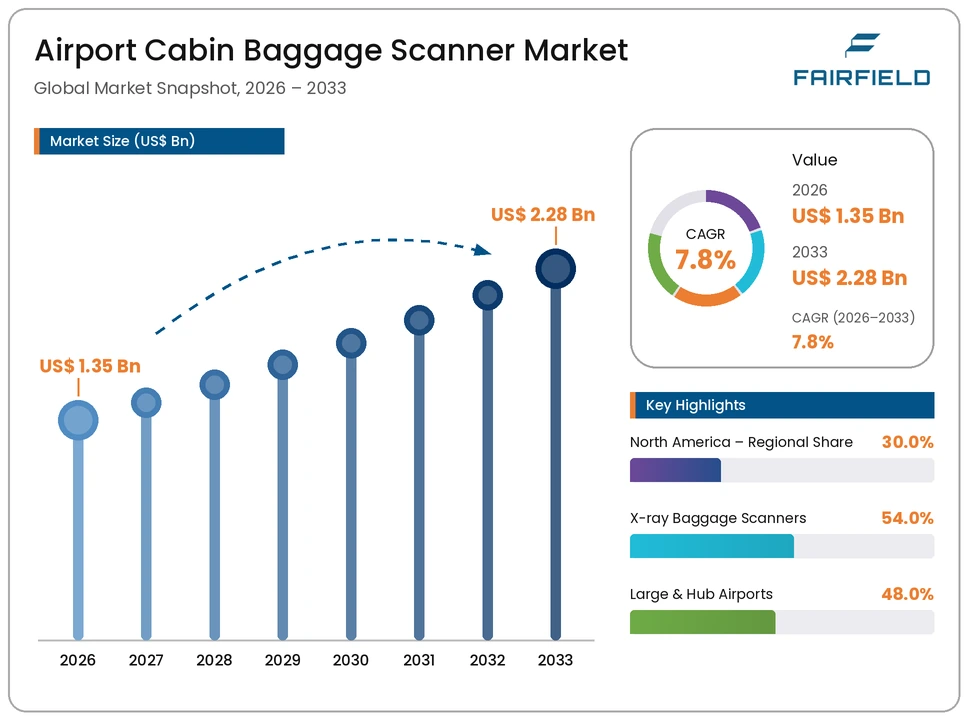
The market is valued at USD 1.35 Billion in 2026, with equipment manufacturers directing investment toward automated threat detection algorithms and streamlined checkpoint designs that improve passenger flow. By 2033, the market is forecast to reach USD 2.28 Billion, reflecting continued airport security infrastructure investment alongside the gradual transition toward next-generation scanning technology.
Key Highlights
- The global airport cabin baggage scanner market is valued at USD 1.35 Billion in 2026 and is projected to reach USD 2.28 Billion by 2033, expanding at a CAGR of 7.8% across the 2026-2033 forecast period.
- X-ray Baggage Scanners lead the technology segment with a 54.0% share in 2026, equivalent to USD 0.73 Billion.
- Large & Hub Airports remain the dominant deployment segment, accounting for 48.0% of global demand, or USD 0.65 Billion, in 2026.
- North America commands the largest regional share at 30.0% of the global market in 2026.
- CT-based scanning systems are emerging as the fastest-growing technology category through 2033.
Market Dynamics
Key Growth Drivers
Growth in the airport cabin baggage scanner market is driven primarily by sustained growth in global air passenger volumes, which is prompting airport operators to expand and upgrade checkpoint infrastructure to manage higher throughput without extending passenger wait times. This expansion is particularly pronounced in emerging markets where new airport capacity is being added to accommodate rising travel demand.
A second driver is regulatory momentum toward CT-based screening technology, with aviation security authorities in several regions establishing timelines for airports to replace conventional X-ray systems with CT-based scanners offering automated liquid and explosive detection capability, reducing the need for passengers to separate liquids and electronics during screening.
Key Restraints
The high capital cost of next-generation CT-based scanning systems relative to conventional X-ray equipment creates a significant barrier for smaller airports and budget-constrained aviation authorities, slowing the pace of technology transition in regions where security infrastructure budgets face competing priorities.
Additionally, checkpoint retrofitting to accommodate larger CT-based scanning equipment often requires physical reconfiguration of terminal security areas, adding project complexity and cost beyond the equipment purchase itself, which can delay adoption timelines even where budget approval has been secured.
Market Opportunities
The ongoing global transition toward CT-based screening presents a substantial opportunity for equipment manufacturers, as airports upgrading from conventional X-ray systems require not only new hardware but also integration services, staff training, and software updates that extend vendor engagement beyond the initial equipment sale.
A second opportunity lies in the integration of artificial intelligence-based automated threat recognition into scanning systems, reducing dependence on manual image interpretation and improving detection consistency across screening lanes. Manufacturers that successfully embed reliable automated detection capabilities are positioned to differentiate their offerings as airports seek to improve both security effectiveness and checkpoint efficiency.
Segmentation Analysis
By Technology
X-ray Baggage Scanners lead the technology segment, accounting for 54.0% of global market value in 2026, equivalent to USD 0.73 Billion. Their leadership reflects the large installed base of conventional screening equipment still in operation across airports worldwide. CT-Based Scanners hold a growing secondary share, increasingly deployed at major international airports pursuing enhanced detection capability and passenger convenience. Explosive Trace Detection-Integrated Scanners address a smaller, specialized share of deployments focused on secondary screening applications. CT-based systems represent the fastest-growing technology category through 2033 as regulatory transition timelines advance.
By Deployment
Large & Hub Airports form the leading deployment segment, representing 48.0% of global demand in 2026, or USD 0.65 Billion, reflecting their higher passenger volumes and earlier adoption of advanced screening technology. Medium-Sized Airports form the second-largest segment and represent the fastest-growing deployment category, as regional airport expansion programs extend advanced screening infrastructure beyond major hubs. Small & Regional Airports represent a smaller, gradually growing share of deployments.
Regional Insights
North America
North America holds the largest regional share, at 30.0% of the global market in 2026, equivalent to USD 0.41 Billion. The region's leadership reflects an established aviation security regulatory framework and ongoing checkpoint modernization programs across major airport hubs in the United States and Canada.
Europe
Europe accounts for 27.0% of the global market in 2026, valued at USD 0.36 Billion. Demand is supported by coordinated aviation security standards across the region and active CT-based screening rollout programs at major international airports.
Asia Pacific
Asia Pacific represents 28.0% of the global market in 2026, or USD 0.38 Billion. Growth is underpinned by rapid airport construction and expansion across China, India, and Southeast Asia, alongside rising passenger traffic that is driving new checkpoint infrastructure investment.
Latin America
Latin America contributes 8.0% of the global market in 2026, equivalent to USD 0.11 Billion. Growth is linked to gradual airport infrastructure modernization in Brazil and Mexico, supported by rising domestic and international air travel demand.
Middle East & Africa
Middle East & Africa holds 7.0% of the global market in 2026, valued at USD 0.09 Billion. Demand is concentrated among major Gulf Cooperation Council aviation hubs investing in advanced screening infrastructure to support growing international transit passenger volumes.
Competitive Landscape
The global airport cabin baggage scanner market is moderately concentrated, with a limited number of established security equipment manufacturers holding strong positions through long-standing relationships with aviation authorities and extensive regulatory certification track records. Competition centers on detection accuracy, checkpoint throughput performance, and the ability to meet evolving regulatory certification requirements across different aviation security jurisdictions. Manufacturers are increasingly differentiating through automated threat recognition software and service contracts rather than competing on hardware pricing alone.
Key Market Players
- Smiths Detection Group Ltd.
- Leidos Holdings, Inc.
- L3Harris Technologies, Inc.
- OSI Systems, Inc.
- Analogic Corporation
- Nuctech Company Limited
- VOTI Detection Inc.
- Astrophysics Inc.
- CEIA S.p.A.
- Adani Systems Inc.
Market Segmentation
By Technology
- X-ray Baggage Scanners
- CT-Based Scanners
- Explosive Trace Detection-Integrated Scanners
By Deployment
- Large & Hub Airports
- Medium-Sized Airports
- Small & Regional Airports
By View Type
- Single-View Systems
- Multi-View Systems
By Geography
- North America
- Europe
- Asia Pacific
- Latin America
- Middle East & Africa
- Executive Summary
- Global Airport Cabin Baggage Scanner Market Snapshot
- Future Projections
- Key Market Trends
- Regional Snapshot, by Value, 2026
- Analyst Recommendations
- Market Overview
- Market Definitions and Segmentations
- Market Dynamics
- Drivers
- Restraints
- Market Opportunities
- Value Chain Analysis
- COVID-19 Impact Analysis
- Porter's Five Forces Analysis
- Impact of Russia-Ukraine Conflict
- PESTLE Analysis
- Regulatory Analysis
- Price Trend Analysis
- Current Prices and Future Projections, 2025-2033
- Price Impact Factors
- Global Airport Cabin Baggage Scanner Market Outlook, 2020 - 2033
- Global Airport Cabin Baggage Scanner Market Outlook, by Technology, Value (US$ Mn), 2020-2033
- X-ray Baggage Scanners
- CT-Based Scanners
- Explosive Trace Detection-Integrated Scanners
- Global Airport Cabin Baggage Scanner Market Outlook, by Deployment, Value (US$ Mn), 2020-2033
- Large & Hub Airports
- Large & Hub Airports
- Large & Hub Airports
- Global Airport Cabin Baggage Scanner Market Outlook, by View Type, Value (US$ Mn), 2020-2033
- Single-View Systems
- Multi-View Systems
- Global Airport Cabin Baggage Scanner Market Outlook, by Region, Value (US$ Mn), 2020-2033
- North America
- Europe
- Asia Pacific
- Latin America
- Middle East & Africa
- Global Airport Cabin Baggage Scanner Market Outlook, by Technology, Value (US$ Mn), 2020-2033
- North America Airport Cabin Baggage Scanner Market Outlook, 2020 - 2033
- North America Airport Cabin Baggage Scanner Market Outlook, by Technology, Value (US$ Mn), 2020-2033
- X-ray Baggage Scanners
- CT-Based Scanners
- Explosive Trace Detection-Integrated Scanners
- North America Airport Cabin Baggage Scanner Market Outlook, by Deployment, Value (US$ Mn), 2020-2033
- Large & Hub Airports
- Large & Hub Airports
- Large & Hub Airports
- North America Airport Cabin Baggage Scanner Market Outlook, by View Type, Value (US$ Mn), 2020-2033
- Single-View Systems
- Multi-View Systems
- North America Airport Cabin Baggage Scanner Market Outlook, by Country, Value (US$ Mn), 2020-2033
- U.S. Airport Cabin Baggage Scanner Market Outlook, by Technology, 2020-2033
- U.S. Airport Cabin Baggage Scanner Market Outlook, by Deployment, 2020-2033
- U.S. Airport Cabin Baggage Scanner Market Outlook, by View Type, 2020-2033
- Canada Airport Cabin Baggage Scanner Market Outlook, by Technology, 2020-2033
- Canada Airport Cabin Baggage Scanner Market Outlook, by Deployment, 2020-2033
- Canada Airport Cabin Baggage Scanner Market Outlook, by View Type, 2020-2033
- BPS Analysis/Market Attractiveness Analysis
- North America Airport Cabin Baggage Scanner Market Outlook, by Technology, Value (US$ Mn), 2020-2033
- Europe Airport Cabin Baggage Scanner Market Outlook, 2020 - 2033
- Europe Airport Cabin Baggage Scanner Market Outlook, by Technology, Value (US$ Mn), 2020-2033
- X-ray Baggage Scanners
- CT-Based Scanners
- Explosive Trace Detection-Integrated Scanners
- Europe Airport Cabin Baggage Scanner Market Outlook, by Deployment, Value (US$ Mn), 2020-2033
- Large & Hub Airports
- Large & Hub Airports
- Large & Hub Airports
- Europe Airport Cabin Baggage Scanner Market Outlook, by View Type, Value (US$ Mn), 2020-2033
- Single-View Systems
- Multi-View Systems
- Europe Airport Cabin Baggage Scanner Market Outlook, by Country, Value (US$ Mn), 2020-2033
- Germany Airport Cabin Baggage Scanner Market Outlook, by Technology, 2020-2033
- Germany Airport Cabin Baggage Scanner Market Outlook, by Deployment, 2020-2033
- Germany Airport Cabin Baggage Scanner Market Outlook, by View Type, 2020-2033
- Italy Airport Cabin Baggage Scanner Market Outlook, by Technology, 2020-2033
- Italy Airport Cabin Baggage Scanner Market Outlook, by Deployment, 2020-2033
- Italy Airport Cabin Baggage Scanner Market Outlook, by View Type, 2020-2033
- France Airport Cabin Baggage Scanner Market Outlook, by Technology, 2020-2033
- France Airport Cabin Baggage Scanner Market Outlook, by Deployment, 2020-2033
- France Airport Cabin Baggage Scanner Market Outlook, by View Type, 2020-2033
- U.K. Airport Cabin Baggage Scanner Market Outlook, by Technology, 2020-2033
- U.K. Airport Cabin Baggage Scanner Market Outlook, by Deployment, 2020-2033
- U.K. Airport Cabin Baggage Scanner Market Outlook, by View Type, 2020-2033
- Spain Airport Cabin Baggage Scanner Market Outlook, by Technology, 2020-2033
- Spain Airport Cabin Baggage Scanner Market Outlook, by Deployment, 2020-2033
- Spain Airport Cabin Baggage Scanner Market Outlook, by View Type, 2020-2033
- Russia Airport Cabin Baggage Scanner Market Outlook, by Technology, 2020-2033
- Russia Airport Cabin Baggage Scanner Market Outlook, by Deployment, 2020-2033
- Russia Airport Cabin Baggage Scanner Market Outlook, by View Type, 2020-2033
- Rest of Europe Airport Cabin Baggage Scanner Market Outlook, by Technology, 2020-2033
- Rest of Europe Airport Cabin Baggage Scanner Market Outlook, by Deployment, 2020-2033
- Rest of Europe Airport Cabin Baggage Scanner Market Outlook, by View Type, 2020-2033
- BPS Analysis/Market Attractiveness Analysis
- Europe Airport Cabin Baggage Scanner Market Outlook, by Technology, Value (US$ Mn), 2020-2033
- Asia Pacific Airport Cabin Baggage Scanner Market Outlook, 2020 - 2033
- Asia Pacific Airport Cabin Baggage Scanner Market Outlook, by Technology, Value (US$ Mn), 2020-2033
- X-ray Baggage Scanners
- CT-Based Scanners
- Explosive Trace Detection-Integrated Scanners
- Asia Pacific Airport Cabin Baggage Scanner Market Outlook, by Deployment, Value (US$ Mn), 2020-2033
- Large & Hub Airports
- Large & Hub Airports
- Large & Hub Airports
- Asia Pacific Airport Cabin Baggage Scanner Market Outlook, by View Type, Value (US$ Mn), 2020-2033
- Single-View Systems
- Multi-View Systems
- Asia Pacific Airport Cabin Baggage Scanner Market Outlook, by Country, Value (US$ Mn), 2020-2033
- China Airport Cabin Baggage Scanner Market Outlook, by Technology, 2020-2033
- China Airport Cabin Baggage Scanner Market Outlook, by Deployment, 2020-2033
- China Airport Cabin Baggage Scanner Market Outlook, by View Type, 2020-2033
- Japan Airport Cabin Baggage Scanner Market Outlook, by Technology, 2020-2033
- Japan Airport Cabin Baggage Scanner Market Outlook, by Deployment, 2020-2033
- Japan Airport Cabin Baggage Scanner Market Outlook, by View Type, 2020-2033
- South Korea Airport Cabin Baggage Scanner Market Outlook, by Technology, 2020-2033
- South Korea Airport Cabin Baggage Scanner Market Outlook, by Deployment, 2020-2033
- South Korea Airport Cabin Baggage Scanner Market Outlook, by View Type, 2020-2033
- India Airport Cabin Baggage Scanner Market Outlook, by Technology, 2020-2033
- India Airport Cabin Baggage Scanner Market Outlook, by Deployment, 2020-2033
- India Airport Cabin Baggage Scanner Market Outlook, by View Type, 2020-2033
- Southeast Asia Airport Cabin Baggage Scanner Market Outlook, by Technology, 2020-2033
- Southeast Asia Airport Cabin Baggage Scanner Market Outlook, by Deployment, 2020-2033
- Southeast Asia Airport Cabin Baggage Scanner Market Outlook, by View Type, 2020-2033
- Rest of SAO Airport Cabin Baggage Scanner Market Outlook, by Technology, 2020-2033
- Rest of SAO Airport Cabin Baggage Scanner Market Outlook, by Deployment, 2020-2033
- Rest of SAO Airport Cabin Baggage Scanner Market Outlook, by View Type, 2020-2033
- BPS Analysis/Market Attractiveness Analysis
- Asia Pacific Airport Cabin Baggage Scanner Market Outlook, by Technology, Value (US$ Mn), 2020-2033
- Latin America Airport Cabin Baggage Scanner Market Outlook, 2020 - 2033
- Latin America Airport Cabin Baggage Scanner Market Outlook, by Technology, Value (US$ Mn), 2020-2033
- X-ray Baggage Scanners
- CT-Based Scanners
- Explosive Trace Detection-Integrated Scanners
- Latin America Airport Cabin Baggage Scanner Market Outlook, by Deployment, Value (US$ Mn), 2020-2033
- Large & Hub Airports
- Large & Hub Airports
- Large & Hub Airports
- Latin America Airport Cabin Baggage Scanner Market Outlook, by View Type, Value (US$ Mn), 2020-2033
- Single-View Systems
- Multi-View Systems
- Latin America Airport Cabin Baggage Scanner Market Outlook, by Country, Value (US$ Mn), 2020-2033
- Brazil Airport Cabin Baggage Scanner Market Outlook, by Technology, 2020-2033
- Brazil Airport Cabin Baggage Scanner Market Outlook, by Deployment, 2020-2033
- Brazil Airport Cabin Baggage Scanner Market Outlook, by View Type, 2020-2033
- Mexico Airport Cabin Baggage Scanner Market Outlook, by Technology, 2020-2033
- Mexico Airport Cabin Baggage Scanner Market Outlook, by Deployment, 2020-2033
- Mexico Airport Cabin Baggage Scanner Market Outlook, by View Type, 2020-2033
- Argentina Airport Cabin Baggage Scanner Market Outlook, by Technology, 2020-2033
- Argentina Airport Cabin Baggage Scanner Market Outlook, by Deployment, 2020-2033
- Argentina Airport Cabin Baggage Scanner Market Outlook, by View Type, 2020-2033
- Rest of LATAM Airport Cabin Baggage Scanner Market Outlook, by Technology, 2020-2033
- Rest of LATAM Airport Cabin Baggage Scanner Market Outlook, by Deployment, 2020-2033
- Rest of LATAM Airport Cabin Baggage Scanner Market Outlook, by View Type, 2020-2033
- BPS Analysis/Market Attractiveness Analysis
- Latin America Airport Cabin Baggage Scanner Market Outlook, by Technology, Value (US$ Mn), 2020-2033
- Middle East & Africa Airport Cabin Baggage Scanner Market Outlook, 2020 - 2033
- Middle East & Africa Airport Cabin Baggage Scanner Market Outlook, by Technology, Value (US$ Mn), 2020-2033
- X-ray Baggage Scanners
- CT-Based Scanners
- Explosive Trace Detection-Integrated Scanners
- Middle East & Africa Airport Cabin Baggage Scanner Market Outlook, by Deployment, Value (US$ Mn), 2020-2033
- Large & Hub Airports
- Large & Hub Airports
- Large & Hub Airports
- Middle East & Africa Airport Cabin Baggage Scanner Market Outlook, by View Type, Value (US$ Mn), 2020-2033
- Single-View Systems
- Multi-View Systems
- Middle East & Africa Airport Cabin Baggage Scanner Market Outlook, by Country, Value (US$ Mn), 2020-2033
- GCC Airport Cabin Baggage Scanner Market Outlook, by Technology, 2020-2033
- GCC Airport Cabin Baggage Scanner Market Outlook, by Deployment, 2020-2033
- GCC Airport Cabin Baggage Scanner Market Outlook, by View Type, 2020-2033
- South Africa Airport Cabin Baggage Scanner Market Outlook, by Technology, 2020-2033
- South Africa Airport Cabin Baggage Scanner Market Outlook, by Deployment, 2020-2033
- South Africa Airport Cabin Baggage Scanner Market Outlook, by View Type, 2020-2033
- Egypt Airport Cabin Baggage Scanner Market Outlook, by Technology, 2020-2033
- Egypt Airport Cabin Baggage Scanner Market Outlook, by Deployment, 2020-2033
- Egypt Airport Cabin Baggage Scanner Market Outlook, by View Type, 2020-2033
- Nigeria Airport Cabin Baggage Scanner Market Outlook, by Technology, 2020-2033
- Nigeria Airport Cabin Baggage Scanner Market Outlook, by Deployment, 2020-2033
- Nigeria Airport Cabin Baggage Scanner Market Outlook, by View Type, 2020-2033
- Rest of Middle East Airport Cabin Baggage Scanner Market Outlook, by Technology, 2020-2033
- Rest of Middle East Airport Cabin Baggage Scanner Market Outlook, by Deployment, 2020-2033
- Rest of Middle East Airport Cabin Baggage Scanner Market Outlook, by View Type, 2020-2033
- BPS Analysis/Market Attractiveness Analysis
- Middle East & Africa Airport Cabin Baggage Scanner Market Outlook, by Technology, Value (US$ Mn), 2020-2033
- Competitive Landscape
- Company Vs Segment Heatmap
- Company Market Share Analysis, 2025
- Competitive Dashboard
- Company Profiles
- Smiths Detection Group Ltd.
- Company Overview
- Product Portfolio
- Financial Overview
- Business Strategies and Developments
- Leidos Holdings, Inc.
- L3Harris Technologies, Inc.
- OSI Systems, Inc.
- Analogic Corporation
- Nuctech Company Limited
- VOTI Detection Inc.
- Astrophysics Inc.
- CEIA S.p.A.
- Adani Systems Inc.
- Smiths Detection Group Ltd.
- Appendix
- Research Methodology
- Report Assumptions
- Acronyms and Abbreviations
By Technology
- X-ray Baggage Scanners
- CT-Based Scanners
- Explosive Trace Detection-Integrated Scanners
By Deployment
- Large & Hub Airports
- Medium-Sized Airports
- Small & Regional Airports
By View Type
- Single-View Systems
- Multi-View Systems
By Geography
- North America
- Europe
- Asia Pacific
- Latin America
- Middle East & Africa
Our Research Methodology
Considering the volatility of business today, traditional approaches to strategizing a game plan can be unfruitful if not detrimental. True ambiguity is no way to determine a forecast. A myriad of predetermined factors must be accounted for such as the degree of risk involved, the magnitude of circumstances, as well as conditions or consequences that are not known or unpredictable. To circumvent binary views that cast uncertainty, the application of market research intelligence to strategically posture, move, and enable actionable outcomes is necessary.
View Methodology
Quality Assured
Rigorous Validation Process

Confidentiality Assured
End-to-end Data Security

Custom Research Services
Tailored To Your Objectives
FAQs
The global airport cabin baggage scanner market is valued at USD 1.35 Billion in 2026, reflecting sustained investment in airport checkpoint infrastructure.
The market is projected to grow at a CAGR of 7.8%, reaching USD 2.28 Billion by 2033, driven by rising passenger traffic and the shift toward CT-based screening.
X-ray Baggage Scanners lead with a 54.0% share in 2026, reflecting the large installed base of conventional screening equipment still in service.
North America leads with a 30.0% share in 2026, supported by an established regulatory framework and ongoing checkpoint modernization programs.
The largest opportunity lies in the global transition to CT-based screening, which creates demand for new hardware, integration services, and software upgrades.
Related Reports
Automotive Alternator and Starter Motor Market Size, Share, Insights, Competitive Landscape, and Forecast 2026 to 2033
The global automotive alternator and starter motor market is valued at US$32.0 billion in 2026, reaching US$38.0 billion by 2033, at a 2.5% CAGR
Automotive Start-Stop Battery Market Size, Share, Insights, Competitive Landscape, and Forecast 2026 to 2033
Hybrid Electric Vehicle (EV) Conversion Kit Market Size, Share, Insights, Competitive Landscape, and Forecast 2026 to 2033
The global hybrid EV conversion kit market will reach US$ 1.42 Bn by 2033, growing at 11.09% CAGR from 2026-2033, driven by cost-effective electrification
Passenger Vehicles HVAC Services Market Size, Share, Insights, Competitive Landscape, and Forecast 2026 to 2033
The passenger vehicles HVAC services market, valued at US$ 48.6 billion in 2026, and projected to reach US$ 73.4 billion by 2033, growing at 6.1% CAGR
Automotive 48-Volt Electronic Junction Box and Power Distribution Center Market Size, Share, Insights, Competitive Landscape, and Forecast 2026 to 2033
The global automotive 48-volt junction box and power distribution center market will reach US$ 4.55 Bn by 2033, growing at 11.68% CAGR from 2026-2033
Ultra-Fast EV Charging (350kW+) Systems Market Size, Share, Insights, Competitive Landscape, and Forecast 2026 to 2033
The global Ultra-Fast EV charging systems market will grow from US$ 7.1 billion in 2026 to US$ 34.5 billion by 2033, at a 25.3% CAGR. Discover key trends