



Airport Shuttle Bus Market
Airport Shuttle Bus Market Size, Share, Insights, Competitive Landscape, and Forecast 2026 to 2033
Airport Shuttle Bus Market Analysis, 2026–2033
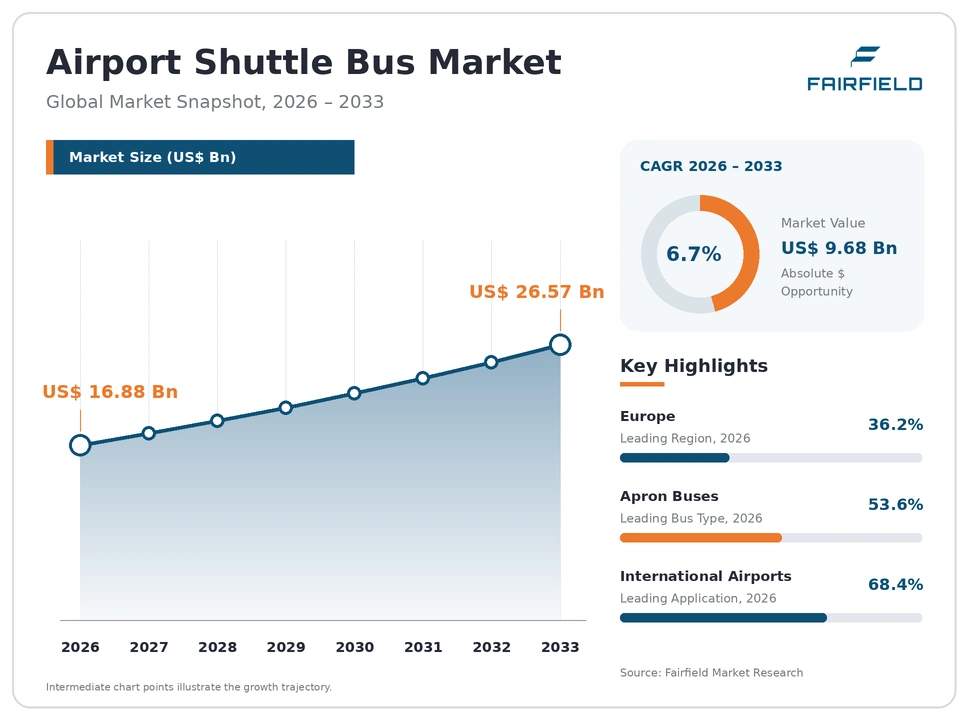
Airport Shuttle Bus Market Size and Trend Analysis
How Fast Is the Airport Shuttle Bus Market Growing?
The global airport shuttle bus market size is expected to be valued at US$ 16.88 billion in 2026 and projected to reach US$ 26.57 billion by 2033, growing at a CAGR of 6.7% between 2026 and 2033.
Between 2020 and 2025, the market grew at a CAGR of about 3.4%, as the pandemic halted air travel and fleet orders in 2020 and 2021 before a strong recovery in passenger traffic. Three factors now drive growth: record air passenger numbers, airport expansion projects, and decarbonization targets that push airports to replace diesel fleets with electric shuttle buses. The market is shifting toward battery-electric apron buses, digital fleet management, and early trials of autonomous shuttles for airside operations and landside parking routes, as airports also face shortages of qualified drivers.
Key Report Takeaways
- By Bus Type: Apron Buses held 53.6% share in 2026, while Landside Minibuses & Vans are projected to expand at a 7.6% CAGR through 2033, driven by parking, rental car, and hotel shuttle demand.
- By Fuel Type: Diesel held 47.8% share in 2026, while Electric is projected to expand at a 12.4% CAGR through 2033, driven by airport net-zero targets and falling battery costs.
- By Application: International Airports held 68.4% share in 2026, while Domestic & Regional Airports are projected to expand at a 7.5% CAGR through 2033, driven by new regional airports in emerging markets.
- By Region: Europe held 36.2% share in 2026, while Asia Pacific is projected to expand at an 8.9% CAGR through 2033, driven by airport construction in China, India, and Indonesia.
Global Airport Shuttle Bus Market Trends and Insights
Drivers Impact Analysis
Two drivers carry the strongest influence on airport shuttle bus demand during the forecast period.
| Driver | Impact on CAGR Forecast | Geographic Relevance | Impact Timeline |
| Air passenger growth and airport expansion | High | Asia Pacific, Middle East & Africa, Europe | Long term (≥4 years) |
| Airport decarbonization and fleet electrification | High | Europe, North America | Medium term (2-4 years) |
Air Passenger Growth Is Driving the Airport Shuttle Bus Market
Air passenger growth and airport expansion are the strongest drivers of the airport shuttle bus market. More passengers mean more buses to carry people between terminals, aircraft stands, car parks, and hotels.
The mechanism is rising traffic and limited gate capacity. Global air passenger numbers have surpassed pre-pandemic levels, and the International Air Transport Association expects continued growth. Many airports lack enough contact gates, so passengers board aircraft from remote stands served by apron buses. Low-cost carriers often prefer remote stands to cut fees and turnaround times, increasing bus use. New airports and terminals in India, China, Saudi Arabia, and Turkey need large shuttle fleets. Landside, growing car parks, rental car centers, and airport hotels need regular shuttle services. These trends create steady demand for new and replacement buses.
Airport Decarbonization Is Expanding the Airport Shuttle Bus Market
Airport decarbonization and fleet electrification are expanding the airport shuttle bus market. Airports are replacing diesel shuttles with electric shuttle buses to meet climate targets and improve local air quality.
The cause is industry commitments and supportive policies. Airports Council International members in Europe have committed to net-zero emissions by 2050, and many large airports aim to reach this earlier. Airport carbon accreditation programs reward lower ground emissions. Apron buses suit electrification because they drive short, predictable routes and return to depots for charging. Lithuanian Airports ordered 12 electric buses in 2025 to replace its entire diesel apron fleet at Vilnius. In North America, federal programs fund electric ground support equipment and shuttles. These factors make electric buses the default choice for new orders in many markets.
Restraints Impact Analysis
Two restraints limit how quickly the airport shuttle bus market grows.
| Restraint | Impact on CAGR Forecast | Geographic Relevance | Impact Timeline |
| High costs of electric buses and charging infrastructure | High | Latin America, Middle East & Africa, Asia Pacific | Short term (≤2 years) |
| Shift to contact gates, people movers, and rail links | Medium | North America, Europe | Long term (≥4 years) |
High Electric Bus and Charging Costs Slow the Airport Shuttle Bus Market
High costs of electric buses and charging infrastructure slow the airport shuttle bus market. Airports and ground handlers must invest heavily to replace diesel fleets.
The specific causes are high vehicle prices and grid limitations. Electric apron buses cost significantly more than diesel models, and batteries may need replacement during the vehicle’s life. Airports must install chargers and often upgrade electrical connections, which can take years. Ground handling companies operate on thin margins and long contracts, making large investments difficult. In hot climates, air conditioning drains batteries faster, reducing range. Airports in Latin America, Africa, and parts of Asia Pacific have smaller budgets for fleet renewal. Some operators extend the life of diesel buses to delay spending. These factors slow electric adoption, especially at smaller airports with limited capital.
Alternative Transport Modes Restrict the Airport Shuttle Bus Market
The shift to contact gates, automated people movers, and rail links restricts the airport shuttle bus market. Airports increasingly use other ways to move passengers.
The underlying causes are passenger experience and long-term efficiency. Many new terminals are designed with more contact gates and jet bridges, which reduce the need for apron buses. Large airports such as Los Angeles International Airport and Denver International Airport are investing in automated people movers that replace landside shuttles between terminals, car parks, and rental car centers. Rail links connect airports with city centers, reducing demand for coach and hotel shuttles. Ride-hailing services also compete with hotel and parking shuttles. These alternatives require large investments but reduce bus fleet needs over time, particularly at major hubs in North America and Europe with space for new infrastructure.
Market Opportunities
Electric Fleet Replacement Opens a Major Revenue Pool
Electric fleet replacement opens a major revenue pool in the airport shuttle bus market. Thousands of diesel apron and landside buses worldwide will need replacing as airports pursue net-zero targets.
Bus makers, charger suppliers, and leasing companies can capture this opportunity. Electric apron buses from COBUS Industries, BYD, and Weihai Guangtai Airport Equipment are winning orders at major airports. COBUS Industries delivered its 5,000th bus in 2025, a fully electric model for British Airways at London Heathrow. Packages that combine buses, charging equipment, and maintenance contracts reduce risk for airports and ground handlers. Leasing and fleet-as-a-service models lower upfront costs. Battery recycling and second-life storage add further value. Suppliers that offer complete packages can win long-term contracts across airport groups.
Autonomous Shuttles and Smart Fleet Management Create a Technology Revenue Pool
Autonomous shuttles and smart fleet management create a technology revenue pool in the airport shuttle bus market. Airports are controlled environments, making them good testing grounds for driverless vehicles.
Technology developers and bus makers can capture this opportunity. Royal Schiphol Group trialed electric self-driving buses on the apron in 2024 as part of its goal of fully autonomous ground operations by 2050. Changi Airport in Singapore has also tested autonomous vehicles airside. Driverless shuttles can reduce driver shortages and labor costs, which are major challenges for ground handlers. Fleet management software using real-time flight data improves bus scheduling and reduces waiting times. Telematics and predictive maintenance raise uptime and lower repair costs. Suppliers that combine vehicles, software, and data services can capture recurring revenue from airports and ground handling companies.
Segment Analysis
By Bus Type: Apron Buses Lead While Landside Minibuses & Vans Grow Fastest
Apron Buses held 53.6% share in 2026. Apron buses carry passengers between terminals and remote aircraft stands, with low floors, wide doors, and space for up to about 110 passengers. These buses are expensive specialized vehicles, raising their value share. COBUS Industries, BYD, and Weihai Guangtai Airport Equipment lead this segment, and full-size landside buses serve terminal and car park links.
Landside Minibuses & Vans are the fastest-growing bus type, expanding at a 7.6% CAGR through 2033. Airports, hotels, rental car companies, and parking operators use smaller shuttles for frequent, flexible services. Growth in airport hotels, off-site parking, and rental car centers drives demand, and electric minibuses from suppliers such as Endera and GreenPower Motor are gaining ground. For the market, smaller shuttles add volume across many operators.
By Fuel Type: Diesel Leads While Electric Grows Fastest
Diesel held 47.8% share in 2026. Diesel buses remain common at many airports, especially in Latin America, Africa, and parts of Asia Pacific, where budgets are tight and charging infrastructure is limited. Many existing fleets still have years of service life left. Natural gas, hybrid, and renewable diesel buses form a middle option, with some operators using hydrotreated vegetable oil to cut emissions.
Electric is the fastest-growing fuel type, expanding at a 12.4% CAGR through 2033. Electric shuttle buses suit airport routes because they run short, predictable trips and return to depots for charging. Airports in Europe, North America, and China increasingly buy only electric buses for new orders. COBUS Industries and BYD supply electric apron models. Battery improvements extend range and reduce charging time. For the market, electrification raises vehicle values and creates demand for chargers.
By Application: International Airports Lead While Domestic & Regional Airports Grow Fastest
International Airports held 68.4% share in 2026. Large hub airports such as London Heathrow, Dubai International, Istanbul Airport, and Beijing Daxing operate large fleets of apron and landside buses. High passenger volumes, remote stands, and multiple terminals create strong demand. These airports also lead adoption of electric and autonomous buses.
Domestic & Regional Airports are the fastest-growing application, expanding at a 7.5% CAGR through 2033. New regional airports in India, China, Indonesia, and Saudi Arabia need shuttle fleets as domestic air travel grows. India’s UDAN regional connectivity program has added many new airports. Low-cost carriers often use remote stands at regional airports, increasing apron bus use. For the market, regional growth adds many smaller fleet orders.
Geography Analysis
North America Expands the Airport Shuttle Bus Market Through Landside Services
North America is a large airport shuttle bus market led by landside shuttles serving parking, rental car centers, and hotels. The United States has the world’s largest airport network, and most airports use contact gates rather than apron buses. The Federal Aviation Administration funds electric vehicles and charging through its Voluntary Airport Low Emissions program. Little Rock airport approved electric shuttles from Endera in 2024. Canada has large airports in Toronto and Vancouver. Large hubs such as Atlanta, Dallas Fort Worth, and Chicago O’Hare run big parking and rental car shuttle fleets. One change shaping the region is the shift to electric parking shuttles and automated people movers.
Which Region Is Leading the Airport Shuttle Bus Market?
Europe is leading the airport shuttle bus market with a 36.2% share in 2026. Many European airports use remote stands and apron buses, especially for low-cost carriers. COBUS Industries, based in Germany and Portugal, is a leading apron bus maker. London Heathrow, Paris Charles de Gaulle, Frankfurt, Istanbul, and Madrid run large fleets. Airports across Europe aim for net-zero emissions, driving electric fleet orders such as Vilnius Airport’s switch to electric buses. Royal Schiphol Group tests self-driving buses. Spain, Italy, and Poland add demand from fast-growing low-cost airline traffic. One change shaping the region is full fleet electrification.
Which Region Is Growing Fastest in the Airport Shuttle Bus Market?
Asia Pacific is growing fastest in the airport shuttle bus market at an 8.9% CAGR through 2033. China is building dozens of new airports and has strong domestic bus makers such as BYD, Yutong, and Weihai Guangtai Airport Equipment. India is expanding airports under private operators such as Adani Airports and GMR Airports, and new airports such as Navi Mumbai and Noida need shuttle fleets. Indonesia, Vietnam, and the Philippines are expanding airport capacity. Singapore’s Changi Airport tests autonomous vehicles. Japan and South Korea also replace older fleets at major hubs. One opportunity is electric apron buses for new airports.
Latin America Grows the Airport Shuttle Bus Market Through Airport Concessions
Latin America is a developing airport shuttle bus market where private airport concessions drive investment. Mexico, Brazil, Colombia, and Chile have growing air traffic and many remote stands. Airport operators such as Grupo Aeroportuario del Pacífico and Aena Brasil invest in terminal and fleet upgrades. BYD and Marcopolo supply buses in the region. Low-cost carriers such as Viva Aerobus, Volaris, and JetSMART increase demand for remote-stand boarding. Ground handlers often operate older diesel fleets. Key barriers include tight budgets, currency swings, and limited charging infrastructure. One opportunity is electric apron buses supported by concession investment requirements.
Middle East & Africa Advances the Airport Shuttle Bus Market Through Mega Airports
Middle East & Africa is a growing airport shuttle bus market driven by large airport projects. Saudi Arabia is building King Salman International Airport in Riyadh, and the United Arab Emirates is expanding Al Maktoum International Airport in Dubai. Hub airports in Doha, Dubai, and Abu Dhabi operate large apron bus fleets. In Africa, Egypt, Ethiopia, and Nigeria are expanding airports. Airline hubs run by Emirates, Qatar Airways, and Etihad handle large transfer flows. Key barriers include hot climates that affect battery performance and air conditioning loads. One opportunity is high-capacity electric buses for mega hubs.
Competitive Landscape
The airport shuttle bus market is moderately concentrated. COBUS Industries, BYD, Yutong, Mallaghan, and Weihai Guangtai Airport Equipment lead in apron buses, while TAM-Europe, BMC Otomotiv, Kiitokori, Solaris, and Volvo compete in regional markets. Landside shuttles are more fragmented, with many minibus and van makers such as Endera, GreenPower Motor, and REV Group.
Companies compete on passenger capacity, battery range, charging solutions, reliability, total cost of ownership, and after-sales service at airports. Apron buses must meet strict airside safety rules, which favors experienced suppliers with proven designs and service teams based at or near major airports. Ground handlers such as Swissport, dnata, and Menzies Aviation are major buyers, so relationships with these firms matter. Chinese makers compete on price for electric models, while European makers compete on quality, service networks, and relationships with ground handlers and airlines.
Strategic moves show how competition is changing. In March 2024, Royal Schiphol Group trialed self-driving electric buses on the apron. In September 2025, COBUS Industries delivered its 5,000th bus, an electric model for British Airways at London Heathrow. In November 2025, Lithuanian Airports ordered 12 electric buses from COBUS Industries for Vilnius Airport. These moves show competition shifting toward electric and autonomous fleets, with airports increasingly buying buses together with maintenance and charging services under multi-year contracts.
Three themes shape vendor strategy. First, companies are expanding electric product lines. Second, they are offering maintenance and charging packages. Third, they are testing autonomous driving and fleet software with airports and ground handlers.
Airport Shuttle Bus Market Industry Leaders
- COBUS Industries
- BYD
- Yutong
- Mallaghan
- Weihai Guangtai Airport Equipment
Recent Industry Developments
- November 2025: Lithuanian Airports ordered 12 electric COBUS buses worth €7.2 million for Vilnius Airport - will replace its entire diesel apron fleet in 2026.
- September 2025: COBUS Industries delivered its 5,000th apron bus, an electric model for British Airways at London Heathrow - marks a milestone for electric apron fleets.
- April 2024: Little Rock airport approved the purchase of electric shuttle buses from Endera - shows electric adoption at regional airports.
- March 2024: Royal Schiphol Group trialed self-driving electric buses on the apron - supports its goal of autonomous ground operations by 2050.
Companies Covered in the Report
- COBUS Industries
- BYD
- Yutong
- Mallaghan
- Weihai Guangtai Airport Equipment
- TAM-Europe
- BMC Otomotiv
- Kiitokori
- Solaris Bus & Coach
- Volvo Buses
- Endera
- GreenPower Motor
Airport Shuttle Bus Market Report Scope
This report covers airport shuttle buses, including apron buses, landside full-size buses, and minibuses and vans powered by diesel, natural gas, hybrid, and electric drivetrains, used at international, domestic, and regional airports for terminal, aircraft, parking, rental car, and hotel transfers. It excludes automated people movers, rail links, and intercity coaches. The base year is 2025, and the forecast period runs from 2026 to 2033. All values are expressed in US$ Billion.
Bus Type
- Apron Buses
- Landside Full-size Buses
- Landside Minibuses & Vans
Fuel Type
- Diesel
- Natural Gas & Hybrid
- Electric
Application
- International Airports
- Domestic & Regional Airports
Regions
- North America
- Europe
- Asia Pacific
- Latin America
- Middle East & Africa
1. Executive Summary
1.1. Global Airport Shuttle Bus Market Snapshot
1.2. Future Projections
1.3. Key Report Takeaways
1.4. Regional Snapshot
2. Market Overview
2.1. Market Definition and Report Scope
2.2. Historical Trends 2020–2025
2.3. Market Dynamics
2.3.1. Drivers
2.3.1.1. Air Passenger Growth Is Driving the Airport Shuttle Bus Market
2.3.1.2. Airport Decarbonization Is Expanding the Airport Shuttle Bus Market
2.3.2. Restraints
2.3.2.1. High Electric Bus and Charging Costs Slow the Airport Shuttle Bus Market
2.3.2.2. Alternative Transport Modes Restrict the Airport Shuttle Bus Market
2.3.3. Market Opportunities
2.3.3.1. Electric Fleet Replacement Opens a Major Revenue Pool
2.3.3.2. Autonomous Shuttles and Smart Fleet Management Create a Technology Revenue Pool
3. Global Airport Shuttle Bus Market Outlook, 2020-2033
3.1. Global Airport Shuttle Bus Market Outlook, by Bus Type, Value (US$ Billion), 2020-2033
3.1.1. Apron Buses
3.1.2. Landside Full-size Buses
3.1.3. Landside Minibuses & Vans
3.2. Global Airport Shuttle Bus Market Outlook, by Fuel Type, Value (US$ Billion), 2020-2033
3.2.1. Diesel
3.2.2. Natural Gas & Hybrid
3.2.3. Electric
3.3. Global Airport Shuttle Bus Market Outlook, by Application, Value (US$ Billion), 2020-2033
3.3.1. International Airports
3.3.2. Domestic & Regional Airports
3.4. Global Airport Shuttle Bus Market Outlook, by Region, Value (US$ Billion), 2020-2033
3.4.1. North America
3.4.2. Europe
3.4.3. Asia Pacific
3.4.4. Latin America
3.4.5. Middle East & Africa
4. North America Airport Shuttle Bus Market Outlook, 2020-2033
4.1. North America Airport Shuttle Bus Market Outlook, by Bus Type, Value (US$ Billion), 2020-2033
4.1.1. Apron Buses
4.1.2. Landside Full-size Buses
4.1.3. Landside Minibuses & Vans
4.2. North America Airport Shuttle Bus Market Outlook, by Fuel Type, Value (US$ Billion), 2020-2033
4.2.1. Diesel
4.2.2. Natural Gas & Hybrid
4.2.3. Electric
4.3. North America Airport Shuttle Bus Market Outlook, by Application, Value (US$ Billion), 2020-2033
4.3.1. International Airports
4.3.2. Domestic & Regional Airports
4.4. North America Airport Shuttle Bus Market Outlook, by Country, Value (US$ Billion), 2020-2033
4.4.1. United States Airport Shuttle Bus Market Outlook, by Bus Type, 2020-2033
4.4.2. United States Airport Shuttle Bus Market Outlook, by Fuel Type, 2020-2033
4.4.3. United States Airport Shuttle Bus Market Outlook, by Application, 2020-2033
4.4.4. Canada Airport Shuttle Bus Market Outlook, by Bus Type, 2020-2033
4.4.5. Canada Airport Shuttle Bus Market Outlook, by Fuel Type, 2020-2033
4.4.6. Canada Airport Shuttle Bus Market Outlook, by Application, 2020-2033
5. Europe Airport Shuttle Bus Market Outlook, 2020-2033
5.1. Europe Airport Shuttle Bus Market Outlook, by Bus Type, Value (US$ Billion), 2020-2033
5.1.1. Apron Buses
5.1.2. Landside Full-size Buses
5.1.3. Landside Minibuses & Vans
5.2. Europe Airport Shuttle Bus Market Outlook, by Fuel Type, Value (US$ Billion), 2020-2033
5.2.1. Diesel
5.2.2. Natural Gas & Hybrid
5.2.3. Electric
5.3. Europe Airport Shuttle Bus Market Outlook, by Application, Value (US$ Billion), 2020-2033
5.3.1. International Airports
5.3.2. Domestic & Regional Airports
5.4. Europe Airport Shuttle Bus Market Outlook, by Country, Value (US$ Billion), 2020-2033
5.4.1. Germany Airport Shuttle Bus Market Outlook, by Bus Type, 2020-2033
5.4.2. Germany Airport Shuttle Bus Market Outlook, by Fuel Type, 2020-2033
5.4.3. Germany Airport Shuttle Bus Market Outlook, by Application, 2020-2033
5.4.4. Portugal Airport Shuttle Bus Market Outlook, by Bus Type, 2020-2033
5.4.5. Portugal Airport Shuttle Bus Market Outlook, by Fuel Type, 2020-2033
5.4.6. Portugal Airport Shuttle Bus Market Outlook, by Application, 2020-2033
5.4.7. Spain Airport Shuttle Bus Market Outlook, by Bus Type, 2020-2033
5.4.8. Spain Airport Shuttle Bus Market Outlook, by Fuel Type, 2020-2033
5.4.9. Spain Airport Shuttle Bus Market Outlook, by Application, 2020-2033
5.4.10. Italy Airport Shuttle Bus Market Outlook, by Bus Type, 2020-2033
5.4.11. Italy Airport Shuttle Bus Market Outlook, by Fuel Type, 2020-2033
5.4.12. Italy Airport Shuttle Bus Market Outlook, by Application, 2020-2033
5.4.13. Poland Airport Shuttle Bus Market Outlook, by Bus Type, 2020-2033
5.4.14. Poland Airport Shuttle Bus Market Outlook, by Fuel Type, 2020-2033
5.4.15. Poland Airport Shuttle Bus Market Outlook, by Application, 2020-2033
6. Asia Pacific Airport Shuttle Bus Market Outlook, 2020-2033
6.1. Asia Pacific Airport Shuttle Bus Market Outlook, by Bus Type, Value (US$ Billion), 2020-2033
6.1.1. Apron Buses
6.1.2. Landside Full-size Buses
6.1.3. Landside Minibuses & Vans
6.2. Asia Pacific Airport Shuttle Bus Market Outlook, by Fuel Type, Value (US$ Billion), 2020-2033
6.2.1. Diesel
6.2.2. Natural Gas & Hybrid
6.2.3. Electric
6.3. Asia Pacific Airport Shuttle Bus Market Outlook, by Application, Value (US$ Billion), 2020-2033
6.3.1. International Airports
6.3.2. Domestic & Regional Airports
6.4. Asia Pacific Airport Shuttle Bus Market Outlook, by Country, Value (US$ Billion), 2020-2033
6.4.1. China Airport Shuttle Bus Market Outlook, by Bus Type, 2020-2033
6.4.2. China Airport Shuttle Bus Market Outlook, by Fuel Type, 2020-2033
6.4.3. China Airport Shuttle Bus Market Outlook, by Application, 2020-2033
6.4.4. India Airport Shuttle Bus Market Outlook, by Bus Type, 2020-2033
6.4.5. India Airport Shuttle Bus Market Outlook, by Fuel Type, 2020-2033
6.4.6. India Airport Shuttle Bus Market Outlook, by Application, 2020-2033
6.4.7. Indonesia Airport Shuttle Bus Market Outlook, by Bus Type, 2020-2033
6.4.8. Indonesia Airport Shuttle Bus Market Outlook, by Fuel Type, 2020-2033
6.4.9. Indonesia Airport Shuttle Bus Market Outlook, by Application, 2020-2033
6.4.10. Vietnam Airport Shuttle Bus Market Outlook, by Bus Type, 2020-2033
6.4.11. Vietnam Airport Shuttle Bus Market Outlook, by Fuel Type, 2020-2033
6.4.12. Vietnam Airport Shuttle Bus Market Outlook, by Application, 2020-2033
6.4.13. Philippines Airport Shuttle Bus Market Outlook, by Bus Type, 2020-2033
6.4.14. Philippines Airport Shuttle Bus Market Outlook, by Fuel Type, 2020-2033
6.4.15. Philippines Airport Shuttle Bus Market Outlook, by Application, 2020-2033
6.4.16. Singapore Airport Shuttle Bus Market Outlook, by Bus Type, 2020-2033
6.4.17. Singapore Airport Shuttle Bus Market Outlook, by Fuel Type, 2020-2033
6.4.18. Singapore Airport Shuttle Bus Market Outlook, by Application, 2020-2033
6.4.19. Japan Airport Shuttle Bus Market Outlook, by Bus Type, 2020-2033
6.4.20. Japan Airport Shuttle Bus Market Outlook, by Fuel Type, 2020-2033
6.4.21. Japan Airport Shuttle Bus Market Outlook, by Application, 2020-2033
6.4.22. South Korea Airport Shuttle Bus Market Outlook, by Bus Type, 2020-2033
6.4.23. South Korea Airport Shuttle Bus Market Outlook, by Fuel Type, 2020-2033
6.4.24. South Korea Airport Shuttle Bus Market Outlook, by Application, 2020-2033
7. Latin America Airport Shuttle Bus Market Outlook, 2020-2033
7.1. Latin America Airport Shuttle Bus Market Outlook, by Bus Type, Value (US$ Billion), 2020-2033
7.1.1. Apron Buses
7.1.2. Landside Full-size Buses
7.1.3. Landside Minibuses & Vans
7.2. Latin America Airport Shuttle Bus Market Outlook, by Fuel Type, Value (US$ Billion), 2020-2033
7.2.1. Diesel
7.2.2. Natural Gas & Hybrid
7.2.3. Electric
7.3. Latin America Airport Shuttle Bus Market Outlook, by Application, Value (US$ Billion), 2020-2033
7.3.1. International Airports
7.3.2. Domestic & Regional Airports
7.4. Latin America Airport Shuttle Bus Market Outlook, by Country, Value (US$ Billion), 2020-2033
7.4.1. Mexico Airport Shuttle Bus Market Outlook, by Bus Type, 2020-2033
7.4.2. Mexico Airport Shuttle Bus Market Outlook, by Fuel Type, 2020-2033
7.4.3. Mexico Airport Shuttle Bus Market Outlook, by Application, 2020-2033
7.4.4. Brazil Airport Shuttle Bus Market Outlook, by Bus Type, 2020-2033
7.4.5. Brazil Airport Shuttle Bus Market Outlook, by Fuel Type, 2020-2033
7.4.6. Brazil Airport Shuttle Bus Market Outlook, by Application, 2020-2033
7.4.7. Colombia Airport Shuttle Bus Market Outlook, by Bus Type, 2020-2033
7.4.8. Colombia Airport Shuttle Bus Market Outlook, by Fuel Type, 2020-2033
7.4.9. Colombia Airport Shuttle Bus Market Outlook, by Application, 2020-2033
7.4.10. Chile Airport Shuttle Bus Market Outlook, by Bus Type, 2020-2033
7.4.11. Chile Airport Shuttle Bus Market Outlook, by Fuel Type, 2020-2033
7.4.12. Chile Airport Shuttle Bus Market Outlook, by Application, 2020-2033
8. Middle East & Africa Airport Shuttle Bus Market Outlook, 2020-2033
8.1. Middle East & Africa Airport Shuttle Bus Market Outlook, by Bus Type, Value (US$ Billion), 2020-2033
8.1.1. Apron Buses
8.1.2. Landside Full-size Buses
8.1.3. Landside Minibuses & Vans
8.2. Middle East & Africa Airport Shuttle Bus Market Outlook, by Fuel Type, Value (US$ Billion), 2020-2033
8.2.1. Diesel
8.2.2. Natural Gas & Hybrid
8.2.3. Electric
8.3. Middle East & Africa Airport Shuttle Bus Market Outlook, by Application, Value (US$ Billion), 2020-2033
8.3.1. International Airports
8.3.2. Domestic & Regional Airports
8.4. Middle East & Africa Airport Shuttle Bus Market Outlook, by Country, Value (US$ Billion), 2020-2033
8.4.1. Saudi Arabia Airport Shuttle Bus Market Outlook, by Bus Type, 2020-2033
8.4.2. Saudi Arabia Airport Shuttle Bus Market Outlook, by Fuel Type, 2020-2033
8.4.3. Saudi Arabia Airport Shuttle Bus Market Outlook, by Application, 2020-2033
8.4.4. United Arab Emirates Airport Shuttle Bus Market Outlook, by Bus Type, 2020-2033
8.4.5. United Arab Emirates Airport Shuttle Bus Market Outlook, by Fuel Type, 2020-2033
8.4.6. United Arab Emirates Airport Shuttle Bus Market Outlook, by Application, 2020-2033
8.4.7. Egypt Airport Shuttle Bus Market Outlook, by Bus Type, 2020-2033
8.4.8. Egypt Airport Shuttle Bus Market Outlook, by Fuel Type, 2020-2033
8.4.9. Egypt Airport Shuttle Bus Market Outlook, by Application, 2020-2033
8.4.10. Ethiopia Airport Shuttle Bus Market Outlook, by Bus Type, 2020-2033
8.4.11. Ethiopia Airport Shuttle Bus Market Outlook, by Fuel Type, 2020-2033
8.4.12. Ethiopia Airport Shuttle Bus Market Outlook, by Application, 2020-2033
8.4.13. Nigeria Airport Shuttle Bus Market Outlook, by Bus Type, 2020-2033
8.4.14. Nigeria Airport Shuttle Bus Market Outlook, by Fuel Type, 2020-2033
8.4.15. Nigeria Airport Shuttle Bus Market Outlook, by Application, 2020-2033
9. Competitive Landscape
9.1. Market Concentration and Industry Leaders
9.2. Competitive Differentiation
9.3. Strategic Moves and Market Direction
9.4. Recent Industry Developments
9.5. Company Profiles
9.5.1. COBUS Industries
9.5.2. BYD
9.5.3. Yutong
9.5.4. Mallaghan
9.5.5. Weihai Guangtai Airport Equipment
9.5.6. TAM-Europe
9.5.7. BMC Otomotiv
9.5.8. Kiitokori
9.5.9. Solaris Bus & Coach
9.5.10. Volvo Buses
9.5.11. Endera
9.5.12. GreenPower Motor
10. Appendix
10.1. Research Methodology
10.2. Report Assumptions
10.3. Acronyms and Abbreviations
| Base Year | 2025 |
|---|---|
| Historical Data | 2020–2025 |
| Forecast Period | 2026–2033 |
| Units | Value: US$ Billion |
| Bus Type |
|
|---|---|
| Fuel Type |
|
| Application |
|
| Regions |
|
| Companies Covered |
|
Our Research Methodology
Considering the volatility of business today, traditional approaches to strategizing a game plan can be unfruitful if not detrimental. True ambiguity is no way to determine a forecast. A myriad of predetermined factors must be accounted for such as the degree of risk involved, the magnitude of circumstances, as well as conditions or consequences that are not known or unpredictable. To circumvent binary views that cast uncertainty, the application of market research intelligence to strategically posture, move, and enable actionable outcomes is necessary.
View Methodology
Quality Assured
Rigorous Validation Process

Confidentiality Assured
End-to-end Data Security

Custom Research Services
Tailored To Your Objectives
FAQs
The airport shuttle bus market is valued at US$ 16.88 billion in 2026, led by apron buses at large international airports.
The market is projected to reach US$ 26.57 billion by 2033, growing at a 6.7% CAGR and adding US$ 9.68 billion.
Electric is growing fastest at a 12.4% CAGR through 2033, driven by airport net-zero targets and falling battery costs.
Asia Pacific is growing fastest at an 8.9% CAGR through 2033, driven by new airports in China, India, and Indonesia.
Europe holds the largest share at 36.2% in 2026, supported by remote-stand operations and electric apron bus adoption.
Related Reports
Smart Oil Dipstick Market Size, Share, Insights, Competitive Landscape, and Forecast 2026 to 2033
Smart Oil Dipstick Market is projected to rise from US$ 4.03 billion in 2026 to US$ 13.02 billion by 2033 at an 18.2% CAGR. Explore key uses and trends.
Rail Glazing Market Size, Share, Insights, Competitive Landscape, and Forecast 2026 to 2033
Rail Glazing Market is projected to grow from US$ 2.37 billion in 2026 to US$ 3.56 billion by 2033 at a 6.0% CAGR. Explore materials and applications.
Passenger Vehicle ADAS Market Size, Share, Insights, Competitive Landscape, and Forecast 2026 to 2033
Passenger Vehicle ADAS Market is set to grow from US$ 36.7 billion in 2026 to US$ 115.5 billion by 2033 at a 17.8% CAGR. Explore sensors and trends.
Container Fleet Market Size, Share, Insights, Competitive Landscape, and Forecast 2026 to 2033
Explore the container fleet market, projected to reach US$ 26.8 billion by 2033 at a 5.4% CAGR, with container types, ownership and regional insights.
Micro-mobility Charging Infrastructure Market Size, Share, Insights, Competitive Landscape, and Forecast 2026 to 2033
The global micro-mobility charging infrastructure market is valued at US$9.06 billion in 2026, reaching US$34.02 billion by 2033, growing at a 20.8% CAGR
eCTOL Aircraft Market Size, Share, Insights, Competitive Landscape, and Forecast 2026 to 2033
Explore the eCTOL aircraft market, projected to reach US$ 11.14 billion by 2033 at a 10.6% CAGR, with propulsion, application and regional insights.