



Aluminium Foil Packaging Market
Aluminium Foil Packaging Market Size, Share, Insights, Competitive Landscape, and Forecast 2026 to 2033
Aluminium Foil Packaging Market Analysis, 2026–2033
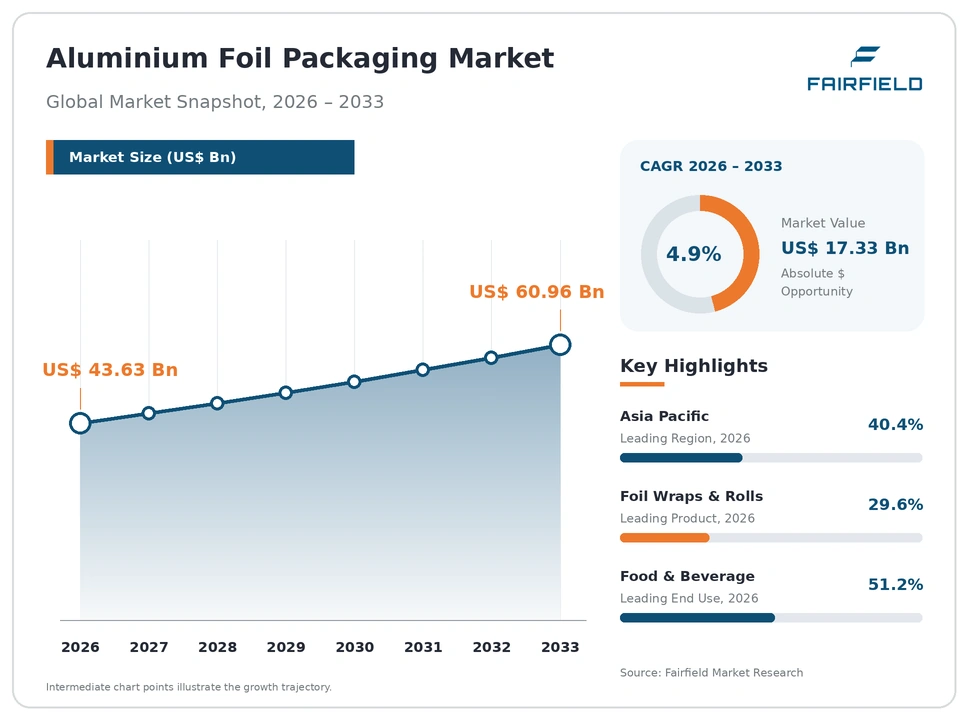
Aluminium Foil Packaging Market Size and Trend Analysis
How Fast Is the Aluminium Foil Packaging Market Growing?
The global aluminium foil packaging market size is expected to be valued at US$ 43.63 billion in 2026 and projected to reach US$ 60.96 billion by 2033, growing at a CAGR of 4.9% between 2026 and 2033.
Between 2020 and 2025, the market grew at a CAGR of about 4.1%, as home cooking, food delivery, and pharmaceutical demand rose during the pandemic, while aluminium price spikes and trade disputes raised costs. Three factors now drive growth: rising demand for ready meals and food delivery containers, growth in pharmaceutical blister packaging, and aluminium’s high recyclability compared with many plastics. The market is shifting toward thinner gauges, recycled aluminium content, and recyclable mono-material designs. Food service operators are adopting ovenable and recyclable aluminium foil containers as alternatives to plastic trays.
Key Report Takeaways
- By Product: Foil Wraps & Rolls held 29.6% share in 2026, while Containers & Trays are projected to expand at a 5.9% CAGR through 2033, driven by food delivery, ready meals, and plastic replacement.
- By Thickness: 0.009 mm-0.025 mm held 41.3% share in 2026, while Below 0.009 mm is projected to expand at a 5.6% CAGR through 2033, driven by downgauging in flexible laminates.
- By End Use: Food & Beverage held 51.2% share in 2026, while Pharmaceuticals are projected to expand at a 6.2% CAGR through 2033, driven by blister packs for moisture-sensitive generic drugs.
- By Region: Asia Pacific held 40.4% share in 2026, while India is projected to expand at a 6.3% CAGR through 2033, driven by pharmaceutical exports and packaged food growth.
Global Aluminium Foil Packaging Market Trends and Insights
Drivers Impact Analysis
Two drivers carry the strongest influence on aluminium foil packaging demand during the forecast period.
| Driver | Impact on CAGR Forecast | Geographic Relevance | Impact Timeline |
| Food delivery, ready meals, and convenience food growth | High | Asia Pacific, North America, Europe | Medium term (2-4 years) |
| Pharmaceutical blister packaging demand | High | Asia Pacific, Europe, North America | Long term (≥4 years) |
Food Delivery and Ready Meals Are Driving Aluminium Foil Packaging Demand
Food delivery, ready meals, and convenience food growth are the strongest drivers of aluminium foil packaging demand. Aluminium containers and wraps keep food hot, can go into ovens, and protect against light, oxygen, and moisture.
The mechanism is changing eating habits and food service growth. Online food delivery platforms such as DoorDash, Uber Eats, Zomato, and Meituan have expanded rapidly, increasing demand for takeaway containers. Supermarkets sell more chilled and frozen ready meals in aluminium trays that consumers heat at home. Airlines, caterers, hospitals, and bakeries use aluminium containers for portion control and reheating. Household foil remains a staple for cooking, grilling, and food storage. Aluminium’s barrier properties extend shelf life for dairy lids, chocolate wraps, and coffee capsules. Restrictions on some single-use plastic food containers in Europe and India further favor aluminium alternatives.
Pharmaceutical Blister Packaging Is Expanding Aluminium Foil Packaging Use
Pharmaceutical blister packaging is expanding aluminium foil packaging use. Aluminium foil provides a near-total barrier to moisture, oxygen, and light, protecting sensitive tablets and capsules.
The cause is growth in medicine consumption and stricter protection requirements. Aging populations, chronic disease, and expanding healthcare access in Asia Pacific, Latin America, and Africa increase demand for packaged medicines. Generic drug manufacturers in India and China supply huge volumes of tablets in blister packaging with aluminium lidding foil. Cold-form aluminium blisters offer complete protection for highly moisture-sensitive drugs. Regulators such as the U.S. Food and Drug Administration and the European Medicines Agency require packaging that maintains product stability. Unit-dose blisters also support patient compliance and anti-counterfeiting features. These trends create steady, high-value demand for pharmaceutical-grade foil.
Restraints Impact Analysis
Two restraints limit how quickly aluminium foil packaging grows.
| Restraint | Impact on CAGR Forecast | Geographic Relevance | Impact Timeline |
| Aluminium price volatility, tariffs, and trade disputes | High | North America, Europe | Short term (≤2 years) |
| Recycling challenges of foil laminates and high carbon footprint | Medium | Europe, North America | Medium term (2-4 years) |
Aluminium Price Volatility and Tariffs Squeeze Aluminium Foil Packaging Margins
Aluminium price volatility, tariffs, and trade disputes squeeze margins for aluminium foil packaging producers. Aluminium makes up a large share of foil costs, so price changes directly affect profitability.
The specific causes are energy-intensive smelting and trade policy. Primary aluminium production uses large amounts of electricity, so energy price spikes in Europe after 2022 forced some smelters to cut output. United States tariffs on aluminium imports under Section 232 were raised to 25% in March 2025 and to 50% in June 2025, increasing costs for foil users and converters. The U.S. has also imposed antidumping duties on aluminium foil from several countries, including China. China dominates global aluminium and foil production, and its export policies affect prices worldwide. Converters often struggle to pass costs to customers quickly, leading to margin pressure.
Recycling Challenges and Carbon Footprint Restrict Aluminium Foil Packaging Growth
Recycling challenges of foil laminates and aluminium’s high carbon footprint restrict aluminium foil packaging growth. While pure aluminium is highly recyclable, many foil packages combine aluminium with plastic and paper layers.
The underlying causes are multi-material designs and energy-intensive primary production. Laminates used in pouches, sachets, blister packs, and beverage cartons are difficult to separate and recycle in standard systems. Small and lightweight foil pieces are often lost during sorting. Primary aluminium production emits significant carbon dioxide, especially where electricity comes from coal. The European Union Packaging and Packaging Waste Regulation requires packaging to be recyclable by 2030 and may penalize hard-to-recycle laminates. Brands seeking lower carbon footprints compare aluminium with paper and plastic options. These factors push producers to increase recycled content and develop recyclable designs.
Market Opportunities
Recycled Aluminium and Low-carbon Foil Open a Sustainable Revenue Pool
Recycled aluminium and low-carbon foil open a sustainable revenue pool in the aluminium foil packaging market. Recycling aluminium uses about 95% less energy than producing primary metal, giving recycled foil a strong environmental advantage.
Foil producers with access to scrap and low-carbon smelting can capture this demand. Recyclable aluminium containers and trays can be recycled repeatedly without losing quality. Producers are increasing recycled content and sourcing aluminium made with hydropower or other renewable energy. Certifications from the Aluminium Stewardship Initiative verify responsible production. Food brands, retailers, and pharmaceutical companies with carbon reduction targets are the main customers. Low-carbon and high-recycled-content foil can command premium prices, especially in Europe, where carbon pricing and packaging rules reward lower emissions. Closed-loop collection programs for capsules and trays strengthen supply of quality scrap.
Plastic Replacement in Food Service Creates a Container Revenue Pool
Plastic replacement in food service creates a container revenue pool for aluminium foil packaging suppliers. Restaurants, caterers, and retailers seek alternatives to plastic and polystyrene containers affected by bans and consumer concerns.
Container manufacturers can capture this opportunity. Aluminium trays and containers are ovenable, grease-resistant, and widely recyclable, making them suitable for takeaway, ready meals, bakery, and catering. Bans on expanded polystyrene food containers in several U.S. states and cities, and the European Union Single-Use Plastics Directive, encourage substitution. India banned many single-use plastic items in 2022. Quick-service restaurants, cloud kitchens, airlines, and supermarket ready-meal producers are key customers. Smooth-wall containers with lids and printed designs offer premium options for branded food service operators. Container makers that expand capacity near fast-growing delivery markets can win long-term supply contracts.
Segment Analysis
By Product: Foil Wraps & Rolls Lead While Containers & Trays Gain Momentum
Foil Wraps & Rolls held 29.6% share in 2026. Household foil rolls and food service wraps are used in homes, restaurants, and catering for cooking, baking, grilling, and storage. Brands such as Reynolds Wrap have strong consumer recognition, and private-label foil sells widely in supermarkets. Large household use and steady replacement purchases keep this segment the largest by value.
Containers & Trays are the fastest-growing product, expanding at a 5.9% CAGR through 2033. Food delivery, ready meals, and plastic bans are increasing demand for aluminium containers that can be heated and recycled. Airlines, hospitals, and caterers also use foil trays. Blisters and lidding, pouches and sachets, and capsules are other important products. Smooth-wall containers with lids suit premium takeaway and retail ready meals. For the market, container growth adds value through shaping, coating, and printing.
By Thickness: 0.009 mm-0.025 mm Leads While Below 0.009 mm Grows Fastest
0.009 mm-0.025 mm held 41.3% share in 2026. This thickness range is common for household foil, pharmaceutical lidding, and many flexible packaging laminates, balancing strength and barrier performance.
Below 0.009 mm is the fastest-growing thickness segment, expanding at a 5.6% CAGR through 2033. Very thin foils are used in foil laminates for pouches, sachets, cigarette packs, and beverage cartons, where they provide barrier at minimal weight and cost. Downgauging reduces aluminium use and carbon emissions. Advanced rolling mills from producers such as UACJ, Hindalco, and Chinese suppliers can produce ultra-thin foil. Thicker foils above 0.025 mm serve containers, trays, and heavy-duty wraps. For the market, thin foil growth supports cost-efficient flexible packaging.
By End Use: Food & Beverage Leads While Pharmaceuticals Grow Fastest
Food & Beverage held 51.2% share in 2026. Aluminium foil packaging protects dairy products, confectionery, coffee, ready meals, snacks, and beverages from light, oxygen, and moisture. Household foil and food service containers add large volumes, and coffee capsules and foil lidding for yogurt cups support premium uses.
Pharmaceuticals are the fastest-growing end use, expanding at a 6.2% CAGR through 2033. Blister lidding foil, cold-form foil, and sachets protect tablets, capsules, and powders. Growth in generic drugs, chronic disease treatments, and healthcare access in emerging markets increases demand. Strict regulatory requirements favor qualified suppliers. Tobacco, cosmetics, and household products remain important end uses, although tobacco demand is declining in many developed countries. Cosmetics brands use foil sachets for samples and laminated tubes. For the market, pharmaceutical growth adds stable, high-value demand.
Geography Analysis
North America Uses Aluminium Foil Packaging for Household Foil and Food Service
North America is a major aluminium foil packaging market driven by household foil, food service, and pharmaceuticals. The United States has strong consumer brands such as Reynolds Wrap and large food service and grocery sectors using foil containers. Tariffs on imported aluminium and antidumping duties on foil from several countries have raised costs and encouraged domestic production. Novelis, owned by Hindalco, and JW Aluminum supply rolled products. Canada adds demand from food processors. Ready-meal, bakery, and pharmaceutical producers also use foil lids and blisters. Mexico is a growing supplier of food and pharmaceutical packaging for the regional market. One change shaping the region is the replacement of polystyrene containers with aluminium as states and cities ban foam food packaging.
Europe Advances Aluminium Foil Packaging Through Recycling and Low-carbon Production
Europe is a mature aluminium foil packaging market focused on recycling and low-carbon production. Germany, Italy, France, and the United Kingdom have large food, confectionery, coffee capsule, and pharmaceutical industries. Constantia Flexibles, Amcor, and Speira are major suppliers. The Packaging and Packaging Waste Regulation encourages recyclable packaging, and aluminium recycling rates are high in many countries. Coffee capsules made from aluminium are popular in Switzerland, France, and Italy, and collection schemes help recycle them. High energy costs challenge smelters and rolling mills, and imports from Asia Pacific compete on price. Spain and Poland add growing demand from food processing. One opportunity is low-carbon foil made with renewable energy and recycled content.
Which Region Is Leading the Aluminium Foil Packaging Market?
Asia Pacific is leading the aluminium foil packaging market with a 40.4% share in 2026. China is the world’s largest producer of aluminium and aluminium foil, supplying domestic demand and exports. India has large pharmaceutical and packaged food industries. Japan and South Korea have advanced foil producers such as UACJ and strong demand for convenience foods. Indonesia, Thailand, and Vietnam are expanding food processing and pharmaceutical production, adding demand for foil lids, wraps, and blister packs. Rising incomes and urbanization increase consumption of packaged and convenience foods across the region. Chinese producers also export large volumes of foil to other regions, which shapes global prices and trade policy. One change shaping the region is rapid growth in online food delivery through platforms such as Meituan, which raises demand for aluminium foil containers and trays.
Which Country Is Growing Fastest in the Aluminium Foil Packaging Market?
India is growing fastest in the aluminium foil packaging market at a 6.3% CAGR through 2033. The country is a global hub for generic drug manufacturing, creating strong demand for pharmaceutical blister foil. Food delivery platforms such as Zomato and Swiggy drive demand for foil containers, and the 2022 ban on many single-use plastics favors aluminium alternatives. Hindalco and other producers supply foil. Rising urban incomes and organized retail increase demand for packaged dairy, confectionery, and snacks in foil wraps and lids. Domestic producers such as Raviraj Foils are expanding converting capacity. Price sensitivity and competition from imported foil remain challenges. One opportunity is pharmaceutical-grade foil for exports to regulated markets.
Latin America Expands Aluminium Foil Packaging Through Food and Pharmaceuticals
Latin America is an emerging aluminium foil packaging market where food processing and pharmaceuticals drive demand. Brazil and Mexico have large food, beverage, and pharmaceutical industries using foil lids, wraps, and blisters. Food delivery is growing in major cities. Supermarket chains in Brazil, Mexico, Chile, and Colombia are expanding ready-meal and bakery ranges packaged in aluminium trays. Household foil is widely used for cooking and barbecue. Key barriers include aluminium price volatility, currency swings, import costs, and limited local foil rolling capacity. Brazil has a strong aluminium recycling culture, mainly for cans, which could support recyclable aluminium containers. One opportunity is aluminium containers for food delivery and ready meals.
Middle East & Africa Grows Aluminium Foil Packaging With Food Service Demand
Middle East & Africa is a developing aluminium foil packaging market where food service, catering, and household use drive demand. Saudi Arabia and the United Arab Emirates have large catering, airline, and food service sectors using foil containers. Gulf countries also produce primary aluminium through companies such as Emirates Global Aluminium and Ma’aden. In Africa, Egypt and South Africa have growing food industries. Large hospitality, religious tourism, and event catering sectors use high volumes of disposable foil trays. Key barriers include limited converting capacity, reliance on imported foil, and weak recycling systems in many countries. One opportunity is local foil container production using regional primary aluminium.
Competitive Landscape
The aluminium foil packaging market is moderately concentrated. Amcor, Constantia Flexibles, Novelis, Reynolds Consumer Products, UACJ, Speira, and Hindalco lead in foil production and converting, while Chinese producers supply large volumes globally. Many regional converters make containers, wraps, and laminates, and dozens of producers in China compete mainly on price. Integrated companies that own rolling mills and converting plants control quality and cost across the value chain.
Companies compete on foil quality, thickness capability, barrier performance, recycled content, price, and supply reliability. Pharmaceutical customers require strict quality standards and certifications. Access to low-cost or low-carbon aluminium is a key competitive advantage. Container makers such as Handi-foil and Pactiv Evergreen compete on shape range, lids, and food service distribution, while household foil brands compete on retail shelf presence and private-label supply. Tariffs and antidumping duties in the United States influence where customers source foil and favor domestic suppliers such as JW Aluminum.
Strategic moves show how competition is changing. In January 2024, an affiliate of One Rock Capital Partners completed its acquisition of Constantia Flexibles. In February 2024, Constantia Flexibles agreed to acquire about 57% of Aluflexpack, a European foil and film packaging producer, expanding its foil portfolio in Europe with sites in Croatia, Switzerland, and other countries. In April 2025, Amcor completed its acquisition of Berry Global. These moves show competition shifting toward scale and broader portfolios, with larger groups able to serve global food and pharmaceutical customers from multiple sites.
Three themes shape vendor strategy. First, companies are increasing recycled and low-carbon content to meet customer carbon targets. Second, they are consolidating to gain scale and purchasing power. Third, they are developing recyclable mono-material designs and thinner gauges to reduce aluminium use.
Aluminium Foil Packaging Market Industry Leaders
- Amcor
- Constantia Flexibles
- Novelis (Hindalco)
- Reynolds Consumer Products
- UACJ
Recent Industry Developments
- June 2025: The United States raised Section 232 tariffs on aluminium imports to 50% - increases costs for foil users and converters.
- April 2025: Amcor completed its acquisition of Berry Global - expands its flexible packaging portfolio.
- February 2024: Constantia Flexibles agreed to acquire about 57% of Aluflexpack - strengthens its foil packaging presence in Europe.
- January 2024: One Rock Capital Partners completed its acquisition of Constantia Flexibles - brings new ownership to a leading foil converter.
Companies Covered in the Report
- Amcor
- Constantia Flexibles
- Novelis (Hindalco)
- Reynolds Consumer Products
- UACJ
- Speira
- Hindalco Industries
- JW Aluminum
- Handi-foil
- Pactiv Evergreen
- Aluflexpack
- Raviraj Foils
Aluminium Foil Packaging Market Report Scope
This report covers aluminium foil packaging, including foil wraps and rolls, containers and trays, blisters and lidding, pouches and sachets, and capsules, across thickness ranges, used in food and beverage, pharmaceuticals, tobacco, cosmetics, and household products. It excludes aluminium cans, rigid aluminium bottles, and industrial foil for insulation or electronics. The base year is 2025, and the forecast period runs from 2026 to 2033. All values are expressed in US$ Billion.
| Segmentation | Coverage |
| Product | Foil Wraps & Rolls; Containers & Trays; Blisters & Lidding; Pouches & Sachets; Capsules |
| Thickness | Below 0.009 mm; 0.009 mm-0.025 mm; Above 0.025 mm |
| End Use | Food & Beverage; Pharmaceuticals; Tobacco; Cosmetics; Household Products |
| Regions | North America; Europe; Asia Pacific; Latin America; Middle East & Africa |
Key Questions Answered in the Report
How big is the aluminium foil packaging market in 2026?
The aluminium foil packaging market is valued at US$ 43.63 billion in 2026, led by food and beverage applications worldwide.
What is the aluminium foil packaging market forecast to 2033?
The market is projected to reach US$ 60.96 billion by 2033, growing at a 4.9% CAGR and adding US$ 17.33 billion.
Which product is growing fastest in aluminium foil packaging?
Containers & Trays are growing fastest at a 5.9% CAGR through 2033, driven by food delivery, ready meals, and plastic replacement.
Which country is growing fastest in the aluminium foil packaging market?
India is growing fastest at a 6.3% CAGR through 2033, driven by pharmaceutical exports, food delivery, and packaged food growth.
Which region holds the largest aluminium foil packaging market share?
Asia Pacific holds the largest share at 40.4% in 2026, supported by large aluminium foil production in China and India.
1. Executive Summary
1.1. Global Aluminium Foil Packaging Market Snapshot
1.2. Future Projections
1.3. Key Report Takeaways
1.4. Regional Snapshot
2. Market Overview
2.1. Market Definition and Report Scope
2.2. Historical Trends 2020–2025
2.3. Market Dynamics
2.3.1. Drivers
2.3.1.1. Food Delivery and Ready Meals Are Driving Aluminium Foil Packaging Demand
2.3.1.2. Pharmaceutical Blister Packaging Is Expanding Aluminium Foil Packaging Use
2.3.2. Restraints
2.3.2.1. Aluminium Price Volatility and Tariffs Squeeze Aluminium Foil Packaging Margins
2.3.2.2. Recycling Challenges and Carbon Footprint Restrict Aluminium Foil Packaging Growth
2.3.3. Market Opportunities
2.3.3.1. Recycled Aluminium and Low-carbon Foil Open a Sustainable Revenue Pool
2.3.3.2. Plastic Replacement in Food Service Creates a Container Revenue Pool
3. Global Aluminium Foil Packaging Market Outlook, 2020-2033
3.1. Global Aluminium Foil Packaging Market Outlook, by Product, Value (US$ Billion), 2020-2033
3.1.1. Foil Wraps & Rolls
3.1.2. Containers & Trays
3.1.3. Blisters & Lidding
3.1.4. Pouches & Sachets
3.1.5. Capsules
3.2. Global Aluminium Foil Packaging Market Outlook, by Thickness, Value (US$ Billion), 2020-2033
3.2.1. Below 0.009 mm
3.2.2. 0.009 mm-0.025 mm
3.2.3. Above 0.025 mm
3.3. Global Aluminium Foil Packaging Market Outlook, by End Use, Value (US$ Billion), 2020-2033
3.3.1. Food & Beverage
3.3.2. Pharmaceuticals
3.3.3. Tobacco
3.3.4. Cosmetics
3.3.5. Household Products
3.4. Global Aluminium Foil Packaging Market Outlook, by Region, Value (US$ Billion), 2020-2033
3.4.1. North America
3.4.2. Europe
3.4.3. Asia Pacific
3.4.4. Latin America
3.4.5. Middle East & Africa
4. North America Aluminium Foil Packaging Market Outlook, 2020-2033
4.1. North America Aluminium Foil Packaging Market Outlook, by Product, Value (US$ Billion), 2020-2033
4.1.1. Foil Wraps & Rolls
4.1.2. Containers & Trays
4.1.3. Blisters & Lidding
4.1.4. Pouches & Sachets
4.1.5. Capsules
4.2. North America Aluminium Foil Packaging Market Outlook, by Thickness, Value (US$ Billion), 2020-2033
4.2.1. Below 0.009 mm
4.2.2. 0.009 mm-0.025 mm
4.2.3. Above 0.025 mm
4.3. North America Aluminium Foil Packaging Market Outlook, by End Use, Value (US$ Billion), 2020-2033
4.3.1. Food & Beverage
4.3.2. Pharmaceuticals
4.3.3. Tobacco
4.3.4. Cosmetics
4.3.5. Household Products
4.4. North America Aluminium Foil Packaging Market Outlook, by Country, Value (US$ Billion), 2020-2033
4.4.1. United States Aluminium Foil Packaging Market Outlook, by Product, 2020-2033
4.4.2. United States Aluminium Foil Packaging Market Outlook, by Thickness, 2020-2033
4.4.3. United States Aluminium Foil Packaging Market Outlook, by End Use, 2020-2033
4.4.4. Canada Aluminium Foil Packaging Market Outlook, by Product, 2020-2033
4.4.5. Canada Aluminium Foil Packaging Market Outlook, by Thickness, 2020-2033
4.4.6. Canada Aluminium Foil Packaging Market Outlook, by End Use, 2020-2033
4.4.7. Mexico Aluminium Foil Packaging Market Outlook, by Product, 2020-2033
4.4.8. Mexico Aluminium Foil Packaging Market Outlook, by Thickness, 2020-2033
4.4.9. Mexico Aluminium Foil Packaging Market Outlook, by End Use, 2020-2033
5. Europe Aluminium Foil Packaging Market Outlook, 2020-2033
5.1. Europe Aluminium Foil Packaging Market Outlook, by Product, Value (US$ Billion), 2020-2033
5.1.1. Foil Wraps & Rolls
5.1.2. Containers & Trays
5.1.3. Blisters & Lidding
5.1.4. Pouches & Sachets
5.1.5. Capsules
5.2. Europe Aluminium Foil Packaging Market Outlook, by Thickness, Value (US$ Billion), 2020-2033
5.2.1. Below 0.009 mm
5.2.2. 0.009 mm-0.025 mm
5.2.3. Above 0.025 mm
5.3. Europe Aluminium Foil Packaging Market Outlook, by End Use, Value (US$ Billion), 2020-2033
5.3.1. Food & Beverage
5.3.2. Pharmaceuticals
5.3.3. Tobacco
5.3.4. Cosmetics
5.3.5. Household Products
5.4. Europe Aluminium Foil Packaging Market Outlook, by Country, Value (US$ Billion), 2020-2033
5.4.1. Germany Aluminium Foil Packaging Market Outlook, by Product, 2020-2033
5.4.2. Germany Aluminium Foil Packaging Market Outlook, by Thickness, 2020-2033
5.4.3. Germany Aluminium Foil Packaging Market Outlook, by End Use, 2020-2033
5.4.4. Italy Aluminium Foil Packaging Market Outlook, by Product, 2020-2033
5.4.5. Italy Aluminium Foil Packaging Market Outlook, by Thickness, 2020-2033
5.4.6. Italy Aluminium Foil Packaging Market Outlook, by End Use, 2020-2033
5.4.7. France Aluminium Foil Packaging Market Outlook, by Product, 2020-2033
5.4.8. France Aluminium Foil Packaging Market Outlook, by Thickness, 2020-2033
5.4.9. France Aluminium Foil Packaging Market Outlook, by End Use, 2020-2033
5.4.10. United Kingdom Aluminium Foil Packaging Market Outlook, by Product, 2020-2033
5.4.11. United Kingdom Aluminium Foil Packaging Market Outlook, by Thickness, 2020-2033
5.4.12. United Kingdom Aluminium Foil Packaging Market Outlook, by End Use, 2020-2033
5.4.13. Switzerland Aluminium Foil Packaging Market Outlook, by Product, 2020-2033
5.4.14. Switzerland Aluminium Foil Packaging Market Outlook, by Thickness, 2020-2033
5.4.15. Switzerland Aluminium Foil Packaging Market Outlook, by End Use, 2020-2033
5.4.16. Spain Aluminium Foil Packaging Market Outlook, by Product, 2020-2033
5.4.17. Spain Aluminium Foil Packaging Market Outlook, by Thickness, 2020-2033
5.4.18. Spain Aluminium Foil Packaging Market Outlook, by End Use, 2020-2033
5.4.19. Poland Aluminium Foil Packaging Market Outlook, by Product, 2020-2033
5.4.20. Poland Aluminium Foil Packaging Market Outlook, by Thickness, 2020-2033
5.4.21. Poland Aluminium Foil Packaging Market Outlook, by End Use, 2020-2033
6. Asia Pacific Aluminium Foil Packaging Market Outlook, 2020-2033
6.1. Asia Pacific Aluminium Foil Packaging Market Outlook, by Product, Value (US$ Billion), 2020-2033
6.1.1. Foil Wraps & Rolls
6.1.2. Containers & Trays
6.1.3. Blisters & Lidding
6.1.4. Pouches & Sachets
6.1.5. Capsules
6.2. Asia Pacific Aluminium Foil Packaging Market Outlook, by Thickness, Value (US$ Billion), 2020-2033
6.2.1. Below 0.009 mm
6.2.2. 0.009 mm-0.025 mm
6.2.3. Above 0.025 mm
6.3. Asia Pacific Aluminium Foil Packaging Market Outlook, by End Use, Value (US$ Billion), 2020-2033
6.3.1. Food & Beverage
6.3.2. Pharmaceuticals
6.3.3. Tobacco
6.3.4. Cosmetics
6.3.5. Household Products
6.4. Asia Pacific Aluminium Foil Packaging Market Outlook, by Country, Value (US$ Billion), 2020-2033
6.4.1. China Aluminium Foil Packaging Market Outlook, by Product, 2020-2033
6.4.2. China Aluminium Foil Packaging Market Outlook, by Thickness, 2020-2033
6.4.3. China Aluminium Foil Packaging Market Outlook, by End Use, 2020-2033
6.4.4. India Aluminium Foil Packaging Market Outlook, by Product, 2020-2033
6.4.5. India Aluminium Foil Packaging Market Outlook, by Thickness, 2020-2033
6.4.6. India Aluminium Foil Packaging Market Outlook, by End Use, 2020-2033
6.4.7. Japan Aluminium Foil Packaging Market Outlook, by Product, 2020-2033
6.4.8. Japan Aluminium Foil Packaging Market Outlook, by Thickness, 2020-2033
6.4.9. Japan Aluminium Foil Packaging Market Outlook, by End Use, 2020-2033
6.4.10. South Korea Aluminium Foil Packaging Market Outlook, by Product, 2020-2033
6.4.11. South Korea Aluminium Foil Packaging Market Outlook, by Thickness, 2020-2033
6.4.12. South Korea Aluminium Foil Packaging Market Outlook, by End Use, 2020-2033
6.4.13. Indonesia Aluminium Foil Packaging Market Outlook, by Product, 2020-2033
6.4.14. Indonesia Aluminium Foil Packaging Market Outlook, by Thickness, 2020-2033
6.4.15. Indonesia Aluminium Foil Packaging Market Outlook, by End Use, 2020-2033
6.4.16. Thailand Aluminium Foil Packaging Market Outlook, by Product, 2020-2033
6.4.17. Thailand Aluminium Foil Packaging Market Outlook, by Thickness, 2020-2033
6.4.18. Thailand Aluminium Foil Packaging Market Outlook, by End Use, 2020-2033
6.4.19. Vietnam Aluminium Foil Packaging Market Outlook, by Product, 2020-2033
6.4.20. Vietnam Aluminium Foil Packaging Market Outlook, by Thickness, 2020-2033
6.4.21. Vietnam Aluminium Foil Packaging Market Outlook, by End Use, 2020-2033
7. Latin America Aluminium Foil Packaging Market Outlook, 2020-2033
7.1. Latin America Aluminium Foil Packaging Market Outlook, by Product, Value (US$ Billion), 2020-2033
7.1.1. Foil Wraps & Rolls
7.1.2. Containers & Trays
7.1.3. Blisters & Lidding
7.1.4. Pouches & Sachets
7.1.5. Capsules
7.2. Latin America Aluminium Foil Packaging Market Outlook, by Thickness, Value (US$ Billion), 2020-2033
7.2.1. Below 0.009 mm
7.2.2. 0.009 mm-0.025 mm
7.2.3. Above 0.025 mm
7.3. Latin America Aluminium Foil Packaging Market Outlook, by End Use, Value (US$ Billion), 2020-2033
7.3.1. Food & Beverage
7.3.2. Pharmaceuticals
7.3.3. Tobacco
7.3.4. Cosmetics
7.3.5. Household Products
7.4. Latin America Aluminium Foil Packaging Market Outlook, by Country, Value (US$ Billion), 2020-2033
7.4.1. Brazil Aluminium Foil Packaging Market Outlook, by Product, 2020-2033
7.4.2. Brazil Aluminium Foil Packaging Market Outlook, by Thickness, 2020-2033
7.4.3. Brazil Aluminium Foil Packaging Market Outlook, by End Use, 2020-2033
7.4.4. Mexico Aluminium Foil Packaging Market Outlook, by Product, 2020-2033
7.4.5. Mexico Aluminium Foil Packaging Market Outlook, by Thickness, 2020-2033
7.4.6. Mexico Aluminium Foil Packaging Market Outlook, by End Use, 2020-2033
7.4.7. Chile Aluminium Foil Packaging Market Outlook, by Product, 2020-2033
7.4.8. Chile Aluminium Foil Packaging Market Outlook, by Thickness, 2020-2033
7.4.9. Chile Aluminium Foil Packaging Market Outlook, by End Use, 2020-2033
7.4.10. Colombia Aluminium Foil Packaging Market Outlook, by Product, 2020-2033
7.4.11. Colombia Aluminium Foil Packaging Market Outlook, by Thickness, 2020-2033
7.4.12. Colombia Aluminium Foil Packaging Market Outlook, by End Use, 2020-2033
8. Middle East & Africa Aluminium Foil Packaging Market Outlook, 2020-2033
8.1. Middle East & Africa Aluminium Foil Packaging Market Outlook, by Product, Value (US$ Billion), 2020-2033
8.1.1. Foil Wraps & Rolls
8.1.2. Containers & Trays
8.1.3. Blisters & Lidding
8.1.4. Pouches & Sachets
8.1.5. Capsules
8.2. Middle East & Africa Aluminium Foil Packaging Market Outlook, by Thickness, Value (US$ Billion), 2020-2033
8.2.1. Below 0.009 mm
8.2.2. 0.009 mm-0.025 mm
8.2.3. Above 0.025 mm
8.3. Middle East & Africa Aluminium Foil Packaging Market Outlook, by End Use, Value (US$ Billion), 2020-2033
8.3.1. Food & Beverage
8.3.2. Pharmaceuticals
8.3.3. Tobacco
8.3.4. Cosmetics
8.3.5. Household Products
8.4. Middle East & Africa Aluminium Foil Packaging Market Outlook, by Country, Value (US$ Billion), 2020-2033
8.4.1. Saudi Arabia Aluminium Foil Packaging Market Outlook, by Product, 2020-2033
8.4.2. Saudi Arabia Aluminium Foil Packaging Market Outlook, by Thickness, 2020-2033
8.4.3. Saudi Arabia Aluminium Foil Packaging Market Outlook, by End Use, 2020-2033
8.4.4. United Arab Emirates Aluminium Foil Packaging Market Outlook, by Product, 2020-2033
8.4.5. United Arab Emirates Aluminium Foil Packaging Market Outlook, by Thickness, 2020-2033
8.4.6. United Arab Emirates Aluminium Foil Packaging Market Outlook, by End Use, 2020-2033
8.4.7. Egypt Aluminium Foil Packaging Market Outlook, by Product, 2020-2033
8.4.8. Egypt Aluminium Foil Packaging Market Outlook, by Thickness, 2020-2033
8.4.9. Egypt Aluminium Foil Packaging Market Outlook, by End Use, 2020-2033
8.4.10. South Africa Aluminium Foil Packaging Market Outlook, by Product, 2020-2033
8.4.11. South Africa Aluminium Foil Packaging Market Outlook, by Thickness, 2020-2033
8.4.12. South Africa Aluminium Foil Packaging Market Outlook, by End Use, 2020-2033
9. Competitive Landscape
9.1. Market Concentration and Industry Leaders
9.2. Competitive Differentiation
9.3. Strategic Moves and Market Direction
9.4. Recent Industry Developments
9.5. Company Profiles
9.5.1. Amcor
9.5.2. Constantia Flexibles
9.5.3. Novelis (Hindalco)
9.5.4. Reynolds Consumer Products
9.5.5. UACJ
9.5.6. Speira
9.5.7. Hindalco Industries
9.5.8. JW Aluminum
9.5.9. Handi-foil
9.5.10. Pactiv Evergreen
9.5.11. Aluflexpack
9.5.12. Raviraj Foils
10. Appendix
10.1. Research Methodology
10.2. Report Assumptions
10.3. Acronyms and Abbreviations
| Segmentation | Coverage |
|---|---|
| Product | Foil Wraps & Rolls; Containers & Trays; Blisters & Lidding; Pouches & Sachets; Capsules |
| Thickness | Below 0.009 mm; 0.009 mm-0.025 mm; Above 0.025 mm |
| End Use | Food & Beverage; Pharmaceuticals; Tobacco; Cosmetics; Household Products |
| Regions | North America; Europe; Asia Pacific; Latin America; Middle East & Africa |
Our Research Methodology
Considering the volatility of business today, traditional approaches to strategizing a game plan can be unfruitful if not detrimental. True ambiguity is no way to determine a forecast. A myriad of predetermined factors must be accounted for such as the degree of risk involved, the magnitude of circumstances, as well as conditions or consequences that are not known or unpredictable. To circumvent binary views that cast uncertainty, the application of market research intelligence to strategically posture, move, and enable actionable outcomes is necessary.
View Methodology
Quality Assured
Rigorous Validation Process

Confidentiality Assured
End-to-end Data Security

Custom Research Services
Tailored To Your Objectives
FAQs
The aluminium foil packaging market is valued at US$ 43.63 billion in 2026, led by food and beverage applications worldwide.
The market is projected to reach US$ 60.96 billion by 2033, growing at a 4.9% CAGR and adding US$ 17.33 billion.
Containers & Trays are growing fastest at a 5.9% CAGR through 2033, driven by food delivery, ready meals, and plastic replacement.
India is growing fastest at a 6.3% CAGR through 2033, driven by pharmaceutical exports, food delivery, and packaged food growth.
Asia Pacific holds the largest share at 40.4% in 2026, supported by large aluminium foil production in China and India.
Related Reports
Polytetrafluoroethylene Market Size, Share, Insights, Competitive Landscape, and Forecast 2026 to 2033
The global polytetrafluoroethylene market is valued at US$4.3 billion in 2026, reaching US$6.1 billion by 2033, growing at a 5.1% CAGR
Plastic Resins Market
The plastic resins market is forecast to rise from US$655.0 billion in 2026 to US$805.0 billion by 2033, growing at a 3.0% CAGR.
Detergent Chemicals Market Size, Share, Insights, Competitive Landscape, and Forecast 2026 to 2033
The detergent chemicals market is forecast to grow from US$ 72.0 billion in 2026 to US$ 99.3 billion by 2033 at a 4.7% CAGR.
Aviation Carbon Fiber Market Size, Share, Insights, Competitive Landscape, and Forecast 2026 to 2033
The aviation carbon fiber market is forecast to reach US$ 5.10 billion by 2033 from US$ 2.65 billion in 2026, growing at a 9.8% CAGR.
Transportation Composites Market Size, Share, Insights, Competitive Landscape, and Forecast 2026 to 2033
The global transportation composites market is valued at US$48.6 billion in 2026, reaching US$78.5 billion by 2033, growing at a 7.1% CAGR
Tamper Evident Packaging Market Size, Share, Insights, Competitive Landscape, and Forecast 2026 to 2033
The global tamper evident packaging market is valued at US$18.5 billion in 2026, reaching US$26.9 billion by 2033, growing at a 5.5% CAGR