



Automotive ABS and ESC Market
Automotive ABS and ESC Market Size, Share, Insights, Competitive Landscape, and Forecast 2026 to 2033
Automotive ABS and ESC Market Analysis, 2026–2033
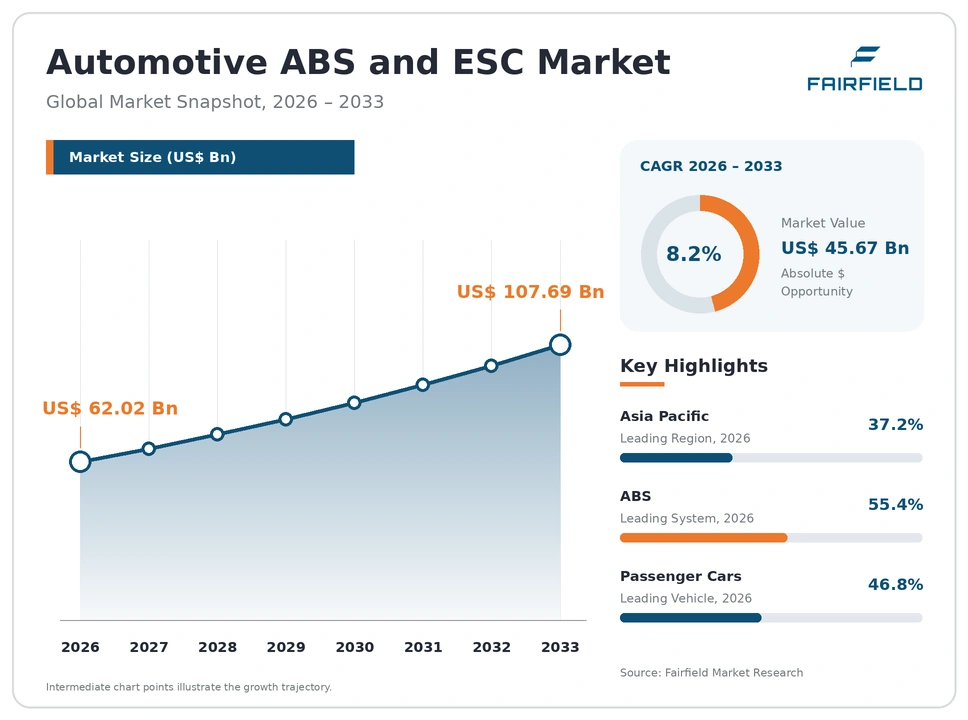
Automotive ABS and ESC Market Size and Trend Analysis
How Fast Is the Automotive ABS and ESC Market Growing?
The global automotive ABS and ESC market size is expected to be valued at US$ 62.02 billion in 2026 and projected to reach US$ 107.69 billion by 2033, growing at a CAGR of 8.2% between 2026 and 2033.
Between 2020 and 2025, the market grew at a CAGR of about 5.6%, as chip shortages and lower vehicle output in 2020 to 2022 were followed by a production recovery and wider safety mandates. Three factors now drive growth: safety regulations that require an anti-lock braking system and electronic stability control in more vehicle classes and countries, rising vehicle production in emerging markets, and the shift to electric vehicles that need integrated brake control. The market is moving toward brake-by-wire systems, software-based stability functions, and tighter links with driver assistance features.
Key Report Takeaways
- By System Type: ABS held 55.4% share in 2026, while ESC is projected to expand at a 9.4% CAGR through 2033, driven by new mandates in emerging markets and integration with driver assistance systems.
- By Vehicle Type: Passenger Cars held 46.8% share in 2026, while Two-wheelers are projected to expand at a 13.6% CAGR through 2033, driven by motorcycle ABS mandates in Asia Pacific.
- By Propulsion: Internal Combustion Engine held 68.7% share in 2026, while Electric is projected to expand at a 15.9% CAGR through 2033, driven by integrated brake systems that support regenerative braking.
- By Region: Asia Pacific held 37.2% share in 2026, while India is projected to expand at an 11.4% CAGR through 2033, driven by two-wheeler ABS rules and rising car safety ratings.
Global Automotive ABS and ESC Market Trends and Insights
Drivers Impact Analysis
Two drivers carry the strongest influence on automotive ABS and ESC demand during the forecast period.
| Driver | Impact on CAGR Forecast | Geographic Relevance | Impact Timeline |
| Safety regulations and crash-test programs | High | Asia Pacific, Latin America, Middle East & Africa | Medium term (2-4 years) |
| Electrification and integrated brake control | High | Asia Pacific, Europe, North America | Long term (≥4 years) |
Safety Regulations Are Driving the Automotive ABS and ESC Market
Safety regulations and crash-test programs are the strongest drivers of the automotive ABS and ESC market. Governments require these systems because they prevent skidding and loss of control, two major causes of fatal crashes.
The mechanism is mandatory fitment and consumer ratings. The United States, the European Union, Japan, and Australia already require electronic stability control on new cars, and many emerging markets are following. India requires ABS on cars and on motorcycles of 125 cc and above, and in June 2025 the Ministry of Road Transport and Highways announced plans to extend ABS to all new two-wheelers. Brazil, Mexico, and Argentina have phased in ESC requirements under regional agreements. Crash-test programs such as Global NCAP, Latin NCAP, and Bharat NCAP require ESC for top star ratings. These rules push ABS and ESC into lower-cost vehicles.
Electrification and Integrated Brake Control Are Expanding the Automotive ABS and ESC Market
Electrification and integrated brake control are expanding the automotive ABS and ESC market. Electric and hybrid vehicles need brake systems that blend regenerative braking with friction braking.
The cause is new vehicle architectures and higher content per vehicle. Integrated brake systems such as Bosch iBooster and ZF Integrated Brake Control combine ABS, ESC, and brake boosting in one unit, replacing vacuum boosters that electric vehicles cannot use. These systems cost more than standalone ABS modules, raising value per vehicle. Driver assistance features such as automatic emergency braking and adaptive cruise control rely on ESC hardware to apply brakes. Automated driving requires redundant braking, which increases demand for backup modules. China, Europe, and North America lead electric vehicle adoption. Brake-by-wire systems are entering production, opening a new generation of brake control.
Restraints Impact Analysis
Two restraints limit how quickly the automotive ABS and ESC market grows.
| Restraint | Impact on CAGR Forecast | Geographic Relevance | Impact Timeline |
| Cost pressure in entry-level vehicles and two-wheelers | High | Asia Pacific, Latin America | Short term (≤2 years) |
| Semiconductor supply risks and market saturation | Medium | North America, Europe | Medium term (2-4 years) |
Cost Pressure in Entry-level Vehicles Slows the Automotive ABS and ESC Market
Cost pressure in entry-level vehicles and two-wheelers slows the automotive ABS and ESC market. In price-sensitive markets, even small cost increases can affect vehicle sales.
The specific causes are thin margins and low vehicle prices. An ABS unit adds significant cost to a low-cost scooter or commuter motorcycle, which can raise prices by several percent. Two-wheeler makers in India have expressed concern that mandatory ABS on all bikes could raise prices and hurt demand, especially in rural markets. Entry-level car buyers in India, Indonesia, and Africa are highly price-sensitive. Suppliers must design low-cost single-channel ABS units to meet these needs, which lowers revenue per unit. Mandates are sometimes delayed to give manufacturers time to adapt. These factors slow adoption in the fastest-growing vehicle segments.
Semiconductor Supply and Market Saturation Restrict the Automotive ABS and ESC Market
Semiconductor supply risks and market saturation restrict the automotive ABS and ESC market. Brake control systems rely on chips and sensors, and mature markets already have full fitment.
The underlying causes are supply chain fragility and limited unit growth in developed regions. The chip shortage of 2021 and 2022 halted vehicle production worldwide and delayed ABS and ESC deliveries. Export restrictions and trade disputes between the United States and China add new supply risks. In North America, Europe, and Japan, almost all new cars already have ESC, so growth depends on vehicle output and higher-value systems rather than new fitment. Vehicle sales in Europe remain below pre-pandemic levels. Tariffs on car parts raise costs for suppliers that ship modules across borders. These factors limit growth in mature markets.
Market Opportunities
Brake-by-wire and Software-defined Vehicles Open a High-value Revenue Pool
Brake-by-wire systems and software-defined vehicles open a high-value revenue pool in the automotive ABS and ESC market. These systems replace hydraulic or mechanical links with electronic control.
Brake suppliers with strong software and electronics skills can capture this opportunity. Electro-hydraulic and electromechanical brakes allow faster response, better integration with regenerative braking, and redundancy for automated driving. In January 2025, ZF announced a contract to supply brake-by-wire and steering systems for nearly 5 million vehicles. Bosch tested its brake-by-wire system on public roads in 2025 ahead of launch. Stability and traction control functions can be updated through software, creating recurring revenue from feature upgrades. Electric vehicle makers in China, Europe, and North America are early customers for these systems.
Two-wheeler ABS in Emerging Markets Creates a Volume Revenue Pool
Two-wheeler ABS in emerging markets creates a volume revenue pool in the automotive ABS and ESC market. Motorcycles and scooters account for a large share of road deaths in Asia Pacific, and governments are acting.
Brake suppliers with low-cost designs can capture this opportunity. India is the world’s largest two-wheeler market, and extending ABS to all new bikes would add millions of units each year. Indonesia, Vietnam, Thailand, and the Philippines have large motorcycle fleets where ABS fitment is rising. Brazil requires ABS or combined braking on new motorcycles. Single-channel ABS units, compact sensors, and local production can lower costs. Bosch, Continental, Nissin, and Indian suppliers such as Endurance Technologies compete for this demand. Suppliers that localize production can win large contracts with Hero MotoCorp, Honda, TVS Motor, and Bajaj Auto.
Segment Analysis
By System Type: ABS Leads While ESC Gains Momentum
ABS held 55.4% share in 2026. The anti-lock braking system is the base brake control function and is fitted to almost all new cars and to a growing share of motorcycles and trucks worldwide. ABS includes wheel speed sensors, a hydraulic modulator, and an electronic control unit. High two-wheeler volumes in Asia Pacific add large unit numbers.
ESC is the fastest-growing system type, expanding at a 9.4% CAGR through 2033. Electronic stability control builds on ABS with yaw and steering sensors and selective braking to prevent skids and rollovers. New mandates and crash-test rules in India, Latin America, and Africa are driving fitment, while integrated systems add value in electric vehicles. ESC also includes traction control and rollover mitigation. For the market, ESC growth raises content and value per vehicle.
By Vehicle Type: Passenger Cars Lead While Two-wheelers Grow Fastest
Passenger Cars held 46.8% share in 2026. Cars account for most ABS and ESC value because nearly all new cars carry both systems, and integrated brake units in electric cars raise content. China, the United States, Japan, India, and Germany are the largest car markets. Light and heavy commercial vehicles form other important segments, with trucks using electronic braking and stability systems from ZF and Knorr-Bremse.
Two-wheelers are the fastest-growing vehicle type, expanding at a 13.6% CAGR through 2033. ABS mandates for motorcycles in India, Indonesia, Brazil, and other markets are expanding fitment, and premium bikes increasingly use cornering ABS and motorcycle stability control. Electric scooters also adopt ABS as they become faster. Bosch pioneered motorcycle ABS and leads this segment. For the market, two-wheeler growth adds large unit volumes in emerging markets.
By Propulsion: Internal Combustion Engine Leads While Electric Grows Fastest
Internal Combustion Engine held 68.7% share in 2026. Petrol and diesel vehicles still make up most global production, especially in India, Latin America, Africa, and Saudi Arabia. Conventional ABS and ESC modules with vacuum brake boosters remain common in these vehicles. Hybrid vehicles form a growing middle segment.
Electric is the fastest-growing propulsion type, expanding at a 15.9% CAGR through 2033. Battery-electric vehicles need integrated brake systems that blend regenerative and friction braking without a vacuum supply. These systems cost more than conventional modules, raising value per vehicle. China leads electric vehicle production, followed by Europe and North America. Bosch, ZF, AUMOVIO, and Hitachi Astemo supply integrated brake controls. For the market, electrification moves value toward higher-content brake systems.
Geography Analysis
North America Advances the Automotive ABS and ESC Market Through Integrated Brakes
North America is a mature automotive ABS and ESC market with full fitment in new light vehicles. The United States has required ESC on new cars and light trucks since the 2012 model year, and the National Highway Traffic Safety Administration requires automatic emergency braking on new light vehicles from 2029, increasing reliance on ESC hardware. Large pickup trucks and SUVs need high-capacity brake systems. Bosch, ZF, and Hitachi Astemo supply major carmakers. Mexico is a major production hub for brake modules. One change shaping the region is the rise of integrated brakes in electric trucks and SUVs.
Europe Drives the Automotive ABS and ESC Market With Safety Regulation
Europe is a mature automotive ABS and ESC market shaped by strict safety rules. The European Union General Safety Regulation requires ESC, automatic emergency braking, and other systems on new vehicles. Germany is home to leading suppliers Bosch, ZF, and AUMOVIO, as well as truck brake makers Knorr-Bremse. Euro NCAP ratings push carmakers to adopt advanced braking and stability functions. Electric vehicle growth increases demand for integrated brake systems and brake-by-wire. Truck makers use electronic braking systems with stability functions. One challenge is weak vehicle sales, which limits unit growth, so suppliers focus on higher-value integrated systems.
Which Region Is Leading the Automotive ABS and ESC Market?
Asia Pacific is leading the automotive ABS and ESC market with a 37.2% share in 2026. China is the world’s largest vehicle producer and leads electric vehicle output, creating strong demand for integrated brake systems. Chinese suppliers are growing quickly as carmakers seek local alternatives. Japan hosts ADVICS, Hitachi Astemo, Denso, and Nissin, while South Korea hosts Hyundai Mobis and HL Mando. Indonesia and Thailand have large motorcycle and car industries with rising safety rules. India is growing fastest, as detailed below. One change shaping the region is rapid two-wheeler ABS adoption across major motorcycle markets.
Which Country Is Growing Fastest in the Automotive ABS and ESC Market?
India is growing fastest in the automotive ABS and ESC market at an 11.4% CAGR through 2033. The country is the world’s largest two-wheeler market, and the government announced plans in 2025 to extend ABS to all new two-wheelers. Bharat NCAP encourages ESC fitment in cars, and more models now offer ESC as standard. Bosch, Continental, and local suppliers such as Endurance Technologies produce ABS units locally. Car production is rising, and buyers increasingly value safety features. Cost pressure from two-wheeler makers remains a challenge. One opportunity is low-cost single-channel ABS for commuter bikes and scooters.
Latin America Expands the Automotive ABS and ESC Market Through Mandates
Latin America is a growing automotive ABS and ESC market driven by safety mandates. Brazil requires ESC on new cars under a phased schedule, and Argentina and Mexico have adopted similar rules. Latin NCAP has pushed carmakers to add ESC to popular models. Brazil also has a large motorcycle market, where ABS or combined braking is required. Bosch and ZF have local production in Brazil. Key barriers include currency swings, low vehicle prices, and economic volatility. Chinese carmakers entering the region bring vehicles with full safety equipment. One opportunity is ESC fitment in entry-level cars and light commercial vehicles.
Middle East & Africa Builds the Automotive ABS and ESC Market Through Imports and Rules
Middle East & Africa is an emerging automotive ABS and ESC market. Saudi Arabia, the United Arab Emirates, and other Gulf countries import vehicles from Asia Pacific, Europe, and North America, most with ABS and ESC fitted. South Africa produces cars for export and follows United Nations vehicle regulations, while Morocco builds vehicles for Europe. Many African markets rely on used imports without ESC. Gulf countries are adopting stricter vehicle standards. Key barriers include weak safety regulation and limited enforcement in many African countries. One opportunity is safety rules for new and imported vehicles.
Competitive Landscape
The automotive ABS and ESC market is highly concentrated. Robert Bosch, ZF Friedrichshafen, AUMOVIO, Hitachi Astemo, and ADVICS hold most passenger vehicle supply, while Hyundai Mobis, HL Mando, Nissin, Knorr-Bremse, and Chinese suppliers compete in specific regions or vehicle types.
Companies compete on system performance, software capability, integration with driver assistance features, cost, and global production footprint. Long development cycles and safety approvals create high barriers to entry, so carmakers tend to stay with proven suppliers. Chinese suppliers are gaining share in electric vehicles by offering lower prices and fast development, while established suppliers focus on brake-by-wire and software.
Strategic moves show how competition is changing. In January 2025, ZF announced a contract to supply brake-by-wire and steering systems for nearly 5 million vehicles. In January 2025, Bosch completed public-road tests of its brake-by-wire system ahead of launch. In September 2025, Continental spun off its automotive business as AUMOVIO, which now includes braking systems. These moves show competition shifting toward brake-by-wire and software-defined chassis systems, where suppliers that combine hardware, software, and redundancy for automated driving gain an edge. Chinese suppliers are also expanding exports of brake control units.
Three themes shape vendor strategy. First, companies are developing brake-by-wire and integrated systems. Second, they are building low-cost ABS for two-wheelers in emerging markets. Third, they are restructuring and spinning off businesses to focus on core technologies and protect margins.
Automotive ABS and ESC Market Industry Leaders
- Robert Bosch
- ZF Friedrichshafen
- AUMOVIO (Continental)
- Hitachi Astemo
- ADVICS
Recent Industry Developments
- September 2025: Continental completed the spin-off and listing of AUMOVIO, including its braking systems business - creates a focused automotive technology supplier.
- June 2025: India’s Ministry of Road Transport and Highways announced plans to make ABS mandatory on all new two-wheelers - would add millions of ABS units a year.
- January 2025: ZF announced a contract for brake-by-wire and steering systems for nearly 5 million vehicles - one of the largest brake-by-wire orders to date.
- January 2025: Bosch tested its brake-by-wire system on public roads to the Arctic Circle - prepares the technology for series launch.
Companies Covered in the Report
- Robert Bosch
- ZF Friedrichshafen
- AUMOVIO (Continental)
- Hitachi Astemo
- ADVICS
- Hyundai Mobis
- HL Mando
- Knorr-Bremse
- Nissin Kogyo
- Brembo
- Haldex
- Endurance Technologies
Automotive ABS and ESC Market Report Scope
This report covers automotive anti-lock braking systems and electronic stability control systems, including sensors, electronic control units, and hydraulic modulators, for passenger cars, commercial vehicles, and two-wheelers powered by combustion, hybrid, and electric drivetrains, sold through OEM and aftermarket channels. It excludes brake pads, discs, calipers, and standalone driver assistance sensors. The base year is 2025, and the forecast period runs from 2026 to 2033. All values are expressed in US$ Billion.
| Segmentation | Coverage |
| System Type | ABS; ESC |
| Vehicle Type | Passenger Cars; Light Commercial Vehicles; Heavy Commercial Vehicles; Two-wheelers |
| Propulsion | Internal Combustion Engine; Hybrid; Electric |
| Regions | North America; Europe; Asia Pacific; Latin America; Middle East & Africa |
Key Questions Answered in the Report
How big is the automotive ABS and ESC market in 2026?
The automotive ABS and ESC market is valued at US$ 62.02 billion in 2026, led by anti-lock braking systems in passenger cars.
What is the automotive ABS and ESC market forecast to 2033?
The market is projected to reach US$ 107.69 billion by 2033, growing at an 8.2% CAGR and adding US$ 45.67 billion.
Which vehicle type is growing fastest in the automotive ABS and ESC market?
Two-wheelers are growing fastest at a 13.6% CAGR through 2033, driven by motorcycle ABS mandates in Asia Pacific and Latin America.
Which country is growing fastest in the automotive ABS and ESC market?
India is growing fastest at an 11.4% CAGR through 2033, driven by two-wheeler ABS plans and rising car safety ratings.
Which region holds the largest automotive ABS and ESC market share?
Asia Pacific holds the largest share at 37.2% in 2026, supported by vehicle production in China, Japan, and India.
1. Executive Summary
1.1. Global Automotive ABS and ESC Market Snapshot
1.2. Future Projections
1.3. Key Report Takeaways
1.4. Regional Snapshot
2. Market Overview
2.1. Market Definition and Report Scope
2.2. Historical Trends 2020–2025
2.3. Market Dynamics
2.3.1. Drivers
2.3.1.1. Safety Regulations Are Driving the Automotive ABS and ESC Market
2.3.1.2. Electrification and Integrated Brake Control Are Expanding the Automotive ABS and ESC Market
2.3.2. Restraints
2.3.2.1. Cost Pressure in Entry-level Vehicles Slows the Automotive ABS and ESC Market
2.3.2.2. Semiconductor Supply and Market Saturation Restrict the Automotive ABS and ESC Market
2.3.3. Market Opportunities
2.3.3.1. Brake-by-wire and Software-defined Vehicles Open a High-value Revenue Pool
2.3.3.2. Two-wheeler ABS in Emerging Markets Creates a Volume Revenue Pool
3. Global Automotive ABS and ESC Market Outlook, 2020-2033
3.1. Global Automotive ABS and ESC Market Outlook, by System Type, Value (US$ Billion), 2020-2033
3.1.1. ABS
3.1.2. ESC
3.2. Global Automotive ABS and ESC Market Outlook, by Vehicle Type, Value (US$ Billion), 2020-2033
3.2.1. Passenger Cars
3.2.2. Light Commercial Vehicles
3.2.3. Heavy Commercial Vehicles
3.2.4. Two-wheelers
3.3. Global Automotive ABS and ESC Market Outlook, by Propulsion, Value (US$ Billion), 2020-2033
3.3.1. Internal Combustion Engine
3.3.2. Hybrid
3.3.3. Electric
3.4. Global Automotive ABS and ESC Market Outlook, by Region, Value (US$ Billion), 2020-2033
3.4.1. North America
3.4.2. Europe
3.4.3. Asia Pacific
3.4.4. Latin America
3.4.5. Middle East & Africa
4. North America Automotive ABS and ESC Market Outlook, 2020-2033
4.1. North America Automotive ABS and ESC Market Outlook, by System Type, Value (US$ Billion), 2020-2033
4.1.1. ABS
4.1.2. ESC
4.2. North America Automotive ABS and ESC Market Outlook, by Vehicle Type, Value (US$ Billion), 2020-2033
4.2.1. Passenger Cars
4.2.2. Light Commercial Vehicles
4.2.3. Heavy Commercial Vehicles
4.2.4. Two-wheelers
4.3. North America Automotive ABS and ESC Market Outlook, by Propulsion, Value (US$ Billion), 2020-2033
4.3.1. Internal Combustion Engine
4.3.2. Hybrid
4.3.3. Electric
4.4. North America Automotive ABS and ESC Market Outlook, by Country, Value (US$ Billion), 2020-2033
4.4.1. United States Automotive ABS and ESC Market Outlook, by System Type, 2020-2033
4.4.2. United States Automotive ABS and ESC Market Outlook, by Vehicle Type, 2020-2033
4.4.3. United States Automotive ABS and ESC Market Outlook, by Propulsion, 2020-2033
4.4.4. Mexico Automotive ABS and ESC Market Outlook, by System Type, 2020-2033
4.4.5. Mexico Automotive ABS and ESC Market Outlook, by Vehicle Type, 2020-2033
4.4.6. Mexico Automotive ABS and ESC Market Outlook, by Propulsion, 2020-2033
5. Europe Automotive ABS and ESC Market Outlook, 2020-2033
5.1. Europe Automotive ABS and ESC Market Outlook, by System Type, Value (US$ Billion), 2020-2033
5.1.1. ABS
5.1.2. ESC
5.2. Europe Automotive ABS and ESC Market Outlook, by Vehicle Type, Value (US$ Billion), 2020-2033
5.2.1. Passenger Cars
5.2.2. Light Commercial Vehicles
5.2.3. Heavy Commercial Vehicles
5.2.4. Two-wheelers
5.3. Europe Automotive ABS and ESC Market Outlook, by Propulsion, Value (US$ Billion), 2020-2033
5.3.1. Internal Combustion Engine
5.3.2. Hybrid
5.3.3. Electric
5.4. Europe Automotive ABS and ESC Market Outlook, by Country, Value (US$ Billion), 2020-2033
5.4.1. Germany Automotive ABS and ESC Market Outlook, by System Type, 2020-2033
5.4.2. Germany Automotive ABS and ESC Market Outlook, by Vehicle Type, 2020-2033
5.4.3. Germany Automotive ABS and ESC Market Outlook, by Propulsion, 2020-2033
6. Asia Pacific Automotive ABS and ESC Market Outlook, 2020-2033
6.1. Asia Pacific Automotive ABS and ESC Market Outlook, by System Type, Value (US$ Billion), 2020-2033
6.1.1. ABS
6.1.2. ESC
6.2. Asia Pacific Automotive ABS and ESC Market Outlook, by Vehicle Type, Value (US$ Billion), 2020-2033
6.2.1. Passenger Cars
6.2.2. Light Commercial Vehicles
6.2.3. Heavy Commercial Vehicles
6.2.4. Two-wheelers
6.3. Asia Pacific Automotive ABS and ESC Market Outlook, by Propulsion, Value (US$ Billion), 2020-2033
6.3.1. Internal Combustion Engine
6.3.2. Hybrid
6.3.3. Electric
6.4. Asia Pacific Automotive ABS and ESC Market Outlook, by Country, Value (US$ Billion), 2020-2033
6.4.1. China Automotive ABS and ESC Market Outlook, by System Type, 2020-2033
6.4.2. China Automotive ABS and ESC Market Outlook, by Vehicle Type, 2020-2033
6.4.3. China Automotive ABS and ESC Market Outlook, by Propulsion, 2020-2033
6.4.4. Japan Automotive ABS and ESC Market Outlook, by System Type, 2020-2033
6.4.5. Japan Automotive ABS and ESC Market Outlook, by Vehicle Type, 2020-2033
6.4.6. Japan Automotive ABS and ESC Market Outlook, by Propulsion, 2020-2033
6.4.7. South Korea Automotive ABS and ESC Market Outlook, by System Type, 2020-2033
6.4.8. South Korea Automotive ABS and ESC Market Outlook, by Vehicle Type, 2020-2033
6.4.9. South Korea Automotive ABS and ESC Market Outlook, by Propulsion, 2020-2033
6.4.10. Indonesia Automotive ABS and ESC Market Outlook, by System Type, 2020-2033
6.4.11. Indonesia Automotive ABS and ESC Market Outlook, by Vehicle Type, 2020-2033
6.4.12. Indonesia Automotive ABS and ESC Market Outlook, by Propulsion, 2020-2033
6.4.13. Thailand Automotive ABS and ESC Market Outlook, by System Type, 2020-2033
6.4.14. Thailand Automotive ABS and ESC Market Outlook, by Vehicle Type, 2020-2033
6.4.15. Thailand Automotive ABS and ESC Market Outlook, by Propulsion, 2020-2033
6.4.16. India Automotive ABS and ESC Market Outlook, by System Type, 2020-2033
6.4.17. India Automotive ABS and ESC Market Outlook, by Vehicle Type, 2020-2033
6.4.18. India Automotive ABS and ESC Market Outlook, by Propulsion, 2020-2033
7. Latin America Automotive ABS and ESC Market Outlook, 2020-2033
7.1. Latin America Automotive ABS and ESC Market Outlook, by System Type, Value (US$ Billion), 2020-2033
7.1.1. ABS
7.1.2. ESC
7.2. Latin America Automotive ABS and ESC Market Outlook, by Vehicle Type, Value (US$ Billion), 2020-2033
7.2.1. Passenger Cars
7.2.2. Light Commercial Vehicles
7.2.3. Heavy Commercial Vehicles
7.2.4. Two-wheelers
7.3. Latin America Automotive ABS and ESC Market Outlook, by Propulsion, Value (US$ Billion), 2020-2033
7.3.1. Internal Combustion Engine
7.3.2. Hybrid
7.3.3. Electric
7.4. Latin America Automotive ABS and ESC Market Outlook, by Country, Value (US$ Billion), 2020-2033
7.4.1. Brazil Automotive ABS and ESC Market Outlook, by System Type, 2020-2033
7.4.2. Brazil Automotive ABS and ESC Market Outlook, by Vehicle Type, 2020-2033
7.4.3. Brazil Automotive ABS and ESC Market Outlook, by Propulsion, 2020-2033
7.4.4. Argentina Automotive ABS and ESC Market Outlook, by System Type, 2020-2033
7.4.5. Argentina Automotive ABS and ESC Market Outlook, by Vehicle Type, 2020-2033
7.4.6. Argentina Automotive ABS and ESC Market Outlook, by Propulsion, 2020-2033
7.4.7. Mexico Automotive ABS and ESC Market Outlook, by System Type, 2020-2033
7.4.8. Mexico Automotive ABS and ESC Market Outlook, by Vehicle Type, 2020-2033
7.4.9. Mexico Automotive ABS and ESC Market Outlook, by Propulsion, 2020-2033
8. Middle East & Africa Automotive ABS and ESC Market Outlook, 2020-2033
8.1. Middle East & Africa Automotive ABS and ESC Market Outlook, by System Type, Value (US$ Billion), 2020-2033
8.1.1. ABS
8.1.2. ESC
8.2. Middle East & Africa Automotive ABS and ESC Market Outlook, by Vehicle Type, Value (US$ Billion), 2020-2033
8.2.1. Passenger Cars
8.2.2. Light Commercial Vehicles
8.2.3. Heavy Commercial Vehicles
8.2.4. Two-wheelers
8.3. Middle East & Africa Automotive ABS and ESC Market Outlook, by Propulsion, Value (US$ Billion), 2020-2033
8.3.1. Internal Combustion Engine
8.3.2. Hybrid
8.3.3. Electric
8.4. Middle East & Africa Automotive ABS and ESC Market Outlook, by Country, Value (US$ Billion), 2020-2033
8.4.1. Saudi Arabia Automotive ABS and ESC Market Outlook, by System Type, 2020-2033
8.4.2. Saudi Arabia Automotive ABS and ESC Market Outlook, by Vehicle Type, 2020-2033
8.4.3. Saudi Arabia Automotive ABS and ESC Market Outlook, by Propulsion, 2020-2033
8.4.4. United Arab Emirates Automotive ABS and ESC Market Outlook, by System Type, 2020-2033
8.4.5. United Arab Emirates Automotive ABS and ESC Market Outlook, by Vehicle Type, 2020-2033
8.4.6. United Arab Emirates Automotive ABS and ESC Market Outlook, by Propulsion, 2020-2033
8.4.7. South Africa Automotive ABS and ESC Market Outlook, by System Type, 2020-2033
8.4.8. South Africa Automotive ABS and ESC Market Outlook, by Vehicle Type, 2020-2033
8.4.9. South Africa Automotive ABS and ESC Market Outlook, by Propulsion, 2020-2033
8.4.10. Morocco Automotive ABS and ESC Market Outlook, by System Type, 2020-2033
8.4.11. Morocco Automotive ABS and ESC Market Outlook, by Vehicle Type, 2020-2033
8.4.12. Morocco Automotive ABS and ESC Market Outlook, by Propulsion, 2020-2033
9. Competitive Landscape
9.1. Market Concentration and Industry Leaders
9.2. Competitive Differentiation
9.3. Strategic Moves and Market Direction
9.4. Recent Industry Developments
9.5. Company Profiles
9.5.1. Robert Bosch
9.5.2. ZF Friedrichshafen
9.5.3. AUMOVIO (Continental)
9.5.4. Hitachi Astemo
9.5.5. ADVICS
9.5.6. Hyundai Mobis
9.5.7. HL Mando
9.5.8. Knorr-Bremse
9.5.9. Nissin Kogyo
9.5.10. Brembo
9.5.11. Haldex
9.5.12. Endurance Technologies
10. Appendix
10.1. Research Methodology
10.2. Report Assumptions
10.3. Acronyms and Abbreviations
| Segmentation | Coverage |
|---|---|
| System Type | ABS; ESC |
| Vehicle Type | Passenger Cars; Light Commercial Vehicles; Heavy Commercial Vehicles; Two-wheelers |
| Propulsion | Internal Combustion Engine; Hybrid; Electric |
| Regions | North America; Europe; Asia Pacific; Latin America; Middle East & Africa |
Our Research Methodology
Considering the volatility of business today, traditional approaches to strategizing a game plan can be unfruitful if not detrimental. True ambiguity is no way to determine a forecast. A myriad of predetermined factors must be accounted for such as the degree of risk involved, the magnitude of circumstances, as well as conditions or consequences that are not known or unpredictable. To circumvent binary views that cast uncertainty, the application of market research intelligence to strategically posture, move, and enable actionable outcomes is necessary.
View Methodology
Quality Assured
Rigorous Validation Process

Confidentiality Assured
End-to-end Data Security

Custom Research Services
Tailored To Your Objectives
FAQs
The automotive ABS and ESC market is valued at US$ 62.02 billion in 2026, led by anti-lock braking systems in passenger cars.
The market is projected to reach US$ 107.69 billion by 2033, growing at an 8.2% CAGR and adding US$ 45.67 billion.
Two-wheelers are growing fastest at a 13.6% CAGR through 2033, driven by motorcycle ABS mandates in Asia Pacific and Latin America.
India is growing fastest at an 11.4% CAGR through 2033, driven by two-wheeler ABS plans and rising car safety ratings.
Asia Pacific holds the largest share at 37.2% in 2026, supported by vehicle production in China, Japan, and India.
Related Reports
Smart Oil Dipstick Market Size, Share, Insights, Competitive Landscape, and Forecast 2026 to 2033
Smart Oil Dipstick Market is projected to rise from US$ 4.03 billion in 2026 to US$ 13.02 billion by 2033 at an 18.2% CAGR. Explore key uses and trends.
Rail Glazing Market Size, Share, Insights, Competitive Landscape, and Forecast 2026 to 2033
Rail Glazing Market is projected to grow from US$ 2.37 billion in 2026 to US$ 3.56 billion by 2033 at a 6.0% CAGR. Explore materials and applications.
Passenger Vehicle ADAS Market Size, Share, Insights, Competitive Landscape, and Forecast 2026 to 2033
Passenger Vehicle ADAS Market is set to grow from US$ 36.7 billion in 2026 to US$ 115.5 billion by 2033 at a 17.8% CAGR. Explore sensors and trends.
Container Fleet Market Size, Share, Insights, Competitive Landscape, and Forecast 2026 to 2033
Explore the container fleet market, projected to reach US$ 26.8 billion by 2033 at a 5.4% CAGR, with container types, ownership and regional insights.
Micro-mobility Charging Infrastructure Market Size, Share, Insights, Competitive Landscape, and Forecast 2026 to 2033
The global micro-mobility charging infrastructure market is valued at US$9.06 billion in 2026, reaching US$34.02 billion by 2033, growing at a 20.8% CAGR
eCTOL Aircraft Market Size, Share, Insights, Competitive Landscape, and Forecast 2026 to 2033
Explore the eCTOL aircraft market, projected to reach US$ 11.14 billion by 2033 at a 10.6% CAGR, with propulsion, application and regional insights.