



Baby Food Packaging Market
Baby Food Packaging Market Size, Share, Insights, Competitive Landscape, and Forecast 2026 to 2033
Baby Food Packaging Market Analysis, 2026–2033
Baby Food Packaging Market Size and Trend Analysis
How Fast Is the Baby Food Packaging Market Growing?
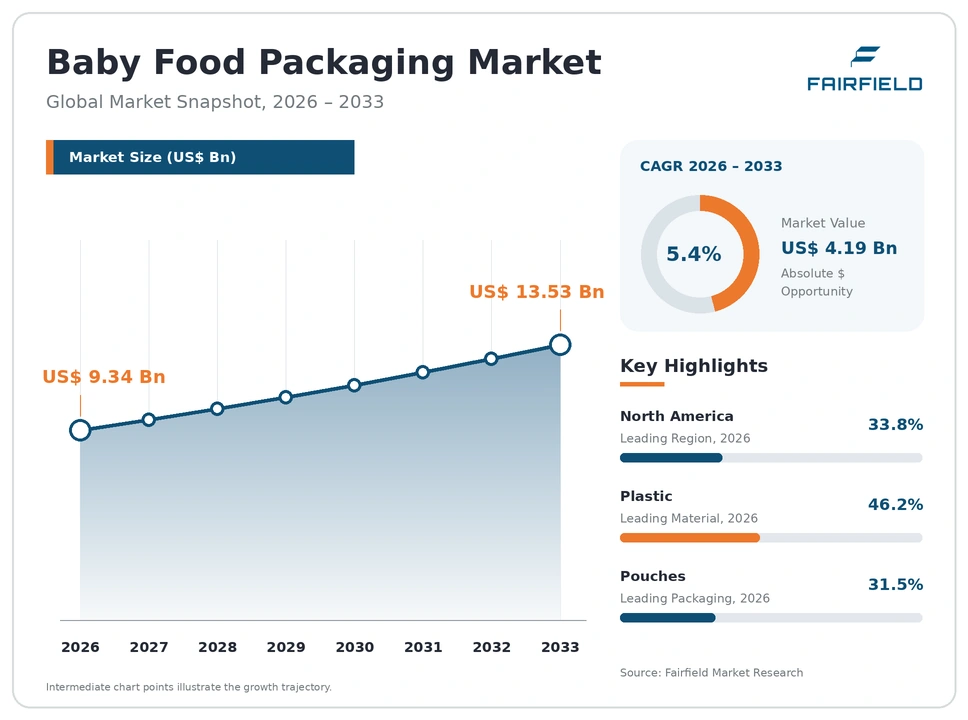
The global baby food packaging market size is expected to be valued at US$ 9.34 billion in 2026 and projected to reach US$ 13.53 billion by 2033, growing at a CAGR of 5.4% between 2026 and 2033.
Between 2020 and 2025, the market grew at a CAGR of about 4.6%, supported by rising demand for convenient baby food and infant formula, while the 2022 U.S. formula shortage highlighted the importance of secure, safe packaging supply. Three factors now drive growth: urbanization and more working parents choosing ready-to-eat baby food, stricter food safety expectations for infant products, and a shift to recyclable and lightweight formats. The market is moving from glass jars and multi-layer pouches toward spouted pouches made from recyclable mono-materials, paper-based cartons, and single-serve formats. Premium organic brands and e-commerce are reshaping pack sizes and designs.
Key Report Takeaways
- By Material: Plastic held 46.2% share in 2026, while Paper & Paperboard is projected to expand at a 7.6% CAGR through 2033, driven by brand sustainability goals and recyclable carton formats.
- By Packaging Type: Pouches held 31.5% share in 2026, while Sachets & Stick Packs are projected to expand at a 7.1% CAGR through 2033, driven by single-serve formula and travel convenience.
- By Product: Prepared Baby Food held 37.6% share in 2026, while Baby Snacks are projected to expand at a 7.4% CAGR through 2033, driven by finger foods and toddler snacking.
- By Closure Type: Screw Caps held 38.5% share in 2026, while Spouts & Fitments are projected to expand at a 7.3% CAGR through 2033, driven by squeezable pouches and child-safe, recyclable closure designs.
- By Region: North America held 33.8% share in 2026, while Asia Pacific is projected to expand at a 6.9% CAGR through 2033, driven by rising incomes and infant formula demand in China, India, and Indonesia.
Global Baby Food Packaging Market Trends and Insights
Drivers Impact Analysis
Two drivers carry the strongest influence on baby food packaging demand during the forecast period.
| Driver | Impact on CAGR Forecast | Geographic Relevance | Impact Timeline |
| Convenience demand from working parents and urbanization | High | Asia Pacific, North America, Latin America | Long term (≥4 years) |
| Stricter food safety and quality requirements | High | North America, Europe, Asia Pacific | Medium term (2-4 years) |
Convenience Demand Is Driving Baby Food Packaging Growth
Convenience demand from working parents is the strongest driver of baby food packaging growth. Busy families increasingly buy ready-to-eat purees, snacks, and formula in packaging that is easy to open, carry, and serve.
The mechanism is urbanization and rising female workforce participation. Parents have less time to prepare homemade baby food, so they choose packaged products that offer safety and nutrition on the go. Squeezable spouted pouches let toddlers eat without spoons, while single-serve formula sticks and ready-to-feed bottles simplify travel. Brands such as Gerber, owned by Nestlé, Danone, Kraft Heinz, and Hain Celestial’s Earth’s Best offer wide ranges of pouches and jars. Online grocery and subscription services increase demand for durable, lightweight packaging. In emerging markets, growing middle classes are switching from traditional homemade food to packaged products, adding new demand.
Food Safety Requirements Are Expanding Premium Baby Food Packaging
Stricter food safety and quality requirements are expanding demand for premium baby food packaging. Infants are especially vulnerable to contamination, so packaging must protect products from bacteria, oxygen, moisture, and chemical migration.
The cause is stronger regulation and public scrutiny. In March 2025, the U.S. Department of Health and Human Services and the Food and Drug Administration launched Operation Stork Speed to strengthen infant formula oversight, including increased testing for contaminants and spore-forming bacteria. The 2022 formula shortage and recalls raised attention on supply security and safe packaging. Regulators in the European Union and China apply strict food contact material rules. Packaging must provide tamper evidence, high barrier protection, and safe materials free of harmful substances. Infant formula packaging in metal cans and multi-layer containers ensures long shelf life, while aseptic processing supports liquid products.
Restraints Impact Analysis
Two restraints limit how quickly baby food packaging grows.
| Restraint | Impact on CAGR Forecast | Geographic Relevance | Impact Timeline |
| Recyclability challenges of multi-layer pouches | Medium | Europe, North America | Medium term (2-4 years) |
| Declining birth rates in major markets | Medium | Europe, Asia Pacific, North America | Long term (≥4 years) |
Multi-layer Pouch Recyclability Challenges Limit Baby Food Packaging Growth
Recyclability challenges of multi-layer pouches limit baby food packaging growth and raise compliance costs. Many pouches combine plastics, aluminum foil, or metallized layers that are hard to separate and recycle.
The specific causes are barrier needs and recycling infrastructure gaps. Baby food requires strong protection against oxygen and moisture, which traditionally came from foil or multiple film layers. These structures are rarely accepted in curbside recycling. The European Union Packaging and Packaging Waste Regulation, in force from February 2025, requires packaging to be recyclable and sets recycled content targets. Extended producer responsibility fees in Europe and several U.S. states charge more for hard-to-recycle packaging. Redesigning pouches with mono-materials while maintaining shelf life, heat resistance, and food safety requires new films, testing, and equipment investment, raising costs for brands and converters.
Declining Birth Rates Constrain Baby Food Packaging Volumes
Declining birth rates constrain baby food packaging volumes in many major markets. Fewer babies mean fewer potential consumers of baby food and infant formula.
The underlying cause is demographic change. Birth rates have fallen to record lows in China, Japan, South Korea, Italy, and other countries, and fertility in the United States and much of Europe is below replacement level. China’s births have declined sharply since the mid-2010s, reducing demand for infant formula, one of the largest segments for baby food packaging. Some parents also prefer homemade food or breastfeeding for longer periods, supported by health organizations. As a result, growth depends more on premiumization, higher spending per child, and expansion into toddler foods and emerging markets than on volume growth from rising births.
Market Opportunities
Recyclable Mono-material Pouches Open a Sustainable Baby Food Packaging Revenue Pool
Recyclable mono-material pouches open a sustainable revenue pool in the baby food packaging market. Brands want pouches that keep convenience and shelf life while meeting recycling rules.
Converters with advanced film and lamination technology can capture this demand. All-polyethylene and all-polypropylene structures remove foil and mixed layers, making pouches easier to recycle. In March 2024, Amcor, Stonyfield Organic, and Cheer Pack North America launched an all-polyethylene spouted pouch for YoBaby yogurt, replacing a multi-laminate structure. Earlier, Heinz introduced a recyclable polypropylene baby food pouch in the United Kingdom. Baby food brands, private-label retailers, and organic producers are the main customers. Mono-material packaging helps brands meet extended producer responsibility rules and consumer expectations, supporting premium pricing for compliant, certified materials.
Paper-based and Refillable Formats Create a Premium Eco-packaging Revenue Pool
Paper-based and refillable formats create a premium eco-packaging revenue pool for baby food packaging. Parents increasingly prefer packaging they see as natural, safe, and sustainable.
Carton makers and innovative packaging firms can capture this opportunity. Paper-based cartons with thin barrier layers can hold purees, cereals, and liquid formula. In September 2024, Tetra Pak developed a paper-based baby food packaging solution using renewable materials. Refill packs for formula powder reduce plastic tub use, while glass jars appeal to parents seeking plastic-free options. Organic and premium brands use eco-friendly packaging to differentiate on shelves and online. Retailers in Europe and North America actively promote sustainable baby products in stores and online. These formats command higher prices, strengthen brand loyalty, and help brands meet retailer sustainability scorecards.
Segment Analysis
By Material: Plastic Leads While Paper & Paperboard Gains Momentum
Plastic held 46.2% share in 2026. Flexible pouches, formula tubs, bottles, cups, and lids rely on plastics such as polyethylene, polypropylene, and PET because they are lightweight, shatterproof, and provide good barrier performance at relatively low cost.
Paper & Paperboard is the fastest-growing material, expanding at a 7.6% CAGR through 2033. Cartons, paper-based cups, and paperboard canisters for formula and cereals appeal strongly to parents seeking sustainable options. New barrier coatings allow paper packaging to protect sensitive foods. Packaging regulations in Europe favor recyclable fiber-based materials. Glass and metal remain important for jars and powdered formula cans. For the market, paper growth supports brand sustainability claims and creates new opportunities for carton and fiber packaging suppliers.
By Packaging Type: Pouches Lead While Sachets & Stick Packs Grow Fastest
Pouches held 31.5% share in 2026. Spouted pouches have become the most popular format for fruit and vegetable purees because they are portable, lightweight, and easy for toddlers to use. They also reduce shipping weight compared with glass.
Sachets & Stick Packs are the fastest-growing packaging type, expanding at a 7.1% CAGR through 2033. Single-serve formula sticks and cereal sachets provide accurate portions, hygiene, and convenience for travel, daycare, and night feeds. They also allow lower-priced entry packs and trial sizes in emerging markets. Jars, cans, bottles, and cartons remain important for purees, formula, and liquid products. For the market, single-serve growth increases the number of packs per volume of food and supports flexible packaging suppliers.
By Product: Prepared Baby Food Leads While Baby Snacks Grow Fastest
Prepared Baby Food held 37.6% share in 2026. Purees, meals, and cereals for infants are sold in pouches, jars, and trays, and represent a large share of packaging demand in North America and Europe.
Baby Snacks are the fastest-growing product, expanding at a 7.4% CAGR through 2033. Puffs, melts, yogurt bites, teething biscuits, and finger foods support self-feeding and are popular with toddlers. Resealable pouches, canisters, and single-serve packs keep snacks fresh. Brands are expanding snack ranges with organic, low-sugar, and allergen-friendly options. Infant formula, cereals, and liquid products remain major categories by packaging value. For the market, snack growth extends packaging demand to older toddlers and supports resealable and portion-controlled formats.
By Closure Type: Screw Caps Lead While Spouts & Fitments Grow Fastest
Screw Caps held 38.5% share in 2026. Jars, bottles, and formula tubs use screw caps and snap lids that provide tight seals, tamper evidence, and easy reclosing for multi-serve products. Suppliers such as AptarGroup and Silgan produce closures designed to meet strict food contact rules.
Spouts & Fitments are the fastest-growing closure type, expanding at a 7.3% CAGR through 2033. Growth in squeezable pouches increases demand for spouts with large caps that reduce choking risk for toddlers. New designs use the same plastic as the pouch, improving recyclability. Tethered caps, required on many beverage containers in Europe, are influencing closure design. Heat seals and peel lids remain common for cups and trays. For the market, spout growth supports innovation in safe, recyclable fitments.
Geography Analysis
Which Region Is Leading the Baby Food Packaging Market?
North America is leading the baby food packaging market with a 33.8% share in 2026. The United States has high consumption of packaged baby food and formula, strong brands such as Gerber, Similac, and Enfamil, and widespread use of pouches. The FDA’s Operation Stork Speed is strengthening oversight of infant formula. Retailers and e-commerce platforms such as Amazon drive demand for durable packaging. Several states have extended producer responsibility laws for packaging. Canada adds demand for organic products and recyclable packaging under provincial producer responsibility programs. One change shaping the region is the shift to recyclable pouches.
Europe Drives Sustainable Baby Food Packaging Innovation
Europe is a major baby food packaging market and a leader in sustainable packaging innovation. Germany, the United Kingdom, France, and Italy have strong demand for organic and premium baby food. Brands such as HiPP, Ella’s Kitchen, and Danone are adopting recyclable materials. The Packaging and Packaging Waste Regulation sets strict recyclability and recycled content requirements. Packaging makers such as Mondi, Constantia Flexibles, and Huhtamaki develop mono-material solutions. Low birth rates limit volume growth, but spending per child on organic products remains high. One opportunity is paper-based and fully recyclable pouches.
Which Region Is Growing Fastest in the Baby Food Packaging Market?
Asia Pacific is growing fastest in the baby food packaging market at a 6.9% CAGR through 2033. China is the world’s largest infant formula market, with demand for premium, imported, and safety-assured products packaged in high-barrier cans. India and Indonesia have large young populations and growing middle classes switching to packaged baby food. Online sales through platforms such as Tmall and Flipkart increase demand. Falling birth rates in China and Japan are a challenge, pushing brands toward premium, high-value products. Vietnam and the Philippines add growing demand. One opportunity is affordable single-serve formats for emerging markets.
Latin America Expands Baby Food Packaging Through Urbanization
Latin America is an emerging baby food packaging market where urbanization and rising incomes drive demand. Brazil and Mexico have large young populations and growing sales of packaged baby food and formula. Multinationals such as Nestlé and Danone have strong local manufacturing and distribution operations. Colombia, Peru, and Chile add demand through modern retail growth and expanding pharmacy chains that sell infant formula. Local converters supply pouches and sachets. Key barriers include price sensitivity, economic volatility, informal retail, and limited recycling infrastructure. One opportunity is affordable pouches and sachets suited to lower-income consumers in fast-growing cities.
Middle East & Africa Grows Baby Food Packaging Demand With Young Populations
Middle East & Africa is a developing baby food packaging market with young, growing populations. Saudi Arabia, the United Arab Emirates, and Egypt have rising demand for imported, organic, and premium baby food and formula. In Africa, Nigeria, Kenya, Ethiopia, and South Africa have high birth rates and growing urban middle classes. Key barriers include low purchasing power, limited cold chains, and reliance on imports. Humanitarian nutrition programs also buy packaged fortified foods for infants in several countries. One opportunity is local packaging production for fortified infant foods and formula to reduce import costs.
Competitive Landscape
The baby food packaging market is moderately concentrated. Amcor, which acquired Berry Global in 2025, Tetra Pak, Mondi, Huhtamaki, Ardagh Group, Sonoco, Constantia Flexibles, and Silgan supply pouches, cartons, cans, jars, and closures to major baby food brands. Specialist firms such as Cheer Pack focus on spouted pouches and fitments, while SIG and Tetra Pak supply aseptic cartons.
Packaging suppliers mainly compete on food safety, barrier performance, recyclability, design convenience, supply reliability, and cost. Baby food brands require strict quality certifications and long qualification processes, creating stable, multi-year supplier relationships. Sustainability innovation has become a key differentiator as regulations tighten. Converters invest in high-speed pouch filling lines and spout insertion technology, while glass and metal suppliers emphasize recyclability and product safety. Private-label baby food from large retailers increases price pressure on packaging suppliers.
Strategic moves show clearly how competition is changing. In March 2024, Amcor, Stonyfield Organic, and Cheer Pack North America launched an all-polyethylene spouted pouch. In September 2024, Tetra Pak developed a paper-based baby food package. In April 2025, Amcor completed its acquisition of Berry Global, creating a larger supplier of flexible and rigid packaging. These moves show competition shifting toward recyclable materials and scale.
Three themes shape vendor strategy. First, companies are developing mono-material and paper-based packaging. Second, they are consolidating to gain scale. Third, they are improving safety, tamper evidence, and convenience features for parents.
Baby Food Packaging Market Industry Leaders
- Amcor
- Tetra Pak
- Mondi
- Huhtamaki
- Ardagh Group
Recent Industry Developments
- April 2025: Amcor completed its acquisition of Berry Global - expands flexible and rigid packaging capacity for baby food brands.
- March 2025: HHS and the FDA launched Operation Stork Speed - raises safety and testing standards for infant formula.
- September 2024: Tetra Pak developed a paper-based baby food packaging solution - supports renewable materials.
- March 2024: Amcor, Stonyfield Organic, and Cheer Pack launched an all-polyethylene spouted pouch - improves recyclability of baby food pouches.
Companies Covered in the Report
- Amcor
- Tetra Pak
- Mondi
- Huhtamaki
- Ardagh Group
- Sonoco
- Constantia Flexibles
- Silgan
- Cheer Pack
- Winpak
- AptarGroup
- O-I Glass
Baby Food Packaging Market Report Scope
This report covers packaging for baby food and infant formula, including pouches, jars, cans, cartons, bottles, sachets, and stick packs made from plastic, paper and paperboard, glass, and metal, used for prepared baby food, infant formula, cereals, and snacks. It excludes baby care packaging for non-food products and feeding bottles. The base year is 2025, and the forecast period runs from 2026 to 2033. All values are expressed in US$ Billion.
| Segmentation | Coverage |
| Material | Plastic; Paper & Paperboard; Glass; Metal |
| Packaging Type | Pouches; Jars; Cans; Cartons; Bottles; Sachets & Stick Packs |
| Product | Prepared Baby Food; Infant Formula; Baby Cereals; Baby Snacks |
| Closure Type | Screw Caps; Spouts & Fitments; Heat Seals & Peel Lids |
| Regions | North America; Europe; Asia Pacific; Latin America; Middle East & Africa |
Key Questions Answered in the Report
How big is the baby food packaging market in 2026?
The baby food packaging market is valued at US$ 9.34 billion in 2026, led by plastic packaging such as spouted pouches.
What is the baby food packaging market forecast to 2033?
The market is projected to reach US$ 13.53 billion by 2033, growing at a 5.4% CAGR and adding US$ 4.19 billion.
Which material is growing fastest in baby food packaging?
Paper & Paperboard is growing fastest at a 7.6% CAGR through 2033, driven by sustainability goals and recyclable carton formats.
Which region is growing fastest in the baby food packaging market?
Asia Pacific is growing fastest at a 6.9% CAGR through 2033, driven by infant formula demand in China, India, and Indonesia.
Which region holds the largest baby food packaging market share?
North America holds the largest share at 33.8% in 2026, supported by high packaged baby food consumption and strong brands.
1. Executive Summary
1.1. Global Baby Food Packaging Market Snapshot
1.2. Future Projections
1.3. Key Report Takeaways
1.4. Regional Snapshot
2. Market Overview
2.1. Market Definition and Report Scope
2.2. Historical Trends 2020–2025
2.3. Market Dynamics
2.3.1. Drivers
2.3.1.1. Convenience Demand Is Driving Baby Food Packaging Growth
2.3.1.2. Food Safety Requirements Are Expanding Premium Baby Food Packaging
2.3.2. Restraints
2.3.2.1. Multi-layer Pouch Recyclability Challenges Limit Baby Food Packaging Growth
2.3.2.2. Declining Birth Rates Constrain Baby Food Packaging Volumes
2.3.3. Market Opportunities
2.3.3.1. Recyclable Mono-material Pouches Open a Sustainable Baby Food Packaging Revenue Pool
2.3.3.2. Paper-based and Refillable Formats Create a Premium Eco-packaging Revenue Pool
3. Global Baby Food Packaging Market Outlook, 2020-2033
3.1. Global Baby Food Packaging Market Outlook, by Material, Value (US$ Billion), 2020-2033
3.1.1. Plastic
3.1.2. Paper & Paperboard
3.1.3. Glass
3.1.4. Metal
3.2. Global Baby Food Packaging Market Outlook, by Packaging Type, Value (US$ Billion), 2020-2033
3.2.1. Pouches
3.2.2. Jars
3.2.3. Cans
3.2.4. Cartons
3.2.5. Bottles
3.2.6. Sachets & Stick Packs
3.3. Global Baby Food Packaging Market Outlook, by Product, Value (US$ Billion), 2020-2033
3.3.1. Prepared Baby Food
3.3.2. Infant Formula
3.3.3. Baby Cereals
3.3.4. Baby Snacks
3.4. Global Baby Food Packaging Market Outlook, by Closure Type, Value (US$ Billion), 2020-2033
3.4.1. Screw Caps
3.4.2. Spouts & Fitments
3.4.3. Heat Seals & Peel Lids
3.5. Global Baby Food Packaging Market Outlook, by Region, Value (US$ Billion), 2020-2033
3.5.1. North America
3.5.2. Europe
3.5.3. Asia Pacific
3.5.4. Latin America
3.5.5. Middle East & Africa
4. North America Baby Food Packaging Market Outlook, 2020-2033
4.1. North America Baby Food Packaging Market Outlook, by Material, Value (US$ Billion), 2020-2033
4.1.1. Plastic
4.1.2. Paper & Paperboard
4.1.3. Glass
4.1.4. Metal
4.2. North America Baby Food Packaging Market Outlook, by Packaging Type, Value (US$ Billion), 2020-2033
4.2.1. Pouches
4.2.2. Jars
4.2.3. Cans
4.2.4. Cartons
4.2.5. Bottles
4.2.6. Sachets & Stick Packs
4.3. North America Baby Food Packaging Market Outlook, by Product, Value (US$ Billion), 2020-2033
4.3.1. Prepared Baby Food
4.3.2. Infant Formula
4.3.3. Baby Cereals
4.3.4. Baby Snacks
4.4. North America Baby Food Packaging Market Outlook, by Closure Type, Value (US$ Billion), 2020-2033
4.4.1. Screw Caps
4.4.2. Spouts & Fitments
4.4.3. Heat Seals & Peel Lids
4.5. North America Baby Food Packaging Market Outlook, by Country, Value (US$ Billion), 2020-2033
4.5.1. United States Baby Food Packaging Market Outlook, by Material, 2020-2033
4.5.2. United States Baby Food Packaging Market Outlook, by Packaging Type, 2020-2033
4.5.3. United States Baby Food Packaging Market Outlook, by Product, 2020-2033
4.5.4. United States Baby Food Packaging Market Outlook, by Closure Type, 2020-2033
4.5.5. Canada Baby Food Packaging Market Outlook, by Material, 2020-2033
4.5.6. Canada Baby Food Packaging Market Outlook, by Packaging Type, 2020-2033
4.5.7. Canada Baby Food Packaging Market Outlook, by Product, 2020-2033
4.5.8. Canada Baby Food Packaging Market Outlook, by Closure Type, 2020-2033
5. Europe Baby Food Packaging Market Outlook, 2020-2033
5.1. Europe Baby Food Packaging Market Outlook, by Material, Value (US$ Billion), 2020-2033
5.1.1. Plastic
5.1.2. Paper & Paperboard
5.1.3. Glass
5.1.4. Metal
5.2. Europe Baby Food Packaging Market Outlook, by Packaging Type, Value (US$ Billion), 2020-2033
5.2.1. Pouches
5.2.2. Jars
5.2.3. Cans
5.2.4. Cartons
5.2.5. Bottles
5.2.6. Sachets & Stick Packs
5.3. Europe Baby Food Packaging Market Outlook, by Product, Value (US$ Billion), 2020-2033
5.3.1. Prepared Baby Food
5.3.2. Infant Formula
5.3.3. Baby Cereals
5.3.4. Baby Snacks
5.4. Europe Baby Food Packaging Market Outlook, by Closure Type, Value (US$ Billion), 2020-2033
5.4.1. Screw Caps
5.4.2. Spouts & Fitments
5.4.3. Heat Seals & Peel Lids
5.5. Europe Baby Food Packaging Market Outlook, by Country, Value (US$ Billion), 2020-2033
5.5.1. Germany Baby Food Packaging Market Outlook, by Material, 2020-2033
5.5.2. Germany Baby Food Packaging Market Outlook, by Packaging Type, 2020-2033
5.5.3. Germany Baby Food Packaging Market Outlook, by Product, 2020-2033
5.5.4. Germany Baby Food Packaging Market Outlook, by Closure Type, 2020-2033
5.5.5. United Kingdom Baby Food Packaging Market Outlook, by Material, 2020-2033
5.5.6. United Kingdom Baby Food Packaging Market Outlook, by Packaging Type, 2020-2033
5.5.7. United Kingdom Baby Food Packaging Market Outlook, by Product, 2020-2033
5.5.8. United Kingdom Baby Food Packaging Market Outlook, by Closure Type, 2020-2033
5.5.9. France Baby Food Packaging Market Outlook, by Material, 2020-2033
5.5.10. France Baby Food Packaging Market Outlook, by Packaging Type, 2020-2033
5.5.11. France Baby Food Packaging Market Outlook, by Product, 2020-2033
5.5.12. France Baby Food Packaging Market Outlook, by Closure Type, 2020-2033
5.5.13. Italy Baby Food Packaging Market Outlook, by Material, 2020-2033
5.5.14. Italy Baby Food Packaging Market Outlook, by Packaging Type, 2020-2033
5.5.15. Italy Baby Food Packaging Market Outlook, by Product, 2020-2033
5.5.16. Italy Baby Food Packaging Market Outlook, by Closure Type, 2020-2033
6. Asia Pacific Baby Food Packaging Market Outlook, 2020-2033
6.1. Asia Pacific Baby Food Packaging Market Outlook, by Material, Value (US$ Billion), 2020-2033
6.1.1. Plastic
6.1.2. Paper & Paperboard
6.1.3. Glass
6.1.4. Metal
6.2. Asia Pacific Baby Food Packaging Market Outlook, by Packaging Type, Value (US$ Billion), 2020-2033
6.2.1. Pouches
6.2.2. Jars
6.2.3. Cans
6.2.4. Cartons
6.2.5. Bottles
6.2.6. Sachets & Stick Packs
6.3. Asia Pacific Baby Food Packaging Market Outlook, by Product, Value (US$ Billion), 2020-2033
6.3.1. Prepared Baby Food
6.3.2. Infant Formula
6.3.3. Baby Cereals
6.3.4. Baby Snacks
6.4. Asia Pacific Baby Food Packaging Market Outlook, by Closure Type, Value (US$ Billion), 2020-2033
6.4.1. Screw Caps
6.4.2. Spouts & Fitments
6.4.3. Heat Seals & Peel Lids
6.5. Asia Pacific Baby Food Packaging Market Outlook, by Country, Value (US$ Billion), 2020-2033
6.5.1. China Baby Food Packaging Market Outlook, by Material, 2020-2033
6.5.2. China Baby Food Packaging Market Outlook, by Packaging Type, 2020-2033
6.5.3. China Baby Food Packaging Market Outlook, by Product, 2020-2033
6.5.4. China Baby Food Packaging Market Outlook, by Closure Type, 2020-2033
6.5.5. India Baby Food Packaging Market Outlook, by Material, 2020-2033
6.5.6. India Baby Food Packaging Market Outlook, by Packaging Type, 2020-2033
6.5.7. India Baby Food Packaging Market Outlook, by Product, 2020-2033
6.5.8. India Baby Food Packaging Market Outlook, by Closure Type, 2020-2033
6.5.9. Indonesia Baby Food Packaging Market Outlook, by Material, 2020-2033
6.5.10. Indonesia Baby Food Packaging Market Outlook, by Packaging Type, 2020-2033
6.5.11. Indonesia Baby Food Packaging Market Outlook, by Product, 2020-2033
6.5.12. Indonesia Baby Food Packaging Market Outlook, by Closure Type, 2020-2033
6.5.13. Japan Baby Food Packaging Market Outlook, by Material, 2020-2033
6.5.14. Japan Baby Food Packaging Market Outlook, by Packaging Type, 2020-2033
6.5.15. Japan Baby Food Packaging Market Outlook, by Product, 2020-2033
6.5.16. Japan Baby Food Packaging Market Outlook, by Closure Type, 2020-2033
6.5.17. Vietnam Baby Food Packaging Market Outlook, by Material, 2020-2033
6.5.18. Vietnam Baby Food Packaging Market Outlook, by Packaging Type, 2020-2033
6.5.19. Vietnam Baby Food Packaging Market Outlook, by Product, 2020-2033
6.5.20. Vietnam Baby Food Packaging Market Outlook, by Closure Type, 2020-2033
6.5.21. Philippines Baby Food Packaging Market Outlook, by Material, 2020-2033
6.5.22. Philippines Baby Food Packaging Market Outlook, by Packaging Type, 2020-2033
6.5.23. Philippines Baby Food Packaging Market Outlook, by Product, 2020-2033
6.5.24. Philippines Baby Food Packaging Market Outlook, by Closure Type, 2020-2033
7. Latin America Baby Food Packaging Market Outlook, 2020-2033
7.1. Latin America Baby Food Packaging Market Outlook, by Material, Value (US$ Billion), 2020-2033
7.1.1. Plastic
7.1.2. Paper & Paperboard
7.1.3. Glass
7.1.4. Metal
7.2. Latin America Baby Food Packaging Market Outlook, by Packaging Type, Value (US$ Billion), 2020-2033
7.2.1. Pouches
7.2.2. Jars
7.2.3. Cans
7.2.4. Cartons
7.2.5. Bottles
7.2.6. Sachets & Stick Packs
7.3. Latin America Baby Food Packaging Market Outlook, by Product, Value (US$ Billion), 2020-2033
7.3.1. Prepared Baby Food
7.3.2. Infant Formula
7.3.3. Baby Cereals
7.3.4. Baby Snacks
7.4. Latin America Baby Food Packaging Market Outlook, by Closure Type, Value (US$ Billion), 2020-2033
7.4.1. Screw Caps
7.4.2. Spouts & Fitments
7.4.3. Heat Seals & Peel Lids
7.5. Latin America Baby Food Packaging Market Outlook, by Country, Value (US$ Billion), 2020-2033
7.5.1. Brazil Baby Food Packaging Market Outlook, by Material, 2020-2033
7.5.2. Brazil Baby Food Packaging Market Outlook, by Packaging Type, 2020-2033
7.5.3. Brazil Baby Food Packaging Market Outlook, by Product, 2020-2033
7.5.4. Brazil Baby Food Packaging Market Outlook, by Closure Type, 2020-2033
7.5.5. Mexico Baby Food Packaging Market Outlook, by Material, 2020-2033
7.5.6. Mexico Baby Food Packaging Market Outlook, by Packaging Type, 2020-2033
7.5.7. Mexico Baby Food Packaging Market Outlook, by Product, 2020-2033
7.5.8. Mexico Baby Food Packaging Market Outlook, by Closure Type, 2020-2033
7.5.9. Colombia Baby Food Packaging Market Outlook, by Material, 2020-2033
7.5.10. Colombia Baby Food Packaging Market Outlook, by Packaging Type, 2020-2033
7.5.11. Colombia Baby Food Packaging Market Outlook, by Product, 2020-2033
7.5.12. Colombia Baby Food Packaging Market Outlook, by Closure Type, 2020-2033
7.5.13. Peru Baby Food Packaging Market Outlook, by Material, 2020-2033
7.5.14. Peru Baby Food Packaging Market Outlook, by Packaging Type, 2020-2033
7.5.15. Peru Baby Food Packaging Market Outlook, by Product, 2020-2033
7.5.16. Peru Baby Food Packaging Market Outlook, by Closure Type, 2020-2033
7.5.17. Chile Baby Food Packaging Market Outlook, by Material, 2020-2033
7.5.18. Chile Baby Food Packaging Market Outlook, by Packaging Type, 2020-2033
7.5.19. Chile Baby Food Packaging Market Outlook, by Product, 2020-2033
7.5.20. Chile Baby Food Packaging Market Outlook, by Closure Type, 2020-2033
8. Middle East & Africa Baby Food Packaging Market Outlook, 2020-2033
8.1. Middle East & Africa Baby Food Packaging Market Outlook, by Material, Value (US$ Billion), 2020-2033
8.1.1. Plastic
8.1.2. Paper & Paperboard
8.1.3. Glass
8.1.4. Metal
8.2. Middle East & Africa Baby Food Packaging Market Outlook, by Packaging Type, Value (US$ Billion), 2020-2033
8.2.1. Pouches
8.2.2. Jars
8.2.3. Cans
8.2.4. Cartons
8.2.5. Bottles
8.2.6. Sachets & Stick Packs
8.3. Middle East & Africa Baby Food Packaging Market Outlook, by Product, Value (US$ Billion), 2020-2033
8.3.1. Prepared Baby Food
8.3.2. Infant Formula
8.3.3. Baby Cereals
8.3.4. Baby Snacks
8.4. Middle East & Africa Baby Food Packaging Market Outlook, by Closure Type, Value (US$ Billion), 2020-2033
8.4.1. Screw Caps
8.4.2. Spouts & Fitments
8.4.3. Heat Seals & Peel Lids
8.5. Middle East & Africa Baby Food Packaging Market Outlook, by Country, Value (US$ Billion), 2020-2033
8.5.1. Saudi Arabia Baby Food Packaging Market Outlook, by Material, 2020-2033
8.5.2. Saudi Arabia Baby Food Packaging Market Outlook, by Packaging Type, 2020-2033
8.5.3. Saudi Arabia Baby Food Packaging Market Outlook, by Product, 2020-2033
8.5.4. Saudi Arabia Baby Food Packaging Market Outlook, by Closure Type, 2020-2033
8.5.5. United Arab Emirates Baby Food Packaging Market Outlook, by Material, 2020-2033
8.5.6. United Arab Emirates Baby Food Packaging Market Outlook, by Packaging Type, 2020-2033
8.5.7. United Arab Emirates Baby Food Packaging Market Outlook, by Product, 2020-2033
8.5.8. United Arab Emirates Baby Food Packaging Market Outlook, by Closure Type, 2020-2033
8.5.9. Egypt Baby Food Packaging Market Outlook, by Material, 2020-2033
8.5.10. Egypt Baby Food Packaging Market Outlook, by Packaging Type, 2020-2033
8.5.11. Egypt Baby Food Packaging Market Outlook, by Product, 2020-2033
8.5.12. Egypt Baby Food Packaging Market Outlook, by Closure Type, 2020-2033
8.5.13. Nigeria Baby Food Packaging Market Outlook, by Material, 2020-2033
8.5.14. Nigeria Baby Food Packaging Market Outlook, by Packaging Type, 2020-2033
8.5.15. Nigeria Baby Food Packaging Market Outlook, by Product, 2020-2033
8.5.16. Nigeria Baby Food Packaging Market Outlook, by Closure Type, 2020-2033
8.5.17. Kenya Baby Food Packaging Market Outlook, by Material, 2020-2033
8.5.18. Kenya Baby Food Packaging Market Outlook, by Packaging Type, 2020-2033
8.5.19. Kenya Baby Food Packaging Market Outlook, by Product, 2020-2033
8.5.20. Kenya Baby Food Packaging Market Outlook, by Closure Type, 2020-2033
8.5.21. Ethiopia Baby Food Packaging Market Outlook, by Material, 2020-2033
8.5.22. Ethiopia Baby Food Packaging Market Outlook, by Packaging Type, 2020-2033
8.5.23. Ethiopia Baby Food Packaging Market Outlook, by Product, 2020-2033
8.5.24. Ethiopia Baby Food Packaging Market Outlook, by Closure Type, 2020-2033
8.5.25. South Africa Baby Food Packaging Market Outlook, by Material, 2020-2033
8.5.26. South Africa Baby Food Packaging Market Outlook, by Packaging Type, 2020-2033
8.5.27. South Africa Baby Food Packaging Market Outlook, by Product, 2020-2033
8.5.28. South Africa Baby Food Packaging Market Outlook, by Closure Type, 2020-2033
9. Competitive Landscape
9.1. Market Concentration and Industry Leaders
9.2. Competitive Differentiation
9.3. Strategic Moves and Market Direction
9.4. Recent Industry Developments
9.5. Company Profiles
9.5.1. Amcor
9.5.2. Tetra Pak
9.5.3. Mondi
9.5.4. Huhtamaki
9.5.5. Ardagh Group
9.5.6. Sonoco
9.5.7. Constantia Flexibles
9.5.8. Silgan
9.5.9. Cheer Pack
9.5.10. Winpak
9.5.11. AptarGroup
9.5.12. O-I Glass
10. Appendix
10.1. Research Methodology
10.2. Report Assumptions
10.3. Acronyms and Abbreviations
| Segmentation | Coverage |
|---|---|
| Material | Plastic; Paper & Paperboard; Glass; Metal |
| Packaging Type | Pouches; Jars; Cans; Cartons; Bottles; Sachets & Stick Packs |
| Product | Prepared Baby Food; Infant Formula; Baby Cereals; Baby Snacks |
| Closure Type | Screw Caps; Spouts & Fitments; Heat Seals & Peel Lids |
| Regions | North America; Europe; Asia Pacific; Latin America; Middle East & Africa |
Our Research Methodology
Considering the volatility of business today, traditional approaches to strategizing a game plan can be unfruitful if not detrimental. True ambiguity is no way to determine a forecast. A myriad of predetermined factors must be accounted for such as the degree of risk involved, the magnitude of circumstances, as well as conditions or consequences that are not known or unpredictable. To circumvent binary views that cast uncertainty, the application of market research intelligence to strategically posture, move, and enable actionable outcomes is necessary.
View Methodology
Quality Assured
Rigorous Validation Process

Confidentiality Assured
End-to-end Data Security

Custom Research Services
Tailored To Your Objectives
FAQs
The baby food packaging market is valued at US$ 9.34 billion in 2026, led by plastic packaging such as spouted pouches.
The market is projected to reach US$ 13.53 billion by 2033, growing at a 5.4% CAGR and adding US$ 4.19 billion.
Paper & Paperboard is growing fastest at a 7.6% CAGR through 2033, driven by sustainability goals and recyclable carton formats.
Asia Pacific is growing fastest at a 6.9% CAGR through 2033, driven by infant formula demand in China, India, and Indonesia.
North America holds the largest share at 33.8% in 2026, supported by high packaged baby food consumption and strong brands.
Related Reports
Polytetrafluoroethylene Market Size, Share, Insights, Competitive Landscape, and Forecast 2026 to 2033
The global polytetrafluoroethylene market is valued at US$4.3 billion in 2026, reaching US$6.1 billion by 2033, growing at a 5.1% CAGR
Plastic Resins Market
The plastic resins market is forecast to rise from US$655.0 billion in 2026 to US$805.0 billion by 2033, growing at a 3.0% CAGR.
Detergent Chemicals Market Size, Share, Insights, Competitive Landscape, and Forecast 2026 to 2033
The detergent chemicals market is forecast to grow from US$ 72.0 billion in 2026 to US$ 99.3 billion by 2033 at a 4.7% CAGR.
Aviation Carbon Fiber Market Size, Share, Insights, Competitive Landscape, and Forecast 2026 to 2033
The aviation carbon fiber market is forecast to reach US$ 5.10 billion by 2033 from US$ 2.65 billion in 2026, growing at a 9.8% CAGR.
Transportation Composites Market Size, Share, Insights, Competitive Landscape, and Forecast 2026 to 2033
The global transportation composites market is valued at US$48.6 billion in 2026, reaching US$78.5 billion by 2033, growing at a 7.1% CAGR
Tamper Evident Packaging Market Size, Share, Insights, Competitive Landscape, and Forecast 2026 to 2033
The global tamper evident packaging market is valued at US$18.5 billion in 2026, reaching US$26.9 billion by 2033, growing at a 5.5% CAGR