



Building Inspection Services Market
Building Inspection Services Market Insights, Competitive Landscape, and Market Forecast 2033
Market Overview
Building inspection services encompass the structural, mechanical, electrical, plumbing, and fire and life safety assessments performed to verify building code compliance, identify maintenance and safety issues, and support real estate transaction, insurance, and regulatory requirements across residential, commercial, and industrial properties. As building stock ages and regulatory scrutiny of structural and life safety standards intensifies following high-profile building failure incidents, inspection services have become an increasingly essential component of property ownership, transaction, and management.
Demand growth through the 2026-2033 window is closely tied to aging global building stock requiring more frequent structural and systems inspection to maintain safety and code compliance, intensifying regulatory scrutiny of building safety standards following high-profile structural failure incidents in several markets, and sustained real estate transaction activity requiring pre-purchase inspection as a standard due diligence practice. Growing insurance industry emphasis on building condition assessment as part of underwriting and risk management continues to support inspection service demand across commercial and residential property segments.
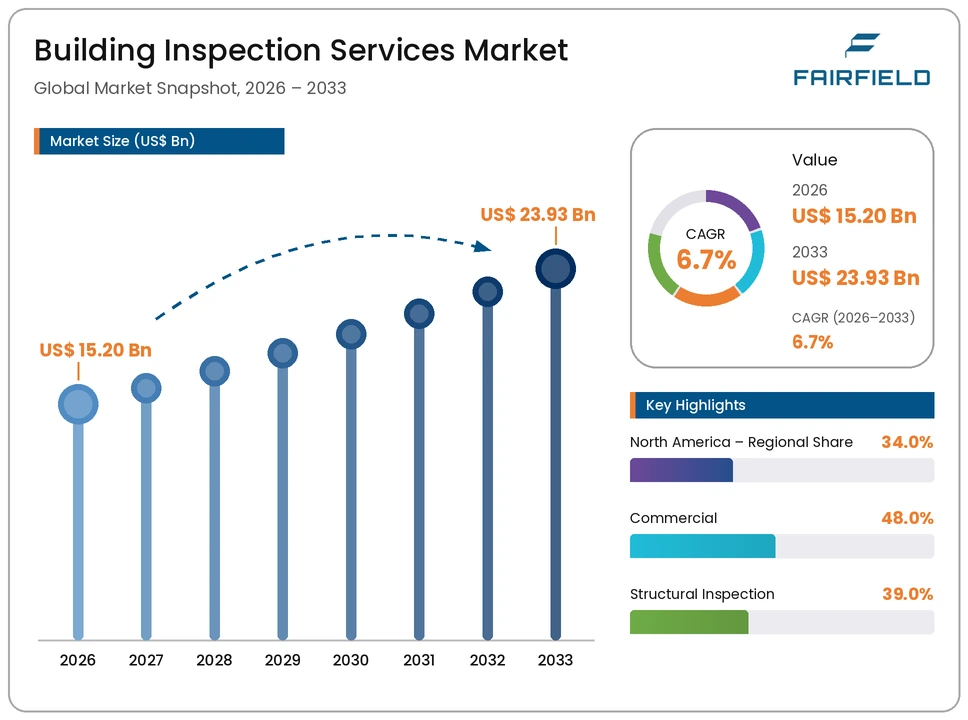
The market is valued at USD 15.20 Billion in 2026, with inspection providers directing investment toward advanced diagnostic technology, including drone-based and sensor-enabled inspection tools that improve assessment accuracy and efficiency. By 2033, the market is forecast to reach USD 23.93 Billion, reflecting steady growth across established commercial applications alongside expanding residential inspection demand.
Key Highlights
- The global building inspection services market is valued at USD 15.20 Billion in 2026 and is projected to reach USD 23.93 Billion by 2033, expanding at a CAGR of 6.7% across the 2026-2033 forecast period.
- Structural Inspection leads the service-type segment with a 39.0% share in 2026, equivalent to USD 5.93 Billion.
- Commercial applications remain the dominant end-use segment, accounting for 48.0% of global demand, or USD 7.30 Billion, in 2026.
- North America commands the largest regional share at 34.0% of the global market in 2026.
- Residential applications are emerging as the fastest-growing end-use segment through 2033.
Key Growth Drivers
Growth in the building inspection services market is driven primarily by aging global building stock, as an increasing share of commercial and residential buildings require more frequent structural and systems inspection to identify maintenance needs and ensure continued regulatory compliance as building components age beyond their original design life.
A second driver is intensifying regulatory scrutiny of building safety standards, as high-profile structural failure incidents in several markets have prompted regulators to strengthen mandatory inspection requirements and enforcement, directly increasing the volume of required building inspections across affected jurisdictions.
Key Restraints
The specialized technical expertise required for comprehensive structural and systems inspection creates a workforce availability constraint, as qualified inspectors with the necessary engineering and certification credentials remain in limited supply relative to growing inspection demand in many markets.
Additionally, inconsistent building inspection regulatory requirements across different jurisdictions create market fragmentation, requiring inspection providers to navigate varying certification, methodology, and reporting standards when operating across multiple regional or international markets.
Market Opportunities
The expansion of residential inspection demand presents a substantial opportunity, as growing homebuyer awareness of pre-purchase inspection value combined with aging residential building stock creates sustained demand for professional inspection services beyond the traditionally dominant commercial property segment.
A second opportunity lies in the continued adoption of advanced diagnostic technology, including drone-based visual inspection and sensor-enabled structural monitoring, that improves inspection accuracy and efficiency while reducing the time and cost associated with comprehensive building assessments. Providers that successfully advance these technologies stand to differentiate their service offerings in an increasingly competitive market.
Segmentation Analysis
- By Service Type
Structural Inspection leads the service-type segment, accounting for 39.0% of global market value in 2026, equivalent to USD 5.93 Billion. Its leadership reflects the foundational importance of structural integrity assessment across all building types and the heightened regulatory attention structural safety has received following recent building failure incidents. MEP (Mechanical, Electrical & Plumbing) Inspection represents a significant, established service-type category. Fire & Life Safety Inspection represents the fastest-growing service-type category through 2033, driven by intensifying regulatory enforcement of fire and life safety compliance standards.
- By End Use
Commercial applications form the leading end-use segment, representing 48.0% of global demand in 2026, or USD 7.30 Billion, reflecting the scale and regulatory complexity of commercial property inspection requirements relative to other property categories. Industrial applications represent a significant, established end-use category. Residential represents the fastest-growing end-use category, propelled by growing homebuyer awareness of pre-purchase inspection value and aging residential building stock.
Regional Insights
North America
North America holds the largest regional share, at 34.0% of the global market in 2026, equivalent to USD 5.17 Billion. The region's leadership reflects well-established building inspection practices integrated into real estate transactions and strong regulatory enforcement of building safety standards across the United States and Canada.
Europe
Europe accounts for 28.0% of the global market in 2026, valued at USD 4.26 Billion. Demand is supported by aging building stock and stringent building safety regulatory frameworks across major European markets.
Asia Pacific
Asia Pacific represents 24.0% of the global market in 2026, or USD 3.65 Billion. Growth is underpinned by rapid construction activity and increasing building safety regulatory enforcement across China, India, and other regional markets.
Latin America
Latin America contributes 8.0% of the global market in 2026, equivalent to USD 1.22 Billion. Growth is linked to expanding real estate transaction activity and growing building safety regulatory attention in Brazil and Mexico.
Middle East & Africa
Middle East & Africa holds 6.0% of the global market in 2026, valued at USD 0.91 Billion. Growth remains gradual, tied to expanding construction and real estate transaction activity across the region.
Competitive Landscape
The global building inspection services market is moderately fragmented, with a mix of large international testing, inspection, and certification companies and specialized regional and local building inspection firms competing for market share. Competition centers on inspection accuracy and technical expertise, breadth of certification and regulatory compliance coverage, and the ability to provide efficient, technology-enabled inspection services across diverse property types. Companies are increasingly differentiating through advanced diagnostic technology adoption rather than competing on traditional inspection pricing alone.
Key Market Players
- Bureau Veritas SA
- SGS SA
- Intertek Group plc
- TÜV SÜD AG
- TÜV Rheinland AG
- DEKRA SE
- UL Solutions Inc.
- Applus Services, S.A.
- CBRE Group, Inc.
- Jones Lang LaSalle Incorporated
Market Segmentation
By Service Type
- Structural Inspection
- MEP (Mechanical, Electrical & Plumbing) Inspection
- Fire & Life Safety Inspection
- Others
By End Use
- Residential
- Commercial
- Industrial
By Inspection Stage
- Pre-Purchase/Transaction Inspection
- Periodic/Regulatory Compliance Inspection
By Geography
- North America
- Europe
- Asia Pacific
- Latin America
- Middle East & Africa
- Executive Summary
- Global Building Inspection Services Market Snapshot
- Future Projections
- Key Market Trends
- Regional Snapshot, by Value, 2026
- Analyst Recommendations
- Market Overview
- Market Definitions and Segmentations
- Market Dynamics
- Drivers
- Restraints
- Market Opportunities
- Value Chain Analysis
- COVID-19 Impact Analysis
- Porter's Five Forces Analysis
- Impact of Russia-Ukraine Conflict
- PESTLE Analysis
- Regulatory Analysis
- Price Trend Analysis
- Current Prices and Future Projections, 2025-2033
- Price Impact Factors
- Global Building Inspection Services Market Outlook, 2020 - 2033
- Global Building Inspection Services Market Outlook, by Service Type, Value (US$ Bn), 2020-2033
- Structural Inspection
- MEP (Mechanical, Electrical & Plumbing) Inspection
- Fire & Life Safety Inspection
- Others
- Global Building Inspection Services Market Outlook, by End Use, Value (US$ Bn), 2020-2033
- Residential
- Commercial
- Industrial
- Global Building Inspection Services Market Outlook, by Inspection Stage, Value (US$ Bn), 2020-2033
- Pre-Purchase/Transaction Inspection
- Periodic/Regulatory Compliance Inspection
- Global Building Inspection Services Market Outlook, by Region, Value (US$ Bn), 2020-2033
- North America
- Europe
- Asia Pacific
- Latin America
- Middle East & Africa
- Global Building Inspection Services Market Outlook, by Service Type, Value (US$ Bn), 2020-2033
- North America Building Inspection Services Market Outlook, 2020 - 2033
- North America Building Inspection Services Market Outlook, by Service Type, Value (US$ Bn), 2020-2033
- Structural Inspection
- MEP (Mechanical, Electrical & Plumbing) Inspection
- Fire & Life Safety Inspection
- Others
- North America Building Inspection Services Market Outlook, by End Use, Value (US$ Bn), 2020-2033
- Residential
- Commercial
- Industrial
- North America Building Inspection Services Market Outlook, by Inspection Stage, Value (US$ Bn), 2020-2033
- Pre-Purchase/Transaction Inspection
- Periodic/Regulatory Compliance Inspection
- North America Building Inspection Services Market Outlook, by Country, Value (US$ Bn), 2020-2033
- U.S. Building Inspection Services Market Outlook, by Service Type, 2020-2033
- U.S. Building Inspection Services Market Outlook, by End Use, 2020-2033
- U.S. Building Inspection Services Market Outlook, by Inspection Stage, 2020-2033
- Canada Building Inspection Services Market Outlook, by Service Type, 2020-2033
- Canada Building Inspection Services Market Outlook, by End Use, 2020-2033
- Canada Building Inspection Services Market Outlook, by Inspection Stage, 2020-2033
- BPS Analysis/Market Attractiveness Analysis
- North America Building Inspection Services Market Outlook, by Service Type, Value (US$ Bn), 2020-2033
- Europe Building Inspection Services Market Outlook, 2020 - 2033
- Europe Building Inspection Services Market Outlook, by Service Type, Value (US$ Bn), 2020-2033
- Structural Inspection
- MEP (Mechanical, Electrical & Plumbing) Inspection
- Fire & Life Safety Inspection
- Others
- Europe Building Inspection Services Market Outlook, by End Use, Value (US$ Bn), 2020-2033
- Residential
- Commercial
- Industrial
- Europe Building Inspection Services Market Outlook, by Inspection Stage, Value (US$ Bn), 2020-2033
- Pre-Purchase/Transaction Inspection
- Periodic/Regulatory Compliance Inspection
- Europe Building Inspection Services Market Outlook, by Country, Value (US$ Bn), 2020-2033
- Germany Building Inspection Services Market Outlook, by Service Type, 2020-2033
- Germany Building Inspection Services Market Outlook, by End Use, 2020-2033
- Germany Building Inspection Services Market Outlook, by Inspection Stage, 2020-2033
- Italy Building Inspection Services Market Outlook, by Service Type, 2020-2033
- Italy Building Inspection Services Market Outlook, by End Use, 2020-2033
- Italy Building Inspection Services Market Outlook, by Inspection Stage, 2020-2033
- France Building Inspection Services Market Outlook, by Service Type, 2020-2033
- France Building Inspection Services Market Outlook, by End Use, 2020-2033
- France Building Inspection Services Market Outlook, by Inspection Stage, 2020-2033
- U.K. Building Inspection Services Market Outlook, by Service Type, 2020-2033
- U.K. Building Inspection Services Market Outlook, by End Use, 2020-2033
- U.K. Building Inspection Services Market Outlook, by Inspection Stage, 2020-2033
- Spain Building Inspection Services Market Outlook, by Service Type, 2020-2033
- Spain Building Inspection Services Market Outlook, by End Use, 2020-2033
- Spain Building Inspection Services Market Outlook, by Inspection Stage, 2020-2033
- Russia Building Inspection Services Market Outlook, by Service Type, 2020-2033
- Russia Building Inspection Services Market Outlook, by End Use, 2020-2033
- Russia Building Inspection Services Market Outlook, by Inspection Stage, 2020-2033
- Rest of Europe Building Inspection Services Market Outlook, by Service Type, 2020-2033
- Rest of Europe Building Inspection Services Market Outlook, by End Use, 2020-2033
- Rest of Europe Building Inspection Services Market Outlook, by Inspection Stage, 2020-2033
- BPS Analysis/Market Attractiveness Analysis
- Europe Building Inspection Services Market Outlook, by Service Type, Value (US$ Bn), 2020-2033
- Asia Pacific Building Inspection Services Market Outlook, 2020 - 2033
- Asia Pacific Building Inspection Services Market Outlook, by Service Type, Value (US$ Bn), 2020-2033
- Structural Inspection
- MEP (Mechanical, Electrical & Plumbing) Inspection
- Fire & Life Safety Inspection
- Others
- Asia Pacific Building Inspection Services Market Outlook, by End Use, Value (US$ Bn), 2020-2033
- Residential
- Commercial
- Industrial
- Asia Pacific Building Inspection Services Market Outlook, by Inspection Stage, Value (US$ Bn), 2020-2033
- Pre-Purchase/Transaction Inspection
- Periodic/Regulatory Compliance Inspection
- Asia Pacific Building Inspection Services Market Outlook, by Country, Value (US$ Bn), 2020-2033
- China Building Inspection Services Market Outlook, by Service Type, 2020-2033
- China Building Inspection Services Market Outlook, by End Use, 2020-2033
- China Building Inspection Services Market Outlook, by Inspection Stage, 2020-2033
- Japan Building Inspection Services Market Outlook, by Service Type, 2020-2033
- Japan Building Inspection Services Market Outlook, by End Use, 2020-2033
- Japan Building Inspection Services Market Outlook, by Inspection Stage, 2020-2033
- South Korea Building Inspection Services Market Outlook, by Service Type, 2020-2033
- South Korea Building Inspection Services Market Outlook, by End Use, 2020-2033
- South Korea Building Inspection Services Market Outlook, by Inspection Stage, 2020-2033
- India Building Inspection Services Market Outlook, by Service Type, 2020-2033
- India Building Inspection Services Market Outlook, by End Use, 2020-2033
- India Building Inspection Services Market Outlook, by Inspection Stage, 2020-2033
- Southeast Asia Building Inspection Services Market Outlook, by Service Type, 2020-2033
- Southeast Asia Building Inspection Services Market Outlook, by End Use, 2020-2033
- Southeast Asia Building Inspection Services Market Outlook, by Inspection Stage, 2020-2033
- Rest of SAO Building Inspection Services Market Outlook, by Service Type, 2020-2033
- Rest of SAO Building Inspection Services Market Outlook, by End Use, 2020-2033
- Rest of SAO Building Inspection Services Market Outlook, by Inspection Stage, 2020-2033
- BPS Analysis/Market Attractiveness Analysis
- Asia Pacific Building Inspection Services Market Outlook, by Service Type, Value (US$ Bn), 2020-2033
- Latin America Building Inspection Services Market Outlook, 2020 - 2033
- Latin America Building Inspection Services Market Outlook, by Service Type, Value (US$ Bn), 2020-2033
- Structural Inspection
- MEP (Mechanical, Electrical & Plumbing) Inspection
- Fire & Life Safety Inspection
- Others
- Latin America Building Inspection Services Market Outlook, by End Use, Value (US$ Bn), 2020-2033
- Residential
- Commercial
- Industrial
- Latin America Building Inspection Services Market Outlook, by Inspection Stage, Value (US$ Bn), 2020-2033
- Pre-Purchase/Transaction Inspection
- Periodic/Regulatory Compliance Inspection
- Latin America Building Inspection Services Market Outlook, by Country, Value (US$ Bn), 2020-2033
- Brazil Building Inspection Services Market Outlook, by Service Type, 2020-2033
- Brazil Building Inspection Services Market Outlook, by End Use, 2020-2033
- Brazil Building Inspection Services Market Outlook, by Inspection Stage, 2020-2033
- Mexico Building Inspection Services Market Outlook, by Service Type, 2020-2033
- Mexico Building Inspection Services Market Outlook, by End Use, 2020-2033
- Mexico Building Inspection Services Market Outlook, by Inspection Stage, 2020-2033
- Argentina Building Inspection Services Market Outlook, by Service Type, 2020-2033
- Argentina Building Inspection Services Market Outlook, by End Use, 2020-2033
- Argentina Building Inspection Services Market Outlook, by Inspection Stage, 2020-2033
- Rest of LATAM Building Inspection Services Market Outlook, by Service Type, 2020-2033
- Rest of LATAM Building Inspection Services Market Outlook, by End Use, 2020-2033
- Rest of LATAM Building Inspection Services Market Outlook, by Inspection Stage, 2020-2033
- BPS Analysis/Market Attractiveness Analysis
- Latin America Building Inspection Services Market Outlook, by Service Type, Value (US$ Bn), 2020-2033
- Middle East & Africa Building Inspection Services Market Outlook, 2020 - 2033
- Middle East & Africa Building Inspection Services Market Outlook, by Service Type, Value (US$ Bn), 2020-2033
- Structural Inspection
- MEP (Mechanical, Electrical & Plumbing) Inspection
- Fire & Life Safety Inspection
- Others
- Middle East & Africa Building Inspection Services Market Outlook, by End Use, Value (US$ Bn), 2020-2033
- Residential
- Commercial
- Industrial
- Middle East & Africa Building Inspection Services Market Outlook, by Inspection Stage, Value (US$ Bn), 2020-2033
- Pre-Purchase/Transaction Inspection
- Periodic/Regulatory Compliance Inspection
- Middle East & Africa Building Inspection Services Market Outlook, by Country, Value (US$ Bn), 2020-2033
- GCC Building Inspection Services Market Outlook, by Service Type, 2020-2033
- GCC Building Inspection Services Market Outlook, by End Use, 2020-2033
- GCC Building Inspection Services Market Outlook, by Inspection Stage, 2020-2033
- South Africa Building Inspection Services Market Outlook, by Service Type, 2020-2033
- South Africa Building Inspection Services Market Outlook, by End Use, 2020-2033
- South Africa Building Inspection Services Market Outlook, by Inspection Stage, 2020-2033
- Egypt Building Inspection Services Market Outlook, by Service Type, 2020-2033
- Egypt Building Inspection Services Market Outlook, by End Use, 2020-2033
- Egypt Building Inspection Services Market Outlook, by Inspection Stage, 2020-2033
- Nigeria Building Inspection Services Market Outlook, by Service Type, 2020-2033
- Nigeria Building Inspection Services Market Outlook, by End Use, 2020-2033
- Nigeria Building Inspection Services Market Outlook, by Inspection Stage, 2020-2033
- Rest of Middle East Building Inspection Services Market Outlook, by Service Type, 2020-2033
- Rest of Middle East Building Inspection Services Market Outlook, by End Use, 2020-2033
- Rest of Middle East Building Inspection Services Market Outlook, by Inspection Stage, 2020-2033
- BPS Analysis/Market Attractiveness Analysis
- Middle East & Africa Building Inspection Services Market Outlook, by Service Type, Value (US$ Bn), 2020-2033
- Competitive Landscape
- Company Vs Segment Heatmap
- Company Market Share Analysis, 2025
- Competitive Dashboard
- Company Profiles
- Bureau Veritas SA
- Company Overview
- Product Portfolio
- Financial Overview
- Business Strategies and Developments
- SGS SA
- Intertek Group plc
- TÜV SÜD AG
- TÜV Rheinland AG
- DEKRA SE
- UL Solutions Inc.
- Applus Services, S.A.
- CBRE Group, Inc.
- Jones Lang LaSalle Incorporated
- Bureau Veritas SA
- Appendix
- Research Methodology
- Report Assumptions
- Acronyms and Abbreviations
By Service Type
- Structural Inspection
- MEP (Mechanical, Electrical & Plumbing) Inspection
- Fire & Life Safety Inspection
- Others
By End Use
- Residential
- Commercial
- Industrial
By Inspection Stage
- Pre-Purchase/Transaction Inspection
- Periodic/Regulatory Compliance Inspection
By Geography
- North America
- Europe
- Asia Pacific
- Latin America
- Middle East & Africa
Our Research Methodology
Considering the volatility of business today, traditional approaches to strategizing a game plan can be unfruitful if not detrimental. True ambiguity is no way to determine a forecast. A myriad of predetermined factors must be accounted for such as the degree of risk involved, the magnitude of circumstances, as well as conditions or consequences that are not known or unpredictable. To circumvent binary views that cast uncertainty, the application of market research intelligence to strategically posture, move, and enable actionable outcomes is necessary.
View Methodology
Quality Assured
Rigorous Validation Process

Confidentiality Assured
End-to-end Data Security

Custom Research Services
Tailored To Your Objectives
FAQs
The global building inspection services market is valued at USD 15.20 Billion in 2026, reflecting sustained demand for building safety and compliance assessment.
The market is projected to grow at a CAGR of 6.7%, reaching USD 23.93 Billion by 2033, driven by aging building stock and intensifying safety regulation.
Structural Inspection leads with a 39.0% share in 2026, reflecting its foundational importance and heightened regulatory attention.
North America leads with a 34.0% share in 2026, supported by well-established inspection practices and strong regulatory enforcement.
The largest opportunity lies in residential applications, expanding alongside growing homebuyer awareness of pre-purchase inspection value.
Related Reports
Elevator Maintenance Market Size, Share, Insights, Competitive Landscape, and Forecast 2026 to 2033
The global elevator maintenance market is valued at US$64.8 billion in 2026, reaching US$92.6 billion by 2033, growing at a 5.2% CAGR
Gas Insulated Power Equipment Market Size, Share, Insights, Competitive Landscape, and Forecast 2026 to 2033
The gas insulated power equipment market is valued at US$ 24.0 Bn in 2026 and is projected to reach US$ 40.5 Bn by 2033, growing at a CAGR of 7.8%
Chain Conveyors Market Size, Share, Insights, Competitive Landscape, and Forecast 2026 to 2033
The global chain conveyors market will grow from US$9.78 billion in 2026 to US$15.45 billion by 2033, at a CAGR of 6.75%, driven by industrial automation.
Reciprocating Plunger Pumps Market Size, Share, Insights, Competitive Landscape, and Forecast 2026 to 2033
The reciprocating plunger pumps market will grow from US$4.89 billion in 2026 to US$7.45 billion by 2033, at a CAGR of 6.2%.
Plastic Injection Molding Machine for MedTech Market Size, Share, Insights, Competitive Landscape, and Forecast 2026 to 2033
The plastic injection molding machine for MedTech market will grow from US$2.1 billion in 2026 to US$3.46 billion by 2033, at a CAGR of 7.4%.
Plastic Processing Machinery Market Size, Share, Insights, Competitive Landscape, and Forecast 2026 to 2033
The plastic processing machinery market will grow from US$38.5 billion in 2026 to US$55.3 billion by 2033, at a 5.3% CAGR, driven by industrial demand.