



Built To Rent Residential Market
Built To Rent Residential Market Insights, Competitive Landscape, and Market Forecast 2033
Market Overview
Built to rent residential refers to purpose-built housing developments, spanning single-family homes and multi-family communities, that are designed, constructed, and professionally managed specifically for long-term rental occupancy rather than individual homeownership sale. This institutional real estate model has expanded rapidly as large-scale investors and developers recognize the operational efficiency and long-term income stability advantages of purpose-built rental communities relative to fragmented ownership of individually acquired rental properties.
Demand growth through the 2026-2033 window is closely tied to persistent homeownership affordability challenges across major markets pushing a growing share of households toward long-term renting as a housing tenure choice, sustained institutional capital investment seeking stable, long-duration income streams from residential real estate, and growing consumer preference for professionally managed rental communities offering amenities and service standards comparable to homeownership without the associated maintenance responsibilities. Continued urbanization and shifting household formation patterns, including delayed homeownership among younger demographics, continue to expand the addressable renter population for purpose-built rental communities.
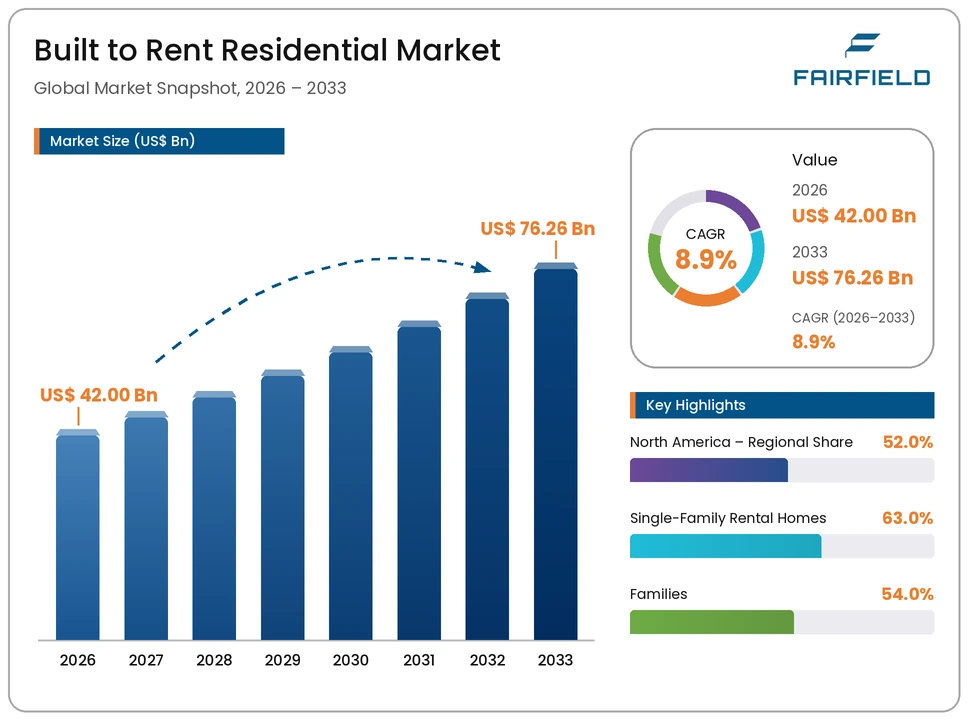
The market is valued at USD 42.00 Billion in 2026, with developers and operators directing substantial investment toward expanding purpose-built rental community pipelines across both single-family and multi-family formats. By 2033, the market is forecast to reach USD 76.26 Billion, reflecting sustained growth across established single-family rental applications alongside expanding multi-family and townhome community development.
Key Highlights
- The global built to rent residential market is valued at USD 42.00 Billion in 2026 and is projected to reach USD 76.26 Billion by 2033, expanding at a CAGR of 8.9% across the 2026-2033 forecast period.
- Single-Family Rental Homes lead the housing-type segment with a 63.0% share in 2026, equivalent to USD 26.46 Billion.
- Families remain the dominant end-user segment, accounting for 54.0% of global demand, or USD 22.68 Billion, in 2026.
- North America commands the largest regional share at 52.0% of the global market in 2026.
- Young professional and single-occupant demand is emerging as the fastest-growing end-user segment through 2033.
Key Growth Drivers
Growth in the built to rent residential market is driven primarily by persistent homeownership affordability challenges, as elevated home prices and mortgage financing costs across major markets continue to push a growing share of households toward long-term renting, supporting sustained demand for high-quality, professionally managed rental housing options.
A second driver is sustained institutional capital investment, as large-scale investors increasingly recognize purpose-built rental communities as an attractive long-duration income asset class offering more predictable operational efficiency than fragmented single-property rental ownership models.
Key Restraints
The substantial capital investment and extended development timelines required for large-scale built to rent communities create significant barriers to entry, requiring developers to secure patient, long-term-oriented capital sources willing to accept multi-year development periods before generating rental income.
Additionally, zoning and land use regulatory restrictions in many markets create development approval challenges for large-scale rental communities, particularly in jurisdictions where local policy has historically favored for-sale housing development over purpose-built rental projects.
Market Opportunities
The expansion of multi-family and townhome community formats presents a substantial opportunity, as developers increasingly explore higher-density rental community designs that improve land use efficiency while still offering many of the amenity and lifestyle benefits associated with single-family built to rent communities.
A second opportunity lies in expanding built to rent product offerings targeted at young professional and single-occupant renters, a demographic segment that has historically been underserved by traditional single-family rental community designs oriented primarily toward families. Developers that successfully address this segment's distinct preferences stand to capture significant incremental demand.
Segmentation Analysis
By Housing Type
Single-Family Rental Homes lead the housing-type segment, accounting for 63.0% of global market value in 2026, equivalent to USD 26.46 Billion. Their leadership reflects strong renter preference for the space, privacy, and homeownership-like living experience that single-family rental communities provide. Multi-Family/Townhome Communities represent the fastest-growing housing-type category through 2033, driven by improving land use efficiency and expanding development in denser urban and suburban markets.
By End User
Families form the leading end-user segment, representing 54.0% of global demand in 2026, or USD 22.68 Billion, reflecting families' strong preference for the space, school district access, and community amenities that built to rent developments typically offer. Young Professionals/Singles represent the fastest-growing end-user category, propelled by expanding product offerings tailored to this demographic's distinct lifestyle and location preferences.
Regional Insights
North America
North America holds the largest regional share, at 52.0% of the global market in 2026, equivalent to USD 21.84 Billion. The region's leadership reflects the scale of institutional capital investment in purpose-built rental housing and well-established built to rent development activity across the United States and Canada.
Europe
Europe accounts for 26.0% of the global market in 2026, valued at USD 10.92 Billion. Demand is supported by growing institutional investment in purpose-built rental housing and persistent homeownership affordability challenges across major European markets, particularly the United Kingdom.
Asia Pacific
Asia Pacific represents 14.0% of the global market in 2026, or USD 5.88 Billion. Growth is underpinned by rising urbanization and growing institutional interest in purpose-built rental housing models across Australia, Japan, and other regional markets.
Latin America
Latin America contributes 5.0% of the global market in 2026, equivalent to USD 2.10 Billion. Growth is linked to gradually expanding institutional real estate investment in Brazil and Mexico.
Middle East & Africa
Middle East & Africa holds 3.0% of the global market in 2026, valued at USD 1.26 Billion. Growth remains at an early stage, tied to gradual expansion of institutional rental housing development across the region.
Competitive Landscape
The global built to rent residential market is moderately concentrated, with a limited number of large institutional real estate operators and homebuilders holding strong positions supported by substantial capital access and established development and property management capability. Competition centers on development pipeline scale and location quality, property management service standards, and the ability to secure long-term institutional capital partnerships. Companies are increasingly differentiating through expanded product formats and demographic-targeted community design rather than competing on rental pricing alone.
Key Market Players
- Invitation Homes, Inc.
- American Homes 4 Rent
- Greystar Real Estate Partners, LLC
- AvalonBay Communities, Inc.
- Camden Property Trust
- Lennar Corporation
- Pretium Partners, LLC
- Tricon Residential Inc.
- D.R. Horton, Inc.
- Mynd Management, Inc.
Market Segmentation
By Housing Type
- Single-Family Rental Homes
- Multi-Family/Townhome Communities
- Others
By End User
- Families
- Young Professionals/Singles
- Others
By Ownership Model
- Institutional Investor-Owned
- Homebuilder-Operated
By Geography
- North America
- Europe
- Asia Pacific
- Latin America
- Middle East & Africa
- Executive Summary
- Global Built To Rent Residential Market Snapshot
- Future Projections
- Key Market Trends
- Regional Snapshot, by Value, 2026
- Analyst Recommendations
- Market Overview
- Market Definitions and Segmentations
- Market Dynamics
- Drivers
- Restraints
- Market Opportunities
- Value Chain Analysis
- COVID-19 Impact Analysis
- Porter's Five Forces Analysis
- Impact of Russia-Ukraine Conflict
- PESTLE Analysis
- Regulatory Analysis
- Price Trend Analysis
- Current Prices and Future Projections, 2025-2033
- Price Impact Factors
- Global Built To Rent Residential Market Outlook, 2020 - 2033
- Global Built To Rent Residential Market Outlook, by Housing Type, Value (US$ Bn), 2020-2033
- Single-Family Rental Homes
- Multi-Family/Townhome Communities
- Others
- Global Built To Rent Residential Market Outlook, by End User, Value (US$ Bn), 2020-2033
- Families
- Young Professionals/Singles
- Others
- Global Built To Rent Residential Market Outlook, by Ownership Model, Value (US$ Bn), 2020-2033
- Institutional Investor-Owned
- Homebuilder-Operated
- Global Built To Rent Residential Market Outlook, by Region, Value (US$ Bn), 2020-2033
- North America
- Europe
- Asia Pacific
- Latin America
- Middle East & Africa
- Global Built To Rent Residential Market Outlook, by Housing Type, Value (US$ Bn), 2020-2033
- North America Built To Rent Residential Market Outlook, 2020 - 2033
- North America Built To Rent Residential Market Outlook, by Housing Type, Value (US$ Bn), 2020-2033
- Single-Family Rental Homes
- Multi-Family/Townhome Communities
- Others
- North America Built To Rent Residential Market Outlook, by End User, Value (US$ Bn), 2020-2033
- Families
- Young Professionals/Singles
- Others
- North America Built To Rent Residential Market Outlook, by Ownership Model, Value (US$ Bn), 2020-2033
- Institutional Investor-Owned
- Homebuilder-Operated
- North America Built To Rent Residential Market Outlook, by Country, Value (US$ Bn), 2020-2033
- U.S. Built To Rent Residential Market Outlook, by Housing Type, 2020-2033
- U.S. Built To Rent Residential Market Outlook, by End User, 2020-2033
- U.S. Built To Rent Residential Market Outlook, by Ownership Model, 2020-2033
- Canada Built To Rent Residential Market Outlook, by Housing Type, 2020-2033
- Canada Built To Rent Residential Market Outlook, by End User, 2020-2033
- Canada Built To Rent Residential Market Outlook, by Ownership Model, 2020-2033
- BPS Analysis/Market Attractiveness Analysis
- North America Built To Rent Residential Market Outlook, by Housing Type, Value (US$ Bn), 2020-2033
- Europe Built To Rent Residential Market Outlook, 2020 - 2033
- Europe Built To Rent Residential Market Outlook, by Housing Type, Value (US$ Bn), 2020-2033
- Single-Family Rental Homes
- Multi-Family/Townhome Communities
- Others
- Europe Built To Rent Residential Market Outlook, by End User, Value (US$ Bn), 2020-2033
- Families
- Young Professionals/Singles
- Others
- Europe Built To Rent Residential Market Outlook, by Ownership Model, Value (US$ Bn), 2020-2033
- Institutional Investor-Owned
- Homebuilder-Operated
- Europe Built To Rent Residential Market Outlook, by Country, Value (US$ Bn), 2020-2033
- Germany Built To Rent Residential Market Outlook, by Housing Type, 2020-2033
- Germany Built To Rent Residential Market Outlook, by End User, 2020-2033
- Germany Built To Rent Residential Market Outlook, by Ownership Model, 2020-2033
- Italy Built To Rent Residential Market Outlook, by Housing Type, 2020-2033
- Italy Built To Rent Residential Market Outlook, by End User, 2020-2033
- Italy Built To Rent Residential Market Outlook, by Ownership Model, 2020-2033
- France Built To Rent Residential Market Outlook, by Housing Type, 2020-2033
- France Built To Rent Residential Market Outlook, by End User, 2020-2033
- France Built To Rent Residential Market Outlook, by Ownership Model, 2020-2033
- U.K. Built To Rent Residential Market Outlook, by Housing Type, 2020-2033
- U.K. Built To Rent Residential Market Outlook, by End User, 2020-2033
- U.K. Built To Rent Residential Market Outlook, by Ownership Model, 2020-2033
- Spain Built To Rent Residential Market Outlook, by Housing Type, 2020-2033
- Spain Built To Rent Residential Market Outlook, by End User, 2020-2033
- Spain Built To Rent Residential Market Outlook, by Ownership Model, 2020-2033
- Russia Built To Rent Residential Market Outlook, by Housing Type, 2020-2033
- Russia Built To Rent Residential Market Outlook, by End User, 2020-2033
- Russia Built To Rent Residential Market Outlook, by Ownership Model, 2020-2033
- Rest of Europe Built To Rent Residential Market Outlook, by Housing Type, 2020-2033
- Rest of Europe Built To Rent Residential Market Outlook, by End User, 2020-2033
- Rest of Europe Built To Rent Residential Market Outlook, by Ownership Model, 2020-2033
- BPS Analysis/Market Attractiveness Analysis
- Europe Built To Rent Residential Market Outlook, by Housing Type, Value (US$ Bn), 2020-2033
- Asia Pacific Built To Rent Residential Market Outlook, 2020 - 2033
- Asia Pacific Built To Rent Residential Market Outlook, by Housing Type, Value (US$ Bn), 2020-2033
- Single-Family Rental Homes
- Multi-Family/Townhome Communities
- Others
- Asia Pacific Built To Rent Residential Market Outlook, by End User, Value (US$ Bn), 2020-2033
- Families
- Young Professionals/Singles
- Others
- Asia Pacific Built To Rent Residential Market Outlook, by Ownership Model, Value (US$ Bn), 2020-2033
- Institutional Investor-Owned
- Homebuilder-Operated
- Asia Pacific Built To Rent Residential Market Outlook, by Country, Value (US$ Bn), 2020-2033
- China Built To Rent Residential Market Outlook, by Housing Type, 2020-2033
- China Built To Rent Residential Market Outlook, by End User, 2020-2033
- China Built To Rent Residential Market Outlook, by Ownership Model, 2020-2033
- Japan Built To Rent Residential Market Outlook, by Housing Type, 2020-2033
- Japan Built To Rent Residential Market Outlook, by End User, 2020-2033
- Japan Built To Rent Residential Market Outlook, by Ownership Model, 2020-2033
- South Korea Built To Rent Residential Market Outlook, by Housing Type, 2020-2033
- South Korea Built To Rent Residential Market Outlook, by End User, 2020-2033
- South Korea Built To Rent Residential Market Outlook, by Ownership Model, 2020-2033
- India Built To Rent Residential Market Outlook, by Housing Type, 2020-2033
- India Built To Rent Residential Market Outlook, by End User, 2020-2033
- India Built To Rent Residential Market Outlook, by Ownership Model, 2020-2033
- Southeast Asia Built To Rent Residential Market Outlook, by Housing Type, 2020-2033
- Southeast Asia Built To Rent Residential Market Outlook, by End User, 2020-2033
- Southeast Asia Built To Rent Residential Market Outlook, by Ownership Model, 2020-2033
- Rest of SAO Built To Rent Residential Market Outlook, by Housing Type, 2020-2033
- Rest of SAO Built To Rent Residential Market Outlook, by End User, 2020-2033
- Rest of SAO Built To Rent Residential Market Outlook, by Ownership Model, 2020-2033
- BPS Analysis/Market Attractiveness Analysis
- Asia Pacific Built To Rent Residential Market Outlook, by Housing Type, Value (US$ Bn), 2020-2033
- Latin America Built To Rent Residential Market Outlook, 2020 - 2033
- Latin America Built To Rent Residential Market Outlook, by Housing Type, Value (US$ Bn), 2020-2033
- Single-Family Rental Homes
- Multi-Family/Townhome Communities
- Others
- Latin America Built To Rent Residential Market Outlook, by End User, Value (US$ Bn), 2020-2033
- Families
- Young Professionals/Singles
- Others
- Latin America Built To Rent Residential Market Outlook, by Ownership Model, Value (US$ Bn), 2020-2033
- Institutional Investor-Owned
- Homebuilder-Operated
- Latin America Built To Rent Residential Market Outlook, by Country, Value (US$ Bn), 2020-2033
- Brazil Built To Rent Residential Market Outlook, by Housing Type, 2020-2033
- Brazil Built To Rent Residential Market Outlook, by End User, 2020-2033
- Brazil Built To Rent Residential Market Outlook, by Ownership Model, 2020-2033
- Mexico Built To Rent Residential Market Outlook, by Housing Type, 2020-2033
- Mexico Built To Rent Residential Market Outlook, by End User, 2020-2033
- Mexico Built To Rent Residential Market Outlook, by Ownership Model, 2020-2033
- Argentina Built To Rent Residential Market Outlook, by Housing Type, 2020-2033
- Argentina Built To Rent Residential Market Outlook, by End User, 2020-2033
- Argentina Built To Rent Residential Market Outlook, by Ownership Model, 2020-2033
- Rest of LATAM Built To Rent Residential Market Outlook, by Housing Type, 2020-2033
- Rest of LATAM Built To Rent Residential Market Outlook, by End User, 2020-2033
- Rest of LATAM Built To Rent Residential Market Outlook, by Ownership Model, 2020-2033
- BPS Analysis/Market Attractiveness Analysis
- Latin America Built To Rent Residential Market Outlook, by Housing Type, Value (US$ Bn), 2020-2033
- Middle East & Africa Built To Rent Residential Market Outlook, 2020 - 2033
- Middle East & Africa Built To Rent Residential Market Outlook, by Housing Type, Value (US$ Bn), 2020-2033
- Single-Family Rental Homes
- Multi-Family/Townhome Communities
- Others
- Middle East & Africa Built To Rent Residential Market Outlook, by End User, Value (US$ Bn), 2020-2033
- Families
- Young Professionals/Singles
- Others
- Middle East & Africa Built To Rent Residential Market Outlook, by Ownership Model, Value (US$ Bn), 2020-2033
- Institutional Investor-Owned
- Homebuilder-Operated
- Middle East & Africa Built To Rent Residential Market Outlook, by Country, Value (US$ Bn), 2020-2033
- GCC Built To Rent Residential Market Outlook, by Housing Type, 2020-2033
- GCC Built To Rent Residential Market Outlook, by End User, 2020-2033
- GCC Built To Rent Residential Market Outlook, by Ownership Model, 2020-2033
- South Africa Built To Rent Residential Market Outlook, by Housing Type, 2020-2033
- South Africa Built To Rent Residential Market Outlook, by End User, 2020-2033
- South Africa Built To Rent Residential Market Outlook, by Ownership Model, 2020-2033
- Egypt Built To Rent Residential Market Outlook, by Housing Type, 2020-2033
- Egypt Built To Rent Residential Market Outlook, by End User, 2020-2033
- Egypt Built To Rent Residential Market Outlook, by Ownership Model, 2020-2033
- Nigeria Built To Rent Residential Market Outlook, by Housing Type, 2020-2033
- Nigeria Built To Rent Residential Market Outlook, by End User, 2020-2033
- Nigeria Built To Rent Residential Market Outlook, by Ownership Model, 2020-2033
- Rest of Middle East Built To Rent Residential Market Outlook, by Housing Type, 2020-2033
- Rest of Middle East Built To Rent Residential Market Outlook, by End User, 2020-2033
- Rest of Middle East Built To Rent Residential Market Outlook, by Ownership Model, 2020-2033
- BPS Analysis/Market Attractiveness Analysis
- Middle East & Africa Built To Rent Residential Market Outlook, by Housing Type, Value (US$ Bn), 2020-2033
- Competitive Landscape
- Company Vs Segment Heatmap
- Company Market Share Analysis, 2025
- Competitive Dashboard
- Company Profiles
- Invitation Homes, Inc.
- Company Overview
- Product Portfolio
- Financial Overview
- Business Strategies and Developments
- American Homes 4 Rent
- Greystar Real Estate Partners, LLC
- AvalonBay Communities, Inc.
- Camden Property Trust
- Lennar Corporation
- Pretium Partners, LLC
- Tricon Residential Inc.
- D.R. Horton, Inc.
- Mynd Management, Inc.
- Invitation Homes, Inc.
- Appendix
- Research Methodology
- Report Assumptions
- Acronyms and Abbreviations
By Housing Type
- Single-Family Rental Homes
- Multi-Family/Townhome Communities
- Others
By End User
- Families
- Young Professionals/Singles
- Others
By Ownership Model
- Institutional Investor-Owned
- Homebuilder-Operated
By Geography
- North America
- Europe
- Asia Pacific
- Latin America
- Middle East & Africa
Our Research Methodology
Considering the volatility of business today, traditional approaches to strategizing a game plan can be unfruitful if not detrimental. True ambiguity is no way to determine a forecast. A myriad of predetermined factors must be accounted for such as the degree of risk involved, the magnitude of circumstances, as well as conditions or consequences that are not known or unpredictable. To circumvent binary views that cast uncertainty, the application of market research intelligence to strategically posture, move, and enable actionable outcomes is necessary.
View Methodology
Quality Assured
Rigorous Validation Process

Confidentiality Assured
End-to-end Data Security

Custom Research Services
Tailored To Your Objectives
FAQs
The global built to rent residential market is valued at USD 42.00 Billion in 2026, reflecting sustained institutional investment in purpose-built rental housing.
The market is projected to grow at a CAGR of 8.9%, reaching USD 76.26 Billion by 2033, driven by homeownership affordability challenges and institutional capital investment.
Single-Family Rental Homes lead with a 63.0% share in 2026, reflecting strong renter preference for space and a homeownership-like living experience.
North America leads with a 52.0% share in 2026, supported by the scale of institutional capital investment in purpose-built rental housing.
The largest opportunity lies in serving young professional and single-occupant renters, a segment historically underserved by family-oriented community designs.
Related Reports
Chain Conveyors Market Size, Share, Insights, Competitive Landscape, and Forecast 2026 to 2033
The global chain conveyors market will grow from US$9.78 billion in 2026 to US$15.45 billion by 2033, at a CAGR of 6.75%, driven by industrial automation.
Reciprocating Plunger Pumps Market Size, Share, Insights, Competitive Landscape, and Forecast 2026 to 2033
The reciprocating plunger pumps market will grow from US$4.89 billion in 2026 to US$7.45 billion by 2033, at a CAGR of 6.2%.
Plastic Injection Molding Machine for MedTech Market Size, Share, Insights, Competitive Landscape, and Forecast 2026 to 2033
The plastic injection molding machine for MedTech market will grow from US$2.1 billion in 2026 to US$3.46 billion by 2033, at a CAGR of 7.4%.
Plastic Processing Machinery Market Size, Share, Insights, Competitive Landscape, and Forecast 2026 to 2033
The plastic processing machinery market will grow from US$38.5 billion in 2026 to US$55.3 billion by 2033, at a 5.3% CAGR, driven by industrial demand.
Padel Court Construction Market Size, Share, Insights, Competitive Landscape, and Market Forecast - 2033
The Padel Court Construction Market is projected to reach US$8.9 billion by 2033, growing at 13.8% CAGR from US$3.6 billion in 2026.
Modular Extrusion Control Units Market Size, Share, Insights, Competitive Landscape, and Forecast 2026 to 2033
The modular extrusion control units market, valued at US$ 1.46 billion in 2026, projected to reach US$ 2.57 billion by 2033 at an 8.41% CAGR