



Butter Packaging Market
Butter Packaging Market Size, Share, Insights, Competitive Landscape, and Forecast 2026 to 2033
Butter Packaging Market Analysis, 2026–2033
Butter Packaging Market
Butter Packaging Market Size, Share, Insights, Competitive Landscape, and Forecast 2026 to 2033
Butter Packaging Market Size and Trend Analysis
How Fast Is the Butter Packaging Market Growing?
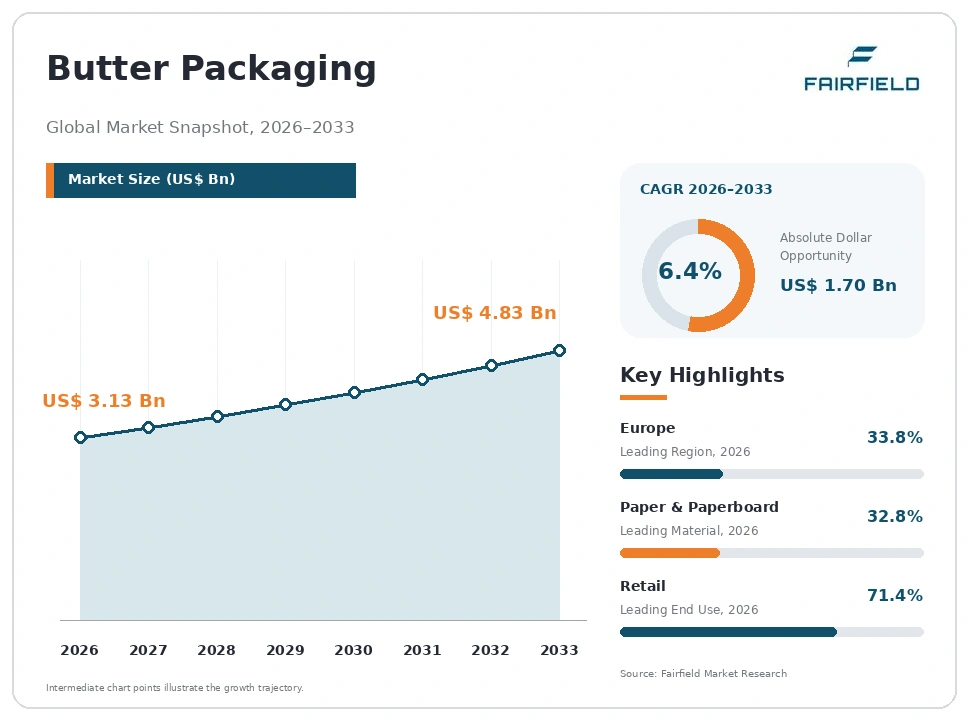
The global butter packaging market size is expected to be valued at US$ 3.13 billion in 2026 and projected to reach US$ 4.83 billion by 2033, growing at a CAGR of 6.4% between 2026 and 2033.
Between 2020 and 2025, the market grew at a CAGR of about 5.2%, as home baking during the pandemic lifted butter demand, followed by record butter prices in 2024 and 2025 that encouraged smaller pack sizes. Three factors now drive growth: steady global butter consumption, especially in Asia Pacific and North America, rising demand for spreadable butter and portion packs in foodservice, and new rules that push brands toward recyclable paper wraps. The market is shifting away from foil-laminated paper and non-recyclable plastic tubs toward mono-material paper, recyclable polypropylene, and home-compostable butter wrappers that still protect butter from light, oxygen, and odors.
Key Report Takeaways
- By Material: Paper & Paperboard held 32.8% share in 2026, while Compostable & Bio-based Materials are projected to expand at a 9.6% CAGR through 2033, driven by plastic-free and home-compostable wrap launches.
- By Packaging Type: Tubs & Cups held 34.6% share in 2026, while Wrappers are projected to expand at a 7.3% CAGR through 2033, driven by recyclable paper wraps replacing foil laminates.
- By End Use: Retail held 71.4% share in 2026, while Foodservice is projected to expand at a 7.6% CAGR through 2033, driven by single-serve portion packs for hotels, airlines, and quick-service restaurants.
- By Region: Europe held 33.8% share in 2026, while North America is projected to expand at a 7.2% CAGR through 2033, driven by premium butter demand and sustainable packaging rules.
Global Butter Packaging Market Trends and Insights
Drivers Impact Analysis
Two drivers carry the strongest influence on butter packaging demand during the forecast period.
| Driver | Impact on CAGR Forecast | Geographic Relevance | Impact Timeline |
| Steady butter consumption and premiumization | High | North America, Asia Pacific, Europe | Long term (≥4 years) |
| Sustainability regulations and recyclable packaging | High | Europe, North America | Medium term (2-4 years) |
Butter Consumption and Premiumization Are Driving the Butter Packaging Market
Steady butter consumption and premiumization are the strongest drivers of the butter packaging market. Every block, tub, and portion of butter needs packaging that protects quality and shelf life.
The mechanism is changing diets and rising incomes. Consumers in North America and Europe have returned to butter as a natural fat, moving away from some margarines. Butter demand is rising in China, India, Indonesia, and Vietnam as bakery, café, and Western food culture spread. Premium grass-fed, cultured, salted, and flavored butters use attractive packaging to stand out. Spreadable butter and blends in plastic tubs add convenience. Dairy companies are investing in capacity; Fonterra announced a US$ 75 million expansion of butter production at Clandeboye in New Zealand in October 2025. Foodservice uses single-serve portion packs in hotels and restaurants. These trends support steady packaging demand.
Sustainability Rules Are Expanding the Butter Packaging Market
Sustainability regulations and demand for recyclable packaging are expanding the butter packaging market. Traditional butter wraps are hard to recycle.
The cause is new laws and retailer commitments. Most butter wrappers have long used foil-laminated paper or parchment laminated with aluminium and plastic, which recycling systems struggle to separate. The European Union Packaging and Packaging Waste Regulation requires packaging to be recyclable by 2030, and extended producer responsibility fees in Europe and some U.S. states penalize hard-to-recycle formats. Retailers such as Aldi have moved own-label butter to home-recyclable paper wraps. Saputo Dairy UK removed non-recyclable cover papers from its spread packs in 2024. Packaging makers are developing recyclable paper wraps and compostable options. This shift drives replacement demand and higher-value materials.
Restraints Impact Analysis
Two restraints limit how quickly the butter packaging market grows.
| Restraint | Impact on CAGR Forecast | Geographic Relevance | Impact Timeline |
| Barrier performance challenges in sustainable materials | High | Global | Medium term (2-4 years) |
| Butter price volatility and raw material costs | Medium | Global | Short term (≤2 years) |
Barrier Performance Challenges Slow the Butter Packaging Market
Barrier performance challenges in sustainable materials slow the butter packaging market. Butter is sensitive to light, oxygen, moisture, and odors, which can cause rancidity and off-flavors.
The specific causes are technical limits of new materials. Aluminium foil provides an excellent barrier against light and oxygen, and replacing it with paper or bio-based coatings can shorten shelf life. Grease resistance is essential because butter fat can soak into paper. New coatings must work on high-speed wrapping machines without tearing. Brands must run shelf-life trials before switching, which takes time and money. Some compostable materials cost more and perform worse in humid or warm conditions. Export butter, which travels long distances, needs strong barriers. Packaging lines may need new sealing and folding settings, adding conversion costs. These factors slow the switch from established foil laminates to new materials.
Butter Price Volatility Restricts the Butter Packaging Market
Butter price volatility and raw material costs restrict the butter packaging market. Packaging demand depends on butter volumes and producer margins.
The underlying causes are dairy market swings and input costs. Butter prices reached record highs in Europe and other markets in 2024 and 2025 due to lower milk fat supply and strong demand, reducing some consumer purchases and squeezing dairy margins. Dairy companies push packaging suppliers for lower prices when margins fall. Paper, aluminium, and resin prices have also been volatile, raising packaging costs. Smaller dairy processors may delay packaging upgrades. Private-label growth increases price competition. Some consumers switch to cheaper spreads or smaller packs when butter prices rise, which changes packaging formats and volumes. Trade disputes and tariffs on dairy products also affect export packaging demand. These factors limit packaging value growth in some periods.
Market Opportunities
Recyclable and Compostable Butter Wraps Open a Sustainable Revenue Pool
Recyclable and compostable butter wraps open a sustainable revenue pool in the butter packaging market. Brands and retailers need alternatives to foil laminates that meet new rules.
Flexible packaging and paper specialists can capture this opportunity. Wipak UK developed an aluminium-free paper butter wrap that can be recycled in household paper collection. Novolex’s compostable butter wraps made by Shields received certification in 2025, and ProAmpac’s ButterFresh Parchment received home-compostable certification in September 2025. Sirane and Constantia Flexibles also offer plastic-free wraps. Mono-material polypropylene tubs from Berry Global, now part of Amcor, are recyclable. Brands can use sustainable packaging in marketing and on-pack claims. Suppliers with proven barrier performance and machine compatibility can win long-term contracts with major dairy brands.
Foodservice Portions and Emerging Markets Create a Growth Revenue Pool
Foodservice portions and emerging markets create a growth revenue pool in the butter packaging market. Portion packs and rising butter demand in new markets need more packaging.
Packaging converters and machinery makers can capture this opportunity. Hotels, airlines, hospitals, and restaurants use single-serve portion packs, cups, and foil mini-blocks for hygiene and portion control. Recovery in travel and tourism supports demand. China, India, Indonesia, Vietnam, and the Middle East & Africa region are increasing butter consumption as bakeries and cafés spread. Local dairy brands are upgrading from bulk to branded retail packs. India’s Amul sells large volumes of packaged butter. Suppliers with local production and cost-effective formats can win share in these fast-growing markets, where branded dairy is replacing loose products.
Segment Analysis
By Material: Paper & Paperboard Lead While Compostable & Bio-based Materials Grow Fastest
Paper & Paperboard held 32.8% share in 2026. Paper wraps, parchment, and paperboard cartons are widely used for butter blocks, often with coatings or laminates for grease and moisture resistance. Paperboard outer cartons protect wrapped butter and carry branding. Plastics and aluminium foil laminates form other major materials.
Compostable & Bio-based Materials are the fastest-growing material, expanding at a 9.6% CAGR through 2033. Brands are adopting home-compostable parchment, bio-based coatings, and paper with natural barrier layers to reduce plastic and aluminium use. Certifications such as TÜV Austria’s OK compost HOME and BPI support claims. Costs are falling as volumes rise and more converters invest in coating lines. Retailers in Europe and North America prefer plastic-free options for own-label products. For the market, compostable growth reflects strong sustainability demand.
By Packaging Type: Tubs & Cups Lead While Wrappers Grow Fastest
Tubs & Cups held 34.6% share in 2026. Plastic tubs and cups hold spreadable butter, butter blends, and whipped butter, offering resealable convenience. Polypropylene tubs are becoming recyclable mono-material designs, and Upfield launched a paper-based tub for plant butters in 2024. Large tubs serve bakeries and foodservice. Tubs require good barrier lids and clear branding to stand out on shelves.
Wrappers are the fastest-growing packaging type, expanding at a 7.3% CAGR through 2033. Butter wrappers for blocks are being redesigned from foil-laminated paper to recyclable paper wraps and compostable parchment, creating replacement demand. Premium butter brands use high-quality printed wraps for shelf appeal and storytelling about origin and farming. Portion packs, cartons, and bulk packaging form other types. For the market, wrapper growth reflects sustainable redesign.
By End Use: Retail Leads While Foodservice Grows Fastest
Retail held 71.4% share in 2026. Supermarkets, hypermarkets, convenience stores, and online grocery sell most butter in blocks and tubs. Brand owners and private labels invest in packaging for shelf appeal and sustainability. Lurpak, Kerrygold, Land O’Lakes, and Président are leading brands.
Foodservice is the fastest-growing end use, expanding at a 7.6% CAGR through 2033. Hotels, airlines, restaurants, cafés, and hospitals use single-serve portion packs and bulk blocks. Hygiene and portion control drive demand for individual packs. Industrial bakery and food manufacturing use bulk butter in large cartons and blocks. Airlines and hotels are reducing plastic waste, creating demand for paper-based portion packs. For the market, foodservice growth adds steady demand for portion formats.
Geography Analysis
Which Region Is Growing Fastest in the Butter Packaging Market?
North America is growing fastest in the butter packaging market at a 7.2% CAGR through 2033. The United States has seen strong growth in butter consumption as consumers choose natural fats, and premium European-style and grass-fed butters are gaining share. Brands such as Land O’Lakes, Kerrygold, and Tillamook use paper wraps, cartons, and tubs. Extended producer responsibility laws in California, Oregon, Colorado, and other states push recyclable packaging. ProAmpac, Novolex, and Amcor supply butter packaging in the region. Canada and Mexico have growing dairy markets. One change shaping the region is the shift to compostable and recyclable wraps.
Which Region Is Leading the Butter Packaging Market?
Europe is leading the butter packaging market with a 33.8% share in 2026. France, Germany, Ireland, Denmark, and the United Kingdom have high butter consumption and leading brands such as Président, Lurpak, and Kerrygold. The Packaging and Packaging Waste Regulation requires recyclable packaging by 2030. Constantia Flexibles, Huhtamaki, Mondi, and Wipak are major suppliers. Retailers such as Aldi and Tesco are moving own-label butter to recyclable paper. Poland, the Netherlands, and Belgium are large butter producers and exporters that supply retailers across the region. One change shaping the region is the replacement of foil-laminated wraps.
Asia Pacific Expands the Butter Packaging Market Through Rising Consumption
Asia Pacific is a fast-growing butter packaging market. New Zealand and Australia are major butter exporters, with Fonterra investing in new capacity. China imports large volumes of butter for bakeries and cafés. India has a large butter market led by Amul, mostly sold in paper wraps and cartons. Japan and South Korea have growing bakery and café demand, and Indonesia, Vietnam, and the Philippines are seeing rising butter use in baked goods. Packaging for export butter from New Zealand must protect quality during long shipping times. Local converters in China and India supply low-cost wraps and cartons. One opportunity is branded retail packs as consumers move from loose to packaged butter.
Latin America Grows the Butter Packaging Market Through Dairy Production
Latin America is a growing butter packaging market. Brazil, Argentina, and Mexico have large dairy industries and growing bakery sectors. Butter is sold in tubs, wraps, and foodservice packs, and spreads and margarine compete strongly on price with butter. Uruguay and Argentina export dairy products, including butter, to markets worldwide. Local converters supply most packaging, while multinational dairy companies such as Nestlé and Danone bring global standards. Supermarket expansion in Brazil and Mexico increases demand for branded retail packs. Key barriers include price sensitivity, currency swings, and limited recycling infrastructure. One opportunity is recyclable tubs and paper wraps.
Middle East & Africa Builds the Butter Packaging Market
Middle East & Africa is an emerging butter packaging market. Saudi Arabia, the United Arab Emirates, and Egypt import butter and have growing bakery and hospitality sectors. Almarai produces dairy in Saudi Arabia, and the region has a large hotel and airline sector that uses portion packs. South Africa, Morocco, and Kenya have growing dairy industries. Hot climates require packaging that protects butter during storage and transport, often with cold chain support. Most butter is imported from Europe and New Zealand. Key barriers include hot climates and price sensitivity. One opportunity is foodservice portions for hotels and airlines.
Competitive Landscape
The butter packaging market is moderately concentrated. Amcor, Constantia Flexibles, Huhtamaki, Mondi, and ProAmpac are leading suppliers, while Novolex, Sealed Air, Sonoco, Coveris, Winpak, Wipak, Sirane, and UFlex compete.
Companies compete on barrier performance, recyclability, printing quality, machine compatibility, delivery reliability, and price. Large flexible packaging groups offer full ranges of wraps, lids, and tubs, while specialists such as Wipak and Sirane focus on innovative paper and compostable solutions. Close cooperation with dairy brands and wrapping machine makers is essential for success, since new materials must run on existing lines. Retailer sustainability targets increasingly decide which suppliers win large own-label contracts across Europe and North America. Consolidation, such as Amcor’s acquisition of Berry Global, has created larger suppliers with broader portfolios.
Strategic moves show how competition is changing. In January 2024, Upfield launched a plastic-free, recyclable paper tub for plant butters and spreads. In May 2024, Aldi moved two own-label butter lines to recyclable paper wraps. In March 2025, Novolex’s compostable butter wraps gained certification. In September 2025, ProAmpac’s ButterFresh Parchment gained home-compostable certification. These moves show competition shifting toward sustainable, certified wraps and recyclable formats that meet retailer and regulatory targets in major markets.
Three themes shape vendor strategy. First, companies are removing aluminium and plastic from wraps. Second, they are certifying recyclability and compostability. Third, they are expanding paper-based portion formats for foodservice.
Butter Packaging Market Industry Leaders
- Amcor
- Constantia Flexibles
- Huhtamaki
- Mondi
- ProAmpac
Recent Industry Developments
- October 2025: Fonterra announced a US$ 75 million investment to expand butter production at Clandeboye - increases demand for butter packaging in export markets.
- September 2025: ProAmpac’s ButterFresh Parchment received OK compost HOME certification from TÜV Austria - offers home-compostable butter wraps.
- March 2025: Novolex said its compostable butter wraps made by Shields received BPI certification - supports plastic-free butter packaging.
- May 2024: Aldi announced it would switch two own-label butter lines to home-recyclable paper wraps - shows retailer-led sustainable redesign.
Companies Covered in the Report
- Amcor
- Constantia Flexibles
- Huhtamaki
- Mondi
- ProAmpac
- Novolex
- Sealed Air
- Sonoco
- Coveris
- Winpak
- Wipak
- Sirane
Butter Packaging Market Report Scope
This report covers butter packaging, including paper and paperboard, plastics, aluminium foil laminates, and compostable and bio-based materials, in wrappers, tubs and cups, portion packs, cartons, and bulk formats, used for retail and foodservice butter, spreadable butter, and butter blends. It excludes margarine-only packaging and packaging machinery. The base year is 2025, and the forecast period runs from 2026 to 2033. All values are expressed in US$ Billion.
Material
- Paper & Paperboard
- Plastics
- Aluminium Foil Laminates
- Compostable & Bio-based Materials
Packaging Type
- Wrappers
- Tubs & Cups
- Portion Packs
- Cartons & Bulk Packaging
End Use
- Retail
- Foodservice
- Industrial
Regions
- North America
- Europe
- Asia Pacific
- Latin America
- Middle East & Africa
Key Questions Answered in the Report
How big is the butter packaging market in 2026?
The butter packaging market is valued at US$ 3.13 billion in 2026, led by paper and paperboard materials and tubs.
What is the butter packaging market forecast to 2033?
The market is projected to reach US$ 4.83 billion by 2033, growing at a 6.4% CAGR and adding US$ 1.70 billion.
Which packaging type is growing fastest in the butter packaging market?
Wrappers are growing fastest at a 7.3% CAGR through 2033, driven by recyclable paper wraps replacing foil laminates in retail.
Which region is growing fastest in the butter packaging market?
North America is growing fastest at a 7.2% CAGR through 2033, driven by premium butter demand and sustainable packaging rules.
Which region holds the largest butter packaging market share?
Europe holds the largest share at 33.8% in 2026, supported by high butter consumption in France, Germany, and Ireland.
1. Executive Summary
1.1. Global Butter Packaging Market Snapshot
1.2. Future Projections
1.3. Key Report Takeaways
1.4. Regional Snapshot
2. Market Overview
2.1. Market Definition and Report Scope
2.2. Historical Trends 2020–2025
2.3. Market Dynamics
2.3.1. Drivers
2.3.1.1. Butter Consumption and Premiumization Are Driving the Butter Packaging Market
2.3.1.2. Sustainability Rules Are Expanding the Butter Packaging Market
2.3.2. Restraints
2.3.2.1. Barrier Performance Challenges Slow the Butter Packaging Market
2.3.2.2. Butter Price Volatility Restricts the Butter Packaging Market
2.3.3. Market Opportunities
2.3.3.1. Recyclable and Compostable Butter Wraps Open a Sustainable Revenue Pool
2.3.3.2. Foodservice Portions and Emerging Markets Create a Growth Revenue Pool
3. Global Butter Packaging Market Outlook, 2020-2033
3.1. Global Butter Packaging Market Outlook, by Material, Value (US$ Billion), 2020-2033
3.1.1. Paper & Paperboard
3.1.2. Plastics
3.1.3. Aluminium Foil Laminates
3.1.4. Compostable & Bio-based Materials
3.2. Global Butter Packaging Market Outlook, by Packaging Type, Value (US$ Billion), 2020-2033
3.2.1. Wrappers
3.2.2. Tubs & Cups
3.2.3. Portion Packs
3.2.4. Cartons & Bulk Packaging
3.3. Global Butter Packaging Market Outlook, by End Use, Value (US$ Billion), 2020-2033
3.3.1. Retail
3.3.2. Foodservice
3.3.3. Industrial
3.4. Global Butter Packaging Market Outlook, by Region, Value (US$ Billion), 2020-2033
3.4.1. North America
3.4.2. Europe
3.4.3. Asia Pacific
3.4.4. Latin America
3.4.5. Middle East & Africa
4. North America Butter Packaging Market Outlook, 2020-2033
4.1. North America Butter Packaging Market Outlook, by Material, Value (US$ Billion), 2020-2033
4.1.1. Paper & Paperboard
4.1.2. Plastics
4.1.3. Aluminium Foil Laminates
4.1.4. Compostable & Bio-based Materials
4.2. North America Butter Packaging Market Outlook, by Packaging Type, Value (US$ Billion), 2020-2033
4.2.1. Wrappers
4.2.2. Tubs & Cups
4.2.3. Portion Packs
4.2.4. Cartons & Bulk Packaging
4.3. North America Butter Packaging Market Outlook, by End Use, Value (US$ Billion), 2020-2033
4.3.1. Retail
4.3.2. Foodservice
4.3.3. Industrial
4.4. North America Butter Packaging Market Outlook, by Country, Value (US$ Billion), 2020-2033
4.4.1. United States Butter Packaging Market Outlook, by Material, 2020-2033
4.4.2. United States Butter Packaging Market Outlook, by Packaging Type, 2020-2033
4.4.3. United States Butter Packaging Market Outlook, by End Use, 2020-2033
4.4.4. Canada Butter Packaging Market Outlook, by Material, 2020-2033
4.4.5. Canada Butter Packaging Market Outlook, by Packaging Type, 2020-2033
4.4.6. Canada Butter Packaging Market Outlook, by End Use, 2020-2033
4.4.7. Mexico Butter Packaging Market Outlook, by Material, 2020-2033
4.4.8. Mexico Butter Packaging Market Outlook, by Packaging Type, 2020-2033
4.4.9. Mexico Butter Packaging Market Outlook, by End Use, 2020-2033
5. Europe Butter Packaging Market Outlook, 2020-2033
5.1. Europe Butter Packaging Market Outlook, by Material, Value (US$ Billion), 2020-2033
5.1.1. Paper & Paperboard
5.1.2. Plastics
5.1.3. Aluminium Foil Laminates
5.1.4. Compostable & Bio-based Materials
5.2. Europe Butter Packaging Market Outlook, by Packaging Type, Value (US$ Billion), 2020-2033
5.2.1. Wrappers
5.2.2. Tubs & Cups
5.2.3. Portion Packs
5.2.4. Cartons & Bulk Packaging
5.3. Europe Butter Packaging Market Outlook, by End Use, Value (US$ Billion), 2020-2033
5.3.1. Retail
5.3.2. Foodservice
5.3.3. Industrial
5.4. Europe Butter Packaging Market Outlook, by Country, Value (US$ Billion), 2020-2033
5.4.1. France Butter Packaging Market Outlook, by Material, 2020-2033
5.4.2. France Butter Packaging Market Outlook, by Packaging Type, 2020-2033
5.4.3. France Butter Packaging Market Outlook, by End Use, 2020-2033
5.4.4. Germany Butter Packaging Market Outlook, by Material, 2020-2033
5.4.5. Germany Butter Packaging Market Outlook, by Packaging Type, 2020-2033
5.4.6. Germany Butter Packaging Market Outlook, by End Use, 2020-2033
5.4.7. Ireland Butter Packaging Market Outlook, by Material, 2020-2033
5.4.8. Ireland Butter Packaging Market Outlook, by Packaging Type, 2020-2033
5.4.9. Ireland Butter Packaging Market Outlook, by End Use, 2020-2033
5.4.10. Denmark Butter Packaging Market Outlook, by Material, 2020-2033
5.4.11. Denmark Butter Packaging Market Outlook, by Packaging Type, 2020-2033
5.4.12. Denmark Butter Packaging Market Outlook, by End Use, 2020-2033
5.4.13. United Kingdom Butter Packaging Market Outlook, by Material, 2020-2033
5.4.14. United Kingdom Butter Packaging Market Outlook, by Packaging Type, 2020-2033
5.4.15. United Kingdom Butter Packaging Market Outlook, by End Use, 2020-2033
5.4.16. Poland Butter Packaging Market Outlook, by Material, 2020-2033
5.4.17. Poland Butter Packaging Market Outlook, by Packaging Type, 2020-2033
5.4.18. Poland Butter Packaging Market Outlook, by End Use, 2020-2033
5.4.19. Netherlands Butter Packaging Market Outlook, by Material, 2020-2033
5.4.20. Netherlands Butter Packaging Market Outlook, by Packaging Type, 2020-2033
5.4.21. Netherlands Butter Packaging Market Outlook, by End Use, 2020-2033
5.4.22. Belgium Butter Packaging Market Outlook, by Material, 2020-2033
5.4.23. Belgium Butter Packaging Market Outlook, by Packaging Type, 2020-2033
5.4.24. Belgium Butter Packaging Market Outlook, by End Use, 2020-2033
6. Asia Pacific Butter Packaging Market Outlook, 2020-2033
6.1. Asia Pacific Butter Packaging Market Outlook, by Material, Value (US$ Billion), 2020-2033
6.1.1. Paper & Paperboard
6.1.2. Plastics
6.1.3. Aluminium Foil Laminates
6.1.4. Compostable & Bio-based Materials
6.2. Asia Pacific Butter Packaging Market Outlook, by Packaging Type, Value (US$ Billion), 2020-2033
6.2.1. Wrappers
6.2.2. Tubs & Cups
6.2.3. Portion Packs
6.2.4. Cartons & Bulk Packaging
6.3. Asia Pacific Butter Packaging Market Outlook, by End Use, Value (US$ Billion), 2020-2033
6.3.1. Retail
6.3.2. Foodservice
6.3.3. Industrial
6.4. Asia Pacific Butter Packaging Market Outlook, by Country, Value (US$ Billion), 2020-2033
6.4.1. New Zealand Butter Packaging Market Outlook, by Material, 2020-2033
6.4.2. New Zealand Butter Packaging Market Outlook, by Packaging Type, 2020-2033
6.4.3. New Zealand Butter Packaging Market Outlook, by End Use, 2020-2033
6.4.4. Australia Butter Packaging Market Outlook, by Material, 2020-2033
6.4.5. Australia Butter Packaging Market Outlook, by Packaging Type, 2020-2033
6.4.6. Australia Butter Packaging Market Outlook, by End Use, 2020-2033
6.4.7. China Butter Packaging Market Outlook, by Material, 2020-2033
6.4.8. China Butter Packaging Market Outlook, by Packaging Type, 2020-2033
6.4.9. China Butter Packaging Market Outlook, by End Use, 2020-2033
6.4.10. India Butter Packaging Market Outlook, by Material, 2020-2033
6.4.11. India Butter Packaging Market Outlook, by Packaging Type, 2020-2033
6.4.12. India Butter Packaging Market Outlook, by End Use, 2020-2033
6.4.13. Japan Butter Packaging Market Outlook, by Material, 2020-2033
6.4.14. Japan Butter Packaging Market Outlook, by Packaging Type, 2020-2033
6.4.15. Japan Butter Packaging Market Outlook, by End Use, 2020-2033
6.4.16. South Korea Butter Packaging Market Outlook, by Material, 2020-2033
6.4.17. South Korea Butter Packaging Market Outlook, by Packaging Type, 2020-2033
6.4.18. South Korea Butter Packaging Market Outlook, by End Use, 2020-2033
6.4.19. Indonesia Butter Packaging Market Outlook, by Material, 2020-2033
6.4.20. Indonesia Butter Packaging Market Outlook, by Packaging Type, 2020-2033
6.4.21. Indonesia Butter Packaging Market Outlook, by End Use, 2020-2033
6.4.22. Vietnam Butter Packaging Market Outlook, by Material, 2020-2033
6.4.23. Vietnam Butter Packaging Market Outlook, by Packaging Type, 2020-2033
6.4.24. Vietnam Butter Packaging Market Outlook, by End Use, 2020-2033
6.4.25. Philippines Butter Packaging Market Outlook, by Material, 2020-2033
6.4.26. Philippines Butter Packaging Market Outlook, by Packaging Type, 2020-2033
6.4.27. Philippines Butter Packaging Market Outlook, by End Use, 2020-2033
7. Latin America Butter Packaging Market Outlook, 2020-2033
7.1. Latin America Butter Packaging Market Outlook, by Material, Value (US$ Billion), 2020-2033
7.1.1. Paper & Paperboard
7.1.2. Plastics
7.1.3. Aluminium Foil Laminates
7.1.4. Compostable & Bio-based Materials
7.2. Latin America Butter Packaging Market Outlook, by Packaging Type, Value (US$ Billion), 2020-2033
7.2.1. Wrappers
7.2.2. Tubs & Cups
7.2.3. Portion Packs
7.2.4. Cartons & Bulk Packaging
7.3. Latin America Butter Packaging Market Outlook, by End Use, Value (US$ Billion), 2020-2033
7.3.1. Retail
7.3.2. Foodservice
7.3.3. Industrial
7.4. Latin America Butter Packaging Market Outlook, by Country, Value (US$ Billion), 2020-2033
7.4.1. Brazil Butter Packaging Market Outlook, by Material, 2020-2033
7.4.2. Brazil Butter Packaging Market Outlook, by Packaging Type, 2020-2033
7.4.3. Brazil Butter Packaging Market Outlook, by End Use, 2020-2033
7.4.4. Argentina Butter Packaging Market Outlook, by Material, 2020-2033
7.4.5. Argentina Butter Packaging Market Outlook, by Packaging Type, 2020-2033
7.4.6. Argentina Butter Packaging Market Outlook, by End Use, 2020-2033
7.4.7. Mexico Butter Packaging Market Outlook, by Material, 2020-2033
7.4.8. Mexico Butter Packaging Market Outlook, by Packaging Type, 2020-2033
7.4.9. Mexico Butter Packaging Market Outlook, by End Use, 2020-2033
7.4.10. Uruguay Butter Packaging Market Outlook, by Material, 2020-2033
7.4.11. Uruguay Butter Packaging Market Outlook, by Packaging Type, 2020-2033
7.4.12. Uruguay Butter Packaging Market Outlook, by End Use, 2020-2033
8. Middle East & Africa Butter Packaging Market Outlook, 2020-2033
8.1. Middle East & Africa Butter Packaging Market Outlook, by Material, Value (US$ Billion), 2020-2033
8.1.1. Paper & Paperboard
8.1.2. Plastics
8.1.3. Aluminium Foil Laminates
8.1.4. Compostable & Bio-based Materials
8.2. Middle East & Africa Butter Packaging Market Outlook, by Packaging Type, Value (US$ Billion), 2020-2033
8.2.1. Wrappers
8.2.2. Tubs & Cups
8.2.3. Portion Packs
8.2.4. Cartons & Bulk Packaging
8.3. Middle East & Africa Butter Packaging Market Outlook, by End Use, Value (US$ Billion), 2020-2033
8.3.1. Retail
8.3.2. Foodservice
8.3.3. Industrial
8.4. Middle East & Africa Butter Packaging Market Outlook, by Country, Value (US$ Billion), 2020-2033
8.4.1. Saudi Arabia Butter Packaging Market Outlook, by Material, 2020-2033
8.4.2. Saudi Arabia Butter Packaging Market Outlook, by Packaging Type, 2020-2033
8.4.3. Saudi Arabia Butter Packaging Market Outlook, by End Use, 2020-2033
8.4.4. United Arab Emirates Butter Packaging Market Outlook, by Material, 2020-2033
8.4.5. United Arab Emirates Butter Packaging Market Outlook, by Packaging Type, 2020-2033
8.4.6. United Arab Emirates Butter Packaging Market Outlook, by End Use, 2020-2033
8.4.7. Egypt Butter Packaging Market Outlook, by Material, 2020-2033
8.4.8. Egypt Butter Packaging Market Outlook, by Packaging Type, 2020-2033
8.4.9. Egypt Butter Packaging Market Outlook, by End Use, 2020-2033
8.4.10. South Africa Butter Packaging Market Outlook, by Material, 2020-2033
8.4.11. South Africa Butter Packaging Market Outlook, by Packaging Type, 2020-2033
8.4.12. South Africa Butter Packaging Market Outlook, by End Use, 2020-2033
8.4.13. Morocco Butter Packaging Market Outlook, by Material, 2020-2033
8.4.14. Morocco Butter Packaging Market Outlook, by Packaging Type, 2020-2033
8.4.15. Morocco Butter Packaging Market Outlook, by End Use, 2020-2033
8.4.16. Kenya Butter Packaging Market Outlook, by Material, 2020-2033
8.4.17. Kenya Butter Packaging Market Outlook, by Packaging Type, 2020-2033
8.4.18. Kenya Butter Packaging Market Outlook, by End Use, 2020-2033
9. Competitive Landscape
9.1. Market Concentration and Industry Leaders
9.2. Competitive Differentiation
9.3. Strategic Moves and Market Direction
9.4. Recent Industry Developments
9.5. Company Profiles
9.5.1. Amcor
9.5.2. Constantia Flexibles
9.5.3. Huhtamaki
9.5.4. Mondi
9.5.5. ProAmpac
9.5.6. Novolex
9.5.7. Sealed Air
9.5.8. Sonoco
9.5.9. Coveris
9.5.10. Winpak
9.5.11. Wipak
9.5.12. Sirane
10. Appendix
10.1. Research Methodology
10.2. Report Assumptions
10.3. Acronyms and Abbreviations
| Segment | Categories |
|---|---|
| Material | Paper & Paperboard, Plastics, Aluminium Foil Laminates, Compostable & Bio-based Materials |
| Packaging Type | Wrappers, Tubs & Cups, Portion Packs, Cartons & Bulk Packaging |
| End Use | Retail, Foodservice, Industrial |
| Regions | North America, Europe, Asia Pacific, Latin America, Middle East & Africa |
Our Research Methodology
Considering the volatility of business today, traditional approaches to strategizing a game plan can be unfruitful if not detrimental. True ambiguity is no way to determine a forecast. A myriad of predetermined factors must be accounted for such as the degree of risk involved, the magnitude of circumstances, as well as conditions or consequences that are not known or unpredictable. To circumvent binary views that cast uncertainty, the application of market research intelligence to strategically posture, move, and enable actionable outcomes is necessary.
View Methodology
Quality Assured
Rigorous Validation Process

Confidentiality Assured
End-to-end Data Security

Custom Research Services
Tailored To Your Objectives
FAQs
The butter packaging market is valued at US$ 3.13 billion in 2026, led by paper and paperboard materials and tubs.
The market is projected to reach US$ 4.83 billion by 2033, growing at a 6.4% CAGR and adding US$ 1.70 billion.
Wrappers are growing fastest at a 7.3% CAGR through 2033, driven by recyclable paper wraps replacing foil laminates in retail.
North America is growing fastest at a 7.2% CAGR through 2033, driven by premium butter demand and sustainable packaging rules.
Europe holds the largest share at 33.8% in 2026, supported by high butter consumption in France, Germany, and Ireland.
Related Reports
Non-Woven Abrasives Market Size, Share, Insights, Competitive Landscape, and Forecast 2026 to 2033
Non-Woven Abrasives Market is projected to grow from US$ 2.89 billion in 2026 to US$ 4.03 billion by 2033 at a 4.9% CAGR. See key products and trends.
Agricultural Lubricant Market Size, Share, Insights, Competitive Landscape, and Forecast 2026 to 2033
The agricultural lubricant market is valued at US$ 6.58 billion in 2026 and projected to reach US$ 8.71 billion by 2033 at a CAGR of 4.1%.
Acaricides Market Size, Share, Insights, Competitive Landscape, and Forecast 2026 to 2033
Explore the acaricides market, valued at US$ 393.98 million in 2026 and projected to reach US$ 521.95 million by 2033 at a CAGR of 4.1%.
Rigid Bulk Packaging Market Size, Share, Insights, Competitive Landscape, and Forecast 2026 to 2033
The global rigid bulk packaging market is valued at US$68.5 billion in 2026, reaching US$96.4 billion by 2033, growing at a 5.0% CAGR
Probiotics Packaging Market Size, Share, Insights, Competitive Landscape, and Forecast 2026 to 2033
Explore the probiotics packaging market, valued at US$ 1.4 billion in 2026 and projected to reach US$ 2.4 billion by 2033, growing at an 8.0% CAGR.
Epoxy Composites Market Size, Share, Insights, Competitive Landscape, and Forecast 2026 to 2033
Explore the epoxy composites market, projected to reach US$ 22.3 billion by 2033 at a 6.7% CAGR, with resin, reinforcement and regional insights.