



Connected Drug Delivery Devices Market
Connected Drug Delivery Devices Market
Market Overview
Connected drug delivery devices integrate wireless connectivity and digital tracking capability into insulin pens and pumps, inhalers, auto-injectors, and other drug delivery devices, enabling remote monitoring of medication adherence and dosing accuracy for patients managing chronic conditions. As chronic disease management increasingly emphasizes data-driven treatment optimization and remote patient monitoring, connected drug delivery devices have gained adoption as tools supporting both improved patient outcomes and enhanced care team visibility into treatment adherence.
Demand growth through the 2026-2033 window is closely tied to growing chronic disease prevalence requiring long-term medication management supported by adherence tracking technology, increasing healthcare payer and provider recognition of connected device data's value in optimizing treatment protocols and identifying non-adherence early, and continued device miniaturization and connectivity improvement expanding the practical feasibility of embedding connectivity within existing drug delivery device form factors. Growing pharmaceutical company interest in connected delivery devices as a treatment differentiation strategy continues to support market expansion.
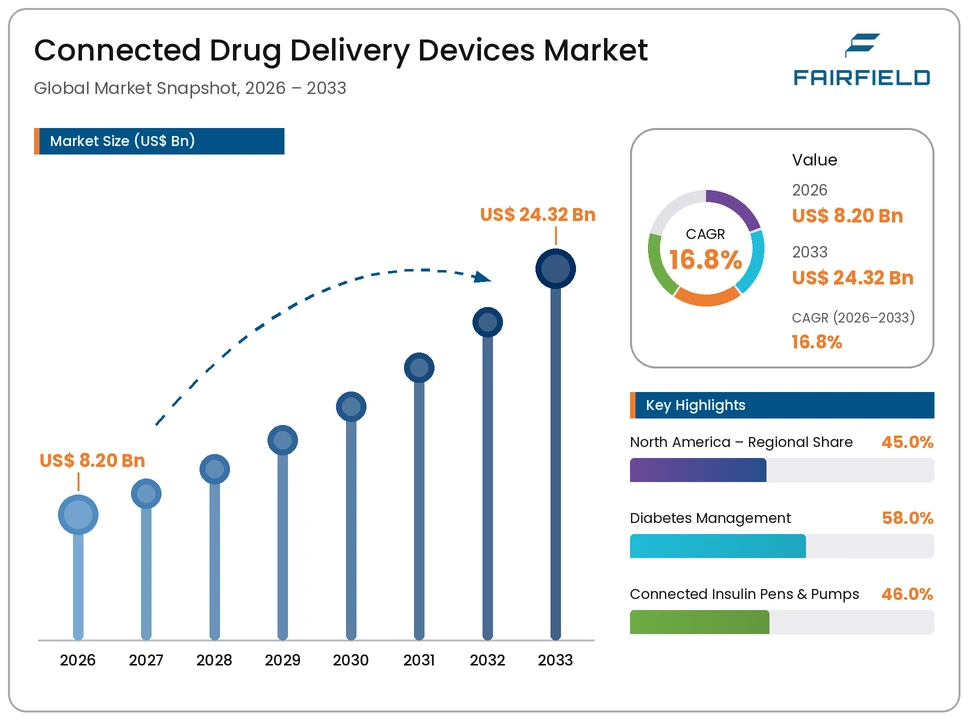
The market is valued at USD 8.20 Billion in 2026, with device manufacturers directing substantial investment toward improved connectivity reliability and expanded data integration with broader digital health and care coordination platforms. By 2033, the market is forecast to reach USD 24.32 Billion, reflecting rapid growth across established diabetes management applications alongside accelerating respiratory disease management adoption.
Key Highlights
- The global connected drug delivery devices market is valued at USD 8.20 Billion in 2026 and is projected to reach USD 24.32 Billion by 2033, expanding at a CAGR of 16.8% across the 2026-2033 forecast period.
- Connected Insulin Pens & Pumps lead the product-type segment with a 46.0% share in 2026, equivalent to USD 3.77 Billion.
- Diabetes Management remains the dominant application, accounting for 58.0% of global demand, or USD 4.76 Billion, in 2026.
- North America commands the largest regional share at 45.0% of the global market in 2026.
- Respiratory disease management is emerging as the fastest-growing application through 2033.
Key Growth Drivers
Growth in the connected drug delivery devices market is driven primarily by growing chronic disease prevalence, as increasing rates of diabetes and respiratory conditions requiring long-term medication management create substantial and growing demand for adherence tracking and treatment optimization technology.
A second driver is increasing healthcare payer and provider recognition of connected device data's value, as adherence data collected through connected devices increasingly supports more informed treatment adjustments and early identification of non-adherence patterns that can be addressed before they affect health outcomes.
Key Restraints
The additional cost of connected drug delivery devices relative to conventional, non-connected alternatives creates an affordability barrier for some patients, particularly those without comprehensive insurance coverage for connected device technology.
Additionally, data privacy and security concerns associated with connected medical devices transmitting personal health information create regulatory compliance complexity that device manufacturers must carefully navigate across different international markets.
Market Opportunities
The expansion of respiratory disease management applications presents a substantial opportunity, as connected inhaler technology remains at an earlier adoption stage relative to connected insulin delivery devices, creating substantial headroom for growth as this technology matures.
A second opportunity lies in continued integration of connected drug delivery devices with broader digital health platforms and care coordination systems, providing care teams with comprehensive treatment adherence visibility. Companies that successfully build this broader digital health ecosystem integration stand to capture growing demand as healthcare systems increasingly prioritize coordinated, data-driven chronic disease management.
Segmentation Analysis
- By Product Type
Connected Insulin Pens & Pumps lead the product-type segment, accounting for 46.0% of global market value in 2026, equivalent to USD 3.77 Billion. Their leadership reflects the substantial and established diabetes patient population requiring precise, trackable insulin dosing. Connected Auto-Injectors represent a significant, established product-type category. Connected Inhalers represent the fastest-growing product-type category through 2033, driven by growing respiratory disease management technology adoption.
- By Application
Diabetes Management forms the leading application segment, representing 58.0% of global demand in 2026, or USD 4.76 Billion, reflecting the scale of the global diabetic patient population requiring ongoing insulin management. Respiratory Disease Management represents the fastest-growing application category, propelled by growing connected inhaler technology adoption among asthma and COPD patients.
Regional Insights
- North America
North America holds the largest regional share, at 45.0% of the global market in 2026, equivalent to USD 3.69 Billion. The region's leadership reflects strong connected device adoption and substantial healthcare payer support for digital health technology across the United States and Canada.
- Europe
Europe accounts for 27.0% of the global market in 2026, valued at USD 2.21 Billion. Demand is supported by growing chronic disease management technology adoption and expanding digital health infrastructure across major European markets.
- Asia Pacific
Asia Pacific represents 20.0% of the global market in 2026, or USD 1.64 Billion. Growth is underpinned by rising diabetes prevalence and expanding connected medical device adoption across China, Japan, and India.
- Latin America
Latin America contributes 5.0% of the global market in 2026, equivalent to USD 0.41 Billion. Growth is linked to expanding chronic disease management technology adoption in Brazil and Mexico.
- Middle East & Africa
Middle East & Africa holds 3.0% of the global market in 2026, valued at USD 0.25 Billion. Growth remains gradual, tied to expanding healthcare technology infrastructure across the region.
Competitive Landscape
The global connected drug delivery devices market is moderately concentrated, with a mix of established medical device manufacturers and specialized diabetes technology companies competing for adoption across diabetes and respiratory disease applications. Competition centers on device connectivity reliability, dosing accuracy, and the strength of integration with broader digital health and care coordination platforms. Companies are increasingly differentiating through expanded respiratory and auto-injector connectivity capability rather than competing on insulin delivery devices alone.
Key Market Players
- Becton, Dickinson and Company
- Novo Nordisk A/S
- Ypsomed Holding AG
- Medtronic plc
- Insulet Corporation
- Tandem Diabetes Care, Inc.
- Halozyme Therapeutics, Inc.
- Elcam Medical
- Molex, LLC
- SHL Medical AG
Market Segmentation
By Product Type
- Connected Insulin Pens & Pumps
- Connected Inhalers
- Connected Auto-Injectors
- Others
By Application
- Diabetes Management
- Respiratory Disease Management
- Others
By Connectivity Type
- Bluetooth-Enabled
- Cellular-Connected
By Geography
- North America
- Europe
- Asia Pacific
- Latin America
- Middle East & Africa
- Executive Summary
- Global Connected Drug Delivery Devices Market Snapshot
- Future Projections
- Key Market Trends
- Regional Snapshot, by Value, 2026
- Analyst Recommendations
- Market Overview
- Market Definitions and Segmentations
- Market Dynamics
- Drivers
- Restraints
- Market Opportunities
- Value Chain Analysis
- COVID-19 Impact Analysis
- Porter's Five Forces Analysis
- Impact of Russia-Ukraine Conflict
- PESTLE Analysis
- Regulatory Analysis
- Price Trend Analysis
- Current Prices and Future Projections, 2025-2033
- Price Impact Factors
- Global Connected Drug Delivery Devices Market Outlook, 2020 - 2033
- Global Connected Drug Delivery Devices Market Outlook, by Product Type, Value (US$ Bn), 2020-2033
- Connected Insulin Pens & Pumps
- Connected Inhalers
- Connected Auto-Injectors
- Others
- Global Connected Drug Delivery Devices Market Outlook, by Application, Value (US$ Bn), 2020-2033
- Diabetes Management
- Respiratory Disease Management
- Others
- Global Connected Drug Delivery Devices Market Outlook, by Connectivity Type, Value (US$ Bn), 2020-2033
- Bluetooth-Enabled
- Cellular-Connected
- Global Connected Drug Delivery Devices Market Outlook, by Region, Value (US$ Bn), 2020-2033
- North America
- Europe
- Asia Pacific
- Latin America
- Middle East & Africa
- Global Connected Drug Delivery Devices Market Outlook, by Product Type, Value (US$ Bn), 2020-2033
- North America Connected Drug Delivery Devices Market Outlook, 2020 - 2033
- North America Connected Drug Delivery Devices Market Outlook, by Product Type, Value (US$ Bn), 2020-2033
- Connected Insulin Pens & Pumps
- Connected Inhalers
- Connected Auto-Injectors
- Others
- North America Connected Drug Delivery Devices Market Outlook, by Application, Value (US$ Bn), 2020-2033
- Diabetes Management
- Respiratory Disease Management
- Others
- North America Connected Drug Delivery Devices Market Outlook, by Connectivity Type, Value (US$ Bn), 2020-2033
- Bluetooth-Enabled
- Cellular-Connected
- North America Connected Drug Delivery Devices Market Outlook, by Country, Value (US$ Bn), 2020-2033
- U.S. Connected Drug Delivery Devices Market Outlook, by Product Type, 2020-2033
- U.S. Connected Drug Delivery Devices Market Outlook, by Application, 2020-2033
- U.S. Connected Drug Delivery Devices Market Outlook, by Connectivity Type, 2020-2033
- Canada Connected Drug Delivery Devices Market Outlook, by Product Type, 2020-2033
- Canada Connected Drug Delivery Devices Market Outlook, by Application, 2020-2033
- Canada Connected Drug Delivery Devices Market Outlook, by Connectivity Type, 2020-2033
- BPS Analysis/Market Attractiveness Analysis
- North America Connected Drug Delivery Devices Market Outlook, by Product Type, Value (US$ Bn), 2020-2033
- Europe Connected Drug Delivery Devices Market Outlook, 2020 - 2033
- Europe Connected Drug Delivery Devices Market Outlook, by Product Type, Value (US$ Bn), 2020-2033
- Connected Insulin Pens & Pumps
- Connected Inhalers
- Connected Auto-Injectors
- Others
- Europe Connected Drug Delivery Devices Market Outlook, by Application, Value (US$ Bn), 2020-2033
- Diabetes Management
- Respiratory Disease Management
- Others
- Europe Connected Drug Delivery Devices Market Outlook, by Connectivity Type, Value (US$ Bn), 2020-2033
- Bluetooth-Enabled
- Cellular-Connected
- Europe Connected Drug Delivery Devices Market Outlook, by Country, Value (US$ Bn), 2020-2033
- Germany Connected Drug Delivery Devices Market Outlook, by Product Type, 2020-2033
- Germany Connected Drug Delivery Devices Market Outlook, by Application, 2020-2033
- Germany Connected Drug Delivery Devices Market Outlook, by Connectivity Type, 2020-2033
- Italy Connected Drug Delivery Devices Market Outlook, by Product Type, 2020-2033
- Italy Connected Drug Delivery Devices Market Outlook, by Application, 2020-2033
- Italy Connected Drug Delivery Devices Market Outlook, by Connectivity Type, 2020-2033
- France Connected Drug Delivery Devices Market Outlook, by Product Type, 2020-2033
- France Connected Drug Delivery Devices Market Outlook, by Application, 2020-2033
- France Connected Drug Delivery Devices Market Outlook, by Connectivity Type, 2020-2033
- U.K. Connected Drug Delivery Devices Market Outlook, by Product Type, 2020-2033
- U.K. Connected Drug Delivery Devices Market Outlook, by Application, 2020-2033
- U.K. Connected Drug Delivery Devices Market Outlook, by Connectivity Type, 2020-2033
- Spain Connected Drug Delivery Devices Market Outlook, by Product Type, 2020-2033
- Spain Connected Drug Delivery Devices Market Outlook, by Application, 2020-2033
- Spain Connected Drug Delivery Devices Market Outlook, by Connectivity Type, 2020-2033
- Russia Connected Drug Delivery Devices Market Outlook, by Product Type, 2020-2033
- Russia Connected Drug Delivery Devices Market Outlook, by Application, 2020-2033
- Russia Connected Drug Delivery Devices Market Outlook, by Connectivity Type, 2020-2033
- Rest of Europe Connected Drug Delivery Devices Market Outlook, by Product Type, 2020-2033
- Rest of Europe Connected Drug Delivery Devices Market Outlook, by Application, 2020-2033
- Rest of Europe Connected Drug Delivery Devices Market Outlook, by Connectivity Type, 2020-2033
- BPS Analysis/Market Attractiveness Analysis
- Europe Connected Drug Delivery Devices Market Outlook, by Product Type, Value (US$ Bn), 2020-2033
- Asia Pacific Connected Drug Delivery Devices Market Outlook, 2020 - 2033
- Asia Pacific Connected Drug Delivery Devices Market Outlook, by Product Type, Value (US$ Bn), 2020-2033
- Connected Insulin Pens & Pumps
- Connected Inhalers
- Connected Auto-Injectors
- Others
- Asia Pacific Connected Drug Delivery Devices Market Outlook, by Application, Value (US$ Bn), 2020-2033
- Diabetes Management
- Respiratory Disease Management
- Others
- Asia Pacific Connected Drug Delivery Devices Market Outlook, by Connectivity Type, Value (US$ Bn), 2020-2033
- Bluetooth-Enabled
- Cellular-Connected
- Asia Pacific Connected Drug Delivery Devices Market Outlook, by Country, Value (US$ Bn), 2020-2033
- China Connected Drug Delivery Devices Market Outlook, by Product Type, 2020-2033
- China Connected Drug Delivery Devices Market Outlook, by Application, 2020-2033
- China Connected Drug Delivery Devices Market Outlook, by Connectivity Type, 2020-2033
- Japan Connected Drug Delivery Devices Market Outlook, by Product Type, 2020-2033
- Japan Connected Drug Delivery Devices Market Outlook, by Application, 2020-2033
- Japan Connected Drug Delivery Devices Market Outlook, by Connectivity Type, 2020-2033
- South Korea Connected Drug Delivery Devices Market Outlook, by Product Type, 2020-2033
- South Korea Connected Drug Delivery Devices Market Outlook, by Application, 2020-2033
- South Korea Connected Drug Delivery Devices Market Outlook, by Connectivity Type, 2020-2033
- India Connected Drug Delivery Devices Market Outlook, by Product Type, 2020-2033
- India Connected Drug Delivery Devices Market Outlook, by Application, 2020-2033
- India Connected Drug Delivery Devices Market Outlook, by Connectivity Type, 2020-2033
- Southeast Asia Connected Drug Delivery Devices Market Outlook, by Product Type, 2020-2033
- Southeast Asia Connected Drug Delivery Devices Market Outlook, by Application, 2020-2033
- Southeast Asia Connected Drug Delivery Devices Market Outlook, by Connectivity Type, 2020-2033
- Rest of SAO Connected Drug Delivery Devices Market Outlook, by Product Type, 2020-2033
- Rest of SAO Connected Drug Delivery Devices Market Outlook, by Application, 2020-2033
- Rest of SAO Connected Drug Delivery Devices Market Outlook, by Connectivity Type, 2020-2033
- BPS Analysis/Market Attractiveness Analysis
- Asia Pacific Connected Drug Delivery Devices Market Outlook, by Product Type, Value (US$ Bn), 2020-2033
- Latin America Connected Drug Delivery Devices Market Outlook, 2020 - 2033
- Latin America Connected Drug Delivery Devices Market Outlook, by Product Type, Value (US$ Bn), 2020-2033
- Connected Insulin Pens & Pumps
- Connected Inhalers
- Connected Auto-Injectors
- Others
- Latin America Connected Drug Delivery Devices Market Outlook, by Application, Value (US$ Bn), 2020-2033
- Diabetes Management
- Respiratory Disease Management
- Others
- Latin America Connected Drug Delivery Devices Market Outlook, by Connectivity Type, Value (US$ Bn), 2020-2033
- Bluetooth-Enabled
- Cellular-Connected
- Latin America Connected Drug Delivery Devices Market Outlook, by Country, Value (US$ Bn), 2020-2033
- Brazil Connected Drug Delivery Devices Market Outlook, by Product Type, 2020-2033
- Brazil Connected Drug Delivery Devices Market Outlook, by Application, 2020-2033
- Brazil Connected Drug Delivery Devices Market Outlook, by Connectivity Type, 2020-2033
- Mexico Connected Drug Delivery Devices Market Outlook, by Product Type, 2020-2033
- Mexico Connected Drug Delivery Devices Market Outlook, by Application, 2020-2033
- Mexico Connected Drug Delivery Devices Market Outlook, by Connectivity Type, 2020-2033
- Argentina Connected Drug Delivery Devices Market Outlook, by Product Type, 2020-2033
- Argentina Connected Drug Delivery Devices Market Outlook, by Application, 2020-2033
- Argentina Connected Drug Delivery Devices Market Outlook, by Connectivity Type, 2020-2033
- Rest of LATAM Connected Drug Delivery Devices Market Outlook, by Product Type, 2020-2033
- Rest of LATAM Connected Drug Delivery Devices Market Outlook, by Application, 2020-2033
- Rest of LATAM Connected Drug Delivery Devices Market Outlook, by Connectivity Type, 2020-2033
- BPS Analysis/Market Attractiveness Analysis
- Latin America Connected Drug Delivery Devices Market Outlook, by Product Type, Value (US$ Bn), 2020-2033
- Middle East & Africa Connected Drug Delivery Devices Market Outlook, 2020 - 2033
- Middle East & Africa Connected Drug Delivery Devices Market Outlook, by Product Type, Value (US$ Bn), 2020-2033
- Connected Insulin Pens & Pumps
- Connected Inhalers
- Connected Auto-Injectors
- Others
- Middle East & Africa Connected Drug Delivery Devices Market Outlook, by Application, Value (US$ Bn), 2020-2033
- Diabetes Management
- Respiratory Disease Management
- Others
- Middle East & Africa Connected Drug Delivery Devices Market Outlook, by Connectivity Type, Value (US$ Bn), 2020-2033
- Bluetooth-Enabled
- Cellular-Connected
- Middle East & Africa Connected Drug Delivery Devices Market Outlook, by Country, Value (US$ Bn), 2020-2033
- GCC Connected Drug Delivery Devices Market Outlook, by Product Type, 2020-2033
- GCC Connected Drug Delivery Devices Market Outlook, by Application, 2020-2033
- GCC Connected Drug Delivery Devices Market Outlook, by Connectivity Type, 2020-2033
- South Africa Connected Drug Delivery Devices Market Outlook, by Product Type, 2020-2033
- South Africa Connected Drug Delivery Devices Market Outlook, by Application, 2020-2033
- South Africa Connected Drug Delivery Devices Market Outlook, by Connectivity Type, 2020-2033
- Egypt Connected Drug Delivery Devices Market Outlook, by Product Type, 2020-2033
- Egypt Connected Drug Delivery Devices Market Outlook, by Application, 2020-2033
- Egypt Connected Drug Delivery Devices Market Outlook, by Connectivity Type, 2020-2033
- Nigeria Connected Drug Delivery Devices Market Outlook, by Product Type, 2020-2033
- Nigeria Connected Drug Delivery Devices Market Outlook, by Application, 2020-2033
- Nigeria Connected Drug Delivery Devices Market Outlook, by Connectivity Type, 2020-2033
- Rest of Middle East Connected Drug Delivery Devices Market Outlook, by Product Type, 2020-2033
- Rest of Middle East Connected Drug Delivery Devices Market Outlook, by Application, 2020-2033
- Rest of Middle East Connected Drug Delivery Devices Market Outlook, by Connectivity Type, 2020-2033
- BPS Analysis/Market Attractiveness Analysis
- Middle East & Africa Connected Drug Delivery Devices Market Outlook, by Product Type, Value (US$ Bn), 2020-2033
- Competitive Landscape
- Company Vs Segment Heatmap
- Company Market Share Analysis, 2025
- Competitive Dashboard
- Company Profiles
- Becton, Dickinson and Company
- Company Overview
- Product Portfolio
- Financial Overview
- Business Strategies and Developments
- Novo Nordisk A/S
- Ypsomed Holding AG
- Medtronic plc
- Insulet Corporation
- Tandem Diabetes Care, Inc.
- Halozyme Therapeutics, Inc.
- Elcam Medical
- Molex, LLC
- SHL Medical AG
- Becton, Dickinson and Company
- Appendix
- Research Methodology
- Report Assumptions
- Acronyms and Abbreviations
By Product Type
- Connected Insulin Pens & Pumps
- Connected Inhalers
- Connected Auto-Injectors
- Others
By Application
- Diabetes Management
- Respiratory Disease Management
- Others
By Connectivity Type
- Bluetooth-Enabled
- Cellular-Connected
By Geography
- North America
- Europe
- Asia Pacific
- Latin America
- Middle East & Africa
Our Research Methodology
Considering the volatility of business today, traditional approaches to strategizing a game plan can be unfruitful if not detrimental. True ambiguity is no way to determine a forecast. A myriad of predetermined factors must be accounted for such as the degree of risk involved, the magnitude of circumstances, as well as conditions or consequences that are not known or unpredictable. To circumvent binary views that cast uncertainty, the application of market research intelligence to strategically posture, move, and enable actionable outcomes is necessary.
View Methodology
Quality Assured
Rigorous Validation Process

Confidentiality Assured
End-to-end Data Security

Custom Research Services
Tailored To Your Objectives
FAQs
The global connected drug delivery devices market is valued at USD 8.20 Billion in 2026, reflecting growing adoption of adherence-tracking medical technology.
The market is projected to grow at a CAGR of 16.8%, reaching USD 24.32 Billion by 2033, driven by chronic disease prevalence and payer recognition of adherence data value.
Connected Insulin Pens & Pumps lead with a 46.0% share in 2026, reflecting the substantial global diabetic patient population.
North America leads with a 45.0% share in 2026, supported by strong connected device adoption and payer support.
The largest opportunity lies in respiratory disease management, expanding as connected inhaler technology adoption accelerates.
Related Reports
Diagnostic Imaging Services Market Size, Share, Insights, Competitive Landscape, and Forecast 2026 to 2033
The diagnostic imaging services market is valued at US$600.05 billion in 2026 and is projected to reach US$908.23 billion by 2033, growing at a 6.1% CAGR.
TAVR (Transcatheter Aortic Valve Replacement) Market Size, Share, Insights, Competitive Landscape, and Forecast 2026 to 2033
The global TAVR market is valued at US$7.2 billion in 2026 and is projected to reach US$14 billion by 2033, growing at 9.97% CAGR
Specimen Collection Cards Market Size, Share, Insights, Competitive Landscape, and Forecast 2026 to 2033
The specimen collection cards market is valued at US$498.5 million in 2026 and is projected to reach US$687.5 million by 2033, growing at a 4.7% CAGR.
Point of Care CT Imaging Systems Market Size, Share, Insights, Competitive Landscape, and Forecast 2026 to 2033
The global point-of-care CT imaging systems market is valued at US$0.7 billion in 2026, reaching US$1.4 billion by 2033, growing at a 10.41% CAGR
Transcutaneous Oximetry Systems Market Size, Share, Insights, Competitive Landscape, and Forecast 2026 to 2033
The global transcutaneous oximetry systems market is projected to grow from US$0.4 billion in 2026 to US$0.6 billion by 2033, at a 5.96% CAGR
Healthcare Quality Management Software Market Size, Share, Insights, Competitive Landscape, and Forecast 2026 to 2033
The global healthcare quality management software market will reach US$ 3.80 Billion by 2033, growing at 12.2% CAGR from 2026-2033