



Cosmetic Nanoencapsulation Market
Cosmetic Nanoencapsulation Market
Market Overview
Cosmetic nanoencapsulation technology encloses active cosmetic ingredients within microscopic delivery structures, including liposomes, nanoemulsions, and solid lipid nanoparticles, designed to improve ingredient stability, skin penetration, and controlled release across skin care, hair care, and color cosmetic applications. As consumer demand for high-performance, scientifically validated cosmetic products has grown, nanoencapsulation technology has become an increasingly important tool for formulators seeking to improve the efficacy and stability of active cosmetic ingredients.
Demand growth through the 2026-2033 window is closely tied to growing consumer demand for high-performance, clinically differentiated cosmetic products supporting premium ingredient delivery technology adoption, continued formulation technology advancement improving nanoencapsulation stability and manufacturing scalability, and expanding application of nanoencapsulation technology across an increasing range of cosmetic product categories beyond traditional skin care. Growing regulatory and consumer interest in ingredient safety and efficacy validation continues to support demand for technologies that improve controlled, targeted ingredient delivery.
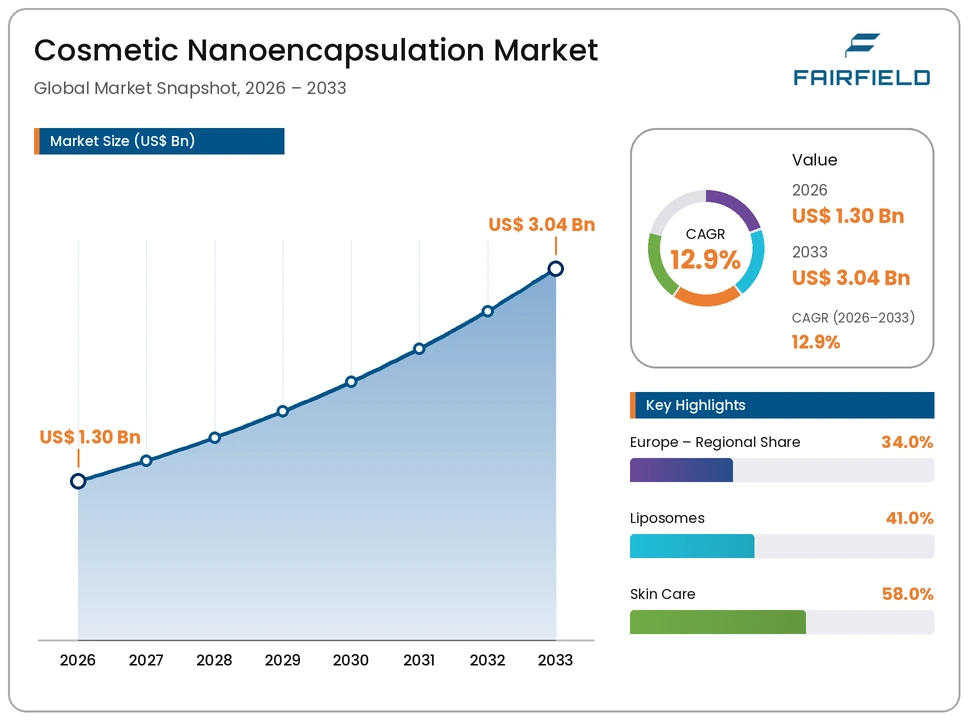
The market is valued at USD 1.30 Billion in 2026, with ingredient technology developers directing investment toward improved encapsulation stability and manufacturing cost efficiency that broadens nanoencapsulation technology’s commercial viability across mainstream cosmetic product tiers. By 2033, the market is forecast to reach USD 3.04 Billion, reflecting steady growth across established skin care applications alongside expanding color cosmetics adoption.
Key Highlights
- The global cosmetic nanoencapsulation market is valued at USD 1.30 Billion in 2026 and is projected to reach USD 3.04 Billion by 2033, expanding at a CAGR of 12.9% across the 2026-2033 forecast period.
- Liposomes lead the encapsulation-technology segment with a 41.0% share in 2026, equivalent to USD 0.53 Billion.
- Skin Care remains the dominant application, accounting for 58.0% of global demand, or USD 0.75 Billion, in 2026.
- Europe commands the largest regional share at 34.0% of the global market in 2026.
- Color cosmetics applications are emerging as the fastest-growing application through 2033.
Market Dynamics
- Key Growth Drivers
Growth in the cosmetic nanoencapsulation market is driven primarily by growing consumer demand for high-performance, clinically differentiated cosmetic products, as consumers increasingly seek products with demonstrated efficacy advantages that nanoencapsulation technology can help deliver through improved active ingredient stability and skin penetration.
A second driver is continued formulation technology advancement, as improving nanoencapsulation stability and manufacturing scalability make this technology increasingly accessible and cost-effective for a broader range of cosmetic product manufacturers beyond premium, high-end formulations.
- Key Restraints
Regulatory scrutiny of nanomaterials in cosmetic products creates compliance complexity across different international markets, as regulatory frameworks governing nanotechnology safety and labeling requirements continue to evolve and vary across jurisdictions.
Additionally, the specialized manufacturing expertise and equipment required for consistent, high-quality nanoencapsulation production create cost and complexity barriers relative to conventional cosmetic ingredient formulation approaches.
- Market Opportunities
The expansion of color cosmetics applications presents a substantial opportunity, as growing interest in long-lasting, high-performance color cosmetic formulations creates demand for nanoencapsulation technology beyond its traditional skin care application focus.
A second opportunity lies in continued formulation technology advancement that improves manufacturing scalability and cost efficiency, broadening nanoencapsulation technology’s accessibility across mainstream cosmetic product tiers. Companies that successfully advance this manufacturing scalability stand to capture growing demand as the technology becomes increasingly commercially viable beyond premium product positioning.
Segmentation Analysis
- By Encapsulation Technology
Liposomes lead the encapsulation-technology segment, accounting for 41.0% of global market value in 2026, equivalent to USD 0.53 Billion. Their leadership reflects liposomes’ established manufacturing track record and broad compatibility with a wide range of active cosmetic ingredients. Nanoemulsions represent a significant, established encapsulation-technology category. Solid Lipid Nanoparticles represent the fastest-growing encapsulation-technology category through 2033, driven by their improved stability characteristics relative to earlier-generation encapsulation approaches.
- By Application
Skin Care forms the leading application segment, representing 58.0% of global demand in 2026, or USD 0.75 Billion, reflecting skin care’s substantial scale and strong consumer demand for high-performance active ingredient delivery. Hair Care represents a significant, established application category. Color Cosmetics represents the fastest-growing application category, propelled by growing interest in long-lasting, high-performance color formulations.
Regional Insights
- Europe
Europe holds the largest regional share, at 34.0% of the global market in 2026, equivalent to USD 0.44 Billion. The region’s leadership reflects a sophisticated cosmetic ingredient innovation ecosystem and strong consumer demand for scientifically validated cosmetic products across major European markets.
- North America
North America accounts for 32.0% of the global market in 2026, valued at USD 0.42 Billion. Demand is supported by strong consumer interest in premium, high-performance cosmetic products across the United States and Canada.
- Asia Pacific
Asia Pacific represents 26.0% of the global market in 2026, or USD 0.34 Billion. Growth is underpinned by rapidly expanding premium cosmetics consumption and growing ingredient technology investment across China, Japan, and South Korea.
- Latin America
Latin America contributes 5.0% of the global market in 2026, equivalent to USD 0.07 Billion. Growth is linked to expanding premium cosmetics category development in Brazil and Mexico.
- Middle East & Africa
Middle East & Africa holds 3.0% of the global market in 2026, valued at USD 0.04 Billion. Growth remains gradual, tied to expanding premium cosmetics accessibility across the region.
Competitive Landscape
The global cosmetic nanoencapsulation market is moderately fragmented, with a mix of large diversified specialty chemical companies and specialized cosmetic ingredient technology developers competing for cosmetic manufacturer adoption. Competition centers on encapsulation technology stability and efficacy performance, formulation flexibility across active ingredients, and manufacturing scale supporting competitive ingredient pricing. Companies are increasingly differentiating through expanded solid lipid nanoparticle capability rather than competing on traditional liposome technology alone.
Key Market Players
- BASF SE
- Croda International Plc
- Evonik Industries AG
- Clariant AG
- Lubrizol Corporation
- Ashland Global Holdings Inc.
- DSM-Firmenich AG
- Symrise AG
- Kobo Products, Inc.
- Sederma S.A.S.
Market Segmentation
By Encapsulation Technology
- Liposomes
- Nanoemulsions
- Solid Lipid Nanoparticles
- Others
By Application
- Skin Care
- Hair Care
- Color Cosmetics
- Others
By End Product Format
- Creams & Serums
- Masks & Treatments
By Geography
- North America
- Europe
- Asia Pacific
- Latin America
- Middle East & Africa
- Executive Summary
- Global Cosmetic Nanoencapsulation Market Snapshot
- Future Projections
- Key Market Trends
- Regional Snapshot, by Value, 2026
- Analyst Recommendations
- Market Overview
- Market Definitions and Segmentations
- Market Dynamics
- Drivers
- Restraints
- Market Opportunities
- Value Chain Analysis
- COVID-19 Impact Analysis
- Porter's Five Forces Analysis
- Impact of Russia-Ukraine Conflict
- PESTLE Analysis
- Regulatory Analysis
- Price Trend Analysis
- Current Prices and Future Projections, 2025-2033
- Price Impact Factors
- Global Cosmetic Nanoencapsulation Market Outlook, 2020 - 2033
- Global Cosmetic Nanoencapsulation Market Outlook, by Encapsulation Technology, Value (US$ Bn), 2020-2033
- Liposomes
- Nanoemulsions
- Solid Lipid Nanoparticles
- Others
- Global Cosmetic Nanoencapsulation Market Outlook, by Application, Value (US$ Bn), 2020-2033
- Skin Care
- Hair Care
- Color Cosmetics
- Others
- Global Cosmetic Nanoencapsulation Market Outlook, by End Product Format, Value (US$ Bn), 2020-2033
- Creams & Serums
- Masks & Treatments
- Global Cosmetic Nanoencapsulation Market Outlook, by Region, Value (US$ Bn), 2020-2033
- North America
- Europe
- Asia Pacific
- Latin America
- Middle East & Africa
- Global Cosmetic Nanoencapsulation Market Outlook, by Encapsulation Technology, Value (US$ Bn), 2020-2033
- North America Cosmetic Nanoencapsulation Market Outlook, 2020 - 2033
- North America Cosmetic Nanoencapsulation Market Outlook, by Encapsulation Technology, Value (US$ Bn), 2020-2033
- Liposomes
- Nanoemulsions
- Solid Lipid Nanoparticles
- Others
- North America Cosmetic Nanoencapsulation Market Outlook, by Application, Value (US$ Bn), 2020-2033
- Skin Care
- Hair Care
- Color Cosmetics
- Others
- North America Cosmetic Nanoencapsulation Market Outlook, by End Product Format, Value (US$ Bn), 2020-2033
- Creams & Serums
- Masks & Treatments
- North America Cosmetic Nanoencapsulation Market Outlook, by Country, Value (US$ Bn), 2020-2033
- U.S. Cosmetic Nanoencapsulation Market Outlook, by Encapsulation Technology, 2020-2033
- U.S. Cosmetic Nanoencapsulation Market Outlook, by Application, 2020-2033
- U.S. Cosmetic Nanoencapsulation Market Outlook, by End Product Format, 2020-2033
- Canada Cosmetic Nanoencapsulation Market Outlook, by Encapsulation Technology, 2020-2033
- Canada Cosmetic Nanoencapsulation Market Outlook, by Application, 2020-2033
- Canada Cosmetic Nanoencapsulation Market Outlook, by End Product Format, 2020-2033
- BPS Analysis/Market Attractiveness Analysis
- North America Cosmetic Nanoencapsulation Market Outlook, by Encapsulation Technology, Value (US$ Bn), 2020-2033
- Europe Cosmetic Nanoencapsulation Market Outlook, 2020 - 2033
- Europe Cosmetic Nanoencapsulation Market Outlook, by Encapsulation Technology, Value (US$ Bn), 2020-2033
- Liposomes
- Nanoemulsions
- Solid Lipid Nanoparticles
- Others
- Europe Cosmetic Nanoencapsulation Market Outlook, by Application, Value (US$ Bn), 2020-2033
- Skin Care
- Hair Care
- Color Cosmetics
- Others
- Europe Cosmetic Nanoencapsulation Market Outlook, by End Product Format, Value (US$ Bn), 2020-2033
- Creams & Serums
- Masks & Treatments
- Europe Cosmetic Nanoencapsulation Market Outlook, by Country, Value (US$ Bn), 2020-2033
- Germany Cosmetic Nanoencapsulation Market Outlook, by Encapsulation Technology, 2020-2033
- Germany Cosmetic Nanoencapsulation Market Outlook, by Application, 2020-2033
- Germany Cosmetic Nanoencapsulation Market Outlook, by End Product Format, 2020-2033
- Italy Cosmetic Nanoencapsulation Market Outlook, by Encapsulation Technology, 2020-2033
- Italy Cosmetic Nanoencapsulation Market Outlook, by Application, 2020-2033
- Italy Cosmetic Nanoencapsulation Market Outlook, by End Product Format, 2020-2033
- France Cosmetic Nanoencapsulation Market Outlook, by Encapsulation Technology, 2020-2033
- France Cosmetic Nanoencapsulation Market Outlook, by Application, 2020-2033
- France Cosmetic Nanoencapsulation Market Outlook, by End Product Format, 2020-2033
- U.K. Cosmetic Nanoencapsulation Market Outlook, by Encapsulation Technology, 2020-2033
- U.K. Cosmetic Nanoencapsulation Market Outlook, by Application, 2020-2033
- U.K. Cosmetic Nanoencapsulation Market Outlook, by End Product Format, 2020-2033
- Spain Cosmetic Nanoencapsulation Market Outlook, by Encapsulation Technology, 2020-2033
- Spain Cosmetic Nanoencapsulation Market Outlook, by Application, 2020-2033
- Spain Cosmetic Nanoencapsulation Market Outlook, by End Product Format, 2020-2033
- Russia Cosmetic Nanoencapsulation Market Outlook, by Encapsulation Technology, 2020-2033
- Russia Cosmetic Nanoencapsulation Market Outlook, by Application, 2020-2033
- Russia Cosmetic Nanoencapsulation Market Outlook, by End Product Format, 2020-2033
- Rest of Europe Cosmetic Nanoencapsulation Market Outlook, by Encapsulation Technology, 2020-2033
- Rest of Europe Cosmetic Nanoencapsulation Market Outlook, by Application, 2020-2033
- Rest of Europe Cosmetic Nanoencapsulation Market Outlook, by End Product Format, 2020-2033
- BPS Analysis/Market Attractiveness Analysis
- Europe Cosmetic Nanoencapsulation Market Outlook, by Encapsulation Technology, Value (US$ Bn), 2020-2033
- Asia Pacific Cosmetic Nanoencapsulation Market Outlook, 2020 - 2033
- Asia Pacific Cosmetic Nanoencapsulation Market Outlook, by Encapsulation Technology, Value (US$ Bn), 2020-2033
- Liposomes
- Nanoemulsions
- Solid Lipid Nanoparticles
- Others
- Asia Pacific Cosmetic Nanoencapsulation Market Outlook, by Application, Value (US$ Bn), 2020-2033
- Skin Care
- Hair Care
- Color Cosmetics
- Others
- Asia Pacific Cosmetic Nanoencapsulation Market Outlook, by End Product Format, Value (US$ Bn), 2020-2033
- Creams & Serums
- Masks & Treatments
- Asia Pacific Cosmetic Nanoencapsulation Market Outlook, by Country, Value (US$ Bn), 2020-2033
- China Cosmetic Nanoencapsulation Market Outlook, by Encapsulation Technology, 2020-2033
- China Cosmetic Nanoencapsulation Market Outlook, by Application, 2020-2033
- China Cosmetic Nanoencapsulation Market Outlook, by End Product Format, 2020-2033
- Japan Cosmetic Nanoencapsulation Market Outlook, by Encapsulation Technology, 2020-2033
- Japan Cosmetic Nanoencapsulation Market Outlook, by Application, 2020-2033
- Japan Cosmetic Nanoencapsulation Market Outlook, by End Product Format, 2020-2033
- South Korea Cosmetic Nanoencapsulation Market Outlook, by Encapsulation Technology, 2020-2033
- South Korea Cosmetic Nanoencapsulation Market Outlook, by Application, 2020-2033
- South Korea Cosmetic Nanoencapsulation Market Outlook, by End Product Format, 2020-2033
- India Cosmetic Nanoencapsulation Market Outlook, by Encapsulation Technology, 2020-2033
- India Cosmetic Nanoencapsulation Market Outlook, by Application, 2020-2033
- India Cosmetic Nanoencapsulation Market Outlook, by End Product Format, 2020-2033
- Southeast Asia Cosmetic Nanoencapsulation Market Outlook, by Encapsulation Technology, 2020-2033
- Southeast Asia Cosmetic Nanoencapsulation Market Outlook, by Application, 2020-2033
- Southeast Asia Cosmetic Nanoencapsulation Market Outlook, by End Product Format, 2020-2033
- Rest of SAO Cosmetic Nanoencapsulation Market Outlook, by Encapsulation Technology, 2020-2033
- Rest of SAO Cosmetic Nanoencapsulation Market Outlook, by Application, 2020-2033
- Rest of SAO Cosmetic Nanoencapsulation Market Outlook, by End Product Format, 2020-2033
- BPS Analysis/Market Attractiveness Analysis
- Asia Pacific Cosmetic Nanoencapsulation Market Outlook, by Encapsulation Technology, Value (US$ Bn), 2020-2033
- Latin America Cosmetic Nanoencapsulation Market Outlook, 2020 - 2033
- Latin America Cosmetic Nanoencapsulation Market Outlook, by Encapsulation Technology, Value (US$ Bn), 2020-2033
- Liposomes
- Nanoemulsions
- Solid Lipid Nanoparticles
- Others
- Latin America Cosmetic Nanoencapsulation Market Outlook, by Application, Value (US$ Bn), 2020-2033
- Skin Care
- Hair Care
- Color Cosmetics
- Others
- Latin America Cosmetic Nanoencapsulation Market Outlook, by End Product Format, Value (US$ Bn), 2020-2033
- Creams & Serums
- Masks & Treatments
- Latin America Cosmetic Nanoencapsulation Market Outlook, by Country, Value (US$ Bn), 2020-2033
- Brazil Cosmetic Nanoencapsulation Market Outlook, by Encapsulation Technology, 2020-2033
- Brazil Cosmetic Nanoencapsulation Market Outlook, by Application, 2020-2033
- Brazil Cosmetic Nanoencapsulation Market Outlook, by End Product Format, 2020-2033
- Mexico Cosmetic Nanoencapsulation Market Outlook, by Encapsulation Technology, 2020-2033
- Mexico Cosmetic Nanoencapsulation Market Outlook, by Application, 2020-2033
- Mexico Cosmetic Nanoencapsulation Market Outlook, by End Product Format, 2020-2033
- Argentina Cosmetic Nanoencapsulation Market Outlook, by Encapsulation Technology, 2020-2033
- Argentina Cosmetic Nanoencapsulation Market Outlook, by Application, 2020-2033
- Argentina Cosmetic Nanoencapsulation Market Outlook, by End Product Format, 2020-2033
- Rest of LATAM Cosmetic Nanoencapsulation Market Outlook, by Encapsulation Technology, 2020-2033
- Rest of LATAM Cosmetic Nanoencapsulation Market Outlook, by Application, 2020-2033
- Rest of LATAM Cosmetic Nanoencapsulation Market Outlook, by End Product Format, 2020-2033
- BPS Analysis/Market Attractiveness Analysis
- Latin America Cosmetic Nanoencapsulation Market Outlook, by Encapsulation Technology, Value (US$ Bn), 2020-2033
- Middle East & Africa Cosmetic Nanoencapsulation Market Outlook, 2020 - 2033
- Middle East & Africa Cosmetic Nanoencapsulation Market Outlook, by Encapsulation Technology, Value (US$ Bn), 2020-2033
- Liposomes
- Nanoemulsions
- Solid Lipid Nanoparticles
- Others
- Middle East & Africa Cosmetic Nanoencapsulation Market Outlook, by Application, Value (US$ Bn), 2020-2033
- Skin Care
- Hair Care
- Color Cosmetics
- Others
- Middle East & Africa Cosmetic Nanoencapsulation Market Outlook, by End Product Format, Value (US$ Bn), 2020-2033
- Creams & Serums
- Masks & Treatments
- Middle East & Africa Cosmetic Nanoencapsulation Market Outlook, by Country, Value (US$ Bn), 2020-2033
- GCC Cosmetic Nanoencapsulation Market Outlook, by Encapsulation Technology, 2020-2033
- GCC Cosmetic Nanoencapsulation Market Outlook, by Application, 2020-2033
- GCC Cosmetic Nanoencapsulation Market Outlook, by End Product Format, 2020-2033
- South Africa Cosmetic Nanoencapsulation Market Outlook, by Encapsulation Technology, 2020-2033
- South Africa Cosmetic Nanoencapsulation Market Outlook, by Application, 2020-2033
- South Africa Cosmetic Nanoencapsulation Market Outlook, by End Product Format, 2020-2033
- Egypt Cosmetic Nanoencapsulation Market Outlook, by Encapsulation Technology, 2020-2033
- Egypt Cosmetic Nanoencapsulation Market Outlook, by Application, 2020-2033
- Egypt Cosmetic Nanoencapsulation Market Outlook, by End Product Format, 2020-2033
- Nigeria Cosmetic Nanoencapsulation Market Outlook, by Encapsulation Technology, 2020-2033
- Nigeria Cosmetic Nanoencapsulation Market Outlook, by Application, 2020-2033
- Nigeria Cosmetic Nanoencapsulation Market Outlook, by End Product Format, 2020-2033
- Rest of Middle East Cosmetic Nanoencapsulation Market Outlook, by Encapsulation Technology, 2020-2033
- Rest of Middle East Cosmetic Nanoencapsulation Market Outlook, by Application, 2020-2033
- Rest of Middle East Cosmetic Nanoencapsulation Market Outlook, by End Product Format, 2020-2033
- BPS Analysis/Market Attractiveness Analysis
- Middle East & Africa Cosmetic Nanoencapsulation Market Outlook, by Encapsulation Technology, Value (US$ Bn), 2020-2033
- Competitive Landscape
- Company Vs Segment Heatmap
- Company Market Share Analysis, 2025
- Competitive Dashboard
- Company Profiles
- BASF SE
- Company Overview
- Product Portfolio
- Financial Overview
- Business Strategies and Developments
- Croda International Plc
- Evonik Industries AG
- Clariant AG
- Lubrizol Corporation
- Ashland Global Holdings Inc.
- DSM-Firmenich AG
- Symrise AG
- Kobo Products, Inc.
- Sederma S.A.S.
- BASF SE
- Appendix
- Research Methodology
- Report Assumptions
- Acronyms and Abbreviations
By Encapsulation Technology
- Liposomes
- Nanoemulsions
- Solid Lipid Nanoparticles
- Others
By Application
- Skin Care
- Hair Care
- Color Cosmetics
- Others
By End Product Format
- Creams & Serums
- Masks & Treatments
By Geography
- North America
- Europe
- Asia Pacific
- Latin America
- Middle East & Africa
Our Research Methodology
Considering the volatility of business today, traditional approaches to strategizing a game plan can be unfruitful if not detrimental. True ambiguity is no way to determine a forecast. A myriad of predetermined factors must be accounted for such as the degree of risk involved, the magnitude of circumstances, as well as conditions or consequences that are not known or unpredictable. To circumvent binary views that cast uncertainty, the application of market research intelligence to strategically posture, move, and enable actionable outcomes is necessary.
View Methodology
Quality Assured
Rigorous Validation Process

Confidentiality Assured
End-to-end Data Security

Custom Research Services
Tailored To Your Objectives
FAQs
The global cosmetic nanoencapsulation market is valued at USD 1.30 Billion in 2026, reflecting growing demand for high-performance ingredient delivery technology.
The market is projected to grow at a CAGR of 12.9%, reaching USD 3.04 Billion by 2033, driven by consumer demand for clinically differentiated products.
Liposomes lead with a 41.0% share in 2026, reflecting their established manufacturing track record.
Europe leads with a 34.0% share in 2026, reflecting a sophisticated cosmetic ingredient innovation ecosystem.
The largest opportunity lies in color cosmetics, expanding as brands seek long-lasting, high-performance formulations.
Related Reports
Knee High Boots Market Size, Share, Insights, Competitive Landscape, and Forecast 2026 to 2033
The global knee high boots market is valued at US$18.7 billion in 2026, reaching US$26.4 billion by 2033, growing at a 5.05% CAGR
Drop Shipping Market Size, Share, Insights, Competitive Landscape, and Forecast 2026 to 2033
The global drop shipping market is valued at US$420.0 billion in 2026, reaching US$985.0 billion by 2033, growing at a 12.95% CAGR
Esports Arenas Market Size, Share, Insights, Competitive Landscape, and Forecast 2026 to 2033
Esports Arenas Market to reach US$6.5 Bn by 2033, growing at 14.0% CAGR, driven by esports events, venue upgrades, and broadcast infrastructure.
Automated Tape Application Systems (ATAS) Market Size, Share, Insights, Competitive Landscape, and Forecast 2026 to 2033
The Automated Tape Application Systems market, valued at US$ 0.46 billion in 2026, and projected to reach US$ 0.82 billion by 2033 at an 8.6% CAGR.
Surf Parks Market Size, Share, Insights, Competitive Landscape, and Forecast 2026 to 2033
Surf Parks Market to reach US$4.1 Bn by 2033, growing at 16.59% CAGR, driven by wave technology, resort development, and tourism investment.
Golf Simulator Lounges Market Size, Share, Insights, Competitive Landscape, and Forecast 2026 to 2033
Golf Simulator Lounges Market to reach US$14.8 Bn by 2033, growing at 13.24% CAGR, driven by indoor golf, memberships, and social play.