



Decorative Rugs Market
Decorative Rugs Market Insights, Competitive Landscape, and Market Forecast - 2033
Market Overview
Decorative rugs serve both functional and aesthetic purposes within residential and commercial interiors, offering warmth, sound dampening, and floor protection alongside significant design and style contribution to a space. Produced from synthetic fibers, wool, cotton, and natural materials such as jute and sisal, decorative rugs span a wide range of price points and design aesthetics, from mass-market machine-made pieces to premium handmade and artisanal products.
Demand growth through the 2026-2033 window is closely tied to sustained global home renovation and furnishing spending, growing consumer interest in natural and sustainable rug materials as environmental consciousness influences home furnishing decisions, and continued expansion of online retail channels that have made rug shopping more accessible through virtual visualization tools and simplified return policies. Rising residential construction and housing turnover in several markets also supports steady replacement and new-purchase demand for decorative rugs.
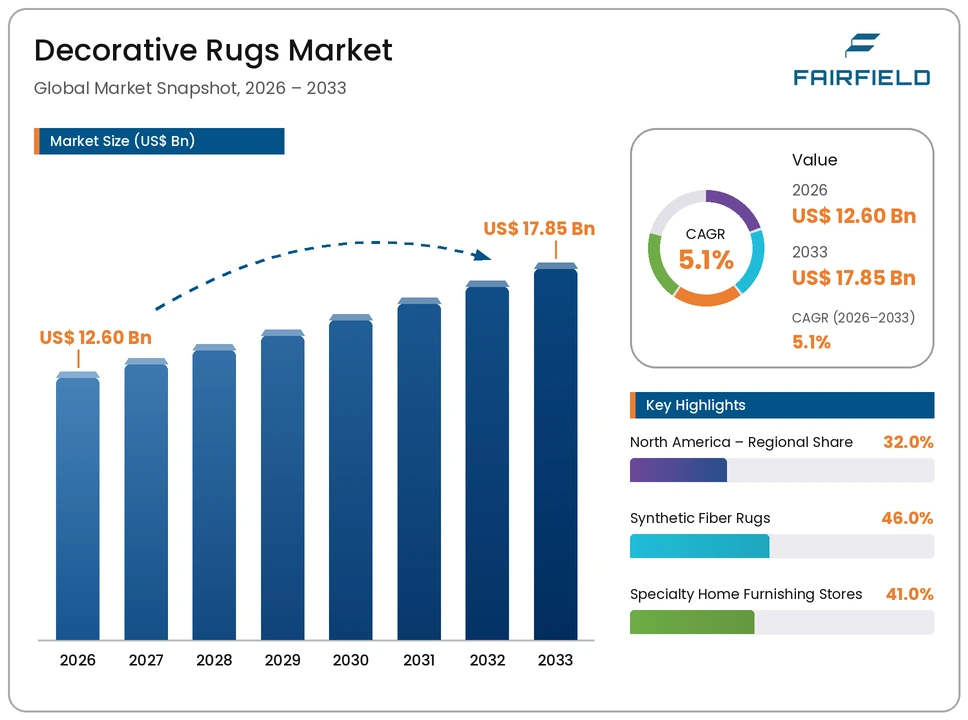
The market is valued at USD 12.60 Billion in 2026, with manufacturers directing investment toward expanded natural fiber product lines and improved e-commerce merchandising tools that help consumers visualize rugs within their own spaces before purchase. By 2033, the market is forecast to reach USD 17.85 Billion, reflecting steady growth across established specialty retail channels alongside rapidly expanding online purchasing.
Key Highlights
- The global decorative rugs market is valued at USD 12.60 Billion in 2026 and is projected to reach USD 17.85 Billion by 2033, expanding at a CAGR of 5.1% across the 2026-2033 forecast period.
- Synthetic Fiber Rugs lead the material segment with a 46.0% share in 2026, equivalent to USD 5.80 Billion.
- Specialty Home Furnishing Stores remain the dominant distribution channel, accounting for 41.0% of global demand, or USD 5.17 Billion, in 2026.
- North America commands the largest regional share at 32.0% of the global market in 2026.
- Online retail is emerging as the fastest-growing distribution channel through 2033.
Key Growth Drivers
Growth in the decorative rugs market is driven primarily by sustained global home renovation and furnishing spending, as consumers continue to invest in home interior updates, with rugs representing a relatively accessible way to refresh a room's aesthetic without the cost and disruption of larger renovation projects.
A second driver is growing consumer interest in natural and sustainable rug materials, as environmental consciousness increasingly influences home furnishing purchase decisions, driving demand for rugs made from jute, sisal, wool, and other natural fibers positioned as more environmentally favorable alternatives to synthetic materials.
Key Restraints
Price competition from mass-market and lower-cost import rug producers creates margin pressure for manufacturers, particularly in commodity synthetic fiber rug segments where consumers have limited brand loyalty and readily compare prices across retail channels.
Additionally, the difficulty of accurately assessing rug texture, color, and scale through online shopping alone creates purchase hesitation and elevated return rates for e-commerce channels relative to in-person specialty retail shopping, where consumers can physically evaluate rugs before purchase.
Market Opportunities
The expansion of online retail channels presents a substantial opportunity, as improving virtual visualization tools, including augmented reality room preview features, help address the traditional limitations of online rug shopping and support continued e-commerce channel growth relative to physical retail.
A second opportunity lies in expanding natural fiber and sustainably produced rug offerings, as growing consumer environmental consciousness creates demand for rugs made from responsibly sourced materials and produced through more environmentally favorable manufacturing processes. Manufacturers that successfully build credible sustainability positioning stand to differentiate their offerings in an increasingly competitive market.
Segmentation Analysis
- By Material
Synthetic Fiber Rugs lead the material segment, accounting for 46.0% of global market value in 2026, equivalent to USD 5.80 Billion. Their leadership reflects their cost-effectiveness, durability, and wide availability across mass-market retail channels. Wool Rugs and Cotton Rugs hold significant secondary shares in mid-to-premium price segments. Natural Fiber Rugs (Jute & Sisal) represent the fastest-growing material category through 2033, driven by growing consumer preference for sustainable, natural home furnishing materials.
- By Distribution Channel
Specialty Home Furnishing Stores form the leading distribution channel, representing 41.0% of global demand in 2026, or USD 5.17 Billion, reflecting consumer preference for in-person evaluation of rug texture, color, and scale before purchase. Department Stores & Others represent a significant, established distribution channel. Online Retail represents the fastest-growing distribution channel category, propelled by improving virtual visualization tools and expanding e-commerce home furnishing adoption.
Regional Insights
- North America
North America holds the largest regional share, at 32.0% of the global market in 2026, equivalent to USD 4.03 Billion. The region's leadership reflects strong consumer spending on home furnishings and an established specialty retail and e-commerce rug distribution ecosystem across the United States and Canada.
- Asia Pacific
Asia Pacific accounts for 28.0% of the global market in 2026, valued at USD 3.53 Billion. Growth is underpinned by rising disposable incomes and expanding home furnishing consumption across China, India, and other regional markets, alongside significant rug manufacturing capacity concentrated in the region.
- Europe
Europe represents 27.0% of the global market in 2026, or USD 3.40 Billion. Demand is supported by strong consumer interest in home interior design and an established specialty home furnishing retail sector across major European markets.
- Latin America
Latin America contributes 7.0% of the global market in 2026, equivalent to USD 0.88 Billion. Growth is linked to expanding home furnishing consumption in Brazil and Mexico alongside rising residential construction activity.
- Middle East & Africa
Middle East & Africa holds 6.0% of the global market in 2026, valued at USD 0.76 Billion. Growth is tied to steady demand for decorative rugs, including traditional handmade pieces, alongside gradual expansion of modern retail channels across the region.
Competitive Landscape
The global decorative rugs market is moderately fragmented, with a mix of large diversified flooring and home furnishing companies holding broad rug portfolios and specialized rug manufacturers focused on specific materials, design aesthetics, or price segments. Competition centers on design variety, material quality, and the ability to serve both specialty retail and expanding e-commerce distribution channels effectively. Manufacturers are increasingly differentiating through sustainable material sourcing and expanded design collections rather than competing on commodity pricing alone.
Key Market Players
- Mohawk Industries, Inc.
- Shaw Industries Group, Inc.
- Oriental Weavers Group
- Balta Group
- Nourison Industries, Inc.
- Surya, Inc.
- Jaipur Living, Inc.
- Kaleen Rugs, Inc.
- Interface, Inc.
- Obeetee Private Limited
Market Segmentation
By Material
- Synthetic Fiber Rugs
- Wool Rugs
- Cotton Rugs
- Natural Fiber Rugs (Jute & Sisal)
- Others
By Distribution Channel
- Online Retail
- Specialty Home Furnishing Stores
- Department Stores & Others
By End Use
- Residential
- Commercial
By Geography
- North America
- Europe
- Asia Pacific
- Latin America
- Middle East & Africa
- Executive Summary
- Global Decorative Rugs Market Snapshot
- Future Projections
- Key Market Trends
- Regional Snapshot, by Value, 2026
- Analyst Recommendations
- Market Overview
- Market Definitions and Segmentations
- Market Dynamics
- Drivers
- Restraints
- Market Opportunities
- Value Chain Analysis
- COVID-19 Impact Analysis
- Porter's Five Forces Analysis
- Impact of Russia-Ukraine Conflict
- PESTLE Analysis
- Regulatory Analysis
- Price Trend Analysis
- Current Prices and Future Projections, 2025-2033
- Price Impact Factors
- Global Decorative Rugs Market Outlook, 2020 - 2033
- Global Decorative Rugs Market Outlook, by Material, Value (US$ Bn), 2020-2033
- Synthetic Fiber Rugs
- Wool Rugs
- Cotton Rugs
- Natural Fiber Rugs (Jute & Sisal)
- Others
- Global Decorative Rugs Market Outlook, by Distribution Channel, Value (US$ Bn), 2020-2033
- Online Retail
- Specialty Home Furnishing Stores
- Department Stores & Others
- Global Decorative Rugs Market Outlook, by End Use, Value (US$ Bn), 2020-2033
- Residential
- Commercial
- Global Decorative Rugs Market Outlook, by Region, Value (US$ Bn), 2020-2033
- North America
- Europe
- Asia Pacific
- Latin America
- Middle East & Africa
- Global Decorative Rugs Market Outlook, by Material, Value (US$ Bn), 2020-2033
- North America Decorative Rugs Market Outlook, 2020 - 2033
- North America Decorative Rugs Market Outlook, by Material, Value (US$ Bn), 2020-2033
- Synthetic Fiber Rugs
- Wool Rugs
- Cotton Rugs
- Natural Fiber Rugs (Jute & Sisal)
- Others
- North America Decorative Rugs Market Outlook, by Distribution Channel, Value (US$ Bn), 2020-2033
- Online Retail
- Specialty Home Furnishing Stores
- Department Stores & Others
- North America Decorative Rugs Market Outlook, by End Use, Value (US$ Bn), 2020-2033
- Residential
- Commercial
- North America Decorative Rugs Market Outlook, by Country, Value (US$ Bn), 2020-2033
- U.S. Decorative Rugs Market Outlook, by Material, 2020-2033
- U.S. Decorative Rugs Market Outlook, by Distribution Channel, 2020-2033
- U.S. Decorative Rugs Market Outlook, by End Use, 2020-2033
- Canada Decorative Rugs Market Outlook, by Material, 2020-2033
- Canada Decorative Rugs Market Outlook, by Distribution Channel, 2020-2033
- Canada Decorative Rugs Market Outlook, by End Use, 2020-2033
- BPS Analysis/Market Attractiveness Analysis
- North America Decorative Rugs Market Outlook, by Material, Value (US$ Bn), 2020-2033
- Europe Decorative Rugs Market Outlook, 2020 - 2033
- Europe Decorative Rugs Market Outlook, by Material, Value (US$ Bn), 2020-2033
- Synthetic Fiber Rugs
- Wool Rugs
- Cotton Rugs
- Natural Fiber Rugs (Jute & Sisal)
- Others
- Europe Decorative Rugs Market Outlook, by Distribution Channel, Value (US$ Bn), 2020-2033
- Online Retail
- Specialty Home Furnishing Stores
- Department Stores & Others
- Europe Decorative Rugs Market Outlook, by End Use, Value (US$ Bn), 2020-2033
- Residential
- Commercial
- Europe Decorative Rugs Market Outlook, by Country, Value (US$ Bn), 2020-2033
- Germany Decorative Rugs Market Outlook, by Material, 2020-2033
- Germany Decorative Rugs Market Outlook, by Distribution Channel, 2020-2033
- Germany Decorative Rugs Market Outlook, by End Use, 2020-2033
- Italy Decorative Rugs Market Outlook, by Material, 2020-2033
- Italy Decorative Rugs Market Outlook, by Distribution Channel, 2020-2033
- Italy Decorative Rugs Market Outlook, by End Use, 2020-2033
- France Decorative Rugs Market Outlook, by Material, 2020-2033
- France Decorative Rugs Market Outlook, by Distribution Channel, 2020-2033
- France Decorative Rugs Market Outlook, by End Use, 2020-2033
- U.K. Decorative Rugs Market Outlook, by Material, 2020-2033
- U.K. Decorative Rugs Market Outlook, by Distribution Channel, 2020-2033
- U.K. Decorative Rugs Market Outlook, by End Use, 2020-2033
- Spain Decorative Rugs Market Outlook, by Material, 2020-2033
- Spain Decorative Rugs Market Outlook, by Distribution Channel, 2020-2033
- Spain Decorative Rugs Market Outlook, by End Use, 2020-2033
- Russia Decorative Rugs Market Outlook, by Material, 2020-2033
- Russia Decorative Rugs Market Outlook, by Distribution Channel, 2020-2033
- Russia Decorative Rugs Market Outlook, by End Use, 2020-2033
- Rest of Europe Decorative Rugs Market Outlook, by Material, 2020-2033
- Rest of Europe Decorative Rugs Market Outlook, by Distribution Channel, 2020-2033
- Rest of Europe Decorative Rugs Market Outlook, by End Use, 2020-2033
- BPS Analysis/Market Attractiveness Analysis
- Europe Decorative Rugs Market Outlook, by Material, Value (US$ Bn), 2020-2033
- Asia Pacific Decorative Rugs Market Outlook, 2020 - 2033
- Asia Pacific Decorative Rugs Market Outlook, by Material, Value (US$ Bn), 2020-2033
- Synthetic Fiber Rugs
- Wool Rugs
- Cotton Rugs
- Natural Fiber Rugs (Jute & Sisal)
- Others
- Asia Pacific Decorative Rugs Market Outlook, by Distribution Channel, Value (US$ Bn), 2020-2033
- Online Retail
- Specialty Home Furnishing Stores
- Department Stores & Others
- Asia Pacific Decorative Rugs Market Outlook, by End Use, Value (US$ Bn), 2020-2033
- Residential
- Commercial
- Asia Pacific Decorative Rugs Market Outlook, by Country, Value (US$ Bn), 2020-2033
- China Decorative Rugs Market Outlook, by Material, 2020-2033
- China Decorative Rugs Market Outlook, by Distribution Channel, 2020-2033
- China Decorative Rugs Market Outlook, by End Use, 2020-2033
- Japan Decorative Rugs Market Outlook, by Material, 2020-2033
- Japan Decorative Rugs Market Outlook, by Distribution Channel, 2020-2033
- Japan Decorative Rugs Market Outlook, by End Use, 2020-2033
- South Korea Decorative Rugs Market Outlook, by Material, 2020-2033
- South Korea Decorative Rugs Market Outlook, by Distribution Channel, 2020-2033
- South Korea Decorative Rugs Market Outlook, by End Use, 2020-2033
- India Decorative Rugs Market Outlook, by Material, 2020-2033
- India Decorative Rugs Market Outlook, by Distribution Channel, 2020-2033
- India Decorative Rugs Market Outlook, by End Use, 2020-2033
- Southeast Asia Decorative Rugs Market Outlook, by Material, 2020-2033
- Southeast Asia Decorative Rugs Market Outlook, by Distribution Channel, 2020-2033
- Southeast Asia Decorative Rugs Market Outlook, by End Use, 2020-2033
- Rest of SAO Decorative Rugs Market Outlook, by Material, 2020-2033
- Rest of SAO Decorative Rugs Market Outlook, by Distribution Channel, 2020-2033
- Rest of SAO Decorative Rugs Market Outlook, by End Use, 2020-2033
- BPS Analysis/Market Attractiveness Analysis
- Asia Pacific Decorative Rugs Market Outlook, by Material, Value (US$ Bn), 2020-2033
- Latin America Decorative Rugs Market Outlook, 2020 - 2033
- Latin America Decorative Rugs Market Outlook, by Material, Value (US$ Bn), 2020-2033
- Synthetic Fiber Rugs
- Wool Rugs
- Cotton Rugs
- Natural Fiber Rugs (Jute & Sisal)
- Others
- Latin America Decorative Rugs Market Outlook, by Distribution Channel, Value (US$ Bn), 2020-2033
- Online Retail
- Specialty Home Furnishing Stores
- Department Stores & Others
- Latin America Decorative Rugs Market Outlook, by End Use, Value (US$ Bn), 2020-2033
- Residential
- Commercial
- Latin America Decorative Rugs Market Outlook, by Country, Value (US$ Bn), 2020-2033
- Brazil Decorative Rugs Market Outlook, by Material, 2020-2033
- Brazil Decorative Rugs Market Outlook, by Distribution Channel, 2020-2033
- Brazil Decorative Rugs Market Outlook, by End Use, 2020-2033
- Mexico Decorative Rugs Market Outlook, by Material, 2020-2033
- Mexico Decorative Rugs Market Outlook, by Distribution Channel, 2020-2033
- Mexico Decorative Rugs Market Outlook, by End Use, 2020-2033
- Argentina Decorative Rugs Market Outlook, by Material, 2020-2033
- Argentina Decorative Rugs Market Outlook, by Distribution Channel, 2020-2033
- Argentina Decorative Rugs Market Outlook, by End Use, 2020-2033
- Rest of LATAM Decorative Rugs Market Outlook, by Material, 2020-2033
- Rest of LATAM Decorative Rugs Market Outlook, by Distribution Channel, 2020-2033
- Rest of LATAM Decorative Rugs Market Outlook, by End Use, 2020-2033
- BPS Analysis/Market Attractiveness Analysis
- Latin America Decorative Rugs Market Outlook, by Material, Value (US$ Bn), 2020-2033
- Middle East & Africa Decorative Rugs Market Outlook, 2020 - 2033
- Middle East & Africa Decorative Rugs Market Outlook, by Material, Value (US$ Bn), 2020-2033
- Synthetic Fiber Rugs
- Wool Rugs
- Cotton Rugs
- Natural Fiber Rugs (Jute & Sisal)
- Others
- Middle East & Africa Decorative Rugs Market Outlook, by Distribution Channel, Value (US$ Bn), 2020-2033
- Online Retail
- Specialty Home Furnishing Stores
- Department Stores & Others
- Middle East & Africa Decorative Rugs Market Outlook, by End Use, Value (US$ Bn), 2020-2033
- Residential
- Commercial
- Middle East & Africa Decorative Rugs Market Outlook, by Country, Value (US$ Bn), 2020-2033
- GCC Decorative Rugs Market Outlook, by Material, 2020-2033
- GCC Decorative Rugs Market Outlook, by Distribution Channel, 2020-2033
- GCC Decorative Rugs Market Outlook, by End Use, 2020-2033
- South Africa Decorative Rugs Market Outlook, by Material, 2020-2033
- South Africa Decorative Rugs Market Outlook, by Distribution Channel, 2020-2033
- South Africa Decorative Rugs Market Outlook, by End Use, 2020-2033
- Egypt Decorative Rugs Market Outlook, by Material, 2020-2033
- Egypt Decorative Rugs Market Outlook, by Distribution Channel, 2020-2033
- Egypt Decorative Rugs Market Outlook, by End Use, 2020-2033
- Nigeria Decorative Rugs Market Outlook, by Material, 2020-2033
- Nigeria Decorative Rugs Market Outlook, by Distribution Channel, 2020-2033
- Nigeria Decorative Rugs Market Outlook, by End Use, 2020-2033
- Rest of Middle East Decorative Rugs Market Outlook, by Material, 2020-2033
- Rest of Middle East Decorative Rugs Market Outlook, by Distribution Channel, 2020-2033
- Rest of Middle East Decorative Rugs Market Outlook, by End Use, 2020-2033
- BPS Analysis/Market Attractiveness Analysis
- Middle East & Africa Decorative Rugs Market Outlook, by Material, Value (US$ Bn), 2020-2033
- Competitive Landscape
- Company Vs Segment Heatmap
- Company Market Share Analysis, 2025
- Competitive Dashboard
- Company Profiles
- Mohawk Industries, Inc.
- Company Overview
- Product Portfolio
- Financial Overview
- Business Strategies and Developments
- Shaw Industries Group, Inc.
- Oriental Weavers Group
- Balta Group
- Nourison Industries, Inc.
- Surya, Inc.
- Jaipur Living, Inc.
- Kaleen Rugs, Inc.
- Interface, Inc.
- Obeetee Private Limited
- Mohawk Industries, Inc.
- Appendix
- Research Methodology
- Report Assumptions
- Acronyms and Abbreviations
By Material
- Synthetic Fiber Rugs
- Wool Rugs
- Cotton Rugs
- Natural Fiber Rugs (Jute & Sisal)
- Others
By Distribution Channel
- Online Retail
- Specialty Home Furnishing Stores
- Department Stores & Others
By End Use
- Residential
- Commercial
By Geography
- North America
- Europe
- Asia Pacific
- Latin America
- Middle East & Africa
Our Research Methodology
Considering the volatility of business today, traditional approaches to strategizing a game plan can be unfruitful if not detrimental. True ambiguity is no way to determine a forecast. A myriad of predetermined factors must be accounted for such as the degree of risk involved, the magnitude of circumstances, as well as conditions or consequences that are not known or unpredictable. To circumvent binary views that cast uncertainty, the application of market research intelligence to strategically posture, move, and enable actionable outcomes is necessary.
View Methodology
Quality Assured
Rigorous Validation Process

Confidentiality Assured
End-to-end Data Security

Custom Research Services
Tailored To Your Objectives
FAQs
The global decorative rugs market is valued at USD 12.60 Billion in 2026, reflecting sustained consumer spending on home furnishing and interior design.
The market is projected to grow at a CAGR of 5.1%, reaching USD 17.85 Billion by 2033, driven by home renovation spending and growing e-commerce adoption.
Synthetic Fiber Rugs lead with a 46.0% share in 2026, reflecting their cost-effectiveness and wide availability across mass-market retail.
North America leads with a 32.0% share in 2026, supported by strong home furnishing spending and an established retail ecosystem.
The largest opportunity lies in online retail, as improving virtual visualization tools address traditional barriers to purchasing rugs sight-unseen.
Related Reports
Knee High Boots Market Size, Share, Insights, Competitive Landscape, and Forecast 2026 to 2033
The global knee high boots market is valued at US$18.7 billion in 2026, reaching US$26.4 billion by 2033, growing at a 5.05% CAGR
Drop Shipping Market Size, Share, Insights, Competitive Landscape, and Forecast 2026 to 2033
The global drop shipping market is valued at US$420.0 billion in 2026, reaching US$985.0 billion by 2033, growing at a 12.95% CAGR
Esports Arenas Market Size, Share, Insights, Competitive Landscape, and Forecast 2026 to 2033
Esports Arenas Market to reach US$6.5 Bn by 2033, growing at 14.0% CAGR, driven by esports events, venue upgrades, and broadcast infrastructure.
Automated Tape Application Systems (ATAS) Market Size, Share, Insights, Competitive Landscape, and Forecast 2026 to 2033
The Automated Tape Application Systems market, valued at US$ 0.46 billion in 2026, and projected to reach US$ 0.82 billion by 2033 at an 8.6% CAGR.
Surf Parks Market Size, Share, Insights, Competitive Landscape, and Forecast 2026 to 2033
Surf Parks Market to reach US$4.1 Bn by 2033, growing at 16.59% CAGR, driven by wave technology, resort development, and tourism investment.
Golf Simulator Lounges Market Size, Share, Insights, Competitive Landscape, and Forecast 2026 to 2033
Golf Simulator Lounges Market to reach US$14.8 Bn by 2033, growing at 13.24% CAGR, driven by indoor golf, memberships, and social play.