



Dicyclopentadiene (DCPD) Market
Dicyclopentadiene (DCPD) Market Insights, Competitive Landscape, and Market Forecast - 2033
Market Overview
Dicyclopentadiene, commonly abbreviated as DCPD, is a hydrocarbon byproduct recovered from naphtha steam cracking processes used to produce ethylene and propylene. Once separated and purified, DCPD serves as a key feedstock for unsaturated polyester resins, hydrocarbon tackifying resins, EPDM rubber, and a range of specialty resins and coatings, valued for the reactive double bonds that allow it to participate in polymerization reactions across diverse downstream chemistries.
Demand growth through the 2026-2033 window is closely tied to steady growth in unsaturated polyester resin consumption for construction, marine, and transportation composite applications, alongside expanding use of DCPD-based hydrocarbon resins in adhesives and rubber compounding. Availability of DCPD is inherently linked to naphtha cracker utilization rates, meaning supply dynamics in this market are shaped as much by ethylene production economics as by direct downstream DCPD demand.
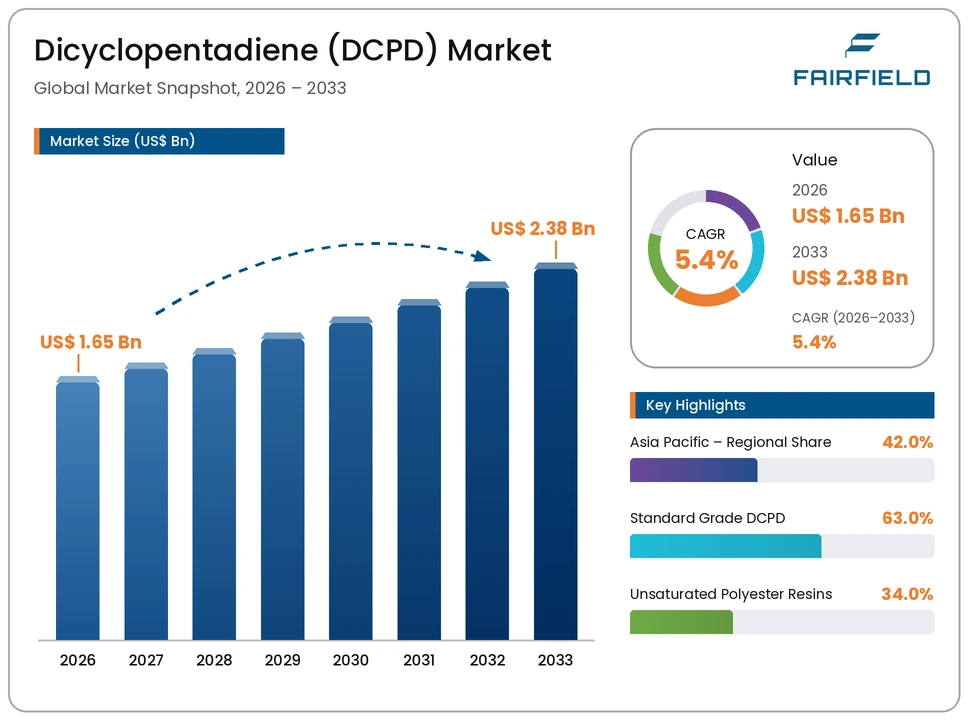
The market is valued at USD 1.65 Billion in 2026, with producers directing investment toward higher-purity DCPD grades that command premium pricing in specialty resin and coating applications. By 2033, the market is forecast to reach USD 2.38 Billion, reflecting steady growth across established resin applications alongside gradual expansion into higher-value specialty uses.
Key Highlights
- The global dicyclopentadiene (DCPD) market is valued at USD 1.65 Billion in 2026 and is projected to reach USD 2.38 Billion by 2033, expanding at a CAGR of 5.4% across the 2026-2033 forecast period.
- Standard Grade DCPD leads the purity-grade segment with a 63.0% share in 2026, equivalent to USD 1.04 Billion.
- Unsaturated Polyester Resins remain the dominant application, accounting for 34.0% of global demand, or USD 0.56 Billion, in 2026.
- Asia Pacific commands the largest regional share at 42.0% of the global market in 2026.
- Specialty resins and coatings applications are emerging as the fastest-growing demand pocket through 2033.
Key Growth Drivers
Growth in the DCPD market is driven primarily by sustained demand for unsaturated polyester resins across construction, marine, and transportation composite applications, where DCPD-modified resins offer improved rigidity and dimensional stability compared with conventional formulations. This established application base continues to anchor steady baseline demand for standard-grade DCPD.
A second driver is growing use of DCPD in hydrocarbon tackifying resins for adhesives, sealants, and rubber compounding, supported by expanding packaging and construction adhesive markets that rely on hydrocarbon resins for tack and adhesion performance. Rising EPDM rubber demand in automotive sealing and roofing membrane applications further reinforces DCPD consumption as a key monomer input.
Key Restraints
DCPD supply availability is closely tied to naphtha cracker operating rates, meaning fluctuations in ethylene production economics, driven by feedstock costs and petrochemical demand cycles, can create supply variability that is largely outside the direct control of DCPD-focused producers and downstream resin manufacturers.
Additionally, DCPD requires careful handling and stabilization due to its reactivity and characteristic odor, adding storage and transportation cost considerations that affect smaller downstream converters without dedicated handling infrastructure, particularly for higher-purity grades used in specialty applications.
Market Opportunities
The development of higher-purity DCPD grades suited to specialty resin and coating applications presents a substantial opportunity, as these grades command meaningfully higher pricing than standard-grade material used in commodity polyester resin production, allowing producers to capture greater value from their DCPD output streams.
A second opportunity lies in expanding EPDM rubber demand driven by automotive electrification, where EPDM continues to be used extensively in sealing and gasket applications regardless of powertrain type, along with growing roofing membrane demand in construction markets pursuing durable, weather-resistant building materials.
Segmentation Analysis
- By Purity Grade
Standard Grade DCPD leads the purity-grade segment, accounting for 63.0% of global market value in 2026, equivalent to USD 1.04 Billion. Its leadership reflects its widespread use as feedstock for unsaturated polyester resins and EPDM rubber, applications that do not require the highest purity levels. High Purity DCPD represents the fastest-growing grade category through 2033, driven by expanding use in specialty hydrocarbon resins and coatings applications where impurity levels directly affect end-product performance and clarity.
- By Application
Unsaturated Polyester Resins form the leading application segment, representing 34.0% of global demand in 2026, or USD 0.56 Billion, supported by sustained use in construction and transportation composite manufacturing. Hydrocarbon Resins form the second-largest segment, used extensively in adhesives and rubber compounding. EPDM Rubber represents a steady, mature application, while Specialty Resins & Coatings represent the fastest-growing application category as higher-purity DCPD grades find use in premium formulations.
Regional Insights
- Asia Pacific
Asia Pacific holds the largest regional share, at 42.0% of the global market in 2026, equivalent to USD 0.69 Billion. The region's dominance reflects its large naphtha cracking capacity, led by China, South Korea, and Japan, alongside substantial downstream resin and rubber manufacturing that consumes DCPD as feedstock.
- North America
North America accounts for 26.0% of the global market in 2026, valued at USD 0.43 Billion. Demand is supported by significant ethylene cracker capacity in the United States, which generates DCPD as a byproduct, alongside established unsaturated polyester resin and EPDM rubber manufacturing.
- Europe
Europe represents 20.0% of the global market in 2026, or USD 0.33 Billion. The region's mature petrochemical industry and established composite resin manufacturing base sustain steady DCPD demand, though cracker capacity trends in the region shape long-term supply availability.
- Latin America
Latin America contributes 7.0% of the global market in 2026, equivalent to USD 0.12 Billion. Brazil anchors regional demand, supported by its petrochemical production base and growing composite resin consumption in construction and transportation applications.
- Middle East & Africa
Middle East & Africa holds 5.0% of the global market in 2026, valued at USD 0.08 Billion. Growth is tied to expanding petrochemical cracker capacity in Gulf Cooperation Council countries, positioning the region as a potential future DCPD supply source alongside gradually rising downstream resin demand.
Competitive Landscape
The global DCPD market is moderately concentrated, with supply closely linked to a limited number of large-scale petrochemical producers operating naphtha crackers capable of generating DCPD as a byproduct stream. A smaller number of specialty producers focus on purification and upgrading of DCPD into higher-value grades for specialty resin and coating applications. Competition centers on purity consistency, supply reliability tied to cracker utilization rates, and the ability to serve downstream resin and rubber manufacturers with technical formulation support.
Key Market Players
- ExxonMobil Corporation
- Shell plc
- TotalEnergies SE
- LyondellBasell Industries N.V.
- Braskem S.A.
- ENEOS Holdings, Inc.
- Zeon Corporation
- Kolon Industries, Inc.
- Cymetech, LLC
- China Petroleum & Chemical Corporation (Sinopec)
Market Segmentation
By Purity Grade
- Standard Grade DCPD
- High Purity DCPD
By Application
- Unsaturated Polyester Resins
- Hydrocarbon Resins
- EPDM Rubber
- Specialty Resins & Coatings
- Others
By End-Use Industry
- Construction
- Automotive & Transportation
- Adhesives & Sealants
By Geography
- North America
- Europe
- Asia Pacific
- Latin America
- Middle East & Africa
- Executive Summary
- Global Dicyclopentadiene (DCPD) Market Snapshot
- Future Projections
- Key Market Trends
- Regional Snapshot, by Value, 2026
- Analyst Recommendations
- Market Overview
- Market Definitions and Segmentations
- Market Dynamics
- Drivers
- Restraints
- Market Opportunities
- Value Chain Analysis
- COVID-19 Impact Analysis
- Porter's Five Forces Analysis
- Impact of Russia-Ukraine Conflict
- PESTLE Analysis
- Regulatory Analysis
- Price Trend Analysis
- Current Prices and Future Projections, 2025-2033
- Price Impact Factors
- Global Dicyclopentadiene (DCPD) Market Outlook, 2020 - 2033
- Global Dicyclopentadiene (DCPD) Market Outlook, by Purity Grade, Value (US$ Bn), 2020-2033
- Standard Grade DCPD
- High Purity DCPD
- Global Dicyclopentadiene (DCPD) Market Outlook, by Application, Value (US$ Bn), 2020-2033
- Unsaturated Polyester Resins
- Hydrocarbon Resins
- EPDM Rubber
- Specialty Resins & Coatings
- Others
- Global Dicyclopentadiene (DCPD) Market Outlook, by End-Use Industry, Value (US$ Bn), 2020-2033
- Construction
- Automotive & Transportation
- Adhesives & Sealants
- Global Dicyclopentadiene (DCPD) Market Outlook, by Region, Value (US$ Bn), 2020-2033
- North America
- Europe
- Asia Pacific
- Latin America
- Middle East & Africa
- Global Dicyclopentadiene (DCPD) Market Outlook, by Purity Grade, Value (US$ Bn), 2020-2033
- North America Dicyclopentadiene (DCPD) Market Outlook, 2020 - 2033
- North America Dicyclopentadiene (DCPD) Market Outlook, by Purity Grade, Value (US$ Bn), 2020-2033
- Standard Grade DCPD
- High Purity DCPD
- North America Dicyclopentadiene (DCPD) Market Outlook, by Application, Value (US$ Bn), 2020-2033
- Unsaturated Polyester Resins
- Hydrocarbon Resins
- EPDM Rubber
- Specialty Resins & Coatings
- Others
- North America Dicyclopentadiene (DCPD) Market Outlook, by End-Use Industry, Value (US$ Bn), 2020-2033
- Construction
- Automotive & Transportation
- Adhesives & Sealants
- North America Dicyclopentadiene (DCPD) Market Outlook, by Country, Value (US$ Bn), 2020-2033
- U.S. Dicyclopentadiene (DCPD) Market Outlook, by Purity Grade, 2020-2033
- U.S. Dicyclopentadiene (DCPD) Market Outlook, by Application, 2020-2033
- U.S. Dicyclopentadiene (DCPD) Market Outlook, by End-Use Industry, 2020-2033
- Canada Dicyclopentadiene (DCPD) Market Outlook, by Purity Grade, 2020-2033
- Canada Dicyclopentadiene (DCPD) Market Outlook, by Application, 2020-2033
- Canada Dicyclopentadiene (DCPD) Market Outlook, by End-Use Industry, 2020-2033
- BPS Analysis/Market Attractiveness Analysis
- North America Dicyclopentadiene (DCPD) Market Outlook, by Purity Grade, Value (US$ Bn), 2020-2033
- Europe Dicyclopentadiene (DCPD) Market Outlook, 2020 - 2033
- Europe Dicyclopentadiene (DCPD) Market Outlook, by Purity Grade, Value (US$ Bn), 2020-2033
- Standard Grade DCPD
- High Purity DCPD
- Europe Dicyclopentadiene (DCPD) Market Outlook, by Application, Value (US$ Bn), 2020-2033
- Unsaturated Polyester Resins
- Hydrocarbon Resins
- EPDM Rubber
- Specialty Resins & Coatings
- Others
- Europe Dicyclopentadiene (DCPD) Market Outlook, by End-Use Industry, Value (US$ Bn), 2020-2033
- Construction
- Automotive & Transportation
- Adhesives & Sealants
- Europe Dicyclopentadiene (DCPD) Market Outlook, by Country, Value (US$ Bn), 2020-2033
- Germany Dicyclopentadiene (DCPD) Market Outlook, by Purity Grade, 2020-2033
- Germany Dicyclopentadiene (DCPD) Market Outlook, by Application, 2020-2033
- Germany Dicyclopentadiene (DCPD) Market Outlook, by End-Use Industry, 2020-2033
- Italy Dicyclopentadiene (DCPD) Market Outlook, by Purity Grade, 2020-2033
- Italy Dicyclopentadiene (DCPD) Market Outlook, by Application, 2020-2033
- Italy Dicyclopentadiene (DCPD) Market Outlook, by End-Use Industry, 2020-2033
- France Dicyclopentadiene (DCPD) Market Outlook, by Purity Grade, 2020-2033
- France Dicyclopentadiene (DCPD) Market Outlook, by Application, 2020-2033
- France Dicyclopentadiene (DCPD) Market Outlook, by End-Use Industry, 2020-2033
- U.K. Dicyclopentadiene (DCPD) Market Outlook, by Purity Grade, 2020-2033
- U.K. Dicyclopentadiene (DCPD) Market Outlook, by Application, 2020-2033
- U.K. Dicyclopentadiene (DCPD) Market Outlook, by End-Use Industry, 2020-2033
- Spain Dicyclopentadiene (DCPD) Market Outlook, by Purity Grade, 2020-2033
- Spain Dicyclopentadiene (DCPD) Market Outlook, by Application, 2020-2033
- Spain Dicyclopentadiene (DCPD) Market Outlook, by End-Use Industry, 2020-2033
- Russia Dicyclopentadiene (DCPD) Market Outlook, by Purity Grade, 2020-2033
- Russia Dicyclopentadiene (DCPD) Market Outlook, by Application, 2020-2033
- Russia Dicyclopentadiene (DCPD) Market Outlook, by End-Use Industry, 2020-2033
- Rest of Europe Dicyclopentadiene (DCPD) Market Outlook, by Purity Grade, 2020-2033
- Rest of Europe Dicyclopentadiene (DCPD) Market Outlook, by Application, 2020-2033
- Rest of Europe Dicyclopentadiene (DCPD) Market Outlook, by End-Use Industry, 2020-2033
- BPS Analysis/Market Attractiveness Analysis
- Europe Dicyclopentadiene (DCPD) Market Outlook, by Purity Grade, Value (US$ Bn), 2020-2033
- Asia Pacific Dicyclopentadiene (DCPD) Market Outlook, 2020 - 2033
- Asia Pacific Dicyclopentadiene (DCPD) Market Outlook, by Purity Grade, Value (US$ Bn), 2020-2033
- Standard Grade DCPD
- High Purity DCPD
- Asia Pacific Dicyclopentadiene (DCPD) Market Outlook, by Application, Value (US$ Bn), 2020-2033
- Unsaturated Polyester Resins
- Hydrocarbon Resins
- EPDM Rubber
- Specialty Resins & Coatings
- Others
- Asia Pacific Dicyclopentadiene (DCPD) Market Outlook, by End-Use Industry, Value (US$ Bn), 2020-2033
- Construction
- Automotive & Transportation
- Adhesives & Sealants
- Asia Pacific Dicyclopentadiene (DCPD) Market Outlook, by Country, Value (US$ Bn), 2020-2033
- China Dicyclopentadiene (DCPD) Market Outlook, by Purity Grade, 2020-2033
- China Dicyclopentadiene (DCPD) Market Outlook, by Application, 2020-2033
- China Dicyclopentadiene (DCPD) Market Outlook, by End-Use Industry, 2020-2033
- Japan Dicyclopentadiene (DCPD) Market Outlook, by Purity Grade, 2020-2033
- Japan Dicyclopentadiene (DCPD) Market Outlook, by Application, 2020-2033
- Japan Dicyclopentadiene (DCPD) Market Outlook, by End-Use Industry, 2020-2033
- South Korea Dicyclopentadiene (DCPD) Market Outlook, by Purity Grade, 2020-2033
- South Korea Dicyclopentadiene (DCPD) Market Outlook, by Application, 2020-2033
- South Korea Dicyclopentadiene (DCPD) Market Outlook, by End-Use Industry, 2020-2033
- India Dicyclopentadiene (DCPD) Market Outlook, by Purity Grade, 2020-2033
- India Dicyclopentadiene (DCPD) Market Outlook, by Application, 2020-2033
- India Dicyclopentadiene (DCPD) Market Outlook, by End-Use Industry, 2020-2033
- Southeast Asia Dicyclopentadiene (DCPD) Market Outlook, by Purity Grade, 2020-2033
- Southeast Asia Dicyclopentadiene (DCPD) Market Outlook, by Application, 2020-2033
- Southeast Asia Dicyclopentadiene (DCPD) Market Outlook, by End-Use Industry, 2020-2033
- Rest of SAO Dicyclopentadiene (DCPD) Market Outlook, by Purity Grade, 2020-2033
- Rest of SAO Dicyclopentadiene (DCPD) Market Outlook, by Application, 2020-2033
- Rest of SAO Dicyclopentadiene (DCPD) Market Outlook, by End-Use Industry, 2020-2033
- BPS Analysis/Market Attractiveness Analysis
- Asia Pacific Dicyclopentadiene (DCPD) Market Outlook, by Purity Grade, Value (US$ Bn), 2020-2033
- Latin America Dicyclopentadiene (DCPD) Market Outlook, 2020 - 2033
- Latin America Dicyclopentadiene (DCPD) Market Outlook, by Purity Grade, Value (US$ Bn), 2020-2033
- Standard Grade DCPD
- High Purity DCPD
- Latin America Dicyclopentadiene (DCPD) Market Outlook, by Application, Value (US$ Bn), 2020-2033
- Unsaturated Polyester Resins
- Hydrocarbon Resins
- EPDM Rubber
- Specialty Resins & Coatings
- Others
- Latin America Dicyclopentadiene (DCPD) Market Outlook, by End-Use Industry, Value (US$ Bn), 2020-2033
- Construction
- Automotive & Transportation
- Adhesives & Sealants
- Latin America Dicyclopentadiene (DCPD) Market Outlook, by Country, Value (US$ Bn), 2020-2033
- Brazil Dicyclopentadiene (DCPD) Market Outlook, by Purity Grade, 2020-2033
- Brazil Dicyclopentadiene (DCPD) Market Outlook, by Application, 2020-2033
- Brazil Dicyclopentadiene (DCPD) Market Outlook, by End-Use Industry, 2020-2033
- Mexico Dicyclopentadiene (DCPD) Market Outlook, by Purity Grade, 2020-2033
- Mexico Dicyclopentadiene (DCPD) Market Outlook, by Application, 2020-2033
- Mexico Dicyclopentadiene (DCPD) Market Outlook, by End-Use Industry, 2020-2033
- Argentina Dicyclopentadiene (DCPD) Market Outlook, by Purity Grade, 2020-2033
- Argentina Dicyclopentadiene (DCPD) Market Outlook, by Application, 2020-2033
- Argentina Dicyclopentadiene (DCPD) Market Outlook, by End-Use Industry, 2020-2033
- Rest of LATAM Dicyclopentadiene (DCPD) Market Outlook, by Purity Grade, 2020-2033
- Rest of LATAM Dicyclopentadiene (DCPD) Market Outlook, by Application, 2020-2033
- Rest of LATAM Dicyclopentadiene (DCPD) Market Outlook, by End-Use Industry, 2020-2033
- BPS Analysis/Market Attractiveness Analysis
- Latin America Dicyclopentadiene (DCPD) Market Outlook, by Purity Grade, Value (US$ Bn), 2020-2033
- Middle East & Africa Dicyclopentadiene (DCPD) Market Outlook, 2020 - 2033
- Middle East & Africa Dicyclopentadiene (DCPD) Market Outlook, by Purity Grade, Value (US$ Bn), 2020-2033
- Standard Grade DCPD
- High Purity DCPD
- Middle East & Africa Dicyclopentadiene (DCPD) Market Outlook, by Application, Value (US$ Bn), 2020-2033
- Unsaturated Polyester Resins
- Hydrocarbon Resins
- EPDM Rubber
- Specialty Resins & Coatings
- Others
- Middle East & Africa Dicyclopentadiene (DCPD) Market Outlook, by End-Use Industry, Value (US$ Bn), 2020-2033
- Construction
- Automotive & Transportation
- Adhesives & Sealants
- Middle East & Africa Dicyclopentadiene (DCPD) Market Outlook, by Country, Value (US$ Bn), 2020-2033
- GCC Dicyclopentadiene (DCPD) Market Outlook, by Purity Grade, 2020-2033
- GCC Dicyclopentadiene (DCPD) Market Outlook, by Application, 2020-2033
- GCC Dicyclopentadiene (DCPD) Market Outlook, by End-Use Industry, 2020-2033
- South Africa Dicyclopentadiene (DCPD) Market Outlook, by Purity Grade, 2020-2033
- South Africa Dicyclopentadiene (DCPD) Market Outlook, by Application, 2020-2033
- South Africa Dicyclopentadiene (DCPD) Market Outlook, by End-Use Industry, 2020-2033
- Egypt Dicyclopentadiene (DCPD) Market Outlook, by Purity Grade, 2020-2033
- Egypt Dicyclopentadiene (DCPD) Market Outlook, by Application, 2020-2033
- Egypt Dicyclopentadiene (DCPD) Market Outlook, by End-Use Industry, 2020-2033
- Nigeria Dicyclopentadiene (DCPD) Market Outlook, by Purity Grade, 2020-2033
- Nigeria Dicyclopentadiene (DCPD) Market Outlook, by Application, 2020-2033
- Nigeria Dicyclopentadiene (DCPD) Market Outlook, by End-Use Industry, 2020-2033
- Rest of Middle East Dicyclopentadiene (DCPD) Market Outlook, by Purity Grade, 2020-2033
- Rest of Middle East Dicyclopentadiene (DCPD) Market Outlook, by Application, 2020-2033
- Rest of Middle East Dicyclopentadiene (DCPD) Market Outlook, by End-Use Industry, 2020-2033
- BPS Analysis/Market Attractiveness Analysis
- Middle East & Africa Dicyclopentadiene (DCPD) Market Outlook, by Purity Grade, Value (US$ Bn), 2020-2033
- Competitive Landscape
- Company Vs Segment Heatmap
- Company Market Share Analysis, 2025
- Competitive Dashboard
- Company Profiles
- ExxonMobil Corporation
- Company Overview
- Product Portfolio
- Financial Overview
- Business Strategies and Developments
- Shell plc
- TotalEnergies SE
- LyondellBasell Industries N.V.
- Braskem S.A.
- ENEOS Holdings, Inc.
- Zeon Corporation
- Kolon Industries, Inc.
- Cymetech, LLC
- China Petroleum & Chemical Corporation (Sinopec)
- ExxonMobil Corporation
- Appendix
- Research Methodology
- Report Assumptions
- Acronyms and Abbreviations
By Purity Grade
- Standard Grade DCPD
- High Purity DCPD
By Application
- Unsaturated Polyester Resins
- Hydrocarbon Resins
- EPDM Rubber
- Specialty Resins & Coatings
- Others
By End-Use Industry
- Construction
- Automotive & Transportation
- Adhesives & Sealants
By Geography
- North America
- Europe
- Asia Pacific
- Latin America
- Middle East & Africa
Our Research Methodology
Considering the volatility of business today, traditional approaches to strategizing a game plan can be unfruitful if not detrimental. True ambiguity is no way to determine a forecast. A myriad of predetermined factors must be accounted for such as the degree of risk involved, the magnitude of circumstances, as well as conditions or consequences that are not known or unpredictable. To circumvent binary views that cast uncertainty, the application of market research intelligence to strategically posture, move, and enable actionable outcomes is necessary.
View Methodology
Quality Assured
Rigorous Validation Process

Confidentiality Assured
End-to-end Data Security

Custom Research Services
Tailored To Your Objectives
FAQs
The global dicyclopentadiene market is valued at USD 1.65 Billion in 2026, reflecting steady demand from resin, rubber, and adhesive manufacturing.
The market is projected to grow at a CAGR of 5.4%, reaching USD 2.38 Billion by 2033, supported by sustained composite resin and EPDM rubber demand.
Standard Grade DCPD leads with a 63.0% share in 2026, reflecting its widespread use as feedstock for polyester resins and EPDM rubber.
Asia Pacific leads with a 42.0% share in 2026, driven by its large naphtha cracking capacity and downstream resin manufacturing base.
The largest opportunity lies in higher-purity DCPD grades for specialty resins and coatings, which command premium pricing over standard commodity-grade material.
Related Reports
Electrical Steel Coatings Market Size, Share, Insights, Competitive Landscape, and Forecast 2026 to 2033
The electrical steel coatings market, valued at US$ 1.42 billion in 2026, and forecast to reach US$ 2.41 billion by 2033, growing at a 7.85% CAGR
Self-repairing Polymers Market Size, Share, Insights, Competitive Landscape, and Forecast 2026 to 2033
The global self-repairing polymers market is projected to grow from US$ 0.42 billion in 2026 to US$ 1.18 billion by 2033, at a CAGR of 15.90%
Biomass Coating Additives Market Size, Share, Insights, Competitive Landscape, and Forecast 2026 to 2033
The Biomass Coating Additives Market is projected to reach US$3.48 billion by 2033, growing at 9.36% CAGR from US$1.86 billion in 2026.
Oxygen-Barrier Compostable Films Market Size, Share, Insights, Competitive Landscape, and Forecast 2026 to 2033
The global oxygen-barrier compostable films market is projected to reach US$2.34 billion by 2033, growing at an 11.1% CAGR from 2026 to 2033
Dielectric Ester Fluids Market Size, Share, Insights, Competitive Landscape, and Forecast 2026 to 2033
The global Dielectric Ester Fluids market is projected to grow from US$1.62 billion in 2026 to US$3.16 billion by 2033, at a CAGR of 10.02%.
CO2-Derived Chemicals Market Size, Share, Insights, Competitive Landscape, and Forecast 2026 to 2033
The global CO2-derived chemicals market is projected to reach US$22.8 billion by 2033, growing from US$9.4 billion in 2026 at a 13.5% CAGR