



Digital Therapeutics Delivery Devices Market
Digital Therapeutics Delivery Devices Market Insights, Competitive Landscape, and Market Forecast 2033
Key Highlights
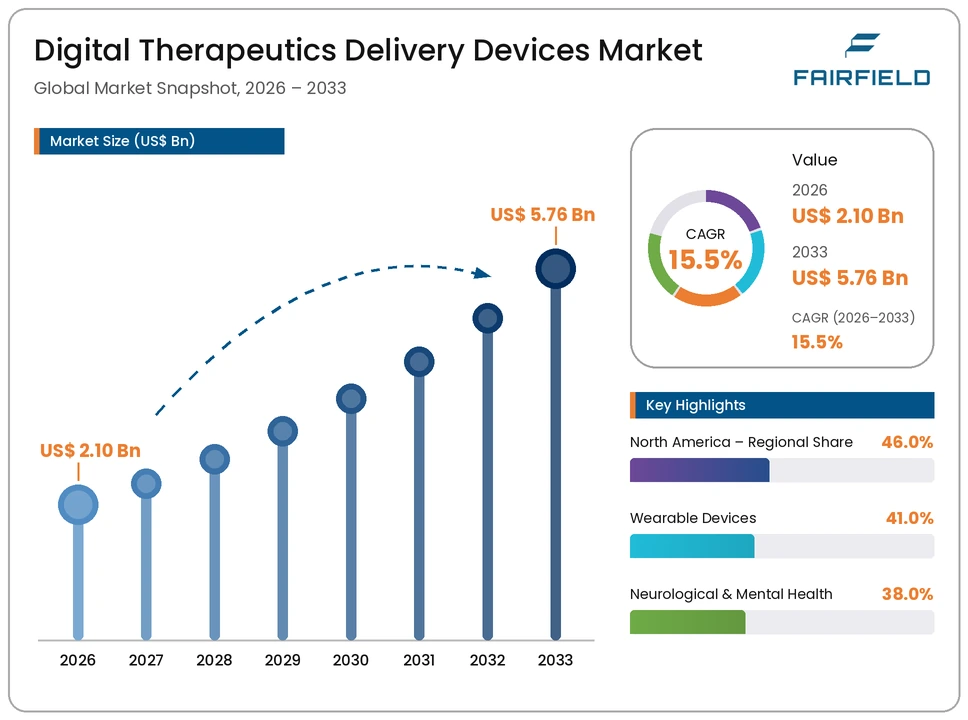
- The global digital therapeutics delivery devices market is valued at USD 2.10 Billion in 2026 and is projected to reach USD 5.76 Billion by 2033, expanding at a CAGR of 15.5% across the 2026-2033 forecast period.
- Wearable Devices lead the device-type segment with a 41.0% share in 2026, equivalent to USD 0.86 Billion.
- Neurological & Mental Health Disorders remains the dominant therapeutic application, accounting for 38.0% of global demand, or USD 0.80 Billion, in 2026.
- North America commands the largest regional share at 46.0% of the global market in 2026.
- Implantable and ingestible delivery devices are emerging as the fastest-growing device category through 2033.
Market Overview
Digital therapeutics delivery devices are the hardware component of digital therapeutic interventions, combining sensors, connectivity, and physical delivery mechanisms with software-driven treatment protocols to monitor, support, or directly administer clinically validated therapy. Unlike standalone therapeutic software, these devices bridge the physical and digital treatment experience, spanning wearable sensors that track physiological or behavioral data, connected devices that support remote patient monitoring, and implantable or ingestible mechanisms that enable more direct therapeutic delivery under clinical supervision.
Demand growth through the 2026-2033 window is closely tied to expanding regulatory pathways for software-and-device combination therapies, growing payer willingness to reimburse device-supported digital interventions, and rising clinical adoption of remote patient monitoring across chronic disease management. The shift toward value-based care models is reinforcing this trend, as health systems and payers increasingly favor interventions that generate continuous, objective patient data to support treatment adjustments and demonstrate measurable outcomes over time.
The market is valued at USD 2.10 Billion in 2026, with device developers directing investment toward miniaturization, extended battery life, and interoperability with electronic health record systems to ease clinical integration. By 2033, the market is forecast to reach USD 5.76 Billion, reflecting the compounding effect of broadening clinical indications, expanding reimbursement coverage, and rising patient familiarity with connected health devices.
Market Dynamics
Key Growth Drivers
Growth in the digital therapeutics delivery devices market is driven primarily by expanding regulatory clearance pathways that increasingly accommodate combined software-and-hardware therapeutic products, giving device developers a clearer route to market than in earlier years when regulatory frameworks were built around either drugs or devices alone. This clarity is encouraging greater investment in device-based therapeutic platforms across neurological, respiratory, and metabolic conditions.
A second driver is the growing body of clinical evidence supporting device-based digital interventions, which is improving payer confidence and expanding reimbursement coverage in key markets. As health systems gain access to real-world outcomes data generated by these devices, adoption is extending beyond early pilot programs into broader standard-of-care use, particularly for chronic conditions requiring ongoing monitoring and behavioral reinforcement.
Key Restraints
High development and regulatory approval costs associated with combination software-hardware products create a significant barrier for smaller developers, since these devices typically require both device-specific clearance and software validation, extending time to market relative to purely digital or purely hardware therapeutic products. This cost structure concentrates capital-intensive development among better-funded organizations.
Additionally, inconsistent reimbursement policies across different healthcare systems and payers create uncertainty for developers seeking to scale device-based digital therapeutics commercially, since coverage decisions vary considerably by therapeutic area, region, and individual payer, complicating long-term revenue planning for device manufacturers.
Market Opportunities
Expansion into chronic disease management presents a substantial opportunity, as delivery devices capable of continuous monitoring and adaptive therapeutic delivery are well suited to conditions such as diabetes, respiratory disease, and mental health disorders that require sustained patient engagement beyond periodic clinical visits.
A second opportunity lies in the integration of delivery devices with artificial intelligence-driven treatment personalization, allowing devices to adjust therapeutic delivery or behavioral prompts based on individual patient response patterns. Developers that successfully combine device-based delivery with adaptive, data-driven treatment algorithms are positioned to differentiate their offerings in an increasingly crowded digital health field.
Segmentation Analysis
By Device Type
Wearable Devices lead the device-type segment, accounting for 41.0% of global market value in 2026, equivalent to USD 0.86 Billion. Their leadership reflects broad applicability across neurological, cardiovascular, and behavioral health conditions, along with strong patient acceptance of wrist-worn and patch-based form factors. Sensor-Based & Connected Monitoring Devices hold the second-largest share, widely used to support remote patient monitoring and medication adherence tracking. Implantable & Ingestible Devices, though currently a smaller share of the market, represent the fastest-growing device category through 2033 as novel drug-device combination therapies advance through clinical development.
By Therapeutic Area
Neurological & Mental Health Disorders form the leading therapeutic application, representing 38.0% of global demand in 2026, or USD 0.80 Billion, supported by growing clinical validation of device-supported interventions for conditions such as attention disorders, anxiety, and insomnia. Diabetes & Metabolic Disorders form the second-largest application, driven by continuous monitoring and connected delivery devices supporting glucose management. Respiratory Disorders represent the fastest-growing therapeutic area, propelled by rising adoption of connected inhaler and sensor-based respiratory monitoring devices.
Regional Insights
North America
North America holds the largest regional share, at 46.0% of the global market in 2026, equivalent to USD 0.97 Billion. The region's leadership reflects an established digital health regulatory framework, relatively favorable reimbursement pathways for device-based digital therapeutics, and a concentration of developers advancing combination software-hardware products through clinical trials. The region is also expected to maintain a leading position through 2033 as reimbursement frameworks continue to mature.
Europe
Europe accounts for 26.0% of the global market in 2026, valued at USD 0.55 Billion. Growth is supported by expanding digital health assessment frameworks in several countries that provide structured reimbursement pathways for approved digital therapeutic devices, alongside rising clinical interest in remote monitoring solutions for chronic disease management.
Asia Pacific
Asia Pacific represents 18.0% of the global market in 2026, or USD 0.38 Billion. Demand is rising alongside expanding digital health infrastructure investment in Japan, South Korea, China, and India, though regulatory pathways for combination digital therapeutic devices remain less standardized than in North America and Europe, moderating near-term growth relative to the region's overall digital health momentum.
Latin America
Latin America contributes 6.0% of the global market in 2026, equivalent to USD 0.13 Billion. Adoption remains at an early stage, concentrated in Brazil and Mexico, with growth linked to gradual expansion of private healthcare providers piloting connected device-based interventions for chronic disease management.
Middle East & Africa
Middle East & Africa holds 4.0% of the global market in 2026, valued at USD 0.08 Billion. Growth here is tied to selective adoption within well-funded private healthcare networks in Gulf Cooperation Council countries, with broader regional uptake constrained by limited reimbursement infrastructure for digital therapeutic devices.
Competitive Landscape
The global digital therapeutics delivery devices market remains fragmented, with a mix of specialized digital health developers, established medical device manufacturers extending into connected therapeutic devices, and early-stage companies advancing novel drug-device combination products. Competition centers on clinical evidence generation, regulatory clearance strategy, and the ability to secure payer reimbursement, since commercial success in this market depends heavily on demonstrating measurable clinical outcomes rather than device features alone. Developers with established relationships across healthcare providers and payers hold an advantage in scaling adoption beyond pilot programs into sustained clinical use.
Key Market Players
- Akili, Inc.
- Better Therapeutics
- Click Therapeutics
- Cala Health
- DarioHealth Corp.
- Biofourmis
- WellDoc, Inc.
- Propeller Health (ResMed)
- NeuroMetrix, Inc.
- Omada Health
Market Segmentation
By Device Type
- Wearable Devices
- Sensor-Based & Connected Monitoring Devices
- Implantable & Ingestible Devices
By Therapeutic Area
- Neurological & Mental Health Disorders
- Diabetes & Metabolic Disorders
- Respiratory Disorders
- Cardiovascular Disorders
- Others
By End Use
- Homecare & Patient Self-Use
- Hospitals & Clinics
By Geography
- North America
- Europe
- Asia Pacific
- Latin America
- Middle East & Africa
- Executive Summary
- Global Digital Therapeutics Delivery Devices Market Snapshot
- Future Projections
- Key Market Trends
- Regional Snapshot, by Value, 2026
- Analyst Recommendations
- Market Overview
- Market Definitions and Segmentations
- Market Dynamics
- Drivers
- Restraints
- Market Opportunities
- Value Chain Analysis
- COVID-19 Impact Analysis
- Porter's Five Forces Analysis
- Impact of Russia-Ukraine Conflict
- PESTLE Analysis
- Regulatory Analysis
- Price Trend Analysis
- Current Prices and Future Projections, 2025-2033
- Price Impact Factors
- Global Digital Therapeutics Delivery Devices Market Outlook, 2020 - 2033
- Global Digital Therapeutics Delivery Devices Market Outlook, by Device Type, Value (US$ Mn), 2020-2033
- Wearable Devices
- Sensor-Based & Connected Monitoring Devices
- Implantable & Ingestible Devices
- Global Digital Therapeutics Delivery Devices Market Outlook, by Therapeutic Area, Value (US$ Mn), 2020-2033
- Neurological & Mental Health Disorders
- Diabetes & Metabolic Disorders
- Respiratory Disorders
- Cardiovascular Disorders
- Others
- Global Digital Therapeutics Delivery Devices Market Outlook, by End Use, Value (US$ Mn), 2020-2033
- Homecare & Patient Self-Use
- Hospitals & Clinics
- Global Digital Therapeutics Delivery Devices Market Outlook, by Region, Value (US$ Mn), 2020-2033
- North America
- Europe
- Asia Pacific
- Latin America
- Middle East & Africa
- Global Digital Therapeutics Delivery Devices Market Outlook, by Device Type, Value (US$ Mn), 2020-2033
- North America Digital Therapeutics Delivery Devices Market Outlook, 2020 - 2033
- North America Digital Therapeutics Delivery Devices Market Outlook, by Device Type, Value (US$ Mn), 2020-2033
- Wearable Devices
- Sensor-Based & Connected Monitoring Devices
- Implantable & Ingestible Devices
- North America Digital Therapeutics Delivery Devices Market Outlook, by Therapeutic Area, Value (US$ Mn), 2020-2033
- Neurological & Mental Health Disorders
- Diabetes & Metabolic Disorders
- Respiratory Disorders
- Cardiovascular Disorders
- Others
- North America Digital Therapeutics Delivery Devices Market Outlook, by End Use, Value (US$ Mn), 2020-2033
- Homecare & Patient Self-Use
- Hospitals & Clinics
- North America Digital Therapeutics Delivery Devices Market Outlook, by Country, Value (US$ Mn), 2020-2033
- U.S. Digital Therapeutics Delivery Devices Market Outlook, by Device Type, 2020-2033
- U.S. Digital Therapeutics Delivery Devices Market Outlook, by Therapeutic Area, 2020-2033
- U.S. Digital Therapeutics Delivery Devices Market Outlook, by End Use, 2020-2033
- Canada Digital Therapeutics Delivery Devices Market Outlook, by Device Type, 2020-2033
- Canada Digital Therapeutics Delivery Devices Market Outlook, by Therapeutic Area, 2020-2033
- Canada Digital Therapeutics Delivery Devices Market Outlook, by End Use, 2020-2033
- BPS Analysis/Market Attractiveness Analysis
- North America Digital Therapeutics Delivery Devices Market Outlook, by Device Type, Value (US$ Mn), 2020-2033
- Europe Digital Therapeutics Delivery Devices Market Outlook, 2020 - 2033
- Europe Digital Therapeutics Delivery Devices Market Outlook, by Device Type, Value (US$ Mn), 2020-2033
- Wearable Devices
- Sensor-Based & Connected Monitoring Devices
- Implantable & Ingestible Devices
- Europe Digital Therapeutics Delivery Devices Market Outlook, by Therapeutic Area, Value (US$ Mn), 2020-2033
- Neurological & Mental Health Disorders
- Diabetes & Metabolic Disorders
- Respiratory Disorders
- Cardiovascular Disorders
- Others
- Europe Digital Therapeutics Delivery Devices Market Outlook, by End Use, Value (US$ Mn), 2020-2033
- Homecare & Patient Self-Use
- Hospitals & Clinics
- Europe Digital Therapeutics Delivery Devices Market Outlook, by Country, Value (US$ Mn), 2020-2033
- Germany Digital Therapeutics Delivery Devices Market Outlook, by Device Type, 2020-2033
- Germany Digital Therapeutics Delivery Devices Market Outlook, by Therapeutic Area, 2020-2033
- Germany Digital Therapeutics Delivery Devices Market Outlook, by End Use, 2020-2033
- Italy Digital Therapeutics Delivery Devices Market Outlook, by Device Type, 2020-2033
- Italy Digital Therapeutics Delivery Devices Market Outlook, by Therapeutic Area, 2020-2033
- Italy Digital Therapeutics Delivery Devices Market Outlook, by End Use, 2020-2033
- France Digital Therapeutics Delivery Devices Market Outlook, by Device Type, 2020-2033
- France Digital Therapeutics Delivery Devices Market Outlook, by Therapeutic Area, 2020-2033
- France Digital Therapeutics Delivery Devices Market Outlook, by End Use, 2020-2033
- U.K. Digital Therapeutics Delivery Devices Market Outlook, by Device Type, 2020-2033
- U.K. Digital Therapeutics Delivery Devices Market Outlook, by Therapeutic Area, 2020-2033
- U.K. Digital Therapeutics Delivery Devices Market Outlook, by End Use, 2020-2033
- Spain Digital Therapeutics Delivery Devices Market Outlook, by Device Type, 2020-2033
- Spain Digital Therapeutics Delivery Devices Market Outlook, by Therapeutic Area, 2020-2033
- Spain Digital Therapeutics Delivery Devices Market Outlook, by End Use, 2020-2033
- Russia Digital Therapeutics Delivery Devices Market Outlook, by Device Type, 2020-2033
- Russia Digital Therapeutics Delivery Devices Market Outlook, by Therapeutic Area, 2020-2033
- Russia Digital Therapeutics Delivery Devices Market Outlook, by End Use, 2020-2033
- Rest of Europe Digital Therapeutics Delivery Devices Market Outlook, by Device Type, 2020-2033
- Rest of Europe Digital Therapeutics Delivery Devices Market Outlook, by Therapeutic Area, 2020-2033
- Rest of Europe Digital Therapeutics Delivery Devices Market Outlook, by End Use, 2020-2033
- BPS Analysis/Market Attractiveness Analysis
- Europe Digital Therapeutics Delivery Devices Market Outlook, by Device Type, Value (US$ Mn), 2020-2033
- Asia Pacific Digital Therapeutics Delivery Devices Market Outlook, 2020 - 2033
- Asia Pacific Digital Therapeutics Delivery Devices Market Outlook, by Device Type, Value (US$ Mn), 2020-2033
- Wearable Devices
- Sensor-Based & Connected Monitoring Devices
- Implantable & Ingestible Devices
- Asia Pacific Digital Therapeutics Delivery Devices Market Outlook, by Therapeutic Area, Value (US$ Mn), 2020-2033
- Neurological & Mental Health Disorders
- Diabetes & Metabolic Disorders
- Respiratory Disorders
- Cardiovascular Disorders
- Others
- Asia Pacific Digital Therapeutics Delivery Devices Market Outlook, by End Use, Value (US$ Mn), 2020-2033
- Homecare & Patient Self-Use
- Hospitals & Clinics
- Asia Pacific Digital Therapeutics Delivery Devices Market Outlook, by Country, Value (US$ Mn), 2020-2033
- China Digital Therapeutics Delivery Devices Market Outlook, by Device Type, 2020-2033
- China Digital Therapeutics Delivery Devices Market Outlook, by Therapeutic Area, 2020-2033
- China Digital Therapeutics Delivery Devices Market Outlook, by End Use, 2020-2033
- Japan Digital Therapeutics Delivery Devices Market Outlook, by Device Type, 2020-2033
- Japan Digital Therapeutics Delivery Devices Market Outlook, by Therapeutic Area, 2020-2033
- Japan Digital Therapeutics Delivery Devices Market Outlook, by End Use, 2020-2033
- South Korea Digital Therapeutics Delivery Devices Market Outlook, by Device Type, 2020-2033
- South Korea Digital Therapeutics Delivery Devices Market Outlook, by Therapeutic Area, 2020-2033
- South Korea Digital Therapeutics Delivery Devices Market Outlook, by End Use, 2020-2033
- India Digital Therapeutics Delivery Devices Market Outlook, by Device Type, 2020-2033
- India Digital Therapeutics Delivery Devices Market Outlook, by Therapeutic Area, 2020-2033
- India Digital Therapeutics Delivery Devices Market Outlook, by End Use, 2020-2033
- Southeast Asia Digital Therapeutics Delivery Devices Market Outlook, by Device Type, 2020-2033
- Southeast Asia Digital Therapeutics Delivery Devices Market Outlook, by Therapeutic Area, 2020-2033
- Southeast Asia Digital Therapeutics Delivery Devices Market Outlook, by End Use, 2020-2033
- Rest of SAO Digital Therapeutics Delivery Devices Market Outlook, by Device Type, 2020-2033
- Rest of SAO Digital Therapeutics Delivery Devices Market Outlook, by Therapeutic Area, 2020-2033
- Rest of SAO Digital Therapeutics Delivery Devices Market Outlook, by End Use, 2020-2033
- BPS Analysis/Market Attractiveness Analysis
- Asia Pacific Digital Therapeutics Delivery Devices Market Outlook, by Device Type, Value (US$ Mn), 2020-2033
- Latin America Digital Therapeutics Delivery Devices Market Outlook, 2020 - 2033
- Latin America Digital Therapeutics Delivery Devices Market Outlook, by Device Type, Value (US$ Mn), 2020-2033
- Wearable Devices
- Sensor-Based & Connected Monitoring Devices
- Implantable & Ingestible Devices
- Latin America Digital Therapeutics Delivery Devices Market Outlook, by Therapeutic Area, Value (US$ Mn), 2020-2033
- Neurological & Mental Health Disorders
- Diabetes & Metabolic Disorders
- Respiratory Disorders
- Cardiovascular Disorders
- Others
- Latin America Digital Therapeutics Delivery Devices Market Outlook, by End Use, Value (US$ Mn), 2020-2033
- Homecare & Patient Self-Use
- Hospitals & Clinics
- Latin America Digital Therapeutics Delivery Devices Market Outlook, by Country, Value (US$ Mn), 2020-2033
- Brazil Digital Therapeutics Delivery Devices Market Outlook, by Device Type, 2020-2033
- Brazil Digital Therapeutics Delivery Devices Market Outlook, by Therapeutic Area, 2020-2033
- Brazil Digital Therapeutics Delivery Devices Market Outlook, by End Use, 2020-2033
- Mexico Digital Therapeutics Delivery Devices Market Outlook, by Device Type, 2020-2033
- Mexico Digital Therapeutics Delivery Devices Market Outlook, by Therapeutic Area, 2020-2033
- Mexico Digital Therapeutics Delivery Devices Market Outlook, by End Use, 2020-2033
- Argentina Digital Therapeutics Delivery Devices Market Outlook, by Device Type, 2020-2033
- Argentina Digital Therapeutics Delivery Devices Market Outlook, by Therapeutic Area, 2020-2033
- Argentina Digital Therapeutics Delivery Devices Market Outlook, by End Use, 2020-2033
- Rest of LATAM Digital Therapeutics Delivery Devices Market Outlook, by Device Type, 2020-2033
- Rest of LATAM Digital Therapeutics Delivery Devices Market Outlook, by Therapeutic Area, 2020-2033
- Rest of LATAM Digital Therapeutics Delivery Devices Market Outlook, by End Use, 2020-2033
- BPS Analysis/Market Attractiveness Analysis
- Latin America Digital Therapeutics Delivery Devices Market Outlook, by Device Type, Value (US$ Mn), 2020-2033
- Middle East & Africa Digital Therapeutics Delivery Devices Market Outlook, 2020 - 2033
- Middle East & Africa Digital Therapeutics Delivery Devices Market Outlook, by Device Type, Value (US$ Mn), 2020-2033
- Wearable Devices
- Sensor-Based & Connected Monitoring Devices
- Implantable & Ingestible Devices
- Middle East & Africa Digital Therapeutics Delivery Devices Market Outlook, by Therapeutic Area, Value (US$ Mn), 2020-2033
- Neurological & Mental Health Disorders
- Diabetes & Metabolic Disorders
- Respiratory Disorders
- Cardiovascular Disorders
- Others
- Middle East & Africa Digital Therapeutics Delivery Devices Market Outlook, by End Use, Value (US$ Mn), 2020-2033
- Homecare & Patient Self-Use
- Hospitals & Clinics
- Middle East & Africa Digital Therapeutics Delivery Devices Market Outlook, by Country, Value (US$ Mn), 2020-2033
- GCC Digital Therapeutics Delivery Devices Market Outlook, by Device Type, 2020-2033
- GCC Digital Therapeutics Delivery Devices Market Outlook, by Therapeutic Area, 2020-2033
- GCC Digital Therapeutics Delivery Devices Market Outlook, by End Use, 2020-2033
- South Africa Digital Therapeutics Delivery Devices Market Outlook, by Device Type, 2020-2033
- South Africa Digital Therapeutics Delivery Devices Market Outlook, by Therapeutic Area, 2020-2033
- South Africa Digital Therapeutics Delivery Devices Market Outlook, by End Use, 2020-2033
- Egypt Digital Therapeutics Delivery Devices Market Outlook, by Device Type, 2020-2033
- Egypt Digital Therapeutics Delivery Devices Market Outlook, by Therapeutic Area, 2020-2033
- Egypt Digital Therapeutics Delivery Devices Market Outlook, by End Use, 2020-2033
- Nigeria Digital Therapeutics Delivery Devices Market Outlook, by Device Type, 2020-2033
- Nigeria Digital Therapeutics Delivery Devices Market Outlook, by Therapeutic Area, 2020-2033
- Nigeria Digital Therapeutics Delivery Devices Market Outlook, by End Use, 2020-2033
- Rest of Middle East Digital Therapeutics Delivery Devices Market Outlook, by Device Type, 2020-2033
- Rest of Middle East Digital Therapeutics Delivery Devices Market Outlook, by Therapeutic Area, 2020-2033
- Rest of Middle East Digital Therapeutics Delivery Devices Market Outlook, by End Use, 2020-2033
- BPS Analysis/Market Attractiveness Analysis
- Middle East & Africa Digital Therapeutics Delivery Devices Market Outlook, by Device Type, Value (US$ Mn), 2020-2033
- Competitive Landscape
- Company Vs Segment Heatmap
- Company Market Share Analysis, 2025
- Competitive Dashboard
- Company Profiles
- Akili, Inc.
- Company Overview
- Product Portfolio
- Financial Overview
- Business Strategies and Developments
- Better Therapeutics
- Click Therapeutics
- Cala Health
- DarioHealth Corp.
- Biofourmis
- WellDoc, Inc.
- Propeller Health (ResMed)
- NeuroMetrix, Inc.
- Omada Health
- Akili, Inc.
- Appendix
- Research Methodology
- Report Assumptions
- Acronyms and Abbreviations
By Device Type
- Wearable Devices
- Sensor-Based & Connected Monitoring Devices
- Implantable & Ingestible Devices
By Therapeutic Area
- Neurological & Mental Health Disorders
- Diabetes & Metabolic Disorders
- Respiratory Disorders
- Cardiovascular Disorders
- Others
By End Use
- Homecare & Patient Self-Use
- Hospitals & Clinics
By Geography
- North America
- Europe
- Asia Pacific
- Latin America
- Middle East & Africa
Our Research Methodology
Considering the volatility of business today, traditional approaches to strategizing a game plan can be unfruitful if not detrimental. True ambiguity is no way to determine a forecast. A myriad of predetermined factors must be accounted for such as the degree of risk involved, the magnitude of circumstances, as well as conditions or consequences that are not known or unpredictable. To circumvent binary views that cast uncertainty, the application of market research intelligence to strategically posture, move, and enable actionable outcomes is necessary.
View Methodology
Quality Assured
Rigorous Validation Process

Confidentiality Assured
End-to-end Data Security

Custom Research Services
Tailored To Your Objectives
FAQs
global digital therapeutics delivery devices market is valued at USD 2.10 Billion in 2026, reflecting rising clinical adoption of device-based digital interventions.
The market is projected to grow at a CAGR of 15.5%, reaching USD 5.76 Billion by 2033, driven by expanding regulatory pathways and reimbursement coverage.
Wearable Devices lead with a 41.0% share in 2026, supported by broad applicability across neurological, cardiovascular, and behavioral health conditions.
North America leads with a 46.0% share in 2026, driven by an established regulatory framework and favorable reimbursement pathways for device-based therapeutics.
The largest opportunity lies in combining delivery devices with AI-driven treatment personalization, allowing therapy to adapt to individual patient response patterns over time.
Related Reports
Ankle Boots Market Insights, Competitive Landscape, and Market Forecast 2033
The ankle boots market is valued at USD 18.50 Bn in 2026 and is projected to reach USD 27.45 Bn by 2033, expanding at a CAGR of 5.8% during 2026-2033
Foot And Ankle Devices Market Insights, Competitive Landscape, and Market Forecast 2033
The foot and ankle devices market will grow from USD 6.40 Bn in 2026 to USD 10.14 Bn by 2033 at a CAGR of 6.8%, driven by rising trauma & sports injuries.
Global Infant Incubator Insights, Competitive Landscape, and Market Forecast 2033
Infant Incubator Market to reach US$1,306.72 Mn by 2033, growing at 5.3% CAGR, driven by preterm births, NICU expansion and transport incubators care.
Pulse Electromagnetic Field Therapy Devices Market Insights, Competitive Landscape, and Market Forecast 2026–2033
Pulse Electromagnetic Field Therapy Devices Market to reach US$930.86 Mn by 2033, driven by pain management and wearable devices.
Vaginal Rejuvenation Market Insights, Competitive Landscape, and Market Forecast 2026–2033
Vaginal Rejuvenation Market to Reach US$26.75 Billion by 2033, Driven by Rising Demand for Minimally Invasive Women's Health Solutions.
Red Light Therapy Market Insights, Competitive Landscape, and Market Forecast 2033
The red light therapy market will grow from US$587.50 Mn in 2026 to US$1,130.38 Mn by 2033 at a 9.8% CAGR, driven by clinical adoption & FDA clearances.