



Dispersible Bio Films Market
Dispersible Bio Films Market Insights, Competitive Landscape, and Market Forecast 2033
Market Overview
Dispersible bio films are thin, biodegradable film formats derived from pullulan, hydroxypropyl methylcellulose, and starch-based materials that rapidly dissolve or disperse upon contact with moisture, supporting pharmaceutical oral thin film and nutraceutical delivery applications requiring precise, convenient dosing without water. As pharmaceutical and nutraceutical manufacturers have continued seeking patient-friendly delivery formats that improve dosing compliance, dispersible bio film technology has gained increasing adoption as a differentiated alternative to conventional tablet and capsule delivery formats.
Demand growth through the 2026-2033 window is closely tied to sustained pharmaceutical industry investment in patient-friendly, compliance-improving delivery formats, growing nutraceutical and supplement manufacturer adoption of dispersible film formats supporting convenient dosing, and continued biopolymer formulation technology advancement improving film stability and active ingredient loading capacity. Growing consumer preference for water-free, convenient dosing formats continues to support demand across both pharmaceutical and nutraceutical applications.
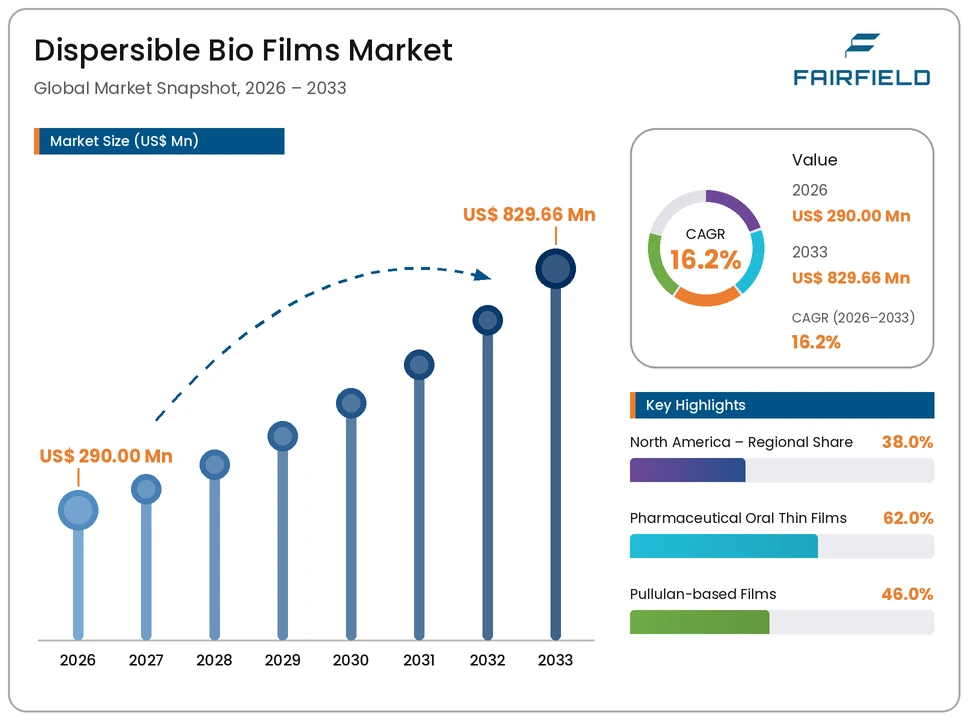
The market is valued at USD 290.00 Million in 2026, with manufacturers directing investment toward improved biopolymer formulation technology that enhances film stability and active ingredient compatibility. By 2033, the market is forecast to reach USD 829.66 Million, reflecting rapid growth across established pullulan-based film applications alongside accelerating starch-based film adoption.
Key Highlights
- The global dispersible bio films market is valued at USD 290.00 Million in 2026 and is projected to reach USD 829.66 Million by 2033, expanding at a CAGR of 16.2% across the 2026-2033 forecast period.
- Pullulan-based Films lead the material-type segment with a 46.0% share in 2026, equivalent to USD 133.40 Million.
- Pharmaceutical Oral Thin Films remain the dominant application, accounting for 62.0% of global demand, or USD 179.80 Million, in 2026.
- North America commands the largest regional share at 38.0% of the global market in 2026.
- Starch-based films are emerging as the fastest-growing material-type category through 2033.
Market Dynamics
Key Growth Drivers
Growth in the dispersible bio films market is driven primarily by sustained pharmaceutical industry investment in patient-friendly delivery formats, as manufacturers increasingly prioritize dosing formats that improve patient compliance relative to conventional tablets and capsules.
A second driver is growing nutraceutical and supplement manufacturer adoption of dispersible film formats, as these manufacturers increasingly seek differentiated, convenient dosing formats supporting consumer preference for water-free administration.
Key Restraints
The comparatively limited active ingredient loading capacity of thin film formats relative to conventional tablet and capsule formats creates formulation constraints for higher-dose pharmaceutical and nutraceutical applications.
Additionally, the specialized manufacturing equipment and formulation expertise required for reliable, consistent film production creates capital investment barriers for smaller manufacturers.
Market Opportunities
The expansion of starch-based film formulations presents a substantial opportunity, as growing interest in cost-competitive, broadly biodegradable film alternatives continues to expand material options beyond pullulan and cellulose-based formulations.
A second opportunity lies in continued biopolymer formulation technology advancement that improves active ingredient loading capacity. Companies that successfully advance this formulation capability stand to capture growing demand as manufacturers increasingly seek film formats supporting a broader range of active ingredient applications.
Segmentation Analysis
By Material Type
Pullulan-based Films lead the material-type segment, accounting for 46.0% of global market value in 2026, equivalent to USD 133.40 Million. Their leadership reflects pullulan’s well-established regulatory approval and strong film-forming performance across pharmaceutical applications. Hydroxypropyl Methylcellulose (HPMC)-based Films represents a significant, established material-type category. Starch-based Films represents the fastest-growing material-type category through 2033, driven by growing interest in cost-competitive, biodegradable alternatives.
By Application
Pharmaceutical Oral Thin Films form the leading application segment, representing 62.0% of global demand in 2026, or USD 179.80 Million, reflecting the pharmaceutical industry’s substantial investment in patient-friendly delivery format development. Nutraceutical & Supplement Films represents the fastest-growing application category, propelled by growing consumer preference for convenient, water-free dosing.
Regional Insights
North America
North America holds the largest regional share, at 38.0% of the global market in 2026, equivalent to USD 110.20 Million. The region’s dominance reflects substantial pharmaceutical delivery format innovation investment and strong nutraceutical industry development across the United States and Canada.
Europe
Europe accounts for 28.0% of the global market in 2026, valued at USD 81.20 Million. Demand is supported by strong pharmaceutical manufacturing capacity and growing nutraceutical product development across major European markets.
Asia Pacific
Asia Pacific represents 24.0% of the global market in 2026, or USD 69.60 Million. Growth is underpinned by expanding pharmaceutical and nutraceutical manufacturing capacity across China, Japan, and India.
Latin America
Latin America contributes 6.0% of the global market in 2026, equivalent to USD 17.40 Million. Growth is linked to expanding pharmaceutical and nutraceutical product development in Brazil and Mexico.
Middle East & Africa
Middle East & Africa holds 4.0% of the global market in 2026, valued at USD 11.60 Million. Growth remains gradual, tied to expanding regional pharmaceutical manufacturing capacity.
Competitive Landscape
The global dispersible bio films market is moderately concentrated, with a mix of specialized pharmaceutical film technology companies and diversified specialty ingredient manufacturers competing for pharmaceutical and nutraceutical manufacturer adoption. Competition centers on film formulation technology and active ingredient compatibility, regulatory approval breadth across markets, and the strength of relationships with pharmaceutical and nutraceutical brand owners. Companies are increasingly differentiating through expanded starch-based and alternative biopolymer capability rather than competing on pullulan and cellulose-based films alone.
Key Market Players
- Catalent, Inc.
- Indivior PLC
- Aquestive Therapeutics, Inc.
- IntelGenx Technologies Corp.
- LTS Lohmann Therapie-Systeme AG
- BioDelivery Sciences International, Inc.
- tesa Labtec GmbH
- Roquette Frères
- Cure Pharmaceutical Holding Corp.
- Nitto Denko Corporation
Market Segmentation
By Material Type
- Pullulan-based Films
- Hydroxypropyl Methylcellulose (HPMC)-based Films
- Starch-based Films
- Others
By Application
- Pharmaceutical Oral Thin Films
- Nutraceutical & Supplement Films
- Others
By End User
- Pharmaceutical Manufacturers
- Nutraceutical & Supplement Companies
By Geography
- North America
- Europe
- Asia Pacific
- Latin America
- Middle East & Africa
- Executive Summary
- Global Dispersible Bio Films Market Snapshot
- Future Projections
- Key Highlights
- Regional Snapshot by Value 2026
- Market Overview
- Market Definition and Segmentation
- Market Dynamics
- Key Growth Drivers
- Key Restraints
- Market Opportunities
- Global Dispersible Bio Films Market Outlook 2026–2033
- Global Dispersible Bio Films Market Outlook, by Material Type, Value (USD Million), 2026–2033
- Pullulan-based Films
- Hydroxypropyl Methylcellulose (HPMC)-based Films
- Starch-based Films
- Others
- Global Dispersible Bio Films Market Outlook, by Application, Value (USD Million), 2026–2033
- Pharmaceutical Oral Thin Films
- Nutraceutical & Supplement Films
- Others
- Global Dispersible Bio Films Market Outlook, by End User, Value (USD Million), 2026–2033
- Pharmaceutical Manufacturers
- Nutraceutical & Supplement Companies
- Global Dispersible Bio Films Market Outlook, by Region, Value (USD Million), 2026–2033
- North America
- Europe
- Asia Pacific
- Latin America
- Middle East & Africa
- Global Dispersible Bio Films Market Outlook, by Material Type, Value (USD Million), 2026–2033
- North America Dispersible Bio Films Market Outlook 2026–2033
- North America Dispersible Bio Films Market Outlook, by Material Type, Value (USD Million), 2026–2033
- Pullulan-based Films
- Hydroxypropyl Methylcellulose (HPMC)-based Films
- Starch-based Films
- Others
- North America Dispersible Bio Films Market Outlook, by Application, Value (USD Million), 2026–2033
- Pharmaceutical Oral Thin Films
- Nutraceutical & Supplement Films
- Others
- North America Dispersible Bio Films Market Outlook, by End User, Value (USD Million), 2026–2033
- Pharmaceutical Manufacturers
- Nutraceutical & Supplement Companies
- North America Dispersible Bio Films Market Outlook, by Country and Subregion, Value (USD Million), 2026–2033
- United States Dispersible Bio Films Market Outlook, by Material Type, 2026–2033
- United States Dispersible Bio Films Market Outlook, by Application, 2026–2033
- United States Dispersible Bio Films Market Outlook, by End User, 2026–2033
- Canada Dispersible Bio Films Market Outlook, by Material Type, 2026–2033
- Canada Dispersible Bio Films Market Outlook, by Application, 2026–2033
- Canada Dispersible Bio Films Market Outlook, by End User, 2026–2033
- North America Dispersible Bio Films Market Outlook, by Material Type, Value (USD Million), 2026–2033
- Europe Dispersible Bio Films Market Outlook 2026–2033
- Europe Dispersible Bio Films Market Outlook, by Material Type, Value (USD Million), 2026–2033
- Pullulan-based Films
- Hydroxypropyl Methylcellulose (HPMC)-based Films
- Starch-based Films
- Others
- Europe Dispersible Bio Films Market Outlook, by Application, Value (USD Million), 2026–2033
- Pharmaceutical Oral Thin Films
- Nutraceutical & Supplement Films
- Others
- Europe Dispersible Bio Films Market Outlook, by End User, Value (USD Million), 2026–2033
- Pharmaceutical Manufacturers
- Nutraceutical & Supplement Companies
- Europe Dispersible Bio Films Market Outlook, by Material Type, Value (USD Million), 2026–2033
- Asia Pacific Dispersible Bio Films Market Outlook 2026–2033
- Asia Pacific Dispersible Bio Films Market Outlook, by Material Type, Value (USD Million), 2026–2033
- Pullulan-based Films
- Hydroxypropyl Methylcellulose (HPMC)-based Films
- Starch-based Films
- Others
- Asia Pacific Dispersible Bio Films Market Outlook, by Application, Value (USD Million), 2026–2033
- Pharmaceutical Oral Thin Films
- Nutraceutical & Supplement Films
- Others
- Asia Pacific Dispersible Bio Films Market Outlook, by End User, Value (USD Million), 2026–2033
- Pharmaceutical Manufacturers
- Nutraceutical & Supplement Companies
- Asia Pacific Dispersible Bio Films Market Outlook, by Country and Subregion, Value (USD Million), 2026–2033
- China Dispersible Bio Films Market Outlook, by Material Type, 2026–2033
- China Dispersible Bio Films Market Outlook, by Application, 2026–2033
- China Dispersible Bio Films Market Outlook, by End User, 2026–2033
- Japan Dispersible Bio Films Market Outlook, by Material Type, 2026–2033
- Japan Dispersible Bio Films Market Outlook, by Application, 2026–2033
- Japan Dispersible Bio Films Market Outlook, by End User, 2026–2033
- India Dispersible Bio Films Market Outlook, by Material Type, 2026–2033
- India Dispersible Bio Films Market Outlook, by Application, 2026–2033
- India Dispersible Bio Films Market Outlook, by End User, 2026–2033
- Asia Pacific Dispersible Bio Films Market Outlook, by Material Type, Value (USD Million), 2026–2033
- Latin America Dispersible Bio Films Market Outlook 2026–2033
- Latin America Dispersible Bio Films Market Outlook, by Material Type, Value (USD Million), 2026–2033
- Pullulan-based Films
- Hydroxypropyl Methylcellulose (HPMC)-based Films
- Starch-based Films
- Others
- Latin America Dispersible Bio Films Market Outlook, by Application, Value (USD Million), 2026–2033
- Pharmaceutical Oral Thin Films
- Nutraceutical & Supplement Films
- Others
- Latin America Dispersible Bio Films Market Outlook, by End User, Value (USD Million), 2026–2033
- Pharmaceutical Manufacturers
- Nutraceutical & Supplement Companies
- Latin America Dispersible Bio Films Market Outlook, by Country and Subregion, Value (USD Million), 2026–2033
- Brazil Dispersible Bio Films Market Outlook, by Material Type, 2026–2033
- Brazil Dispersible Bio Films Market Outlook, by Application, 2026–2033
- Brazil Dispersible Bio Films Market Outlook, by End User, 2026–2033
- Mexico Dispersible Bio Films Market Outlook, by Material Type, 2026–2033
- Mexico Dispersible Bio Films Market Outlook, by Application, 2026–2033
- Mexico Dispersible Bio Films Market Outlook, by End User, 2026–2033
- Latin America Dispersible Bio Films Market Outlook, by Material Type, Value (USD Million), 2026–2033
- Middle East & Africa Dispersible Bio Films Market Outlook 2026–2033
- Middle East & Africa Dispersible Bio Films Market Outlook, by Material Type, Value (USD Million), 2026–2033
- Pullulan-based Films
- Hydroxypropyl Methylcellulose (HPMC)-based Films
- Starch-based Films
- Others
- Middle East & Africa Dispersible Bio Films Market Outlook, by Application, Value (USD Million), 2026–2033
- Pharmaceutical Oral Thin Films
- Nutraceutical & Supplement Films
- Others
- Middle East & Africa Dispersible Bio Films Market Outlook, by End User, Value (USD Million), 2026–2033
- Pharmaceutical Manufacturers
- Nutraceutical & Supplement Companies
- Middle East & Africa Dispersible Bio Films Market Outlook, by Material Type, Value (USD Million), 2026–2033
- Competitive Landscape
- Competitive Positioning and Differentiation
- Company Profiles
- Catalent, Inc.
- Indivior PLC
- Aquestive Therapeutics, Inc.
- IntelGenx Technologies Corp.
- LTS Lohmann Therapie-Systeme AG
- BioDelivery Sciences International, Inc.
- tesa Labtec GmbH
- Roquette Frères
- Cure Pharmaceutical Holding Corp.
- Nitto Denko Corporation
- Appendix
- Research Methodology
- Report Assumptions
- Acronyms and Abbreviations
By Material Type
- Pullulan-based Films
- Hydroxypropyl Methylcellulose (HPMC)-based Films
- Starch-based Films
- Others
By Application
- Pharmaceutical Oral Thin Films
- Nutraceutical & Supplement Films
- Others
By End User
- Pharmaceutical Manufacturers
- Nutraceutical & Supplement Companies
By Geography
- North America
- Europe
- Asia Pacific
- Latin America
- Middle East & Africa
Our Research Methodology
Considering the volatility of business today, traditional approaches to strategizing a game plan can be unfruitful if not detrimental. True ambiguity is no way to determine a forecast. A myriad of predetermined factors must be accounted for such as the degree of risk involved, the magnitude of circumstances, as well as conditions or consequences that are not known or unpredictable. To circumvent binary views that cast uncertainty, the application of market research intelligence to strategically posture, move, and enable actionable outcomes is necessary.
View Methodology
Quality Assured
Rigorous Validation Process

Confidentiality Assured
End-to-end Data Security

Custom Research Services
Tailored To Your Objectives
FAQs
The global dispersible bio films market is valued at USD 290.00 Million in 2026, reflecting sustained pharmaceutical investment in patient-friendly delivery formats.
The market is projected to grow at a CAGR of 16.2%, reaching USD 829.66 Million by 2033, driven by nutraceutical adoption and biopolymer formulation advancement.
Pullulan-based Films lead with a 46.0% share in 2026, reflecting well-established regulatory approval and film-forming performance.
North America leads with a 38.0% share in 2026, reflecting substantial pharmaceutical delivery format innovation investment.
The largest opportunity lies in starch-based films, expanding alongside interest in cost-competitive, biodegradable alternatives.
Related Reports
Electrical Steel Coatings Market Size, Share, Insights, Competitive Landscape, and Forecast 2026 to 2033
The electrical steel coatings market, valued at US$ 1.42 billion in 2026, and forecast to reach US$ 2.41 billion by 2033, growing at a 7.85% CAGR
Self-repairing Polymers Market Size, Share, Insights, Competitive Landscape, and Forecast 2026 to 2033
The global self-repairing polymers market is projected to grow from US$ 0.42 billion in 2026 to US$ 1.18 billion by 2033, at a CAGR of 15.90%
Biomass Coating Additives Market Size, Share, Insights, Competitive Landscape, and Forecast 2026 to 2033
The Biomass Coating Additives Market is projected to reach US$3.48 billion by 2033, growing at 9.36% CAGR from US$1.86 billion in 2026.
Oxygen-Barrier Compostable Films Market Size, Share, Insights, Competitive Landscape, and Forecast 2026 to 2033
The global oxygen-barrier compostable films market is projected to reach US$2.34 billion by 2033, growing at an 11.1% CAGR from 2026 to 2033
Dielectric Ester Fluids Market Size, Share, Insights, Competitive Landscape, and Forecast 2026 to 2033
The global Dielectric Ester Fluids market is projected to grow from US$1.62 billion in 2026 to US$3.16 billion by 2033, at a CAGR of 10.02%.
CO2-Derived Chemicals Market Size, Share, Insights, Competitive Landscape, and Forecast 2026 to 2033
The global CO2-derived chemicals market is projected to reach US$22.8 billion by 2033, growing from US$9.4 billion in 2026 at a 13.5% CAGR