



Edge AI Medical Software Market
Edge AI Medical Software Market
Market Overview
Edge AI medical software runs artificial intelligence algorithms directly on local medical devices and imaging equipment rather than relying on cloud-based processing, enabling real-time diagnostic analysis and monitoring without network latency or connectivity dependency. As healthcare providers have continued seeking faster, more reliable AI-assisted diagnostic and monitoring capability, edge computing architecture has gained increasing adoption for its ability to deliver real-time clinical insights while addressing data privacy and connectivity limitations associated with cloud-dependent processing.
Demand growth through the 2026-2033 window is closely tied to rapidly growing healthcare provider demand for real-time, low-latency AI diagnostic capability at the point of care, expanding medical device manufacturer integration of edge AI processing into imaging and monitoring equipment, and continued edge computing hardware and algorithm efficiency advancement supporting increasingly sophisticated on-device processing. Given the market’s genuinely early-stage development alongside rapidly accelerating healthcare AI adoption, this forecast applies a moderated compounding assumption relative to raw near-term growth trends, reflecting an expectation that deployment will gradually normalize as the edge AI medical software category matures across the forecast period.
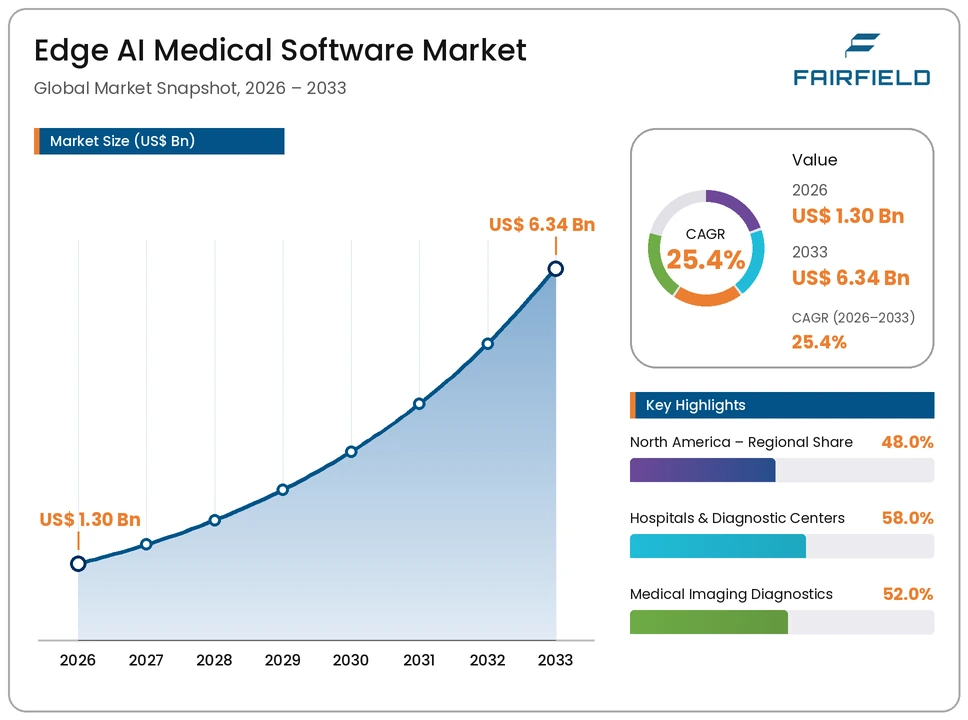
The market is valued at USD 1.30 Billion in 2026, with software developers directing substantial investment toward improved algorithm efficiency and on-device processing capability that supports increasingly sophisticated real-time diagnostic applications. By 2033, the market is forecast to reach USD 6.34 Billion, reflecting rapid growth across established medical imaging diagnostic applications alongside accelerating remote patient monitoring adoption.
Key Highlights
- The global edge AI medical software market is valued at USD 1.30 Billion in 2026 and is projected to reach USD 6.34 Billion by 2033, expanding at a CAGR of 25.4% across the 2026-2033 forecast period.
- Medical Imaging Diagnostics leads the application segment with a 52.0% share in 2026, equivalent to USD 0.68 Billion.
- Hospitals & Diagnostic Centers remain the dominant end-user segment, accounting for 58.0% of global demand, or USD 0.75 Billion, in 2026.
- North America commands the largest regional share at 48.0% of the global market in 2026.
- Remote patient monitoring is emerging as the fastest-growing application category through 2033.
Market Dynamics
Key Growth Drivers
Growth in the edge AI medical software market is driven primarily by rapidly growing healthcare provider demand for real-time, low-latency AI diagnostic capability, as clinicians increasingly require immediate diagnostic insights at the point of care without network connectivity dependency.
A second driver is expanding medical device manufacturer integration of edge AI processing, as device manufacturers increasingly embed on-device intelligence into imaging and monitoring equipment to differentiate product offerings.
Key Restraints
The substantial computational and hardware constraints associated with running sophisticated AI algorithms on local medical devices create technical limitations relative to cloud-based processing capability.
Additionally, stringent medical device regulatory approval requirements for AI-enabled diagnostic software create extended development and certification timelines, as edge AI applications must satisfy the same rigorous clinical validation standards as other diagnostic technology.
Market Opportunities
The expansion of remote patient monitoring applications presents a substantial opportunity, as growing demand for continuous, real-time patient monitoring without cloud connectivity dependency continues to expand edge AI software demand beyond traditional imaging diagnostic applications.
A second opportunity lies in continued edge computing hardware and algorithm efficiency advancement that supports increasingly sophisticated on-device processing. Companies that successfully advance this technology stand to capture growing demand as healthcare providers continue prioritizing both diagnostic sophistication and real-time processing capability.
Segmentation Analysis
By Application
Medical Imaging Diagnostics leads the application segment, accounting for 52.0% of global market value in 2026, equivalent to USD 0.68 Billion. Its leadership reflects medical imaging’s substantial computational requirements and clear clinical benefit from real-time, on-device AI analysis. Remote Patient Monitoring represents the fastest-growing application category through 2033, driven by growing demand for continuous, connectivity-independent patient monitoring.
By End User
Hospitals & Diagnostic Centers form the leading end-user segment, representing 58.0% of global demand in 2026, or USD 0.75 Billion, reflecting these facilities’ substantial diagnostic imaging volume and technology investment capacity. Medical Device Manufacturers represents the fastest-growing end-user category, propelled by expanding embedded edge AI integration into device product lines.
Regional Insights
North America
North America holds the largest regional share, at 48.0% of the global market in 2026, equivalent to USD 0.62 Billion. The region’s dominance reflects substantial healthcare AI adoption and a concentrated base of leading medical device and software companies across the United States and Canada.
Europe
Europe accounts for 24.0% of the global market in 2026, valued at USD 0.31 Billion. Demand is supported by growing healthcare AI adoption and strong medical device manufacturing capacity across major European markets.
Asia Pacific
Asia Pacific represents 21.0% of the global market in 2026, or USD 0.27 Billion. Growth is underpinned by rapidly expanding healthcare AI investment and growing medical device manufacturing capacity across China, Japan, and South Korea.
Latin America
Latin America contributes 4.0% of the global market in 2026, equivalent to USD 0.05 Billion. Growth remains at an early stage, tied to gradual healthcare AI adoption in Brazil and Mexico.
Middle East & Africa
Middle East & Africa holds 3.0% of the global market in 2026, valued at USD 0.04 Billion. Growth remains limited, tied to early-stage regional healthcare AI adoption.
Competitive Landscape
The global edge AI medical software market is moderately concentrated, with a mix of large diversified technology and medical device companies and specialized healthcare AI software providers competing for hospital and device manufacturer adoption. Competition centers on algorithm accuracy and on-device processing efficiency, breadth of regulatory clearances across clinical applications, and the strength of relationships with medical device manufacturers and healthcare providers. Companies are increasingly differentiating through expanded remote monitoring capability rather than competing on imaging diagnostic applications alone.
Key Market Players
- NVIDIA Corporation
- Aidoc Medical Ltd.
- Viz.ai, Inc.
- GE HealthCare Technologies Inc.
- Siemens Healthineers AG
- Qualcomm Incorporated
- Intel Corporation
- Koninklijke Philips N.V.
- Butterfly Network, Inc.
- Paige.AI, Inc.
Market Segmentation
By Application
- Medical Imaging Diagnostics
- Remote Patient Monitoring
- Others
By End User
- Hospitals & Diagnostic Centers
- Medical Device Manufacturers
- Others
By Deployment
- Embedded Device-based
- Portable/Point-of-Care-based
By Geography
- North America
- Europe
- Asia Pacific
- Latin America
- Middle East & Africa
- Executive Summary
- Global Edge AI Medical Software Market Snapshot
- Future Projections
- Key Highlights
- Regional Snapshot by Value 2026
- Market Overview
- Market Definition and Segmentation
- Market Dynamics
- Key Growth Drivers
- Key Restraints
- Market Opportunities
- Global Edge AI Medical Software Market Outlook 2026–2033
- Global Edge AI Medical Software Market Outlook, by Application, Value (USD Billion), 2026–2033
- Medical Imaging Diagnostics
- Remote Patient Monitoring
- Others
- Global Edge AI Medical Software Market Outlook, by End User, Value (USD Billion), 2026–2033
- Hospitals & Diagnostic Centers
- Medical Device Manufacturers
- Others
- Global Edge AI Medical Software Market Outlook, by Deployment, Value (USD Billion), 2026–2033
- Embedded Device-based
- Portable/Point-of-Care-based
- Global Edge AI Medical Software Market Outlook, by Region, Value (USD Billion), 2026–2033
- North America
- Europe
- Asia Pacific
- Latin America
- Middle East & Africa
- Global Edge AI Medical Software Market Outlook, by Application, Value (USD Billion), 2026–2033
- North America Edge AI Medical Software Market Outlook 2026–2033
- North America Edge AI Medical Software Market Outlook, by Application, Value (USD Billion), 2026–2033
- Medical Imaging Diagnostics
- Remote Patient Monitoring
- Others
- North America Edge AI Medical Software Market Outlook, by End User, Value (USD Billion), 2026–2033
- Hospitals & Diagnostic Centers
- Medical Device Manufacturers
- Others
- North America Edge AI Medical Software Market Outlook, by Deployment, Value (USD Billion), 2026–2033
- Embedded Device-based
- Portable/Point-of-Care-based
- North America Edge AI Medical Software Market Outlook, by Country and Subregion, Value (USD Billion), 2026–2033
- United States Edge AI Medical Software Market Outlook, by Application, 2026–2033
- United States Edge AI Medical Software Market Outlook, by End User, 2026–2033
- United States Edge AI Medical Software Market Outlook, by Deployment, 2026–2033
- Canada Edge AI Medical Software Market Outlook, by Application, 2026–2033
- Canada Edge AI Medical Software Market Outlook, by End User, 2026–2033
- Canada Edge AI Medical Software Market Outlook, by Deployment, 2026–2033
- North America Edge AI Medical Software Market Outlook, by Application, Value (USD Billion), 2026–2033
- Europe Edge AI Medical Software Market Outlook 2026–2033
- Europe Edge AI Medical Software Market Outlook, by Application, Value (USD Billion), 2026–2033
- Medical Imaging Diagnostics
- Remote Patient Monitoring
- Others
- Europe Edge AI Medical Software Market Outlook, by End User, Value (USD Billion), 2026–2033
- Hospitals & Diagnostic Centers
- Medical Device Manufacturers
- Others
- Europe Edge AI Medical Software Market Outlook, by Deployment, Value (USD Billion), 2026–2033
- Embedded Device-based
- Portable/Point-of-Care-based
- Europe Edge AI Medical Software Market Outlook, by Application, Value (USD Billion), 2026–2033
- Asia Pacific Edge AI Medical Software Market Outlook 2026–2033
- Asia Pacific Edge AI Medical Software Market Outlook, by Application, Value (USD Billion), 2026–2033
- Medical Imaging Diagnostics
- Remote Patient Monitoring
- Others
- Asia Pacific Edge AI Medical Software Market Outlook, by End User, Value (USD Billion), 2026–2033
- Hospitals & Diagnostic Centers
- Medical Device Manufacturers
- Others
- Asia Pacific Edge AI Medical Software Market Outlook, by Deployment, Value (USD Billion), 2026–2033
- Embedded Device-based
- Portable/Point-of-Care-based
- Asia Pacific Edge AI Medical Software Market Outlook, by Country and Subregion, Value (USD Billion), 2026–2033
- China Edge AI Medical Software Market Outlook, by Application, 2026–2033
- China Edge AI Medical Software Market Outlook, by End User, 2026–2033
- China Edge AI Medical Software Market Outlook, by Deployment, 2026–2033
- Japan Edge AI Medical Software Market Outlook, by Application, 2026–2033
- Japan Edge AI Medical Software Market Outlook, by End User, 2026–2033
- Japan Edge AI Medical Software Market Outlook, by Deployment, 2026–2033
- South Korea Edge AI Medical Software Market Outlook, by Application, 2026–2033
- South Korea Edge AI Medical Software Market Outlook, by End User, 2026–2033
- South Korea Edge AI Medical Software Market Outlook, by Deployment, 2026–2033
- Asia Pacific Edge AI Medical Software Market Outlook, by Application, Value (USD Billion), 2026–2033
- Latin America Edge AI Medical Software Market Outlook 2026–2033
- Latin America Edge AI Medical Software Market Outlook, by Application, Value (USD Billion), 2026–2033
- Medical Imaging Diagnostics
- Remote Patient Monitoring
- Others
- Latin America Edge AI Medical Software Market Outlook, by End User, Value (USD Billion), 2026–2033
- Hospitals & Diagnostic Centers
- Medical Device Manufacturers
- Others
- Latin America Edge AI Medical Software Market Outlook, by Deployment, Value (USD Billion), 2026–2033
- Embedded Device-based
- Portable/Point-of-Care-based
- Latin America Edge AI Medical Software Market Outlook, by Country and Subregion, Value (USD Billion), 2026–2033
- Brazil Edge AI Medical Software Market Outlook, by Application, 2026–2033
- Brazil Edge AI Medical Software Market Outlook, by End User, 2026–2033
- Brazil Edge AI Medical Software Market Outlook, by Deployment, 2026–2033
- Mexico Edge AI Medical Software Market Outlook, by Application, 2026–2033
- Mexico Edge AI Medical Software Market Outlook, by End User, 2026–2033
- Mexico Edge AI Medical Software Market Outlook, by Deployment, 2026–2033
- Latin America Edge AI Medical Software Market Outlook, by Application, Value (USD Billion), 2026–2033
- Middle East & Africa Edge AI Medical Software Market Outlook 2026–2033
- Middle East & Africa Edge AI Medical Software Market Outlook, by Application, Value (USD Billion), 2026–2033
- Medical Imaging Diagnostics
- Remote Patient Monitoring
- Others
- Middle East & Africa Edge AI Medical Software Market Outlook, by End User, Value (USD Billion), 2026–2033
- Hospitals & Diagnostic Centers
- Medical Device Manufacturers
- Others
- Middle East & Africa Edge AI Medical Software Market Outlook, by Deployment, Value (USD Billion), 2026–2033
- Embedded Device-based
- Portable/Point-of-Care-based
- Middle East & Africa Edge AI Medical Software Market Outlook, by Application, Value (USD Billion), 2026–2033
- Competitive Landscape
- Competitive Positioning and Differentiation
- Company Profiles
- NVIDIA Corporation
- Aidoc Medical Ltd.
- Viz.ai, Inc.
- GE HealthCare Technologies Inc.
- Siemens Healthineers AG
- Qualcomm Incorporated
- Intel Corporation
- Koninklijke Philips N.V.
- Butterfly Network, Inc.
- Paige.AI, Inc.
- Appendix
- Research Methodology
- Report Assumptions
- Acronyms and Abbreviations
By Application
- Medical Imaging Diagnostics
- Remote Patient Monitoring
- Others
By End User
- Hospitals & Diagnostic Centers
- Medical Device Manufacturers
- Others
By Deployment
- Embedded Device-based
- Portable/Point-of-Care-based
By Geography
- North America
- Europe
- Asia Pacific
- Latin America
- Middle East & Africa
Our Research Methodology
Considering the volatility of business today, traditional approaches to strategizing a game plan can be unfruitful if not detrimental. True ambiguity is no way to determine a forecast. A myriad of predetermined factors must be accounted for such as the degree of risk involved, the magnitude of circumstances, as well as conditions or consequences that are not known or unpredictable. To circumvent binary views that cast uncertainty, the application of market research intelligence to strategically posture, move, and enable actionable outcomes is necessary.
View Methodology
Quality Assured
Rigorous Validation Process

Confidentiality Assured
End-to-end Data Security

Custom Research Services
Tailored To Your Objectives
FAQs
The global edge AI medical software market is valued at USD 1.30 Billion in 2026, reflecting growing healthcare demand for real-time, low-latency AI diagnostic capability.
The market is projected to grow at a CAGR of 25.4%, reaching USD 6.34 Billion by 2033, driven by remote monitoring adoption and edge computing technology advancement.
Medical Imaging Diagnostics leads with a 52.0% share in 2026, reflecting substantial computational requirements and clinical benefit.
North America leads with a 48.0% share in 2026, reflecting substantial healthcare AI adoption.
The largest opportunity lies in remote patient monitoring, expanding alongside demand for connectivity-independent monitoring.
Related Reports
Tunnel Construction Market Size, Share, Insights, Competitive Landscape, and Forecast 2026 to 2033
The global tunnel construction market is valued at US$29.52 billion in 2026, reaching US$47.09 billion by 2033, growing at a 6.9% CAGR
Sports Analytics Market Size, Share, Insights, Competitive Landscape, and Forecast 2026 to 2033
The global sports analytics market is valued at US$7.06 billion in 2026, reaching US$23.15 billion by 2033, growing at an 18.5% CAGR
Distributed Acoustic Sensing Market Size, Share, Insights, Competitive Landscape, and Forecast 2026 to 2033
The global distributed acoustic sensing market is valued at US$0.565 billion in 2026, reaching US$1.173 billion by 2033, growing at an 11.0% CAGR
Secure Flash Drive Market Size, Share, Insights, Competitive Landscape, and Forecast 2026 to 2033
The global secure flash drive market is valued at US$0.8 billion in 2026, reaching US$1.1 billion by 2033, growing at a 4.7% CAGR
Optical I/O for AI Chips Market Size, Share, Insights, Competitive Landscape, and Forecast 2026 to 2033
The global optical I/O for AI chips market is valued at US$1.6 billion in 2026, reaching US$14.5 billion by 2033, growing at a 37.01% CAGR
Foldable Drones Market Size, Share, Insights, Competitive Landscape, and Forecast 2026 to 2033
The global foldable drones market is valued at US$3.76 billion in 2026 and is projected to reach US$7.57 billion by 2033, growing at a 10.5% CAGR.