



Environmental Sensors Market
Environmental Sensors Market Research Report Insights, Competitive Landscape, and Market Forecast 2033
Market Overview
Environmental sensors detect and measure physical, chemical, and biological parameters such as air quality, water quality, temperature, humidity, and gas concentrations, converting these measurements into data used for regulatory compliance, industrial process control, and public health monitoring. As environmental monitoring requirements expand across regulatory, industrial, and consumer applications, these sensors have become foundational components in systems ranging from factory emissions monitoring to smart building climate control and personal air quality devices.
Demand growth through the 2026-2033 window is closely tied to tightening environmental and emissions regulations across industrial sectors, growing public and institutional investment in air and water quality monitoring infrastructure, and rising integration of environmental sensing into smart building and smart city initiatives. The increasing affordability and miniaturization of sensor technology is also broadening deployment into consumer-facing applications that were previously limited to institutional and industrial settings.
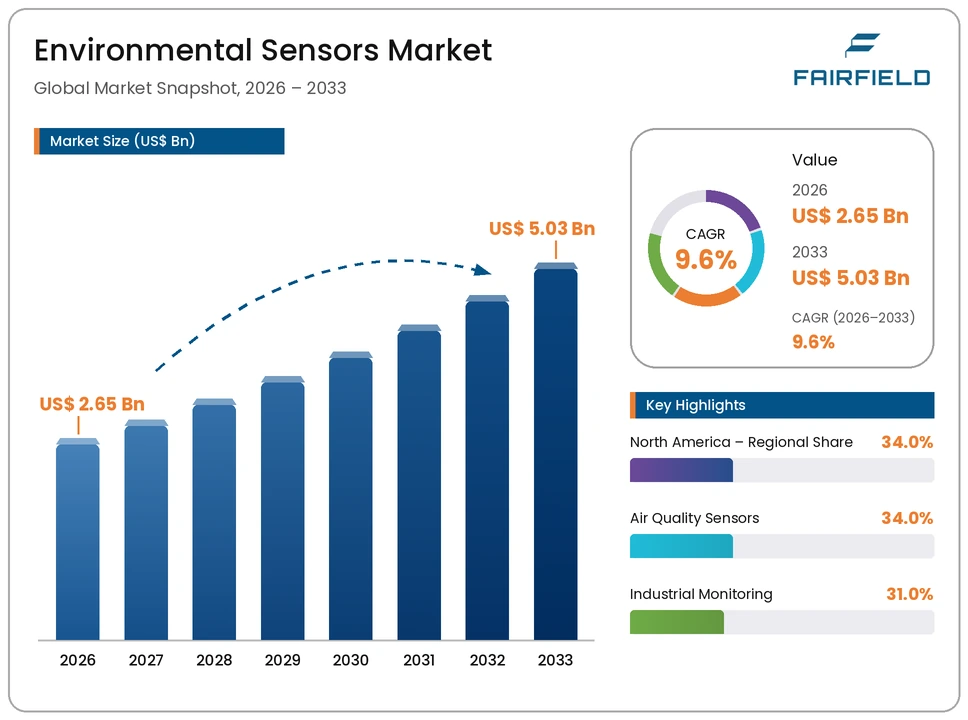
The market is valued at USD 2.65 Billion in 2026, with sensor manufacturers directing investment toward improved accuracy, lower power consumption, and wireless connectivity to support distributed monitoring networks. By 2033, the market is forecast to reach USD 5.03 Billion, reflecting accelerating deployment across both regulatory-driven industrial applications and voluntary smart infrastructure initiatives.
Key Highlights
- The global environmental sensors market is valued at USD 2.65 Billion in 2026 and is projected to reach USD 5.03 Billion by 2033, expanding at a CAGR of 9.6% across the 2026-2033 forecast period.
- Air Quality Sensors lead the type segment with a 34.0% share in 2026, equivalent to USD 0.90 Billion.
- Industrial Monitoring remains the dominant application, accounting for 31.0% of global demand, or USD 0.82 Billion, in 2026.
- North America commands the largest regional share at 34.0% of the global market in 2026.
- Smart cities and building monitoring applications are emerging as the fastest-growing demand pocket through 2033.
Market Dynamics
- Key Growth Drivers
Growth in the environmental sensors market is driven primarily by tightening emissions and environmental compliance regulations across industrial sectors, which require continuous monitoring of air and water discharge parameters to demonstrate regulatory compliance. This regulatory pressure creates consistent baseline demand for accurate, reliable environmental sensing equipment across manufacturing, energy, and chemical processing facilities.
A second driver is the rapid expansion of smart city and smart building initiatives, which increasingly incorporate environmental sensing into building management systems to optimize ventilation, energy consumption, and occupant comfort while providing data supporting sustainability reporting objectives. As municipalities and building owners pursue these initiatives at scale, sensor deployment volumes continue to grow accordingly.
Key Restraints
Sensor accuracy degradation over time, particularly for gas and air quality sensors exposed to challenging environmental conditions, requires periodic calibration and replacement, adding ongoing maintenance costs that can discourage adoption among cost-sensitive users seeking to minimize total ownership expense.
Additionally, fragmented data standards and communication protocols across different sensor manufacturers and monitoring platforms complicate integration into unified monitoring systems, creating interoperability challenges for organizations seeking to deploy sensors from multiple vendors across a single monitoring network.
Market Opportunities
The integration of environmental sensors into consumer-facing smart home and personal health devices presents a substantial opportunity, as growing public awareness of air quality's health impact drives demand for accessible, affordable monitoring solutions beyond traditional industrial and institutional applications.
A second opportunity lies in combining environmental sensor data with artificial intelligence-based analytics to provide predictive insights rather than raw measurement data alone, allowing facility operators and municipalities to anticipate environmental issues before they escalate. Sensor manufacturers that develop integrated data platforms alongside their hardware stand to capture greater value per deployment.
Segmentation Analysis
- By Type
Air Quality Sensors lead the type segment, accounting for 34.0% of global market value in 2026, equivalent to USD 0.90 Billion. Their leadership reflects widespread deployment across industrial emissions monitoring, smart building systems, and growing consumer air quality applications. Temperature & Humidity Sensors hold a significant secondary share, valued for their broad applicability across environmental monitoring use cases. Gas Sensors address specialized industrial safety applications, while Water Quality Sensors represent the fastest-growing type category through 2033, driven by expanding water infrastructure monitoring investment.
- By Application
Industrial Monitoring forms the leading application segment, representing 31.0% of global demand in 2026, or USD 0.82 Billion, reflecting sustained regulatory compliance requirements across manufacturing and process industries. Environmental & Weather Monitoring forms the second-largest segment, supported by government and research institution investment. Smart Cities & Buildings represent the fastest-growing application category, propelled by expanding smart infrastructure investment, while Automotive applications represent a smaller, steadily growing share tied to cabin air quality sensing.
Regional Insights
- North America
North America holds the largest regional share, at 34.0% of the global market in 2026, equivalent to USD 0.90 Billion. The region's leadership reflects strong regulatory emphasis on air and water quality monitoring alongside substantial smart city and smart building infrastructure investment across the United States and Canada.
- Europe
Europe accounts for 27.0% of the global market in 2026, valued at USD 0.72 Billion. The region's stringent environmental regulations and strong sustainability reporting requirements sustain steady demand for industrial and municipal environmental monitoring equipment.
- Asia Pacific
Asia Pacific represents 26.0% of the global market in 2026, or USD 0.69 Billion. Growth is underpinned by rapid industrialization alongside rising environmental regulatory attention in China and India, and expanding smart city investment across the region.
- Latin America
Latin America contributes 7.0% of the global market in 2026, equivalent to USD 0.19 Billion. Growth is linked to gradual expansion of environmental monitoring infrastructure in Brazil and Mexico, supported by rising regulatory attention to industrial emissions.
- Middle East & Africa
Middle East & Africa holds 6.0% of the global market in 2026, valued at USD 0.16 Billion. Demand is concentrated in Gulf Cooperation Council countries investing in smart city infrastructure and environmental monitoring alongside gradual industrial regulatory development.
Competitive Landscape
The global environmental sensors market is moderately fragmented, with a mix of large diversified industrial technology companies offering broad sensor portfolios and specialized sensor manufacturers focused on specific measurement technologies. Competition centers on measurement accuracy, calibration stability, and the ability to integrate sensors into broader monitoring and data analytics platforms. Manufacturers are increasingly differentiating through connected, low-power sensor designs suited to distributed monitoring networks rather than competing on standalone hardware pricing alone.
Key Market Players
- Honeywell International Inc.
- Siemens AG
- ABB Ltd.
- Emerson Electric Co.
- Amphenol Advanced Sensors
- TE Connectivity Ltd.
- Bosch Sensortec GmbH
- Sensirion AG
- Vaisala Oyj
- Aeroqual Limited
Market Segmentation
By Type
- Air Quality Sensors
- Water Quality Sensors
- Temperature & Humidity Sensors
- Gas Sensors
- Others
By Application
- Industrial Monitoring
- Environmental & Weather Monitoring
- Smart Cities & Buildings
- Automotive
- Others
By Connectivity
- Wired Sensors
- Wireless Sensors
By Geography
- North America
- Europe
- Asia Pacific
- Latin America
- Middle East & Africa
- Executive Summary
- Global Environmental Sensors Market Snapshot
- Future Projections
- Key Market Trends
- Regional Snapshot, by Value, 2026
- Analyst Recommendations
- Market Overview
- Market Definitions and Segmentations
- Market Dynamics
- Drivers
- Restraints
- Market Opportunities
- Value Chain Analysis
- COVID-19 Impact Analysis
- Porter's Five Forces Analysis
- Impact of Russia-Ukraine Conflict
- PESTLE Analysis
- Regulatory Analysis
- Price Trend Analysis
- Current Prices and Future Projections, 2025-2033
- Price Impact Factors
- Global Environmental Sensors Market Outlook, 2020 - 2033
- Global Environmental Sensors Market Outlook, by Type, Value (US$ Mn), 2020-2033
- Air Quality Sensors
- Water Quality Sensors
- Temperature & Humidity Sensors
- Gas Sensors
- Others
- Global Environmental Sensors Market Outlook, by Application, Value (US$ Mn), 2020-2033
- Industrial Monitoring
- Environmental & Weather Monitoring
- Smart Cities & Buildings
- Automotive
- Others
- Global Environmental Sensors Market Outlook, by Connectivity, Value (US$ Mn), 2020-2033
- Wired Sensors
- Wireless Sensors
- Global Environmental Sensors Market Outlook, by Region, Value (US$ Mn), 2020-2033
- North America
- Europe
- Asia Pacific
- Latin America
- Middle East & Africa
- Global Environmental Sensors Market Outlook, by Type, Value (US$ Mn), 2020-2033
- North America Environmental Sensors Market Outlook, 2020 - 2033
- North America Environmental Sensors Market Outlook, by Type, Value (US$ Mn), 2020-2033
- Air Quality Sensors
- Water Quality Sensors
- Temperature & Humidity Sensors
- Gas Sensors
- Others
- North America Environmental Sensors Market Outlook, by Application, Value (US$ Mn), 2020-2033
- Industrial Monitoring
- Environmental & Weather Monitoring
- Smart Cities & Buildings
- Automotive
- Others
- North America Environmental Sensors Market Outlook, by Connectivity, Value (US$ Mn), 2020-2033
- Wired Sensors
- Wireless Sensors
- North America Environmental Sensors Market Outlook, by Country, Value (US$ Mn), 2020-2033
- U.S. Environmental Sensors Market Outlook, by Type, 2020-2033
- U.S. Environmental Sensors Market Outlook, by Application, 2020-2033
- U.S. Environmental Sensors Market Outlook, by Connectivity, 2020-2033
- Canada Environmental Sensors Market Outlook, by Type, 2020-2033
- Canada Environmental Sensors Market Outlook, by Application, 2020-2033
- Canada Environmental Sensors Market Outlook, by Connectivity, 2020-2033
- BPS Analysis/Market Attractiveness Analysis
- North America Environmental Sensors Market Outlook, by Type, Value (US$ Mn), 2020-2033
- Europe Environmental Sensors Market Outlook, 2020 - 2033
- Europe Environmental Sensors Market Outlook, by Type, Value (US$ Mn), 2020-2033
- Air Quality Sensors
- Water Quality Sensors
- Temperature & Humidity Sensors
- Gas Sensors
- Others
- Europe Environmental Sensors Market Outlook, by Application, Value (US$ Mn), 2020-2033
- Industrial Monitoring
- Environmental & Weather Monitoring
- Smart Cities & Buildings
- Automotive
- Others
- Europe Environmental Sensors Market Outlook, by Connectivity, Value (US$ Mn), 2020-2033
- Wired Sensors
- Wireless Sensors
- Europe Environmental Sensors Market Outlook, by Country, Value (US$ Mn), 2020-2033
- Germany Environmental Sensors Market Outlook, by Type, 2020-2033
- Germany Environmental Sensors Market Outlook, by Application, 2020-2033
- Germany Environmental Sensors Market Outlook, by Connectivity, 2020-2033
- Italy Environmental Sensors Market Outlook, by Type, 2020-2033
- Italy Environmental Sensors Market Outlook, by Application, 2020-2033
- Italy Environmental Sensors Market Outlook, by Connectivity, 2020-2033
- France Environmental Sensors Market Outlook, by Type, 2020-2033
- France Environmental Sensors Market Outlook, by Application, 2020-2033
- France Environmental Sensors Market Outlook, by Connectivity, 2020-2033
- U.K. Environmental Sensors Market Outlook, by Type, 2020-2033
- U.K. Environmental Sensors Market Outlook, by Application, 2020-2033
- U.K. Environmental Sensors Market Outlook, by Connectivity, 2020-2033
- Spain Environmental Sensors Market Outlook, by Type, 2020-2033
- Spain Environmental Sensors Market Outlook, by Application, 2020-2033
- Spain Environmental Sensors Market Outlook, by Connectivity, 2020-2033
- Russia Environmental Sensors Market Outlook, by Type, 2020-2033
- Russia Environmental Sensors Market Outlook, by Application, 2020-2033
- Russia Environmental Sensors Market Outlook, by Connectivity, 2020-2033
- Rest of Europe Environmental Sensors Market Outlook, by Type, 2020-2033
- Rest of Europe Environmental Sensors Market Outlook, by Application, 2020-2033
- Rest of Europe Environmental Sensors Market Outlook, by Connectivity, 2020-2033
- BPS Analysis/Market Attractiveness Analysis
- Europe Environmental Sensors Market Outlook, by Type, Value (US$ Mn), 2020-2033
- Asia Pacific Environmental Sensors Market Outlook, 2020 - 2033
- Asia Pacific Environmental Sensors Market Outlook, by Type, Value (US$ Mn), 2020-2033
- Air Quality Sensors
- Water Quality Sensors
- Temperature & Humidity Sensors
- Gas Sensors
- Others
- Asia Pacific Environmental Sensors Market Outlook, by Application, Value (US$ Mn), 2020-2033
- Industrial Monitoring
- Environmental & Weather Monitoring
- Smart Cities & Buildings
- Automotive
- Others
- Asia Pacific Environmental Sensors Market Outlook, by Connectivity, Value (US$ Mn), 2020-2033
- Wired Sensors
- Wireless Sensors
- Asia Pacific Environmental Sensors Market Outlook, by Country, Value (US$ Mn), 2020-2033
- China Environmental Sensors Market Outlook, by Type, 2020-2033
- China Environmental Sensors Market Outlook, by Application, 2020-2033
- China Environmental Sensors Market Outlook, by Connectivity, 2020-2033
- Japan Environmental Sensors Market Outlook, by Type, 2020-2033
- Japan Environmental Sensors Market Outlook, by Application, 2020-2033
- Japan Environmental Sensors Market Outlook, by Connectivity, 2020-2033
- South Korea Environmental Sensors Market Outlook, by Type, 2020-2033
- South Korea Environmental Sensors Market Outlook, by Application, 2020-2033
- South Korea Environmental Sensors Market Outlook, by Connectivity, 2020-2033
- India Environmental Sensors Market Outlook, by Type, 2020-2033
- India Environmental Sensors Market Outlook, by Application, 2020-2033
- India Environmental Sensors Market Outlook, by Connectivity, 2020-2033
- Southeast Asia Environmental Sensors Market Outlook, by Type, 2020-2033
- Southeast Asia Environmental Sensors Market Outlook, by Application, 2020-2033
- Southeast Asia Environmental Sensors Market Outlook, by Connectivity, 2020-2033
- Rest of SAO Environmental Sensors Market Outlook, by Type, 2020-2033
- Rest of SAO Environmental Sensors Market Outlook, by Application, 2020-2033
- Rest of SAO Environmental Sensors Market Outlook, by Connectivity, 2020-2033
- BPS Analysis/Market Attractiveness Analysis
- Asia Pacific Environmental Sensors Market Outlook, by Type, Value (US$ Mn), 2020-2033
- Latin America Environmental Sensors Market Outlook, 2020 - 2033
- Latin America Environmental Sensors Market Outlook, by Type, Value (US$ Mn), 2020-2033
- Air Quality Sensors
- Water Quality Sensors
- Temperature & Humidity Sensors
- Gas Sensors
- Others
- Latin America Environmental Sensors Market Outlook, by Application, Value (US$ Mn), 2020-2033
- Industrial Monitoring
- Environmental & Weather Monitoring
- Smart Cities & Buildings
- Automotive
- Others
- Latin America Environmental Sensors Market Outlook, by Connectivity, Value (US$ Mn), 2020-2033
- Wired Sensors
- Wireless Sensors
- Latin America Environmental Sensors Market Outlook, by Country, Value (US$ Mn), 2020-2033
- Brazil Environmental Sensors Market Outlook, by Type, 2020-2033
- Brazil Environmental Sensors Market Outlook, by Application, 2020-2033
- Brazil Environmental Sensors Market Outlook, by Connectivity, 2020-2033
- Mexico Environmental Sensors Market Outlook, by Type, 2020-2033
- Mexico Environmental Sensors Market Outlook, by Application, 2020-2033
- Mexico Environmental Sensors Market Outlook, by Connectivity, 2020-2033
- Argentina Environmental Sensors Market Outlook, by Type, 2020-2033
- Argentina Environmental Sensors Market Outlook, by Application, 2020-2033
- Argentina Environmental Sensors Market Outlook, by Connectivity, 2020-2033
- Rest of LATAM Environmental Sensors Market Outlook, by Type, 2020-2033
- Rest of LATAM Environmental Sensors Market Outlook, by Application, 2020-2033
- Rest of LATAM Environmental Sensors Market Outlook, by Connectivity, 2020-2033
- BPS Analysis/Market Attractiveness Analysis
- Latin America Environmental Sensors Market Outlook, by Type, Value (US$ Mn), 2020-2033
- Middle East & Africa Environmental Sensors Market Outlook, 2020 - 2033
- Middle East & Africa Environmental Sensors Market Outlook, by Type, Value (US$ Mn), 2020-2033
- Air Quality Sensors
- Water Quality Sensors
- Temperature & Humidity Sensors
- Gas Sensors
- Others
- Middle East & Africa Environmental Sensors Market Outlook, by Application, Value (US$ Mn), 2020-2033
- Industrial Monitoring
- Environmental & Weather Monitoring
- Smart Cities & Buildings
- Automotive
- Others
- Middle East & Africa Environmental Sensors Market Outlook, by Connectivity, Value (US$ Mn), 2020-2033
- Wired Sensors
- Wireless Sensors
- Middle East & Africa Environmental Sensors Market Outlook, by Country, Value (US$ Mn), 2020-2033
- GCC Environmental Sensors Market Outlook, by Type, 2020-2033
- GCC Environmental Sensors Market Outlook, by Application, 2020-2033
- GCC Environmental Sensors Market Outlook, by Connectivity, 2020-2033
- South Africa Environmental Sensors Market Outlook, by Type, 2020-2033
- South Africa Environmental Sensors Market Outlook, by Application, 2020-2033
- South Africa Environmental Sensors Market Outlook, by Connectivity, 2020-2033
- Egypt Environmental Sensors Market Outlook, by Type, 2020-2033
- Egypt Environmental Sensors Market Outlook, by Application, 2020-2033
- Egypt Environmental Sensors Market Outlook, by Connectivity, 2020-2033
- Nigeria Environmental Sensors Market Outlook, by Type, 2020-2033
- Nigeria Environmental Sensors Market Outlook, by Application, 2020-2033
- Nigeria Environmental Sensors Market Outlook, by Connectivity, 2020-2033
- Rest of Middle East Environmental Sensors Market Outlook, by Type, 2020-2033
- Rest of Middle East Environmental Sensors Market Outlook, by Application, 2020-2033
- Rest of Middle East Environmental Sensors Market Outlook, by Connectivity, 2020-2033
- BPS Analysis/Market Attractiveness Analysis
- Middle East & Africa Environmental Sensors Market Outlook, by Type, Value (US$ Mn), 2020-2033
- Competitive Landscape
- Company Vs Segment Heatmap
- Company Market Share Analysis, 2025
- Competitive Dashboard
- Company Profiles
- Honeywell International Inc.
- Company Overview
- Product Portfolio
- Financial Overview
- Business Strategies and Developments
- Siemens AG
- ABB Ltd.
- Emerson Electric Co.
- Amphenol Advanced Sensors
- TE Connectivity Ltd.
- Bosch Sensortec GmbH
- Sensirion AG
- Vaisala Oyj
- Aeroqual Limited
- Honeywell International Inc.
- Appendix
- Research Methodology
- Report Assumptions
- Acronyms and Abbreviations
By Type
- Air Quality Sensors
- Water Quality Sensors
- Temperature & Humidity Sensors
- Gas Sensors
- Others
By Application
- Industrial Monitoring
- Environmental & Weather Monitoring
- Smart Cities & Buildings
- Automotive
- Others
By Connectivity
- Wired Sensors
- Wireless Sensors
By Geography
- North America
- Europe
- Asia Pacific
- Latin America
- Middle East & Africa
Our Research Methodology
Considering the volatility of business today, traditional approaches to strategizing a game plan can be unfruitful if not detrimental. True ambiguity is no way to determine a forecast. A myriad of predetermined factors must be accounted for such as the degree of risk involved, the magnitude of circumstances, as well as conditions or consequences that are not known or unpredictable. To circumvent binary views that cast uncertainty, the application of market research intelligence to strategically posture, move, and enable actionable outcomes is necessary.
View Methodology
Quality Assured
Rigorous Validation Process

Confidentiality Assured
End-to-end Data Security

Custom Research Services
Tailored To Your Objectives
FAQs
The global environmental sensors market is valued at USD 2.65 Billion in 2026, reflecting growing regulatory and infrastructure-driven monitoring demand.
The market is projected to grow at a CAGR of 9.6%, reaching USD 5.03 Billion by 2033, driven by smart infrastructure expansion and tightening environmental regulations.
Air Quality Sensors lead with a 34.0% share in 2026, supported by widespread deployment across industrial and smart building applications.
North America leads with a 34.0% share in 2026, driven by strong regulatory emphasis and smart infrastructure investment.
The largest opportunity lies in consumer-facing smart home and personal health devices, as public awareness of air quality's health impact continues to rise.
Related Reports
Intelligent Power Module for AWHP Market Size, Share, Insights, Competitive Landscape, and Forecast 2026 to 2033
Intelligent Power Module for AWHP market is projected to grow from US$0.89 billion in 2026 to US$2.34 billion by 2033, at a CAGR of 14.8%.
LTE & 5G NR-based CBRS Networks Market Size, Share, Insights, Competitive Landscape, and Forecast 2026 to 2033
The LTE & 5G NR-based CBRS Networks market in 2026, valued at US$ 3.4 billion and projected to reach US$ 13.2 billion by 2033, growing at a 21.4% CAGR.
GPS Player Tracking Systems Market Size, Share, Insights, Competitive Landscape, and Forecast 2026 to 2033
GPS Player Tracking Systems Market to reach US$3.3 Bn by 2033, growing at 12.5% CAGR, driven by sports analytics,and performance monitoring.
Smart Watch and Smart Ring LED Market Size, Share, Insights, Competitive Landscape, and Forecast 2026 to 2033
The global smartwatch and smart ring LED market will reach US$ 8.00 Bn by 2033, growing at 15.6% CAGR, driven by wearable adoption and health monitoring
Data Center LV/MV Power Distribution Market Size, Share, Insights, Competitive Landscape, and Forecast 2026 to 2033
The global data center LV/MV power distribution market will reach US$ 62.0 Bn by 2033, growing at 11.8% CAGR, driven by data center demand and AI growth
Perimeter Sensing Satellites Market Size, Share, Insights, Competitive Landscape, and Forecast 2026 to 2033
The blue GIS technologies market is projected to reach US$9.7592 billion by 2033, growing at a 12.8% CAGR from US$4.2 billion in 2026