



First Generation Biofuel Market
First Generation Biofuel Market Insights, Competitive Landscape, and Market Forecast 2033
Market Overview
First generation biofuel encompasses ethanol and biodiesel produced from food crop feedstocks, including corn, sugarcane, and vegetable oils, representing the earliest and most widely commercialized category of biofuel production technology. As biofuel production has continued serving as an established component of global transportation fuel supply and renewable fuel policy mandates, first generation biofuel has maintained substantial production scale despite growing industry and policy attention toward advanced and second-generation biofuel alternatives derived from non-food feedstocks.
Demand growth through the 2026-2033 window is closely tied to sustained government renewable fuel blending mandates requiring continued first generation biofuel production and consumption, established agricultural feedstock supply chains supporting reliable, large-scale production capacity, and continued production efficiency improvements across existing corn and sugarcane ethanol processing infrastructure. Growing competition from advanced and second-generation biofuel alternatives, alongside expanding electric vehicle adoption, continues to moderate the market's longer-term growth trajectory relative to earlier decades of rapid expansion.
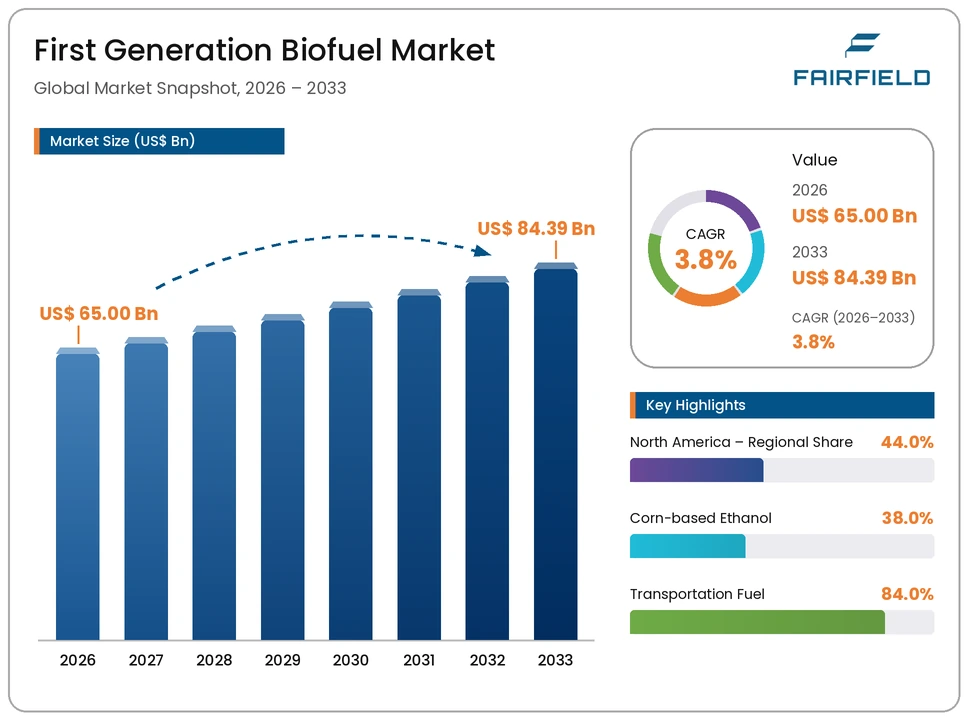
The market is valued at USD 65.00 Billion in 2026, with producers directing investment toward improved processing efficiency that sustains production economics amid moderating demand growth relative to historical expansion rates. By 2033, the market is forecast to reach USD 84.39 Billion, reflecting steady, moderate growth across established corn-based ethanol applications alongside expanding vegetable oil-based biodiesel adoption.
Key Highlights
- The global first generation biofuel market is valued at USD 65.00 Billion in 2026 and is projected to reach USD 84.39 Billion by 2033, expanding at a CAGR of 3.8% across the 2026-2033 forecast period.
- Corn-based Ethanol leads the feedstock segment with a 38.0% share in 2026, equivalent to USD 24.70 Billion.
- Transportation Fuel remains the dominant application, accounting for 84.0% of global demand, or USD 54.60 Billion, in 2026.
- North America commands the largest regional share at 44.0% of the global market in 2026.
- Vegetable oil-based biodiesel is emerging as the fastest-growing feedstock category through 2033.
Market Dynamics
Key Growth Drivers
Growth in the first generation biofuel market is driven primarily by sustained government renewable fuel blending mandates, as continued policy requirements for renewable fuel content within transportation fuel supply sustain baseline first generation biofuel demand across major markets.
A second driver is established agricultural feedstock supply chains, as decades of infrastructure investment in corn, sugarcane, and vegetable oil supply chains continue supporting reliable, cost-competitive biofuel production capacity.
Key Restraints
Intensifying competition from advanced and second-generation biofuel alternatives derived from non-food feedstocks creates long-term market share pressure, as policy and investment attention increasingly shifts toward these alternatives amid food-versus-fuel sustainability concerns.
Additionally, expanding electric vehicle adoption across major transportation markets creates a structural headwind for liquid transportation fuel demand, including first generation biofuel, over the longer term.
Market Opportunities
The expansion of vegetable oil-based biodiesel applications presents a substantial opportunity, as growing biodiesel blending mandates in certain markets continue to expand demand for this feedstock category relative to ethanol-focused production.
A second opportunity lies in continued production efficiency improvements across existing processing infrastructure that sustain cost competitiveness amid moderating overall market growth. Companies that successfully advance this processing efficiency stand to capture sustained demand as established feedstock supply chains continue supporting reliable production capacity.
Segmentation Analysis
By Feedstock
Corn-based Ethanol leads the feedstock segment, accounting for 38.0% of global market value in 2026, equivalent to USD 24.70 Billion. Its leadership reflects corn ethanol's substantial, established production scale supported by extensive North American agricultural infrastructure. Sugarcane-based Ethanol represents a significant, established feedstock category. Vegetable Oil-based Biodiesel represents the fastest-growing feedstock category through 2033, driven by expanding biodiesel blending mandates across multiple markets.
By Application
Transportation Fuel forms the leading application segment, representing 84.0% of global demand in 2026, or USD 54.60 Billion, reflecting transportation's status as the primary end-use application for first generation biofuel production. Power Generation represents the fastest-growing application category, propelled by growing renewable power generation blending applications.
Regional Insights
North America
North America holds the largest regional share, at 44.0% of the global market in 2026, equivalent to USD 28.60 Billion. The region's dominance reflects substantial corn ethanol production capacity and established renewable fuel blending mandates across the United States and Canada.
Europe
Europe accounts for 18.0% of the global market in 2026, valued at USD 11.70 Billion. Demand is supported by established biodiesel production capacity and renewable fuel policy mandates across major European markets.
Asia Pacific
Asia Pacific represents 12.0% of the global market in 2026, or USD 7.80 Billion. Growth is underpinned by expanding biofuel blending mandates and growing production capacity across China, India, and Southeast Asia.
Latin America
Latin America contributes 22.0% of the global market in 2026, equivalent to USD 14.30 Billion. Demand is supported by Brazil's substantial and well-established sugarcane ethanol production infrastructure.
Middle East & Africa
Middle East & Africa holds 4.0% of the global market in 2026, valued at USD 2.60 Billion. Growth remains gradual, tied to limited regional biofuel production capacity.
Competitive Landscape
The global first generation biofuel market is moderately concentrated, with a mix of large diversified agribusiness companies and specialized biofuel producers competing for renewable fuel supply contracts. Competition centers on feedstock supply chain scale and reliability, production processing efficiency and cost competitiveness, and the strength of relationships with fuel blenders and distributors. Companies are increasingly differentiating through expanded biodiesel production capability rather than competing on conventional ethanol production alone.
Key Market Players
- Archer-Daniels-Midland Company
- POET, LLC
- Green Plains Inc.
- Valero Energy Corporation
- Cargill, Incorporated
- Raízen S.A.
- Cosan S.A.
- Louis Dreyfus Company B.V.
- Wilmar International Limited
- Neste Corporation
Market Segmentation
By Feedstock
- Corn-based Ethanol
- Sugarcane-based Ethanol
- Vegetable Oil-based Biodiesel
- Others
By Application
- Transportation Fuel
- Power Generation
- Others
By Blend Type
- Low-Blend Fuels
- High-Blend Fuels
By Geography
- North America
- Europe
- Asia Pacific
- Latin America
- Middle East & Africa
Table of contents is currently unavailable. Request table of contents
By Feedstock
- Corn-based Ethanol
- Sugarcane-based Ethanol
- Vegetable Oil-based Biodiesel
- Others
By Application
- Transportation Fuel
- Power Generation
- Others
By Blend Type
- Low-Blend Fuels
- High-Blend Fuels
By Geography
- North America
- Europe
- Asia Pacific
- Latin America
- Middle East & Africa
Our Research Methodology
Considering the volatility of business today, traditional approaches to strategizing a game plan can be unfruitful if not detrimental. True ambiguity is no way to determine a forecast. A myriad of predetermined factors must be accounted for such as the degree of risk involved, the magnitude of circumstances, as well as conditions or consequences that are not known or unpredictable. To circumvent binary views that cast uncertainty, the application of market research intelligence to strategically posture, move, and enable actionable outcomes is necessary.
View Methodology
Quality Assured
Rigorous Validation Process

Confidentiality Assured
End-to-end Data Security

Custom Research Services
Tailored To Your Objectives
FAQs
The global first generation biofuel market is valued at USD 65.00 Billion in 2026, reflecting sustained renewable fuel blending mandates.
The market is projected to grow at a CAGR of 3.8%, reaching USD 84.39 Billion by 2033, reflecting moderate growth amid competition from advanced biofuel alternatives.
Corn-based Ethanol leads with a 38.0% share in 2026, reflecting its substantial, established North American production scale.
North America leads with a 44.0% share in 2026, reflecting substantial corn ethanol production capacity.
The largest opportunity lies in vegetable oil-based biodiesel, expanding alongside biodiesel blending mandates.
Related Reports
2,4-Dichloro-5-Fluorobenzoic Acid Market Size, Share, Insights, Competitive Landscape, and Forecast 2026 to 2033
The global 2,4-dichloro-5-fluorobenzoic acid market is valued at US$0.09 billion in 2026, reaching US$0.12 billion by 2033, at a 4.2% CAGR
1,5-Hexadiene Market Size, Share, Insights, Competitive Landscape, and Forecast 2026 to 2033
The global 1,5-hexadiene market is valued at US$0.14 billion in 2026, reaching US$0.22 billion by 2033, growing at a 6.7% CAGR
Automotive NVH Materials Market Size, Share, Insights, Competitive Landscape, and Forecast 2026 to 2033
The global automotive NVH materials market is valued at US$13.8 billion in 2026, reaching US$20.5 billion by 2033, growing at a 5.82% CAGR
Acrylonitrile Butadiene Styrene Market Size, Share, Insights, Competitive Landscape, and Forecast 2026 to 2033
The global acrylonitrile butadiene styrene market is valued at US$27.4 billion in 2026, reaching US$38.6 billion by 2033, growing at a 5.02% CAGR
Tank Mix Adjuvants Market Size, Share, Insights, Competitive Landscape, and Forecast 2026 to 2033
The global tank mix adjuvants market is valued at US$4.3 billion in 2026, reaching US$6.6 billion by 2033, growing at a 6.3% CAGR
Glass Flake Coatings Market Size, Share, Insights, Competitive Landscape, and Forecast 2026 to 2033
The glass flake coatings market is projected to grow from US$0.64 billion in 2026 to US$0.96 billion by 2033, at a 5.96% CAGR