



Food and Beverage Automated Storage Retrieval System Market
Food and Beverage Automated Storage Retrieval System Market Size, Share, Insights, Competitive Landscape, and Forecast 2026 to 2033
Food and Beverage Automated Storage Retrieval System Market Analysis, 2026–2033
Food and Beverage Automated Storage Retrieval System Market
Food and Beverage Automated Storage Retrieval System Market Size, Share, Insights, Competitive Landscape, and Forecast 2026 to 2033
Food and Beverage Automated Storage Retrieval System Market Size and Trend Analysis
How Fast Is the Food and Beverage Automated Storage Retrieval System Market Growing?
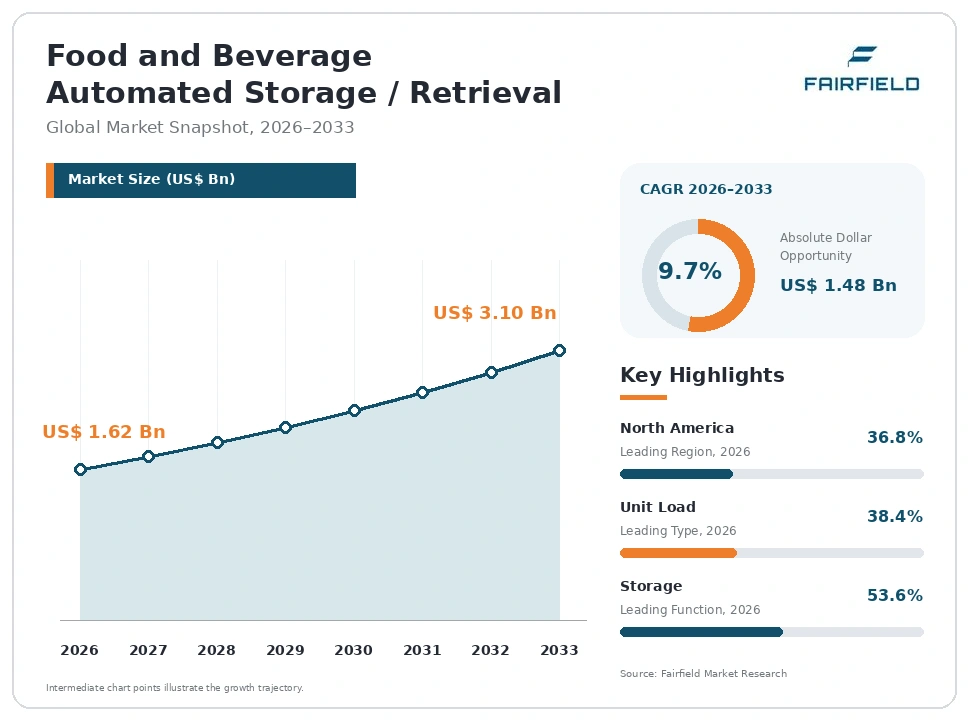
The global food and beverage automated storage retrieval system market size is expected to be valued at US$ 1.62 billion in 2026 and projected to reach US$ 3.10 billion by 2033, growing at a CAGR of 9.7% between 2026 and 2033.
Between 2020 and 2025, the market grew at a CAGR of about 8.2%, as pandemic-driven grocery demand, e-commerce, and labor shortages pushed food companies and cold storage operators to automate warehouses. Three factors now drive growth: persistent labor shortages, especially in freezers, the need for traceability and food safety, and growth in online grocery and store replenishment. The market is shifting toward cold chain automation, high-bay unit load AS/RS and pallet shuttles for frozen storage, mini load systems for case and each picking, and warehouse execution software that links storage with order fulfillment.
Key Report Takeaways
- By Type: Unit Load held 38.4% share in 2026, while Mini Load is projected to expand at a 11.4% CAGR through 2033, driven by high-SKU, fast-moving products that need dense storage and quick picking.
- By Temperature Range: Ambient held 56.8% share in 2026, while Frozen is projected to expand at a 11.8% CAGR through 2033, driven by labor shortages in freezers and growth in frozen foods.
- By Function: Storage held 53.6% share in 2026, while Order Picking is projected to expand at a 11.1% CAGR through 2033, driven by online grocery and mixed-case store replenishment.
- By Region: North America held 36.8% share in 2026, while Asia Pacific is projected to expand at a 11.9% CAGR through 2033, driven by cold chain investment in China, India, and Japan.
Global Food and Beverage Automated Storage Retrieval System Market Trends and Insights
Drivers Impact Analysis
Two drivers carry the strongest influence on food and beverage AS/RS demand during the forecast period.
| Driver | Impact on CAGR Forecast | Geographic Relevance | Impact Timeline |
| Labor shortages and cold storage automation | High | North America, Europe, Asia Pacific | Medium term (2-4 years) |
| Online grocery, SKU growth, and traceability needs | High | North America, Europe, Asia Pacific | Long term (≥4 years) |
Labor Shortages and Cold Storage Automation Are Driving the Food and Beverage AS/RS Market
Labor shortages and cold storage automation are the strongest drivers of the food and beverage automated storage retrieval system market. Food warehouses, especially freezers, struggle to hire and keep workers.
The mechanism is difficult working conditions and rising wages. Workers in frozen warehouses operate at temperatures as low as -25°C, leading to high turnover and safety risks. Automated cranes and shuttles can run around the clock in the cold without breaks. Lineage announced plans in April 2025 to build two fully automated cold storage warehouses with Tyson Foods as anchor customer, part of a US$ 740 million expansion. Automated high-bay warehouses store far more pallets per square meter, reducing the size of costly refrigerated buildings and cutting energy use. Third-party logistics providers, food processors, and retailers are investing to secure capacity and lower costs. These factors make cold chain automation a priority investment.
Online Grocery and Traceability Are Expanding the Food and Beverage AS/RS Market
Online grocery, SKU growth, and traceability needs are expanding the food and beverage automated storage retrieval system market. Food distribution has become more complex and time-sensitive.
The cause is changing shopping habits and stricter rules. Online grocery and click-and-collect require fast, accurate picking of many small orders. Retailers stock more product variants, organic options, and private-label items, increasing SKU counts. Walmart chose Symbotic in January 2025 to automate its accelerated pickup and delivery centers at stores. Food safety rules, such as the U.S. Food and Drug Administration’s Food Traceability Rule, require detailed lot tracking, which automated systems and warehouse execution software provide. First-expired, first-out control reduces waste. Beverage makers need high-throughput pallet storage. These trends drive demand for automated storage and picking.
Restraints Impact Analysis
Two restraints limit how quickly the food and beverage AS/RS market grows.
| Restraint | Impact on CAGR Forecast | Geographic Relevance | Impact Timeline |
| High capital costs and long payback periods | High | Global | Short term (≤2 years) |
| System complexity, downtime risk, and integration challenges | Medium | Global | Medium term (2-4 years) |
High Capital Costs Slow the Food and Beverage AS/RS Market
High capital costs and long payback periods slow the food and beverage automated storage retrieval system market. Automated warehouses require large upfront investments.
The specific causes are expensive equipment and building requirements. A high-bay automated cold store with cranes, conveyors, racks, insulation, and software can cost tens of millions of dollars. Food margins are thin, so companies need clear proof of savings before investing. Higher interest rates since 2022 have raised financing costs. Many existing warehouses cannot be easily converted, so automation often requires new buildings. Small and mid-sized food companies may lack capital and in-house expertise. Construction and equipment lead times can exceed a year. These factors delay projects and lead some firms to choose simpler solutions such as conventional racking, forklifts, or semi-automated pallet shuttles.
Complexity and Downtime Risks Restrict the Food and Beverage AS/RS Market
System complexity, downtime risk, and integration challenges restrict the food and beverage automated storage retrieval system market. Food supply chains cannot tolerate long system outages.
The underlying causes are technical complexity and harsh conditions. If an automated system fails, perishable goods may spoil and store deliveries may be delayed. Frozen environments stress motors, batteries, sensors, and lubricants, requiring special designs and maintenance. Integration with warehouse management, enterprise resource planning, and transport systems can be difficult. Skilled technicians are needed for maintenance and repair. Changing product sizes and packaging can reduce system efficiency. Food companies with seasonal demand peaks may find fixed automation less flexible than manual operations. Cybersecurity risks also grow as systems connect to the internet and cloud software. These factors restrict adoption, especially among smaller operators with limited technical staff.
Market Opportunities
Automated Cold Storage for Third-party Logistics Opens a Large Revenue Pool
Automated cold storage for third-party logistics opens a large revenue pool in the food and beverage automated storage retrieval system market. Cold storage operators are building new automated facilities to meet demand.
AS/RS suppliers and integrators can capture this opportunity. Lineage, Americold, NewCold, and United States Cold Storage operate large networks and are adding automated sites. Swisslog supplied a pallet AS/RS with 48,360 pallet positions for Agile Cold Storage in Georgia, which opened in 2024. Dematic helped Groupe Robert open Quebec’s first fully automated fresh and frozen warehouse. Many older cold stores need replacement, creating long-term demand. Long-term service contracts add recurring revenue. Suppliers with proven freezer designs can win repeat orders across multi-site cold storage networks, and financing models such as automation-as-a-service can lower entry barriers.
Store Replenishment and Micro-fulfillment Create a Retail Revenue Pool
Store replenishment and micro-fulfillment create a retail revenue pool in the food and beverage automated storage retrieval system market. Grocers need faster, more accurate order picking for stores and online orders.
Retail automation suppliers can capture this opportunity. Mini load systems, shuttles, and robotic picking build store-ready, mixed-case pallets that match shelf layouts, reducing store labor. Symbotic expects more than US$ 5 billion in backlog from its agreements with Walmart. Witron, Ocado, AutoStore, and Dematic supply grocers in North America and Europe. Micro-fulfillment centers at or near stores serve online orders quickly. Retailers’ long-term automation programs provide steady demand. Software, robotics, and service offerings create additional revenue streams, and data from automated systems helps retailers improve forecasting and reduce food waste.
Segment Analysis
By Type: Unit Load Leads While Mini Load Grows Fastest
Unit Load held 38.4% share in 2026. Unit load AS/RS use stacker cranes to store and retrieve full pallets in high-bay racks, often over 30 meters tall. They suit beverage makers, food processors, and cold stores that handle large volumes of palletized goods. Pallet shuttles and carton flow systems form other types.
Mini Load is the fastest-growing type, expanding at a 11.4% CAGR through 2033. Mini load systems store totes, trays, and cases for fast picking of many SKUs. They support e-commerce, store replenishment, and ingredient handling. Shuttle-based and robotic cube storage systems from AutoStore, Knapp, and TGW Logistics fall into this group. Compact designs fit smaller buildings and micro-fulfillment centers. For the market, mini load growth links storage with order fulfillment.
By Temperature Range: Ambient Leads While Frozen Grows Fastest
Ambient held 56.8% share in 2026. Dry groceries, canned goods, beverages, snacks, and packaged foods are stored at ambient temperatures. Beverage makers and food manufacturers have long used automated pallet warehouses for these products. Many retail distribution centers automate ambient goods first.
Frozen is the fastest-growing temperature range, expanding at a 11.8% CAGR through 2033. Frozen foods are growing in popularity, and freezer warehouses face the most severe labor shortages. Automation reduces the need for workers in sub-zero conditions and allows denser storage, lowering energy use per pallet. Chilled storage for dairy, meat, and fresh produce forms another range. Energy-efficient designs that reduce door openings and air leaks lower refrigeration costs. For the market, frozen growth raises demand for specialized cold-rated equipment.
By Function: Storage Leads While Order Picking Grows Fastest
Storage held 53.6% share in 2026. Automated storage maximizes space use, tracks inventory, and ensures first-expired, first-out rotation. High-density storage is especially valuable in costly refrigerated buildings. Food processors use storage for raw materials, work in progress, and finished goods.
Order Picking is the fastest-growing function, expanding at a 11.1% CAGR through 2033. Automated case and layer picking, mixed-case palletizing, and goods-to-person systems build orders for stores and online customers. Symbotic, Witron, and Dematic offer complete picking solutions. Warehouse execution software sequences orders for store layouts. Buffering and sequencing form other functions. Robotic arms with vision systems are starting to pick individual items. For the market, picking growth adds value per system.
Geography Analysis
Which Region Is Leading the Food and Beverage Automated Storage Retrieval System Market?
North America is leading the food and beverage automated storage retrieval system market with a 36.8% share in 2026. The United States has a mature food supply chain, large grocery retailers, and major cold storage operators such as Lineage and Americold. Labor shortages and high wages support automation, and Walmart’s program with Symbotic is one of the largest. Food safety and traceability rules require detailed inventory tracking. Canada has growing automated cold storage, such as Groupe Robert’s Quebec facility. Mexico adds beverage and food processing demand. One change shaping the region is fully automated greenfield cold stores.
Europe Advances the Food and Beverage Automated Storage Retrieval System Market Through Retail Automation
Europe is a major food and beverage automated storage retrieval system market with a long history of warehouse automation. Germany hosts SSI Schaefer and Witron, Austria hosts TGW Logistics and Knapp, and Switzerland hosts Swisslog. Grocers such as Edeka, Rewe, Tesco, and Carrefour use automated distribution centers. NewCold, based in the Netherlands, operates automated cold stores. High labor and land costs support automation. Retailers in France, Italy, Spain, Sweden, and Denmark are investing in automated fresh food centers. Strict food safety and sustainability rules encourage efficient, low-energy facilities. One opportunity is retrofitting older warehouses with shuttles and robotic picking.
Which Region Is Growing Fastest in the Food and Beverage Automated Storage Retrieval System Market?
Asia Pacific is growing fastest in the food and beverage automated storage retrieval system market at a 11.9% CAGR through 2033. China is investing heavily in cold chain logistics to reduce food waste, and online grocery is growing quickly. Japan hosts Daifuku, Murata Machinery, and Toyota Industries, and faces severe labor shortages due to an aging population. India is building modern cold storage under government programs. Australia and South Korea have growing automated food distribution. Large e-commerce grocers such as Alibaba’s Freshippo and JD.com use automated warehouses. One opportunity is cold chain automation for meat, seafood, and dairy distribution.
Latin America Grows the Food and Beverage Automated Storage Retrieval System Market Through Beverage and Meat Industries
Latin America is a growing food and beverage automated storage retrieval system market. Brazil and Mexico have large beverage makers and meat exporters that use automated pallet warehouses, and Chile exports fruit and seafood that need cold storage. Beverage giants such as AB InBev’s Ambev and FEMSA operate large automated warehouses, and grocery retail is consolidating in major cities such as São Paulo and Mexico City. Cold storage capacity in the region is still limited compared with demand. Key barriers include high costs, currency swings, and economic volatility. One opportunity is automated cold storage for meat, fruit, and seafood exports.
Middle East & Africa Builds the Food and Beverage Automated Storage Retrieval System Market
Middle East & Africa is an emerging food and beverage automated storage retrieval system market. Saudi Arabia and the United Arab Emirates import much of their food and invest in food security and cold storage. South Africa has large food retailers. Government food security programs in Saudi Arabia and the United Arab Emirates fund strategic reserves and modern logistics hubs, and hot climates make cold storage essential. Egypt, Nigeria, and Kenya have large food losses due to weak cold chains. Key barriers include limited local expertise, high costs, and small warehouse sizes. One opportunity is food security warehouses and cold storage hubs near major ports.
Competitive Landscape
The food and beverage automated storage retrieval system market is moderately concentrated. Daifuku, Dematic, SSI Schaefer, Swisslog, and Murata Machinery are leading suppliers, while TGW Logistics, Witron, Toyota Industries, Symbotic, Knapp, AutoStore, and Honeywell Intelligrated compete strongly.
Companies compete on system reliability, cold-rated designs, throughput, energy efficiency, software, service networks, and project execution. Food companies value suppliers with proven freezer installations and fast, reliable local service. Large suppliers offer complete solutions including racks, cranes, conveyors, robots, and software, while specialists focus on specific technologies such as shuttles, robotic picking, or cube storage. Partnerships with cold storage builders and engineering firms help suppliers win large greenfield projects.
Strategic moves show how competition is changing. In February 2024, Groupe Robert and Dematic opened a fully automated fresh and frozen warehouse in Quebec, and in December 2024, Swisslog’s pallet AS/RS for Agile Cold Storage was profiled after opening in Georgia. In January 2025, Symbotic agreed to acquire Walmart’s robotics business and build systems for its pickup and delivery centers. In April 2025, Lineage announced two fully automated cold storage warehouses with Tyson Foods. These moves show competition shifting toward large, long-term automation programs with major retailers and logistics providers.
Three themes shape vendor strategy. First, companies are developing cold-rated systems for frozen storage. Second, they are integrating warehouse software with picking robots. Third, they are expanding service networks and remote monitoring.
Food and Beverage Automated Storage Retrieval System Market Industry Leaders
- Daifuku
- Dematic (KION Group)
- SSI Schaefer
- Swisslog (KUKA)
- Murata Machinery
Recent Industry Developments
- April 2025: Lineage announced plans for two fully automated cold storage warehouses with Tyson Foods as anchor customer - adds nearly 260,000 pallet positions.
- January 2025: Symbotic agreed to acquire Walmart’s Advanced Systems and Robotics business and automate its pickup and delivery centers - could add more than US$ 5 billion to backlog.
- December 2024: Agile Cold Storage detailed its new Swisslog pallet AS/RS in Georgia with 48,360 positions - shows high-bay automation for frozen food.
- February 2024: Groupe Robert and Dematic opened Quebec’s first fully automated fresh and frozen warehouse - holds 60,000 pallets.
Companies Covered in the Report
- Daifuku
- Dematic (KION Group)
- SSI Schaefer
- Swisslog (KUKA)
- Murata Machinery
- TGW Logistics
- Witron
- Toyota Industries (Vanderlande, Bastian Solutions)
- Symbotic
- Knapp
- AutoStore
- Honeywell Intelligrated
Food and Beverage Automated Storage Retrieval System Market Report Scope
This report covers automated storage and retrieval systems for the food and beverage industry, including unit load, mini load, pallet shuttle, carousel, and robotic cube systems, for ambient, chilled, and frozen storage, used for storage, order picking, and buffering by food processors, beverage makers, retailers, and cold storage operators. It excludes conventional racking and forklifts. The base year is 2025, and the forecast period runs from 2026 to 2033. All values are expressed in US$ Billion.
Type
- Unit Load
- Mini Load
- Pallet Shuttle
- Carousel & Vertical Lift Modules
- Robotic Cube Storage
Temperature Range
- Ambient
- Chilled
- Frozen
Function
- Storage
- Order Picking
- Buffering & Sequencing
Regions
- North America
- Europe
- Asia Pacific
- Latin America
- Middle East & Africa
Key Questions Answered in the Report
How big is the food and beverage automated storage retrieval system market in 2026?
The food and beverage AS/RS market is valued at US$ 1.62 billion in 2026, led by unit load systems for palletized goods.
What is the food and beverage automated storage retrieval system market forecast to 2033?
The market is projected to reach US$ 3.10 billion by 2033, growing at a 9.7% CAGR and adding US$ 1.48 billion.
Which temperature range is growing fastest in food and beverage AS/RS?
Frozen is growing fastest at a 11.8% CAGR through 2033, driven by labor shortages in freezers and growth in frozen foods.
Which region is growing fastest in the food and beverage AS/RS market?
Asia Pacific is growing fastest at a 11.9% CAGR through 2033, driven by cold chain investment in China, India, and Japan.
Which region holds the largest food and beverage AS/RS market share?
North America holds the largest share at 36.8% in 2026, supported by large grocers and cold storage operators in the United States.
1. Executive Summary
1.1. Global Food and Beverage Automated Storage Retrieval System Market Snapshot
1.2. Future Projections
1.3. Key Report Takeaways
1.4. Regional Snapshot
2. Market Overview
2.1. Market Definition and Report Scope
2.2. Historical Trends 2020–2025
2.3. Market Dynamics
2.3.1. Drivers
2.3.1.1. Labor Shortages and Cold Storage Automation Are Driving the Food and Beverage AS/RS Market
2.3.1.2. Online Grocery and Traceability Are Expanding the Food and Beverage AS/RS Market
2.3.2. Restraints
2.3.2.1. High Capital Costs Slow the Food and Beverage AS/RS Market
2.3.2.2. Complexity and Downtime Risks Restrict the Food and Beverage AS/RS Market
2.3.3. Market Opportunities
2.3.3.1. Automated Cold Storage for Third-party Logistics Opens a Large Revenue Pool
2.3.3.2. Store Replenishment and Micro-fulfillment Create a Retail Revenue Pool
3. Global Food and Beverage Automated Storage Retrieval System Market Outlook, 2020-2033
3.1. Global Food and Beverage Automated Storage Retrieval System Market Outlook, by Type, Value (US$ Billion), 2020-2033
3.1.1. Unit Load
3.1.2. Mini Load
3.1.3. Pallet Shuttle
3.1.4. Carousel & Vertical Lift Modules
3.1.5. Robotic Cube Storage
3.2. Global Food and Beverage Automated Storage Retrieval System Market Outlook, by Temperature Range, Value (US$ Billion), 2020-2033
3.2.1. Ambient
3.2.2. Chilled
3.2.3. Frozen
3.3. Global Food and Beverage Automated Storage Retrieval System Market Outlook, by Function, Value (US$ Billion), 2020-2033
3.3.1. Storage
3.3.2. Order Picking
3.3.3. Buffering & Sequencing
3.4. Global Food and Beverage Automated Storage Retrieval System Market Outlook, by Region, Value (US$ Billion), 2020-2033
3.4.1. North America
3.4.2. Europe
3.4.3. Asia Pacific
3.4.4. Latin America
3.4.5. Middle East & Africa
4. North America Food and Beverage Automated Storage Retrieval System Market Outlook, 2020-2033
4.1. North America Food and Beverage Automated Storage Retrieval System Market Outlook, by Type, Value (US$ Billion), 2020-2033
4.1.1. Unit Load
4.1.2. Mini Load
4.1.3. Pallet Shuttle
4.1.4. Carousel & Vertical Lift Modules
4.1.5. Robotic Cube Storage
4.2. North America Food and Beverage Automated Storage Retrieval System Market Outlook, by Temperature Range, Value (US$ Billion), 2020-2033
4.2.1. Ambient
4.2.2. Chilled
4.2.3. Frozen
4.3. North America Food and Beverage Automated Storage Retrieval System Market Outlook, by Function, Value (US$ Billion), 2020-2033
4.3.1. Storage
4.3.2. Order Picking
4.3.3. Buffering & Sequencing
4.4. North America Food and Beverage Automated Storage Retrieval System Market Outlook, by Country, Value (US$ Billion), 2020-2033
4.4.1. United States Food and Beverage Automated Storage Retrieval System Market Outlook, by Type, 2020-2033
4.4.2. United States Food and Beverage Automated Storage Retrieval System Market Outlook, by Temperature Range, 2020-2033
4.4.3. United States Food and Beverage Automated Storage Retrieval System Market Outlook, by Function, 2020-2033
4.4.4. Canada Food and Beverage Automated Storage Retrieval System Market Outlook, by Type, 2020-2033
4.4.5. Canada Food and Beverage Automated Storage Retrieval System Market Outlook, by Temperature Range, 2020-2033
4.4.6. Canada Food and Beverage Automated Storage Retrieval System Market Outlook, by Function, 2020-2033
4.4.7. Mexico Food and Beverage Automated Storage Retrieval System Market Outlook, by Type, 2020-2033
4.4.8. Mexico Food and Beverage Automated Storage Retrieval System Market Outlook, by Temperature Range, 2020-2033
4.4.9. Mexico Food and Beverage Automated Storage Retrieval System Market Outlook, by Function, 2020-2033
5. Europe Food and Beverage Automated Storage Retrieval System Market Outlook, 2020-2033
5.1. Europe Food and Beverage Automated Storage Retrieval System Market Outlook, by Type, Value (US$ Billion), 2020-2033
5.1.1. Unit Load
5.1.2. Mini Load
5.1.3. Pallet Shuttle
5.1.4. Carousel & Vertical Lift Modules
5.1.5. Robotic Cube Storage
5.2. Europe Food and Beverage Automated Storage Retrieval System Market Outlook, by Temperature Range, Value (US$ Billion), 2020-2033
5.2.1. Ambient
5.2.2. Chilled
5.2.3. Frozen
5.3. Europe Food and Beverage Automated Storage Retrieval System Market Outlook, by Function, Value (US$ Billion), 2020-2033
5.3.1. Storage
5.3.2. Order Picking
5.3.3. Buffering & Sequencing
5.4. Europe Food and Beverage Automated Storage Retrieval System Market Outlook, by Country, Value (US$ Billion), 2020-2033
5.4.1. Germany Food and Beverage Automated Storage Retrieval System Market Outlook, by Type, 2020-2033
5.4.2. Germany Food and Beverage Automated Storage Retrieval System Market Outlook, by Temperature Range, 2020-2033
5.4.3. Germany Food and Beverage Automated Storage Retrieval System Market Outlook, by Function, 2020-2033
5.4.4. Austria Food and Beverage Automated Storage Retrieval System Market Outlook, by Type, 2020-2033
5.4.5. Austria Food and Beverage Automated Storage Retrieval System Market Outlook, by Temperature Range, 2020-2033
5.4.6. Austria Food and Beverage Automated Storage Retrieval System Market Outlook, by Function, 2020-2033
5.4.7. Switzerland Food and Beverage Automated Storage Retrieval System Market Outlook, by Type, 2020-2033
5.4.8. Switzerland Food and Beverage Automated Storage Retrieval System Market Outlook, by Temperature Range, 2020-2033
5.4.9. Switzerland Food and Beverage Automated Storage Retrieval System Market Outlook, by Function, 2020-2033
5.4.10. Netherlands Food and Beverage Automated Storage Retrieval System Market Outlook, by Type, 2020-2033
5.4.11. Netherlands Food and Beverage Automated Storage Retrieval System Market Outlook, by Temperature Range, 2020-2033
5.4.12. Netherlands Food and Beverage Automated Storage Retrieval System Market Outlook, by Function, 2020-2033
5.4.13. France Food and Beverage Automated Storage Retrieval System Market Outlook, by Type, 2020-2033
5.4.14. France Food and Beverage Automated Storage Retrieval System Market Outlook, by Temperature Range, 2020-2033
5.4.15. France Food and Beverage Automated Storage Retrieval System Market Outlook, by Function, 2020-2033
5.4.16. Italy Food and Beverage Automated Storage Retrieval System Market Outlook, by Type, 2020-2033
5.4.17. Italy Food and Beverage Automated Storage Retrieval System Market Outlook, by Temperature Range, 2020-2033
5.4.18. Italy Food and Beverage Automated Storage Retrieval System Market Outlook, by Function, 2020-2033
5.4.19. Spain Food and Beverage Automated Storage Retrieval System Market Outlook, by Type, 2020-2033
5.4.20. Spain Food and Beverage Automated Storage Retrieval System Market Outlook, by Temperature Range, 2020-2033
5.4.21. Spain Food and Beverage Automated Storage Retrieval System Market Outlook, by Function, 2020-2033
5.4.22. Sweden Food and Beverage Automated Storage Retrieval System Market Outlook, by Type, 2020-2033
5.4.23. Sweden Food and Beverage Automated Storage Retrieval System Market Outlook, by Temperature Range, 2020-2033
5.4.24. Sweden Food and Beverage Automated Storage Retrieval System Market Outlook, by Function, 2020-2033
5.4.25. Denmark Food and Beverage Automated Storage Retrieval System Market Outlook, by Type, 2020-2033
5.4.26. Denmark Food and Beverage Automated Storage Retrieval System Market Outlook, by Temperature Range, 2020-2033
5.4.27. Denmark Food and Beverage Automated Storage Retrieval System Market Outlook, by Function, 2020-2033
6. Asia Pacific Food and Beverage Automated Storage Retrieval System Market Outlook, 2020-2033
6.1. Asia Pacific Food and Beverage Automated Storage Retrieval System Market Outlook, by Type, Value (US$ Billion), 2020-2033
6.1.1. Unit Load
6.1.2. Mini Load
6.1.3. Pallet Shuttle
6.1.4. Carousel & Vertical Lift Modules
6.1.5. Robotic Cube Storage
6.2. Asia Pacific Food and Beverage Automated Storage Retrieval System Market Outlook, by Temperature Range, Value (US$ Billion), 2020-2033
6.2.1. Ambient
6.2.2. Chilled
6.2.3. Frozen
6.3. Asia Pacific Food and Beverage Automated Storage Retrieval System Market Outlook, by Function, Value (US$ Billion), 2020-2033
6.3.1. Storage
6.3.2. Order Picking
6.3.3. Buffering & Sequencing
6.4. Asia Pacific Food and Beverage Automated Storage Retrieval System Market Outlook, by Country, Value (US$ Billion), 2020-2033
6.4.1. China Food and Beverage Automated Storage Retrieval System Market Outlook, by Type, 2020-2033
6.4.2. China Food and Beverage Automated Storage Retrieval System Market Outlook, by Temperature Range, 2020-2033
6.4.3. China Food and Beverage Automated Storage Retrieval System Market Outlook, by Function, 2020-2033
6.4.4. Japan Food and Beverage Automated Storage Retrieval System Market Outlook, by Type, 2020-2033
6.4.5. Japan Food and Beverage Automated Storage Retrieval System Market Outlook, by Temperature Range, 2020-2033
6.4.6. Japan Food and Beverage Automated Storage Retrieval System Market Outlook, by Function, 2020-2033
6.4.7. India Food and Beverage Automated Storage Retrieval System Market Outlook, by Type, 2020-2033
6.4.8. India Food and Beverage Automated Storage Retrieval System Market Outlook, by Temperature Range, 2020-2033
6.4.9. India Food and Beverage Automated Storage Retrieval System Market Outlook, by Function, 2020-2033
6.4.10. Australia Food and Beverage Automated Storage Retrieval System Market Outlook, by Type, 2020-2033
6.4.11. Australia Food and Beverage Automated Storage Retrieval System Market Outlook, by Temperature Range, 2020-2033
6.4.12. Australia Food and Beverage Automated Storage Retrieval System Market Outlook, by Function, 2020-2033
6.4.13. South Korea Food and Beverage Automated Storage Retrieval System Market Outlook, by Type, 2020-2033
6.4.14. South Korea Food and Beverage Automated Storage Retrieval System Market Outlook, by Temperature Range, 2020-2033
6.4.15. South Korea Food and Beverage Automated Storage Retrieval System Market Outlook, by Function, 2020-2033
7. Latin America Food and Beverage Automated Storage Retrieval System Market Outlook, 2020-2033
7.1. Latin America Food and Beverage Automated Storage Retrieval System Market Outlook, by Type, Value (US$ Billion), 2020-2033
7.1.1. Unit Load
7.1.2. Mini Load
7.1.3. Pallet Shuttle
7.1.4. Carousel & Vertical Lift Modules
7.1.5. Robotic Cube Storage
7.2. Latin America Food and Beverage Automated Storage Retrieval System Market Outlook, by Temperature Range, Value (US$ Billion), 2020-2033
7.2.1. Ambient
7.2.2. Chilled
7.2.3. Frozen
7.3. Latin America Food and Beverage Automated Storage Retrieval System Market Outlook, by Function, Value (US$ Billion), 2020-2033
7.3.1. Storage
7.3.2. Order Picking
7.3.3. Buffering & Sequencing
7.4. Latin America Food and Beverage Automated Storage Retrieval System Market Outlook, by Country, Value (US$ Billion), 2020-2033
7.4.1. Brazil Food and Beverage Automated Storage Retrieval System Market Outlook, by Type, 2020-2033
7.4.2. Brazil Food and Beverage Automated Storage Retrieval System Market Outlook, by Temperature Range, 2020-2033
7.4.3. Brazil Food and Beverage Automated Storage Retrieval System Market Outlook, by Function, 2020-2033
7.4.4. Mexico Food and Beverage Automated Storage Retrieval System Market Outlook, by Type, 2020-2033
7.4.5. Mexico Food and Beverage Automated Storage Retrieval System Market Outlook, by Temperature Range, 2020-2033
7.4.6. Mexico Food and Beverage Automated Storage Retrieval System Market Outlook, by Function, 2020-2033
7.4.7. Chile Food and Beverage Automated Storage Retrieval System Market Outlook, by Type, 2020-2033
7.4.8. Chile Food and Beverage Automated Storage Retrieval System Market Outlook, by Temperature Range, 2020-2033
7.4.9. Chile Food and Beverage Automated Storage Retrieval System Market Outlook, by Function, 2020-2033
8. Middle East & Africa Food and Beverage Automated Storage Retrieval System Market Outlook, 2020-2033
8.1. Middle East & Africa Food and Beverage Automated Storage Retrieval System Market Outlook, by Type, Value (US$ Billion), 2020-2033
8.1.1. Unit Load
8.1.2. Mini Load
8.1.3. Pallet Shuttle
8.1.4. Carousel & Vertical Lift Modules
8.1.5. Robotic Cube Storage
8.2. Middle East & Africa Food and Beverage Automated Storage Retrieval System Market Outlook, by Temperature Range, Value (US$ Billion), 2020-2033
8.2.1. Ambient
8.2.2. Chilled
8.2.3. Frozen
8.3. Middle East & Africa Food and Beverage Automated Storage Retrieval System Market Outlook, by Function, Value (US$ Billion), 2020-2033
8.3.1. Storage
8.3.2. Order Picking
8.3.3. Buffering & Sequencing
8.4. Middle East & Africa Food and Beverage Automated Storage Retrieval System Market Outlook, by Country, Value (US$ Billion), 2020-2033
8.4.1. Saudi Arabia Food and Beverage Automated Storage Retrieval System Market Outlook, by Type, 2020-2033
8.4.2. Saudi Arabia Food and Beverage Automated Storage Retrieval System Market Outlook, by Temperature Range, 2020-2033
8.4.3. Saudi Arabia Food and Beverage Automated Storage Retrieval System Market Outlook, by Function, 2020-2033
8.4.4. United Arab Emirates Food and Beverage Automated Storage Retrieval System Market Outlook, by Type, 2020-2033
8.4.5. United Arab Emirates Food and Beverage Automated Storage Retrieval System Market Outlook, by Temperature Range, 2020-2033
8.4.6. United Arab Emirates Food and Beverage Automated Storage Retrieval System Market Outlook, by Function, 2020-2033
8.4.7. South Africa Food and Beverage Automated Storage Retrieval System Market Outlook, by Type, 2020-2033
8.4.8. South Africa Food and Beverage Automated Storage Retrieval System Market Outlook, by Temperature Range, 2020-2033
8.4.9. South Africa Food and Beverage Automated Storage Retrieval System Market Outlook, by Function, 2020-2033
8.4.10. Egypt Food and Beverage Automated Storage Retrieval System Market Outlook, by Type, 2020-2033
8.4.11. Egypt Food and Beverage Automated Storage Retrieval System Market Outlook, by Temperature Range, 2020-2033
8.4.12. Egypt Food and Beverage Automated Storage Retrieval System Market Outlook, by Function, 2020-2033
8.4.13. Nigeria Food and Beverage Automated Storage Retrieval System Market Outlook, by Type, 2020-2033
8.4.14. Nigeria Food and Beverage Automated Storage Retrieval System Market Outlook, by Temperature Range, 2020-2033
8.4.15. Nigeria Food and Beverage Automated Storage Retrieval System Market Outlook, by Function, 2020-2033
8.4.16. Kenya Food and Beverage Automated Storage Retrieval System Market Outlook, by Type, 2020-2033
8.4.17. Kenya Food and Beverage Automated Storage Retrieval System Market Outlook, by Temperature Range, 2020-2033
8.4.18. Kenya Food and Beverage Automated Storage Retrieval System Market Outlook, by Function, 2020-2033
9. Competitive Landscape
9.1. Market Concentration and Industry Leaders
9.2. Competitive Differentiation
9.3. Strategic Moves and Market Direction
9.4. Recent Industry Developments
9.5. Company Profiles
9.5.1. Daifuku
9.5.2. Dematic (KION Group)
9.5.3. SSI Schaefer
9.5.4. Swisslog (KUKA)
9.5.5. Murata Machinery
9.5.6. TGW Logistics
9.5.7. Witron
9.5.8. Toyota Industries (Vanderlande, Bastian Solutions)
9.5.9. Symbotic
9.5.10. Knapp
9.5.11. AutoStore
9.5.12. Honeywell Intelligrated
10. Appendix
10.1. Research Methodology
10.2. Report Assumptions
10.3. Acronyms and Abbreviations
| Segment | Categories |
|---|---|
| Type | Unit Load, Mini Load, Pallet Shuttle, Carousel & Vertical Lift Modules, Robotic Cube Storage |
| Temperature Range | Ambient, Chilled, Frozen |
| Function | Storage, Order Picking, Buffering & Sequencing |
| Regions | North America, Europe, Asia Pacific, Latin America, Middle East & Africa |
Our Research Methodology
Considering the volatility of business today, traditional approaches to strategizing a game plan can be unfruitful if not detrimental. True ambiguity is no way to determine a forecast. A myriad of predetermined factors must be accounted for such as the degree of risk involved, the magnitude of circumstances, as well as conditions or consequences that are not known or unpredictable. To circumvent binary views that cast uncertainty, the application of market research intelligence to strategically posture, move, and enable actionable outcomes is necessary.
View Methodology
Quality Assured
Rigorous Validation Process

Confidentiality Assured
End-to-end Data Security

Custom Research Services
Tailored To Your Objectives
FAQs
The food and beverage AS/RS market is valued at US$ 1.62 billion in 2026, led by unit load systems for palletized goods.
The market is projected to reach US$ 3.10 billion by 2033, growing at a 9.7% CAGR and adding US$ 1.48 billion.
Frozen is growing fastest at a 11.8% CAGR through 2033, driven by labor shortages in freezers and growth in frozen foods.
Asia Pacific is growing fastest at a 11.9% CAGR through 2033, driven by cold chain investment in China, India, and Japan.
North America holds the largest share at 36.8% in 2026, supported by large grocers and cold storage operators in the United States.
Related Reports
Scroll and Absorption Chillers Market Size, Share, Insights, Competitive Landscape, and Forecast 2026 to 2033
Scroll and Absorption Chillers Market grows from US$ 14.27 billion in 2026 to US$ 19.31 billion by 2033 at a 4.4% CAGR. Explore key segments and trends.
Laser Technologies in Manufacturing Market Size, Share, Insights, Competitive Landscape, and Forecast 2026 to 2033
Explore the laser technologies in manufacturing market, valued at US$ 23.6 billion in 2026 and forecast to reach US$ 38.4 billion by 2033 at 7.2% CAGR.
High Torque Stepper Motor Market Size, Share, Insights, Competitive Landscape, and Forecast 2026 to 2033
Explore the high torque stepper motor market, projected to reach US$ 3.6 billion by 2033 at a 6.6% CAGR, with product and regional insights.
FBG Interrogator Market Size, Share, Insights, Competitive Landscape, and Forecast 2026 to 2033
Explore the FBG interrogator market, projected to reach US$ 316.7 million by 2033 at an 8.5% CAGR, with technology, application and regional insights.
Conveying Equipment Market Size, Share, Insights, Competitive Landscape, and Forecast 2026 to 2033
Explore the conveying equipment market, projected to reach US$ 56.9 billion by 2033 at a 4.5% CAGR, with equipment, services and regional insights.
Bakery Packaging Machine Market Size, Share, Insights, Competitive Landscape, and Forecast 2026 to 2033
Explore the bakery packaging machine market, projected to reach US$ 4.44 billion by 2033 at a 4.6% CAGR, with automation, machine and regional insights.