



Fruit-flavour Drink Compounds Market
Fruit-flavour Drink Compounds Market Size, Share, Insights, Competitive Landscape, and Forecast 2026 to 2033
Fruit-flavour Drink Compounds Market Size and Trend Analysis
What Is Driving Demand for Fruit Beverage Compounds?
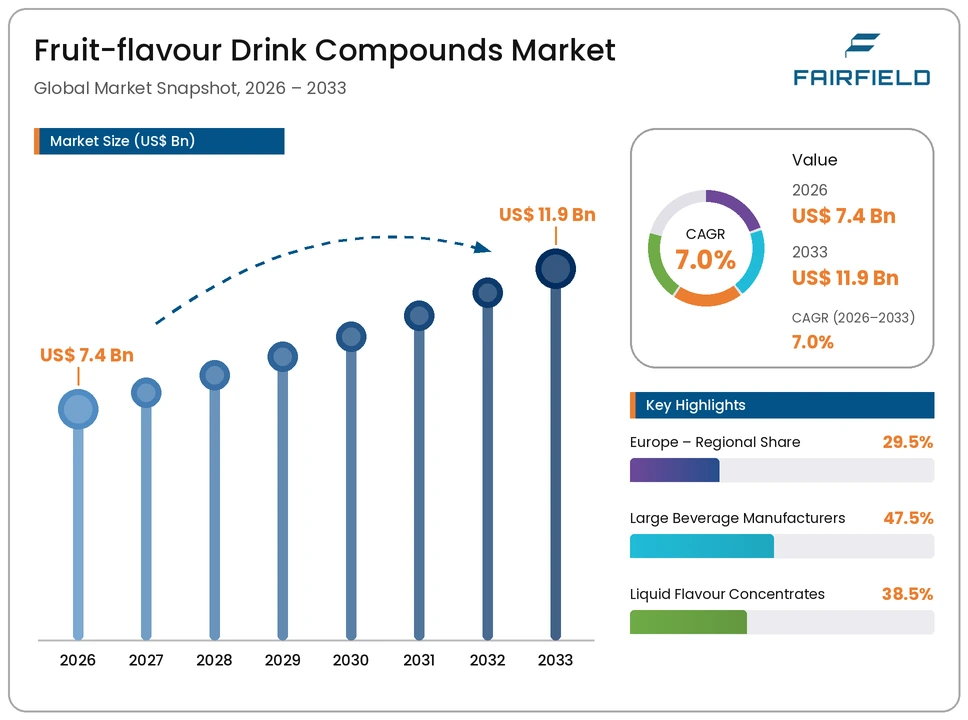
The global Fruit-flavour Drink Compounds market size is expected to be valued at US$ 7.4 billion in 2026 and projected to reach US$ 11.9 billion by 2033, growing at a CAGR of 7.0% between 2026 and 2033.
Between 2020 and 2025 the market expanded at roughly 5.8% a year, a slower pace set by flat carbonated volumes in mature countries. Three factors now lift growth. Sugar reduction forces drink makers to buy taste-modulating compound systems rather than simple flavourings. Tight citrus supply, confirmed by USDA Foreign Agricultural Service orange juice data, pushes bottlers toward engineered fruit profiles. New launch activity in flavoured water and ready-to-drink formats keeps adding fresh formulation work. The market is steadily moving away from commodity essences and toward complete beverage flavour concentrates sold together with laboratory and application support.
Key Report Takeaways
- By Compound Type: Liquid Flavour Concentrates held 38.5% share in 2026, while Powdered and Encapsulated Compounds is projected to expand at a 9.4% CAGR through 2033, driven by lighter freight economics for exporters shipping to distant bottling plants.
- By Flavour Profile: Citrus held 34.2% share in 2026, while Tropical and Exotic is projected to expand at a 9.8% CAGR through 2033, as guava, passionfruit and yuzu profiles move from niche launches into mainstream retail ranges.
- By Application: Carbonated Soft Drinks held 30.8% share in 2026, while Flavoured Water is projected to expand at a 10.1% CAGR through 2033, because unsweetened formats need high-impact aroma systems to deliver taste without sugar.
- By End User: Large Beverage Manufacturers held 47.5% share in 2026, while Contract Manufacturers and Co-Packers is projected to expand at a 9.6% CAGR through 2033, reflecting brand owners outsourcing production of short-run seasonal drinks.
- By Region: Europe held 29.5% share in 2026, while Asia Pacific is projected to expand at a 9.3% CAGR through 2033, supported by rapid packaged juice and flavoured water penetration in India, Indonesia and Vietnam.
Global Fruit-flavour Drink Compounds Market Trends and Insights
Drivers Impact Analysis
Two forces account for most of the incremental compound volume expected across the forecast period.
| Driver | Impact on CAGR Forecast | Geographic Relevance | Impact Timeline |
| Launch growth in flavoured water and ready-to-drink formats | High | Asia Pacific, North America | Short term ≤2 years |
| Citrus supply tightness forcing reformulation of fruit profiles | High | Europe, Latin America | Medium term 2–4 years |
- Flavoured Water and Ready-to-Drink Launches Multiply Compound Formulation Work
Low-sugar and zero-sugar formats consume far more flavour development effort per litre than traditional sweetened drinks. Without sugar to carry body and mask off-notes, formulators must build taste from aroma, acidity and mouthfeel modifiers. Each new flavoured water or ready-to-drink tea therefore requires a bespoke compound rather than an off-the-shelf essence, which raises the value captured per hectolitre of finished beverage.
The mechanism is loss of a functional ingredient. Sugar contributes sweetness, viscosity and aroma release at the same time, so removing it exposes bitterness from fruit acids and plant extracts. Suppliers answer with layered beverage flavour concentrates that combine fruit distillates, encapsulated top notes and bitterness blockers. Symrise opened a dedicated food and beverage application capability in Barcelona in April 2026 to shorten this reformulation cycle for European customers, signalling how much technical service the format now demands.
- Citrus Supply Tightness Pushes Bottlers Toward Engineered Fruit Compounds
Constrained citrus availability is moving beverage makers away from single-fruit juice content and toward compound systems that rebuild a citrus character from smaller quantities of raw material. When orange juice is scarce, formulators extend it with peel oils, essences, aroma recovery fractions and complementary fruit notes. That substitution shifts spending from bulk juice purchases into the higher-value fruit juice compound bases supplied by flavour houses.
Supply data confirms the squeeze. The USDA Foreign Agricultural Service circular published in January 2026 put global orange juice output at 1.35 million tonnes at 65 Brix for 2025/26, against 1.34 million tonnes a year earlier, with Brazil at 1.03 million tonnes. Those volumes remain well below historic highs relative to demand, keeping concentrate prices elevated. Bottlers respond by cutting juice declarations and buying flavour systems that preserve perceived fruitiness at lower cost.
Restraints Impact Analysis
Two constraints hold back conversion of beverage demand into supplier revenue growth.
| Restraint | Impact on CAGR Forecast | Geographic Relevance | Impact Timeline |
| Volatility in citrus oil and natural extract input costs | High | Europe, Latin America | Short term ≤2 years |
| Divergent natural-flavour definitions across the EU and United States | Medium | North America, Europe | Long term ≥4 years |
- Citrus Oil and Natural Extract Price Swings Compress Compound Formulator Margins
Input cost volatility squeezes margins because compound houses quote annual prices to bottlers while buying raw materials on spot terms. Orange and lemon oils, aroma recovery fractions and fruit essences are by-products of juice processing, so their availability falls exactly when citrus crops disappoint. Suppliers absorb the gap for several quarters before contracts reset, which depresses profitability during the periods when demand is strongest.
The specific cost sources are identifiable. Cold-pressed citrus oil yield is tied to fruit tonnage crushed, not to flavour demand, so a poor Brazil or Florida harvest removes supply regardless of orders. Deterpenation, folding and distillation then add energy and solvent costs to every kilogram of usable oil. Symrise agreed in September 2026 to divest its terpene ingredients business, showing how exposed this upstream step has become. Formulators holding safety stock also carry working capital against perishable, oxidation-sensitive materials.
- Conflicting Natural Flavour Rules Raise Dual-Formulation and Documentation Costs
Regulatory divergence between major markets forces suppliers to maintain parallel versions of the same compound, which limits scale economies. A fruit flavour sold as natural in one jurisdiction may not qualify in another, so a single global brand needs two formulations, two specification sheets and two audit trails. That duplication raises development cost per launch and slows the roll-out of new flavour profiles across regions.
The underlying cause is definitional. Regulation (EC) No 1334/2008 permits the term natural flavouring only where at least 95% of the flavouring component comes from the named source, with the remainder restricted in function. The United States instead relies on 21 CFR 101.22, which defines natural flavour by extraction method and by whether the substance functions mainly for flavouring. Reconciling these tests requires analytical verification, supplier declarations and traceability records for every botanical input, all of which carry recurring laboratory and compliance cost.
Market Opportunities
Two revenue pools sit outside today’s core compound business and are opening during the forecast period.
- Reduced-Sugar Juice Categories Create a New Compound Base Revenue Pool in Europe
The reduced-sugar juice categories introduced by Directive (EU) 2024/1438 open a product class that did not legally exist before and that cannot be made without specialist compound support. The directive was adopted in May 2024, entered into force in June 2024, and Member States must apply the national measures from June 2026. It creates reduced-sugar fruit juice, reduced-sugar fruit juice from concentrate and concentrated reduced-sugar fruit juice, each requiring at least a 30% cut in naturally occurring sugars.
Capturing this pool favours suppliers with both process and taste capability. Only membrane filtration and yeast fermentation are permitted to remove the sugars, and both strip aroma alongside sweetness. Juice processors therefore need aroma recovery fractions and restoration compounds to rebuild the original profile. European retailers and private-label bottlers are the first buyers, because the directive also allows a voluntary statement that juices contain only naturally occurring sugars.
- Co-Packers and Regional Bottlers Open a Turnkey Compound Base Channel
Contract manufacturers represent an underserved channel that buys complete, ready-to-dose systems rather than individual flavour ingredients. These operators run short production windows for many brand owners and lack in-house development teams. Selling them a single compound that already contains acid, colour, cloud, preservative and flavour converts several low-margin ingredient lines into one higher-value product, and locks in repeat volume across every brand the co-packer serves.
Suppliers with application laboratories and small-batch blending assets are positioned to capture it. Demand comes from energy drink start-ups, private-label water brands and craft juice producers that cannot justify minimum order quantities for separate natural flavour systems. International Flavors & Fragrances opened a Brazil application laboratory in March 2026, adding exactly the local formulation support this customer group needs. Regional capability of that kind is the entry condition for the channel.
Segment Analysis
- By Compound Type: Liquid Concentrates Dominate While Powdered Systems Scale Fastest
Liquid Flavour Concentrates held 38.5% share in 2026 because they dose accurately into high-speed beverage lines without rehydration steps. Bottlers value their consistency in syrup rooms, and most existing plant equipment is designed around liquid dosing. Powdered and Encapsulated Compounds is the fastest-growing segment at a 9.4% CAGR to 2033, as spray-dried and emulsion-based carriers protect volatile citrus top notes during long sea freight. Beverage Emulsions remain essential for cloudy citrus drinks, while NFC Juice Compounds serve premium chilled ranges. The practical implication is that suppliers now need both wet blending and drying assets. Firms with only liquid capability cannot serve export-oriented bottlers in Africa and inland Asia, where cold-chain storage for liquid compounds is unreliable and shelf-life requirements exceed twelve months.
- By Flavour Profile: Citrus Retains Scale as Tropical Notes Accelerate
Citrus held 34.2% share in 2026, reflecting its entrenched position across colas, lemonades, sparkling waters and juice blends. Orange, lemon and lime remain the default reference flavours for new product development worldwide. Tropical and Exotic is growing fastest at a 9.8% CAGR through 2033, driven by guava, passionfruit, lychee and yuzu entering mainstream supermarket ranges rather than specialty aisles. Berry profiles hold steady in functional and sports formats, while Apple and Pear anchor children’s drinks in Europe. Rising citrus raw material costs make the tropical shift commercially attractive as well as fashionable. Suppliers able to source and stabilise tropical fruit extracts and essences gain pricing power, because these profiles depend on fragile esters that degrade quickly without encapsulation or careful emulsion design.
- By Application: Carbonated Drinks Lead While Flavoured Water Sets the Growth Pace
Carbonated Soft Drinks held 30.8% share in 2026, a position built on installed bottling capacity and the sheer volume of syrup produced globally each year. Flavoured Water is the fastest-growing application at a 10.1% CAGR to 2033, because unsweetened and lightly sweetened waters depend entirely on aroma for consumer acceptance. Juices and Nectars face a structural change as the reduced-sugar categories under Directive (EU) 2024/1438 take effect. Ready-to-Drink Tea and Coffee and Functional and Sports Drinks add steady incremental demand, while Alcoholic Ready-to-Drink Beverages pull in cocktail-style fruit profiles. The business implication is clear: growth now comes from low-solids beverages where the compound, not the sugar or juice content, determines whether a product succeeds on shelf. Suppliers geared to syrup-room economics must therefore rebuild their portfolios around high-impact, low-dosage systems.
- By End User: Brand Owners Hold Volume While Co-Packers Expand Quickest
Large Beverage Manufacturers held 47.5% share in 2026, since global bottling systems buy compounds in multi-tonne annual contracts with fixed specifications. Their scale secures priority on scarce citrus materials. Contract Manufacturers and Co-Packers is the fastest-growing end user at a 9.6% CAGR through 2033, as brand owners outsource seasonal and limited-edition production instead of committing their own lines. Regional Bottlers continue to serve local taste preferences with adapted NFC juice concentrates, and Craft and Artisanal Producers remain small but influential in trend creation. The shift matters commercially because co-packers buy differently. They want documented, ready-to-dose systems with short lead times and small minimum order quantities, which rewards suppliers holding regional stock, flexible blending assets and local technical service teams close to the filling site.
Geography Analysis
- North America Anchors Premium Reformulation and Clean-Label Compound Demand
North America accounted for 26.0% of the market in 2026, supported by the United States and Canada and by one of the world’s densest concentrations of beverage innovation activity. Demand is weighted toward clean-label reformulation, where brands replace artificial flavourings and synthetic colours with natural flavour systems. The FDA definition of natural flavour in 21 CFR 101.22 shapes how these claims are built. Regional growth of about 6.0% a year reflects mature carbonated volumes offset by strong energy drink and sparkling water launches. Symrise opened a food studio in northwest Arkansas in May 2026 to work directly with customers on new concepts. The main change ahead is the migration of flavour development from headquarters laboratories into shared customer innovation centres.
- Which Region Is Leading the Fruit-flavour Drink Compounds Market?
Europe leads the market with 29.5% share in 2026, because the region hosts the largest cluster of compound houses, juice processors and aroma recovery plants anywhere. Germany, France, Switzerland, Austria, Poland and the Netherlands together supply compound bases to bottlers across three continents. Regulation reinforces this position. Regulation (EC) No 1334/2008 sets a single Union list of permitted flavouring substances, giving formulators one approval pathway for a large consumer base. Growth is comparatively modest at roughly 5.6% a year, limited by flat soft drink consumption. The decisive change is Directive (EU) 2024/1438, applicable from June 2026, which forces juice processors to requalify recipes and buy restoration compounds for reduced-sugar lines.
- Which Region Is Growing Fastest in the Fruit-flavour Drink Compounds Market?
Asia Pacific is growing fastest at a 9.3% CAGR between 2026 and 2033, from a 28.0% share in 2026. China, India, Indonesia, Vietnam and Japan drive the expansion as packaged beverages displace unbranded and home-prepared drinks. Rising disposable income, urban convenience retail and cold-chain investment all widen distribution for chilled juice and flavoured water. Local taste preferences for lychee, mango, calamansi and yuzu create formulation work that cannot be served from European reference flavours. Humid climates also favour powdered and encapsulated compounds over liquid formats. The structural change under way is the build-out of regional application laboratories, which lets suppliers develop locally instead of shipping samples across time zones.
- Latin America Supplies Citrus Feedstock and Builds Domestic Compound Capacity
Latin America held 10.5% of the market in 2026 and occupies an unusual dual role as both raw material supplier and growth market. Brazil and Mexico dominate, with Brazil producing the majority of traded orange juice and the citrus oils and essences that flow into compounds worldwide. Domestic demand is expanding at roughly 7.8% a year, led by nectars, flavoured waters and sports drinks. The principal barriers are currency volatility, high logistics costs between producing states and consuming cities, and crop disease pressure in citrus groves. International Flavors & Fragrances opened a Brazil application laboratory in March 2026. That investment points to the regional change under way: value-added formulation moving closer to the fruit supply.
- Middle East & Africa Scales Juice and Flavoured Water From a Small Base
Middle East & Africa represented 6.0% of the market in 2026 and is expanding at about 8.4% a year, among the quicker regional rates despite its limited size. Saudi Arabia, the United Arab Emirates, Egypt, Nigeria and South Africa lead demand, supported by young populations, high ambient temperatures and strong consumption of juice-based drinks. Barriers are material. Import dependence for flavour raw materials, foreign exchange shortages in several African markets and inconsistent cold chains all restrict the formats bottlers can sell. These conditions favour shelf-stable powdered compounds and concentrated bases that tolerate long transit. The opportunity is local blending capacity, which reduces freight cost and shortens response times for regional bottlers.
Competitive Landscape
The market is moderately concentrated. A small group of global flavour houses holds a substantial combined share, yet dozens of regional compound blenders and juice processors supply local bottlers effectively. Givaudan, International Flavors & Fragrances, Symrise and dsm-firmenich compete at the global tier, while Döhler, AustriaJuice and Citrosuco bring juice processing and compound base capability. Consolidation has been visible through portfolio reshaping rather than scale acquisition, as the larger suppliers narrow their focus to taste and aroma.
Competition rests on application expertise, speed of reformulation, security of natural raw material supply and regulatory documentation rather than on unit price alone. Bottlers increasingly award business to suppliers that can match a target taste profile under a specific labelling regime and then guarantee continuity when citrus crops fail. Backward-integrated juice processors are credible new entrants in compound bases because they already control aroma recovery fractions, while smaller specialist houses win share through faster sampling cycles.
Strategic moves over the past two years have centred on sharpening portfolios. International Flavors & Fragrances agreed in May 2026 to sell its food ingredients business to CVC, then in July 2026 agreed to sell its botanical extracts, vitamins and minerals and food enhancement activities to SuanNutra. Symrise agreed in September 2026 to divest its terpene ingredients business to Mutares. Each transaction concentrates capital on formulated taste systems rather than commodity inputs, which is where beverage customers pay for technical service.
Strategic direction across the sector now points toward verified sustainability credentials, closer physical proximity to customers and deeper application services. Givaudan secured a dual certification for its product carbon footprint programme in September 2026, reflecting how procurement teams at beverage companies evaluate suppliers. Investment is flowing into regional studios, laboratories and local blending rather than into large central plants.
Recent Industry Developments
- April 2026: Symrise strengthened its food and beverage capabilities in Barcelona to shorten development distances for customers – brings reformulation support closer to southern European bottlers.
- May 2026: International Flavors & Fragrances agreed to sell its food ingredients business to CVC – concentrates the company on taste, scent and health rather than commodity ingredients.
- July 2026: International Flavors & Fragrances agreed to sell its botanical extracts, vitamins and minerals and food enhancement activities to SuanNutra – further narrows the portfolio toward formulated flavour systems.
- September 2026: Symrise signed an agreement to divest its terpene ingredients business to Mutares – reduces exposure to volatile upstream citrus-derived feedstocks.
- September 2026: Givaudan achieved an industry-first dual certification for its product carbon footprint programme – strengthens its position with beverage customers running supplier carbon disclosure requirements.
Companies Covered in the Report
- Givaudan
- International Flavors & Fragrances
- Symrise
- dsm-firmenich
- Takasago International
- Sensient Technologies
- Döhler
- AustriaJuice
- Kerry Group
- Archer-Daniels-Midland
- Ingredion
- SunOpta
- Citrosuco
- Louis Dreyfus Company
- Mane
Fruit-flavour Drink Compounds Market Report Scope
| Metric | Value |
| Study Period | 2020–2033 |
| Market Size 2026 | US$ 7.4 Billion |
| Market Size 2033 | US$ 11.9 Billion |
| CAGR 2026–2033 | 7.0% |
| Absolute Dollar Opportunity | US$ 4.5 Billion |
| Largest Market | Europe, 29.5% share in 2026 |
| Fastest-Growing Market | Asia Pacific, 9.3% CAGR |
| Market Concentration | Medium |
| Major Players | Givaudan, International Flavors & Fragrances, Symrise, Döhler, Sensient Technologies |
Fruit-flavour Drink Compounds Market Segmentation
Compound Type
- Liquid Flavour Concentrates
- Beverage Emulsions
- Fruit Extracts and Essences
- NFC Juice Compounds
- Powdered and Encapsulated Compounds
Flavour Profile
- Citrus
- Berry
- Tropical and Exotic
- Apple and Pear
- Blended Multi-fruit
Application
- Carbonated Soft Drinks
- Juices and Nectars
- Flavoured Water
- Ready-to-Drink Tea and Coffee
- Functional and Sports Drinks
- Alcoholic Ready-to-Drink Beverages
End User
- Large Beverage Manufacturers
- Regional Bottlers
- Contract Manufacturers and Co-Packers
- Craft and Artisanal Producers
Regions
- North America
- Europe
- Asia Pacific
- Latin America
- Middle East & Africa
- Executive Summary
- Global Fruit-flavour Drink Compounds Market Snapshot
- Market Size and Trend Analysis 2020–2033
- Historical Growth 2020–2025
- Base Year 2025
- Forecast Outlook 2026–2033
- Key Report Takeaways
- Market Overview
- Market Definition and Report Scope
- Market Dynamics
- Drivers
- Flavoured Water and Ready-to-Drink Launches Multiply Compound Formulation Work
- Citrus Supply Tightness Pushes Bottlers Toward Engineered Fruit Compounds
- Restraints
- Citrus Oil and Natural Extract Price Swings Compress Compound Formulator Margins
- Conflicting Natural Flavour Rules Raise Dual-Formulation and Documentation Costs
- Market Opportunities
- Reduced-Sugar Juice Categories Create a New Compound Base Revenue Pool in Europe
- Co-Packers and Regional Bottlers Open a Turnkey Compound Base Channel
- Drivers
- Segment Analysis
- By Compound Type: Liquid Concentrates Dominate While Powdered Systems Scale Fastest
- By Flavour Profile: Citrus Retains Scale as Tropical Notes Accelerate
- By Application: Carbonated Drinks Lead While Flavoured Water Sets the Growth Pace
- By End User: Brand Owners Hold Volume While Co-Packers Expand Quickest
- Global Fruit-flavour Drink Compounds Market Outlook, 2020–2033
- Global Fruit-flavour Drink Compounds Market Outlook, by Compound Type, Value (US$ Billion), 2020–2033
- Liquid Flavour Concentrates
- Beverage Emulsions
- Fruit Extracts and Essences
- NFC Juice Compounds
- Powdered and Encapsulated Compounds
- Global Fruit-flavour Drink Compounds Market Outlook, by Flavour Profile, Value (US$ Billion), 2020–2033
- Citrus
- Berry
- Tropical and Exotic
- Apple and Pear
- Blended Multi-fruit
- Global Fruit-flavour Drink Compounds Market Outlook, by Application, Value (US$ Billion), 2020–2033
- Carbonated Soft Drinks
- Juices and Nectars
- Flavoured Water
- Ready-to-Drink Tea and Coffee
- Functional and Sports Drinks
- Alcoholic Ready-to-Drink Beverages
- Global Fruit-flavour Drink Compounds Market Outlook, by End User, Value (US$ Billion), 2020–2033
- Large Beverage Manufacturers
- Regional Bottlers
- Contract Manufacturers and Co-Packers
- Craft and Artisanal Producers
- Global Fruit-flavour Drink Compounds Market Outlook, by Region, Value (US$ Billion), 2020–2033
- North America
- Europe
- Asia Pacific
- Latin America
- Middle East & Africa
- Global Fruit-flavour Drink Compounds Market Outlook, by Compound Type, Value (US$ Billion), 2020–2033
- North America Fruit-flavour Drink Compounds Market Outlook, 2020–2033
- North America Anchors Premium Reformulation and Clean-Label Compound Demand
- North America Fruit-flavour Drink Compounds Market Outlook, by Compound Type, Value (US$ Billion), 2020–2033
- Liquid Flavour Concentrates
- Beverage Emulsions
- Fruit Extracts and Essences
- NFC Juice Compounds
- Powdered and Encapsulated Compounds
- North America Fruit-flavour Drink Compounds Market Outlook, by Flavour Profile, Value (US$ Billion), 2020–2033
- Citrus
- Berry
- Tropical and Exotic
- Apple and Pear
- Blended Multi-fruit
- North America Fruit-flavour Drink Compounds Market Outlook, by Application, Value (US$ Billion), 2020–2033
- Carbonated Soft Drinks
- Juices and Nectars
- Flavoured Water
- Ready-to-Drink Tea and Coffee
- Functional and Sports Drinks
- Alcoholic Ready-to-Drink Beverages
- North America Fruit-flavour Drink Compounds Market Outlook, by End User, Value (US$ Billion), 2020–2033
- Large Beverage Manufacturers
- Regional Bottlers
- Contract Manufacturers and Co-Packers
- Craft and Artisanal Producers
- North America Fruit-flavour Drink Compounds Market Outlook, by Country, Value (US$ Billion), 2020–2033
- United States Fruit-flavour Drink Compounds Market Outlook, by Compound Type, 2020–2033
- United States Fruit-flavour Drink Compounds Market Outlook, by Flavour Profile, 2020–2033
- United States Fruit-flavour Drink Compounds Market Outlook, by Application, 2020–2033
- United States Fruit-flavour Drink Compounds Market Outlook, by End User, 2020–2033
- Canada Fruit-flavour Drink Compounds Market Outlook, by Compound Type, 2020–2033
- Canada Fruit-flavour Drink Compounds Market Outlook, by Flavour Profile, 2020–2033
- Canada Fruit-flavour Drink Compounds Market Outlook, by Application, 2020–2033
- Canada Fruit-flavour Drink Compounds Market Outlook, by End User, 2020–2033
- Europe Fruit-flavour Drink Compounds Market Outlook, 2020–2033
- Regional Market Leadership
- Europe Fruit-flavour Drink Compounds Market Outlook, by Compound Type, Value (US$ Billion), 2020–2033
- Liquid Flavour Concentrates
- Beverage Emulsions
- Fruit Extracts and Essences
- NFC Juice Compounds
- Powdered and Encapsulated Compounds
- Europe Fruit-flavour Drink Compounds Market Outlook, by Flavour Profile, Value (US$ Billion), 2020–2033
- Citrus
- Berry
- Tropical and Exotic
- Apple and Pear
- Blended Multi-fruit
- Europe Fruit-flavour Drink Compounds Market Outlook, by Application, Value (US$ Billion), 2020–2033
- Carbonated Soft Drinks
- Juices and Nectars
- Flavoured Water
- Ready-to-Drink Tea and Coffee
- Functional and Sports Drinks
- Alcoholic Ready-to-Drink Beverages
- Europe Fruit-flavour Drink Compounds Market Outlook, by End User, Value (US$ Billion), 2020–2033
- Large Beverage Manufacturers
- Regional Bottlers
- Contract Manufacturers and Co-Packers
- Craft and Artisanal Producers
- Europe Fruit-flavour Drink Compounds Market Outlook, by Country, Value (US$ Billion), 2020–2033
- Germany Fruit-flavour Drink Compounds Market Outlook, by Compound Type, 2020–2033
- Germany Fruit-flavour Drink Compounds Market Outlook, by Flavour Profile, 2020–2033
- Germany Fruit-flavour Drink Compounds Market Outlook, by Application, 2020–2033
- Germany Fruit-flavour Drink Compounds Market Outlook, by End User, 2020–2033
- France Fruit-flavour Drink Compounds Market Outlook, by Compound Type, 2020–2033
- France Fruit-flavour Drink Compounds Market Outlook, by Flavour Profile, 2020–2033
- France Fruit-flavour Drink Compounds Market Outlook, by Application, 2020–2033
- France Fruit-flavour Drink Compounds Market Outlook, by End User, 2020–2033
- Switzerland Fruit-flavour Drink Compounds Market Outlook, by Compound Type, 2020–2033
- Switzerland Fruit-flavour Drink Compounds Market Outlook, by Flavour Profile, 2020–2033
- Switzerland Fruit-flavour Drink Compounds Market Outlook, by Application, 2020–2033
- Switzerland Fruit-flavour Drink Compounds Market Outlook, by End User, 2020–2033
- Austria Fruit-flavour Drink Compounds Market Outlook, by Compound Type, 2020–2033
- Austria Fruit-flavour Drink Compounds Market Outlook, by Flavour Profile, 2020–2033
- Austria Fruit-flavour Drink Compounds Market Outlook, by Application, 2020–2033
- Austria Fruit-flavour Drink Compounds Market Outlook, by End User, 2020–2033
- Poland Fruit-flavour Drink Compounds Market Outlook, by Compound Type, 2020–2033
- Poland Fruit-flavour Drink Compounds Market Outlook, by Flavour Profile, 2020–2033
- Poland Fruit-flavour Drink Compounds Market Outlook, by Application, 2020–2033
- Poland Fruit-flavour Drink Compounds Market Outlook, by End User, 2020–2033
- Netherlands Fruit-flavour Drink Compounds Market Outlook, by Compound Type, 2020–2033
- Netherlands Fruit-flavour Drink Compounds Market Outlook, by Flavour Profile, 2020–2033
- Netherlands Fruit-flavour Drink Compounds Market Outlook, by Application, 2020–2033
- Netherlands Fruit-flavour Drink Compounds Market Outlook, by End User, 2020–2033
- Asia Pacific Fruit-flavour Drink Compounds Market Outlook, 2020–2033
- Regional Growth Outlook
- Asia Pacific Fruit-flavour Drink Compounds Market Outlook, by Compound Type, Value (US$ Billion), 2020–2033
- Liquid Flavour Concentrates
- Beverage Emulsions
- Fruit Extracts and Essences
- NFC Juice Compounds
- Powdered and Encapsulated Compounds
- Asia Pacific Fruit-flavour Drink Compounds Market Outlook, by Flavour Profile, Value (US$ Billion), 2020–2033
- Citrus
- Berry
- Tropical and Exotic
- Apple and Pear
- Blended Multi-fruit
- Asia Pacific Fruit-flavour Drink Compounds Market Outlook, by Application, Value (US$ Billion), 2020–2033
- Carbonated Soft Drinks
- Juices and Nectars
- Flavoured Water
- Ready-to-Drink Tea and Coffee
- Functional and Sports Drinks
- Alcoholic Ready-to-Drink Beverages
- Asia Pacific Fruit-flavour Drink Compounds Market Outlook, by End User, Value (US$ Billion), 2020–2033
- Large Beverage Manufacturers
- Regional Bottlers
- Contract Manufacturers and Co-Packers
- Craft and Artisanal Producers
- Asia Pacific Fruit-flavour Drink Compounds Market Outlook, by Country, Value (US$ Billion), 2020–2033
- China Fruit-flavour Drink Compounds Market Outlook, by Compound Type, 2020–2033
- China Fruit-flavour Drink Compounds Market Outlook, by Flavour Profile, 2020–2033
- China Fruit-flavour Drink Compounds Market Outlook, by Application, 2020–2033
- China Fruit-flavour Drink Compounds Market Outlook, by End User, 2020–2033
- India Fruit-flavour Drink Compounds Market Outlook, by Compound Type, 2020–2033
- India Fruit-flavour Drink Compounds Market Outlook, by Flavour Profile, 2020–2033
- India Fruit-flavour Drink Compounds Market Outlook, by Application, 2020–2033
- India Fruit-flavour Drink Compounds Market Outlook, by End User, 2020–2033
- Indonesia Fruit-flavour Drink Compounds Market Outlook, by Compound Type, 2020–2033
- Indonesia Fruit-flavour Drink Compounds Market Outlook, by Flavour Profile, 2020–2033
- Indonesia Fruit-flavour Drink Compounds Market Outlook, by Application, 2020–2033
- Indonesia Fruit-flavour Drink Compounds Market Outlook, by End User, 2020–2033
- Vietnam Fruit-flavour Drink Compounds Market Outlook, by Compound Type, 2020–2033
- Vietnam Fruit-flavour Drink Compounds Market Outlook, by Flavour Profile, 2020–2033
- Vietnam Fruit-flavour Drink Compounds Market Outlook, by Application, 2020–2033
- Vietnam Fruit-flavour Drink Compounds Market Outlook, by End User, 2020–2033
- Japan Fruit-flavour Drink Compounds Market Outlook, by Compound Type, 2020–2033
- Japan Fruit-flavour Drink Compounds Market Outlook, by Flavour Profile, 2020–2033
- Japan Fruit-flavour Drink Compounds Market Outlook, by Application, 2020–2033
- Japan Fruit-flavour Drink Compounds Market Outlook, by End User, 2020–2033
- Latin America Fruit-flavour Drink Compounds Market Outlook, 2020–2033
- Latin America Supplies Citrus Feedstock and Builds Domestic Compound Capacity
- Latin America Fruit-flavour Drink Compounds Market Outlook, by Compound Type, Value (US$ Billion), 2020–2033
- Liquid Flavour Concentrates
- Beverage Emulsions
- Fruit Extracts and Essences
- NFC Juice Compounds
- Powdered and Encapsulated Compounds
- Latin America Fruit-flavour Drink Compounds Market Outlook, by Flavour Profile, Value (US$ Billion), 2020–2033
- Citrus
- Berry
- Tropical and Exotic
- Apple and Pear
- Blended Multi-fruit
- Latin America Fruit-flavour Drink Compounds Market Outlook, by Application, Value (US$ Billion), 2020–2033
- Carbonated Soft Drinks
- Juices and Nectars
- Flavoured Water
- Ready-to-Drink Tea and Coffee
- Functional and Sports Drinks
- Alcoholic Ready-to-Drink Beverages
- Latin America Fruit-flavour Drink Compounds Market Outlook, by End User, Value (US$ Billion), 2020–2033
- Large Beverage Manufacturers
- Regional Bottlers
- Contract Manufacturers and Co-Packers
- Craft and Artisanal Producers
- Latin America Fruit-flavour Drink Compounds Market Outlook, by Country, Value (US$ Billion), 2020–2033
- Brazil Fruit-flavour Drink Compounds Market Outlook, by Compound Type, 2020–2033
- Brazil Fruit-flavour Drink Compounds Market Outlook, by Flavour Profile, 2020–2033
- Brazil Fruit-flavour Drink Compounds Market Outlook, by Application, 2020–2033
- Brazil Fruit-flavour Drink Compounds Market Outlook, by End User, 2020–2033
- Mexico Fruit-flavour Drink Compounds Market Outlook, by Compound Type, 2020–2033
- Mexico Fruit-flavour Drink Compounds Market Outlook, by Flavour Profile, 2020–2033
- Mexico Fruit-flavour Drink Compounds Market Outlook, by Application, 2020–2033
- Mexico Fruit-flavour Drink Compounds Market Outlook, by End User, 2020–2033
- Middle East & Africa Fruit-flavour Drink Compounds Market Outlook, 2020–2033
- Middle East & Africa Scales Juice and Flavoured Water From a Small Base
- Middle East & Africa Fruit-flavour Drink Compounds Market Outlook, by Compound Type, Value (US$ Billion), 2020–2033
- Liquid Flavour Concentrates
- Beverage Emulsions
- Fruit Extracts and Essences
- NFC Juice Compounds
- Powdered and Encapsulated Compounds
- Middle East & Africa Fruit-flavour Drink Compounds Market Outlook, by Flavour Profile, Value (US$ Billion), 2020–2033
- Citrus
- Berry
- Tropical and Exotic
- Apple and Pear
- Blended Multi-fruit
- Middle East & Africa Fruit-flavour Drink Compounds Market Outlook, by Application, Value (US$ Billion), 2020–2033
- Carbonated Soft Drinks
- Juices and Nectars
- Flavoured Water
- Ready-to-Drink Tea and Coffee
- Functional and Sports Drinks
- Alcoholic Ready-to-Drink Beverages
- Middle East & Africa Fruit-flavour Drink Compounds Market Outlook, by End User, Value (US$ Billion), 2020–2033
- Large Beverage Manufacturers
- Regional Bottlers
- Contract Manufacturers and Co-Packers
- Craft and Artisanal Producers
- Middle East & Africa Fruit-flavour Drink Compounds Market Outlook, by Country, Value (US$ Billion), 2020–2033
- Saudi Arabia Fruit-flavour Drink Compounds Market Outlook, by Compound Type, 2020–2033
- Saudi Arabia Fruit-flavour Drink Compounds Market Outlook, by Flavour Profile, 2020–2033
- Saudi Arabia Fruit-flavour Drink Compounds Market Outlook, by Application, 2020–2033
- Saudi Arabia Fruit-flavour Drink Compounds Market Outlook, by End User, 2020–2033
- United Arab Emirates Fruit-flavour Drink Compounds Market Outlook, by Compound Type, 2020–2033
- United Arab Emirates Fruit-flavour Drink Compounds Market Outlook, by Flavour Profile, 2020–2033
- United Arab Emirates Fruit-flavour Drink Compounds Market Outlook, by Application, 2020–2033
- United Arab Emirates Fruit-flavour Drink Compounds Market Outlook, by End User, 2020–2033
- Egypt Fruit-flavour Drink Compounds Market Outlook, by Compound Type, 2020–2033
- Egypt Fruit-flavour Drink Compounds Market Outlook, by Flavour Profile, 2020–2033
- Egypt Fruit-flavour Drink Compounds Market Outlook, by Application, 2020–2033
- Egypt Fruit-flavour Drink Compounds Market Outlook, by End User, 2020–2033
- Nigeria Fruit-flavour Drink Compounds Market Outlook, by Compound Type, 2020–2033
- Nigeria Fruit-flavour Drink Compounds Market Outlook, by Flavour Profile, 2020–2033
- Nigeria Fruit-flavour Drink Compounds Market Outlook, by Application, 2020–2033
- Nigeria Fruit-flavour Drink Compounds Market Outlook, by End User, 2020–2033
- South Africa Fruit-flavour Drink Compounds Market Outlook, by Compound Type, 2020–2033
- South Africa Fruit-flavour Drink Compounds Market Outlook, by Flavour Profile, 2020–2033
- South Africa Fruit-flavour Drink Compounds Market Outlook, by Application, 2020–2033
- South Africa Fruit-flavour Drink Compounds Market Outlook, by End User, 2020–2033
- Competitive Landscape
- Market Concentration and Supplier Participation
- Competitive Factors and Strategic Direction
- Recent Industry Developments
- Symrise Barcelona Capabilities Expansion April 2026
- International Flavors & Fragrances Food Ingredients Sale Agreement May 2026
- International Flavors & Fragrances Botanical Extracts Portfolio Sale Agreement July 2026
- Symrise Terpene Ingredients Divestiture Agreement September 2026
- Givaudan Product Carbon Footprint Certification September 2026
- Company Profiles
- Givaudan
- International Flavors & Fragrances
- Symrise
- dsm-firmenich
- Takasago International
- Sensient Technologies
- Döhler
- AustriaJuice
- Kerry Group
- Archer-Daniels-Midland
- Ingredion
- SunOpta
- Citrosuco
- Louis Dreyfus Company
- Mane
- Appendix
- Research Methodology
- Report Assumptions
- Acronyms and Abbreviations
Compound Type
- Liquid Flavour Concentrates
- Beverage Emulsions
- Fruit Extracts and Essences
- NFC Juice Compounds
- Powdered and Encapsulated Compounds
Flavour Profile
- Citrus
- Berry
- Tropical and Exotic
- Apple and Pear
- Blended Multi-fruit
Application
- Carbonated Soft Drinks
- Juices and Nectars
- Flavoured Water
- Ready-to-Drink Tea and Coffee
- Functional and Sports Drinks
- Alcoholic Ready-to-Drink Beverages
End User
- Large Beverage Manufacturers
- Regional Bottlers
- Contract Manufacturers and Co-Packers
- Craft and Artisanal Producers
Regions
- North America
- Europe
- Asia Pacific
- Latin America
- Middle East & Africa
Our Research Methodology
Considering the volatility of business today, traditional approaches to strategizing a game plan can be unfruitful if not detrimental. True ambiguity is no way to determine a forecast. A myriad of predetermined factors must be accounted for such as the degree of risk involved, the magnitude of circumstances, as well as conditions or consequences that are not known or unpredictable. To circumvent binary views that cast uncertainty, the application of market research intelligence to strategically posture, move, and enable actionable outcomes is necessary.
View Methodology
Quality Assured
Rigorous Validation Process

Confidentiality Assured
End-to-end Data Security

Custom Research Services
Tailored To Your Objectives
FAQs
The market is valued at US$ 7.4 billion in 2026, covering concentrated flavour systems, emulsions, extracts and juice compound bases sold to beverage manufacturers worldwide.
The market is projected to reach US$ 11.9 billion by 2033, growing at a 7.0% CAGR and adding an absolute opportunity of US$ 4.5 billion.
Liquid Flavour Concentrates hold the largest share at 38.5% in 2026, because they dose directly into high-speed bottling lines without any rehydration step.
Flavoured Water is the fastest-growing application at a 10.1% CAGR, since unsweetened formats rely entirely on aroma systems to deliver acceptable taste.
Europe leads with 29.5% share in 2026, and the market is moderately concentrated, with global flavour houses competing alongside many regional compound blenders.
Related Reports
Kombucha Market Size, Share, Insights, Competitive Landscape, and Forecast 2026 to 2033
The Kombucha Market is projected to grow from US$ 3.2 billion in 2026 to US$ 4.8 billion by 2033 at a 6.0% CAGR. Explore trends and leading segments.
Insect Protein Market Size, Share, Insights, Competitive Landscape, and Forecast 2026 to 2033
Insect Protein Market is projected to grow from US$ 1.03 billion in 2026 to US$ 3.17 billion by 2033 at a 17.4% CAGR. Explore trends and key segments.
Functional Mushroom Market Size, Share, Insights, Competitive Landscape, and Forecast 2026 to 2033
Explore the Functional Mushroom Market, projected to grow from US$ 2.6 billion in 2026 to US$ 4.4 billion by 2033 at a 7.8% CAGR. See trends and segments.
Food Preservatives Market Size, Share, Insights, Competitive Landscape, and Forecast 2026 to 2033
The food preservatives market is valued at US$ 3.67 billion in 2026 and projected to reach US$ 4.97 billion by 2033 at a CAGR of 4.4%.
Beeswax Market Size, Share, Insights, Competitive Landscape, and Forecast 2026 to 2033
The beeswax market is valued at US$ 0.7 billion in 2026 and projected to reach US$ 1.0 billion by 2033 at a CAGR of 5.2%.
Adaptogens Market Size, Share, Insights, Competitive Landscape, and Forecast 2026 to 2033
The adaptogens market is valued at US$ 17.09 billion in 2026 and projected to reach US$ 29.08 billion by 2033, growing at a CAGR of 7.9%.