



Graphene Infrared Imaging Sensors Market
Graphene Infrared Imaging Sensors Market
Market Overview
Graphene infrared imaging sensors leverage graphene's exceptional broadband light absorption and rapid photoresponse characteristics to detect infrared radiation across short-wave, mid-wave, and long-wave bands, offering potential advantages in sensitivity, response speed, and manufacturing cost relative to conventional infrared detector materials. As a still-emerging sensor technology, graphene-based infrared imaging is transitioning from research and early commercial deployment toward broader adoption across defense, industrial, and automotive applications.
Demand growth through the 2026-2033 window is closely tied to expanding defense and security sector investment in advanced infrared imaging and surveillance capability, growing automotive industry interest in infrared sensing for advanced driver assistance systems and pedestrian detection, and continued technology maturation reducing graphene sensor production costs relative to established infrared detector materials. Ongoing research investment in graphene sensor manufacturing scalability continues to support the technology's transition from specialized research applications toward broader commercial deployment.
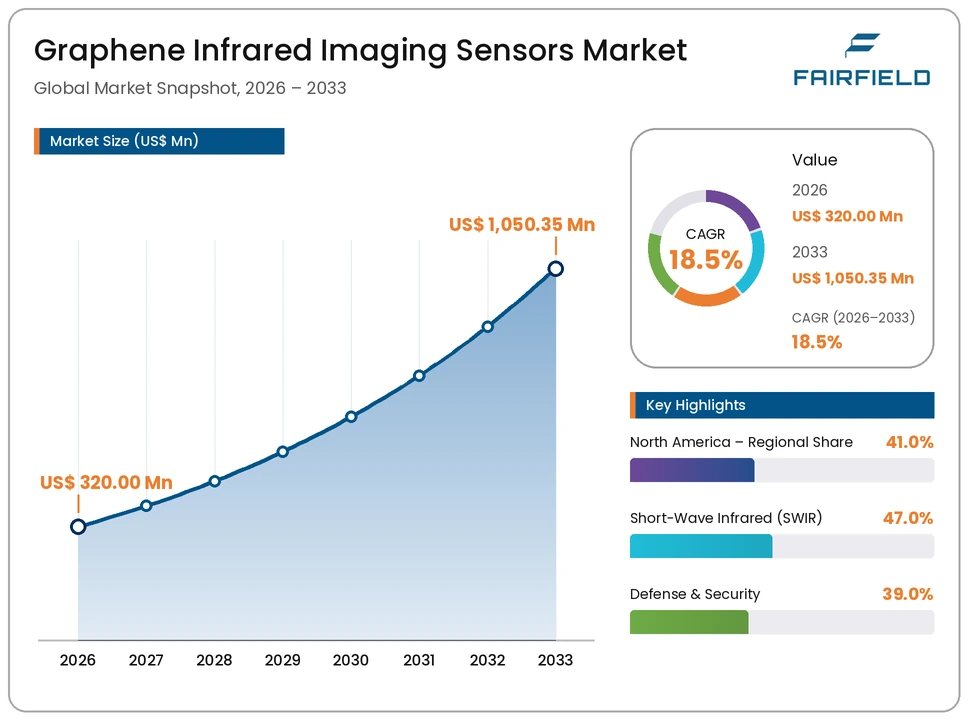
The market is valued at USD 320.00 Million in 2026, with manufacturers directing investment toward production scalability and sensor integration technology that supports broader commercial adoption beyond current defense and specialized industrial applications. By 2033, the market is forecast to reach USD 1,050.35 Million, reflecting rapid growth as the technology matures and expands into automotive and broader industrial applications.
Key Highlights
- The global graphene infrared imaging sensors market is valued at USD 320.00 Million in 2026 and is projected to reach USD 1,050.35 Million by 2033, expanding at a CAGR of 18.5% across the 2026-2033 forecast period.
- Short-Wave Infrared (SWIR) leads the wavelength segment with a 47.0% share in 2026, equivalent to USD 150.40 Million.
- Defense & Security remains the dominant application, accounting for 39.0% of global demand, or USD 124.80 Million, in 2026.
- North America commands the largest regional share at 41.0% of the global market in 2026.
- Automotive and ADAS applications are emerging as the fastest-growing application through 2033.
Market Dynamics
Key Growth Drivers
Growth in the graphene infrared imaging sensors market is driven primarily by expanding defense and security sector investment in advanced infrared imaging capability, as military and security agencies worldwide continue to prioritize enhanced surveillance and target detection technology, supporting demand for graphene sensors' potential sensitivity and response speed advantages.
A second driver is growing automotive industry interest in infrared sensing for advanced driver assistance systems, as automakers increasingly explore infrared imaging for pedestrian and obstacle detection in low-visibility conditions, creating a substantial potential application category for cost-effective graphene-based sensor technology.
Key Restraints
The technology's relative immaturity compared to established infrared detector materials creates uncertainty regarding long-term reliability and manufacturing scalability, requiring continued research and development investment before broader commercial adoption can be achieved across cost-sensitive application segments.
Additionally, competition from established infrared detector technologies with proven track records and existing manufacturing infrastructure creates an adoption barrier for graphene sensors, particularly in applications where switching costs and qualification requirements favor incumbent detector materials.
Market Opportunities
The expansion of automotive and ADAS applications presents a substantial opportunity, as the automotive industry's growing infrared sensing requirements for driver assistance and autonomous driving systems represent a large potential volume application where graphene sensors' cost advantages could prove decisive.
A second opportunity lies in continued advancement of graphene sensor manufacturing scalability and yield, addressing the production cost and consistency challenges that have historically limited broader commercial deployment. Manufacturers that successfully advance manufacturing scale stand to capture significant market share as the technology transitions from niche to mainstream applications.
Segmentation Analysis
By Wavelength
Short-Wave Infrared (SWIR) leads the wavelength segment, accounting for 47.0% of global market value in 2026, equivalent to USD 150.40 Million. Its leadership reflects SWIR's established use in current defense and industrial inspection applications where graphene sensor technology has achieved earliest commercial traction. Mid-Wave Infrared (MWIR) represents a significant, established wavelength category. Long-Wave Infrared (LWIR) represents the fastest-growing wavelength category through 2033, driven by expanding thermal imaging applications across security and industrial monitoring.
By Application
Defense & Security forms the leading application segment, representing 39.0% of global demand in 2026, or USD 124.80 Million, reflecting sustained military and security sector investment in advanced infrared imaging capability. Industrial Inspection & Monitoring represents a significant, established application area. Automotive & ADAS represents the fastest-growing application category, propelled by growing automaker interest in infrared sensing for driver assistance systems.
Regional Insights
North America
North America holds the largest regional share, at 41.0% of the global market in 2026, equivalent to USD 131.20 Million. The region's leadership reflects substantial defense sector investment and significant graphene sensor research and development activity across the United States.
Europe
Europe accounts for 29.0% of the global market in 2026, valued at USD 92.80 Million. Demand is supported by strong graphene research infrastructure and growing automotive industry interest in advanced sensing technology.
Asia Pacific
Asia Pacific represents 22.0% of the global market in 2026, or USD 70.40 Million. Growth is underpinned by expanding electronics manufacturing capacity and growing defense and automotive sector investment across China, Japan, and South Korea.
Latin America
Latin America contributes 5.0% of the global market in 2026, equivalent to USD 16.00 Million. Growth remains at an early stage, tied to limited regional advanced sensor manufacturing and research capacity.
Middle East & Africa
Middle East & Africa holds 3.0% of the global market in 2026, valued at USD 9.60 Million. Growth remains limited, tied to gradual defense sector technology adoption across the region.
Competitive Landscape
The global graphene infrared imaging sensors market is fragmented, with a mix of specialized graphene sensor developers, established infrared imaging companies exploring graphene integration, and graphene materials suppliers supporting sensor development. Competition centers on sensor sensitivity and response performance, manufacturing scalability and yield, and the ability to demonstrate reliability advantages over established infrared detector technologies. Companies are increasingly differentiating through production scale-up capability rather than competing on research-stage performance claims alone.
Key Market Players
- Emberion Oy
- Graphenea S.A.
- 2-DTech Limited
- Teledyne FLIR
- Xenics NV
- Lynred
- Raytheon Technologies Corporation
- AIXTRON SE
- First Graphene Ltd
- Applied Nanolayers B.V.
Market Segmentation
By Wavelength
- Short-Wave Infrared (SWIR)
- Mid-Wave Infrared (MWIR)
- Long-Wave Infrared (LWIR)
By Application
- Defense & Security
- Industrial Inspection & Monitoring
- Automotive & ADAS
- Others
By End User
- Government & Defense Agencies
- Commercial & Industrial Enterprises
By Geography
- North America
- Europe
- Asia Pacific
- Latin America
- Middle East & Africa
- Executive Summary
- Global Graphene Infrared Imaging Sensors Market Snapshot
- Future Projections
- Key Market Trends
- Regional Snapshot, by Value, 2026
- Analyst Recommendations
- Market Overview
- Market Definitions and Segmentations
- Market Dynamics
- Drivers
- Restraints
- Market Opportunities
- Value Chain Analysis
- COVID-19 Impact Analysis
- Porter's Five Forces Analysis
- Impact of Russia-Ukraine Conflict
- PESTLE Analysis
- Regulatory Analysis
- Price Trend Analysis
- Current Prices and Future Projections, 2025-2033
- Price Impact Factors
- Global Graphene Infrared Imaging Sensors Market Outlook, 2020 - 2033
- Global Graphene Infrared Imaging Sensors Market Outlook, by Wavelength, Value (US$ Mn), 2020-2033
- Short-Wave Infrared (SWIR)
- Mid-Wave Infrared (MWIR)
- Long-Wave Infrared (LWIR)
- Global Graphene Infrared Imaging Sensors Market Outlook, by End User, Value (US$ Mn), 2020-2033
- Government & Defense Agencies
- Commercial & Industrial Enterprises
- Global Graphene Infrared Imaging Sensors Market Outlook, by Application, Value (US$ Mn), 2020-2033
- Defense & Security
- Industrial Inspection & Monitoring
- Automotive & ADAS
- Others
- Global Graphene Infrared Imaging Sensors Market Outlook, by Region, Value (US$ Mn), 2020-2033
- North America
- Europe
- Asia Pacific
- Latin America
- Middle East & Africa
- Global Graphene Infrared Imaging Sensors Market Outlook, by Wavelength, Value (US$ Mn), 2020-2033
- North America Graphene Infrared Imaging Sensors Market Outlook, 2020 - 2033
- North America Graphene Infrared Imaging Sensors Market Outlook, by Wavelength, Value (US$ Mn), 2020-2033
- Short-Wave Infrared (SWIR)
- Mid-Wave Infrared (MWIR)
- Long-Wave Infrared (LWIR)
- North America Graphene Infrared Imaging Sensors Market Outlook, by End User, Value (US$ Mn), 2020-2033
- Government & Defense Agencies
- Commercial & Industrial Enterprises
- North America Graphene Infrared Imaging Sensors Market Outlook, by Application, Value (US$ Mn), 2020-2033
- Defense & Security
- Industrial Inspection & Monitoring
- Automotive & ADAS
- Others
- North America Graphene Infrared Imaging Sensors Market Outlook, by Country, Value (US$ Mn), 2020-2033
- U.S. Graphene Infrared Imaging Sensors Market Outlook, by Wavelength, 2020-2033
- U.S. Graphene Infrared Imaging Sensors Market Outlook, by End User, 2020-2033
- U.S. Graphene Infrared Imaging Sensors Market Outlook, by Application, 2020-2033
- Canada Graphene Infrared Imaging Sensors Market Outlook, by Wavelength, 2020-2033
- Canada Graphene Infrared Imaging Sensors Market Outlook, by End User, 2020-2033
- Canada Graphene Infrared Imaging Sensors Market Outlook, by Application, 2020-2033
- BPS Analysis/Market Attractiveness Analysis
- North America Graphene Infrared Imaging Sensors Market Outlook, by Wavelength, Value (US$ Mn), 2020-2033
- Europe Graphene Infrared Imaging Sensors Market Outlook, 2020 - 2033
- Europe Graphene Infrared Imaging Sensors Market Outlook, by Wavelength, Value (US$ Mn), 2020-2033
- Short-Wave Infrared (SWIR)
- Mid-Wave Infrared (MWIR)
- Long-Wave Infrared (LWIR)
- Europe Graphene Infrared Imaging Sensors Market Outlook, by End User, Value (US$ Mn), 2020-2033
- Government & Defense Agencies
- Commercial & Industrial Enterprises
- Europe Graphene Infrared Imaging Sensors Market Outlook, by Application, Value (US$ Mn), 2020-2033
- Defense & Security
- Industrial Inspection & Monitoring
- Automotive & ADAS
- Others
- Europe Graphene Infrared Imaging Sensors Market Outlook, by Country, Value (US$ Mn), 2020-2033
- Germany Graphene Infrared Imaging Sensors Market Outlook, by Wavelength, 2020-2033
- Germany Graphene Infrared Imaging Sensors Market Outlook, by End User, 2020-2033
- Germany Graphene Infrared Imaging Sensors Market Outlook, by Application, 2020-2033
- Italy Graphene Infrared Imaging Sensors Market Outlook, by Wavelength, 2020-2033
- Italy Graphene Infrared Imaging Sensors Market Outlook, by End User, 2020-2033
- Italy Graphene Infrared Imaging Sensors Market Outlook, by Application, 2020-2033
- France Graphene Infrared Imaging Sensors Market Outlook, by Wavelength, 2020-2033
- France Graphene Infrared Imaging Sensors Market Outlook, by End User, 2020-2033
- France Graphene Infrared Imaging Sensors Market Outlook, by Application, 2020-2033
- U.K. Graphene Infrared Imaging Sensors Market Outlook, by Wavelength, 2020-2033
- U.K. Graphene Infrared Imaging Sensors Market Outlook, by End User, 2020-2033
- U.K. Graphene Infrared Imaging Sensors Market Outlook, by Application, 2020-2033
- Spain Graphene Infrared Imaging Sensors Market Outlook, by Wavelength, 2020-2033
- Spain Graphene Infrared Imaging Sensors Market Outlook, by End User, 2020-2033
- Spain Graphene Infrared Imaging Sensors Market Outlook, by Application, 2020-2033
- Russia Graphene Infrared Imaging Sensors Market Outlook, by Wavelength, 2020-2033
- Russia Graphene Infrared Imaging Sensors Market Outlook, by End User, 2020-2033
- Russia Graphene Infrared Imaging Sensors Market Outlook, by Application, 2020-2033
- Rest of Europe Graphene Infrared Imaging Sensors Market Outlook, by Wavelength, 2020-2033
- Rest of Europe Graphene Infrared Imaging Sensors Market Outlook, by End User, 2020-2033
- Rest of Europe Graphene Infrared Imaging Sensors Market Outlook, by Application, 2020-2033
- BPS Analysis/Market Attractiveness Analysis
- Europe Graphene Infrared Imaging Sensors Market Outlook, by Wavelength, Value (US$ Mn), 2020-2033
- Asia Pacific Graphene Infrared Imaging Sensors Market Outlook, 2020 - 2033
- Asia Pacific Graphene Infrared Imaging Sensors Market Outlook, by Wavelength, Value (US$ Mn), 2020-2033
- Short-Wave Infrared (SWIR)
- Mid-Wave Infrared (MWIR)
- Long-Wave Infrared (LWIR)
- Asia Pacific Graphene Infrared Imaging Sensors Market Outlook, by End User, Value (US$ Mn), 2020-2033
- Government & Defense Agencies
- Commercial & Industrial Enterprises
- Asia Pacific Graphene Infrared Imaging Sensors Market Outlook, by Application, Value (US$ Mn), 2020-2033
- Defense & Security
- Industrial Inspection & Monitoring
- Automotive & ADAS
- Others
- Asia Pacific Graphene Infrared Imaging Sensors Market Outlook, by Country, Value (US$ Mn), 2020-2033
- China Graphene Infrared Imaging Sensors Market Outlook, by Wavelength, 2020-2033
- China Graphene Infrared Imaging Sensors Market Outlook, by End User, 2020-2033
- China Graphene Infrared Imaging Sensors Market Outlook, by Application, 2020-2033
- Japan Graphene Infrared Imaging Sensors Market Outlook, by Wavelength, 2020-2033
- Japan Graphene Infrared Imaging Sensors Market Outlook, by End User, 2020-2033
- Japan Graphene Infrared Imaging Sensors Market Outlook, by Application, 2020-2033
- South Korea Graphene Infrared Imaging Sensors Market Outlook, by Wavelength, 2020-2033
- South Korea Graphene Infrared Imaging Sensors Market Outlook, by End User, 2020-2033
- South Korea Graphene Infrared Imaging Sensors Market Outlook, by Application, 2020-2033
- India Graphene Infrared Imaging Sensors Market Outlook, by Wavelength, 2020-2033
- India Graphene Infrared Imaging Sensors Market Outlook, by End User, 2020-2033
- India Graphene Infrared Imaging Sensors Market Outlook, by Application, 2020-2033
- Southeast Asia Graphene Infrared Imaging Sensors Market Outlook, by Wavelength, 2020-2033
- Southeast Asia Graphene Infrared Imaging Sensors Market Outlook, by End User, 2020-2033
- Southeast Asia Graphene Infrared Imaging Sensors Market Outlook, by Application, 2020-2033
- Rest of SAO Graphene Infrared Imaging Sensors Market Outlook, by Wavelength, 2020-2033
- Rest of SAO Graphene Infrared Imaging Sensors Market Outlook, by End User, 2020-2033
- Rest of SAO Graphene Infrared Imaging Sensors Market Outlook, by Application, 2020-2033
- BPS Analysis/Market Attractiveness Analysis
- Asia Pacific Graphene Infrared Imaging Sensors Market Outlook, by Wavelength, Value (US$ Mn), 2020-2033
- Latin America Graphene Infrared Imaging Sensors Market Outlook, 2020 - 2033
- Latin America Graphene Infrared Imaging Sensors Market Outlook, by Wavelength, Value (US$ Mn), 2020-2033
- Short-Wave Infrared (SWIR)
- Mid-Wave Infrared (MWIR)
- Long-Wave Infrared (LWIR)
- Latin America Graphene Infrared Imaging Sensors Market Outlook, by End User, Value (US$ Mn), 2020-2033
- Government & Defense Agencies
- Commercial & Industrial Enterprises
- Latin America Graphene Infrared Imaging Sensors Market Outlook, by Application, Value (US$ Mn), 2020-2033
- Defense & Security
- Industrial Inspection & Monitoring
- Automotive & ADAS
- Others
- Latin America Graphene Infrared Imaging Sensors Market Outlook, by Country, Value (US$ Mn), 2020-2033
- Brazil Graphene Infrared Imaging Sensors Market Outlook, by Wavelength, 2020-2033
- Brazil Graphene Infrared Imaging Sensors Market Outlook, by End User, 2020-2033
- Brazil Graphene Infrared Imaging Sensors Market Outlook, by Application, 2020-2033
- Mexico Graphene Infrared Imaging Sensors Market Outlook, by Wavelength, 2020-2033
- Mexico Graphene Infrared Imaging Sensors Market Outlook, by End User, 2020-2033
- Mexico Graphene Infrared Imaging Sensors Market Outlook, by Application, 2020-2033
- Argentina Graphene Infrared Imaging Sensors Market Outlook, by Wavelength, 2020-2033
- Argentina Graphene Infrared Imaging Sensors Market Outlook, by End User, 2020-2033
- Argentina Graphene Infrared Imaging Sensors Market Outlook, by Application, 2020-2033
- Rest of LATAM Graphene Infrared Imaging Sensors Market Outlook, by Wavelength, 2020-2033
- Rest of LATAM Graphene Infrared Imaging Sensors Market Outlook, by End User, 2020-2033
- Rest of LATAM Graphene Infrared Imaging Sensors Market Outlook, by Application, 2020-2033
- BPS Analysis/Market Attractiveness Analysis
- Latin America Graphene Infrared Imaging Sensors Market Outlook, by Wavelength, Value (US$ Mn), 2020-2033
- Middle East & Africa Graphene Infrared Imaging Sensors Market Outlook, 2020 - 2033
- Middle East & Africa Graphene Infrared Imaging Sensors Market Outlook, by Wavelength, Value (US$ Mn), 2020-2033
- Short-Wave Infrared (SWIR)
- Mid-Wave Infrared (MWIR)
- Long-Wave Infrared (LWIR)
- Middle East & Africa Graphene Infrared Imaging Sensors Market Outlook, by End User, Value (US$ Mn), 2020-2033
- Government & Defense Agencies
- Commercial & Industrial Enterprises
- Middle East & Africa Graphene Infrared Imaging Sensors Market Outlook, by Application, Value (US$ Mn), 2020-2033
- Defense & Security
- Industrial Inspection & Monitoring
- Automotive & ADAS
- Others
- Middle East & Africa Graphene Infrared Imaging Sensors Market Outlook, by Country, Value (US$ Mn), 2020-2033
- GCC Graphene Infrared Imaging Sensors Market Outlook, by Wavelength, 2020-2033
- GCC Graphene Infrared Imaging Sensors Market Outlook, by End User, 2020-2033
- GCC Graphene Infrared Imaging Sensors Market Outlook, by Application, 2020-2033
- South Africa Graphene Infrared Imaging Sensors Market Outlook, by Wavelength, 2020-2033
- South Africa Graphene Infrared Imaging Sensors Market Outlook, by End User, 2020-2033
- South Africa Graphene Infrared Imaging Sensors Market Outlook, by Application, 2020-2033
- Egypt Graphene Infrared Imaging Sensors Market Outlook, by Wavelength, 2020-2033
- Egypt Graphene Infrared Imaging Sensors Market Outlook, by End User, 2020-2033
- Egypt Graphene Infrared Imaging Sensors Market Outlook, by Application, 2020-2033
- Nigeria Graphene Infrared Imaging Sensors Market Outlook, by Wavelength, 2020-2033
- Nigeria Graphene Infrared Imaging Sensors Market Outlook, by End User, 2020-2033
- Nigeria Graphene Infrared Imaging Sensors Market Outlook, by Application, 2020-2033
- Rest of Middle East Graphene Infrared Imaging Sensors Market Outlook, by Wavelength, 2020-2033
- Rest of Middle East Graphene Infrared Imaging Sensors Market Outlook, by End User, 2020-2033
- Rest of Middle East Graphene Infrared Imaging Sensors Market Outlook, by Application, 2020-2033
- BPS Analysis/Market Attractiveness Analysis
- Middle East & Africa Graphene Infrared Imaging Sensors Market Outlook, by Wavelength, Value (US$ Mn), 2020-2033
- Competitive Landscape
- Company Vs Segment Heatmap
- Company Market Share Analysis, 2025
- Competitive Dashboard
- Company Profiles
- Emberion Oy
- Company Overview
- Product Portfolio
- Financial Overview
- Business Strategies and Developments
- Graphenea S.A.
- 2-DTech Limited
- Teledyne FLIR
- Xenics NV
- Lynred
- Raytheon Technologies Corporation
- AIXTRON SE
- First Graphene Ltd
- Applied Nanolayers B.V.
- Emberion Oy
- Appendix
- Research Methodology
- Report Assumptions
- Acronyms and Abbreviations
By Wavelength
- Short-Wave Infrared (SWIR)
- Mid-Wave Infrared (MWIR)
- Long-Wave Infrared (LWIR)
By Application
- Defense & Security
- Industrial Inspection & Monitoring
- Automotive & ADAS
- Others
By End User
- Government & Defense Agencies
- Commercial & Industrial Enterprises
By Geography
- North America
- Europe
- Asia Pacific
- Latin America
- Middle East & Africa
Our Research Methodology
Considering the volatility of business today, traditional approaches to strategizing a game plan can be unfruitful if not detrimental. True ambiguity is no way to determine a forecast. A myriad of predetermined factors must be accounted for such as the degree of risk involved, the magnitude of circumstances, as well as conditions or consequences that are not known or unpredictable. To circumvent binary views that cast uncertainty, the application of market research intelligence to strategically posture, move, and enable actionable outcomes is necessary.
View Methodology
Quality Assured
Rigorous Validation Process

Confidentiality Assured
End-to-end Data Security

Custom Research Services
Tailored To Your Objectives
FAQs
The global graphene infrared imaging sensors market is valued at USD 320.00 Million in 2026, reflecting early but expanding commercial adoption of this emerging sensor technology.
The market is projected to grow at a CAGR of 18.5%, reaching USD 1,050.35 Million by 2033, driven by defense investment and expanding automotive sensing applications.
Short-Wave Infrared (SWIR) leads with a 47.0% share in 2026, reflecting its established use in current defense and industrial applications.
North America leads with a 41.0% share in 2026, supported by substantial defense sector investment and research activity.
The largest opportunity lies in automotive and ADAS applications, expanding alongside growing automaker interest in cost-effective infrared sensing.
Related Reports
2D Barcode Reader Market Size, Share, Insights, Competitive Landscape, and Forecast 2026 to 2033
The global 2D barcode reader market is valued at US$4.8 billion in 2026, reaching US$8.6 billion by 2033, growing at an 8.7% CAGR
Tunnel Construction Market Size, Share, Insights, Competitive Landscape, and Forecast 2026 to 2033
The global tunnel construction market is valued at US$29.52 billion in 2026, reaching US$47.09 billion by 2033, growing at a 6.9% CAGR
Sports Analytics Market Size, Share, Insights, Competitive Landscape, and Forecast 2026 to 2033
The global sports analytics market is valued at US$7.06 billion in 2026, reaching US$23.15 billion by 2033, growing at an 18.5% CAGR
Distributed Acoustic Sensing Market Size, Share, Insights, Competitive Landscape, and Forecast 2026 to 2033
The global distributed acoustic sensing market is valued at US$0.565 billion in 2026, reaching US$1.173 billion by 2033, growing at an 11.0% CAGR
Secure Flash Drive Market Size, Share, Insights, Competitive Landscape, and Forecast 2026 to 2033
The global secure flash drive market is valued at US$0.8 billion in 2026, reaching US$1.1 billion by 2033, growing at a 4.7% CAGR
Optical I/O for AI Chips Market Size, Share, Insights, Competitive Landscape, and Forecast 2026 to 2033
The global optical I/O for AI chips market is valued at US$1.6 billion in 2026, reaching US$14.5 billion by 2033, growing at a 37.01% CAGR