



Helium in Semiconductor Market
Helium in Semiconductor Market Size, Share, Insights, Competitive Landscape, and Forecast 2026 to 2033
Helium in Semiconductor Market Size and Trend Analysis
How is semiconductor manufacturing shaping helium demand?
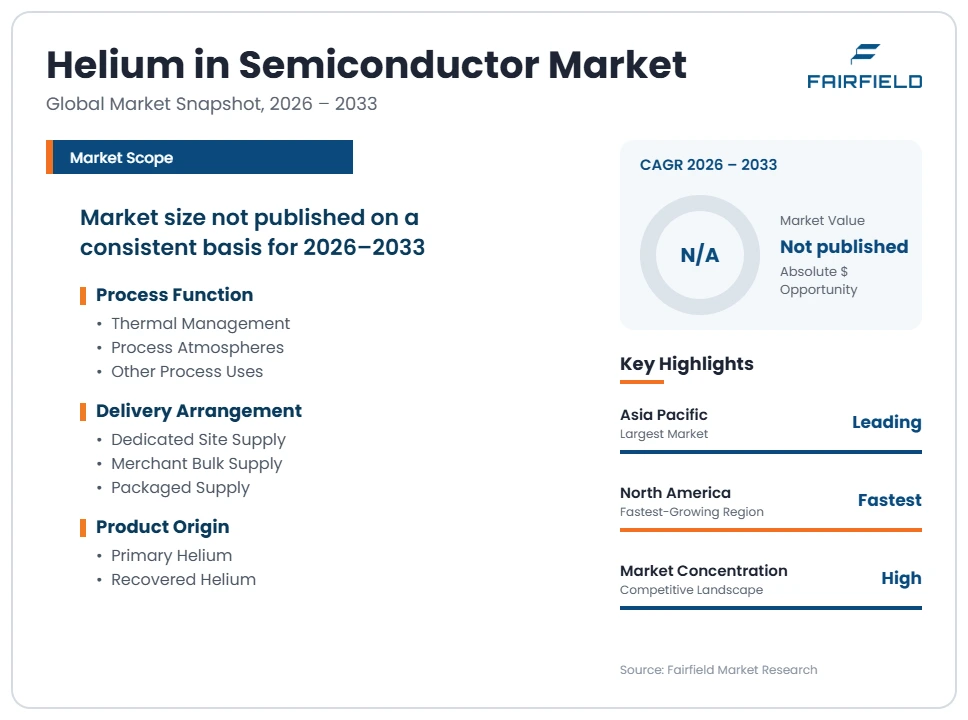
The global Helium in Semiconductor market has no sufficiently consistent public benchmark for its 2026 value, 2033 value, or 2026–2033 CAGR within the defined gas-only scope. Published estimates differ substantially in coverage and arithmetic. Combining semiconductor demand with the entire helium market would overstate the opportunity. The commercially relevant measure is qualified helium supplied to semiconductor manufacturing customers, separated from equipment, unrelated gases, and other helium applications.
During 2020–2025, semiconductor gas suppliers developed integrated supply and purity-management capabilities. A comparable historical CAGR and 2025 market value are unavailable. Fabrication investment, thermal-management requirements, and supply continuity support purchasing. Recovery and improved gas utilization can moderate purchases of fresh helium. The outlook therefore depends on operating fab capacity, process intensity, delivered prices, and reuse. New fabrication announcements indicate potential customers, but do not establish immediate consumption or a measurable market-growth rate.
Key Report Takeaways
- By Process Function: Thermal Management has directly documented semiconductor use, including cooling applications described by Air Liquide and Messer. Process Atmospheres and Other Process Uses complete the functional taxonomy. Consistent segment shares and fastest-growth rates are unavailable within the gas-only boundary.
- By Delivery Arrangement: Dedicated Site Supply supports customers requiring integrated storage and distribution. Merchant Bulk Supply and Packaged Supply serve other purchasing patterns. The appropriate choice depends on consumption, purity specifications, and backup requirements rather than a universal preference for one supply format.
- By Product Origin: Primary Helium and Recovered Helium separate externally purchased gas by origin. Internal recirculation is excluded from market revenue. Recovery creates service opportunities while potentially reducing fresh-gas purchases; its adoption should not automatically be interpreted as additional helium sales.
- By Geography: Asia Pacific is the published directional leader, while North America has the fastest-growth outlook. Neither finding supplies a verified regional percentage or comparable country ranking. Operating fabs and qualified supply relationships matter more than regional project announcements alone.
- By Procurement: Linde, Air Liquide, Air Products, Messer, and Nippon Sanso document relevant helium or semiconductor-gas capabilities. Supplier qualification, source diversity, and delivered impurity control influence contracts; total industrial-gas revenue is not an appropriate proxy for semiconductor helium share.
Global Helium in Semiconductor Market Trends and Insights
Drivers Impact Analysis
Impact ratings reflect procurement mechanisms and analyst judgement, rather than unsupported numerical additions to the forecast.
| Driver | Impact on CAGR Forecast | Geographic Relevance | Impact Timeline |
| Operating fabrication capacity and process requirements | High | Asia Pacific; North America; Europe | Medium term (2–4 years) |
| Purity and continuity requirements | High | All five standard regions | Short term (≤2 years) |
Helium in Semiconductor Demand Follows Actual Fab Operations
Operating fabrication capacity creates helium demand where production processes require its thermal or inert properties. The key purchasing trigger is a qualified production recipe and its gas consumption, rather than a headline investment commitment. Semiconductor fabs require coordinated deliveries that match tool use and schedules. Suppliers therefore need to understand customer ramp plans, process requirements, and backup arrangements before allocating capacity. This distinction matters because delayed construction, slower qualification, or lower utilization can postpone anticipated gas purchases.
Air Liquide explicitly identifies semiconductor cooling as a helium application. Messer also documents ultra-high-purity helium for electronics manufacturing, including cooling and process uses. These primary disclosures establish a concrete demand mechanism. They do not establish a fixed quantity of helium per wafer or prove that every fabrication technology uses the same amount. Suppliers can improve planning through customer-specific consumption models and realistic ramp assumptions, keeping equipment announcements separate from realized gas demand.
Helium in Semiconductor Qualification Supports Integrated Gas Contracts
Qualification requirements support demand for suppliers capable of delivering specified helium consistently at the customer connection. A nominal purity label is only part of the purchasing decision. Customers also need clarity about critical contaminants, handling procedures, sampling, and distribution integrity. The supply chain therefore extends from sourcing and purification through containers, site storage, and delivery infrastructure. A supplier able to manage these interfaces can compete on reliable process support as well as the quoted price of gas.
Air Products describes its BIP technology as controlling critical impurities for semiconductor applications. Linde documents integrated storage, purification, and distribution within its electronics offering. These capabilities explain why procurement can favor qualified service relationships over interchangeable commodity buying. Implementation still requires agreement on specifications and responsibilities. Suppliers should distinguish semiconductor-grade helium from a general industrial product and document controls, while avoiding unsupported claims that a higher nominal purity alone guarantees better manufacturing outcomes.
Restraints Impact Analysis
Supply exposure and process-specific qualification can restrict market access even when semiconductor customers have clear requirements.
| Restraint | Impact on CAGR Forecast | Geographic Relevance | Impact Timeline |
| Concentrated sourcing and specialized logistics | High | Import-dependent fabrication hubs | Short term (≤2 years) |
| Qualification and recovery economics | Medium | Established and expanding fabs | Medium term (2–4 years) |
Helium in Semiconductor Supply Requires Specialized Resilience
Concentrated sourcing and specialized transport can constrain semiconductor helium availability. A new fabrication site cannot assume that a nearby industrial-gas facility produces helium from air. Helium supply generally requires a separate resource, purification chain, and distribution plan. Interruptions can therefore travel across geographic boundaries through common sourcing and logistics dependencies. Customers need to understand backup arrangements and the availability of qualified replacement supply, while suppliers must manage working capital tied to inventories and transport equipment.
Linde commissioned a helium storage cavern in July 2025, illustrating investment in supply resilience. Air Products reported additional production, storage withdrawals, liquefaction activity, and container repositioning in April 2026. These measures demonstrate the commercial importance of supply-network management. They do not establish that every customer is protected from disruption. Specific costs include inventory financing, specialized containers, purification, handling, and alternative freight. Delivered availability therefore deserves separate consideration from upstream reserves or nominal production capacity.
Helium in Semiconductor Recovery Can Moderate Fresh-Gas Revenue
Recovery can limit fresh-helium revenue growth when customers reuse gas rather than purchase an equivalent amount of new supply. This does not remove semiconductor process demand, but changes how that demand translates into merchant sales. Customers must assess whether collection, purification, and reuse are technically compatible with the intended application. Economic comparisons should include equipment, utilities, maintenance, analytical verification, and recoverable gas volumes. Universal recovery should not be assumed.
Contamination control remains important because recovered streams can contain impurities introduced during use or collection. Suppliers of semiconductor gases already emphasize specifications and distribution integrity, supporting the need for process-specific validation. Recovery investments may create attractive equipment and service revenue while reducing the gas-only opportunity defined here. Buyers should compare the total cost of qualified delivered gas against recovery costs and losses. Suppliers can respond through balanced contracts, technical support, and transparent allocation of gas, equipment, and service charges.
Market Opportunities
Helium in Semiconductor Recovery Services Can Address Qualified Reuse
Qualified recovery creates an emerging service opportunity where customers have sufficient consumption and a technically recoverable exhaust stream. The commercial offer can include assessment, collection design, purification, analytical verification, and continuing maintenance. This opportunity differs from selling more fresh helium: successful reuse may lower the customer’s external gas requirement. Providers should therefore define the revenue pool as equipment and services adjacent to the gas market, or separately purchased recovered gas when an external transaction actually occurs.
Industrial-gas suppliers and specialist integrators can pursue fabs with suitable reuse requirements. The relevant customer is one able to document gas composition, collection conditions, and acceptable specifications for reuse. Existing expertise in high-purity gas handling provides a foundation, but does not replace customer qualification. Commercial proposals should establish realistic losses, verification responsibilities, and maintenance costs. This approach creates a measurable purchasing case without claiming a universal recovery rate or an unverified financial payback.
Helium in Semiconductor Backup Management Creates Specialized Contracts
Backup management creates an opportunity for suppliers offering qualified inventory and delivery planning around specific fabrication sites. Customers may need alternative sourcing, container availability, consumption monitoring, or clearer contingency procedures. These services can support contract value beyond unit-price comparison, especially where continuity matters. The opportunity concerns a defined service commitment with measurable responsibilities. It should not be presented as an assurance that any possible supply interruption can be eliminated through storage.
Linde’s storage investment and Air Products’ documented supply-chain actions provide evidence that resilience requires active infrastructure and logistics management. Suppliers with sourcing access, technical staff, and distribution capabilities can offer tailored arrangements to semiconductor customers. Regional distributors may participate through local handling and support subject to qualification. Contracts should distinguish the gas purchase from reservation fees, equipment, and logistics services. Clear allocation helps customers assess total cost and prevents all resilience-related revenue from being reported as additional consumption.
Segment Analysis
- By Process Function: Helium in Semiconductor Cooling Has Direct Supplier Evidence
Thermal Management includes helium purchased for cooling and heat-transfer tasks in semiconductor production. Air Liquide explicitly documents cooling use, while Messer describes helium applications in electronics manufacturing. These disclosures support the segment’s commercial relevance, but not a measured share or a universal consumption intensity. Customers should identify the tool and process requirements behind each specification instead of treating helium demand as proportional to total semiconductor revenue.
Process Atmospheres covers helium used primarily for a controlled process environment or carrier function. Other Process Uses includes remaining qualifying semiconductor uses, such as relevant testing or supporting process tasks. Each purchase is assigned to its principal documented function, avoiding overlap between a cooling role and an atmosphere role. Comparable leadership and fastest-growth rates are unavailable. The strategic implication is to build demand estimates from validated customer applications, production activity, and gas intensity, with explicit treatment of recovery and process changes.
- By Delivery Arrangement: Helium in Semiconductor Supply Matches Site Requirements
Dedicated Site Supply covers helium delivered through an integrated, customer-specific supply arrangement with associated storage and distribution. Linde describes such infrastructure within its semiconductor-gas offering. Merchant Bulk Supply covers other bulk deliveries without assigning the transaction to a dedicated integrated site contract. Packaged Supply includes cylinder-based purchases outside those arrangements. Assignment follows the contracted supply relationship, preventing the same helium from being counted in several delivery categories.
Consumption, delivery frequency, site layout, and qualification needs determine suitability. A large customer may value continuity and integrated management, while smaller or specialist uses may favor packaged delivery. Public evidence does not establish comparable segment shares or the fastest-growth delivery format. Suppliers should evaluate container availability, turnaround, and local service costs alongside gas margins. Buyers should compare complete delivered cost and documented responsibilities, because the cheapest quoted gas price may exclude infrastructure, analysis, or contingency services required at the fabrication site.
- By Product Origin: Helium in Semiconductor Reuse Changes the Revenue Boundary
Primary Helium includes externally purchased gas derived from original resource production and subsequent purification. Recovered Helium includes externally purchased gas recovered from prior use and qualified for the intended semiconductor application. Internal recirculation is excluded because it creates no separate gas sale. This distinction makes the taxonomy commercially measurable and prevents counting the same gas again each time it moves through a customer’s own recovery loop.
Source origin does not independently establish semiconductor suitability. Specifications, handling, and qualification remain necessary regardless of whether gas is primary or recovered. Comparable origin shares and fastest-growth rates are unavailable. Recovery may reduce dependence on fresh purchases, but creates costs for collection, purification, analysis, and maintenance. Suppliers can combine gas contracts with recovery services while reporting their revenues separately. Buyers should assess the actual recoverable stream and intended reuse application instead of assuming that all helium leaving a process can return without additional treatment or losses.
Geography Analysis
- Which Region Is Growing Fastest in the Helium in Semiconductor Market?
North America has the fastest-growth direction in the selected published industry outlook, without a verified comparable regional CAGR. The United States combines fabrication investment with domestic helium sourcing and supplier infrastructure. Canada contributes an additional sourcing context, although resource development alone does not establish semiconductor-grade supply or local fabrication demand. Qualification and distribution remain essential links between an upstream project and a fab customer.
The region offers opportunities for integrated contracts, backup planning, and recovery assessment. Suppliers should align commitments with operating production schedules and realistic customer qualification timelines. Linde’s storage investment and Air Products’ supply-chain disclosures illustrate relevant capabilities. Project delays, capital intensity, and logistics costs remain constraints, making actual delivered availability more useful than nominal regional resource abundance.
- Helium in Semiconductor European Demand Favors Integrated Supply
Europe has a documented semiconductor-gas investment context in Germany, alongside other fabrication locations. Air Liquide announced a Dresden supply project in July 2025 that explicitly includes helium among several gases. The project demonstrates a qualified commercial route, but its total investment cannot be allocated entirely to helium. Nor should helium be described as an air-separation product simply because the same project includes air-separation units.
Germany, France, and other semiconductor locations require customer-specific sourcing and distribution arrangements. Opportunities include supply integration, backup management, and suitable recovery services. Import dependence, qualification work, and infrastructure costs can limit expansion. Suppliers should distinguish planned facilities from operating capacity and separate the helium component from broader gas contracts when assessing addressable revenue and competitive participation.
- Which Region Is Leading the Helium in Semiconductor Market?
Asia Pacific is the directional leader in the selected published assessment, although a consistent current percentage is unavailable. Taiwan, South Korea, China, and Japan provide important semiconductor customer settings. Linde, Air Liquide, and Nippon Sanso document relevant electronics-gas capabilities. The region’s purchasing case depends on operating fabrication requirements and qualified distribution, rather than a single uniform regional gas specification.
Suppliers can pursue local support, diversified sourcing, and customer-specific purity management. Imported helium requires coordinated handling and timely deliveries, while recovery may help selected customers reduce external purchases. Country rankings and fastest national growth are not established here. The commercial priority is to connect verified production processes with deliverable supply, making customer qualification and contract execution central to regional strategy.
- Helium in Semiconductor Latin America Requires Selective Customer Validation
Latin America should be approached as a selective customer-development opportunity rather than assigned an unsupported regional market share. Brazil and Mexico provide potential electronics-related customer settings, but electronics assembly is not equivalent to semiconductor wafer fabrication. Suppliers must establish whether a specific site performs a helium-consuming process before treating it as addressable demand. Broader industrial-gas sales cannot resolve that distinction.
Barriers include limited comparable demand data, imported supply costs, and the scale needed to support specialized service. Opportunities may arise around documented manufacturing projects, research-linked production, or qualified packaged-gas applications. Local distributors can help with delivery and customer support. A commercially credible entry strategy starts with identifiable consumption and specifications, then evaluates the infrastructure and economics required to serve that demand reliably.
- Helium in Semiconductor Middle East & Africa Separates Resources From Demand
Middle East & Africa includes helium resource and processing locations, but upstream production does not establish leadership in semiconductor consumption. Qatar and Algeria are relevant to sourcing discussions, while customer-development opportunities require separate evidence of fabrication activity. South Africa and prospective regional projects should be evaluated individually. Resource availability, industrial strategy, and semiconductor-grade delivered demand are different commercial measures.
Suppliers face qualification, transport, infrastructure, and customer-scale constraints. An opportunity exists to connect qualified sourcing with international fabrication customers, while any local demand case should be tied to an actual operating process. Companies should avoid presenting all regional helium exports as semiconductor revenue. Clear destination, grade, and end-use allocation are necessary to understand participation and prevent double counting between production, distribution, and final customer purchases.
Competitive Landscape
Competition centers on qualified supply, technical specifications, and delivery continuity. High concentration is an analyst judgement about the limited number of globally integrated suppliers with documented helium and electronics capabilities. It is not a measured company-share calculation. Linde, Air Liquide, Air Products, Messer, and Nippon Sanso have relevant verified offerings. Their total industrial-gas revenues cannot establish semiconductor helium rankings because those revenues include many other products, services, and applications.
The basis of competition extends beyond resource access. Suppliers need purification and analytical expertise, suitable containers, local delivery, and customer qualification. New producers can expand upstream availability, but still require commercial partners or their own capabilities to reach fabrication customers. Specialist distributors may compete in local service and packaged supply. A claimed helium resource or an initial production announcement therefore does not establish readiness to supply every semiconductor application.
Documented moves show investment in both integrated customer relationships and resilience. Air Liquide’s Dresden project includes helium within a broader semiconductor-gas commitment. Linde’s storage cavern strengthens its helium network. Air Products has described production and logistics actions supporting global customer supply. These developments are relevant to competition, although neither total project investment nor general helium inventories can be allocated entirely to semiconductor demand.
Strategic direction should connect customer-specific consumption with a credible delivered supply plan. Suppliers can differentiate through transparent specifications, realistic contingency arrangements, and appropriate recovery support. Buyers should examine which entity owns each responsibility from sourcing to the customer connection. Contracts should distinguish gas, infrastructure, reservation, and service charges. This approach supports meaningful comparison without predicting winners or treating a broad supplier’s scale as proof of leadership in this narrowly defined end-use market.
Recent Industry Developments
- July 2025: Air Liquide announced its Dresden semiconductor-gas investment, including helium supply within a broader integrated contract rather than a helium-only project.
- July 2025: Linde commissioned a large helium storage cavern, strengthening network resilience relevant to multiple customer industries.
- April 2026: Air Products reported helium production, liquefaction, storage, and container-management actions supporting supply continuity across its customer base.
Companies Covered in the Report
Linde; Air Liquide; Air Products; Messer; Nippon Sanso. Coverage reflects verified participation, with no company-share estimates.
Helium in Semiconductor Market Report Scope
| Metric | Value |
| Study Period | 2020–2033 |
| Market Size 2026 | Not available on a sufficiently consistent basis |
| Market Size 2033 | Not available on a sufficiently consistent basis |
| CAGR 2026–2033 | Not available |
| Absolute Dollar Opportunity | Not available |
| Largest Market | Asia Pacific, published directional assessment |
| Fastest-Growing Market | North America, published directional assessment |
| Market Concentration | High, analyst judgement for qualified global supply |
| Major Players | Linde, Air Liquide, Air Products, Messer, Nippon Sanso |
Helium in Semiconductor Market Segmentation
Process Function
- Thermal Management
- Process Atmospheres
- Other Process Uses
Delivery Arrangement
- Dedicated Site Supply
- Merchant Bulk Supply
- Packaged Supply
Product Origin
- Primary Helium
- Recovered Helium
Regions
- North America
- Europe
- Asia Pacific
- Latin America
- Middle East & Africa
- Executive Summary
- Global Helium in Semiconductor Market Snapshot
- Future Projections
- Key Report Takeaways
- Regional Snapshot
- Market Overview
- Market Definition and Report Scope
- Historical Trends 2020–2025
- Market Dynamics
- Drivers
- Helium in Semiconductor Demand Follows Actual Fab Operations
- Helium in Semiconductor Qualification Supports Integrated Gas Contracts
- Restraints
- Helium in Semiconductor Supply Requires Specialized Resilience
- Helium in Semiconductor Recovery Can Moderate Fresh-Gas Revenue
- Market Opportunities
- Helium in Semiconductor Recovery Services Can Address Qualified Reuse
- Helium in Semiconductor Backup Management Creates Specialized Contracts
- Drivers
- Global Helium in Semiconductor Market Outlook, 2020–2033
- Global Helium in Semiconductor Market Outlook, by Process Function, Value (US$ Million), 2020–2033
- Thermal Management
- Process Atmospheres
- Other Process Uses
- Global Helium in Semiconductor Market Outlook, by Delivery Arrangement, Value (US$ Million), 2020–2033
- Dedicated Site Supply
- Merchant Bulk Supply
- Packaged Supply
- Global Helium in Semiconductor Market Outlook, by Product Origin, Value (US$ Million), 2020–2033
- Primary Helium
- Recovered Helium
- Global Helium in Semiconductor Market Outlook, by Region, Value (US$ Million), 2020–2033
- North America
- Europe
- Asia Pacific
- Latin America
- Middle East & Africa
- Global Helium in Semiconductor Market Outlook, by Process Function, Value (US$ Million), 2020–2033
- North America Helium in Semiconductor Market Outlook, 2020–2033
- North America Helium in Semiconductor Market Outlook, by Process Function, Value (US$ Million), 2020–2033
- Thermal Management
- Process Atmospheres
- Other Process Uses
- North America Helium in Semiconductor Market Outlook, by Delivery Arrangement, Value (US$ Million), 2020–2033
- Dedicated Site Supply
- Merchant Bulk Supply
- Packaged Supply
- North America Helium in Semiconductor Market Outlook, by Product Origin, Value (US$ Million), 2020–2033
- Primary Helium
- Recovered Helium
- North America Helium in Semiconductor Market Outlook, by Country, Value (US$ Million), 2020–2033
- United States Helium in Semiconductor Market Outlook, by Process Function, 2020–2033
- United States Helium in Semiconductor Market Outlook, by Delivery Arrangement, 2020–2033
- United States Helium in Semiconductor Market Outlook, by Product Origin, 2020–2033
- Canada Helium in Semiconductor Market Outlook, by Process Function, 2020–2033
- Canada Helium in Semiconductor Market Outlook, by Delivery Arrangement, 2020–2033
- Canada Helium in Semiconductor Market Outlook, by Product Origin, 2020–2033
- North America Helium in Semiconductor Market Outlook, by Process Function, Value (US$ Million), 2020–2033
- Europe Helium in Semiconductor Market Outlook, 2020–2033
- Europe Helium in Semiconductor Market Outlook, by Process Function, Value (US$ Million), 2020–2033
- Thermal Management
- Process Atmospheres
- Other Process Uses
- Europe Helium in Semiconductor Market Outlook, by Delivery Arrangement, Value (US$ Million), 2020–2033
- Dedicated Site Supply
- Merchant Bulk Supply
- Packaged Supply
- Europe Helium in Semiconductor Market Outlook, by Product Origin, Value (US$ Million), 2020–2033
- Primary Helium
- Recovered Helium
- Europe Helium in Semiconductor Market Outlook, by Country, Value (US$ Million), 2020–2033
- Germany Helium in Semiconductor Market Outlook, by Process Function, 2020–2033
- Germany Helium in Semiconductor Market Outlook, by Delivery Arrangement, 2020–2033
- Germany Helium in Semiconductor Market Outlook, by Product Origin, 2020–2033
- France Helium in Semiconductor Market Outlook, by Process Function, 2020–2033
- France Helium in Semiconductor Market Outlook, by Delivery Arrangement, 2020–2033
- France Helium in Semiconductor Market Outlook, by Product Origin, 2020–2033
- Europe Helium in Semiconductor Market Outlook, by Process Function, Value (US$ Million), 2020–2033
- Asia Pacific Helium in Semiconductor Market Outlook, 2020–2033
- Asia Pacific Helium in Semiconductor Market Outlook, by Process Function, Value (US$ Million), 2020–2033
- Thermal Management
- Process Atmospheres
- Other Process Uses
- Asia Pacific Helium in Semiconductor Market Outlook, by Delivery Arrangement, Value (US$ Million), 2020–2033
- Dedicated Site Supply
- Merchant Bulk Supply
- Packaged Supply
- Asia Pacific Helium in Semiconductor Market Outlook, by Product Origin, Value (US$ Million), 2020–2033
- Primary Helium
- Recovered Helium
- Asia Pacific Helium in Semiconductor Market Outlook, by Country, Value (US$ Million), 2020–2033
- Taiwan Helium in Semiconductor Market Outlook, by Process Function, 2020–2033
- Taiwan Helium in Semiconductor Market Outlook, by Delivery Arrangement, 2020–2033
- Taiwan Helium in Semiconductor Market Outlook, by Product Origin, 2020–2033
- South Korea Helium in Semiconductor Market Outlook, by Process Function, 2020–2033
- South Korea Helium in Semiconductor Market Outlook, by Delivery Arrangement, 2020–2033
- South Korea Helium in Semiconductor Market Outlook, by Product Origin, 2020–2033
- China Helium in Semiconductor Market Outlook, by Process Function, 2020–2033
- China Helium in Semiconductor Market Outlook, by Delivery Arrangement, 2020–2033
- China Helium in Semiconductor Market Outlook, by Product Origin, 2020–2033
- Japan Helium in Semiconductor Market Outlook, by Process Function, 2020–2033
- Japan Helium in Semiconductor Market Outlook, by Delivery Arrangement, 2020–2033
- Japan Helium in Semiconductor Market Outlook, by Product Origin, 2020–2033
- Asia Pacific Helium in Semiconductor Market Outlook, by Process Function, Value (US$ Million), 2020–2033
- Latin America Helium in Semiconductor Market Outlook, 2020–2033
- Latin America Helium in Semiconductor Market Outlook, by Process Function, Value (US$ Million), 2020–2033
- Thermal Management
- Process Atmospheres
- Other Process Uses
- Latin America Helium in Semiconductor Market Outlook, by Delivery Arrangement, Value (US$ Million), 2020–2033
- Dedicated Site Supply
- Merchant Bulk Supply
- Packaged Supply
- Latin America Helium in Semiconductor Market Outlook, by Product Origin, Value (US$ Million), 2020–2033
- Primary Helium
- Recovered Helium
- Latin America Helium in Semiconductor Market Outlook, by Country, Value (US$ Million), 2020–2033
- Brazil Helium in Semiconductor Market Outlook, by Process Function, 2020–2033
- Brazil Helium in Semiconductor Market Outlook, by Delivery Arrangement, 2020–2033
- Brazil Helium in Semiconductor Market Outlook, by Product Origin, 2020–2033
- Mexico Helium in Semiconductor Market Outlook, by Process Function, 2020–2033
- Mexico Helium in Semiconductor Market Outlook, by Delivery Arrangement, 2020–2033
- Mexico Helium in Semiconductor Market Outlook, by Product Origin, 2020–2033
- Latin America Helium in Semiconductor Market Outlook, by Process Function, Value (US$ Million), 2020–2033
- Middle East & Africa Helium in Semiconductor Market Outlook, 2020–2033
- Middle East & Africa Helium in Semiconductor Market Outlook, by Process Function, Value (US$ Million), 2020–2033
- Thermal Management
- Process Atmospheres
- Other Process Uses
- Middle East & Africa Helium in Semiconductor Market Outlook, by Delivery Arrangement, Value (US$ Million), 2020–2033
- Dedicated Site Supply
- Merchant Bulk Supply
- Packaged Supply
- Middle East & Africa Helium in Semiconductor Market Outlook, by Product Origin, Value (US$ Million), 2020–2033
- Primary Helium
- Recovered Helium
- Middle East & Africa Helium in Semiconductor Market Outlook, by Country, Value (US$ Million), 2020–2033
- Qatar Helium in Semiconductor Market Outlook, by Process Function, 2020–2033
- Qatar Helium in Semiconductor Market Outlook, by Delivery Arrangement, 2020–2033
- Qatar Helium in Semiconductor Market Outlook, by Product Origin, 2020–2033
- Algeria Helium in Semiconductor Market Outlook, by Process Function, 2020–2033
- Algeria Helium in Semiconductor Market Outlook, by Delivery Arrangement, 2020–2033
- Algeria Helium in Semiconductor Market Outlook, by Product Origin, 2020–2033
- South Africa Helium in Semiconductor Market Outlook, by Process Function, 2020–2033
- South Africa Helium in Semiconductor Market Outlook, by Delivery Arrangement, 2020–2033
- South Africa Helium in Semiconductor Market Outlook, by Product Origin, 2020–2033
- Middle East & Africa Helium in Semiconductor Market Outlook, by Process Function, Value (US$ Million), 2020–2033
- Competitive Landscape
- Market Concentration and Industry Leaders
- Competitive Differentiation
- Strategic Moves and Market Direction
- Recent Industry Developments
- Company Profiles
- Linde
- Air Liquide
- Air Products
- Messer
- Nippon Sanso
- Appendix
- Research Methodology
- Report Assumptions
- Acronyms and Abbreviations
Process Function
- Thermal Management
- Process Atmospheres
- Other Process Uses
Delivery Arrangement
- Dedicated Site Supply
- Merchant Bulk Supply
- Packaged Supply
Product Origin
- Primary Helium
- Recovered Helium
Regions
- North America
- Europe
- Asia Pacific
- Latin America
- Middle East & Africa
Our Research Methodology
Considering the volatility of business today, traditional approaches to strategizing a game plan can be unfruitful if not detrimental. True ambiguity is no way to determine a forecast. A myriad of predetermined factors must be accounted for such as the degree of risk involved, the magnitude of circumstances, as well as conditions or consequences that are not known or unpredictable. To circumvent binary views that cast uncertainty, the application of market research intelligence to strategically posture, move, and enable actionable outcomes is necessary.
View Methodology
Quality Assured
Rigorous Validation Process

Confidentiality Assured
End-to-end Data Security

Custom Research Services
Tailored To Your Objectives
FAQs
A sufficiently consistent 2026 market value is unavailable for the defined gas-only scope; conflicting public estimates are not combined into a synthetic total.
A reliable 2033 value and 2026–2033 CAGR are unavailable; the outlook depends on operating capacity, process intensity, recovery, delivered prices, and qualified supply.
A comparable process-segment leader is not established; Thermal Management has direct supplier evidence, while consistent shares and fastest-growth rates remain publicly unavailable.
North America has the fastest-growth direction in the selected published assessment, without a verified regional CAGR or consistently comparable country-specific growth ranking.
Asia Pacific leads the selected directional assessment, supported by semiconductor manufacturing activity and documented gas-supply capabilities, although a consistent current share remains unavailable.
Related Reports
Non-Woven Abrasives Market Size, Share, Insights, Competitive Landscape, and Forecast 2026 to 2033
Non-Woven Abrasives Market is projected to grow from US$ 2.89 billion in 2026 to US$ 4.03 billion by 2033 at a 4.9% CAGR. See key products and trends.
Agricultural Lubricant Market Size, Share, Insights, Competitive Landscape, and Forecast 2026 to 2033
The agricultural lubricant market is valued at US$ 6.58 billion in 2026 and projected to reach US$ 8.71 billion by 2033 at a CAGR of 4.1%.
Acaricides Market Size, Share, Insights, Competitive Landscape, and Forecast 2026 to 2033
Explore the acaricides market, valued at US$ 393.98 million in 2026 and projected to reach US$ 521.95 million by 2033 at a CAGR of 4.1%.
Rigid Bulk Packaging Market Size, Share, Insights, Competitive Landscape, and Forecast 2026 to 2033
The global rigid bulk packaging market is valued at US$68.5 billion in 2026, reaching US$96.4 billion by 2033, growing at a 5.0% CAGR
Probiotics Packaging Market Size, Share, Insights, Competitive Landscape, and Forecast 2026 to 2033
Explore the probiotics packaging market, valued at US$ 1.4 billion in 2026 and projected to reach US$ 2.4 billion by 2033, growing at an 8.0% CAGR.
Epoxy Composites Market Size, Share, Insights, Competitive Landscape, and Forecast 2026 to 2033
Explore the epoxy composites market, projected to reach US$ 22.3 billion by 2033 at a 6.7% CAGR, with resin, reinforcement and regional insights.