



HER2-Targeted Therapy Market
HER2-Targeted Therapy Market Size, Share, Insights, Competitive Landscape, and Forecast 2026 to 2033
HER2-Targeted Therapy Market Analysis, 2026–2033
HER2-Targeted Therapy Market
HER2-Targeted Therapy Market Size, Share, Insights, Competitive Landscape, and Forecast 2026 to 2033
HER2-Targeted Therapy Market Size and Trend Analysis
How Fast Is the HER2-Targeted Therapy Market Growing?
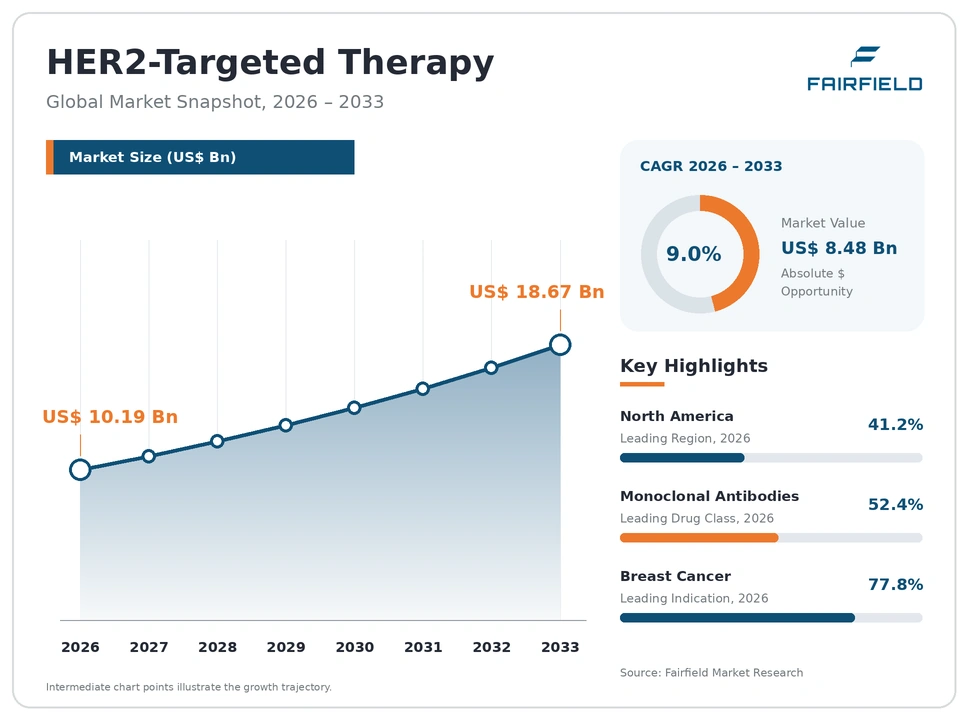
The global HER2-targeted therapy market size is expected to be valued at US$ 10.19 billion in 2026 and projected to reach US$ 18.67 billion by 2033, growing at a CAGR of 9.0% between 2026 and 2033.
Between 2020 and 2025, the market grew at a CAGR of about 6.4%, as trastuzumab biosimilars lowered prices for older antibodies while new antibody-drug conjugates expanded treatment into later lines and HER2-low breast cancer. Three factors now drive growth: rapid uptake of antibody-drug conjugates in earlier lines of therapy, new approvals in lung, gastric, and biliary tract cancers, and wider HER2 testing that identifies more eligible patients. The market is shifting from traditional antibodies toward antibody-drug conjugates, bispecific antibodies, and oral tyrosine kinase inhibitors for HER2-mutant tumors.
Key Report Takeaways
- By Drug Class: Monoclonal Antibodies held 52.4% share in 2026, while Antibody-Drug Conjugates are projected to expand at a 15.6% CAGR through 2033, driven by first-line approvals and use in HER2-low and HER2-ultralow disease.
- By Indication: Breast Cancer held 77.8% share in 2026, while Lung Cancer is projected to expand at a 19.2% CAGR through 2033, driven by new targeted drugs for HER2-mutant non-small cell lung cancer.
- By Route of Administration: Intravenous held 72.6% share in 2026, while Oral is projected to expand at a 13.4% CAGR through 2033, driven by new tyrosine kinase inhibitors for lung and breast cancer.
- By Region: North America held 41.2% share in 2026, while China is projected to expand at a 12.6% CAGR through 2033, driven by local antibody-drug conjugates, biosimilars, and expanded reimbursement.
Global HER2-Targeted Therapy Market Trends and Insights
Drivers Impact Analysis
Two drivers carry the strongest influence on HER2-targeted therapy demand during the forecast period.
| Driver | Impact on CAGR Forecast | Geographic Relevance | Impact Timeline |
| Antibody-drug conjugate adoption in earlier lines | High | North America, Europe, Asia Pacific | Medium term (2-4 years) |
| Expansion into new tumor types and HER2-low disease | High | Global | Long term (≥4 years) |
Antibody-Drug Conjugates Are Driving the HER2-Targeted Therapy Market
The adoption of antibody-drug conjugates in earlier lines of treatment is the strongest driver of the HER2-targeted therapy market. These drugs combine a HER2 antibody with a potent chemotherapy payload, delivering the drug directly to cancer cells.
The mechanism is strong clinical results and label expansions. Enhertu, developed by Daiichi Sankyo and AstraZeneca, has shown better outcomes than older treatments in several trials. In the DESTINY-Breast09 trial, Enhertu plus pertuzumab cut the risk of progression or death by 44% compared with standard therapy in first-line HER2-positive breast cancer, with median progression-free survival of 40.7 months. The U.S. Food and Drug Administration approved this combination in December 2025. Kadcyla from Roche remains standard after surgery for some patients. Earlier-line use means longer treatment duration and higher revenue per patient.
New Tumor Types and HER2-low Disease Are Expanding the HER2-Targeted Therapy Market
Expansion into new tumor types and HER2-low breast cancer is expanding the HER2-targeted therapy market. HER2 is found in many cancers beyond breast cancer, and lower levels of HER2 can now be targeted.
The cause is better drugs and broader testing. Antibody-drug conjugates work in tumors with low HER2 levels, which make up a large share of breast cancers that were once considered HER2-negative. HER2 mutations occur in a small share of non-small cell lung cancers, and Boehringer Ingelheim’s zongertinib and Bayer’s sevabertinib received accelerated approvals for these patients in 2025. Jazz Pharmaceuticals’ Ziihera was approved for HER2-positive biliary tract cancer in 2024. HER2-positive gastric, colorectal, bladder, and endometrial cancers are also targets. Companion diagnostics and next-generation sequencing identify more eligible patients. These trends enlarge the treated population.
Restraints Impact Analysis
Two restraints limit how quickly the HER2-targeted therapy market grows.
| Restraint | Impact on CAGR Forecast | Geographic Relevance | Impact Timeline |
| Biosimilar competition and price erosion | High | Europe, North America, Asia Pacific | Short term (≤2 years) |
| Toxicity concerns and high treatment costs | Medium | Global | Medium term (2-4 years) |
Biosimilar Competition Slows the HER2-Targeted Therapy Market
Biosimilar competition and price erosion slow the HER2-targeted therapy market. Older HER2 antibodies have lost patent protection, and cheaper copies have entered many markets.
The specific causes are patent expiries and payer pressure. Trastuzumab biosimilars from Celltrion, Samsung Bioepis, Amgen, Biocon Biologics, and Pfizer have taken a large share of trastuzumab sales in Europe, the United States, and India, cutting prices sharply. Pertuzumab biosimilars are expected to follow as patents expire. Governments and insurers in Europe and China push for lower drug prices through tenders and price negotiations. Roche has seen declining revenue from Herceptin. Biosimilar uptake shifts value from brand leaders to lower-cost suppliers. These factors offset part of the growth from new drugs and push brand owners to focus on newer, patent-protected products.
Toxicity and High Costs Restrict the HER2-Targeted Therapy Market
Toxicity concerns and high treatment costs restrict the HER2-targeted therapy market. Newer HER2 drugs are powerful but can cause serious side effects and are expensive.
The underlying causes are drug mechanisms and pricing. Trastuzumab-based drugs can affect heart function, so patients need regular cardiac monitoring. Enhertu carries a risk of interstitial lung disease, which can be fatal and requires careful monitoring and early treatment. Tyrosine kinase inhibitors can cause diarrhea and liver problems that lead to dose reductions. Antibody-drug conjugates and new targeted drugs cost tens of thousands of dollars per course, limiting access in low- and middle-income countries. Health technology assessment bodies, such as NICE in the United Kingdom, sometimes restrict use due to cost. These factors limit uptake in some patients and markets.
Market Opportunities
HER2-low and Non-breast Cancers Open a New Patient Revenue Pool
HER2-low and non-breast cancers open a new patient revenue pool in the HER2-targeted therapy market. Many patients who were previously ineligible can now benefit from HER2-directed drugs.
Drug developers with antibody-drug conjugates and targeted drugs can capture this opportunity. HER2-low and HER2-ultralow breast cancers represent a large share of breast cancer cases, and Enhertu is approved for these patients after earlier treatments. Lung, gastric, biliary tract, colorectal, and bladder cancers with HER2 changes offer further expansion. Tumor-agnostic approvals for HER2-positive solid tumors widen use. Companion diagnostic makers such as Roche Diagnostics and Thermo Fisher Scientific benefit from new testing needs. Combination trials with immunotherapy and hormone therapy may expand use further. Developers that run trials across tumor types can capture large new markets.
Bispecifics, Next-generation ADCs, and Subcutaneous Forms Create an Innovation Revenue Pool
Bispecific antibodies, next-generation antibody-drug conjugates, and subcutaneous forms create an innovation revenue pool in the HER2-targeted therapy market. New formats aim to improve efficacy, safety, and convenience.
Biotech and pharmaceutical companies can capture this opportunity. Bispecific antibodies such as Ziihera (zanidatamab) bind two parts of HER2 for stronger action. Chinese developers, including RemeGen with disitamab vedotin and Kelun-Biotech, are developing new antibody-drug conjugates and licensing them globally. Subcutaneous Phesgo, which combines pertuzumab and trastuzumab, cuts treatment time from hours to minutes and protects Roche from biosimilars. Oral tyrosine kinase inhibitors offer at-home treatment. Licensing deals and acquisitions let large companies access innovation. Successful new drugs can command premium prices and long patent protection, and partnerships with large companies help smaller developers reach global markets.
Segment Analysis
By Drug Class: Monoclonal Antibodies Lead While Antibody-Drug Conjugates Gain Momentum
Monoclonal Antibodies held 52.4% share in 2026. Trastuzumab, pertuzumab, and their biosimilars and combinations remain standard treatment for HER2-positive breast cancer and gastric cancer before and after surgery and in advanced disease. Roche leads with Herceptin, Perjeta, and Phesgo, while many biosimilar makers supply trastuzumab at lower prices. Bispecific antibodies are a small but growing part.
Antibody-Drug Conjugates are the fastest-growing drug class, expanding at a 15.6% CAGR through 2033. Enhertu has gained approvals in first-line metastatic breast cancer, HER2-low and HER2-ultralow disease, lung cancer, and gastric cancer, while Kadcyla is used after surgery. New conjugates from Chinese developers are entering global trials. Tyrosine kinase inhibitors such as tucatinib and neratinib form another class. For the market, conjugate growth raises value per patient.
By Indication: Breast Cancer Leads While Lung Cancer Grows Fastest
Breast Cancer held 77.8% share in 2026. About 15% to 20% of breast cancers are HER2-positive, and many more are HER2-low, making breast cancer the largest use for HER2-targeted drugs. Treatment spans early-stage disease before and after surgery, and advanced disease. Gastric and gastroesophageal cancers form the second-largest indication, with treatment growing in Japan, South Korea, and China.
Lung Cancer is the fastest-growing indication, expanding at a 19.2% CAGR through 2033. HER2 mutations occur in about 2% to 4% of non-small cell lung cancers, and Enhertu, zongertinib, and sevabertinib are now approved for these patients. Broader genetic testing of lung tumors identifies more eligible patients, and first-line trials could expand use. Biliary tract, colorectal, bladder, and endometrial cancers form other indications. For the market, lung cancer growth adds new patient groups.
By Route of Administration: Intravenous Leads While Oral Grows Fastest
Intravenous held 72.6% share in 2026. Most HER2 antibodies and all approved antibody-drug conjugates are given by infusion in hospitals and cancer centers. Infusions require clinic visits, nursing time, and monitoring. Subcutaneous forms such as Phesgo and subcutaneous Herceptin form a growing alternative that shortens treatment time.
Oral is the fastest-growing route, expanding at a 13.4% CAGR through 2033. Oral tyrosine kinase inhibitors, such as tucatinib, neratinib, zongertinib, and sevabertinib, let patients take treatment at home. New approvals for HER2-mutant lung cancer and use in breast cancer with brain metastases support growth, since some oral drugs reach the brain. Oral drugs reduce clinic visits and costs. For the market, oral growth increases convenience and broadens treatment options.
Geography Analysis
Which Region Is Leading the HER2-Targeted Therapy Market?
North America is leading the HER2-targeted therapy market with a 41.2% share in 2026. The United States has high breast cancer screening rates, broad access to new drugs, and high drug prices. The U.S. Food and Drug Administration approved Enhertu plus pertuzumab for first-line treatment in December 2025, and approved zongertinib and sevabertinib for HER2-mutant lung cancer in 2025. Leading companies such as Pfizer, Jazz Pharmaceuticals, and Genentech are based in the region. Trastuzumab biosimilars have gained large market share. Canada adds demand through public health systems. One change shaping the region is earlier use of antibody-drug conjugates.
Europe Advances the HER2-Targeted Therapy Market Through Biosimilars and Access
Europe is a major HER2-targeted therapy market with strong biosimilar adoption. Germany, France, Italy, Spain, and the United Kingdom have large breast cancer patient populations and universal health coverage. Trastuzumab biosimilars dominate trastuzumab use, lowering costs and freeing budgets for newer drugs. The European Medicines Agency has approved Enhertu in several indications. Roche, based in Switzerland, leads the market. Health technology assessment and price negotiations can delay access to new antibody-drug conjugates, and some countries limit use to specific patient groups. Breast cancer screening programs identify cancers early, increasing treatment before and after surgery. One opportunity is subcutaneous treatment to save hospital time and staff resources.
Asia Pacific Drives the HER2-Targeted Therapy Market Through China
Asia Pacific is a fast-growing HER2-targeted therapy market. Japan is home to Daiichi Sankyo, the developer of Enhertu, and has high gastric cancer rates. South Korea hosts biosimilar leaders Celltrion and Samsung Bioepis. India has large patient numbers and low-cost biosimilars from Biocon Biologics. China is growing fastest, as detailed below. Australia has strong cancer care systems and fast access through its Pharmaceutical Benefits Scheme. Thailand, Vietnam, and Indonesia are improving cancer care but rely mainly on biosimilars. Gastric cancer is common in Japan, South Korea, and China, adding demand. One change shaping the region is wider access to antibody-drug conjugates.
Which Country Is Growing Fastest in the HER2-Targeted Therapy Market?
China is growing fastest in the HER2-targeted therapy market at a 12.6% CAGR through 2033. The country has the largest number of breast and gastric cancer patients, and the National Reimbursement Drug List has added HER2 drugs, improving access. Local companies such as RemeGen, Kelun-Biotech, and Hengrui have developed antibody-drug conjugates and biosimilars. Chinese developers have signed licensing deals with Western companies, bringing new drugs to global markets. Large-scale screening programs are improving early diagnosis in cities. Price cuts from reimbursement negotiations and volume-based buying remain a challenge. One opportunity is local innovation for export.
Latin America Expands the HER2-Targeted Therapy Market Through Biosimilars
Latin America is a growing HER2-targeted therapy market. Brazil and Mexico have large breast cancer populations and public health systems that buy trastuzumab biosimilars to expand access. Argentina, Colombia, and Chile are adopting newer drugs through private insurance and court-ordered access. Late diagnosis remains common, which increases demand for treatment of advanced disease. Cancer centers in major cities offer advanced care, but rural patients often lack access. Key barriers include high prices for antibody-drug conjugates, currency swings, and limited HER2 testing. One opportunity is biosimilar-based treatment for more patients, supported by local production partnerships.
Middle East & Africa Builds the HER2-Targeted Therapy Market
Middle East & Africa is an emerging HER2-targeted therapy market. Saudi Arabia and the United Arab Emirates have well-funded cancer centers that adopt new drugs quickly. Israel has advanced cancer care and strong clinical research. In Africa, South Africa, Egypt, and Nigeria face high breast cancer death rates due to late diagnosis and limited access. Gulf governments invest in cancer screening and specialist hospitals. Key barriers include cost, limited pathology services, and limited HER2 testing in many African countries. One opportunity is lower-cost biosimilars, supported by access programs from global companies and nonprofit groups.
Competitive Landscape
The HER2-targeted therapy market is highly concentrated. Roche, AstraZeneca, Daiichi Sankyo, Pfizer, and Jazz Pharmaceuticals lead the market, while biosimilar makers such as Celltrion, Samsung Bioepis, Amgen, and Biocon Biologics, and Chinese developers such as RemeGen and Kelun-Biotech, compete strongly.
Companies compete on clinical data, safety, convenience, price, and breadth of approved uses. Strong trial results in earlier lines of treatment are the most important factor for winning market share. Roche defends its antibody franchise with subcutaneous Phesgo, while Daiichi Sankyo and AstraZeneca expand Enhertu into earlier lines. Biosimilar makers compete on price, supply reliability, and tender contracts with public health systems. Chinese developers compete through low-cost development and licensing deals with global partners.
Strategic moves show how competition is changing. In November 2024, Jazz Pharmaceuticals received accelerated approval for Ziihera in HER2-positive biliary tract cancer. In August 2025, Boehringer Ingelheim received accelerated approval for zongertinib in HER2-mutant lung cancer, followed by Bayer’s sevabertinib in November 2025. In December 2025, Enhertu plus pertuzumab was approved for first-line HER2-positive metastatic breast cancer. These moves show competition shifting toward new tumor types and earlier treatment.
Three themes shape vendor strategy. First, companies are moving antibody-drug conjugates into earlier lines. Second, they are expanding into non-breast cancers such as lung and gastric cancer. Third, they are licensing innovation from China to fill their pipelines with new antibody-drug conjugates and bispecific antibodies.
HER2-Targeted Therapy Market Industry Leaders
- Roche
- AstraZeneca
- Daiichi Sankyo
- Pfizer
- Jazz Pharmaceuticals
Recent Industry Developments
- December 2025: AstraZeneca and Daiichi Sankyo won U.S. approval for Enhertu plus pertuzumab in first-line HER2-positive metastatic breast cancer - the first new first-line option in more than a decade.
- November 2025: Bayer received U.S. accelerated approval for sevabertinib (Hyrnuo) in HER2-mutant lung cancer - adds a second oral option for these patients.
- August 2025: Boehringer Ingelheim received U.S. accelerated approval for zongertinib (Hernexeos) in HER2-mutant lung cancer - the first oral HER2 inhibitor for this group.
- November 2024: Jazz Pharmaceuticals received U.S. accelerated approval for Ziihera in HER2-positive biliary tract cancer - expands HER2 treatment beyond breast and gastric cancer.
Companies Covered in the Report
- Roche
- AstraZeneca
- Daiichi Sankyo
- Pfizer
- Jazz Pharmaceuticals
- Boehringer Ingelheim
- Bayer
- Puma Biotechnology
- Celltrion
- Samsung Bioepis
- Biocon Biologics
- RemeGen
HER2-Targeted Therapy Market Report Scope
This report covers HER2-targeted therapies, including monoclonal antibodies, antibody-drug conjugates, bispecific antibodies, tyrosine kinase inhibitors, and biosimilars, given intravenously, subcutaneously, or orally, for breast, gastric, lung, biliary tract, colorectal, and other cancers. It excludes HER2 diagnostic tests, chemotherapy given without HER2-targeted drugs, and investigational products not yet approved. The base year is 2025, and the forecast period runs from 2026 to 2033. All values are expressed in US$ Billion.
Drug Class
- Monoclonal Antibodies
- Antibody-Drug Conjugates
- Tyrosine Kinase Inhibitors
- Bispecific Antibodies
Indication
- Breast Cancer
- Gastric & Gastroesophageal Cancer
- Lung Cancer
- Other Cancers
Route of Administration
- Intravenous
- Subcutaneous
- Oral
Regions
- North America
- Europe
- Asia Pacific
- Latin America
- Middle East & Africa
Key Questions Answered in the Report
How big is the HER2-targeted therapy market in 2026?
The HER2-targeted therapy market is valued at US$ 10.19 billion in 2026, led by monoclonal antibodies for HER2-positive breast cancer.
What is the HER2-targeted therapy market forecast to 2033?
The market is projected to reach US$ 18.67 billion by 2033, growing at a 9.0% CAGR and adding US$ 8.48 billion.
Which drug class is growing fastest in HER2-targeted therapy?
Antibody-Drug Conjugates are growing fastest at a 15.6% CAGR through 2033, driven by first-line approvals and HER2-low breast cancer use.
Which country is growing fastest in the HER2-targeted therapy market?
China is growing fastest at a 12.6% CAGR through 2033, driven by local antibody-drug conjugates, biosimilars, and expanded reimbursement.
Which region holds the largest HER2-targeted therapy market share?
North America holds the largest share at 41.2% in 2026, supported by broad access to new drugs in the United States.
1. Executive Summary
1.1. Global HER2-Targeted Therapy Market Snapshot
1.2. Future Projections
1.3. Key Report Takeaways
1.4. Regional Snapshot
2. Market Overview
2.1. Market Definition and Report Scope
2.2. Historical Trends 2020–2025
2.3. Market Dynamics
2.3.1. Drivers
2.3.1.1. Antibody-Drug Conjugates Are Driving the HER2-Targeted Therapy Market
2.3.1.2. New Tumor Types and HER2-low Disease Are Expanding the HER2-Targeted Therapy Market
2.3.2. Restraints
2.3.2.1. Biosimilar Competition Slows the HER2-Targeted Therapy Market
2.3.2.2. Toxicity and High Costs Restrict the HER2-Targeted Therapy Market
2.3.3. Market Opportunities
2.3.3.1. HER2-low and Non-breast Cancers Open a New Patient Revenue Pool
2.3.3.2. Bispecifics, Next-generation ADCs, and Subcutaneous Forms Create an Innovation Revenue Pool
3. Global HER2-Targeted Therapy Market Outlook, 2020-2033
3.1. Global HER2-Targeted Therapy Market Outlook, by Drug Class, Value (US$ Billion), 2020-2033
3.1.1. Monoclonal Antibodies
3.1.2. Antibody-Drug Conjugates
3.1.3. Tyrosine Kinase Inhibitors
3.1.4. Bispecific Antibodies
3.2. Global HER2-Targeted Therapy Market Outlook, by Indication, Value (US$ Billion), 2020-2033
3.2.1. Breast Cancer
3.2.2. Gastric & Gastroesophageal Cancer
3.2.3. Lung Cancer
3.2.4. Other Cancers
3.3. Global HER2-Targeted Therapy Market Outlook, by Route of Administration, Value (US$ Billion), 2020-2033
3.3.1. Intravenous
3.3.2. Subcutaneous
3.3.3. Oral
3.4. Global HER2-Targeted Therapy Market Outlook, by Region, Value (US$ Billion), 2020-2033
3.4.1. North America
3.4.2. Europe
3.4.3. Asia Pacific
3.4.4. Latin America
3.4.5. Middle East & Africa
4. North America HER2-Targeted Therapy Market Outlook, 2020-2033
4.1. North America HER2-Targeted Therapy Market Outlook, by Drug Class, Value (US$ Billion), 2020-2033
4.1.1. Monoclonal Antibodies
4.1.2. Antibody-Drug Conjugates
4.1.3. Tyrosine Kinase Inhibitors
4.1.4. Bispecific Antibodies
4.2. North America HER2-Targeted Therapy Market Outlook, by Indication, Value (US$ Billion), 2020-2033
4.2.1. Breast Cancer
4.2.2. Gastric & Gastroesophageal Cancer
4.2.3. Lung Cancer
4.2.4. Other Cancers
4.3. North America HER2-Targeted Therapy Market Outlook, by Route of Administration, Value (US$ Billion), 2020-2033
4.3.1. Intravenous
4.3.2. Subcutaneous
4.3.3. Oral
4.4. North America HER2-Targeted Therapy Market Outlook, by Country, Value (US$ Billion), 2020-2033
4.4.1. United States HER2-Targeted Therapy Market Outlook, by Drug Class, 2020-2033
4.4.2. United States HER2-Targeted Therapy Market Outlook, by Indication, 2020-2033
4.4.3. United States HER2-Targeted Therapy Market Outlook, by Route of Administration, 2020-2033
4.4.4. Canada HER2-Targeted Therapy Market Outlook, by Drug Class, 2020-2033
4.4.5. Canada HER2-Targeted Therapy Market Outlook, by Indication, 2020-2033
4.4.6. Canada HER2-Targeted Therapy Market Outlook, by Route of Administration, 2020-2033
5. Europe HER2-Targeted Therapy Market Outlook, 2020-2033
5.1. Europe HER2-Targeted Therapy Market Outlook, by Drug Class, Value (US$ Billion), 2020-2033
5.1.1. Monoclonal Antibodies
5.1.2. Antibody-Drug Conjugates
5.1.3. Tyrosine Kinase Inhibitors
5.1.4. Bispecific Antibodies
5.2. Europe HER2-Targeted Therapy Market Outlook, by Indication, Value (US$ Billion), 2020-2033
5.2.1. Breast Cancer
5.2.2. Gastric & Gastroesophageal Cancer
5.2.3. Lung Cancer
5.2.4. Other Cancers
5.3. Europe HER2-Targeted Therapy Market Outlook, by Route of Administration, Value (US$ Billion), 2020-2033
5.3.1. Intravenous
5.3.2. Subcutaneous
5.3.3. Oral
5.4. Europe HER2-Targeted Therapy Market Outlook, by Country, Value (US$ Billion), 2020-2033
5.4.1. Germany HER2-Targeted Therapy Market Outlook, by Drug Class, 2020-2033
5.4.2. Germany HER2-Targeted Therapy Market Outlook, by Indication, 2020-2033
5.4.3. Germany HER2-Targeted Therapy Market Outlook, by Route of Administration, 2020-2033
5.4.4. France HER2-Targeted Therapy Market Outlook, by Drug Class, 2020-2033
5.4.5. France HER2-Targeted Therapy Market Outlook, by Indication, 2020-2033
5.4.6. France HER2-Targeted Therapy Market Outlook, by Route of Administration, 2020-2033
5.4.7. Italy HER2-Targeted Therapy Market Outlook, by Drug Class, 2020-2033
5.4.8. Italy HER2-Targeted Therapy Market Outlook, by Indication, 2020-2033
5.4.9. Italy HER2-Targeted Therapy Market Outlook, by Route of Administration, 2020-2033
5.4.10. Spain HER2-Targeted Therapy Market Outlook, by Drug Class, 2020-2033
5.4.11. Spain HER2-Targeted Therapy Market Outlook, by Indication, 2020-2033
5.4.12. Spain HER2-Targeted Therapy Market Outlook, by Route of Administration, 2020-2033
5.4.13. United Kingdom HER2-Targeted Therapy Market Outlook, by Drug Class, 2020-2033
5.4.14. United Kingdom HER2-Targeted Therapy Market Outlook, by Indication, 2020-2033
5.4.15. United Kingdom HER2-Targeted Therapy Market Outlook, by Route of Administration, 2020-2033
5.4.16. Switzerland HER2-Targeted Therapy Market Outlook, by Drug Class, 2020-2033
5.4.17. Switzerland HER2-Targeted Therapy Market Outlook, by Indication, 2020-2033
5.4.18. Switzerland HER2-Targeted Therapy Market Outlook, by Route of Administration, 2020-2033
6. Asia Pacific HER2-Targeted Therapy Market Outlook, 2020-2033
6.1. Asia Pacific HER2-Targeted Therapy Market Outlook, by Drug Class, Value (US$ Billion), 2020-2033
6.1.1. Monoclonal Antibodies
6.1.2. Antibody-Drug Conjugates
6.1.3. Tyrosine Kinase Inhibitors
6.1.4. Bispecific Antibodies
6.2. Asia Pacific HER2-Targeted Therapy Market Outlook, by Indication, Value (US$ Billion), 2020-2033
6.2.1. Breast Cancer
6.2.2. Gastric & Gastroesophageal Cancer
6.2.3. Lung Cancer
6.2.4. Other Cancers
6.3. Asia Pacific HER2-Targeted Therapy Market Outlook, by Route of Administration, Value (US$ Billion), 2020-2033
6.3.1. Intravenous
6.3.2. Subcutaneous
6.3.3. Oral
6.4. Asia Pacific HER2-Targeted Therapy Market Outlook, by Country, Value (US$ Billion), 2020-2033
6.4.1. Japan HER2-Targeted Therapy Market Outlook, by Drug Class, 2020-2033
6.4.2. Japan HER2-Targeted Therapy Market Outlook, by Indication, 2020-2033
6.4.3. Japan HER2-Targeted Therapy Market Outlook, by Route of Administration, 2020-2033
6.4.4. South Korea HER2-Targeted Therapy Market Outlook, by Drug Class, 2020-2033
6.4.5. South Korea HER2-Targeted Therapy Market Outlook, by Indication, 2020-2033
6.4.6. South Korea HER2-Targeted Therapy Market Outlook, by Route of Administration, 2020-2033
6.4.7. India HER2-Targeted Therapy Market Outlook, by Drug Class, 2020-2033
6.4.8. India HER2-Targeted Therapy Market Outlook, by Indication, 2020-2033
6.4.9. India HER2-Targeted Therapy Market Outlook, by Route of Administration, 2020-2033
6.4.10. China HER2-Targeted Therapy Market Outlook, by Drug Class, 2020-2033
6.4.11. China HER2-Targeted Therapy Market Outlook, by Indication, 2020-2033
6.4.12. China HER2-Targeted Therapy Market Outlook, by Route of Administration, 2020-2033
6.4.13. Australia HER2-Targeted Therapy Market Outlook, by Drug Class, 2020-2033
6.4.14. Australia HER2-Targeted Therapy Market Outlook, by Indication, 2020-2033
6.4.15. Australia HER2-Targeted Therapy Market Outlook, by Route of Administration, 2020-2033
6.4.16. Thailand HER2-Targeted Therapy Market Outlook, by Drug Class, 2020-2033
6.4.17. Thailand HER2-Targeted Therapy Market Outlook, by Indication, 2020-2033
6.4.18. Thailand HER2-Targeted Therapy Market Outlook, by Route of Administration, 2020-2033
6.4.19. Vietnam HER2-Targeted Therapy Market Outlook, by Drug Class, 2020-2033
6.4.20. Vietnam HER2-Targeted Therapy Market Outlook, by Indication, 2020-2033
6.4.21. Vietnam HER2-Targeted Therapy Market Outlook, by Route of Administration, 2020-2033
6.4.22. Indonesia HER2-Targeted Therapy Market Outlook, by Drug Class, 2020-2033
6.4.23. Indonesia HER2-Targeted Therapy Market Outlook, by Indication, 2020-2033
6.4.24. Indonesia HER2-Targeted Therapy Market Outlook, by Route of Administration, 2020-2033
7. Latin America HER2-Targeted Therapy Market Outlook, 2020-2033
7.1. Latin America HER2-Targeted Therapy Market Outlook, by Drug Class, Value (US$ Billion), 2020-2033
7.1.1. Monoclonal Antibodies
7.1.2. Antibody-Drug Conjugates
7.1.3. Tyrosine Kinase Inhibitors
7.1.4. Bispecific Antibodies
7.2. Latin America HER2-Targeted Therapy Market Outlook, by Indication, Value (US$ Billion), 2020-2033
7.2.1. Breast Cancer
7.2.2. Gastric & Gastroesophageal Cancer
7.2.3. Lung Cancer
7.2.4. Other Cancers
7.3. Latin America HER2-Targeted Therapy Market Outlook, by Route of Administration, Value (US$ Billion), 2020-2033
7.3.1. Intravenous
7.3.2. Subcutaneous
7.3.3. Oral
7.4. Latin America HER2-Targeted Therapy Market Outlook, by Country, Value (US$ Billion), 2020-2033
7.4.1. Brazil HER2-Targeted Therapy Market Outlook, by Drug Class, 2020-2033
7.4.2. Brazil HER2-Targeted Therapy Market Outlook, by Indication, 2020-2033
7.4.3. Brazil HER2-Targeted Therapy Market Outlook, by Route of Administration, 2020-2033
7.4.4. Mexico HER2-Targeted Therapy Market Outlook, by Drug Class, 2020-2033
7.4.5. Mexico HER2-Targeted Therapy Market Outlook, by Indication, 2020-2033
7.4.6. Mexico HER2-Targeted Therapy Market Outlook, by Route of Administration, 2020-2033
7.4.7. Argentina HER2-Targeted Therapy Market Outlook, by Drug Class, 2020-2033
7.4.8. Argentina HER2-Targeted Therapy Market Outlook, by Indication, 2020-2033
7.4.9. Argentina HER2-Targeted Therapy Market Outlook, by Route of Administration, 2020-2033
7.4.10. Colombia HER2-Targeted Therapy Market Outlook, by Drug Class, 2020-2033
7.4.11. Colombia HER2-Targeted Therapy Market Outlook, by Indication, 2020-2033
7.4.12. Colombia HER2-Targeted Therapy Market Outlook, by Route of Administration, 2020-2033
7.4.13. Chile HER2-Targeted Therapy Market Outlook, by Drug Class, 2020-2033
7.4.14. Chile HER2-Targeted Therapy Market Outlook, by Indication, 2020-2033
7.4.15. Chile HER2-Targeted Therapy Market Outlook, by Route of Administration, 2020-2033
8. Middle East & Africa HER2-Targeted Therapy Market Outlook, 2020-2033
8.1. Middle East & Africa HER2-Targeted Therapy Market Outlook, by Drug Class, Value (US$ Billion), 2020-2033
8.1.1. Monoclonal Antibodies
8.1.2. Antibody-Drug Conjugates
8.1.3. Tyrosine Kinase Inhibitors
8.1.4. Bispecific Antibodies
8.2. Middle East & Africa HER2-Targeted Therapy Market Outlook, by Indication, Value (US$ Billion), 2020-2033
8.2.1. Breast Cancer
8.2.2. Gastric & Gastroesophageal Cancer
8.2.3. Lung Cancer
8.2.4. Other Cancers
8.3. Middle East & Africa HER2-Targeted Therapy Market Outlook, by Route of Administration, Value (US$ Billion), 2020-2033
8.3.1. Intravenous
8.3.2. Subcutaneous
8.3.3. Oral
8.4. Middle East & Africa HER2-Targeted Therapy Market Outlook, by Country, Value (US$ Billion), 2020-2033
8.4.1. Saudi Arabia HER2-Targeted Therapy Market Outlook, by Drug Class, 2020-2033
8.4.2. Saudi Arabia HER2-Targeted Therapy Market Outlook, by Indication, 2020-2033
8.4.3. Saudi Arabia HER2-Targeted Therapy Market Outlook, by Route of Administration, 2020-2033
8.4.4. United Arab Emirates HER2-Targeted Therapy Market Outlook, by Drug Class, 2020-2033
8.4.5. United Arab Emirates HER2-Targeted Therapy Market Outlook, by Indication, 2020-2033
8.4.6. United Arab Emirates HER2-Targeted Therapy Market Outlook, by Route of Administration, 2020-2033
8.4.7. Israel HER2-Targeted Therapy Market Outlook, by Drug Class, 2020-2033
8.4.8. Israel HER2-Targeted Therapy Market Outlook, by Indication, 2020-2033
8.4.9. Israel HER2-Targeted Therapy Market Outlook, by Route of Administration, 2020-2033
8.4.10. South Africa HER2-Targeted Therapy Market Outlook, by Drug Class, 2020-2033
8.4.11. South Africa HER2-Targeted Therapy Market Outlook, by Indication, 2020-2033
8.4.12. South Africa HER2-Targeted Therapy Market Outlook, by Route of Administration, 2020-2033
8.4.13. Egypt HER2-Targeted Therapy Market Outlook, by Drug Class, 2020-2033
8.4.14. Egypt HER2-Targeted Therapy Market Outlook, by Indication, 2020-2033
8.4.15. Egypt HER2-Targeted Therapy Market Outlook, by Route of Administration, 2020-2033
8.4.16. Nigeria HER2-Targeted Therapy Market Outlook, by Drug Class, 2020-2033
8.4.17. Nigeria HER2-Targeted Therapy Market Outlook, by Indication, 2020-2033
8.4.18. Nigeria HER2-Targeted Therapy Market Outlook, by Route of Administration, 2020-2033
9. Competitive Landscape
9.1. Market Concentration and Industry Leaders
9.2. Competitive Differentiation
9.3. Strategic Moves and Market Direction
9.4. Recent Industry Developments
9.5. Company Profiles
9.5.1. Roche
9.5.2. AstraZeneca
9.5.3. Daiichi Sankyo
9.5.4. Pfizer
9.5.5. Jazz Pharmaceuticals
9.5.6. Boehringer Ingelheim
9.5.7. Bayer
9.5.8. Puma Biotechnology
9.5.9. Celltrion
9.5.10. Samsung Bioepis
9.5.11. Biocon Biologics
9.5.12. RemeGen
10. Appendix
10.1. Research Methodology
10.2. Report Assumptions
10.3. Acronyms and Abbreviations
| Segment | Categories |
|---|---|
| Drug Class | Monoclonal Antibodies, Antibody-Drug Conjugates, Tyrosine Kinase Inhibitors, Bispecific Antibodies |
| Indication | Breast Cancer, Gastric & Gastroesophageal Cancer, Lung Cancer, Other Cancers |
| Route of Administration | Intravenous, Subcutaneous, Oral |
| Regions | North America, Europe, Asia Pacific, Latin America, Middle East & Africa |
Our Research Methodology
Considering the volatility of business today, traditional approaches to strategizing a game plan can be unfruitful if not detrimental. True ambiguity is no way to determine a forecast. A myriad of predetermined factors must be accounted for such as the degree of risk involved, the magnitude of circumstances, as well as conditions or consequences that are not known or unpredictable. To circumvent binary views that cast uncertainty, the application of market research intelligence to strategically posture, move, and enable actionable outcomes is necessary.
View Methodology
Quality Assured
Rigorous Validation Process

Confidentiality Assured
End-to-end Data Security

Custom Research Services
Tailored To Your Objectives
FAQs
The HER2-targeted therapy market is valued at US$ 10.19 billion in 2026, led by monoclonal antibodies for HER2-positive breast cancer.
The market is projected to reach US$ 18.67 billion by 2033, growing at a 9.0% CAGR and adding US$ 8.48 billion.
Antibody-Drug Conjugates are growing fastest at a 15.6% CAGR through 2033, driven by first-line approvals and HER2-low breast cancer use.
China is growing fastest at a 12.6% CAGR through 2033, driven by local antibody-drug conjugates, biosimilars, and expanded reimbursement.
North America holds the largest share at 41.2% in 2026, supported by broad access to new drugs in the United States.
Related Reports
Pharmaceutical Temperature Controlled Packaging Solutions Market Size, Share, Insights, Competitive Landscape, and Forecast 2026 to 2033
Pharmaceutical temperature controlled packaging solutions market to grow from US$ 6.86 billion in 2026 to US$ 13.98 billion by 2033 at a 10.7% CAGR.
Dermatology CRO Market Size, Share, Insights, Competitive Landscape, and Forecast 2026 to 2033
Explore the dermatology CRO market, projected to reach US$ 9.7 billion by 2033 at a 6.6% CAGR, with service, indication and regional insights.
Acetaminophen Market Size, Share, Insights, Competitive Landscape, and Forecast 2026 to 2033
The global acetaminophen market is valued at US$11.70 billion in 2026, reaching US$15.93 billion by 2033, growing at a 4.5% CAGR
Allergy Diagnostics and Therapeutics Market Size, Share, Insights, Competitive Landscape, and Forecast 2026 to 2033
The global allergy diagnostics and therapeutics market is valued at US$41.50 billion in 2026, reaching US$88.30 billion by 2033, growing at an 11.4% CAGR
Homeopathic Products Market Size, Share, Insights, Competitive Landscape, and Forecast 2026 to 2033
The global homeopathic products market is valued at US$59.45 billion in 2026, reaching US$169.21 billion by 2033, growing at a 16.1% CAGR
Nanoparticle Formulation Market Size, Share, Insights, Competitive Landscape, and Forecast 2026 to 2033
The nanoparticle formulation market is projected to grow from US$6.80 billion in 2026 to US$12.67 billion by 2033, at a 9.3% CAGR, driven by RNA therapies.