



In Situ Hybridization Market
In Situ Hybridization Market Size, Share, Insights, Competitive Landscape, and Forecast 2026 to 2033
In Situ Hybridization Market Analysis, 2026–2033
In Situ Hybridization Market
In Situ Hybridization Market Size, Share, Insights, Competitive Landscape, and Forecast 2026 to 2033
In Situ Hybridization Market Size and Trend Analysis
How Fast Is the In Situ Hybridization Market Growing?
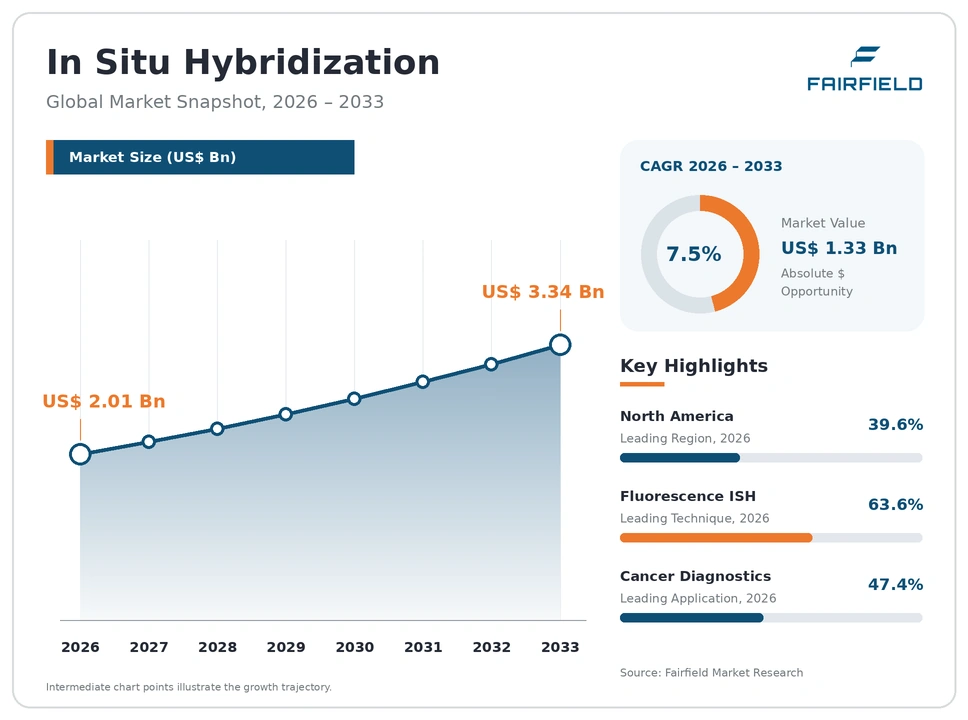
The global in situ hybridization market size is expected to be valued at US$ 2.01 billion in 2026 and projected to reach US$ 3.34 billion by 2033, growing at a CAGR of 7.5% between 2026 and 2033.
Between 2020 and 2025, the market grew at a CAGR of about 5.8%, as cancer testing dipped during the pandemic and then recovered, while research use of RNA in situ hybridization grew strongly. Three factors now drive growth: the rising number of cancer cases needing biomarker testing, the growth of targeted drugs that require companion diagnostics, and the rapid expansion of spatial biology research. The market is shifting from manual fluorescence in situ hybridization toward automated, brightfield chromogenic in situ hybridization, multiplex assays that detect RNA and protein together, and digital image analysis.
Key Report Takeaways
- By Technique: Fluorescence In Situ Hybridization held 63.6% share in 2026, while Chromogenic In Situ Hybridization is projected to expand at a 8.8% CAGR through 2033, driven by automation and use with standard brightfield microscopes.
- By Probe Type: DNA Probes held 61.2% share in 2026, while RNA Probes are projected to expand at a 9.6% CAGR through 2033, driven by gene expression studies and spatial biology research.
- By Application: Cancer Diagnostics held 47.4% share in 2026, while Infectious Diseases is projected to expand at a 8.6% CAGR through 2033, driven by detection of viruses and pathogens directly in tissue.
- By Region: North America held 39.6% share in 2026, while Asia Pacific is projected to expand at a 9.5% CAGR through 2033, driven by cancer testing growth in China, India, and South Korea.
Global In Situ Hybridization Market Trends and Insights
Drivers Impact Analysis
Two drivers carry the strongest influence on in situ hybridization demand during the forecast period.
| Driver | Impact on CAGR Forecast | Geographic Relevance | Impact Timeline |
| Rising cancer burden and companion diagnostic testing | High | North America, Europe, Asia Pacific | Long term (≥4 years) |
| Spatial biology and RNA research growth | Medium | North America, Europe, Asia Pacific | Medium term (2-4 years) |
Cancer Testing and Companion Diagnostics Are Driving the In Situ Hybridization Market
The rising cancer burden and companion diagnostics testing are the strongest drivers of the in situ hybridization market. In situ hybridization shows gene changes directly in tumor tissue, guiding treatment choices.
The mechanism is targeted therapy that depends on biomarker results. HER2 testing in breast and gastric cancer uses fluorescence in situ hybridization or chromogenic tests to decide whether patients receive HER2-targeted drugs. ALK, ROS1, and MET tests in lung cancer and gene rearrangement tests in lymphoma and leukemia also rely on in situ hybridization. In September 2025, the U.S. Food and Drug Administration cleared Oxford Gene Technology’s CytoCell KMT2A FISH probe kit as a companion diagnostic for Syndax’s Revuforj in acute leukemia. More than 20 million new cancer cases occur worldwide each year, increasing test volumes. These trends create steady demand.
Spatial Biology and RNA Research Are Expanding the In Situ Hybridization Market
Spatial biology and RNA research growth are expanding the in situ hybridization market. Researchers want to see where genes are active inside tissues, not just whether they are present.
The cause is new technology and research priorities. RNA in situ hybridization methods such as Bio-Techne’s RNAscope detect single RNA molecules in tissue with high sensitivity. Multiplex assays now detect several RNA and protein targets on one slide. Bio-Techne and Leica Biosystems automated the RNAscope Multiomic LS Assay on BOND RX instruments in 2025, and Bio-Techne combined RNAscope with its COMET spatial platform. Neuroscience, immunology, cell and gene therapy, and drug development studies use these tools. Funding for single-cell and spatial atlases, such as the Human Cell Atlas, increases demand. These trends broaden use beyond clinical testing.
Restraints Impact Analysis
Two restraints limit how quickly the in situ hybridization market grows.
| Restraint | Impact on CAGR Forecast | Geographic Relevance | Impact Timeline |
| Competition from next-generation sequencing and PCR | High | North America, Europe | Medium term (2-4 years) |
| High costs, skilled labor needs, and reimbursement limits | Medium | Asia Pacific, Latin America, Middle East & Africa | Short term (≤2 years) |
Competition From Sequencing Slows the In Situ Hybridization Market
Competition from next-generation sequencing and PCR slows the in situ hybridization market. Newer molecular tests can detect many gene changes in a single run.
The specific causes are broader panels and falling sequencing costs. Next-generation sequencing panels test dozens or hundreds of genes at once, including fusions and amplifications previously detected by FISH. Many lung cancer guidelines now recommend broad sequencing rather than single-gene tests. PCR tests offer fast results for some targets. Liquid biopsy tests detect mutations from blood without tissue samples. As sequencing costs fall, laboratories may replace some in situ hybridization tests. However, in situ hybridization still shows results in tissue context and remains useful when samples are small. These factors slow growth in some cancer testing segments, especially lung cancer, where broad panels are becoming standard.
High Costs and Skill Needs Restrict the In Situ Hybridization Market
High costs, skilled labor needs, and reimbursement limits restrict the in situ hybridization market. In situ hybridization tests require specialized equipment and trained staff.
The underlying causes are complex workflows and limited budgets. FISH tests need fluorescence microscopes, dark rooms, and experienced technologists to count signals, and results can take one to two days. Probes and reagents are expensive, especially for multiplex and research assays. Many laboratories in Asia Pacific, Latin America, and Africa lack skilled cytogeneticists and pathologists. Reimbursement rates for molecular pathology tests vary between countries and may not cover full costs. Regulatory approval for diagnostic probes, such as the European Union In Vitro Diagnostic Regulation, adds cost for manufacturers. These factors limit adoption in smaller laboratories, which often send samples to large reference centers.
Market Opportunities
Automated Chromogenic and Multiplex Assays Open a Clinical Revenue Pool
Automated chromogenic and multiplex assays open a clinical revenue pool in the in situ hybridization market. Laboratories want faster, easier tests that fit routine pathology workflows.
Instrument and reagent makers can capture this opportunity. Chromogenic in situ hybridization produces permanent stains viewed on standard brightfield microscopes, so pathologists can see gene changes alongside tissue structure. Automated staining platforms from Roche, Leica Biosystems, and Agilent Technologies reduce hands-on time and improve consistency. Dual-color and multiplex assays reduce the number of slides needed. Digital pathology and AI image analysis can count signals automatically, saving pathologist time. Reagent rental and service contracts create recurring revenue for suppliers. Suppliers that combine instruments, reagents, and software can win long-term laboratory contracts and lock in recurring reagent sales across hospital networks.
Spatial Multiomics and Drug Development Create a Research Revenue Pool
Spatial multiomics and drug development create a research revenue pool in the in situ hybridization market. Pharmaceutical companies and researchers need tools to study gene activity in tissues.
Research tool companies can capture this opportunity. RNA in situ hybridization helps drug developers check where drug targets are expressed, monitor gene therapy delivery, and study immune cells in tumors. Multiplex assays that combine RNA and protein detection give more information from scarce samples. Bio-Techne, Akoya Biosciences, 10x Genomics, and NanoString offer spatial tools. Contract research organizations provide spatial services to drug companies. Custom probe design for new targets adds further value. Companies that link research assays to clinical tests can move biomarkers from discovery to diagnostics, creating future companion diagnostic opportunities and long-term partnerships with drug developers.
Segment Analysis
By Technique: Fluorescence In Situ Hybridization Leads While Chromogenic In Situ Hybridization Grows Fastest
Fluorescence In Situ Hybridization held 63.6% share in 2026. Fluorescence in situ hybridization uses fluorescent probes to detect gene amplifications, deletions, and rearrangements in cancer and genetic disorders. It is widely used in cytogenetics laboratories for leukemia, lymphoma, breast cancer, and prenatal testing. Abbott, Oxford Gene Technology, and Agilent Technologies supply FISH probes.
Chromogenic In Situ Hybridization is the fastest-growing technique, expanding at a 8.8% CAGR through 2033. Chromogenic in situ hybridization uses color-producing stains visible on standard microscopes and works well with automated staining platforms. Stains do not fade, so slides can be stored and reviewed later, and results fit digital pathology. Roche offers automated HER2 dual ISH tests on Ventana platforms. For the market, chromogenic growth supports routine use in pathology laboratories.
By Probe Type: DNA Probes Lead While RNA Probes Grow Fastest
DNA Probes held 61.2% share in 2026. DNA probes detect gene copy number changes and rearrangements, such as HER2 amplification and ALK fusions, and are used in most clinical FISH and CISH tests. Established diagnostic kits and long clinical use support this segment. Cytogenetics laboratories also use DNA probes for chromosome analysis in genetic disorders and prenatal testing.
RNA Probes are the fastest-growing probe type, expanding at a 9.6% CAGR through 2033. RNA probes detect gene expression in tissue, showing which cells are active. RNA in situ hybridization methods such as RNAscope are used in spatial biology, neuroscience, immunology, and gene therapy research. RNA tests are also used to detect viral RNA, such as HPV, in tissue. For the market, RNA probe growth expands research and diagnostic uses.
By Application: Cancer Diagnostics Leads While Infectious Diseases Grow Fastest
Cancer Diagnostics held 47.4% share in 2026. In situ hybridization guides treatment for breast, gastric, lung, and blood cancers by detecting gene changes in tumors. Rising cancer incidence and new targeted drugs requiring companion diagnostics support demand. Hospitals and reference laboratories run most cancer tests, often using automated platforms.
Infectious Diseases is the fastest-growing application, expanding at a 8.6% CAGR through 2033. In situ hybridization detects viruses, bacteria, and fungi directly in tissue, helping pathologists confirm infections such as HPV, Epstein-Barr virus, and cytomegalovirus. Detection in tissue shows where the infection is located and links it to tissue damage. Genetic disorders, neuroscience, and other research applications form further segments. For the market, infectious disease growth broadens clinical use.
Geography Analysis
Which Region Is Leading the In Situ Hybridization Market?
North America is leading the in situ hybridization market with a 39.6% share in 2026. The United States has high cancer testing rates, broad insurance coverage for molecular pathology, and many reference laboratories such as Labcorp, Quest Diagnostics, and NeoGenomics. Leading suppliers including Abbott, Agilent Technologies, and Bio-Techne are based in the region. The U.S. Food and Drug Administration clears new companion diagnostic probes, such as the KMT2A FISH kit in 2025. Canada adds demand. Research funding from the National Institutes of Health supports spatial biology studies. One change shaping the region is digital pathology adoption.
Europe Advances the In Situ Hybridization Market Through Pathology Networks
Europe is a major in situ hybridization market with strong pathology networks. Germany, France, Italy, Spain, and the United Kingdom have large cancer testing programs. Roche, based in Switzerland, and Oxford Gene Technology, based in the United Kingdom, are leading suppliers. Germany hosts ZytoVision, a specialist probe maker, and the Netherlands and Sweden have strong research use of spatial tools. Public health systems reimburse HER2 and lymphoma testing, supporting steady volumes. The In Vitro Diagnostic Regulation raises requirements for test approval, adding costs for smaller probe makers. One opportunity is automated chromogenic testing.
Which Region Is Growing Fastest in the In Situ Hybridization Market?
Asia Pacific is growing fastest in the in situ hybridization market at a 9.5% CAGR through 2033. China has the largest number of cancer patients and is expanding molecular pathology in hospitals. India and South Korea are investing in cancer diagnostics and genetic testing, and Japan has advanced pathology services. Local probe makers in China compete on price. Australia and Singapore have advanced research and pathology services. Government cancer programs in China and India expand access to biomarker testing in large hospitals. One challenge is a shortage of trained pathologists and cytogeneticists. One opportunity is automated testing that reduces manual work.
Latin America Grows the In Situ Hybridization Market Through Cancer Testing
Latin America is a growing in situ hybridization market. Brazil and Mexico have large cancer patient populations and expanding private laboratory networks such as Dasa and Fleury in Brazil. HER2 testing for breast cancer and lymphoma testing drive most demand in the region. Argentina, Colombia, and Chile are adding molecular pathology and cytogenetics services in major hospitals. Key barriers include high costs, import duties, limited reimbursement in public systems, and a shortage of trained staff outside large cities. One opportunity is centralized reference laboratories that test samples from many hospitals, along with automated chromogenic tests that use standard microscopes.
Middle East & Africa Builds the In Situ Hybridization Market
Middle East & Africa is an emerging in situ hybridization market. Saudi Arabia, the United Arab Emirates, and Israel have advanced hospitals, national genome programs, and genetic testing services. High rates of inherited genetic disorders in Saudi Arabia and neighboring countries increase demand for cytogenetic testing. In Africa, South Africa has major pathology laboratories, while Egypt, Nigeria, and Kenya are building cancer diagnostic capacity with support from global health partners. Key barriers include limited skilled staff, high costs, and limited access in rural areas. One opportunity is reference laboratory services and partnerships with international laboratories.
Competitive Landscape
The in situ hybridization market is moderately concentrated. Roche, Abbott, Leica Biosystems, Bio-Techne, and Agilent Technologies lead the market, while Oxford Gene Technology, Thermo Fisher Scientific, Biocare Medical, ZytoVision, and Empire Genomics compete in probes and reagents.
Companies compete on probe accuracy, test approvals, automation, turnaround time, and integration with digital pathology. Companion diagnostic approvals create strong positions because laboratories must use approved tests. Large suppliers offer complete systems of instruments, reagents, and software, while specialist probe makers compete on test range and price. Research tool companies compete on sensitivity, multiplexing, and ease of use for spatial biology studies.
Digital pathology partnerships help suppliers offer automated signal counting and remote review, which saves pathologist time.
Strategic moves show how competition is changing. In April 2025, Bio-Techne and Leica Biosystems expanded their partnership to automate the RNAscope Multiomic LS Assay. In September 2025, Oxford Gene Technology received U.S. clearance for its KMT2A FISH companion diagnostic. In September 2025, Bio-Techne showcased RNAscope combined with its COMET spatial platform. These moves show competition shifting toward automation, multiomics, and new companion diagnostics, as suppliers seek to defend in situ hybridization against sequencing by offering faster, tissue-based answers that fit routine pathology work.
Three themes shape vendor strategy. First, companies are automating assays for routine labs. Second, they are developing companion diagnostics with drug makers. Third, they are combining RNA and protein detection together on single slides to save scarce tissue.
In Situ Hybridization Market Industry Leaders
- Roche (Ventana)
- Abbott
- Leica Biosystems (Danaher)
- Bio-Techne
- Agilent Technologies
Recent Industry Developments
- June 2026: Merck KGaA agreed to acquire Bio-Techne for about US$ 11.3 billion - brings RNAscope and in situ hybridization technology into a larger life science group.
- September 2025: Oxford Gene Technology received U.S. FDA clearance for its CytoCell KMT2A Breakapart FISH Probe Kit PDx as a companion diagnostic for Revuforj - expands FISH use in targeted leukemia treatment.
- September 2025: Bio-Techne advanced its spatial biology portfolio by combining RNAscope with its COMET platform - detects RNA and protein on the same tissue section.
- April 2025: Bio-Techne and Leica Biosystems expanded their partnership to automate the RNAscope Multiomic LS Assay on BOND RX - detects up to six biomarkers on one slide.
Companies Covered in the Report
- Roche (Ventana)
- Abbott
- Leica Biosystems (Danaher)
- Bio-Techne
- Agilent Technologies
- Oxford Gene Technology
- Thermo Fisher Scientific
- Biocare Medical
- ZytoVision
- Empire Genomics
- PerkinElmer (Revvity)
- BioView
In Situ Hybridization Market Report Scope
This report covers in situ hybridization products and services, including fluorescence and chromogenic in situ hybridization, DNA and RNA probes, kits, reagents, instruments, and software, used for cancer diagnostics, infectious diseases, genetic disorders, neuroscience, and research in hospitals, diagnostic laboratories, and research institutes. It excludes immunohistochemistry-only tests and sequencing. The base year is 2025, and the forecast period runs from 2026 to 2033. All values are expressed in US$ Billion.
Technique
- Fluorescence In Situ Hybridization
- Chromogenic In Situ Hybridization
Probe Type
- DNA Probes
- RNA Probes
Application
- Cancer Diagnostics
- Infectious Diseases
- Genetic Disorders
- Neuroscience & Research
- Others
Regions
- North America
- Europe
- Asia Pacific
- Latin America
- Middle East & Africa
Key Questions Answered in the Report
How big is the in situ hybridization market in 2026?
The in situ hybridization market is valued at US$ 2.01 billion in 2026, led by fluorescence in situ hybridization for cancer diagnostics.
What is the in situ hybridization market forecast to 2033?
The market is projected to reach US$ 3.34 billion by 2033, growing at a 7.5% CAGR and adding US$ 1.33 billion.
Which probe type is growing fastest in in situ hybridization?
RNA Probes are growing fastest at a 9.6% CAGR through 2033, driven by gene expression studies and spatial biology research.
Which region is growing fastest in the in situ hybridization market?
Asia Pacific is growing fastest at a 9.5% CAGR through 2033, driven by cancer testing growth in China and India.
Which region holds the largest in situ hybridization market share?
North America holds the largest share at 39.6% in 2026, supported by high cancer testing rates in the United States.
1. Executive Summary
1.1. Global In Situ Hybridization Market Snapshot
1.2. Future Projections
1.3. Key Report Takeaways
1.4. Regional Snapshot
2. Market Overview
2.1. Market Definition and Report Scope
2.2. Historical Trends 2020–2025
2.3. Market Dynamics
2.3.1. Drivers
2.3.1.1. Cancer Testing and Companion Diagnostics Are Driving the In Situ Hybridization Market
2.3.1.2. Spatial Biology and RNA Research Are Expanding the In Situ Hybridization Market
2.3.2. Restraints
2.3.2.1. Competition From Sequencing Slows the In Situ Hybridization Market
2.3.2.2. High Costs and Skill Needs Restrict the In Situ Hybridization Market
2.3.3. Market Opportunities
2.3.3.1. Automated Chromogenic and Multiplex Assays Open a Clinical Revenue Pool
2.3.3.2. Spatial Multiomics and Drug Development Create a Research Revenue Pool
3. Global In Situ Hybridization Market Outlook, 2020-2033
3.1. Global In Situ Hybridization Market Outlook, by Technique, Value (US$ Billion), 2020-2033
3.1.1. Fluorescence In Situ Hybridization
3.1.2. Chromogenic In Situ Hybridization
3.2. Global In Situ Hybridization Market Outlook, by Probe Type, Value (US$ Billion), 2020-2033
3.2.1. DNA Probes
3.2.2. RNA Probes
3.3. Global In Situ Hybridization Market Outlook, by Application, Value (US$ Billion), 2020-2033
3.3.1. Cancer Diagnostics
3.3.2. Infectious Diseases
3.3.3. Genetic Disorders
3.3.4. Neuroscience & Research
3.3.5. Others
3.4. Global In Situ Hybridization Market Outlook, by Region, Value (US$ Billion), 2020-2033
3.4.1. North America
3.4.2. Europe
3.4.3. Asia Pacific
3.4.4. Latin America
3.4.5. Middle East & Africa
4. North America In Situ Hybridization Market Outlook, 2020-2033
4.1. North America In Situ Hybridization Market Outlook, by Technique, Value (US$ Billion), 2020-2033
4.1.1. Fluorescence In Situ Hybridization
4.1.2. Chromogenic In Situ Hybridization
4.2. North America In Situ Hybridization Market Outlook, by Probe Type, Value (US$ Billion), 2020-2033
4.2.1. DNA Probes
4.2.2. RNA Probes
4.3. North America In Situ Hybridization Market Outlook, by Application, Value (US$ Billion), 2020-2033
4.3.1. Cancer Diagnostics
4.3.2. Infectious Diseases
4.3.3. Genetic Disorders
4.3.4. Neuroscience & Research
4.3.5. Others
4.4. North America In Situ Hybridization Market Outlook, by Country, Value (US$ Billion), 2020-2033
4.4.1. United States In Situ Hybridization Market Outlook, by Technique, 2020-2033
4.4.2. United States In Situ Hybridization Market Outlook, by Probe Type, 2020-2033
4.4.3. United States In Situ Hybridization Market Outlook, by Application, 2020-2033
4.4.4. Canada In Situ Hybridization Market Outlook, by Technique, 2020-2033
4.4.5. Canada In Situ Hybridization Market Outlook, by Probe Type, 2020-2033
4.4.6. Canada In Situ Hybridization Market Outlook, by Application, 2020-2033
5. Europe In Situ Hybridization Market Outlook, 2020-2033
5.1. Europe In Situ Hybridization Market Outlook, by Technique, Value (US$ Billion), 2020-2033
5.1.1. Fluorescence In Situ Hybridization
5.1.2. Chromogenic In Situ Hybridization
5.2. Europe In Situ Hybridization Market Outlook, by Probe Type, Value (US$ Billion), 2020-2033
5.2.1. DNA Probes
5.2.2. RNA Probes
5.3. Europe In Situ Hybridization Market Outlook, by Application, Value (US$ Billion), 2020-2033
5.3.1. Cancer Diagnostics
5.3.2. Infectious Diseases
5.3.3. Genetic Disorders
5.3.4. Neuroscience & Research
5.3.5. Others
5.4. Europe In Situ Hybridization Market Outlook, by Country, Value (US$ Billion), 2020-2033
5.4.1. Germany In Situ Hybridization Market Outlook, by Technique, 2020-2033
5.4.2. Germany In Situ Hybridization Market Outlook, by Probe Type, 2020-2033
5.4.3. Germany In Situ Hybridization Market Outlook, by Application, 2020-2033
5.4.4. France In Situ Hybridization Market Outlook, by Technique, 2020-2033
5.4.5. France In Situ Hybridization Market Outlook, by Probe Type, 2020-2033
5.4.6. France In Situ Hybridization Market Outlook, by Application, 2020-2033
5.4.7. Italy In Situ Hybridization Market Outlook, by Technique, 2020-2033
5.4.8. Italy In Situ Hybridization Market Outlook, by Probe Type, 2020-2033
5.4.9. Italy In Situ Hybridization Market Outlook, by Application, 2020-2033
5.4.10. Spain In Situ Hybridization Market Outlook, by Technique, 2020-2033
5.4.11. Spain In Situ Hybridization Market Outlook, by Probe Type, 2020-2033
5.4.12. Spain In Situ Hybridization Market Outlook, by Application, 2020-2033
5.4.13. United Kingdom In Situ Hybridization Market Outlook, by Technique, 2020-2033
5.4.14. United Kingdom In Situ Hybridization Market Outlook, by Probe Type, 2020-2033
5.4.15. United Kingdom In Situ Hybridization Market Outlook, by Application, 2020-2033
5.4.16. Switzerland In Situ Hybridization Market Outlook, by Technique, 2020-2033
5.4.17. Switzerland In Situ Hybridization Market Outlook, by Probe Type, 2020-2033
5.4.18. Switzerland In Situ Hybridization Market Outlook, by Application, 2020-2033
5.4.19. Netherlands In Situ Hybridization Market Outlook, by Technique, 2020-2033
5.4.20. Netherlands In Situ Hybridization Market Outlook, by Probe Type, 2020-2033
5.4.21. Netherlands In Situ Hybridization Market Outlook, by Application, 2020-2033
5.4.22. Sweden In Situ Hybridization Market Outlook, by Technique, 2020-2033
5.4.23. Sweden In Situ Hybridization Market Outlook, by Probe Type, 2020-2033
5.4.24. Sweden In Situ Hybridization Market Outlook, by Application, 2020-2033
6. Asia Pacific In Situ Hybridization Market Outlook, 2020-2033
6.1. Asia Pacific In Situ Hybridization Market Outlook, by Technique, Value (US$ Billion), 2020-2033
6.1.1. Fluorescence In Situ Hybridization
6.1.2. Chromogenic In Situ Hybridization
6.2. Asia Pacific In Situ Hybridization Market Outlook, by Probe Type, Value (US$ Billion), 2020-2033
6.2.1. DNA Probes
6.2.2. RNA Probes
6.3. Asia Pacific In Situ Hybridization Market Outlook, by Application, Value (US$ Billion), 2020-2033
6.3.1. Cancer Diagnostics
6.3.2. Infectious Diseases
6.3.3. Genetic Disorders
6.3.4. Neuroscience & Research
6.3.5. Others
6.4. Asia Pacific In Situ Hybridization Market Outlook, by Country, Value (US$ Billion), 2020-2033
6.4.1. China In Situ Hybridization Market Outlook, by Technique, 2020-2033
6.4.2. China In Situ Hybridization Market Outlook, by Probe Type, 2020-2033
6.4.3. China In Situ Hybridization Market Outlook, by Application, 2020-2033
6.4.4. India In Situ Hybridization Market Outlook, by Technique, 2020-2033
6.4.5. India In Situ Hybridization Market Outlook, by Probe Type, 2020-2033
6.4.6. India In Situ Hybridization Market Outlook, by Application, 2020-2033
6.4.7. South Korea In Situ Hybridization Market Outlook, by Technique, 2020-2033
6.4.8. South Korea In Situ Hybridization Market Outlook, by Probe Type, 2020-2033
6.4.9. South Korea In Situ Hybridization Market Outlook, by Application, 2020-2033
6.4.10. Japan In Situ Hybridization Market Outlook, by Technique, 2020-2033
6.4.11. Japan In Situ Hybridization Market Outlook, by Probe Type, 2020-2033
6.4.12. Japan In Situ Hybridization Market Outlook, by Application, 2020-2033
6.4.13. Australia In Situ Hybridization Market Outlook, by Technique, 2020-2033
6.4.14. Australia In Situ Hybridization Market Outlook, by Probe Type, 2020-2033
6.4.15. Australia In Situ Hybridization Market Outlook, by Application, 2020-2033
6.4.16. Singapore In Situ Hybridization Market Outlook, by Technique, 2020-2033
6.4.17. Singapore In Situ Hybridization Market Outlook, by Probe Type, 2020-2033
6.4.18. Singapore In Situ Hybridization Market Outlook, by Application, 2020-2033
7. Latin America In Situ Hybridization Market Outlook, 2020-2033
7.1. Latin America In Situ Hybridization Market Outlook, by Technique, Value (US$ Billion), 2020-2033
7.1.1. Fluorescence In Situ Hybridization
7.1.2. Chromogenic In Situ Hybridization
7.2. Latin America In Situ Hybridization Market Outlook, by Probe Type, Value (US$ Billion), 2020-2033
7.2.1. DNA Probes
7.2.2. RNA Probes
7.3. Latin America In Situ Hybridization Market Outlook, by Application, Value (US$ Billion), 2020-2033
7.3.1. Cancer Diagnostics
7.3.2. Infectious Diseases
7.3.3. Genetic Disorders
7.3.4. Neuroscience & Research
7.3.5. Others
7.4. Latin America In Situ Hybridization Market Outlook, by Country, Value (US$ Billion), 2020-2033
7.4.1. Brazil In Situ Hybridization Market Outlook, by Technique, 2020-2033
7.4.2. Brazil In Situ Hybridization Market Outlook, by Probe Type, 2020-2033
7.4.3. Brazil In Situ Hybridization Market Outlook, by Application, 2020-2033
7.4.4. Mexico In Situ Hybridization Market Outlook, by Technique, 2020-2033
7.4.5. Mexico In Situ Hybridization Market Outlook, by Probe Type, 2020-2033
7.4.6. Mexico In Situ Hybridization Market Outlook, by Application, 2020-2033
7.4.7. Argentina In Situ Hybridization Market Outlook, by Technique, 2020-2033
7.4.8. Argentina In Situ Hybridization Market Outlook, by Probe Type, 2020-2033
7.4.9. Argentina In Situ Hybridization Market Outlook, by Application, 2020-2033
7.4.10. Colombia In Situ Hybridization Market Outlook, by Technique, 2020-2033
7.4.11. Colombia In Situ Hybridization Market Outlook, by Probe Type, 2020-2033
7.4.12. Colombia In Situ Hybridization Market Outlook, by Application, 2020-2033
7.4.13. Chile In Situ Hybridization Market Outlook, by Technique, 2020-2033
7.4.14. Chile In Situ Hybridization Market Outlook, by Probe Type, 2020-2033
7.4.15. Chile In Situ Hybridization Market Outlook, by Application, 2020-2033
8. Middle East & Africa In Situ Hybridization Market Outlook, 2020-2033
8.1. Middle East & Africa In Situ Hybridization Market Outlook, by Technique, Value (US$ Billion), 2020-2033
8.1.1. Fluorescence In Situ Hybridization
8.1.2. Chromogenic In Situ Hybridization
8.2. Middle East & Africa In Situ Hybridization Market Outlook, by Probe Type, Value (US$ Billion), 2020-2033
8.2.1. DNA Probes
8.2.2. RNA Probes
8.3. Middle East & Africa In Situ Hybridization Market Outlook, by Application, Value (US$ Billion), 2020-2033
8.3.1. Cancer Diagnostics
8.3.2. Infectious Diseases
8.3.3. Genetic Disorders
8.3.4. Neuroscience & Research
8.3.5. Others
8.4. Middle East & Africa In Situ Hybridization Market Outlook, by Country, Value (US$ Billion), 2020-2033
8.4.1. Saudi Arabia In Situ Hybridization Market Outlook, by Technique, 2020-2033
8.4.2. Saudi Arabia In Situ Hybridization Market Outlook, by Probe Type, 2020-2033
8.4.3. Saudi Arabia In Situ Hybridization Market Outlook, by Application, 2020-2033
8.4.4. United Arab Emirates In Situ Hybridization Market Outlook, by Technique, 2020-2033
8.4.5. United Arab Emirates In Situ Hybridization Market Outlook, by Probe Type, 2020-2033
8.4.6. United Arab Emirates In Situ Hybridization Market Outlook, by Application, 2020-2033
8.4.7. Israel In Situ Hybridization Market Outlook, by Technique, 2020-2033
8.4.8. Israel In Situ Hybridization Market Outlook, by Probe Type, 2020-2033
8.4.9. Israel In Situ Hybridization Market Outlook, by Application, 2020-2033
8.4.10. South Africa In Situ Hybridization Market Outlook, by Technique, 2020-2033
8.4.11. South Africa In Situ Hybridization Market Outlook, by Probe Type, 2020-2033
8.4.12. South Africa In Situ Hybridization Market Outlook, by Application, 2020-2033
8.4.13. Egypt In Situ Hybridization Market Outlook, by Technique, 2020-2033
8.4.14. Egypt In Situ Hybridization Market Outlook, by Probe Type, 2020-2033
8.4.15. Egypt In Situ Hybridization Market Outlook, by Application, 2020-2033
8.4.16. Nigeria In Situ Hybridization Market Outlook, by Technique, 2020-2033
8.4.17. Nigeria In Situ Hybridization Market Outlook, by Probe Type, 2020-2033
8.4.18. Nigeria In Situ Hybridization Market Outlook, by Application, 2020-2033
8.4.19. Kenya In Situ Hybridization Market Outlook, by Technique, 2020-2033
8.4.20. Kenya In Situ Hybridization Market Outlook, by Probe Type, 2020-2033
8.4.21. Kenya In Situ Hybridization Market Outlook, by Application, 2020-2033
9. Competitive Landscape
9.1. Market Concentration and Industry Leaders
9.2. Competitive Differentiation
9.3. Strategic Moves and Market Direction
9.4. Recent Industry Developments
9.5. Company Profiles
9.5.1. Roche (Ventana)
9.5.2. Abbott
9.5.3. Leica Biosystems (Danaher)
9.5.4. Bio-Techne
9.5.5. Agilent Technologies
9.5.6. Oxford Gene Technology
9.5.7. Thermo Fisher Scientific
9.5.8. Biocare Medical
9.5.9. ZytoVision
9.5.10. Empire Genomics
9.5.11. PerkinElmer (Revvity)
9.5.12. BioView
10. Appendix
10.1. Research Methodology
10.2. Report Assumptions
10.3. Acronyms and Abbreviations
| Segment | Categories |
|---|---|
| Technique | Fluorescence In Situ Hybridization, Chromogenic In Situ Hybridization |
| Probe Type | DNA Probes, RNA Probes |
| Application | Cancer Diagnostics, Infectious Diseases, Genetic Disorders, Neuroscience & Research, Others |
| Regions | North America, Europe, Asia Pacific, Latin America, Middle East & Africa |
Our Research Methodology
Considering the volatility of business today, traditional approaches to strategizing a game plan can be unfruitful if not detrimental. True ambiguity is no way to determine a forecast. A myriad of predetermined factors must be accounted for such as the degree of risk involved, the magnitude of circumstances, as well as conditions or consequences that are not known or unpredictable. To circumvent binary views that cast uncertainty, the application of market research intelligence to strategically posture, move, and enable actionable outcomes is necessary.
View Methodology
Quality Assured
Rigorous Validation Process

Confidentiality Assured
End-to-end Data Security

Custom Research Services
Tailored To Your Objectives
FAQs
The in situ hybridization market is valued at US$ 2.01 billion in 2026, led by fluorescence in situ hybridization for cancer diagnostics.
The market is projected to reach US$ 3.34 billion by 2033, growing at a 7.5% CAGR and adding US$ 1.33 billion.
RNA Probes are growing fastest at a 9.6% CAGR through 2033, driven by gene expression studies and spatial biology research.
Asia Pacific is growing fastest at a 9.5% CAGR through 2033, driven by cancer testing growth in China and India.
North America holds the largest share at 39.6% in 2026, supported by high cancer testing rates in the United States.
Related Reports
Pharmaceutical Temperature Controlled Packaging Solutions Market Size, Share, Insights, Competitive Landscape, and Forecast 2026 to 2033
Pharmaceutical temperature controlled packaging solutions market to grow from US$ 6.86 billion in 2026 to US$ 13.98 billion by 2033 at a 10.7% CAGR.
Dermatology CRO Market Size, Share, Insights, Competitive Landscape, and Forecast 2026 to 2033
Explore the dermatology CRO market, projected to reach US$ 9.7 billion by 2033 at a 6.6% CAGR, with service, indication and regional insights.
Acetaminophen Market Size, Share, Insights, Competitive Landscape, and Forecast 2026 to 2033
The global acetaminophen market is valued at US$11.70 billion in 2026, reaching US$15.93 billion by 2033, growing at a 4.5% CAGR
Allergy Diagnostics and Therapeutics Market Size, Share, Insights, Competitive Landscape, and Forecast 2026 to 2033
The global allergy diagnostics and therapeutics market is valued at US$41.50 billion in 2026, reaching US$88.30 billion by 2033, growing at an 11.4% CAGR
Homeopathic Products Market Size, Share, Insights, Competitive Landscape, and Forecast 2026 to 2033
The global homeopathic products market is valued at US$59.45 billion in 2026, reaching US$169.21 billion by 2033, growing at a 16.1% CAGR
Nanoparticle Formulation Market Size, Share, Insights, Competitive Landscape, and Forecast 2026 to 2033
The nanoparticle formulation market is projected to grow from US$6.80 billion in 2026 to US$12.67 billion by 2033, at a 9.3% CAGR, driven by RNA therapies.