



In Vitro Toxicology Testing Market
In Vitro Toxicology Testing Market Insights, Competitive Landscape, and Market Forecast 2033
Market Overview
In vitro toxicology testing uses cell culture, tissue models, and other laboratory-based methods to assess the potential toxicity of pharmaceutical compounds, chemicals, and consumer products without relying on animal testing, offering faster, more cost-effective, and increasingly scientifically validated alternatives to traditional in vivo toxicity assessment. As regulatory bodies and industry increasingly prioritize animal testing alternatives alongside improved predictive accuracy, in vitro toxicology methods have become integral to both regulatory safety assessment and early-stage drug and product development screening.
Demand growth through the 2026-2033 window is closely tied to intensifying regulatory and industry emphasis on reducing animal testing across pharmaceutical, chemical, and cosmetics development, continued technology advancement improving the predictive accuracy and biological relevance of in vitro testing models, and sustained pharmaceutical and biotech industry investment in early-stage toxicity screening to reduce late-stage drug development failures. Growing adoption of advanced three-dimensional tissue models and organ-on-chip technology continues to narrow the biological relevance gap between in vitro testing and traditional animal models.
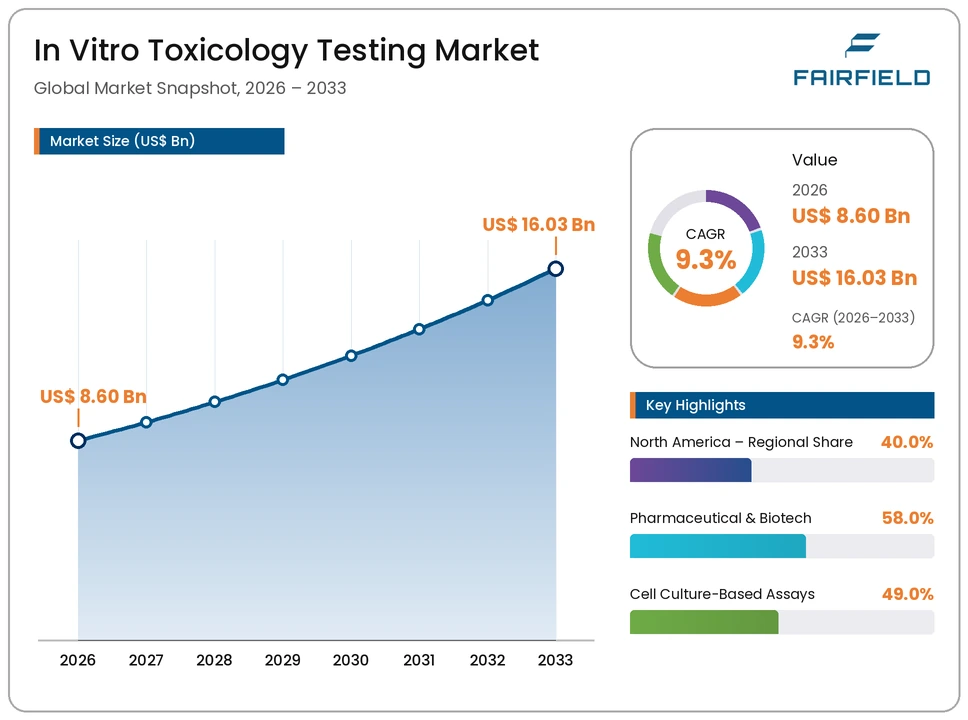
The market is valued at USD 8.60 Billion in 2026, with providers directing substantial investment toward advanced tissue model and organ-on-chip technology that improves predictive accuracy for complex toxicological endpoints. By 2033, the market is forecast to reach USD 16.03 Billion, reflecting steady growth across established pharmaceutical and biotech applications alongside rapidly expanding cosmetics and personal care sector adoption.
Key Highlights
- The global in vitro toxicology testing market is valued at USD 8.60 Billion in 2026 and is projected to reach USD 16.03 Billion by 2033, expanding at a CAGR of 9.3% across the 2026-2033 forecast period.
- Cell Culture-Based Assays lead the technology segment with a 49.0% share in 2026, equivalent to USD 4.21 Billion.
- Pharmaceutical & Biotech remains the dominant application, accounting for 58.0% of global demand, or USD 4.99 Billion, in 2026.
- North America commands the largest regional share at 40.0% of the global market in 2026.
- Cosmetics and personal care applications are emerging as the fastest-growing application through 2033.
Market Dynamics
Key Growth Drivers
Growth in the in vitro toxicology testing market is driven primarily by intensifying regulatory and industry emphasis on reducing animal testing, as regulatory bodies across multiple jurisdictions increasingly encourage or mandate the use of validated alternative testing methods, directly supporting sustained in vitro toxicology testing adoption across pharmaceutical, chemical, and consumer product development.
A second driver is continued technology advancement improving predictive accuracy, as innovations including three-dimensional tissue models, organ-on-chip systems, and high-throughput screening platforms increasingly demonstrate biological relevance comparable to traditional animal testing methods for many toxicological endpoints.
Key Restraints
The scientific and regulatory validation process required to establish in vitro testing methods as accepted alternatives to traditional animal testing for specific toxicological endpoints remains lengthy and resource-intensive, creating a barrier to rapid displacement of established animal testing protocols across all application areas.
Additionally, certain complex toxicological endpoints, particularly those involving whole-organism systemic responses, remain challenging to fully replicate using current in vitro testing technology, limiting complete substitution for animal testing in some regulatory contexts.
Market Opportunities
The expansion of cosmetics and personal care sector adoption presents a substantial opportunity, as regulatory bans on animal testing for cosmetics in an increasing number of jurisdictions have made in vitro toxicology testing an essential and often mandatory component of product safety assessment in this sector.
A second opportunity lies in the continued development of organ-on-chip and advanced three-dimensional tissue model technology that further improves the biological relevance and predictive accuracy of in vitro testing across complex toxicological endpoints. Providers that successfully advance these technologies stand to accelerate broader regulatory and industry acceptance of in vitro methods as primary testing approaches.
Segmentation Analysis
By Technology
Cell Culture-Based Assays lead the technology segment, accounting for 49.0% of global market value in 2026, equivalent to USD 4.21 Billion. Their leadership reflects cell culture assays' well-established validation status and broad applicability across numerous toxicological endpoint assessments. High-Throughput Screening represents a significant, established technology category supporting early-stage compound screening. Organ-on-Chip Technology represents the fastest-growing technology category through 2033, driven by its improved biological relevance for complex, multi-organ toxicological assessment.
By Application
Pharmaceutical & Biotech forms the leading application segment, representing 58.0% of global demand in 2026, or USD 4.99 Billion, reflecting the pharmaceutical industry's substantial and sustained investment in early-stage toxicity screening to reduce late-stage development failures. Chemicals represents a significant, established application category. Cosmetics & Personal Care represents the fastest-growing application category, propelled by regulatory bans on animal testing for cosmetics across an increasing number of jurisdictions.
Regional Insights
North America
North America holds the largest regional share, at 40.0% of the global market in 2026, equivalent to USD 3.44 Billion. The region's leadership reflects substantial pharmaceutical and biotech research investment and strong regulatory emphasis on alternative testing method validation across the United States and Canada.
Europe
Europe accounts for 32.0% of the global market in 2026, valued at USD 2.75 Billion. Demand is supported by comprehensive regulatory bans on animal testing for cosmetics and strong chemical safety assessment requirements across major European markets.
Asia Pacific
Asia Pacific represents 20.0% of the global market in 2026, or USD 1.72 Billion. Growth is underpinned by expanding pharmaceutical and biotech research activity and growing regulatory alignment with international testing standards across China, Japan, and India.
Latin America
Latin America contributes 5.0% of the global market in 2026, equivalent to USD 0.43 Billion. Growth is linked to gradually expanding pharmaceutical research and regulatory testing infrastructure in Brazil and Mexico.
Middle East & Africa
Middle East & Africa holds 3.0% of the global market in 2026, valued at USD 0.26 Billion. Growth remains at an early stage, tied to gradual expansion of research and testing infrastructure across the region.
Competitive Landscape
The global in vitro toxicology testing market is moderately concentrated, with a limited number of large contract research organizations and life science tool companies holding strong positions supported by extensive validated testing method portfolios and long-standing pharmaceutical and chemical industry relationships. Competition centers on breadth of validated testing method offerings, predictive accuracy for complex toxicological endpoints, and the ability to support regulatory submission requirements across multiple jurisdictions. Companies are increasingly differentiating through advanced tissue model and organ-on-chip technology rather than competing on conventional assay pricing alone.
Key Market Players
- Charles River Laboratories International, Inc.
- Merck KGaA
- Thermo Fisher Scientific Inc.
- Eurofins Scientific SE
- Bio-Rad Laboratories, Inc.
- Catalent, Inc.
- SGS SA
- Evotec SE
- MatTek Life Sciences
- Reprocell Inc.
Market Segmentation
By Technology
- Cell Culture-Based Assays
- High-Throughput Screening
- Organ-on-Chip Technology
- Others
By Application
- Pharmaceutical & Biotech
- Cosmetics & Personal Care
- Chemicals
- Others
By End User
- Pharmaceutical & Biotech Companies
- Contract Research Organizations
- Cosmetics & Chemical Companies
By Geography
- North America
- Europe
- Asia Pacific
- Latin America
- Middle East & Africa
- Executive Summary
- Global In Vitro Toxicology Testing Market Snapshot
- Future Projections
- Key Market Trends
- Regional Snapshot, by Value, 2026
- Analyst Recommendations
- Market Overview
- Market Definitions and Segmentations
- Market Dynamics
- Drivers
- Restraints
- Market Opportunities
- Value Chain Analysis
- COVID-19 Impact Analysis
- Porter's Five Forces Analysis
- Impact of Russia-Ukraine Conflict
- PESTLE Analysis
- Regulatory Analysis
- Price Trend Analysis
- Current Prices and Future Projections, 2025-2033
- Price Impact Factors
- Global In Vitro Toxicology Testing Market Outlook, 2020 - 2033
- Global In Vitro Toxicology Testing Market Outlook, by Technology, Value (US$ Mn), 2020-2033
- Cell Culture-Based Assays
- High-Throughput Screening
- Organ-on-Chip Technology
- Others
- Global In Vitro Toxicology Testing Market Outlook, by Application, Value (US$ Mn), 2020-2033
- Pharmaceutical & Biotech
- Cosmetics & Personal Care
- Chemicals
- Others
- Global In Vitro Toxicology Testing Market Outlook, by End User, Value (US$ Mn), 2020-2033
- Pharmaceutical & Biotech Companies
- Contract Research Organizations
- Cosmetics & Chemical Companies
- Global In Vitro Toxicology Testing Market Outlook, by Region, Value (US$ Mn), 2020-2033
- North America
- Europe
- Asia Pacific
- Latin America
- Middle East & Africa
- Global In Vitro Toxicology Testing Market Outlook, by Technology, Value (US$ Mn), 2020-2033
- North America In Vitro Toxicology Testing Market Outlook, 2020 - 2033
- North America In Vitro Toxicology Testing Market Outlook, by Technology, Value (US$ Mn), 2020-2033
- Cell Culture-Based Assays
- High-Throughput Screening
- Organ-on-Chip Technology
- Others
- North America In Vitro Toxicology Testing Market Outlook, by Application, Value (US$ Mn), 2020-2033
- Pharmaceutical & Biotech
- Cosmetics & Personal Care
- Chemicals
- Others
- North America In Vitro Toxicology Testing Market Outlook, by End User, Value (US$ Mn), 2020-2033
- Pharmaceutical & Biotech Companies
- Contract Research Organizations
- Cosmetics & Chemical Companies
- North America In Vitro Toxicology Testing Market Outlook, by Country, Value (US$ Mn), 2020-2033
- U.S. In Vitro Toxicology Testing Market Outlook, by Technology, 2020-2033
- U.S. In Vitro Toxicology Testing Market Outlook, by Application, 2020-2033
- U.S. In Vitro Toxicology Testing Market Outlook, by End User, 2020-2033
- Canada In Vitro Toxicology Testing Market Outlook, by Technology, 2020-2033
- Canada In Vitro Toxicology Testing Market Outlook, by Application, 2020-2033
- Canada In Vitro Toxicology Testing Market Outlook, by End User, 2020-2033
- BPS Analysis/Market Attractiveness Analysis
- North America In Vitro Toxicology Testing Market Outlook, by Technology, Value (US$ Mn), 2020-2033
- Europe In Vitro Toxicology Testing Market Outlook, 2020 - 2033
- Europe In Vitro Toxicology Testing Market Outlook, by Technology, Value (US$ Mn), 2020-2033
- Cell Culture-Based Assays
- High-Throughput Screening
- Organ-on-Chip Technology
- Others
- Europe In Vitro Toxicology Testing Market Outlook, by Application, Value (US$ Mn), 2020-2033
- Pharmaceutical & Biotech
- Cosmetics & Personal Care
- Chemicals
- Others
- Europe In Vitro Toxicology Testing Market Outlook, by End User, Value (US$ Mn), 2020-2033
- Pharmaceutical & Biotech Companies
- Contract Research Organizations
- Cosmetics & Chemical Companies
- Europe In Vitro Toxicology Testing Market Outlook, by Country, Value (US$ Mn), 2020-2033
- Germany In Vitro Toxicology Testing Market Outlook, by Technology, 2020-2033
- Germany In Vitro Toxicology Testing Market Outlook, by Application, 2020-2033
- Germany In Vitro Toxicology Testing Market Outlook, by End User, 2020-2033
- Italy In Vitro Toxicology Testing Market Outlook, by Technology, 2020-2033
- Italy In Vitro Toxicology Testing Market Outlook, by Application, 2020-2033
- Italy In Vitro Toxicology Testing Market Outlook, by End User, 2020-2033
- France In Vitro Toxicology Testing Market Outlook, by Technology, 2020-2033
- France In Vitro Toxicology Testing Market Outlook, by Application, 2020-2033
- France In Vitro Toxicology Testing Market Outlook, by End User, 2020-2033
- U.K. In Vitro Toxicology Testing Market Outlook, by Technology, 2020-2033
- U.K. In Vitro Toxicology Testing Market Outlook, by Application, 2020-2033
- U.K. In Vitro Toxicology Testing Market Outlook, by End User, 2020-2033
- Spain In Vitro Toxicology Testing Market Outlook, by Technology, 2020-2033
- Spain In Vitro Toxicology Testing Market Outlook, by Application, 2020-2033
- Spain In Vitro Toxicology Testing Market Outlook, by End User, 2020-2033
- Russia In Vitro Toxicology Testing Market Outlook, by Technology, 2020-2033
- Russia In Vitro Toxicology Testing Market Outlook, by Application, 2020-2033
- Russia In Vitro Toxicology Testing Market Outlook, by End User, 2020-2033
- Rest of Europe In Vitro Toxicology Testing Market Outlook, by Technology, 2020-2033
- Rest of Europe In Vitro Toxicology Testing Market Outlook, by Application, 2020-2033
- Rest of Europe In Vitro Toxicology Testing Market Outlook, by End User, 2020-2033
- BPS Analysis/Market Attractiveness Analysis
- Europe In Vitro Toxicology Testing Market Outlook, by Technology, Value (US$ Mn), 2020-2033
- Asia Pacific In Vitro Toxicology Testing Market Outlook, 2020 - 2033
- Asia Pacific In Vitro Toxicology Testing Market Outlook, by Technology, Value (US$ Mn), 2020-2033
- Cell Culture-Based Assays
- High-Throughput Screening
- Organ-on-Chip Technology
- Others
- Asia Pacific In Vitro Toxicology Testing Market Outlook, by Application, Value (US$ Mn), 2020-2033
- Pharmaceutical & Biotech
- Cosmetics & Personal Care
- Chemicals
- Others
- Asia Pacific In Vitro Toxicology Testing Market Outlook, by End User, Value (US$ Mn), 2020-2033
- Pharmaceutical & Biotech Companies
- Contract Research Organizations
- Cosmetics & Chemical Companies
- Asia Pacific In Vitro Toxicology Testing Market Outlook, by Country, Value (US$ Mn), 2020-2033
- China In Vitro Toxicology Testing Market Outlook, by Technology, 2020-2033
- China In Vitro Toxicology Testing Market Outlook, by Application, 2020-2033
- China In Vitro Toxicology Testing Market Outlook, by End User, 2020-2033
- Japan In Vitro Toxicology Testing Market Outlook, by Technology, 2020-2033
- Japan In Vitro Toxicology Testing Market Outlook, by Application, 2020-2033
- Japan In Vitro Toxicology Testing Market Outlook, by End User, 2020-2033
- South Korea In Vitro Toxicology Testing Market Outlook, by Technology, 2020-2033
- South Korea In Vitro Toxicology Testing Market Outlook, by Application, 2020-2033
- South Korea In Vitro Toxicology Testing Market Outlook, by End User, 2020-2033
- India In Vitro Toxicology Testing Market Outlook, by Technology, 2020-2033
- India In Vitro Toxicology Testing Market Outlook, by Application, 2020-2033
- India In Vitro Toxicology Testing Market Outlook, by End User, 2020-2033
- Southeast Asia In Vitro Toxicology Testing Market Outlook, by Technology, 2020-2033
- Southeast Asia In Vitro Toxicology Testing Market Outlook, by Application, 2020-2033
- Southeast Asia In Vitro Toxicology Testing Market Outlook, by End User, 2020-2033
- Rest of SAO In Vitro Toxicology Testing Market Outlook, by Technology, 2020-2033
- Rest of SAO In Vitro Toxicology Testing Market Outlook, by Application, 2020-2033
- Rest of SAO In Vitro Toxicology Testing Market Outlook, by End User, 2020-2033
- BPS Analysis/Market Attractiveness Analysis
- Asia Pacific In Vitro Toxicology Testing Market Outlook, by Technology, Value (US$ Mn), 2020-2033
- Latin America In Vitro Toxicology Testing Market Outlook, 2020 - 2033
- Latin America In Vitro Toxicology Testing Market Outlook, by Technology, Value (US$ Mn), 2020-2033
- Cell Culture-Based Assays
- High-Throughput Screening
- Organ-on-Chip Technology
- Others
- Latin America In Vitro Toxicology Testing Market Outlook, by Application, Value (US$ Mn), 2020-2033
- Pharmaceutical & Biotech
- Cosmetics & Personal Care
- Chemicals
- Others
- Latin America In Vitro Toxicology Testing Market Outlook, by End User, Value (US$ Mn), 2020-2033
- Pharmaceutical & Biotech Companies
- Contract Research Organizations
- Cosmetics & Chemical Companies
- Latin America In Vitro Toxicology Testing Market Outlook, by Country, Value (US$ Mn), 2020-2033
- Brazil In Vitro Toxicology Testing Market Outlook, by Technology, 2020-2033
- Brazil In Vitro Toxicology Testing Market Outlook, by Application, 2020-2033
- Brazil In Vitro Toxicology Testing Market Outlook, by End User, 2020-2033
- Mexico In Vitro Toxicology Testing Market Outlook, by Technology, 2020-2033
- Mexico In Vitro Toxicology Testing Market Outlook, by Application, 2020-2033
- Mexico In Vitro Toxicology Testing Market Outlook, by End User, 2020-2033
- Argentina In Vitro Toxicology Testing Market Outlook, by Technology, 2020-2033
- Argentina In Vitro Toxicology Testing Market Outlook, by Application, 2020-2033
- Argentina In Vitro Toxicology Testing Market Outlook, by End User, 2020-2033
- Rest of LATAM In Vitro Toxicology Testing Market Outlook, by Technology, 2020-2033
- Rest of LATAM In Vitro Toxicology Testing Market Outlook, by Application, 2020-2033
- Rest of LATAM In Vitro Toxicology Testing Market Outlook, by End User, 2020-2033
- BPS Analysis/Market Attractiveness Analysis
- Latin America In Vitro Toxicology Testing Market Outlook, by Technology, Value (US$ Mn), 2020-2033
- Middle East & Africa In Vitro Toxicology Testing Market Outlook, 2020 - 2033
- Middle East & Africa In Vitro Toxicology Testing Market Outlook, by Technology, Value (US$ Mn), 2020-2033
- Cell Culture-Based Assays
- High-Throughput Screening
- Organ-on-Chip Technology
- Others
- Middle East & Africa In Vitro Toxicology Testing Market Outlook, by Application, Value (US$ Mn), 2020-2033
- Pharmaceutical & Biotech
- Cosmetics & Personal Care
- Chemicals
- Others
- Middle East & Africa In Vitro Toxicology Testing Market Outlook, by End User, Value (US$ Mn), 2020-2033
- Pharmaceutical & Biotech Companies
- Contract Research Organizations
- Cosmetics & Chemical Companies
- Middle East & Africa In Vitro Toxicology Testing Market Outlook, by Country, Value (US$ Mn), 2020-2033
- GCC In Vitro Toxicology Testing Market Outlook, by Technology, 2020-2033
- GCC In Vitro Toxicology Testing Market Outlook, by Application, 2020-2033
- GCC In Vitro Toxicology Testing Market Outlook, by End User, 2020-2033
- South Africa In Vitro Toxicology Testing Market Outlook, by Technology, 2020-2033
- South Africa In Vitro Toxicology Testing Market Outlook, by Application, 2020-2033
- South Africa In Vitro Toxicology Testing Market Outlook, by End User, 2020-2033
- Egypt In Vitro Toxicology Testing Market Outlook, by Technology, 2020-2033
- Egypt In Vitro Toxicology Testing Market Outlook, by Application, 2020-2033
- Egypt In Vitro Toxicology Testing Market Outlook, by End User, 2020-2033
- Nigeria In Vitro Toxicology Testing Market Outlook, by Technology, 2020-2033
- Nigeria In Vitro Toxicology Testing Market Outlook, by Application, 2020-2033
- Nigeria In Vitro Toxicology Testing Market Outlook, by End User, 2020-2033
- Rest of Middle East In Vitro Toxicology Testing Market Outlook, by Technology, 2020-2033
- Rest of Middle East In Vitro Toxicology Testing Market Outlook, by Application, 2020-2033
- Rest of Middle East In Vitro Toxicology Testing Market Outlook, by End User, 2020-2033
- BPS Analysis/Market Attractiveness Analysis
- Middle East & Africa In Vitro Toxicology Testing Market Outlook, by Technology, Value (US$ Mn), 2020-2033
- Competitive Landscape
- Company Vs Segment Heatmap
- Company Market Share Analysis, 2025
- Competitive Dashboard
- Company Profiles
- Charles River Laboratories International, Inc.
- Company Overview
- Product Portfolio
- Financial Overview
- Business Strategies and Developments
- Merck KGaA
- Thermo Fisher Scientific Inc.
- Eurofins Scientific SE
- Bio-Rad Laboratories, Inc.
- Catalent, Inc.
- SGS SA
- Evotec SE
- MatTek Life Sciences
- Reprocell Inc.
- Charles River Laboratories International, Inc.
- Appendix
- Research Methodology
- Report Assumptions
- Acronyms and Abbreviations
By Technology
- Cell Culture-Based Assays
- High-Throughput Screening
- Organ-on-Chip Technology
- Others
By Application
- Pharmaceutical & Biotech
- Cosmetics & Personal Care
- Chemicals
- Others
By End User
- Pharmaceutical & Biotech Companies
- Contract Research Organizations
- Cosmetics & Chemical Companies
By Geography
- North America
- Europe
- Asia Pacific
- Latin America
- Middle East & Africa
Our Research Methodology
Considering the volatility of business today, traditional approaches to strategizing a game plan can be unfruitful if not detrimental. True ambiguity is no way to determine a forecast. A myriad of predetermined factors must be accounted for such as the degree of risk involved, the magnitude of circumstances, as well as conditions or consequences that are not known or unpredictable. To circumvent binary views that cast uncertainty, the application of market research intelligence to strategically posture, move, and enable actionable outcomes is necessary.
View Methodology
Quality Assured
Rigorous Validation Process

Confidentiality Assured
End-to-end Data Security

Custom Research Services
Tailored To Your Objectives
FAQs
The global in vitro toxicology testing market is valued at USD 8.60 Billion in 2026, reflecting growing adoption of animal testing alternatives.
The market is projected to grow at a CAGR of 9.3%, reaching USD 16.03 Billion by 2033, driven by regulatory emphasis on alternative testing methods and technology advancement.
Cell Culture-Based Assays lead with a 49.0% share in 2026, reflecting their well-established validation status and broad applicability.
North America leads with a 40.0% share in 2026, supported by substantial pharmaceutical research investment and regulatory emphasis on alternative methods.
The largest opportunity lies in cosmetics and personal care applications, expanding as animal testing bans take effect across more jurisdictions.
Related Reports
Diagnostic Imaging Services Market Size, Share, Insights, Competitive Landscape, and Forecast 2026 to 2033
The diagnostic imaging services market is valued at US$600.05 billion in 2026 and is projected to reach US$908.23 billion by 2033, growing at a 6.1% CAGR.
TAVR (Transcatheter Aortic Valve Replacement) Market Size, Share, Insights, Competitive Landscape, and Forecast 2026 to 2033
The global TAVR market is valued at US$7.2 billion in 2026 and is projected to reach US$14 billion by 2033, growing at 9.97% CAGR
Specimen Collection Cards Market Size, Share, Insights, Competitive Landscape, and Forecast 2026 to 2033
The specimen collection cards market is valued at US$498.5 million in 2026 and is projected to reach US$687.5 million by 2033, growing at a 4.7% CAGR.
Point of Care CT Imaging Systems Market Size, Share, Insights, Competitive Landscape, and Forecast 2026 to 2033
The global point-of-care CT imaging systems market is valued at US$0.7 billion in 2026, reaching US$1.4 billion by 2033, growing at a 10.41% CAGR
Transcutaneous Oximetry Systems Market Size, Share, Insights, Competitive Landscape, and Forecast 2026 to 2033
The global transcutaneous oximetry systems market is projected to grow from US$0.4 billion in 2026 to US$0.6 billion by 2033, at a 5.96% CAGR
Healthcare Quality Management Software Market Size, Share, Insights, Competitive Landscape, and Forecast 2026 to 2033
The global healthcare quality management software market will reach US$ 3.80 Billion by 2033, growing at 12.2% CAGR from 2026-2033