



Industrial Demand Response Management Systems Market
Industrial Demand Response Management Systems Market Forecast - 2033
Market Overview
Industrial demand response management systems enable large energy-consuming facilities to automatically adjust electricity usage in response to grid conditions, price signals, or utility requests, allowing industrial operators to reduce peak demand charges, participate in utility incentive programs, and support broader grid stability. These platforms integrate real-time energy monitoring, automated load-shedding controls, and analytics to help industrial facilities balance operational continuity with energy cost optimization and grid support objectives.
Demand growth through the 2026-2033 window is closely tied to rising electricity price volatility and peak demand charges incentivizing industrial facilities to actively manage energy consumption patterns, expanding renewable energy integration on power grids increasing the value of flexible industrial load as a grid balancing resource, and growing utility and grid operator demand response program investment seeking dispatchable load flexibility from large industrial energy consumers. Increasing industrial digitalization and energy monitoring infrastructure adoption continues to provide the underlying data foundation supporting more sophisticated demand response management capability.
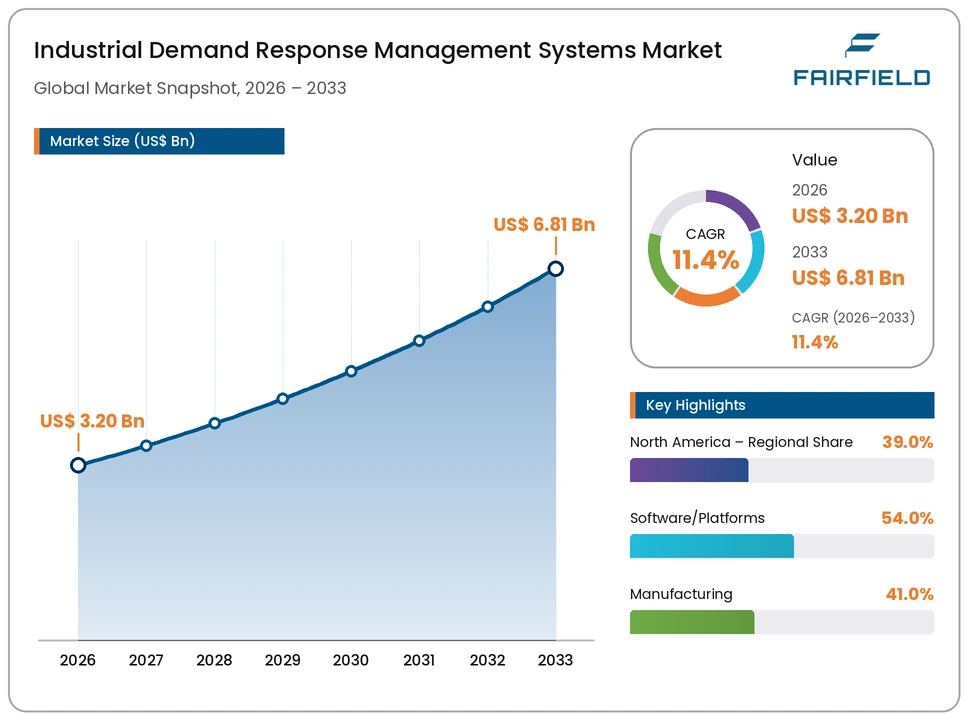
The market is valued at USD 3.20 Billion in 2026, with providers directing investment toward advanced analytics and automation capability that minimizes the operational burden of demand response participation for industrial facility operators. By 2033, the market is forecast to reach USD 6.81 Billion, reflecting steady growth across established manufacturing applications alongside expanding oil and gas sector adoption.
Key Highlights
- The global industrial demand response management systems market is valued at USD 3.20 Billion in 2026 and is projected to reach USD 6.81 Billion by 2033, expanding at a CAGR of 11.4% across the 2026-2033 forecast period.
- Software/Platforms lead the component segment with a 54.0% share in 2026, equivalent to USD 1.73 Billion.
- Manufacturing remains the dominant end-use industry, accounting for 41.0% of global demand, or USD 1.31 Billion, in 2026.
- North America commands the largest regional share at 39.0% of the global market in 2026.
- Oil & gas applications are emerging as the fastest-growing end-use industry through 2033.
Key Growth Drivers
Growth in the industrial demand response management systems market is driven primarily by rising electricity price volatility and peak demand charges, as industrial facilities increasingly seek to actively manage energy consumption timing to reduce costs, creating sustained demand for automated demand response management capability.
A second driver is expanding renewable energy integration on power grids, as growing intermittent renewable generation increases the value of flexible, dispatchable industrial load as a grid balancing resource, supporting utility and grid operator investment in demand response programs that industrial facilities can participate in through dedicated management systems.
Key Restraints
The operational complexity of integrating demand response automation with existing industrial control systems and production processes creates implementation challenges, particularly for facilities with continuous or highly sensitive production processes where load flexibility is inherently limited.
Additionally, industrial facility operators' concerns regarding potential production disruption from automated load-shedding actions can create adoption resistance, requiring demand response solution providers to demonstrate reliable, non-disruptive integration before achieving broader facility-level buy-in.
Market Opportunities
The expansion of demand response adoption within the oil and gas sector presents a substantial opportunity, as this energy-intensive industry increasingly explores demand response participation as both a cost management strategy and a means of supporting broader energy transition and grid stability objectives.
A second opportunity lies in the development of increasingly sophisticated analytics and automation capability that reduces the operational risk and management burden associated with demand response participation. Providers that successfully advance these capabilities stand to capture growing demand from facilities that have historically viewed demand response as operationally too complex to pursue.
Segmentation Analysis
- By Component
Software/Platforms lead the component segment, accounting for 54.0% of global market value in 2026, equivalent to USD 1.73 Billion. Their leadership reflects the central role of analytics and automation software in coordinating demand response actions across industrial facility operations. Hardware represents a significant, established component category supporting monitoring and control infrastructure. Services represent the fastest-growing component category through 2033, driven by growing demand for implementation and ongoing program management support.
- By End-Use Industry
Manufacturing forms the leading end-use industry segment, representing 41.0% of global demand in 2026, or USD 1.31 Billion, reflecting the sector's substantial energy consumption and relatively flexible production scheduling in many manufacturing subsectors. Metals & Mining represents a significant, established end-use category. Oil & Gas represents the fastest-growing end-use industry category, propelled by the sector's growing interest in demand response participation as both a cost and sustainability strategy.
Regional Insights
- North America
North America holds the largest regional share, at 39.0% of the global market in 2026, equivalent to USD 1.25 Billion. The region's leadership reflects well-established utility demand response program infrastructure and substantial industrial energy consumption across the United States and Canada.
- Europe
Europe accounts for 27.0% of the global market in 2026, valued at USD 0.86 Billion. Demand is supported by strong grid stability priorities amid expanding renewable energy integration and established industrial energy efficiency regulatory frameworks.
- Asia Pacific
Asia Pacific represents 25.0% of the global market in 2026, or USD 0.80 Billion. Growth is underpinned by rapidly expanding industrial energy consumption and growing grid modernization investment across China, Japan, and South Korea.
- Latin America
Latin America contributes 5.0% of the global market in 2026, equivalent to USD 0.16 Billion. Growth is linked to gradually expanding industrial energy management adoption in Brazil and Mexico.
- Middle East & Africa
Middle East & Africa holds 4.0% of the global market in 2026, valued at USD 0.13 Billion. Growth remains gradual, tied to expanding industrial energy management infrastructure across the region.
Competitive Landscape
The global industrial demand response management systems market is moderately concentrated, with a limited number of large industrial automation and energy management companies holding strong positions supported by extensive industrial customer relationships and integrated energy management platform portfolios. Competition centers on analytics and automation sophistication, breadth of utility program integration, and the ability to minimize operational disruption for participating industrial facilities. Providers are increasingly differentiating through advanced predictive analytics and automated program participation rather than competing on basic monitoring capability alone.
Key Market Players
- Schneider Electric SE
- Siemens AG
- Honeywell International Inc.
- Johnson Controls International plc
- ABB Ltd
- General Electric Company
- Itron, Inc.
- Enel X
- CPower Energy Management, LLC
- Landis+Gyr Group AG
Market Segmentation
By Component
- Software/Platforms
- Hardware
- Services
By End-Use Industry
- Manufacturing
- Oil & Gas
- Metals & Mining
- Others
By Deployment Mode
- Cloud-Based
- On-Premises
By Geography
- North America
- Europe
- Asia Pacific
- Latin America
- Middle East & Africa
- Executive Summary
- Global Industrial Demand Response Management Systems Market Snapshot
- Future Projections
- Key Market Trends
- Regional Snapshot, by Value, 2026
- Analyst Recommendations
- Market Overview
- Market Definitions and Segmentations
- Market Dynamics
- Drivers
- Restraints
- Market Opportunities
- Value Chain Analysis
- COVID-19 Impact Analysis
- Porter's Five Forces Analysis
- Impact of Russia-Ukraine Conflict
- PESTLE Analysis
- Regulatory Analysis
- Price Trend Analysis
- Current Prices and Future Projections, 2025-2033
- Price Impact Factors
- Global Industrial Demand Response Management Systems Market Outlook, 2020 - 2033
- Global Industrial Demand Response Management Systems Market Outlook, by Component, Value (US$ Mn), 2020-2033
- Software/Platforms
- Hardware
- Services
- Global Industrial Demand Response Management Systems Market Outlook, by End-Use Industry, Value (US$ Mn), 2020-2033
- Manufacturing
- Oil & Gas
- Metals & Mining
- Others
- Global Industrial Demand Response Management Systems Market Outlook, by Deployment Mode, Value (US$ Mn), 2020-2033
- Cloud-Based
- On-Premises
- Global Industrial Demand Response Management Systems Market Outlook, by Region, Value (US$ Mn), 2020-2033
- North America
- Europe
- Asia Pacific
- Latin America
- Middle East & Africa
- Global Industrial Demand Response Management Systems Market Outlook, by Component, Value (US$ Mn), 2020-2033
- North America Industrial Demand Response Management Systems Market Outlook, 2020 - 2033
- North America Industrial Demand Response Management Systems Market Outlook, by Component, Value (US$ Mn), 2020-2033
- Software/Platforms
- Hardware
- Services
- North America Industrial Demand Response Management Systems Market Outlook, by End-Use Industry, Value (US$ Mn), 2020-2033
- Manufacturing
- Oil & Gas
- Metals & Mining
- Others
- North America Industrial Demand Response Management Systems Market Outlook, by Deployment Mode, Value (US$ Mn), 2020-2033
- Cloud-Based
- On-Premises
- North America Industrial Demand Response Management Systems Market Outlook, by Country, Value (US$ Mn), 2020-2033
- U.S. Industrial Demand Response Management Systems Market Outlook, by Component, 2020-2033
- U.S. Industrial Demand Response Management Systems Market Outlook, by End-Use Industry, 2020-2033
- U.S. Industrial Demand Response Management Systems Market Outlook, by Deployment Mode, 2020-2033
- Canada Industrial Demand Response Management Systems Market Outlook, by Component, 2020-2033
- Canada Industrial Demand Response Management Systems Market Outlook, by End-Use Industry, 2020-2033
- Canada Industrial Demand Response Management Systems Market Outlook, by Deployment Mode, 2020-2033
- BPS Analysis/Market Attractiveness Analysis
- North America Industrial Demand Response Management Systems Market Outlook, by Component, Value (US$ Mn), 2020-2033
- Europe Industrial Demand Response Management Systems Market Outlook, 2020 - 2033
- Europe Industrial Demand Response Management Systems Market Outlook, by Component, Value (US$ Mn), 2020-2033
- Software/Platforms
- Hardware
- Services
- Europe Industrial Demand Response Management Systems Market Outlook, by End-Use Industry, Value (US$ Mn), 2020-2033
- Manufacturing
- Oil & Gas
- Metals & Mining
- Others
- Europe Industrial Demand Response Management Systems Market Outlook, by Deployment Mode, Value (US$ Mn), 2020-2033
- Cloud-Based
- On-Premises
- Europe Industrial Demand Response Management Systems Market Outlook, by Country, Value (US$ Mn), 2020-2033
- Germany Industrial Demand Response Management Systems Market Outlook, by Component, 2020-2033
- Germany Industrial Demand Response Management Systems Market Outlook, by End-Use Industry, 2020-2033
- Germany Industrial Demand Response Management Systems Market Outlook, by Deployment Mode, 2020-2033
- Italy Industrial Demand Response Management Systems Market Outlook, by Component, 2020-2033
- Italy Industrial Demand Response Management Systems Market Outlook, by End-Use Industry, 2020-2033
- Italy Industrial Demand Response Management Systems Market Outlook, by Deployment Mode, 2020-2033
- France Industrial Demand Response Management Systems Market Outlook, by Component, 2020-2033
- France Industrial Demand Response Management Systems Market Outlook, by End-Use Industry, 2020-2033
- France Industrial Demand Response Management Systems Market Outlook, by Deployment Mode, 2020-2033
- U.K. Industrial Demand Response Management Systems Market Outlook, by Component, 2020-2033
- U.K. Industrial Demand Response Management Systems Market Outlook, by End-Use Industry, 2020-2033
- U.K. Industrial Demand Response Management Systems Market Outlook, by Deployment Mode, 2020-2033
- Spain Industrial Demand Response Management Systems Market Outlook, by Component, 2020-2033
- Spain Industrial Demand Response Management Systems Market Outlook, by End-Use Industry, 2020-2033
- Spain Industrial Demand Response Management Systems Market Outlook, by Deployment Mode, 2020-2033
- Russia Industrial Demand Response Management Systems Market Outlook, by Component, 2020-2033
- Russia Industrial Demand Response Management Systems Market Outlook, by End-Use Industry, 2020-2033
- Russia Industrial Demand Response Management Systems Market Outlook, by Deployment Mode, 2020-2033
- Rest of Europe Industrial Demand Response Management Systems Market Outlook, by Component, 2020-2033
- Rest of Europe Industrial Demand Response Management Systems Market Outlook, by End-Use Industry, 2020-2033
- Rest of Europe Industrial Demand Response Management Systems Market Outlook, by Deployment Mode, 2020-2033
- BPS Analysis/Market Attractiveness Analysis
- Europe Industrial Demand Response Management Systems Market Outlook, by Component, Value (US$ Mn), 2020-2033
- Asia Pacific Industrial Demand Response Management Systems Market Outlook, 2020 - 2033
- Asia Pacific Industrial Demand Response Management Systems Market Outlook, by Component, Value (US$ Mn), 2020-2033
- Software/Platforms
- Hardware
- Services
- Asia Pacific Industrial Demand Response Management Systems Market Outlook, by End-Use Industry, Value (US$ Mn), 2020-2033
- Manufacturing
- Oil & Gas
- Metals & Mining
- Others
- Asia Pacific Industrial Demand Response Management Systems Market Outlook, by Deployment Mode, Value (US$ Mn), 2020-2033
- Cloud-Based
- On-Premises
- Asia Pacific Industrial Demand Response Management Systems Market Outlook, by Country, Value (US$ Mn), 2020-2033
- China Industrial Demand Response Management Systems Market Outlook, by Component, 2020-2033
- China Industrial Demand Response Management Systems Market Outlook, by End-Use Industry, 2020-2033
- China Industrial Demand Response Management Systems Market Outlook, by Deployment Mode, 2020-2033
- Japan Industrial Demand Response Management Systems Market Outlook, by Component, 2020-2033
- Japan Industrial Demand Response Management Systems Market Outlook, by End-Use Industry, 2020-2033
- Japan Industrial Demand Response Management Systems Market Outlook, by Deployment Mode, 2020-2033
- South Korea Industrial Demand Response Management Systems Market Outlook, by Component, 2020-2033
- South Korea Industrial Demand Response Management Systems Market Outlook, by End-Use Industry, 2020-2033
- South Korea Industrial Demand Response Management Systems Market Outlook, by Deployment Mode, 2020-2033
- India Industrial Demand Response Management Systems Market Outlook, by Component, 2020-2033
- India Industrial Demand Response Management Systems Market Outlook, by End-Use Industry, 2020-2033
- India Industrial Demand Response Management Systems Market Outlook, by Deployment Mode, 2020-2033
- Southeast Asia Industrial Demand Response Management Systems Market Outlook, by Component, 2020-2033
- Southeast Asia Industrial Demand Response Management Systems Market Outlook, by End-Use Industry, 2020-2033
- Southeast Asia Industrial Demand Response Management Systems Market Outlook, by Deployment Mode, 2020-2033
- Rest of SAO Industrial Demand Response Management Systems Market Outlook, by Component, 2020-2033
- Rest of SAO Industrial Demand Response Management Systems Market Outlook, by End-Use Industry, 2020-2033
- Rest of SAO Industrial Demand Response Management Systems Market Outlook, by Deployment Mode, 2020-2033
- BPS Analysis/Market Attractiveness Analysis
- Asia Pacific Industrial Demand Response Management Systems Market Outlook, by Component, Value (US$ Mn), 2020-2033
- Latin America Industrial Demand Response Management Systems Market Outlook, 2020 - 2033
- Latin America Industrial Demand Response Management Systems Market Outlook, by Component, Value (US$ Mn), 2020-2033
- Software/Platforms
- Hardware
- Services
- Latin America Industrial Demand Response Management Systems Market Outlook, by End-Use Industry, Value (US$ Mn), 2020-2033
- Manufacturing
- Oil & Gas
- Metals & Mining
- Others
- Latin America Industrial Demand Response Management Systems Market Outlook, by Deployment Mode, Value (US$ Mn), 2020-2033
- Cloud-Based
- On-Premises
- Latin America Industrial Demand Response Management Systems Market Outlook, by Country, Value (US$ Mn), 2020-2033
- Brazil Industrial Demand Response Management Systems Market Outlook, by Component, 2020-2033
- Brazil Industrial Demand Response Management Systems Market Outlook, by End-Use Industry, 2020-2033
- Brazil Industrial Demand Response Management Systems Market Outlook, by Deployment Mode, 2020-2033
- Mexico Industrial Demand Response Management Systems Market Outlook, by Component, 2020-2033
- Mexico Industrial Demand Response Management Systems Market Outlook, by End-Use Industry, 2020-2033
- Mexico Industrial Demand Response Management Systems Market Outlook, by Deployment Mode, 2020-2033
- Argentina Industrial Demand Response Management Systems Market Outlook, by Component, 2020-2033
- Argentina Industrial Demand Response Management Systems Market Outlook, by End-Use Industry, 2020-2033
- Argentina Industrial Demand Response Management Systems Market Outlook, by Deployment Mode, 2020-2033
- Rest of LATAM Industrial Demand Response Management Systems Market Outlook, by Component, 2020-2033
- Rest of LATAM Industrial Demand Response Management Systems Market Outlook, by End-Use Industry, 2020-2033
- Rest of LATAM Industrial Demand Response Management Systems Market Outlook, by Deployment Mode, 2020-2033
- BPS Analysis/Market Attractiveness Analysis
- Latin America Industrial Demand Response Management Systems Market Outlook, by Component, Value (US$ Mn), 2020-2033
- Middle East & Africa Industrial Demand Response Management Systems Market Outlook, 2020 - 2033
- Middle East & Africa Industrial Demand Response Management Systems Market Outlook, by Component, Value (US$ Mn), 2020-2033
- Software/Platforms
- Hardware
- Services
- Middle East & Africa Industrial Demand Response Management Systems Market Outlook, by End-Use Industry, Value (US$ Mn), 2020-2033
- Manufacturing
- Oil & Gas
- Metals & Mining
- Others
- Middle East & Africa Industrial Demand Response Management Systems Market Outlook, by Deployment Mode, Value (US$ Mn), 2020-2033
- Cloud-Based
- On-Premises
- Middle East & Africa Industrial Demand Response Management Systems Market Outlook, by Country, Value (US$ Mn), 2020-2033
- GCC Industrial Demand Response Management Systems Market Outlook, by Component, 2020-2033
- GCC Industrial Demand Response Management Systems Market Outlook, by End-Use Industry, 2020-2033
- GCC Industrial Demand Response Management Systems Market Outlook, by Deployment Mode, 2020-2033
- South Africa Industrial Demand Response Management Systems Market Outlook, by Component, 2020-2033
- South Africa Industrial Demand Response Management Systems Market Outlook, by End-Use Industry, 2020-2033
- South Africa Industrial Demand Response Management Systems Market Outlook, by Deployment Mode, 2020-2033
- Egypt Industrial Demand Response Management Systems Market Outlook, by Component, 2020-2033
- Egypt Industrial Demand Response Management Systems Market Outlook, by End-Use Industry, 2020-2033
- Egypt Industrial Demand Response Management Systems Market Outlook, by Deployment Mode, 2020-2033
- Nigeria Industrial Demand Response Management Systems Market Outlook, by Component, 2020-2033
- Nigeria Industrial Demand Response Management Systems Market Outlook, by End-Use Industry, 2020-2033
- Nigeria Industrial Demand Response Management Systems Market Outlook, by Deployment Mode, 2020-2033
- Rest of Middle East Industrial Demand Response Management Systems Market Outlook, by Component, 2020-2033
- Rest of Middle East Industrial Demand Response Management Systems Market Outlook, by End-Use Industry, 2020-2033
- Rest of Middle East Industrial Demand Response Management Systems Market Outlook, by Deployment Mode, 2020-2033
- BPS Analysis/Market Attractiveness Analysis
- Middle East & Africa Industrial Demand Response Management Systems Market Outlook, by Component, Value (US$ Mn), 2020-2033
- Competitive Landscape
- Company Vs Segment Heatmap
- Company Market Share Analysis, 2025
- Competitive Dashboard
- Company Profiles
- Schneider Electric SE
- Company Overview
- Product Portfolio
- Financial Overview
- Business Strategies and Developments
- Siemens AG
- Honeywell International Inc.
- Johnson Controls International plc
- ABB Ltd
- General Electric Company
- Itron, Inc.
- Enel X
- CPower Energy Management, LLC
- Landis+Gyr Group AG
- Schneider Electric SE
- Appendix
- Research Methodology
- Report Assumptions
- Acronyms and Abbreviations
By Component
- Software/Platforms
- Hardware
- Services
By End-Use Industry
- Manufacturing
- Oil & Gas
- Metals & Mining
- Others
By Deployment Mode
- Cloud-Based
- On-Premises
By Geography
- North America
- Europe
- Asia Pacific
- Latin America
- Middle East & Africa
Our Research Methodology
Considering the volatility of business today, traditional approaches to strategizing a game plan can be unfruitful if not detrimental. True ambiguity is no way to determine a forecast. A myriad of predetermined factors must be accounted for such as the degree of risk involved, the magnitude of circumstances, as well as conditions or consequences that are not known or unpredictable. To circumvent binary views that cast uncertainty, the application of market research intelligence to strategically posture, move, and enable actionable outcomes is necessary.
View Methodology
Quality Assured
Rigorous Validation Process

Confidentiality Assured
End-to-end Data Security

Custom Research Services
Tailored To Your Objectives
FAQs
The global industrial demand response management systems market is valued at USD 3.20 Billion in 2026, reflecting rising industrial investment in energy cost and grid flexibility management.
The market is projected to grow at a CAGR of 11.4%, reaching USD 6.81 Billion by 2033, driven by electricity price volatility and expanding renewable grid integration.
Software/Platforms lead with a 54.0% share in 2026, reflecting their central role in coordinating automated demand response actions.
North America leads with a 39.0% share in 2026, supported by well-established utility demand response program infrastructure.
The largest opportunity lies in oil and gas sector adoption, growing as the industry embraces demand response as a cost and sustainability strategy.
Related Reports
Elevator Maintenance Market Size, Share, Insights, Competitive Landscape, and Forecast 2026 to 2033
The global elevator maintenance market is valued at US$64.8 billion in 2026, reaching US$92.6 billion by 2033, growing at a 5.2% CAGR
Gas Insulated Power Equipment Market Size, Share, Insights, Competitive Landscape, and Forecast 2026 to 2033
The gas insulated power equipment market is valued at US$ 24.0 Bn in 2026 and is projected to reach US$ 40.5 Bn by 2033, growing at a CAGR of 7.8%
Chain Conveyors Market Size, Share, Insights, Competitive Landscape, and Forecast 2026 to 2033
The global chain conveyors market will grow from US$9.78 billion in 2026 to US$15.45 billion by 2033, at a CAGR of 6.75%, driven by industrial automation.
Reciprocating Plunger Pumps Market Size, Share, Insights, Competitive Landscape, and Forecast 2026 to 2033
The reciprocating plunger pumps market will grow from US$4.89 billion in 2026 to US$7.45 billion by 2033, at a CAGR of 6.2%.
Plastic Injection Molding Machine for MedTech Market Size, Share, Insights, Competitive Landscape, and Forecast 2026 to 2033
The plastic injection molding machine for MedTech market will grow from US$2.1 billion in 2026 to US$3.46 billion by 2033, at a CAGR of 7.4%.
Plastic Processing Machinery Market Size, Share, Insights, Competitive Landscape, and Forecast 2026 to 2033
The plastic processing machinery market will grow from US$38.5 billion in 2026 to US$55.3 billion by 2033, at a 5.3% CAGR, driven by industrial demand.