



Lancet Market
Lancet Market Size, Share, Insights, Competitive Landscape, and Forecast 2026 to 2033
Lancet Market Size and Trend Analysis
How Big Will the Lancet Market Be by 2033?
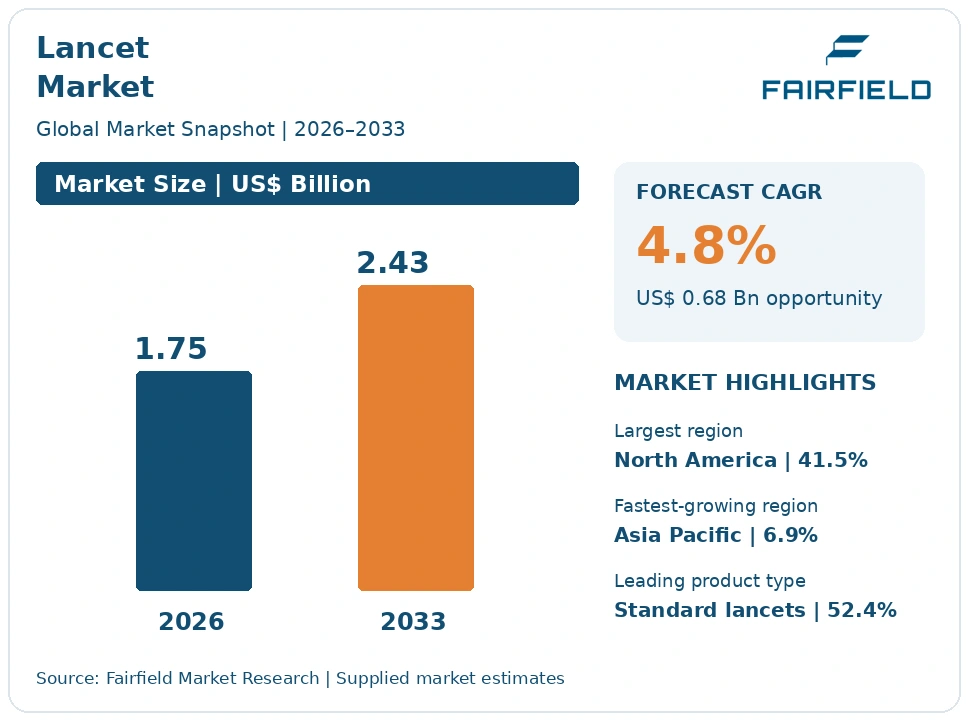
The global lancet market size is expected to be valued at US$ 1.75 billion in 2026 and projected to reach US$ 2.43 billion by 2033, growing at a CAGR of 4.8% between 2026 and 2033.
Between 2020 and 2025, the market grew at a CAGR of about 4.3%, supported by steady diabetes testing volumes and a surge in fingerstick testing during the pandemic. Three factors now drive growth: the rising number of people with diabetes, stricter sharps safety rules in hospitals, and the spread of at-home and remote blood sampling. The market is moving from basic standard lancets toward single-use safety lancets, thinner gauges for less pain, and devices designed for capillary blood collection at home. Price pressure in tenders and growing use of continuous glucose monitors temper value growth in mature markets.
Key Report Takeaways
- By Product Type: Standard Lancets held 52.4% share in 2026, while Safety Lancets are projected to expand at a 6.1% CAGR through 2033, driven by needlestick prevention rules in hospitals and clinics.
- By Gauge Size: 23G-33G held 61.5% share in 2026, while 22G and Below is projected to expand at a 5.6% CAGR through 2033, driven by higher blood volumes needed for laboratory panels.
- By Application: Glucose Testing held 67.8% share in 2026, while Capillary Sampling for Lab Testing is projected to expand at a 7.4% CAGR through 2033, driven by remote and at-home blood collection services.
- By End User: Hospitals & Clinics held 38.6% share in 2026, while Home Care Settings are projected to expand at a 6.3% CAGR through 2033, driven by self-testing and decentralized diagnostics.
- By Region: North America held 41.5% share in 2026, while Asia Pacific is projected to expand at a 6.9% CAGR through 2033, driven by large diabetic populations in China and India.
Global Lancet Market Trends and Insights
Drivers Impact Analysis
Two drivers carry the strongest influence on lancet demand during the forecast period.
| Driver | Impact on CAGR Forecast | Geographic Relevance | Impact Timeline |
| Rising diabetes prevalence and self-monitoring of blood glucose | High | Global, strongest in Asia Pacific and North America | Long term (≥4 years) |
| Sharps safety regulations favoring safety lancets | Medium | North America, Europe | Medium term (2-4 years) |
Rising Diabetes Prevalence Is Driving Lancet Demand for Blood Glucose Monitoring
Rising diabetes prevalence is the strongest driver of lancet demand worldwide. People with diabetes who use fingerstick meters may test several times a day, creating steady, recurring consumption of single-use lancets and lancing devices.
The mechanism is the scale and duration of diabetes care. The International Diabetes Federation estimates that about 589 million adults lived with diabetes in 2024, a figure projected to reach 853 million by 2050. Most growth is in low- and middle-income countries, where fingerstick blood glucose monitoring remains the most affordable testing method. Insulin users, people with gestational diabetes, and newly diagnosed patients rely on regular testing to adjust treatment. Pharmacies, diabetes clinics, and public health programs distribute meters bundled with test strips and lancets. As diagnosis rates improve in China, India, Brazil, and Indonesia, each new patient adds years of lancet demand.
Sharps Safety Rules Are Expanding Safety Lancet Adoption in Healthcare Facilities
Sharps safety regulations are expanding adoption of safety lancets in hospitals, clinics, and laboratories. These devices retract the blade automatically after use, protecting healthcare workers from needlestick injuries and bloodborne infections.
The cause is legal and institutional pressure to reduce occupational injuries. In the United States, the Needlestick Safety and Prevention Act requires employers to evaluate and use safer sharps devices. In Europe, Council Directive 2010/32/EU requires hospitals to prevent sharps injuries through safety-engineered devices. Healthcare workers face risks from hepatitis B, hepatitis C, and HIV after needlestick incidents. Hospitals therefore standardize on single-use, pressure-activated, or push-button safety lancets for point-of-care testing and heel sticks in newborns. Suppliers such as BD, Owen Mumford, Greiner Bio-One, and HTL-Strefa offer color-coded safety lancets by blade size and depth, helping facilities match devices to patient needs.
Restraints Impact Analysis
Two restraints limit how quickly the lancet market grows in value.
| Restraint | Impact on CAGR Forecast | Geographic Relevance | Impact Timeline |
| Shift to continuous glucose monitoring | High | North America, Europe | Medium term (2-4 years) |
| Pricing pressure from tenders, reimbursement cuts, and low-cost imports | Medium | Global | Short term (≤2 years) |
Continuous Glucose Monitors Reduce Fingerstick Lancet Use
Continuous glucose monitors reduce fingerstick lancet use among people with diabetes, especially in high-income markets. Each patient who switches from a meter to a sensor may cut daily lancet consumption sharply or stop routine fingersticks altogether.
The underlying cause is better sensor technology and wider reimbursement. Modern sensors measure glucose in interstitial fluid every few minutes and send readings to smartphones. In March 2024, the U.S. Food and Drug Administration cleared Dexcom’s Stelo, the first over-the-counter glucose biosensor in the United States. Abbott followed with Lingo in June 2024, and Roche received CE marking for Accu-Chek SmartGuide in July 2024. Public insurers in the United States, Germany, France, and the United Kingdom have widened coverage to more insulin users. As sensor prices fall, more type 2 diabetes patients may switch, reducing lancet volumes in diabetes care.
Tender Pricing and Low-Cost Imports Squeeze Lancet Margins
Pricing pressure from tenders, reimbursement cuts, and low-cost imports squeezes lancet margins. Lancets are small, high-volume consumables, so buyers often treat them as commodities and choose the lowest bid.
The specific cost sources are surgical steel, medical-grade plastics, sterilization, and regulatory compliance. Manufacturers must sterilize products by gamma irradiation or ethylene oxide and meet quality rules such as ISO 13485 and the European Union Medical Device Regulation, which raised documentation and clinical evidence costs. At the same time, group purchasing organizations, national health systems, and public tenders push unit prices down. Large volumes of low-cost lancets from China and other Asia Pacific producers compete for retail and generic meter channels. Some insurers also reduce reimbursement for testing supplies. These pressures make scale, automation, and efficient sterilization essential for profitable lancet production.
Market Opportunities
At-home Capillary Blood Collection Opens a New Revenue Pool for Lancets
At-home capillary blood collection opens a new revenue pool for lancet makers beyond diabetes. Consumers and patients can now collect small blood samples at home and mail them to laboratories for testing.
Companies offering high-flow lancets and collection kits can capture this demand. Telehealth providers, employers, insurers, clinical trial sponsors, and wellness companies use remote sampling for cholesterol, hormones, vitamins, HbA1c, and infectious disease tests. Higher-gauge blades and devices with better blood flow improve sample quality. In April 2025, Thriva, a home blood testing company in the United Kingdom, announced a collaboration with Tasso to offer needle-free blood collection for people with needle anxiety. Decentralized clinical trials also need reliable home sampling. Each test kit includes one or more lancets, so wider adoption of remote diagnostics adds recurring, higher-value volumes compared with commodity diabetes lancets.
Comfort-focused and Sustainable Lancet Designs Create a Premium Revenue Pool
Comfort-focused and sustainable lancet designs create a premium revenue pool for manufacturers. Patients who test often value less pain, while hospitals and governments want to reduce plastic and sharps waste.
Manufacturers with advanced grinding, coating, and molding capabilities can capture this opportunity. Thinner 30G to 33G needles, triple-bevel tips, and adjustable depth settings reduce pain, which improves testing adherence among children and older adults. Lancing devices with drum cartridges reduce handling and exposure to used blades. At the same time, hospitals and buyers are asking for lancets with less plastic, recyclable packaging, and lower carbon footprints. The MTD Group has announced plans to build highly competitive pen needle and lancet production facilities in Europe, improving capacity, quality, and environmental performance. These product improvements allow suppliers to defend prices in competitive markets.
Segment Analysis
By Product Type: Standard Lancets Lead While Safety Lancets Gain Momentum
Standard Lancets held 52.4% share in 2026. These lancets are used with reusable lancing devices for home blood glucose monitoring, and they are bundled with meters sold through pharmacies and online channels. Low unit prices and large diabetic populations sustain their high volumes.
Safety Lancets are the fastest-growing product type, expanding at a 6.1% CAGR through 2033. These single-use devices retract the blade automatically after activation, preventing reuse and needlestick injuries. Hospitals, clinics, laboratories, and neonatal units adopt them to meet sharps safety rules. Pressure-activated designs simplify use for nurses and patients, while push-button versions provide deeper punctures for laboratory samples. Growth in home testing for older adults also supports safety lancets because they reduce handling risks. For the market, the shift toward safety lancets raises average selling prices and helps suppliers offset price pressure on standard products.
By Gauge Size: 23G-33G Leads While 22G and Below Gains Ground
23G-33G held 61.5% share in 2026. Thinner needles in this range suit routine blood glucose testing, which needs only a small drop of blood. Patients prefer them because they cause less pain, which supports adherence to daily testing routines.
22G and Below is the fastest-growing gauge segment, expanding at a 5.6% CAGR through 2033. Larger blades produce more blood, which is needed for hemoglobin, lipid panels, and other laboratory tests. Capillary blood sampling at home, in pharmacies, and in clinics often requires more blood than glucose testing. Heel sticks for newborn screening also use specific blade sizes. Manufacturers offer color-coded products by gauge and depth to help clinicians choose. For the market, growth in larger gauges reflects the expansion of lancets beyond diabetes into broader diagnostic testing and decentralized blood collection.
By Application: Glucose Testing Leads While Capillary Sampling for Lab Testing Grows Fastest
Glucose Testing held 67.8% share in 2026. Fingerstick blood glucose monitoring remains the core use for lancets, because millions of people with diabetes test regularly at home. Meters bundled with lancets are widely available and affordable, especially in emerging markets.
Capillary Sampling for Lab Testing is the fastest-growing application, expanding at a 7.4% CAGR through 2033. Remote collection kits allow patients to collect samples at home for cholesterol, HbA1c, hormones, vitamins, and infectious disease tests. Telehealth growth, decentralized clinical trials, and preventive health programs increase this demand. Pharmacies and retail clinics also use capillary sampling for point-of-care testing. Cholesterol testing, hemoglobin testing, and coagulation self-testing remain important uses. For the market, this application diversifies lancet demand and reduces dependence on fingerstick glucose testing, which faces pressure from continuous monitors.
By End User: Hospitals & Clinics Lead While Home Care Settings Expand Fastest
Hospitals & Clinics held 38.6% share in 2026. Healthcare facilities perform large numbers of point-of-care glucose tests, heel sticks in newborns, and capillary samples for emergency and inpatient care. Sharps safety rules make them the main buyers of safety lancets.
Home Care Settings are the fastest-growing end user, expanding at a 6.3% CAGR through 2033. People with diabetes test at home, while remote sampling services ship collection kits directly to consumers. Aging populations prefer managing chronic conditions without frequent clinic visits. Online pharmacies and subscription services make supplies easier to buy. Diagnostic laboratories, ambulatory surgery centers, and others remain important buyers. For the market, home care growth increases demand for easy-to-use lancing devices, comfort features, and safe disposal designs suited to patients without clinical training.
Geography Analysis
Which Region Is Leading the Lancet Market?
North America is leading the lancet market with a 41.5% share in 2026. The United States has a large population living with diabetes, high testing rates, and broad insurance coverage for testing supplies. Sharps safety rules require hospitals to use safety-engineered devices, supporting higher-value safety lancets. Major suppliers such as BD, Abbott, and Ascensia have strong distribution through pharmacies, hospitals, and mail-order channels. Home blood collection and telehealth testing services are well developed. Canada adds demand through public diabetes programs. One change shaping the region is the growing use of continuous glucose monitors, which pushes lancet makers toward laboratory sampling and safety products.
Europe Combines Strict Sharps Safety Rules and Strong Lancet Manufacturing
Europe is a major lancet market with strict safety rules and strong manufacturing. Council Directive 2010/32/EU encourages hospitals to adopt safety lancets. Germany, France, Italy, and the United Kingdom have large diabetic populations and established testing reimbursement. The region hosts important manufacturers, including Owen Mumford in the United Kingdom, Greiner Bio-One in Austria, Sarstedt in Germany, and HTL-Strefa in Poland. The European Union Medical Device Regulation raised compliance costs, favoring larger suppliers. Tender pricing in public health systems keeps margins tight. One opportunity is sustainable lancets with less plastic and recyclable packaging.
Which Region Is Growing Fastest in the Lancet Market?
Asia Pacific is growing fastest in the lancet market at a 6.9% CAGR through 2033. China and India have the world’s largest populations living with diabetes, and diagnosis rates are rising. Affordable blood glucose meters bundled with lancets are widely sold through pharmacies and online platforms. Governments are expanding diabetes screening and primary care programs. Japan and South Korea have aging populations with high testing rates and strong demand for comfort-focused lancets. Local manufacturers in China produce large volumes for domestic and export markets. One opportunity is safety lancet adoption in hospitals as infection control standards improve across public health systems.
Latin America Expands Lancet Demand Through Diabetes Programs
Latin America is an emerging lancet market where rising diabetes rates and public health programs drive demand. Brazil and Mexico have large populations living with diabetes and growing access to blood glucose meters through pharmacies and public clinics. Argentina, Colombia, and Chile add demand from private hospitals and laboratories. Key barriers include limited reimbursement for testing supplies, currency volatility, and reliance on imported devices. Many patients test less often than recommended because they pay for strips and lancets themselves. One opportunity is low-cost lancets and meters distributed through public diabetes programs and expanding retail pharmacy chains in major cities.
Middle East & Africa Grows Lancet Use Amid High Diabetes Prevalence
Middle East & Africa is a developing lancet market with high diabetes prevalence in the Gulf countries. Saudi Arabia, the United Arab Emirates, Kuwait, and Qatar have some of the world’s highest adult diabetes rates, and governments fund screening and care programs. Egypt and South Africa add demand from large populations and expanding healthcare access. Key barriers include limited reimbursement in many African countries, weak distribution outside cities, and price sensitivity. Hospitals in the Gulf are gradually adopting safety lancets as infection control standards improve. One opportunity is national diabetes screening campaigns that bundle meters, strips, and lancets.
Competitive Landscape
The lancet market is moderately concentrated. BD, Roche, Abbott, Terumo, Owen Mumford, and HTL-Strefa, part of the MTD Group, hold strong positions through broad portfolios and long relationships with hospitals, meter makers, and distributors. Greiner Bio-One, Sarstedt, B. Braun, Ascensia Diabetes Care, and Vitrex Medical compete in specific channels, while many low-cost producers in China supply generic and private-label products. Consolidation continues as companies seek scale in diabetes consumables.
Companies compete on safety, comfort, blood flow, price, regulatory approvals, and supply reliability. Meter makers bundle lancets with test strips and lancing devices to retain users. In hospitals, safety features, color coding, and ease of use influence purchasing decisions. New entrants focus on home blood collection devices that combine lancets with sample collection, targeting telehealth and clinical research.
Strategic moves show how competition is changing. In August 2024, the MTD Group completed its acquisition of Ypsomed’s pen needle and blood glucose monitoring businesses and announced a substantial investment plan for its European production sites. This deal expanded MTD’s scale in diabetes consumables, including lancets. In April 2025, Thriva partnered with Tasso to offer needle-free home blood collection, showing how remote sampling creates new channels. Meanwhile, Roche, Abbott, and Dexcom expanded continuous glucose monitoring, pushing lancet suppliers to diversify beyond diabetes testing.
Three themes shape vendor strategy. First, companies are investing in automated production to protect margins. Second, they are expanding safety and comfort-focused products. Third, they are entering home blood collection and laboratory sampling markets.
Lancet Market Industry Leaders
- Becton, Dickinson and Company (BD) Roche Owen Mumford HTL-Strefa (MTD Group) Terumo
Recent Industry Developments
April 2025: Thriva announced a collaboration with Tasso to offer needle-free home blood collection - expands remote sampling beyond fingerstick lancets.
August 2024: MTD Group completed its acquisition of Ypsomed’s pen needle and blood glucose monitoring businesses - adds scale in diabetes consumables and lancet production.
July 2024: Roche received CE marking for Accu-Chek SmartGuide continuous glucose monitoring - signals a shift away from routine fingerstick testing.
Lancet Market Report Scope
| Metric | Value |
| Study Period | 2020-2033 |
| Market Size 2026 | US$ 1.75 Billion |
| Market Size 2033 | US$ 2.43 Billion |
| CAGR 2026-2033 | 4.8% |
| Absolute Dollar Opportunity | US$ 0.68 Billion |
| Largest Market | North America |
| Fastest-Growing Market | Asia Pacific |
| Market Concentration | Medium |
| Major Players | Becton, Dickinson and Company (BD), Roche, Owen Mumford, HTL-Strefa (MTD Group), Terumo |
This report covers blood lancets used for capillary blood sampling, including standard lancets used with lancing devices and single-use safety lancets, across glucose testing, laboratory sampling, and other diagnostic applications. It excludes surgical scalpels, venous blood collection needles, and continuous glucose monitoring sensors. The base year is 2025, and the forecast period runs from 2026 to 2033. All values are expressed in US$ Billion.
Lancet Market Segmentation
Product Type
- Standard Lancets
- Safety Lancets
Gauge Size
- 22G and Below
- 23G-33G
Application
- Glucose Testing
- Capillary Sampling for Lab Testing
- Cholesterol Testing
- Hemoglobin Testing
- Coagulation Testing
- Others
End User
- Hospitals & Clinics
- Home Care Settings
- Diagnostic Laboratories
- Ambulatory Surgery Centers
- Others
Regions
- North America
- Europe
- Asia Pacific
- Latin America
- Middle East & Africa
- Executive Summary
- Global Lancet Market Snapshot
- Future Projections
- Key Report Takeaways
- Regional Snapshot
- Market Overview
- Market Definition and Report Scope
- Historical Trends 2020–2025
- Market Dynamics
- Drivers
- Rising Diabetes Prevalence Is Driving Lancet Demand for Blood Glucose Monitoring
- Sharps Safety Rules Are Expanding Safety Lancet Adoption in Healthcare Facilities
- Restraints
- Continuous Glucose Monitors Reduce Fingerstick Lancet Use
- Tender Pricing and Low-Cost Imports Squeeze Lancet Margins
- Market Opportunities
- At-home Capillary Blood Collection Opens a New Revenue Pool for Lancets
- Comfort-focused and Sustainable Lancet Designs Create a Premium Revenue Pool
- Drivers
- Global Lancet Market Outlook, 2020-2033
- Global Lancet Market Outlook, by Product Type, Value (US$ Billion), 2020-2033
- Standard Lancets
- Safety Lancets
- Global Lancet Market Outlook, by Gauge Size, Value (US$ Billion), 2020-2033
- 22G and Below
- 23G-33G
- Global Lancet Market Outlook, by Application, Value (US$ Billion), 2020-2033
- Glucose Testing
- Capillary Sampling for Lab Testing
- Cholesterol Testing
- Hemoglobin Testing
- Coagulation Testing
- Others
- Global Lancet Market Outlook, by End User, Value (US$ Billion), 2020-2033
- Hospitals & Clinics
- Home Care Settings
- Diagnostic Laboratories
- Ambulatory Surgery Centers
- Others
- Global Lancet Market Outlook, by Region, Value (US$ Billion), 2020-2033
- North America
- Europe
- Asia Pacific
- Latin America
- Middle East & Africa
- Global Lancet Market Outlook, by Product Type, Value (US$ Billion), 2020-2033
- North America Lancet Market Outlook, 2020-2033
- North America Lancet Market Outlook, by Product Type, Value (US$ Billion), 2020-2033
- Standard Lancets
- Safety Lancets
- North America Lancet Market Outlook, by Gauge Size, Value (US$ Billion), 2020-2033
- 22G and Below
- 23G-33G
- North America Lancet Market Outlook, by Application, Value (US$ Billion), 2020-2033
- Glucose Testing
- Capillary Sampling for Lab Testing
- Cholesterol Testing
- Hemoglobin Testing
- Coagulation Testing
- Others
- North America Lancet Market Outlook, by End User, Value (US$ Billion), 2020-2033
- Hospitals & Clinics
- Home Care Settings
- Diagnostic Laboratories
- Ambulatory Surgery Centers
- Others
- North America Lancet Market Outlook, by Country, Value (US$ Billion), 2020-2033
- United States Lancet Market Outlook, by Product Type, 2020-2033
- United States Lancet Market Outlook, by Gauge Size, 2020-2033
- United States Lancet Market Outlook, by Application, 2020-2033
- United States Lancet Market Outlook, by End User, 2020-2033
- Canada Lancet Market Outlook, by Product Type, 2020-2033
- Canada Lancet Market Outlook, by Gauge Size, 2020-2033
- Canada Lancet Market Outlook, by Application, 2020-2033
- Canada Lancet Market Outlook, by End User, 2020-2033
- North America Lancet Market Outlook, by Product Type, Value (US$ Billion), 2020-2033
- Europe Lancet Market Outlook, 2020-2033
- Europe Lancet Market Outlook, by Product Type, Value (US$ Billion), 2020-2033
- Standard Lancets
- Safety Lancets
- Europe Lancet Market Outlook, by Gauge Size, Value (US$ Billion), 2020-2033
- 22G and Below
- 23G-33G
- Europe Lancet Market Outlook, by Application, Value (US$ Billion), 2020-2033
- Glucose Testing
- Capillary Sampling for Lab Testing
- Cholesterol Testing
- Hemoglobin Testing
- Coagulation Testing
- Others
- Europe Lancet Market Outlook, by End User, Value (US$ Billion), 2020-2033
- Hospitals & Clinics
- Home Care Settings
- Diagnostic Laboratories
- Ambulatory Surgery Centers
- Others
- Europe Lancet Market Outlook, by Country, Value (US$ Billion), 2020-2033
- Germany Lancet Market Outlook, by Product Type, 2020-2033
- Germany Lancet Market Outlook, by Gauge Size, 2020-2033
- Germany Lancet Market Outlook, by Application, 2020-2033
- Germany Lancet Market Outlook, by End User, 2020-2033
- France Lancet Market Outlook, by Product Type, 2020-2033
- France Lancet Market Outlook, by Gauge Size, 2020-2033
- France Lancet Market Outlook, by Application, 2020-2033
- France Lancet Market Outlook, by End User, 2020-2033
- Italy Lancet Market Outlook, by Product Type, 2020-2033
- Italy Lancet Market Outlook, by Gauge Size, 2020-2033
- Italy Lancet Market Outlook, by Application, 2020-2033
- Italy Lancet Market Outlook, by End User, 2020-2033
- United Kingdom Lancet Market Outlook, by Product Type, 2020-2033
- United Kingdom Lancet Market Outlook, by Gauge Size, 2020-2033
- United Kingdom Lancet Market Outlook, by Application, 2020-2033
- United Kingdom Lancet Market Outlook, by End User, 2020-2033
- Austria Lancet Market Outlook, by Product Type, 2020-2033
- Austria Lancet Market Outlook, by Gauge Size, 2020-2033
- Austria Lancet Market Outlook, by Application, 2020-2033
- Austria Lancet Market Outlook, by End User, 2020-2033
- Poland Lancet Market Outlook, by Product Type, 2020-2033
- Poland Lancet Market Outlook, by Gauge Size, 2020-2033
- Poland Lancet Market Outlook, by Application, 2020-2033
- Poland Lancet Market Outlook, by End User, 2020-2033
- Europe Lancet Market Outlook, by Product Type, Value (US$ Billion), 2020-2033
- Asia Pacific Lancet Market Outlook, 2020-2033
- Asia Pacific Lancet Market Outlook, by Product Type, Value (US$ Billion), 2020-2033
- Standard Lancets
- Safety Lancets
- Asia Pacific Lancet Market Outlook, by Gauge Size, Value (US$ Billion), 2020-2033
- 22G and Below
- 23G-33G
- Asia Pacific Lancet Market Outlook, by Application, Value (US$ Billion), 2020-2033
- Glucose Testing
- Capillary Sampling for Lab Testing
- Cholesterol Testing
- Hemoglobin Testing
- Coagulation Testing
- Others
- Asia Pacific Lancet Market Outlook, by End User, Value (US$ Billion), 2020-2033
- Hospitals & Clinics
- Home Care Settings
- Diagnostic Laboratories
- Ambulatory Surgery Centers
- Others
- Asia Pacific Lancet Market Outlook, by Country, Value (US$ Billion), 2020-2033
- China Lancet Market Outlook, by Product Type, 2020-2033
- China Lancet Market Outlook, by Gauge Size, 2020-2033
- China Lancet Market Outlook, by Application, 2020-2033
- China Lancet Market Outlook, by End User, 2020-2033
- India Lancet Market Outlook, by Product Type, 2020-2033
- India Lancet Market Outlook, by Gauge Size, 2020-2033
- India Lancet Market Outlook, by Application, 2020-2033
- India Lancet Market Outlook, by End User, 2020-2033
- Japan Lancet Market Outlook, by Product Type, 2020-2033
- Japan Lancet Market Outlook, by Gauge Size, 2020-2033
- Japan Lancet Market Outlook, by Application, 2020-2033
- Japan Lancet Market Outlook, by End User, 2020-2033
- South Korea Lancet Market Outlook, by Product Type, 2020-2033
- South Korea Lancet Market Outlook, by Gauge Size, 2020-2033
- South Korea Lancet Market Outlook, by Application, 2020-2033
- South Korea Lancet Market Outlook, by End User, 2020-2033
- Indonesia Lancet Market Outlook, by Product Type, 2020-2033
- Indonesia Lancet Market Outlook, by Gauge Size, 2020-2033
- Indonesia Lancet Market Outlook, by Application, 2020-2033
- Indonesia Lancet Market Outlook, by End User, 2020-2033
- Asia Pacific Lancet Market Outlook, by Product Type, Value (US$ Billion), 2020-2033
- Latin America Lancet Market Outlook, 2020-2033
- Latin America Lancet Market Outlook, by Product Type, Value (US$ Billion), 2020-2033
- Standard Lancets
- Safety Lancets
- Latin America Lancet Market Outlook, by Gauge Size, Value (US$ Billion), 2020-2033
- 22G and Below
- 23G-33G
- Latin America Lancet Market Outlook, by Application, Value (US$ Billion), 2020-2033
- Glucose Testing
- Capillary Sampling for Lab Testing
- Cholesterol Testing
- Hemoglobin Testing
- Coagulation Testing
- Others
- Latin America Lancet Market Outlook, by End User, Value (US$ Billion), 2020-2033
- Hospitals & Clinics
- Home Care Settings
- Diagnostic Laboratories
- Ambulatory Surgery Centers
- Others
- Latin America Lancet Market Outlook, by Country, Value (US$ Billion), 2020-2033
- Brazil Lancet Market Outlook, by Product Type, 2020-2033
- Brazil Lancet Market Outlook, by Gauge Size, 2020-2033
- Brazil Lancet Market Outlook, by Application, 2020-2033
- Brazil Lancet Market Outlook, by End User, 2020-2033
- Mexico Lancet Market Outlook, by Product Type, 2020-2033
- Mexico Lancet Market Outlook, by Gauge Size, 2020-2033
- Mexico Lancet Market Outlook, by Application, 2020-2033
- Mexico Lancet Market Outlook, by End User, 2020-2033
- Argentina Lancet Market Outlook, by Product Type, 2020-2033
- Argentina Lancet Market Outlook, by Gauge Size, 2020-2033
- Argentina Lancet Market Outlook, by Application, 2020-2033
- Argentina Lancet Market Outlook, by End User, 2020-2033
- Colombia Lancet Market Outlook, by Product Type, 2020-2033
- Colombia Lancet Market Outlook, by Gauge Size, 2020-2033
- Colombia Lancet Market Outlook, by Application, 2020-2033
- Colombia Lancet Market Outlook, by End User, 2020-2033
- Chile Lancet Market Outlook, by Product Type, 2020-2033
- Chile Lancet Market Outlook, by Gauge Size, 2020-2033
- Chile Lancet Market Outlook, by Application, 2020-2033
- Chile Lancet Market Outlook, by End User, 2020-2033
- Latin America Lancet Market Outlook, by Product Type, Value (US$ Billion), 2020-2033
- Middle East & Africa Lancet Market Outlook, 2020-2033
- Middle East & Africa Lancet Market Outlook, by Product Type, Value (US$ Billion), 2020-2033
- Standard Lancets
- Safety Lancets
- Middle East & Africa Lancet Market Outlook, by Gauge Size, Value (US$ Billion), 2020-2033
- 22G and Below
- 23G-33G
- Middle East & Africa Lancet Market Outlook, by Application, Value (US$ Billion), 2020-2033
- Glucose Testing
- Capillary Sampling for Lab Testing
- Cholesterol Testing
- Hemoglobin Testing
- Coagulation Testing
- Others
- Middle East & Africa Lancet Market Outlook, by End User, Value (US$ Billion), 2020-2033
- Hospitals & Clinics
- Home Care Settings
- Diagnostic Laboratories
- Ambulatory Surgery Centers
- Others
- Middle East & Africa Lancet Market Outlook, by Country, Value (US$ Billion), 2020-2033
- Saudi Arabia Lancet Market Outlook, by Product Type, 2020-2033
- Saudi Arabia Lancet Market Outlook, by Gauge Size, 2020-2033
- Saudi Arabia Lancet Market Outlook, by Application, 2020-2033
- Saudi Arabia Lancet Market Outlook, by End User, 2020-2033
- United Arab Emirates Lancet Market Outlook, by Product Type, 2020-2033
- United Arab Emirates Lancet Market Outlook, by Gauge Size, 2020-2033
- United Arab Emirates Lancet Market Outlook, by Application, 2020-2033
- United Arab Emirates Lancet Market Outlook, by End User, 2020-2033
- Kuwait Lancet Market Outlook, by Product Type, 2020-2033
- Kuwait Lancet Market Outlook, by Gauge Size, 2020-2033
- Kuwait Lancet Market Outlook, by Application, 2020-2033
- Kuwait Lancet Market Outlook, by End User, 2020-2033
- Qatar Lancet Market Outlook, by Product Type, 2020-2033
- Qatar Lancet Market Outlook, by Gauge Size, 2020-2033
- Qatar Lancet Market Outlook, by Application, 2020-2033
- Qatar Lancet Market Outlook, by End User, 2020-2033
- Egypt Lancet Market Outlook, by Product Type, 2020-2033
- Egypt Lancet Market Outlook, by Gauge Size, 2020-2033
- Egypt Lancet Market Outlook, by Application, 2020-2033
- Egypt Lancet Market Outlook, by End User, 2020-2033
- South Africa Lancet Market Outlook, by Product Type, 2020-2033
- South Africa Lancet Market Outlook, by Gauge Size, 2020-2033
- South Africa Lancet Market Outlook, by Application, 2020-2033
- South Africa Lancet Market Outlook, by End User, 2020-2033
- Middle East & Africa Lancet Market Outlook, by Product Type, Value (US$ Billion), 2020-2033
- Competitive Landscape
- Market Concentration and Industry Leaders
- Competitive Differentiation
- Strategic Moves and Market Direction
- Recent Industry Developments
- Company Profiles
- Becton, Dickinson and Company (BD)
- Roche
- Abbott
- Terumo
- Owen Mumford
- HTL-Strefa (MTD Group)
- Greiner Bio-One
- Sarstedt
- B. Braun
- Ascensia Diabetes Care
- Vitrex Medical
- Tasso
- Appendix
- Research Methodology
- Report Assumptions
- Acronyms and Abbreviations
Product Type
- Standard Lancets
- Safety Lancets
Gauge Size
- 22G and Below
- 23G-33G
Application
- Glucose Testing
- Capillary Sampling for Lab Testing
- Cholesterol Testing
- Hemoglobin Testing
- Coagulation Testing
- Others
End User
- Hospitals & Clinics
- Home Care Settings
- Diagnostic Laboratories
- Ambulatory Surgery Centers
- Others
Regions
- North America
- Europe
- Asia Pacific
- Latin America
- Middle East & Africa
Our Research Methodology
Considering the volatility of business today, traditional approaches to strategizing a game plan can be unfruitful if not detrimental. True ambiguity is no way to determine a forecast. A myriad of predetermined factors must be accounted for such as the degree of risk involved, the magnitude of circumstances, as well as conditions or consequences that are not known or unpredictable. To circumvent binary views that cast uncertainty, the application of market research intelligence to strategically posture, move, and enable actionable outcomes is necessary.
View Methodology
Quality Assured
Rigorous Validation Process

Confidentiality Assured
End-to-end Data Security

Custom Research Services
Tailored To Your Objectives
FAQs
The lancet market is valued at US$ 1.75 billion in 2026, supported mainly by fingerstick blood glucose testing among people with diabetes.
The market is projected to reach US$ 2.43 billion by 2033, growing at a 4.8% CAGR and adding US$ 0.68 billion in value.
Standard Lancets lead with a 52.4% share in 2026, supported by home blood glucose monitoring with reusable lancing devices and bundled meters.
Asia Pacific is growing fastest at a 6.9% CAGR through 2033, driven by large and growing diabetic populations in China and India.
North America holds the largest share at 41.5% in 2026, supported by high testing rates, insurance coverage, and sharps safety rules.
Related Reports
Wireless Neurostimulators Market Size, Share, Insights, Competitive Landscape, and Forecast 2026 to 2033
Wireless neurostimulators market to grow from US$ 6.2 billion in 2026 to US$ 11.5 billion by 2033 at a 9.2% CAGR. Explore products, applications and regions.
Ultrasound Needle Guides Market Size, Share, Insights, Competitive Landscape, and Forecast 2026 to 2033
Explore the ultrasound needle guides market, projected to reach US$0.7 billion by 2033 at 8.3% CAGR, with product, application and regional insights.
Oncology Molecular Diagnostic Market Size, Share, Insights, Competitive Landscape, and Forecast 2026 to 2033
The oncology molecular diagnostic market is projected to grow from US$12.4 billion in 2026 to US$24.6 billion by 2033, at a 10.3% CAGR. Explore trends.
Mechanical Ventilators Market Size, Share, Insights, Competitive Landscape, and Forecast 2026 to 2033
The global mechanical ventilators market is valued at US$4.80 billion in 2026, reaching US$6.58 billion by 2033, growing at a 4.6% CAGR
Drugs of Abuse Testing Market Size, Share, Insights, Competitive Landscape, and Forecast 2026 to 2033
The global drugs of abuse testing market is valued at US$6.80 billion in 2026, reaching US$14.60 billion by 2033, growing at an 11.5% CAGR
Brain Health Devices Market Size, Share, Insights, Competitive Landscape, and Forecast 2026 to 2033
The global brain health devices market is valued at US$8.60 billion in 2026, reaching US$13.10 billion by 2033, growing at a 6.2% CAGR