



Landing String Equipment Market
Landing String Equipment Market Size, Share, Insights, Competitive Landscape, and Forecast 2026 to 2033
Landing String Equipment Market Size and Trend Analysis
How Fast Is the Landing String Equipment Market Growing?
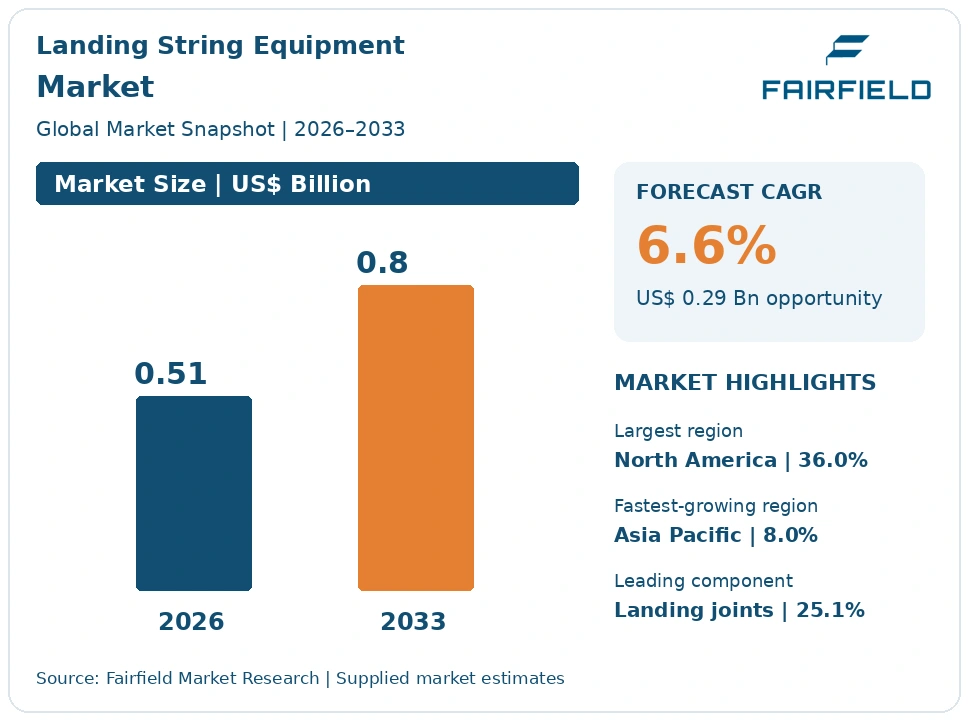
The global landing string equipment market size is expected to be valued at US$ 0.51 billion in 2026 and projected to reach US$ 0.80 billion by 2033, growing at a CAGR of 6.6% between 2026 and 2033.
Between 2020 and 2025, the market grew at a CAGR of about 3.9%, recovering from the 2020 collapse in offshore drilling as oil prices and deepwater project approvals improved. Three factors now drive growth: renewed deepwater drilling in the U.S. Gulf of Mexico, Brazil, Guyana, and West Africa; heavier casing strings in deeper and higher-pressure wells; and more subsea completions and well tests that need safety systems. The market is shifting toward high-capacity landing strings rated for 20,000 psi wells and toward faster, electrohydraulic controls for subsea test trees.
Key Report Takeaways
- By Component: Landing Joints held 25.1% share in 2026, while Subsea Test Trees are projected to expand at a 7.9% CAGR through 2033, driven by more subsea completions and well tests in deepwater fields.
- By Application: Drilling held 43.4% share in 2026, while Completion is projected to expand at a 7.5% CAGR through 2033, driven by final investment decisions on new deepwater developments.
- By Technology: Direct-hydraulic Systems held 36.2% share in 2026, while Electrohydraulic Systems are projected to expand at an 8.4% CAGR through 2033, driven by faster shut-in response in ultra-deep water.
- By Region: North America held 36.0% share in 2026, while Asia Pacific is projected to expand at an 8.0% CAGR through 2033, driven by deepwater programs in India, China, and Malaysia.
Global Landing String Equipment Market Trends and Insights
Drivers Impact Analysis
Two drivers carry the strongest influence on landing string equipment demand during the forecast period.
| Driver | Impact on CAGR Forecast | Geographic Relevance | Impact Timeline |
| Deepwater and ultra-deepwater project activity | High | North America, Latin America, Middle East & Africa | Medium term (2-4 years) |
| HP/HT wells requiring higher-capacity strings | High | North America, Latin America | Long term (≥4 years) |
Deepwater Project Approvals Are Driving Landing String Equipment Demand
Deepwater project approvals are the strongest driver of landing string equipment demand. Each new deepwater well needs a landing string to run heavy casing, and many wells also need subsea safety systems for completion and testing.
The mechanism is the long cycle of offshore field development. Operators are drilling development wells in large fields such as the Stabroek block in Guyana, the Búzios field in Brazil, and new hubs in the U.S. Gulf of Mexico. In Africa, Shell took a final investment decision on Bonga North in Nigeria in December 2024, while Namibia’s Orange Basin discoveries are moving toward appraisal. Each project involves many wells drilled over several years, creating steady rental and service demand for landing joints, slips, spanner joints, and subsea test trees. Deepwater drilling programs also favor service providers with proven equipment fleets and rapid maintenance support.
HP/HT Wells Are Expanding Demand for High-Capacity Landing Strings
High-pressure, high-temperature wells are expanding demand for high-capacity landing strings. These wells use longer and heavier casing strings, which require stronger pipe, connections, and handling tools than standard deepwater wells.
The cause is that operators are targeting deeper reservoirs with pressures up to 20,000 psi. In August 2024, Chevron started production from its Anchor project in the U.S. Gulf of Mexico, the first deepwater development using 20,000 psi technology. Running casing in such wells can create hook loads close to 3 million pounds. In June 2025, Superior Energy Services deployed its FASTR 3.0 landing string in the Green Canyon area, landing 16-inch casing at about 24,000 feet with an indicated hook load of 2.849 million pounds. These records show why operators need landing strings with higher tensile ratings, special slip systems, and qualified connections for HP/HT wells.
Restraints Impact Analysis
Two restraints limit how quickly landing string equipment demand grows.
| Restraint | Impact on CAGR Forecast | Geographic Relevance | Impact Timeline |
| Oil price volatility and offshore spending cycles | High | Global | Short term (≤2 years) |
| High cost and long qualification of HP/HT equipment | Medium | North America, Latin America, Europe | Medium term (2-4 years) |
Oil Price Volatility Delays Offshore Drilling and Landing String Demand
Oil price volatility delays offshore drilling programs and therefore landing string equipment demand. When prices fall or become uncertain, operators defer exploration wells, slow development drilling, and renegotiate service contracts.
The underlying cause is the high cost and long payback of deepwater projects. A single deepwater well can cost well over US$ 100 million, and projects often take years to reach first oil. Operators prioritize capital discipline and shareholder returns, so they delay final investment decisions when oil price forecasts weaken. Decisions by OPEC+ on production quotas, weaker demand growth, and the energy transition all affect long-term price expectations. Drilling contractors may stack rigs when demand drops, reducing the number of active wells that need landing strings. These cycles make rental fleet utilization uneven and discourage service companies from adding new equipment capacity quickly.
Expensive HP/HT Qualification Slows Landing String Equipment Upgrades
Expensive qualification of HP/HT equipment slows landing string equipment upgrades. Service companies must invest heavily before new high-pressure systems can earn revenue, which limits the pace of fleet renewal.
The specific cost sources are high-strength alloys, precision machining, and testing to industry standards. Subsea test trees and retainer valves must meet American Petroleum Institute standards such as API 17G, and 20,000 psi equipment requires extensive design verification and full-scale testing. Landing joints need special steel grades and premium connections to carry loads near 3 million pounds. Long lead times for forgings and certified components add delays. Operators also require proven track records before using new systems on high-value wells. As a result, only a few suppliers can afford to build and certify complete HP/HT landing string packages, which limits competition and slows adoption.
Market Opportunities
Subsea Tiebacks and Intervention Work Open a New Revenue Pool for Landing String Systems
Subsea tiebacks and well intervention create a new revenue pool for landing string systems. Operators increasingly connect new wells to existing platforms and production vessels, and they intervene in aging subsea wells to restore output.
Service companies with subsea test trees, retainer valves, and intervention landing strings can capture this demand. Tiebacks require completion and well testing services, while interventions need safety systems that allow quick disconnection in emergencies. Operators in Norway, the United Kingdom, the U.S. Gulf of Mexico, and Brazil are using tiebacks to extend field life at lower cost than new platforms. Mature subsea wells need scale removal, zone isolation, and plug and abandonment work. Specialist suppliers such as Interventek offer compact subsea valves for these jobs. Each intervention campaign creates rental and service revenue outside traditional drilling cycles, smoothing demand.
Electrohydraulic Controls and Digital Monitoring Create a Premium Equipment Revenue Pool
Electrohydraulic controls and digital monitoring create a premium revenue pool for landing string equipment suppliers. These systems shorten valve response times and give real-time data on pressure, temperature, and equipment status.
Companies that invest in electronic control and sensor technology can capture this opportunity. In ultra-deep water, direct-hydraulic controls can respond slowly because of long umbilical lines, while electrohydraulic systems send signals electrically and act faster. Faster shut-in improves safety during well testing and completion. Digital monitoring also supports predictive maintenance and records equipment use for certification. Operators running high-value wells in the U.S. Gulf of Mexico, Brazil, and Guyana are the main customers. Halliburton, SLB, Baker Hughes, and Expro are developing digital well construction and completion tools. These higher-value systems command premium day rates and strengthen supplier relationships.
Segment Analysis
By Component: Landing Joints Lead While Subsea Test Trees Gain Momentum
Landing Joints held 25.1% share in 2026. These heavy-wall pipe sections connect the casing string to the drilling rig and carry the full weight of casing as it is lowered into the well. Every deepwater casing run needs landing joints, so they generate steady rental demand.
Subsea Test Trees are the fastest-growing component, expanding at a 7.9% CAGR through 2033. A subsea test tree sits inside the blowout preventer and allows the well to be shut in and the riser disconnected quickly during completion, testing, or intervention. More subsea completions in Brazil, Guyana, and the U.S. Gulf of Mexico increase demand. Higher pressure ratings and faster control systems add value. Retainer valves, slick joints, and spanner joints remain essential parts of complete systems. For the market, growth in test trees shifts revenue toward higher-value safety equipment and specialized service crews.
By Application: Drilling Leads While Completion Grows Fastest
Drilling held 43.4% share in 2026. Landing strings are used to run long, heavy casing strings during deepwater drilling, which is the largest share of offshore well activity. Exploration and development drilling programs create regular demand for landing joints, slips, and handling tools.
Completion is the fastest-growing application, expanding at a 7.5% CAGR through 2033. After drilling, wells must be completed with production tubing, sand control, and safety systems before production begins. Well completion work in subsea fields uses landing strings with test trees and retainer valves to control the well. New deepwater developments approved in recent years are now entering their completion phase. Well testing and well intervention also use landing strings for safety and control. For the market, completion growth adds higher-value service work and longer equipment rental periods per well.
By Technology: Direct-hydraulic Systems Lead While Electrohydraulic Systems Grow Fastest
Direct-hydraulic Systems held 36.2% share in 2026. These systems control subsea valves through hydraulic lines from the surface, offering simple, proven, and reliable operation. Operators use them widely in moderate water depths where response time is acceptable.
Electrohydraulic Systems are the fastest-growing technology, expanding at an 8.4% CAGR through 2033. They send electrical signals to subsea control modules, which then operate valves hydraulically. This approach greatly shortens response time in ultra-deep water, where long hydraulic lines slow actuation. Faster shut-in improves safety and supports stricter regulatory expectations for emergency disconnection. Electrohydraulic systems also provide real-time data on valve positions and pressures. Piloted-hydraulic systems remain common in mid-depth wells. For the market, electrohydraulic growth raises equipment value and favors suppliers with advanced subsea control expertise.
Geography Analysis
Which Region Is Leading the Landing String Equipment Market?
North America is leading the landing string equipment market with a 36.0% share in 2026. The U.S. Gulf of Mexico is one of the world’s most active deepwater regions, with large fields operated by Shell, Chevron, BP, ExxonMobil, and Occidental. Wells in the region are among the deepest and highest-pressure globally, requiring heavy-duty landing strings and 20,000 psi equipment. Major service providers, including SLB, Halliburton, Baker Hughes, Expro, NOV, and Superior Energy Services, base large equipment fleets in Houston and Louisiana. Mexico adds deepwater activity through partnerships with Pemex. One change shaping the region is the expansion of 20,000 psi developments after the start of Chevron’s Anchor project.
Europe Uses Landing String Equipment for North Sea Tiebacks and Interventions
Europe is a mature market where the North Sea drives demand for landing string equipment in drilling, tiebacks, and interventions. Norway remains active, with Equinor and Aker BP developing new fields and subsea tiebacks to existing platforms. The United Kingdom sector focuses on maintaining output from mature fields and decommissioning old wells. Strict safety rules from regulators such as Norway’s Petroleum Safety Authority require high equipment standards. Aberdeen and Stavanger host service bases and specialist suppliers such as Interventek. Declining activity and higher windfall taxes in the United Kingdom limit growth. One opportunity is plug and abandonment work on aging subsea wells.
Which Region Is Growing Fastest in the Landing String Equipment Market?
Asia Pacific is growing fastest in the landing string equipment market at an 8.0% CAGR through 2033. India’s ONGC is developing deepwater fields in the Krishna-Godavari basin and expanding exploration. China’s CNOOC is increasing deepwater production in the South China Sea, including the Lingshui gas fields. Malaysia’s Petronas, Indonesia, and Australia add deepwater gas projects. Governments want more domestic oil and gas production to improve energy security and reduce import bills. Limited local high-specification equipment means operators often rely on international service companies. One opportunity is deepwater gas development to supply growing regional demand for liquefied natural gas.
Latin America Expands Landing String Equipment Use in Brazil and Guyana
Latin America is a fast-expanding market where Brazil and Guyana lead deepwater activity. Petrobras is developing pre-salt fields such as Búzios with multiple production vessels, which require many development wells and completions. ExxonMobil and partners continue adding production capacity in Guyana’s Stabroek block. Suriname and Mexico add growing deepwater exploration interest. Key barriers include strict local content rules, high logistics costs, and long equipment mobilization times. Service companies must maintain local bases, trained crews, and certified equipment in each country. One opportunity is long-term completion and well testing contracts tied to new pre-salt and Stabroek production units.
Middle East & Africa Grows Landing String Equipment Demand in West African Deepwater
Middle East & Africa is an emerging market where West Africa and the eastern Mediterranean drive landing string equipment demand. Nigeria and Angola are restarting deepwater investment, including Shell’s Bonga North project. Namibia’s Orange Basin discoveries by TotalEnergies and Shell are moving toward appraisal and development. Egypt and Israel develop deepwater gas fields in the eastern Mediterranean. In the Middle East, most offshore wells are in shallow water, limiting demand for deepwater landing strings. Key barriers include security risks, regulatory delays, limited local infrastructure, and long equipment mobilization from overseas bases. One opportunity is new frontier deepwater basins along Africa’s Atlantic coast.
Competitive Landscape
The landing string equipment market is moderately concentrated. SLB, Halliburton, Baker Hughes, and Expro lead through broad portfolios that combine landing strings, subsea test trees, completion tools, and service crews. NOV, TechnipFMC, Weatherford, Superior Energy Services, and Aker Solutions compete in specific components and services, while Tenaris and Vallourec supply high-strength pipe. Specialist firms such as Interventek focus on subsea safety valves for intervention work.
Companies compete on load capacity, pressure rating, safety record, equipment availability, and service quality. Operators value proven performance in deep, high-pressure wells, so track record strongly influences contract awards. Integrated contracts that bundle drilling, completion, and testing services give large providers an advantage, while specialists compete through compact designs and faster delivery.
Strategic moves show how competition is changing. In April 2024, Halliburton introduced the SuperFill II diverter, which reduces surge pressure along the landing string when running casing. In June 2025, Superior Energy Services deployed its FASTR 3.0 landing string in the Green Canyon area, achieving an indicated hook load of 2.849 million pounds. Chevron’s Anchor project, which started production in August 2024, confirmed demand for 20,000 psi subsea equipment. These moves show competition shifting toward higher load ratings and 20,000 psi capabilities.
Three themes shape vendor strategy. First, companies are building higher-capacity landing strings for ultra-deep and HP/HT wells. Second, they are adding electrohydraulic controls and digital monitoring. Third, they are pursuing long-term framework contracts with major operators to secure fleet utilization.
Landing String Equipment Market Industry Leaders
- SLB Halliburton Baker Hughes Expro NOV
Recent Industry Developments
June 2025: Superior Energy Services deployed its FASTR 3.0 landing string in the U.S. Gulf of Mexico, reaching an indicated hook load of 2.849 million pounds - shows demand for heavier-duty strings.
December 2024: Shell took a final investment decision on the Bonga North deepwater project in Nigeria - adds future drilling and completion demand in West Africa.
August 2024: Chevron started production at Anchor, the first deepwater 20,000 psi development - sets a new benchmark for HP/HT equipment.
April 2024: Halliburton introduced the SuperFill II diverter for its surge reduction equipment line - reduces pressure loss along the landing string during casing runs.
Landing String Equipment Market Report Scope
| Metric | Value |
| Study Period | 2020-2033 |
| Market Size 2026 | US$ 0.51 Billion |
| Market Size 2033 | US$ 0.80 Billion |
| CAGR 2026-2033 | 6.6% |
| Absolute Dollar Opportunity | US$ 0.29 Billion |
| Largest Market | North America |
| Fastest-Growing Market | Asia Pacific |
| Market Concentration | Medium |
| Major Players | SLB, Halliburton, Baker Hughes, Expro, NOV |
This report covers landing string equipment used to run casing and to complete, test, and intervene in offshore and onshore wells, including landing joints, subsea test trees, retainer valves, slick joints, spanner joints, slips, and related control systems. It covers equipment sales and rentals but excludes drill pipe, blowout preventers, and subsea production trees. The base year is 2025, and the forecast period runs from 2026 to 2033. All values are expressed in US$ Billion.
Landing String Equipment Market Segmentation
Component
- Landing Joints
- Subsea Test Trees
- Retainer Valves
- Slick Joints
- Spanner Joints
- Others
Application
- Drilling
- Completion
- Well Testing
- Intervention
Technology
- Direct-hydraulic Systems
- Piloted-hydraulic Systems
- Electrohydraulic Systems
Regions
- North America
- Europe
- Asia Pacific
- Latin America
- Middle East & Africa
- Executive Summary
- Global Landing String Equipment Market Snapshot
- Future Projections
- Key Report Takeaways
- Regional Snapshot
- Market Overview
- Market Definition and Report Scope
- Historical Trends 2020–2025
- Market Dynamics
- Drivers
- Deepwater Project Approvals Are Driving Landing String Equipment Demand
- HP/HT Wells Are Expanding Demand for High-Capacity Landing Strings
- Restraints
- Oil Price Volatility Delays Offshore Drilling and Landing String Demand
- Expensive HP/HT Qualification Slows Landing String Equipment Upgrades
- Market Opportunities
- Subsea Tiebacks and Intervention Work Open a New Revenue Pool for Landing String Systems
- Electrohydraulic Controls and Digital Monitoring Create a Premium Equipment Revenue Pool
- Drivers
- Global Landing String Equipment Market Outlook, 2020-2033
- Global Landing String Equipment Market Outlook, by Component, Value (US$ Billion), 2020-2033
- Landing Joints
- Subsea Test Trees
- Retainer Valves
- Slick Joints
- Spanner Joints
- Others
- Global Landing String Equipment Market Outlook, by Application, Value (US$ Billion), 2020-2033
- Drilling
- Completion
- Well Testing
- Intervention
- Global Landing String Equipment Market Outlook, by Technology, Value (US$ Billion), 2020-2033
- Direct-hydraulic Systems
- Piloted-hydraulic Systems
- Electrohydraulic Systems
- Global Landing String Equipment Market Outlook, by Region, Value (US$ Billion), 2020-2033
- North America
- Europe
- Asia Pacific
- Latin America
- Middle East & Africa
- Global Landing String Equipment Market Outlook, by Component, Value (US$ Billion), 2020-2033
- North America Landing String Equipment Market Outlook, 2020-2033
- North America Landing String Equipment Market Outlook, by Component, Value (US$ Billion), 2020-2033
- Landing Joints
- Subsea Test Trees
- Retainer Valves
- Slick Joints
- Spanner Joints
- Others
- North America Landing String Equipment Market Outlook, by Application, Value (US$ Billion), 2020-2033
- Drilling
- Completion
- Well Testing
- Intervention
- North America Landing String Equipment Market Outlook, by Technology, Value (US$ Billion), 2020-2033
- Direct-hydraulic Systems
- Piloted-hydraulic Systems
- Electrohydraulic Systems
- North America Landing String Equipment Market Outlook, by Country, Value (US$ Billion), 2020-2033
- U.S. Gulf of Mexico Landing String Equipment Market Outlook, by Component, 2020-2033
- U.S. Gulf of Mexico Landing String Equipment Market Outlook, by Application, 2020-2033
- U.S. Gulf of Mexico Landing String Equipment Market Outlook, by Technology, 2020-2033
- Mexico Landing String Equipment Market Outlook, by Component, 2020-2033
- Mexico Landing String Equipment Market Outlook, by Application, 2020-2033
- Mexico Landing String Equipment Market Outlook, by Technology, 2020-2033
- North America Landing String Equipment Market Outlook, by Component, Value (US$ Billion), 2020-2033
- Europe Landing String Equipment Market Outlook, 2020-2033
- Europe Landing String Equipment Market Outlook, by Component, Value (US$ Billion), 2020-2033
- Landing Joints
- Subsea Test Trees
- Retainer Valves
- Slick Joints
- Spanner Joints
- Others
- Europe Landing String Equipment Market Outlook, by Application, Value (US$ Billion), 2020-2033
- Drilling
- Completion
- Well Testing
- Intervention
- Europe Landing String Equipment Market Outlook, by Technology, Value (US$ Billion), 2020-2033
- Direct-hydraulic Systems
- Piloted-hydraulic Systems
- Electrohydraulic Systems
- Europe Landing String Equipment Market Outlook, by Country, Value (US$ Billion), 2020-2033
- Norway Landing String Equipment Market Outlook, by Component, 2020-2033
- Norway Landing String Equipment Market Outlook, by Application, 2020-2033
- Norway Landing String Equipment Market Outlook, by Technology, 2020-2033
- United Kingdom Landing String Equipment Market Outlook, by Component, 2020-2033
- United Kingdom Landing String Equipment Market Outlook, by Application, 2020-2033
- United Kingdom Landing String Equipment Market Outlook, by Technology, 2020-2033
- Europe Landing String Equipment Market Outlook, by Component, Value (US$ Billion), 2020-2033
- Asia Pacific Landing String Equipment Market Outlook, 2020-2033
- Asia Pacific Landing String Equipment Market Outlook, by Component, Value (US$ Billion), 2020-2033
- Landing Joints
- Subsea Test Trees
- Retainer Valves
- Slick Joints
- Spanner Joints
- Others
- Asia Pacific Landing String Equipment Market Outlook, by Application, Value (US$ Billion), 2020-2033
- Drilling
- Completion
- Well Testing
- Intervention
- Asia Pacific Landing String Equipment Market Outlook, by Technology, Value (US$ Billion), 2020-2033
- Direct-hydraulic Systems
- Piloted-hydraulic Systems
- Electrohydraulic Systems
- Asia Pacific Landing String Equipment Market Outlook, by Country, Value (US$ Billion), 2020-2033
- India Landing String Equipment Market Outlook, by Component, 2020-2033
- India Landing String Equipment Market Outlook, by Application, 2020-2033
- India Landing String Equipment Market Outlook, by Technology, 2020-2033
- China Landing String Equipment Market Outlook, by Component, 2020-2033
- China Landing String Equipment Market Outlook, by Application, 2020-2033
- China Landing String Equipment Market Outlook, by Technology, 2020-2033
- Malaysia Landing String Equipment Market Outlook, by Component, 2020-2033
- Malaysia Landing String Equipment Market Outlook, by Application, 2020-2033
- Malaysia Landing String Equipment Market Outlook, by Technology, 2020-2033
- Indonesia Landing String Equipment Market Outlook, by Component, 2020-2033
- Indonesia Landing String Equipment Market Outlook, by Application, 2020-2033
- Indonesia Landing String Equipment Market Outlook, by Technology, 2020-2033
- Australia Landing String Equipment Market Outlook, by Component, 2020-2033
- Australia Landing String Equipment Market Outlook, by Application, 2020-2033
- Australia Landing String Equipment Market Outlook, by Technology, 2020-2033
- Asia Pacific Landing String Equipment Market Outlook, by Component, Value (US$ Billion), 2020-2033
- Latin America Landing String Equipment Market Outlook, 2020-2033
- Latin America Landing String Equipment Market Outlook, by Component, Value (US$ Billion), 2020-2033
- Landing Joints
- Subsea Test Trees
- Retainer Valves
- Slick Joints
- Spanner Joints
- Others
- Latin America Landing String Equipment Market Outlook, by Application, Value (US$ Billion), 2020-2033
- Drilling
- Completion
- Well Testing
- Intervention
- Latin America Landing String Equipment Market Outlook, by Technology, Value (US$ Billion), 2020-2033
- Direct-hydraulic Systems
- Piloted-hydraulic Systems
- Electrohydraulic Systems
- Latin America Landing String Equipment Market Outlook, by Country, Value (US$ Billion), 2020-2033
- Brazil Landing String Equipment Market Outlook, by Component, 2020-2033
- Brazil Landing String Equipment Market Outlook, by Application, 2020-2033
- Brazil Landing String Equipment Market Outlook, by Technology, 2020-2033
- Guyana Landing String Equipment Market Outlook, by Component, 2020-2033
- Guyana Landing String Equipment Market Outlook, by Application, 2020-2033
- Guyana Landing String Equipment Market Outlook, by Technology, 2020-2033
- Suriname Landing String Equipment Market Outlook, by Component, 2020-2033
- Suriname Landing String Equipment Market Outlook, by Application, 2020-2033
- Suriname Landing String Equipment Market Outlook, by Technology, 2020-2033
- Mexico Landing String Equipment Market Outlook, by Component, 2020-2033
- Mexico Landing String Equipment Market Outlook, by Application, 2020-2033
- Mexico Landing String Equipment Market Outlook, by Technology, 2020-2033
- Latin America Landing String Equipment Market Outlook, by Component, Value (US$ Billion), 2020-2033
- Middle East & Africa Landing String Equipment Market Outlook, 2020-2033
- Middle East & Africa Landing String Equipment Market Outlook, by Component, Value (US$ Billion), 2020-2033
- Landing Joints
- Subsea Test Trees
- Retainer Valves
- Slick Joints
- Spanner Joints
- Others
- Middle East & Africa Landing String Equipment Market Outlook, by Application, Value (US$ Billion), 2020-2033
- Drilling
- Completion
- Well Testing
- Intervention
- Middle East & Africa Landing String Equipment Market Outlook, by Technology, Value (US$ Billion), 2020-2033
- Direct-hydraulic Systems
- Piloted-hydraulic Systems
- Electrohydraulic Systems
- Middle East & Africa Landing String Equipment Market Outlook, by Country, Value (US$ Billion), 2020-2033
- Nigeria Landing String Equipment Market Outlook, by Component, 2020-2033
- Nigeria Landing String Equipment Market Outlook, by Application, 2020-2033
- Nigeria Landing String Equipment Market Outlook, by Technology, 2020-2033
- Angola Landing String Equipment Market Outlook, by Component, 2020-2033
- Angola Landing String Equipment Market Outlook, by Application, 2020-2033
- Angola Landing String Equipment Market Outlook, by Technology, 2020-2033
- Namibia Landing String Equipment Market Outlook, by Component, 2020-2033
- Namibia Landing String Equipment Market Outlook, by Application, 2020-2033
- Namibia Landing String Equipment Market Outlook, by Technology, 2020-2033
- Egypt Landing String Equipment Market Outlook, by Component, 2020-2033
- Egypt Landing String Equipment Market Outlook, by Application, 2020-2033
- Egypt Landing String Equipment Market Outlook, by Technology, 2020-2033
- Israel Landing String Equipment Market Outlook, by Component, 2020-2033
- Israel Landing String Equipment Market Outlook, by Application, 2020-2033
- Israel Landing String Equipment Market Outlook, by Technology, 2020-2033
- Middle East & Africa Landing String Equipment Market Outlook, by Component, Value (US$ Billion), 2020-2033
- Competitive Landscape
- Market Concentration and Industry Leaders
- Competitive Differentiation
- Strategic Moves and Market Direction
- Recent Industry Developments
- Company Profiles
- SLB
- Halliburton
- Baker Hughes
- Expro
- NOV
- TechnipFMC
- Weatherford
- Superior Energy Services
- Aker Solutions
- Interventek
- Tenaris
- Vallourec
- Appendix
- Research Methodology
- Report Assumptions
- Acronyms and Abbreviations
Component
- Landing Joints
- Subsea Test Trees
- Retainer Valves
- Slick Joints
- Spanner Joints
- Others
Application
- Drilling
- Completion
- Well Testing
- Intervention
Technology
- Direct-hydraulic Systems
- Piloted-hydraulic Systems
- Electrohydraulic Systems
Regions
- North America
- Europe
- Asia Pacific
- Latin America
- Middle East & Africa
Our Research Methodology
Considering the volatility of business today, traditional approaches to strategizing a game plan can be unfruitful if not detrimental. True ambiguity is no way to determine a forecast. A myriad of predetermined factors must be accounted for such as the degree of risk involved, the magnitude of circumstances, as well as conditions or consequences that are not known or unpredictable. To circumvent binary views that cast uncertainty, the application of market research intelligence to strategically posture, move, and enable actionable outcomes is necessary.
View Methodology
Quality Assured
Rigorous Validation Process

Confidentiality Assured
End-to-end Data Security

Custom Research Services
Tailored To Your Objectives
FAQs
The landing string equipment market is valued at US$ 0.51 billion in 2026, supported by deepwater drilling and subsea completion activity worldwide.
The market is projected to reach US$ 0.80 billion by 2033, growing at a 6.6% CAGR and adding US$ 0.29 billion in value.
Subsea Test Trees are growing fastest at a 7.9% CAGR through 2033, driven by more subsea completions and well tests in deepwater fields.
Asia Pacific is growing fastest at an 8.0% CAGR through 2033, driven by deepwater programs in India, China, and Malaysia.
North America holds the largest share at 36.0% in 2026, led by deep, high-pressure wells in the U.S. Gulf of Mexico.
Related Reports
Power EPC Market Size, Share, Insights, Competitive Landscape, and Forecast 2026 to 2033
Power EPC Market is projected to rise from US$ 780.56 billion in 2026 to US$ 1,220.97 billion by 2033 at a 6.6% CAGR. Explore generation and project trends.
Port Electrification Market Size, Share, Insights, Competitive Landscape, and Forecast 2026 to 2033
Explore the port electrification market, valued at US$ 6.8 billion in 2026 and forecast to reach US$ 16.4 billion by 2033, growing at a 13.4% CAGR.
Polycrystalline Solar Cell Market Size, Share, Insights, Competitive Landscape, and Forecast 2026 to 2033
Explore the polycrystalline solar cell market, valued at US$ 5.4 billion in 2026 and projected to reach US$ 6.6 billion by 2033, growing at 2.9% CAGR.
Synchronous Condenser Market Size, Share, Insights, Competitive Landscape, and Forecast 2026 to 2033
The global synchronous condenser market is valued at US$1.20 billion in 2026, reaching US$1.50 billion by 2033, growing at a 3.2% CAGR
Water and Wastewater Treatment Market Size, Share, Insights, Competitive Landscape, and Forecast 2026 to 2033
Water and wastewater treatment market to reach US$ 508.0 billion by 2033 from US$ 345.0 billion in 2026 at a 5.7% CAGR. Explore trends, segments and regions.
Vehicle-to-Grid Technology Market Size, Share, Insights, Competitive Landscape, and Forecast 2026 to 2033
Explore the vehicle-to-grid technology market, forecast to reach US$6.9 billion by 2033 at 28.4% CAGR, with component, application and regional insights.