



Lithium-Ion Battery Safety Systems Market
Lithium-Ion Battery Safety Systems Market Insights, Competitive Landscape, and Market Forecast 2033
Market Overview
Lithium-ion battery safety systems encompass the battery management systems, thermal management technology, and fire suppression and detection equipment used to monitor cell conditions, prevent thermal runaway, and mitigate fire risk across electric vehicle, energy storage, and consumer electronics applications. As lithium-ion battery deployment has scaled dramatically across these sectors, safety system sophistication has become a critical differentiator amid heightened public and regulatory attention to battery fire incidents.
Demand growth through the 2026-2033 window is closely tied to accelerating global electric vehicle production requiring increasingly sophisticated battery safety architecture, rapid expansion of grid-scale and commercial energy storage deployment where fire risk management is a critical operational and insurance consideration, and tightening regulatory standards governing battery safety certification across major automotive and energy storage markets. Heightened public awareness of battery fire incidents across multiple application categories continues to reinforce manufacturer and regulator emphasis on comprehensive safety system integration.
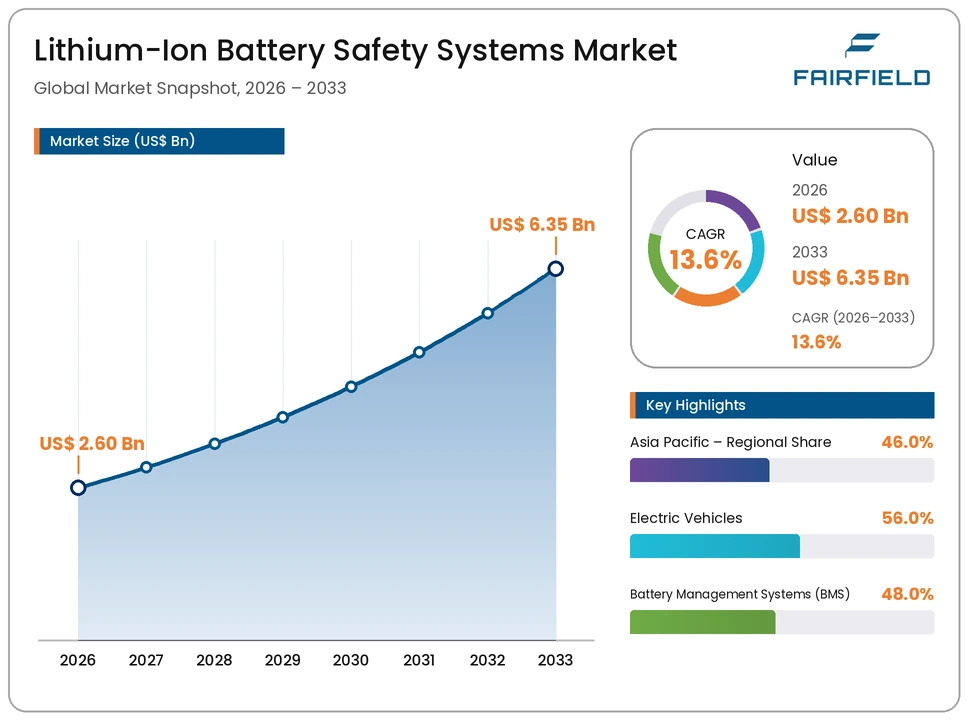
The market is valued at USD 2.60 Billion in 2026, with technology providers directing investment toward integrated monitoring, thermal management, and suppression systems that address the full spectrum of thermal runaway risk across the battery lifecycle. By 2033, the market is forecast to reach USD 6.35 Billion, reflecting rapid growth across established electric vehicle applications alongside expanding energy storage system safety requirements.
Key Highlights
- The global lithium-ion battery safety systems market is valued at USD 2.60 Billion in 2026 and is projected to reach USD 6.35 Billion by 2033, expanding at a CAGR of 13.6% across the 2026-2033 forecast period.
- Battery Management Systems (BMS) lead the product-type segment with a 48.0% share in 2026, equivalent to USD 1.25 Billion.
- Electric Vehicles remain the dominant application, accounting for 56.0% of global demand, or USD 1.46 Billion, in 2026.
- Asia Pacific commands the largest regional share at 46.0% of the global market in 2026.
- Energy storage sy<p><img alt="lithium-ion-battery-safety-systems-market" src= "https://admin.fairfieldmarketresearch.com/public/uploads/tineMceFile/lithium-ion-battery-safety-systems-market.webp" style="height: auto; width:700px" /></p>
stem applications are emerging as the fastest-growing application through 2033.
Key Growth Drivers
Growth in the lithium-ion battery safety systems market is driven primarily by accelerating global electric vehicle production, as automakers increasingly integrate sophisticated battery management and thermal management systems to meet both regulatory safety requirements and consumer confidence expectations regarding electric vehicle fire risk.
A second driver is rapid expansion of grid-scale and commercial energy storage deployment, where battery fire incidents can result in substantial property damage and safety risk, creating strong operator and insurer demand for comprehensive safety system integration including advanced monitoring, thermal management, and fire suppression technology.
Key Restraints
The additional cost associated with comprehensive battery safety system integration creates a competitive consideration for cost-sensitive applications, requiring manufacturers to balance safety system sophistication against overall battery pack cost targets, particularly in price-competitive electric vehicle and consumer electronics segments.
Additionally, the technical complexity of integrating multiple safety subsystems, including monitoring, thermal management, and suppression technology, into a coordinated safety architecture requires significant engineering investment and can extend product development timelines.
Market Opportunities
The expansion of energy storage system safety requirements presents a substantial opportunity, as rapid growth in grid-scale and commercial battery storage deployment creates sustained demand for advanced safety systems addressing the unique fire risk management challenges of large-format, high-density battery installations.
A second opportunity lies in the continued development of integrated, intelligent safety systems that combine real-time monitoring, predictive analytics, and automated response capability into a unified safety architecture. Providers that successfully advance this integration stand to capture growing demand as safety system sophistication becomes an increasingly important competitive differentiator.
Segmentation Analysis
By Product Type
Battery Management Systems (BMS) lead the product-type segment, accounting for 48.0% of global market value in 2026, equivalent to USD 1.25 Billion. Their leadership reflects BMS technology's foundational role in monitoring cell voltage, temperature, and current to prevent conditions that could lead to thermal runaway. Thermal Management Systems represent a significant, established product-type category. Fire Suppression & Detection Systems represent the fastest-growing product-type category through 2033, driven by heightened emphasis on mitigating fire risk consequences beyond prevention alone.
By Application
Electric Vehicles form the leading application segment, representing 56.0% of global demand in 2026, or USD 1.46 Billion, reflecting the scale of global electric vehicle production and the critical safety requirements associated with vehicle battery systems. Consumer Electronics represents a significant, established application area. Energy Storage Systems represent the fastest-growing application category, propelled by rapid growth in grid-scale and commercial battery storage deployment.
Regional Insights
Asia Pacific
Asia Pacific holds the largest regional share, at 46.0% of the global market in 2026, equivalent to USD 1.20 Billion. The region's dominance reflects its position as the world's largest battery and electric vehicle manufacturing base, led by China, South Korea, and Japan.
North America
North America accounts for 26.0% of the global market in 2026, valued at USD 0.68 Billion. Demand is supported by expanding electric vehicle and energy storage deployment alongside tightening battery safety regulatory standards across the United States and Canada.
Europe
Europe represents 21.0% of the global market in 2026, or USD 0.55 Billion. Steady demand is supported by rigorous battery safety certification requirements and expanding electric vehicle production across major European markets.
Latin America
Latin America contributes 4.0% of the global market in 2026, equivalent to USD 0.10 Billion. Growth is linked to gradually expanding electric vehicle and energy storage deployment in Brazil and Mexico.
Middle East & Africa
Middle East & Africa holds 3.0% of the global market in 2026, valued at USD 0.08 Billion. Growth remains gradual, tied to expanding energy storage deployment across the region.
Competitive Landscape
The global lithium-ion battery safety systems market is moderately concentrated, with a limited number of established electronics, semiconductor, and industrial technology companies holding strong positions supported by advanced monitoring and control technology and long-standing automotive and energy storage industry relationships. Competition centers on safety system integration sophistication, fault detection speed and accuracy, and the ability to provide comprehensive solutions spanning monitoring, thermal management, and suppression technology. Companies are increasingly differentiating through intelligent, predictive safety architecture rather than competing on individual component pricing alone.
Key Market Players
- Eaton Corporation plc
- Johnson Matthey plc
- BASF SE
- Amphenol Corporation
- Sensata Technologies Holding plc
- NXP Semiconductors N.V.
- Texas Instruments Incorporated
- Analog Devices, Inc.
- Robert Bosch GmbH
- Panasonic Corporation
Market Segmentation
By Product Type
- Battery Management Systems (BMS)
- Thermal Management Systems
- Fire Suppression & Detection Systems
- Others
By Application
- Electric Vehicles
- Energy Storage Systems
- Consumer Electronics
- Others
By Battery Chemistry
- Lithium Iron Phosphate (LFP)
- Nickel-Based Chemistries (NMC/NCA)
By Geography
- North America
- Europe
- Asia Pacific
- Latin America
- Middle East & Africa
- Executive Summary
- Global Lithium-Ion Battery Safety Systems Market Snapshot
- Future Projections
- Key Market Trends
- Regional Snapshot, by Value, 2026
- Analyst Recommendations
- Market Overview
- Market Definitions and Segmentations
- Market Dynamics
- Drivers
- Restraints
- Market Opportunities
- Value Chain Analysis
- COVID-19 Impact Analysis
- Porter's Five Forces Analysis
- Impact of Russia-Ukraine Conflict
- PESTLE Analysis
- Regulatory Analysis
- Price Trend Analysis
- Current Prices and Future Projections, 2025-2033
- Price Impact Factors
- Global Lithium-Ion Battery Safety Systems Market Outlook, 2020 - 2033
- Global Lithium-Ion Battery Safety Systems Market Outlook, by Product Type, Value (US$ Mn), 2020-2033
- Battery Management Systems (BMS)
- Thermal Management Systems
- Fire Suppression & Detection Systems
- Others
- Global Lithium-Ion Battery Safety Systems Market Outlook, by Application, Value (US$ Mn), 2020-2033
- Electric Vehicles
- Energy Storage Systems
- Consumer Electronics
- Others
- Global Lithium-Ion Battery Safety Systems Market Outlook, by Battery Chemistry, Value (US$ Mn), 2020-2033
- Lithium Iron Phosphate (LFP)
- Nickel-Based Chemistries (NMC/NCA)
- Global Lithium-Ion Battery Safety Systems Market Outlook, by Region, Value (US$ Mn), 2020-2033
- North America
- Europe
- Asia Pacific
- Latin America
- Middle East & Africa
- Global Lithium-Ion Battery Safety Systems Market Outlook, by Product Type, Value (US$ Mn), 2020-2033
- North America Lithium-Ion Battery Safety Systems Market Outlook, 2020 - 2033
- North America Lithium-Ion Battery Safety Systems Market Outlook, by Product Type, Value (US$ Mn), 2020-2033
- Battery Management Systems (BMS)
- Thermal Management Systems
- Fire Suppression & Detection Systems
- Others
- North America Lithium-Ion Battery Safety Systems Market Outlook, by Application, Value (US$ Mn), 2020-2033
- Electric Vehicles
- Energy Storage Systems
- Consumer Electronics
- Others
- North America Lithium-Ion Battery Safety Systems Market Outlook, by Battery Chemistry, Value (US$ Mn), 2020-2033
- Lithium Iron Phosphate (LFP)
- Nickel-Based Chemistries (NMC/NCA)
- North America Lithium-Ion Battery Safety Systems Market Outlook, by Country, Value (US$ Mn), 2020-2033
- U.S. Lithium-Ion Battery Safety Systems Market Outlook, by Product Type, 2020-2033
- U.S. Lithium-Ion Battery Safety Systems Market Outlook, by Application, 2020-2033
- U.S. Lithium-Ion Battery Safety Systems Market Outlook, by Battery Chemistry, 2020-2033
- Canada Lithium-Ion Battery Safety Systems Market Outlook, by Product Type, 2020-2033
- Canada Lithium-Ion Battery Safety Systems Market Outlook, by Application, 2020-2033
- Canada Lithium-Ion Battery Safety Systems Market Outlook, by Battery Chemistry, 2020-2033
- BPS Analysis/Market Attractiveness Analysis
- North America Lithium-Ion Battery Safety Systems Market Outlook, by Product Type, Value (US$ Mn), 2020-2033
- Europe Lithium-Ion Battery Safety Systems Market Outlook, 2020 - 2033
- Europe Lithium-Ion Battery Safety Systems Market Outlook, by Product Type, Value (US$ Mn), 2020-2033
- Battery Management Systems (BMS)
- Thermal Management Systems
- Fire Suppression & Detection Systems
- Others
- Europe Lithium-Ion Battery Safety Systems Market Outlook, by Application, Value (US$ Mn), 2020-2033
- Electric Vehicles
- Energy Storage Systems
- Consumer Electronics
- Others
- Europe Lithium-Ion Battery Safety Systems Market Outlook, by Battery Chemistry, Value (US$ Mn), 2020-2033
- Lithium Iron Phosphate (LFP)
- Nickel-Based Chemistries (NMC/NCA)
- Europe Lithium-Ion Battery Safety Systems Market Outlook, by Country, Value (US$ Mn), 2020-2033
- Germany Lithium-Ion Battery Safety Systems Market Outlook, by Product Type, 2020-2033
- Germany Lithium-Ion Battery Safety Systems Market Outlook, by Application, 2020-2033
- Germany Lithium-Ion Battery Safety Systems Market Outlook, by Battery Chemistry, 2020-2033
- Italy Lithium-Ion Battery Safety Systems Market Outlook, by Product Type, 2020-2033
- Italy Lithium-Ion Battery Safety Systems Market Outlook, by Application, 2020-2033
- Italy Lithium-Ion Battery Safety Systems Market Outlook, by Battery Chemistry, 2020-2033
- France Lithium-Ion Battery Safety Systems Market Outlook, by Product Type, 2020-2033
- France Lithium-Ion Battery Safety Systems Market Outlook, by Application, 2020-2033
- France Lithium-Ion Battery Safety Systems Market Outlook, by Battery Chemistry, 2020-2033
- U.K. Lithium-Ion Battery Safety Systems Market Outlook, by Product Type, 2020-2033
- U.K. Lithium-Ion Battery Safety Systems Market Outlook, by Application, 2020-2033
- U.K. Lithium-Ion Battery Safety Systems Market Outlook, by Battery Chemistry, 2020-2033
- Spain Lithium-Ion Battery Safety Systems Market Outlook, by Product Type, 2020-2033
- Spain Lithium-Ion Battery Safety Systems Market Outlook, by Application, 2020-2033
- Spain Lithium-Ion Battery Safety Systems Market Outlook, by Battery Chemistry, 2020-2033
- Russia Lithium-Ion Battery Safety Systems Market Outlook, by Product Type, 2020-2033
- Russia Lithium-Ion Battery Safety Systems Market Outlook, by Application, 2020-2033
- Russia Lithium-Ion Battery Safety Systems Market Outlook, by Battery Chemistry, 2020-2033
- Rest of Europe Lithium-Ion Battery Safety Systems Market Outlook, by Product Type, 2020-2033
- Rest of Europe Lithium-Ion Battery Safety Systems Market Outlook, by Application, 2020-2033
- Rest of Europe Lithium-Ion Battery Safety Systems Market Outlook, by Battery Chemistry, 2020-2033
- BPS Analysis/Market Attractiveness Analysis
- Europe Lithium-Ion Battery Safety Systems Market Outlook, by Product Type, Value (US$ Mn), 2020-2033
- Asia Pacific Lithium-Ion Battery Safety Systems Market Outlook, 2020 - 2033
- Asia Pacific Lithium-Ion Battery Safety Systems Market Outlook, by Product Type, Value (US$ Mn), 2020-2033
- Battery Management Systems (BMS)
- Thermal Management Systems
- Fire Suppression & Detection Systems
- Others
- Asia Pacific Lithium-Ion Battery Safety Systems Market Outlook, by Application, Value (US$ Mn), 2020-2033
- Electric Vehicles
- Energy Storage Systems
- Consumer Electronics
- Others
- Asia Pacific Lithium-Ion Battery Safety Systems Market Outlook, by Battery Chemistry, Value (US$ Mn), 2020-2033
- Lithium Iron Phosphate (LFP)
- Nickel-Based Chemistries (NMC/NCA)
- Asia Pacific Lithium-Ion Battery Safety Systems Market Outlook, by Country, Value (US$ Mn), 2020-2033
- China Lithium-Ion Battery Safety Systems Market Outlook, by Product Type, 2020-2033
- China Lithium-Ion Battery Safety Systems Market Outlook, by Application, 2020-2033
- China Lithium-Ion Battery Safety Systems Market Outlook, by Battery Chemistry, 2020-2033
- Japan Lithium-Ion Battery Safety Systems Market Outlook, by Product Type, 2020-2033
- Japan Lithium-Ion Battery Safety Systems Market Outlook, by Application, 2020-2033
- Japan Lithium-Ion Battery Safety Systems Market Outlook, by Battery Chemistry, 2020-2033
- South Korea Lithium-Ion Battery Safety Systems Market Outlook, by Product Type, 2020-2033
- South Korea Lithium-Ion Battery Safety Systems Market Outlook, by Application, 2020-2033
- South Korea Lithium-Ion Battery Safety Systems Market Outlook, by Battery Chemistry, 2020-2033
- India Lithium-Ion Battery Safety Systems Market Outlook, by Product Type, 2020-2033
- India Lithium-Ion Battery Safety Systems Market Outlook, by Application, 2020-2033
- India Lithium-Ion Battery Safety Systems Market Outlook, by Battery Chemistry, 2020-2033
- Southeast Asia Lithium-Ion Battery Safety Systems Market Outlook, by Product Type, 2020-2033
- Southeast Asia Lithium-Ion Battery Safety Systems Market Outlook, by Application, 2020-2033
- Southeast Asia Lithium-Ion Battery Safety Systems Market Outlook, by Battery Chemistry, 2020-2033
- Rest of SAO Lithium-Ion Battery Safety Systems Market Outlook, by Product Type, 2020-2033
- Rest of SAO Lithium-Ion Battery Safety Systems Market Outlook, by Application, 2020-2033
- Rest of SAO Lithium-Ion Battery Safety Systems Market Outlook, by Battery Chemistry, 2020-2033
- BPS Analysis/Market Attractiveness Analysis
- Asia Pacific Lithium-Ion Battery Safety Systems Market Outlook, by Product Type, Value (US$ Mn), 2020-2033
- Latin America Lithium-Ion Battery Safety Systems Market Outlook, 2020 - 2033
- Latin America Lithium-Ion Battery Safety Systems Market Outlook, by Product Type, Value (US$ Mn), 2020-2033
- Battery Management Systems (BMS)
- Thermal Management Systems
- Fire Suppression & Detection Systems
- Others
- Latin America Lithium-Ion Battery Safety Systems Market Outlook, by Application, Value (US$ Mn), 2020-2033
- Electric Vehicles
- Energy Storage Systems
- Consumer Electronics
- Others
- Latin America Lithium-Ion Battery Safety Systems Market Outlook, by Battery Chemistry, Value (US$ Mn), 2020-2033
- Lithium Iron Phosphate (LFP)
- Nickel-Based Chemistries (NMC/NCA)
- Latin America Lithium-Ion Battery Safety Systems Market Outlook, by Country, Value (US$ Mn), 2020-2033
- Brazil Lithium-Ion Battery Safety Systems Market Outlook, by Product Type, 2020-2033
- Brazil Lithium-Ion Battery Safety Systems Market Outlook, by Application, 2020-2033
- Brazil Lithium-Ion Battery Safety Systems Market Outlook, by Battery Chemistry, 2020-2033
- Mexico Lithium-Ion Battery Safety Systems Market Outlook, by Product Type, 2020-2033
- Mexico Lithium-Ion Battery Safety Systems Market Outlook, by Application, 2020-2033
- Mexico Lithium-Ion Battery Safety Systems Market Outlook, by Battery Chemistry, 2020-2033
- Argentina Lithium-Ion Battery Safety Systems Market Outlook, by Product Type, 2020-2033
- Argentina Lithium-Ion Battery Safety Systems Market Outlook, by Application, 2020-2033
- Argentina Lithium-Ion Battery Safety Systems Market Outlook, by Battery Chemistry, 2020-2033
- Rest of LATAM Lithium-Ion Battery Safety Systems Market Outlook, by Product Type, 2020-2033
- Rest of LATAM Lithium-Ion Battery Safety Systems Market Outlook, by Application, 2020-2033
- Rest of LATAM Lithium-Ion Battery Safety Systems Market Outlook, by Battery Chemistry, 2020-2033
- BPS Analysis/Market Attractiveness Analysis
- Latin America Lithium-Ion Battery Safety Systems Market Outlook, by Product Type, Value (US$ Mn), 2020-2033
- Middle East & Africa Lithium-Ion Battery Safety Systems Market Outlook, 2020 - 2033
- Middle East & Africa Lithium-Ion Battery Safety Systems Market Outlook, by Product Type, Value (US$ Mn), 2020-2033
- Battery Management Systems (BMS)
- Thermal Management Systems
- Fire Suppression & Detection Systems
- Others
- Middle East & Africa Lithium-Ion Battery Safety Systems Market Outlook, by Application, Value (US$ Mn), 2020-2033
- Electric Vehicles
- Energy Storage Systems
- Consumer Electronics
- Others
- Middle East & Africa Lithium-Ion Battery Safety Systems Market Outlook, by Battery Chemistry, Value (US$ Mn), 2020-2033
- Lithium Iron Phosphate (LFP)
- Nickel-Based Chemistries (NMC/NCA)
- Middle East & Africa Lithium-Ion Battery Safety Systems Market Outlook, by Country, Value (US$ Mn), 2020-2033
- GCC Lithium-Ion Battery Safety Systems Market Outlook, by Product Type, 2020-2033
- GCC Lithium-Ion Battery Safety Systems Market Outlook, by Application, 2020-2033
- GCC Lithium-Ion Battery Safety Systems Market Outlook, by Battery Chemistry, 2020-2033
- South Africa Lithium-Ion Battery Safety Systems Market Outlook, by Product Type, 2020-2033
- South Africa Lithium-Ion Battery Safety Systems Market Outlook, by Application, 2020-2033
- South Africa Lithium-Ion Battery Safety Systems Market Outlook, by Battery Chemistry, 2020-2033
- Egypt Lithium-Ion Battery Safety Systems Market Outlook, by Product Type, 2020-2033
- Egypt Lithium-Ion Battery Safety Systems Market Outlook, by Application, 2020-2033
- Egypt Lithium-Ion Battery Safety Systems Market Outlook, by Battery Chemistry, 2020-2033
- Nigeria Lithium-Ion Battery Safety Systems Market Outlook, by Product Type, 2020-2033
- Nigeria Lithium-Ion Battery Safety Systems Market Outlook, by Application, 2020-2033
- Nigeria Lithium-Ion Battery Safety Systems Market Outlook, by Battery Chemistry, 2020-2033
- Rest of Middle East Lithium-Ion Battery Safety Systems Market Outlook, by Product Type, 2020-2033
- Rest of Middle East Lithium-Ion Battery Safety Systems Market Outlook, by Application, 2020-2033
- Rest of Middle East Lithium-Ion Battery Safety Systems Market Outlook, by Battery Chemistry, 2020-2033
- BPS Analysis/Market Attractiveness Analysis
- Middle East & Africa Lithium-Ion Battery Safety Systems Market Outlook, by Product Type, Value (US$ Mn), 2020-2033
- Competitive Landscape
- Company Vs Segment Heatmap
- Company Market Share Analysis, 2025
- Competitive Dashboard
- Company Profiles
- Eaton Corporation plc
- Company Overview
- Product Portfolio
- Financial Overview
- Business Strategies and Developments
- Johnson Matthey plc
- BASF SE
- Amphenol Corporation
- Sensata Technologies Holding plc
- NXP Semiconductors N.V.
- Texas Instruments Incorporated
- Analog Devices, Inc.
- Robert Bosch GmbH
- Panasonic Corporation
- Eaton Corporation plc
- Appendix
- Research Methodology
- Report Assumptions
- Acronyms and Abbreviations
By Product Type
- Battery Management Systems (BMS)
- Thermal Management Systems
- Fire Suppression & Detection Systems
- Others
By Application
- Electric Vehicles
- Energy Storage Systems
- Consumer Electronics
- Others
By Battery Chemistry
- Lithium Iron Phosphate (LFP)
- Nickel-Based Chemistries (NMC/NCA)
By Geography
- North America
- Europe
- Asia Pacific
- Latin America
- Middle East & Africa
Our Research Methodology
Considering the volatility of business today, traditional approaches to strategizing a game plan can be unfruitful if not detrimental. True ambiguity is no way to determine a forecast. A myriad of predetermined factors must be accounted for such as the degree of risk involved, the magnitude of circumstances, as well as conditions or consequences that are not known or unpredictable. To circumvent binary views that cast uncertainty, the application of market research intelligence to strategically posture, move, and enable actionable outcomes is necessary.
View Methodology
Quality Assured
Rigorous Validation Process

Confidentiality Assured
End-to-end Data Security

Custom Research Services
Tailored To Your Objectives
FAQs
The global lithium-ion battery safety systems market is valued at USD 2.60 Billion in 2026, reflecting rising safety system investment across electric vehicle and energy storage applications.
The market is projected to grow at a CAGR of 13.6%, reaching USD 6.35 Billion by 2033, driven by expanding electric vehicle production and tightening safety regulations.
Battery Management Systems (BMS) lead with a 48.0% share in 2026, reflecting their foundational role in preventing thermal runaway conditions.
Asia Pacific leads with a 46.0% share in 2026, driven by its position as the world's largest battery and electric vehicle manufacturing base.
The largest opportunity lies in energy storage system applications, expanding alongside rapid growth in grid-scale and commercial battery storage deployment.
Related Reports
Knee High Boots Market Size, Share, Insights, Competitive Landscape, and Forecast 2026 to 2033
The global knee high boots market is valued at US$18.7 billion in 2026, reaching US$26.4 billion by 2033, growing at a 5.05% CAGR
Drop Shipping Market Size, Share, Insights, Competitive Landscape, and Forecast 2026 to 2033
The global drop shipping market is valued at US$420.0 billion in 2026, reaching US$985.0 billion by 2033, growing at a 12.95% CAGR
Esports Arenas Market Size, Share, Insights, Competitive Landscape, and Forecast 2026 to 2033
Esports Arenas Market to reach US$6.5 Bn by 2033, growing at 14.0% CAGR, driven by esports events, venue upgrades, and broadcast infrastructure.
Automated Tape Application Systems (ATAS) Market Size, Share, Insights, Competitive Landscape, and Forecast 2026 to 2033
The Automated Tape Application Systems market, valued at US$ 0.46 billion in 2026, and projected to reach US$ 0.82 billion by 2033 at an 8.6% CAGR.
Surf Parks Market Size, Share, Insights, Competitive Landscape, and Forecast 2026 to 2033
Surf Parks Market to reach US$4.1 Bn by 2033, growing at 16.59% CAGR, driven by wave technology, resort development, and tourism investment.
Golf Simulator Lounges Market Size, Share, Insights, Competitive Landscape, and Forecast 2026 to 2033
Golf Simulator Lounges Market to reach US$14.8 Bn by 2033, growing at 13.24% CAGR, driven by indoor golf, memberships, and social play.