



Micro-mobility Charging Infrastructure Market
Micro-mobility Charging Infrastructure Market Size, Share, Insights, Competitive Landscape, and Forecast 2026 to 2033
Micro-mobility Charging Infrastructure Market Size and Trend Analysis
How Fast Is the Micro-mobility Charging Infrastructure Market Growing?
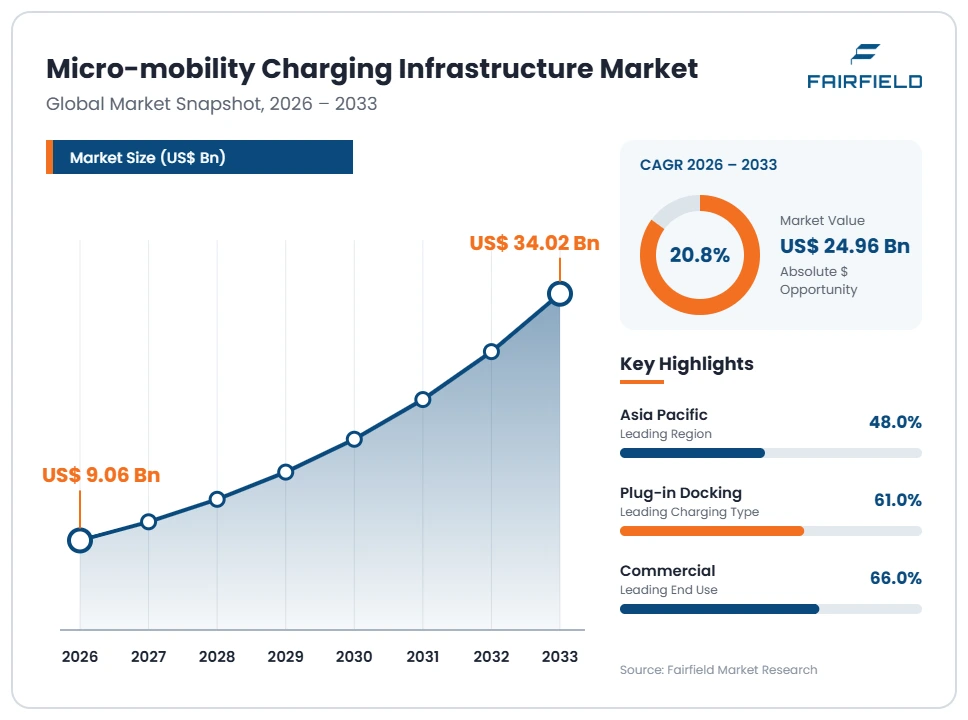
The global micro-mobility charging infrastructure market size is expected to be valued at US$ 9.06 billion in 2026 and projected to reach US$ 34.02 billion by 2033, growing at a CAGR of 20.8% between 2026 and 2033.
Between 2020 and 2025, the market grew at a CAGR of about 17.5%, as electric scooters, e-bikes, and shared fleets spread rapidly through cities, food delivery and quick-commerce riders switched to electric two-wheelers, and governments funded clean urban transport. Micro-mobility charging infrastructure includes public charging docks, e-bike and e-scooter charging hubs, battery swapping stations, home and workplace chargers, solar-powered stations, and the software that manages them. Reliable charging reduces range anxiety, keeps shared fleets available, and cuts the fire risk of charging batteries indoors. Growth comes from e-scooter charging demand in Asia Pacific, e-bike charging stations in Europe and North America, and battery-as-a-service models for delivery fleets. The market is shifting toward swap networks and smart docks. In July 2026, Battery Smart secured over US$ 13 million in debt financing to expand its network of more than 1,600 swap stations in India.
Key Report Takeaways
- By Vehicle Type: E-Scooters held 52.0% share in 2026, while E-Bikes are projected to expand at a 22.6% CAGR through 2033, driven by cargo e-bikes, bike-share fleets, and commuter adoption that need secure public and workplace charging points.
- By Charging Type: Plug-in Docking held 61.0% share in 2026, while Battery Swapping is projected to expand at a 24.8% CAGR through 2033, driven by delivery fleets, electric rickshaws, and two-wheeler riders who need minimal downtime.
- By End Use: Commercial held 66.0% share in 2026, while Residential is projected to expand at a 21.9% CAGR through 2033, driven by apartment charging rooms, safer storage rules, and rising private ownership of e-bikes and scooters.
- By Region: Asia Pacific held 48.0% share in 2026, while India is projected to expand at a 24.5% CAGR through 2033, driven by electric two-wheeler and three-wheeler adoption, battery-as-a-service networks, and government incentives.
Global Micro-mobility Charging Infrastructure Market Trends and Insights
Drivers Impact Analysis
Two drivers carry the strongest influence on micro-mobility charging infrastructure demand during the forecast period.
| Driver | Impact on CAGR Forecast | Geographic Relevance | Impact Timeline |
| Rapid adoption of electric two-wheelers and e-bikes | High | Global | Long term (≥4 years) |
| Delivery fleet electrification and battery-as-a-service | High | Asia Pacific, Europe | Medium term (2–4 years) |
Electric Two-Wheeler Adoption Is Driving the Micro-mobility Charging Infrastructure Market
Rapid adoption of electric two-wheelers and e-bikes is the strongest driver of the micro-mobility charging infrastructure market. More vehicles need more places to charge.
The mechanism is a growing installed base of battery-powered vehicles. Electric scooters and motorcycles now make up a large share of new two-wheeler sales in China, Taiwan, and India, while e-bikes outsell electric cars in several European countries. Shared e-scooter and e-bike fleets operate in hundreds of cities. Riders in dense apartments often cannot charge safely at home, creating demand for public hubs. Governments in India, France, Germany, and Indonesia subsidize electric two-wheelers and charging. Ather Energy has built its own fast-charging grid for scooter owners, and Gogoro operates more than 2,700 GoStation locations. These trends steadily expand the need for micro-mobility charging infrastructure.
Fleet Electrification Is Expanding the Micro-mobility Charging Infrastructure Market
Delivery fleet electrification and battery-as-a-service are expanding the micro-mobility charging infrastructure market. Commercial riders cannot wait hours to charge.
The cause is fast growth in food delivery, parcel delivery, and quick commerce. Delivery riders cover long daily distances and need batteries recharged in minutes. Battery swapping stations let riders exchange a depleted pack for a full one in about two minutes. Battery-as-a-service models remove the battery cost from the vehicle price, making electric scooters and three-wheelers affordable. Battery Smart has grown to more than 1,600 stations across more than 70 cities in India. Platforms such as Zomato, Swiggy, and Amazon set fleet electrification targets. These fleet needs create dense, high-use charging networks with strong utilization.
Restraints Impact Analysis
Two restraints limit how quickly the micro-mobility charging infrastructure market grows.
| Restraint | Impact on CAGR Forecast | Geographic Relevance | Impact Timeline |
| Lack of standardization across batteries and connectors | High | Global | Long term (≥4 years) |
| Space constraints, permitting, and battery safety concerns | Medium | North America, Europe | Medium term (2–4 years) |
Lack of Standards Slows the Micro-mobility Charging Infrastructure Market
Lack of standardization across batteries and connectors slows the micro-mobility charging infrastructure market. Many vehicles cannot share chargers.
The specific causes are proprietary designs. E-scooter and e-bike makers use different battery shapes, voltages, connectors, and communication protocols. Swap stations usually serve only one brand or a small group of partners, which limits utilization and forces duplicate networks. Shared fleet operators often use their own charging systems. Without common standards, cities hesitate to fund public hubs that may become obsolete. India and Taiwan are working on swap standards, and Gogoro licenses its platform to other makers, but progress is slow. Riders who switch vehicle brands may lose access to their usual stations, which reduces loyalty to any one network. Investors also worry about stranded assets if a dominant standard emerges. These gaps increase costs and slow network growth.
Safety and Space Concerns Restrict the Micro-mobility Charging Infrastructure Market
Space constraints, permitting, and battery safety concerns restrict the micro-mobility charging infrastructure market. Cities have limited sidewalk space.
The underlying causes are crowded streets and fire risk. Installing charging docks needs sidewalk or curb space, power connections, and permits from city agencies, which can take months. Lithium-ion battery fires from poor-quality e-bikes have led cities such as New York and London to tighten rules on indoor charging and storage. Landlords and transit operators may restrict charging in buildings. Vandalism and theft add costs. Shared fleet operators have faced financial pressure and market exits. Insurers are raising premiums for buildings that allow indoor battery charging. Grid connection costs in older districts can be high. These issues slow deployment, especially in dense cities across North America and Europe.
Market Opportunities
Battery Swapping Networks Open a Fast-Growth Revenue Pool
Battery swapping networks open a fast-growth revenue pool in the micro-mobility charging infrastructure market. Swapping fits high-use vehicles.
Network operators, vehicle makers, and energy companies can capture this opportunity. Swap stations serve electric scooters, motorcycles, and three-wheelers in India, Taiwan, Indonesia, Vietnam, and Kenya. Subscription and pay-per-swap models create recurring revenue. Gogoro plans to invest about NT$ 1 billion to add more than 100 swap stations and expects its swap business to reach profitability in 2026. Partnerships with oil companies and vehicle makers, such as Gogoro’s venture with Castrol BP in Vietnam, widen reach. Debt financing from impact investors supports rapid rollout. Companies that build dense, reliable swap networks can become the energy backbone for two-wheeler transport.
Smart Docks and Safe Charging Create an Urban Revenue Pool
Smart docks and safe charging create an urban revenue pool in the micro-mobility charging infrastructure market. Cities need safer, tidier charging.
Equipment makers and property owners can capture this opportunity. Smart docks charge shared and private e-scooters and e-bikes, lock them securely, and keep sidewalks clear. Fire-resistant charging lockers in apartment buildings and offices address battery fire concerns. Solar-powered stations reduce grid connection costs. Transit agencies add charging to bike parking at stations. Swiftmile, Bikeep, Perch Mobility, and The Mobility House offer solutions. Software platforms that manage charging, reservations, payments, and battery health add recurring revenue. Insurance companies and fire departments increasingly recommend certified charging solutions. Companies that partner with cities, landlords, and transit agencies can win long-term contracts and steady service income.
Segment Analysis
- By Vehicle Type: E-Scooters Lead While E-Bikes Grow Fastest
E-Scooters held 52.0% share in 2026. This category includes kick scooters and electric two-wheeler scooters and mopeds, which dominate in Asia Pacific. Large swap and fast-charging networks from Gogoro, Ather Energy, and Battery Smart serve this segment, along with charging hubs for shared kick scooters.
E-Bikes are the fastest-growing vehicle type, expanding at a 22.6% CAGR through 2033. E-bike sales are rising quickly in Europe and North America, including cargo e-bikes for delivery. Riders need secure e-bike charging stations at offices, transit stations, and apartments. E-unicycles and e-skateboards are smaller niche segments. For the market, e-bike growth extends demand to commuters and businesses.
- By Charging Type: Plug-in Docking Leads While Battery Swapping Grows Fastest
Plug-in Docking held 61.0% share in 2026. Wired chargers, docks, and charging lockers are simple, flexible, and used for home, workplace, and public charging. Owners of private e-bikes and scooters usually charge with plug-in chargers, and shared fleets use docks that charge vehicles while parked. Ather Energy’s fast-charging grid and Swiftmile’s docks are examples.
Battery Swapping is the fastest-growing charging type, expanding at a 24.8% CAGR through 2033. Swap stations minimize downtime for delivery riders and taxi operators. Swapping also lets operators manage battery health centrally, extending battery life and improving safety. Wireless and inductive charging, offered by firms such as Magment, is an emerging option for shared fleets. For the market, swapping growth supports high-utilization commercial use.
- By End Use: Commercial Leads While Residential Grows Fastest
Commercial held 66.0% share in 2026. Shared fleets, delivery operators, swap networks, transit hubs, offices, and retail locations make up most spending. Commercial sites see high usage and can earn revenue from charging fees, subscriptions, and advertising. Employers add e-bike charging to support green commuting goals.
Residential is the fastest-growing end use, expanding at a 21.9% CAGR through 2033. Apartment buildings add charging rooms and fire-resistant storage for residents’ e-bikes and scooters, often required by new safety rules. Homeowners buy wall-mounted chargers and smart plugs that stop charging when batteries are full. Developers of new apartment projects in Europe and Asia Pacific increasingly include shared charging rooms as a standard feature. For the market, residential growth broadens demand beyond fleets.
Geography Analysis
- Why Is North America Important to the Micro-mobility Charging Infrastructure Market?
North America is important because it has a large shared micro-mobility market, strong e-bike sales, and companies such as Swiftmile, Lime, and Bird. New York, San Francisco, Washington, and Chicago have large e-bike delivery workforces, and New York has funded safe public charging for delivery workers after battery fires. Federal and state programs support e-bike rebates. Canada adds demand, with Montreal, Toronto, and Vancouver running large bike-share systems. Key barriers include permitting and the financial struggles of shared fleet operators. One change shaping the region is safety-focused charging hubs.
- Europe Expands the Micro-mobility Charging Infrastructure Market Through Cycling Policy
Europe is a major micro-mobility charging infrastructure market. Germany, the Netherlands, France, the United Kingdom, and Italy have strong e-bike adoption and shared fleets from Voi, Tier, Lime, and Bolt. Cities build mobility hubs with charging near transit stations, and Paris, Amsterdam, and Copenhagen invest heavily in cycling infrastructure. Bike-share systems increasingly use electric bikes that need docked charging. Battery fire concerns have led to stricter building rules. Key barriers include space limits and slow permitting. One opportunity is cargo e-bike charging for last-mile delivery hubs.
- Which Region Is Leading the Micro-mobility Charging Infrastructure Market?
Asia Pacific is leading the micro-mobility charging infrastructure market with a 48.0% share in 2026. China has the world’s largest electric two-wheeler fleet, and Taiwan hosts Gogoro’s dense swap network. India is the fastest-growing country, expanding at a 24.5% CAGR through 2033, with Battery Smart, Ather Energy, and Sun Mobility building networks. Indonesia and Vietnam are adopting swapping, with Gogoro working with Castrol BP in Vietnam. Japan and South Korea add demand for e-bike and shared scooter charging. Key barriers include fragmented standards. One change shaping the region is battery-as-a-service.
- Latin America Grows the Micro-mobility Charging Infrastructure Market Through Urban Delivery
Latin America is a growing market. Brazil, Mexico, Colombia, and Chile have rising e-scooter and e-bike use for commuting and delivery. São Paulo, Mexico City, and Bogotá run large bike-share programs, some with electric bikes. Delivery apps are encouraging riders to switch from gasoline motorcycles to electric models, which need fast charging or swap stations. Startups are testing battery swapping for delivery fleets in large cities, often with support from local governments and development banks. Key barriers include high import costs and limited financing. One opportunity is delivery fleets that need dense charging networks.
- Middle East & Africa Develops the Micro-mobility Charging Infrastructure Market Through Swap Networks
Middle East & Africa is a developing market. Kenya, Rwanda, Uganda, and Nigeria use battery swapping for electric motorcycle taxis, which carry millions of passengers daily and benefit from lower fuel costs. Startups such as Spiro, Ampersand, and Roam are building swap stations, some powered partly by solar energy. The United Arab Emirates and Saudi Arabia support shared e-scooters in Dubai, Abu Dhabi, and Riyadh. Key barriers include limited financing, low incomes, and unreliable grid power in many areas. One change shaping the region is the growth of swap networks for commercial riders.
Competitive Landscape
The micro-mobility charging infrastructure market is fragmented. Gogoro, Battery Smart, Ather Energy, Swiftmile, and Bosch are leading players, while ABB, Siemens, Schneider Electric, The Mobility House, Bikeep, Perch Mobility, and Magment compete. Many local startups build swap and charging networks in single countries or cities, often backed by venture capital, debt funds, and development finance institutions. Vehicle makers such as Ather Energy, Hero MotoCorp, and Yamaha also invest in charging and swapping to support their scooter sales.
Companies compete on network density, uptime, swap speed, safety, price, and partnerships with vehicle makers, fleets, and cities. Swap networks benefit from scale, because more stations attract more riders and raise utilization. Large equipment makers such as Bosch, ABB, and Siemens supply chargers, power electronics, and battery systems to network operators, landlords, and cities.
Strategic moves show how competition is changing. In February 2026, Gogoro reported more than 2,700 GoStation locations. In April 2026, Battery Smart raised US$ 15 million from Mirova. In July 2026, Battery Smart secured over US$ 13 million more. These moves show competition shifting toward large, well-financed swap networks that can reach profitability through high utilization.
Three themes shape vendor strategy. First, companies are expanding swap networks into new cities and countries. Second, they are forming partnerships with vehicle makers, oil companies, and delivery platforms. Third, they are improving safety with certified chargers, fire-resistant lockers, and battery monitoring.
Recent Industry Developments
- July 2026: Battery Smart secured over US$ 13 million in debt financing from responsAbility to expand its network of more than 1,600 swap stations across more than 70 cities – accelerates battery swapping in India.
- April 2026: Battery Smart raised US$ 15 million in debt funding from Mirova to add swap stations in urban and semi-urban areas – strengthens battery-as-a-service for delivery fleets.
- February 2026: Gogoro reported more than 2,700 GoStation locations and over 800 million cumulative swaps, and expects its swap business to reach profitability in 2026 – shows scale of e-scooter charging networks.
Companies Covered in the Report
- Gogoro
- Battery Smart
- Ather Energy
- Swiftmile
- Bosch
- ABB
- Siemens
- Schneider Electric
- The Mobility House
- Bikeep
- Perch Mobility
- Magment
Micro-mobility Charging Infrastructure Market Report Scope
| Metric | Value |
| Study Period | 2020–2033 |
| Market Size 2026 | US$ 9.06 Billion |
| Market Size 2033 | US$ 34.02 Billion |
| CAGR 2026–2033 | 20.8% |
| Absolute Dollar Opportunity | US$ 24.96 Billion |
| Largest Market | Asia Pacific |
| Fastest-Growing Market | India |
| Market Concentration | Fragmented |
| Major Players | Gogoro, Battery Smart, Ather Energy, Swiftmile, Bosch |
Micro-mobility Charging Infrastructure Market Segmentation
Vehicle Type
- E-Scooters
- E-Bikes
- E-Unicycles
- E-Skateboards
Charging Type
- Plug-in Docking
- Battery Swapping
- Wireless
End Use
- Commercial
- Residential
Regions
- North America
- Europe
- Asia Pacific
- Latin America
- Middle East & Africa
- Executive Summary
- Global Micro-mobility Charging Infrastructure Market Snapshot
- Future Projections
- Key Report Takeaways
- Regional Snapshot
- Market Overview
- Market Definition and Report Scope
- Historical Trends 2020–2025
- Market Dynamics
- Drivers
- Electric Two-Wheeler Adoption Is Driving the Micro-mobility Charging Infrastructure Market
- Fleet Electrification Is Expanding the Micro-mobility Charging Infrastructure Market
- Restraints
- Lack of Standards Slows the Micro-mobility Charging Infrastructure Market
- Safety and Space Concerns Restrict the Micro-mobility Charging Infrastructure Market
- Market Opportunities
- Battery Swapping Networks Open a Fast-Growth Revenue Pool
- Smart Docks and Safe Charging Create an Urban Revenue Pool
- Drivers
- Global Micro-mobility Charging Infrastructure Market Outlook, 2020-2033
- Global Micro-mobility Charging Infrastructure Market Outlook, by Vehicle Type, Value (US$ Billion), 2020-2033
- E-Scooters
- E-Bikes
- E-Unicycles
- E-Skateboards
- Global Micro-mobility Charging Infrastructure Market Outlook, by Charging Type, Value (US$ Billion), 2020-2033
- Plug-in Docking
- Battery Swapping
- Wireless
- Global Micro-mobility Charging Infrastructure Market Outlook, by End Use, Value (US$ Billion), 2020-2033
- Commercial
- Residential
- Global Micro-mobility Charging Infrastructure Market Outlook, by Region, Value (US$ Billion), 2020-2033
- North America
- Europe
- Asia Pacific
- Latin America
- Middle East & Africa
- Global Micro-mobility Charging Infrastructure Market Outlook, by Vehicle Type, Value (US$ Billion), 2020-2033
- North America Micro-mobility Charging Infrastructure Market Outlook, 2020-2033
- North America Micro-mobility Charging Infrastructure Market Outlook, by Vehicle Type, Value (US$ Billion), 2020-2033
- E-Scooters
- E-Bikes
- E-Unicycles
- E-Skateboards
- North America Micro-mobility Charging Infrastructure Market Outlook, by Charging Type, Value (US$ Billion), 2020-2033
- Plug-in Docking
- Battery Swapping
- Wireless
- North America Micro-mobility Charging Infrastructure Market Outlook, by End Use, Value (US$ Billion), 2020-2033
- Commercial
- Residential
- North America Micro-mobility Charging Infrastructure Market Outlook, by Country, Value (US$ Billion), 2020-2033
- Canada Micro-mobility Charging Infrastructure Market Outlook, by Vehicle Type, 2020-2033
- Canada Micro-mobility Charging Infrastructure Market Outlook, by Charging Type, 2020-2033
- Canada Micro-mobility Charging Infrastructure Market Outlook, by End Use, 2020-2033
- North America Micro-mobility Charging Infrastructure Market Outlook, by Vehicle Type, Value (US$ Billion), 2020-2033
- Europe Micro-mobility Charging Infrastructure Market Outlook, 2020-2033
- Europe Micro-mobility Charging Infrastructure Market Outlook, by Vehicle Type, Value (US$ Billion), 2020-2033
- E-Scooters
- E-Bikes
- E-Unicycles
- E-Skateboards
- Europe Micro-mobility Charging Infrastructure Market Outlook, by Charging Type, Value (US$ Billion), 2020-2033
- Plug-in Docking
- Battery Swapping
- Wireless
- Europe Micro-mobility Charging Infrastructure Market Outlook, by End Use, Value (US$ Billion), 2020-2033
- Commercial
- Residential
- Europe Micro-mobility Charging Infrastructure Market Outlook, by Country, Value (US$ Billion), 2020-2033
- Germany Micro-mobility Charging Infrastructure Market Outlook, by Vehicle Type, 2020-2033
- Germany Micro-mobility Charging Infrastructure Market Outlook, by Charging Type, 2020-2033
- Germany Micro-mobility Charging Infrastructure Market Outlook, by End Use, 2020-2033
- Netherlands Micro-mobility Charging Infrastructure Market Outlook, by Vehicle Type, 2020-2033
- Netherlands Micro-mobility Charging Infrastructure Market Outlook, by Charging Type, 2020-2033
- Netherlands Micro-mobility Charging Infrastructure Market Outlook, by End Use, 2020-2033
- France Micro-mobility Charging Infrastructure Market Outlook, by Vehicle Type, 2020-2033
- France Micro-mobility Charging Infrastructure Market Outlook, by Charging Type, 2020-2033
- France Micro-mobility Charging Infrastructure Market Outlook, by End Use, 2020-2033
- United Kingdom Micro-mobility Charging Infrastructure Market Outlook, by Vehicle Type, 2020-2033
- United Kingdom Micro-mobility Charging Infrastructure Market Outlook, by Charging Type, 2020-2033
- United Kingdom Micro-mobility Charging Infrastructure Market Outlook, by End Use, 2020-2033
- Italy Micro-mobility Charging Infrastructure Market Outlook, by Vehicle Type, 2020-2033
- Italy Micro-mobility Charging Infrastructure Market Outlook, by Charging Type, 2020-2033
- Italy Micro-mobility Charging Infrastructure Market Outlook, by End Use, 2020-2033
- Europe Micro-mobility Charging Infrastructure Market Outlook, by Vehicle Type, Value (US$ Billion), 2020-2033
- Asia Pacific Micro-mobility Charging Infrastructure Market Outlook, 2020-2033
- Asia Pacific Micro-mobility Charging Infrastructure Market Outlook, by Vehicle Type, Value (US$ Billion), 2020-2033
- E-Scooters
- E-Bikes
- E-Unicycles
- E-Skateboards
- Asia Pacific Micro-mobility Charging Infrastructure Market Outlook, by Charging Type, Value (US$ Billion), 2020-2033
- Plug-in Docking
- Battery Swapping
- Wireless
- Asia Pacific Micro-mobility Charging Infrastructure Market Outlook, by End Use, Value (US$ Billion), 2020-2033
- Commercial
- Residential
- Asia Pacific Micro-mobility Charging Infrastructure Market Outlook, by Country, Value (US$ Billion), 2020-2033
- China Micro-mobility Charging Infrastructure Market Outlook, by Vehicle Type, 2020-2033
- China Micro-mobility Charging Infrastructure Market Outlook, by Charging Type, 2020-2033
- China Micro-mobility Charging Infrastructure Market Outlook, by End Use, 2020-2033
- Taiwan Micro-mobility Charging Infrastructure Market Outlook, by Vehicle Type, 2020-2033
- Taiwan Micro-mobility Charging Infrastructure Market Outlook, by Charging Type, 2020-2033
- Taiwan Micro-mobility Charging Infrastructure Market Outlook, by End Use, 2020-2033
- India Micro-mobility Charging Infrastructure Market Outlook, by Vehicle Type, 2020-2033
- India Micro-mobility Charging Infrastructure Market Outlook, by Charging Type, 2020-2033
- India Micro-mobility Charging Infrastructure Market Outlook, by End Use, 2020-2033
- Indonesia Micro-mobility Charging Infrastructure Market Outlook, by Vehicle Type, 2020-2033
- Indonesia Micro-mobility Charging Infrastructure Market Outlook, by Charging Type, 2020-2033
- Indonesia Micro-mobility Charging Infrastructure Market Outlook, by End Use, 2020-2033
- Vietnam Micro-mobility Charging Infrastructure Market Outlook, by Vehicle Type, 2020-2033
- Vietnam Micro-mobility Charging Infrastructure Market Outlook, by Charging Type, 2020-2033
- Vietnam Micro-mobility Charging Infrastructure Market Outlook, by End Use, 2020-2033
- Japan Micro-mobility Charging Infrastructure Market Outlook, by Vehicle Type, 2020-2033
- Japan Micro-mobility Charging Infrastructure Market Outlook, by Charging Type, 2020-2033
- Japan Micro-mobility Charging Infrastructure Market Outlook, by End Use, 2020-2033
- South Korea Micro-mobility Charging Infrastructure Market Outlook, by Vehicle Type, 2020-2033
- South Korea Micro-mobility Charging Infrastructure Market Outlook, by Charging Type, 2020-2033
- South Korea Micro-mobility Charging Infrastructure Market Outlook, by End Use, 2020-2033
- Asia Pacific Micro-mobility Charging Infrastructure Market Outlook, by Vehicle Type, Value (US$ Billion), 2020-2033
- Latin America Micro-mobility Charging Infrastructure Market Outlook, 2020-2033
- Latin America Micro-mobility Charging Infrastructure Market Outlook, by Vehicle Type, Value (US$ Billion), 2020-2033
- E-Scooters
- E-Bikes
- E-Unicycles
- E-Skateboards
- Latin America Micro-mobility Charging Infrastructure Market Outlook, by Charging Type, Value (US$ Billion), 2020-2033
- Plug-in Docking
- Battery Swapping
- Wireless
- Latin America Micro-mobility Charging Infrastructure Market Outlook, by End Use, Value (US$ Billion), 2020-2033
- Commercial
- Residential
- Latin America Micro-mobility Charging Infrastructure Market Outlook, by Country, Value (US$ Billion), 2020-2033
- Brazil Micro-mobility Charging Infrastructure Market Outlook, by Vehicle Type, 2020-2033
- Brazil Micro-mobility Charging Infrastructure Market Outlook, by Charging Type, 2020-2033
- Brazil Micro-mobility Charging Infrastructure Market Outlook, by End Use, 2020-2033
- Mexico Micro-mobility Charging Infrastructure Market Outlook, by Vehicle Type, 2020-2033
- Mexico Micro-mobility Charging Infrastructure Market Outlook, by Charging Type, 2020-2033
- Mexico Micro-mobility Charging Infrastructure Market Outlook, by End Use, 2020-2033
- Colombia Micro-mobility Charging Infrastructure Market Outlook, by Vehicle Type, 2020-2033
- Colombia Micro-mobility Charging Infrastructure Market Outlook, by Charging Type, 2020-2033
- Colombia Micro-mobility Charging Infrastructure Market Outlook, by End Use, 2020-2033
- Chile Micro-mobility Charging Infrastructure Market Outlook, by Vehicle Type, 2020-2033
- Chile Micro-mobility Charging Infrastructure Market Outlook, by Charging Type, 2020-2033
- Chile Micro-mobility Charging Infrastructure Market Outlook, by End Use, 2020-2033
- Latin America Micro-mobility Charging Infrastructure Market Outlook, by Vehicle Type, Value (US$ Billion), 2020-2033
- Middle East & Africa Micro-mobility Charging Infrastructure Market Outlook, 2020-2033
- Middle East & Africa Micro-mobility Charging Infrastructure Market Outlook, by Vehicle Type, Value (US$ Billion), 2020-2033
- E-Scooters
- E-Bikes
- E-Unicycles
- E-Skateboards
- Middle East & Africa Micro-mobility Charging Infrastructure Market Outlook, by Charging Type, Value (US$ Billion), 2020-2033
- Plug-in Docking
- Battery Swapping
- Wireless
- Middle East & Africa Micro-mobility Charging Infrastructure Market Outlook, by End Use, Value (US$ Billion), 2020-2033
- Commercial
- Residential
- Middle East & Africa Micro-mobility Charging Infrastructure Market Outlook, by Country, Value (US$ Billion), 2020-2033
- Kenya Micro-mobility Charging Infrastructure Market Outlook, by Vehicle Type, 2020-2033
- Kenya Micro-mobility Charging Infrastructure Market Outlook, by Charging Type, 2020-2033
- Kenya Micro-mobility Charging Infrastructure Market Outlook, by End Use, 2020-2033
- Rwanda Micro-mobility Charging Infrastructure Market Outlook, by Vehicle Type, 2020-2033
- Rwanda Micro-mobility Charging Infrastructure Market Outlook, by Charging Type, 2020-2033
- Rwanda Micro-mobility Charging Infrastructure Market Outlook, by End Use, 2020-2033
- Uganda Micro-mobility Charging Infrastructure Market Outlook, by Vehicle Type, 2020-2033
- Uganda Micro-mobility Charging Infrastructure Market Outlook, by Charging Type, 2020-2033
- Uganda Micro-mobility Charging Infrastructure Market Outlook, by End Use, 2020-2033
- Nigeria Micro-mobility Charging Infrastructure Market Outlook, by Vehicle Type, 2020-2033
- Nigeria Micro-mobility Charging Infrastructure Market Outlook, by Charging Type, 2020-2033
- Nigeria Micro-mobility Charging Infrastructure Market Outlook, by End Use, 2020-2033
- United Arab Emirates Micro-mobility Charging Infrastructure Market Outlook, by Vehicle Type, 2020-2033
- United Arab Emirates Micro-mobility Charging Infrastructure Market Outlook, by Charging Type, 2020-2033
- United Arab Emirates Micro-mobility Charging Infrastructure Market Outlook, by End Use, 2020-2033
- Saudi Arabia Micro-mobility Charging Infrastructure Market Outlook, by Vehicle Type, 2020-2033
- Saudi Arabia Micro-mobility Charging Infrastructure Market Outlook, by Charging Type, 2020-2033
- Saudi Arabia Micro-mobility Charging Infrastructure Market Outlook, by End Use, 2020-2033
- Middle East & Africa Micro-mobility Charging Infrastructure Market Outlook, by Vehicle Type, Value (US$ Billion), 2020-2033
- Competitive Landscape
- Market Concentration and Industry Leaders
- Competitive Differentiation
- Strategic Moves and Market Direction
- Recent Industry Developments
- Company Profiles
- Gogoro
- Battery Smart
- Ather Energy
- Swiftmile
- Bosch
- ABB
- Siemens
- Schneider Electric
- The Mobility House
- Bikeep
- Perch Mobility
- Magment
- Appendix
- Research Methodology
- Report Assumptions
- Acronyms and Abbreviations
Vehicle Type
- E-Scooters
- E-Bikes
- E-Unicycles
- E-Skateboards
Charging Type
- Plug-in Docking
- Battery Swapping
- Wireless
End Use
- Commercial
- Residential
Regions
- North America
- Europe
- Asia Pacific
- Latin America
- Middle East & Africa
Our Research Methodology
Considering the volatility of business today, traditional approaches to strategizing a game plan can be unfruitful if not detrimental. True ambiguity is no way to determine a forecast. A myriad of predetermined factors must be accounted for such as the degree of risk involved, the magnitude of circumstances, as well as conditions or consequences that are not known or unpredictable. To circumvent binary views that cast uncertainty, the application of market research intelligence to strategically posture, move, and enable actionable outcomes is necessary.
View Methodology
Quality Assured
Rigorous Validation Process

Confidentiality Assured
End-to-end Data Security

Custom Research Services
Tailored To Your Objectives
FAQs
The micro-mobility charging infrastructure market is valued at US$ 9.06 billion in 2026, led by e-scooters and Asia Pacific.
The market is projected to reach US$ 34.02 billion by 2033, growing at a 20.8% CAGR and adding US$ 24.96 billion.
Battery swapping is growing fastest at a 24.8% CAGR through 2033, driven by delivery fleets needing minimal charging downtime.
India is growing fastest at a 24.5% CAGR through 2033, driven by electric two-wheeler adoption and battery-as-a-service networks.
Asia Pacific holds the largest share at 48.0% in 2026, supported by large electric two-wheeler fleets in China and India.
Related Reports
Off-highway Electric Vehicle Market Size, Share, Insights, Competitive Landscape, and Forecast 2026 to 2033
The global off-highway electric vehicle market is valued at US$3.64 billion in 2026, reaching US$10.11 billion by 2033, growing at a 15.7% CAGR
Leisure Boat Market Size, Share, Insights, Competitive Landscape, and Forecast 2026 to 2033
The leisure boat market is projected to grow from US$ 53.90 billion in 2026 to US$ 81.04 billion by 2033 at a 6.0% CAGR.
Hydrogen Aircraft Market Size, Share, Insights, Competitive Landscape, and Forecast 2026 to 2033
The hydrogen aircraft market is forecast to grow from US$ 1.20 billion in 2026 to US$ 7.60 billion by 2033 at a 33.6% CAGR.
Exhaust Flexible Couplings Market Size, Share, Insights, Competitive Landscape, and Forecast 2026 to 2033
The exhaust flexible couplings market is projected to grow from US$ 756.4 million in 2026 to US$ 1,057.3 million by 2033 at a 4.9% CAGR.
Automotive VVT System Market Size, Share, Insights, Competitive Landscape, and Forecast 2026 to 2033
The automotive VVT system market is projected to grow from US$ 77.20 billion in 2026 to US$ 118.42 billion by 2033 at a 6.3% CAGR.
Used Vehicle Market Size, Share, Insights, Competitive Landscape, and Forecast 2026 to 2033
The global used vehicle market is valued at US$1.7 trillion in 2026, reaching US$2.6 trillion by 2033, growing at a 6.3% CAGR