



Motor Driver IC Market
Motor Driver IC Market Insights, Competitive Landscape, and Market Forecast 2033
Market Overview
Motor driver ICs are semiconductor devices that translate control signals into the precise voltage and current outputs required to drive electric motors, serving as the interface between a system's control logic and its mechanical actuation. These integrated circuits underpin motor control across an expanding range of applications, from automotive power steering and cooling fans to industrial servo drives, consumer electronics, and home appliances, and have grown in sophistication alongside rising demand for energy-efficient, precisely controlled motor operation.
Demand growth through the 2026-2033 window is closely tied to the ongoing shift from brushed to brushless DC motor architectures across automotive and industrial equipment, driven by their superior efficiency and longevity, along with the broader electrification of vehicle subsystems and the rapid expansion of factory automation and robotics. Rising integration of motor control functions into compact, multi-axis systems is also pushing demand toward driver ICs offering higher levels of onboard protection, diagnostics, and communication capability.
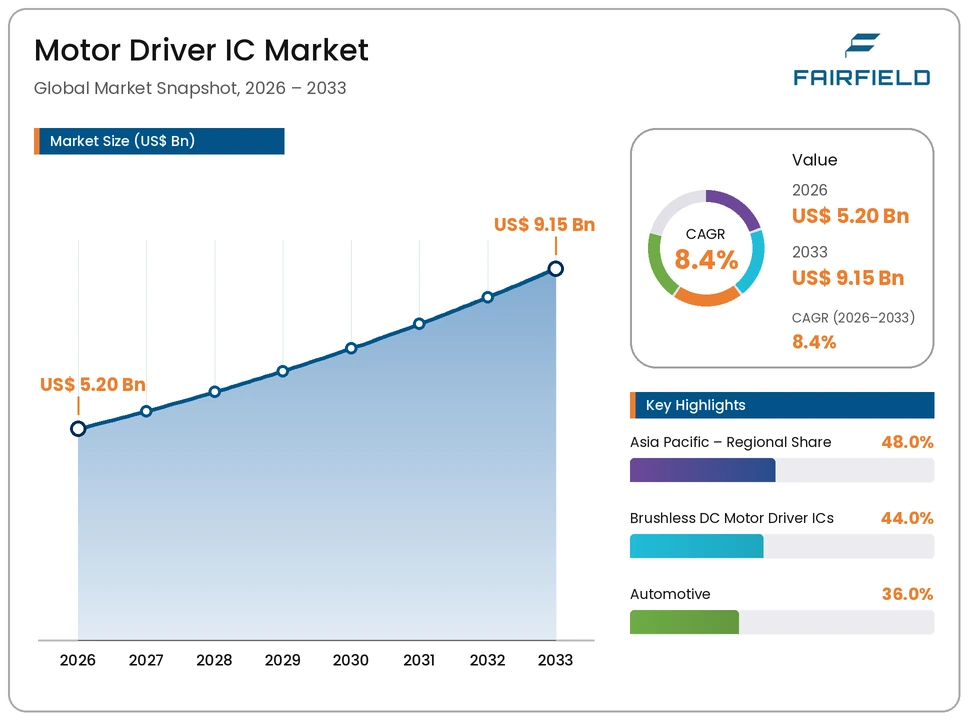
The market is valued at USD 5.20 Billion in 2026, with semiconductor manufacturers directing investment toward higher-voltage, higher-efficiency driver platforms suited to electric vehicle subsystems and industrial servo applications. By 2033, the market is forecast to reach USD 9.15 Billion, reflecting sustained growth in motor-driven systems across both established and emerging application areas.
Key Highlights
- The global motor driver IC market is valued at USD 5.20 Billion in 2026 and is projected to reach USD 9.15 Billion by 2033, expanding at a CAGR of 8.4% across the 2026-2033 forecast period.
- Brushless DC Motor Driver ICs lead the type segment with a 44.0% share in 2026, equivalent to USD 2.29 Billion.
- Automotive remains the dominant application, accounting for 36.0% of global demand, or USD 1.87 Billion, in 2026.
- Asia Pacific commands the largest regional share at 48.0% of the global market in 2026.
- Industrial automation and robotics applications are emerging as the fastest-growing demand pockets through 2033.
Market Dynamics
Key Growth Drivers
Growth in the motor driver IC market is driven primarily by the accelerating adoption of brushless DC motors across automotive and industrial applications, as their higher efficiency, reduced maintenance requirements, and longer operational life make them the preferred choice over brushed alternatives in an increasing share of new equipment designs. This transition requires more sophisticated driver ICs capable of managing commutation and speed control electronically rather than through mechanical brushes.
A second driver is the expansion of factory automation and robotics, where precise, responsive motor control is essential to functions such as robotic arm positioning, conveyor systems, and automated guided vehicles. As manufacturers scale automation deployments to address labor availability and productivity pressures, demand for compact, high-performance motor driver ICs capable of supporting multi-axis coordination continues to rise.
Key Restraints
Extended semiconductor design and qualification cycles, particularly for automotive-grade motor driver ICs that must meet stringent reliability and functional safety standards, slow the pace at which new products reach volume production, creating a persistent lag between technology development and commercial deployment. Suppliers face substantial upfront investment in qualification testing before automotive customers will approve components for use in vehicle programs.
Additionally, cyclical fluctuations in semiconductor demand and periodic supply chain disruptions affecting wafer fabrication and packaging capacity introduce volatility into motor driver IC availability and pricing, complicating long-term planning for both suppliers and equipment manufacturers that depend on consistent component supply.
Market Opportunities
The electrification of vehicle subsystems beyond the powertrain, including electric power steering, thermal management pumps, and seat and window actuation, presents a substantial opportunity for motor driver IC suppliers, as each additional electrified function within a vehicle requires dedicated motor control circuitry.
A second opportunity lies in the integration of advanced diagnostics, communication interfaces, and functional safety features directly into motor driver ICs, allowing equipment manufacturers to simplify system design while meeting increasingly stringent safety and reliability requirements. Suppliers that successfully combine these capabilities into compact, cost-effective packages are positioned to capture greater value per design win.
Segmentation Analysis
By Type
Brushless DC Motor Driver ICs lead the type segment, accounting for 44.0% of global market value in 2026, equivalent to USD 2.29 Billion. Their leadership reflects the broad shift toward brushless motor architectures across automotive and industrial applications seeking higher efficiency and reduced maintenance. Stepper Motor Driver ICs hold a meaningful secondary share, widely used in precision positioning applications such as printers, cameras, and industrial automation equipment. Brushed DC Motor Driver ICs, while still used in cost-sensitive applications, represent the slowest-growing type category as brushless alternatives continue to gain ground.
By Application
Automotive forms the leading application segment, representing 36.0% of global demand in 2026, or USD 1.87 Billion, driven by the growing number of electrified functions within modern vehicles. Industrial Automation forms the second-largest segment, supported by expanding robotics and factory automation deployment. Consumer Electronics and Home Appliances represent steady, mature applications, while industrial automation and robotics applications are the fastest-growing category through 2033, propelled by continued investment in manufacturing automation.
Regional Insights
Asia Pacific
Asia Pacific holds the largest regional share, at 48.0% of the global market in 2026, equivalent to USD 2.50 Billion. The region's dominance reflects its position as the global center of electronics manufacturing and assembly, led by China, Taiwan, South Korea, and Japan, alongside rapidly expanding automotive and industrial automation production. The region is also expected to post the fastest regional CAGR through 2033 as electric vehicle and automation investment continues to scale.
North America
North America accounts for 22.0% of the global market in 2026, valued at USD 1.14 Billion. Demand is supported by strong automotive electronics design activity and growing investment in industrial automation and robotics across manufacturing sectors seeking to address labor availability constraints.
Europe
Europe represents 20.0% of the global market in 2026, or USD 1.04 Billion. The region's advanced automotive manufacturing base and strong industrial automation sector, particularly in Germany, sustain steady demand for high-performance motor driver ICs supporting both vehicle electrification and factory automation applications.
Latin America
Latin America contributes 6.0% of the global market in 2026, equivalent to USD 0.31 Billion. Growth is linked to gradual expansion of automotive assembly operations in Brazil and Mexico alongside rising adoption of automated manufacturing equipment.
Middle East & Africa
Middle East & Africa holds 4.0% of the global market in 2026, valued at USD 0.21 Billion. Growth here remains limited relative to other regions, tied to selective industrial automation adoption and gradual expansion of electronics assembly operations in select markets.
Competitive Landscape
The global motor driver IC market is moderately concentrated, with a limited number of established semiconductor manufacturers holding strong positions across automotive and industrial-grade product lines, supported by long-standing design relationships and rigorous qualification track records. A broader base of suppliers competes across consumer and general-purpose motor driver segments, where design cycles are shorter and qualification requirements less stringent. Competition centers on power efficiency, integration of protection and diagnostic features, and the ability to meet automotive-grade reliability standards, with suppliers increasingly differentiating through higher levels of system-level integration rather than component pricing alone.
Market Segmentation
By Type
- Brushless DC Motor Driver ICs
- Stepper Motor Driver ICs
- Brushed DC Motor Driver ICs
By Voltage Range
- Below 12V
- 12V to 48V
- Above 48V
By Application
- Automotive
- Industrial Automation
- Consumer Electronics
- Home Appliances
- Others
By Geography
- North America
- Europe
- Asia Pacific
- Latin America
- Middle East & Africa
- Executive Summary
- Global Motor Driver IC Market Snapshot
- Future Projections
- Key Market Trends
- Regional Snapshot, by Value, 2026
- Analyst Recommendations
- Market Overview
- Market Definitions and Segmentations
- Market Dynamics
- Drivers
- Restraints
- Market Opportunities
- Value Chain Analysis
- COVID-19 Impact Analysis
- Porter's Five Forces Analysis
- Impact of Russia-Ukraine Conflict
- PESTLE Analysis
- Regulatory Analysis
- Price Trend Analysis
- Current Prices and Future Projections, 2025-2033
- Price Impact Factors
- Global Motor Driver IC Market Outlook, 2020 - 2033
- Global Motor Driver IC Market Outlook, by Type, Value (US$ Mn), 2020-2033
- Brushless DC Motor Driver ICs
- Stepper Motor Driver ICs
- Brushed DC Motor Driver ICs
- Global Motor Driver IC Market Outlook, by Voltage Range, Value (US$ Mn), 2020-2033
- Below 12V
- 12V to 48V
- Above 48V
- Global Motor Driver IC Market Outlook, by Application, Value (US$ Mn), 2020-2033
- Automotive
- Industrial Automation
- Consumer Electronics
- Home Appliances
- Others
- Global Motor Driver IC Market Outlook, by Region, Value (US$ Mn), 2020-2033
- North America
- Europe
- Asia Pacific
- Latin America
- Middle East & Africa
- Global Motor Driver IC Market Outlook, by Type, Value (US$ Mn), 2020-2033
- North America Motor Driver IC Market Outlook, 2020 - 2033
- North America Motor Driver IC Market Outlook, by Type, Value (US$ Mn), 2020-2033
- Brushless DC Motor Driver ICs
- Stepper Motor Driver ICs
- Brushed DC Motor Driver ICs
- North America Motor Driver IC Market Outlook, by Voltage Range, Value (US$ Mn), 2020-2033
- Below 12V
- 12V to 48V
- Above 48V
- North America Motor Driver IC Market Outlook, by Application, Value (US$ Mn), 2020-2033
- Automotive
- Industrial Automation
- Consumer Electronics
- Home Appliances
- Others
- North America Motor Driver IC Market Outlook, by Country, Value (US$ Mn), 2020-2033
- U.S. Motor Driver IC Market Outlook, by Type, 2020-2033
- U.S. Motor Driver IC Market Outlook, by Voltage Range, 2020-2033
- U.S. Motor Driver IC Market Outlook, by Application, 2020-2033
- Canada Motor Driver IC Market Outlook, by Type, 2020-2033
- Canada Motor Driver IC Market Outlook, by Voltage Range, 2020-2033
- Canada Motor Driver IC Market Outlook, by Application, 2020-2033
- BPS Analysis/Market Attractiveness Analysis
- North America Motor Driver IC Market Outlook, by Type, Value (US$ Mn), 2020-2033
- Europe Motor Driver IC Market Outlook, 2020 - 2033
- Europe Motor Driver IC Market Outlook, by Type, Value (US$ Mn), 2020-2033
- Brushless DC Motor Driver ICs
- Stepper Motor Driver ICs
- Brushed DC Motor Driver ICs
- Europe Motor Driver IC Market Outlook, by Voltage Range, Value (US$ Mn), 2020-2033
- Below 12V
- 12V to 48V
- Above 48V
- Europe Motor Driver IC Market Outlook, by Application, Value (US$ Mn), 2020-2033
- Automotive
- Industrial Automation
- Consumer Electronics
- Home Appliances
- Others
- Europe Motor Driver IC Market Outlook, by Country, Value (US$ Mn), 2020-2033
- Germany Motor Driver IC Market Outlook, by Type, 2020-2033
- Germany Motor Driver IC Market Outlook, by Voltage Range, 2020-2033
- Germany Motor Driver IC Market Outlook, by Application, 2020-2033
- Italy Motor Driver IC Market Outlook, by Type, 2020-2033
- Italy Motor Driver IC Market Outlook, by Voltage Range, 2020-2033
- Italy Motor Driver IC Market Outlook, by Application, 2020-2033
- France Motor Driver IC Market Outlook, by Type, 2020-2033
- France Motor Driver IC Market Outlook, by Voltage Range, 2020-2033
- France Motor Driver IC Market Outlook, by Application, 2020-2033
- U.K. Motor Driver IC Market Outlook, by Type, 2020-2033
- U.K. Motor Driver IC Market Outlook, by Voltage Range, 2020-2033
- U.K. Motor Driver IC Market Outlook, by Application, 2020-2033
- Spain Motor Driver IC Market Outlook, by Type, 2020-2033
- Spain Motor Driver IC Market Outlook, by Voltage Range, 2020-2033
- Spain Motor Driver IC Market Outlook, by Application, 2020-2033
- Russia Motor Driver IC Market Outlook, by Type, 2020-2033
- Russia Motor Driver IC Market Outlook, by Voltage Range, 2020-2033
- Russia Motor Driver IC Market Outlook, by Application, 2020-2033
- Rest of Europe Motor Driver IC Market Outlook, by Type, 2020-2033
- Rest of Europe Motor Driver IC Market Outlook, by Voltage Range, 2020-2033
- Rest of Europe Motor Driver IC Market Outlook, by Application, 2020-2033
- BPS Analysis/Market Attractiveness Analysis
- Europe Motor Driver IC Market Outlook, by Type, Value (US$ Mn), 2020-2033
- Asia Pacific Motor Driver IC Market Outlook, 2020 - 2033
- Asia Pacific Motor Driver IC Market Outlook, by Type, Value (US$ Mn), 2020-2033
- Brushless DC Motor Driver ICs
- Stepper Motor Driver ICs
- Brushed DC Motor Driver ICs
- Asia Pacific Motor Driver IC Market Outlook, by Voltage Range, Value (US$ Mn), 2020-2033
- Below 12V
- 12V to 48V
- Above 48V
- Asia Pacific Motor Driver IC Market Outlook, by Application, Value (US$ Mn), 2020-2033
- Automotive
- Industrial Automation
- Consumer Electronics
- Home Appliances
- Others
- Asia Pacific Motor Driver IC Market Outlook, by Country, Value (US$ Mn), 2020-2033
- China Motor Driver IC Market Outlook, by Type, 2020-2033
- China Motor Driver IC Market Outlook, by Voltage Range, 2020-2033
- China Motor Driver IC Market Outlook, by Application, 2020-2033
- Japan Motor Driver IC Market Outlook, by Type, 2020-2033
- Japan Motor Driver IC Market Outlook, by Voltage Range, 2020-2033
- Japan Motor Driver IC Market Outlook, by Application, 2020-2033
- South Korea Motor Driver IC Market Outlook, by Type, 2020-2033
- South Korea Motor Driver IC Market Outlook, by Voltage Range, 2020-2033
- South Korea Motor Driver IC Market Outlook, by Application, 2020-2033
- India Motor Driver IC Market Outlook, by Type, 2020-2033
- India Motor Driver IC Market Outlook, by Voltage Range, 2020-2033
- India Motor Driver IC Market Outlook, by Application, 2020-2033
- Southeast Asia Motor Driver IC Market Outlook, by Type, 2020-2033
- Southeast Asia Motor Driver IC Market Outlook, by Voltage Range, 2020-2033
- Southeast Asia Motor Driver IC Market Outlook, by Application, 2020-2033
- Rest of SAO Motor Driver IC Market Outlook, by Type, 2020-2033
- Rest of SAO Motor Driver IC Market Outlook, by Voltage Range, 2020-2033
- Rest of SAO Motor Driver IC Market Outlook, by Application, 2020-2033
- BPS Analysis/Market Attractiveness Analysis
- Asia Pacific Motor Driver IC Market Outlook, by Type, Value (US$ Mn), 2020-2033
- Latin America Motor Driver IC Market Outlook, 2020 - 2033
- Latin America Motor Driver IC Market Outlook, by Type, Value (US$ Mn), 2020-2033
- Brushless DC Motor Driver ICs
- Stepper Motor Driver ICs
- Brushed DC Motor Driver ICs
- Latin America Motor Driver IC Market Outlook, by Voltage Range, Value (US$ Mn), 2020-2033
- Below 12V
- 12V to 48V
- Above 48V
- Latin America Motor Driver IC Market Outlook, by Application, Value (US$ Mn), 2020-2033
- Automotive
- Industrial Automation
- Consumer Electronics
- Home Appliances
- Others
- Latin America Motor Driver IC Market Outlook, by Country, Value (US$ Mn), 2020-2033
- Brazil Motor Driver IC Market Outlook, by Type, 2020-2033
- Brazil Motor Driver IC Market Outlook, by Voltage Range, 2020-2033
- Brazil Motor Driver IC Market Outlook, by Application, 2020-2033
- Mexico Motor Driver IC Market Outlook, by Type, 2020-2033
- Mexico Motor Driver IC Market Outlook, by Voltage Range, 2020-2033
- Mexico Motor Driver IC Market Outlook, by Application, 2020-2033
- Argentina Motor Driver IC Market Outlook, by Type, 2020-2033
- Argentina Motor Driver IC Market Outlook, by Voltage Range, 2020-2033
- Argentina Motor Driver IC Market Outlook, by Application, 2020-2033
- Rest of LATAM Motor Driver IC Market Outlook, by Type, 2020-2033
- Rest of LATAM Motor Driver IC Market Outlook, by Voltage Range, 2020-2033
- Rest of LATAM Motor Driver IC Market Outlook, by Application, 2020-2033
- BPS Analysis/Market Attractiveness Analysis
- Latin America Motor Driver IC Market Outlook, by Type, Value (US$ Mn), 2020-2033
- Middle East & Africa Motor Driver IC Market Outlook, 2020 - 2033
- Middle East & Africa Motor Driver IC Market Outlook, by Type, Value (US$ Mn), 2020-2033
- Brushless DC Motor Driver ICs
- Stepper Motor Driver ICs
- Brushed DC Motor Driver ICs
- Middle East & Africa Motor Driver IC Market Outlook, by Voltage Range, Value (US$ Mn), 2020-2033
- Below 12V
- 12V to 48V
- Above 48V
- Middle East & Africa Motor Driver IC Market Outlook, by Application, Value (US$ Mn), 2020-2033
- Automotive
- Industrial Automation
- Consumer Electronics
- Home Appliances
- Others
- Middle East & Africa Motor Driver IC Market Outlook, by Country, Value (US$ Mn), 2020-2033
- GCC Motor Driver IC Market Outlook, by Type, 2020-2033
- GCC Motor Driver IC Market Outlook, by Voltage Range, 2020-2033
- GCC Motor Driver IC Market Outlook, by Application, 2020-2033
- South Africa Motor Driver IC Market Outlook, by Type, 2020-2033
- South Africa Motor Driver IC Market Outlook, by Voltage Range, 2020-2033
- South Africa Motor Driver IC Market Outlook, by Application, 2020-2033
- Egypt Motor Driver IC Market Outlook, by Type, 2020-2033
- Egypt Motor Driver IC Market Outlook, by Voltage Range, 2020-2033
- Egypt Motor Driver IC Market Outlook, by Application, 2020-2033
- Nigeria Motor Driver IC Market Outlook, by Type, 2020-2033
- Nigeria Motor Driver IC Market Outlook, by Voltage Range, 2020-2033
- Nigeria Motor Driver IC Market Outlook, by Application, 2020-2033
- Rest of Middle East Motor Driver IC Market Outlook, by Type, 2020-2033
- Rest of Middle East Motor Driver IC Market Outlook, by Voltage Range, 2020-2033
- Rest of Middle East Motor Driver IC Market Outlook, by Application, 2020-2033
- BPS Analysis/Market Attractiveness Analysis
- Middle East & Africa Motor Driver IC Market Outlook, by Type, Value (US$ Mn), 2020-2033
- Competitive Landscape
- Company Vs Segment Heatmap
- Company Market Share Analysis, 2025
- Competitive Dashboard
- Company Profiles
- Texas Instruments Incorporated
- Company Overview
- Product Portfolio
- Financial Overview
- Business Strategies and Developments
- STMicroelectronics N.V.
- Infineon Technologies AG
- onsemi
- Renesas Electronics Corporation
- Toshiba Corporation
- ROHM Co., Ltd.
- Analog Devices, Inc.
- Allegro MicroSystems, Inc.
- Microchip Technology Incorporated
- Texas Instruments Incorporated
- Appendix
- Research Methodology
- Report Assumptions
- Acronyms and Abbreviations
By Type
- Brushless DC Motor Driver ICs
- Stepper Motor Driver ICs
- Brushed DC Motor Driver ICs
By Voltage Range
- Below 12V
- 12V to 48V
- Above 48V
By Application
- Automotive
- Industrial Automation
- Consumer Electronics
- Home Appliances
- Others
By Geography
- North America
- Europe
- Asia Pacific
- Latin America
- Middle East & Africa
Our Research Methodology
Considering the volatility of business today, traditional approaches to strategizing a game plan can be unfruitful if not detrimental. True ambiguity is no way to determine a forecast. A myriad of predetermined factors must be accounted for such as the degree of risk involved, the magnitude of circumstances, as well as conditions or consequences that are not known or unpredictable. To circumvent binary views that cast uncertainty, the application of market research intelligence to strategically posture, move, and enable actionable outcomes is necessary.
View Methodology
Quality Assured
Rigorous Validation Process

Confidentiality Assured
End-to-end Data Security

Custom Research Services
Tailored To Your Objectives
FAQs
The global motor driver IC market is valued at USD 5.20 Billion in 2026, reflecting rising demand for efficient motor control across automotive and industrial applications.
The market is projected to grow at a CAGR of 8.4%, reaching USD 9.15 Billion by 2033, driven by vehicle electrification and factory automation expansion.
Brushless DC Motor Driver ICs lead with a 44.0% share in 2026, supported by the broad shift toward more efficient, longer-lasting motor architectures.
Asia Pacific leads with a 48.0% share in 2026, driven by its position as the global center of electronics and automotive manufacturing.
The largest opportunity lies in the electrification of vehicle subsystems beyond the powertrain, where each new electrified function requires dedicated motor control circuitry.
Related Reports
Intelligent Power Module for AWHP Market Size, Share, Insights, Competitive Landscape, and Forecast 2026 to 2033
Intelligent Power Module for AWHP market is projected to grow from US$0.89 billion in 2026 to US$2.34 billion by 2033, at a CAGR of 14.8%.
LTE & 5G NR-based CBRS Networks Market Size, Share, Insights, Competitive Landscape, and Forecast 2026 to 2033
The LTE & 5G NR-based CBRS Networks market in 2026, valued at US$ 3.4 billion and projected to reach US$ 13.2 billion by 2033, growing at a 21.4% CAGR.
GPS Player Tracking Systems Market Size, Share, Insights, Competitive Landscape, and Forecast 2026 to 2033
GPS Player Tracking Systems Market to reach US$3.3 Bn by 2033, growing at 12.5% CAGR, driven by sports analytics,and performance monitoring.
Smart Watch and Smart Ring LED Market Size, Share, Insights, Competitive Landscape, and Forecast 2026 to 2033
The global smartwatch and smart ring LED market will reach US$ 8.00 Bn by 2033, growing at 15.6% CAGR, driven by wearable adoption and health monitoring
Data Center LV/MV Power Distribution Market Size, Share, Insights, Competitive Landscape, and Forecast 2026 to 2033
The global data center LV/MV power distribution market will reach US$ 62.0 Bn by 2033, growing at 11.8% CAGR, driven by data center demand and AI growth
Perimeter Sensing Satellites Market Size, Share, Insights, Competitive Landscape, and Forecast 2026 to 2033
The blue GIS technologies market is projected to reach US$9.7592 billion by 2033, growing at a 12.8% CAGR from US$4.2 billion in 2026