



Nephrology Drugs Market
Nephrology Drugs Market Insights, Competitive Landscape, and Market Forecast 2033
Market Overview
Nephrology drugs encompass the pharmaceutical treatments used to manage chronic kidney disease progression, end-stage renal disease complications, and associated conditions including anemia and mineral bone disorder, spanning established drug classes such as erythropoiesis-stimulating agents and phosphate binders alongside newer therapeutic approaches including SGLT2 inhibitors and oral hypoxia-inducible factor prolyl hydroxylase inhibitors. As the global burden of chronic kidney disease continues to rise alongside diabetes and hypertension prevalence, the nephrology drug market has evolved substantially beyond traditional dialysis-supportive therapies toward disease-modifying treatments that slow kidney function decline.
Demand growth through the 2026-2033 window is closely tied to rising global chronic kidney disease prevalence driven by increasing diabetes and hypertension rates worldwide, expanding clinical evidence and regulatory approval supporting SGLT2 inhibitor use specifically for kidney disease progression beyond their original diabetes indication, and continued innovation in anemia management therapies offering oral treatment alternatives to traditional injectable erythropoiesis-stimulating agents. Growing nephrology specialist and primary care awareness of early CKD detection and intervention continues to expand the treated patient population eligible for disease-modifying nephrology drug therapy.
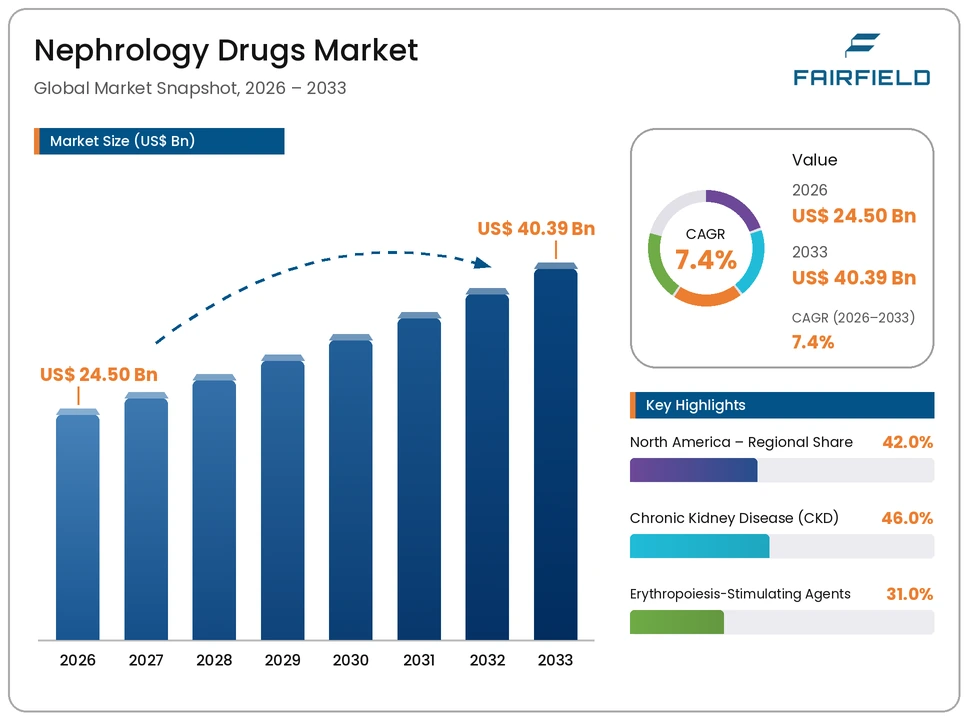
The market is valued at USD 24.50 Billion in 2026, with pharmaceutical companies directing substantial research investment toward novel disease-modifying therapies that address kidney disease progression beyond symptomatic and supportive care approaches. By 2033, the market is forecast to reach USD 40.39 Billion, reflecting steady growth across established CKD treatment applications alongside rapidly expanding anemia of CKD therapy innovation.
Key Highlights
- The global nephrology drugs market is valued at USD 24.50 Billion in 2026 and is projected to reach USD 40.39 Billion by 2033, expanding at a CAGR of 7.4% across the 2026-2033 forecast period.
- Erythropoiesis-Stimulating Agents (ESAs) lead the drug-class segment with a 31.0% share in 2026, equivalent to USD 7.60 Billion.
- Chronic Kidney Disease (CKD) remains the dominant indication, accounting for 46.0% of global demand, or USD 11.27 Billion, in 2026.
- North America commands the largest regional share at 42.0% of the global market in 2026.
- Anemia of CKD treatment is emerging as the fastest-growing indication through 2033.
Market Dynamics
Key Growth Drivers
Growth in the nephrology drugs market is driven primarily by rising global chronic kidney disease prevalence, as increasing diabetes and hypertension rates worldwide continue to expand the population at risk for progressive kidney function decline, directly increasing demand for both disease-modifying and supportive nephrology drug therapies.
A second driver is expanding clinical evidence and regulatory approval supporting SGLT2 inhibitor use for kidney disease progression, as this drug class, originally developed for diabetes management, has demonstrated significant kidney protective benefits that have driven rapid adoption expansion into broader CKD treatment populations beyond diabetic patients alone.
Key Restraints
The substantial cost of newer nephrology drug therapies, particularly novel disease-modifying treatments, creates access and reimbursement challenges in many healthcare systems, potentially limiting broader patient population access relative to established, lower-cost supportive care therapies.
Additionally, the chronic, progressive nature of kidney disease requires long-term treatment adherence and monitoring, creating ongoing patient management challenges that can affect real-world treatment outcomes relative to clinical trial efficacy results.
Market Opportunities
The expansion of anemia of CKD treatment innovation presents a substantial opportunity, as newer oral hypoxia-inducible factor prolyl hydroxylase inhibitor therapies offer patients a more convenient treatment alternative to traditional injectable erythropoiesis-stimulating agents, creating significant potential for market share migration and expanded treatment adoption.
A second opportunity lies in continued development of additional disease-modifying nephrology therapies that further slow kidney disease progression, reducing the population ultimately requiring dialysis or transplantation. Companies that successfully advance this therapeutic innovation pipeline stand to address a substantial unmet medical need across the growing chronic kidney disease patient population.
Segmentation Analysis
By Drug Class
Erythropoiesis-Stimulating Agents (ESAs) lead the drug-class segment, accounting for 31.0% of global market value in 2026, equivalent to USD 7.60 Billion. Their leadership reflects ESAs' long-established role as the standard treatment for anemia associated with chronic kidney disease across both dialysis and non-dialysis patient populations. Phosphate Binders represent a significant, established drug-class category. SGLT2 Inhibitors represent the fastest-growing drug-class category through 2033, driven by rapidly expanding clinical evidence supporting their kidney protective benefits.
By Indication
Chronic Kidney Disease (CKD) forms the leading indication segment, representing 46.0% of global demand in 2026, or USD 11.27 Billion, reflecting the scale of the global CKD patient population and expanding availability of disease-modifying treatment options. End-Stage Renal Disease (ESRD)/Dialysis represents a significant, established indication category. Anemia of CKD represents the fastest-growing indication category, propelled by innovation in oral anemia management therapies offering improved patient convenience.
Regional Insights
North America
North America holds the largest regional share, at 42.0% of the global market in 2026, equivalent to USD 10.29 Billion. The region's leadership reflects high chronic kidney disease prevalence, strong nephrology specialist infrastructure, and rapid adoption of newer disease-modifying therapies across the United States and Canada.
Europe
Europe accounts for 26.0% of the global market in 2026, valued at USD 6.37 Billion. Demand is supported by comprehensive healthcare systems and well-established nephrology treatment protocols across major European markets.
Asia Pacific
Asia Pacific represents 22.0% of the global market in 2026, or USD 5.39 Billion. Growth is underpinned by rapidly rising chronic kidney disease prevalence and expanding healthcare access across China, Japan, and India.
Latin America
Latin America contributes 6.0% of the global market in 2026, equivalent to USD 1.47 Billion. Growth is linked to rising kidney disease prevalence and gradually expanding healthcare access in Brazil and Mexico.
Middle East & Africa
Middle East & Africa holds 4.0% of the global market in 2026, valued at USD 0.98 Billion. Growth remains at an early stage, tied to gradual expansion of nephrology treatment infrastructure across the region.
Competitive Landscape
The global nephrology drugs market is moderately concentrated, with a limited number of large pharmaceutical companies holding strong positions supported by extensive research and development investment and established nephrology specialist relationships. Competition centers on clinical efficacy demonstrating disease progression benefits, breadth of treatment portfolio across CKD stages and complications, and the ability to secure favorable reimbursement for newer, higher-cost therapies. Companies are increasingly differentiating through disease-modifying therapeutic innovation rather than competing on established supportive care therapy pricing alone.
Key Market Players
- AstraZeneca plc
- Bayer AG
- Amgen Inc.
- Vertex Pharmaceuticals Incorporated
- GSK plc
- Otsuka Pharmaceutical Co., Ltd.
- Fresenius Medical Care AG & Co. KGaA
- Novartis AG
- Boehringer Ingelheim International GmbH
- CSL Limited
Market Segmentation
By Drug Class
- Erythropoiesis-Stimulating Agents (ESAs)
- SGLT2 Inhibitors
- Phosphate Binders
- Others
By Indication
- Chronic Kidney Disease (CKD)
- End-Stage Renal Disease (ESRD)/Dialysis
- Anemia of CKD
- Others
By Route of Administration
- Oral
- Injectable
By Geography
- North America
- Europe
- Asia Pacific
- Latin America
- Middle East & Africa
- Executive Summary
- Global Nephrology Drugs Market Snapshot
- Future Projections
- Key Market Trends
- Regional Snapshot, by Value, 2026
- Analyst Recommendations
- Market Overview
- Market Definitions and Segmentations
- Market Dynamics
- Drivers
- Restraints
- Market Opportunities
- Value Chain Analysis
- COVID-19 Impact Analysis
- Porter's Five Forces Analysis
- Impact of Russia-Ukraine Conflict
- PESTLE Analysis
- Regulatory Analysis
- Price Trend Analysis
- Current Prices and Future Projections, 2025-2033
- Price Impact Factors
- Global Nephrology Drugs Market Outlook, 2020 - 2033
- Global Nephrology Drugs Market Outlook, by Drug Class, Value (US$ Mn), 2020-2033
- Erythropoiesis-Stimulating Agents (ESAs)
- SGLT2 Inhibitors
- Phosphate Binders
- Others
- Global Nephrology Drugs Market Outlook, by Indication, Value (US$ Mn), 2020-2033
- Chronic Kidney Disease (CKD)
- End-Stage Renal Disease (ESRD)/Dialysis
- Anemia of CKD
- Others
- Global Nephrology Drugs Market Outlook, by Route of Administration, Value (US$ Mn), 2020-2033
- Oral
- Injectable
- Global Nephrology Drugs Market Outlook, by Region, Value (US$ Mn), 2020-2033
- North America
- Europe
- Asia Pacific
- Latin America
- Middle East & Africa
- Global Nephrology Drugs Market Outlook, by Drug Class, Value (US$ Mn), 2020-2033
- North America Nephrology Drugs Market Outlook, 2020 - 2033
- North America Nephrology Drugs Market Outlook, by Drug Class, Value (US$ Mn), 2020-2033
- Erythropoiesis-Stimulating Agents (ESAs)
- SGLT2 Inhibitors
- Phosphate Binders
- Others
- North America Nephrology Drugs Market Outlook, by Indication, Value (US$ Mn), 2020-2033
- Chronic Kidney Disease (CKD)
- End-Stage Renal Disease (ESRD)/Dialysis
- Anemia of CKD
- Others
- North America Nephrology Drugs Market Outlook, by Route of Administration, Value (US$ Mn), 2020-2033
- Oral
- Injectable
- North America Nephrology Drugs Market Outlook, by Country, Value (US$ Mn), 2020-2033
- U.S. Nephrology Drugs Market Outlook, by Drug Class, 2020-2033
- U.S. Nephrology Drugs Market Outlook, by Indication, 2020-2033
- U.S. Nephrology Drugs Market Outlook, by Route of Administration, 2020-2033
- Canada Nephrology Drugs Market Outlook, by Drug Class, 2020-2033
- Canada Nephrology Drugs Market Outlook, by Indication, 2020-2033
- Canada Nephrology Drugs Market Outlook, by Route of Administration, 2020-2033
- BPS Analysis/Market Attractiveness Analysis
- North America Nephrology Drugs Market Outlook, by Drug Class, Value (US$ Mn), 2020-2033
- Europe Nephrology Drugs Market Outlook, 2020 - 2033
- Europe Nephrology Drugs Market Outlook, by Drug Class, Value (US$ Mn), 2020-2033
- Erythropoiesis-Stimulating Agents (ESAs)
- SGLT2 Inhibitors
- Phosphate Binders
- Others
- Europe Nephrology Drugs Market Outlook, by Indication, Value (US$ Mn), 2020-2033
- Chronic Kidney Disease (CKD)
- End-Stage Renal Disease (ESRD)/Dialysis
- Anemia of CKD
- Others
- Europe Nephrology Drugs Market Outlook, by Route of Administration, Value (US$ Mn), 2020-2033
- Oral
- Injectable
- Europe Nephrology Drugs Market Outlook, by Country, Value (US$ Mn), 2020-2033
- Germany Nephrology Drugs Market Outlook, by Drug Class, 2020-2033
- Germany Nephrology Drugs Market Outlook, by Indication, 2020-2033
- Germany Nephrology Drugs Market Outlook, by Route of Administration, 2020-2033
- Italy Nephrology Drugs Market Outlook, by Drug Class, 2020-2033
- Italy Nephrology Drugs Market Outlook, by Indication, 2020-2033
- Italy Nephrology Drugs Market Outlook, by Route of Administration, 2020-2033
- France Nephrology Drugs Market Outlook, by Drug Class, 2020-2033
- France Nephrology Drugs Market Outlook, by Indication, 2020-2033
- France Nephrology Drugs Market Outlook, by Route of Administration, 2020-2033
- U.K. Nephrology Drugs Market Outlook, by Drug Class, 2020-2033
- U.K. Nephrology Drugs Market Outlook, by Indication, 2020-2033
- U.K. Nephrology Drugs Market Outlook, by Route of Administration, 2020-2033
- Spain Nephrology Drugs Market Outlook, by Drug Class, 2020-2033
- Spain Nephrology Drugs Market Outlook, by Indication, 2020-2033
- Spain Nephrology Drugs Market Outlook, by Route of Administration, 2020-2033
- Russia Nephrology Drugs Market Outlook, by Drug Class, 2020-2033
- Russia Nephrology Drugs Market Outlook, by Indication, 2020-2033
- Russia Nephrology Drugs Market Outlook, by Route of Administration, 2020-2033
- Rest of Europe Nephrology Drugs Market Outlook, by Drug Class, 2020-2033
- Rest of Europe Nephrology Drugs Market Outlook, by Indication, 2020-2033
- Rest of Europe Nephrology Drugs Market Outlook, by Route of Administration, 2020-2033
- BPS Analysis/Market Attractiveness Analysis
- Europe Nephrology Drugs Market Outlook, by Drug Class, Value (US$ Mn), 2020-2033
- Asia Pacific Nephrology Drugs Market Outlook, 2020 - 2033
- Asia Pacific Nephrology Drugs Market Outlook, by Drug Class, Value (US$ Mn), 2020-2033
- Erythropoiesis-Stimulating Agents (ESAs)
- SGLT2 Inhibitors
- Phosphate Binders
- Others
- Asia Pacific Nephrology Drugs Market Outlook, by Indication, Value (US$ Mn), 2020-2033
- Chronic Kidney Disease (CKD)
- End-Stage Renal Disease (ESRD)/Dialysis
- Anemia of CKD
- Others
- Asia Pacific Nephrology Drugs Market Outlook, by Route of Administration, Value (US$ Mn), 2020-2033
- Oral
- Injectable
- Asia Pacific Nephrology Drugs Market Outlook, by Country, Value (US$ Mn), 2020-2033
- China Nephrology Drugs Market Outlook, by Drug Class, 2020-2033
- China Nephrology Drugs Market Outlook, by Indication, 2020-2033
- China Nephrology Drugs Market Outlook, by Route of Administration, 2020-2033
- Japan Nephrology Drugs Market Outlook, by Drug Class, 2020-2033
- Japan Nephrology Drugs Market Outlook, by Indication, 2020-2033
- Japan Nephrology Drugs Market Outlook, by Route of Administration, 2020-2033
- South Korea Nephrology Drugs Market Outlook, by Drug Class, 2020-2033
- South Korea Nephrology Drugs Market Outlook, by Indication, 2020-2033
- South Korea Nephrology Drugs Market Outlook, by Route of Administration, 2020-2033
- India Nephrology Drugs Market Outlook, by Drug Class, 2020-2033
- India Nephrology Drugs Market Outlook, by Indication, 2020-2033
- India Nephrology Drugs Market Outlook, by Route of Administration, 2020-2033
- Southeast Asia Nephrology Drugs Market Outlook, by Drug Class, 2020-2033
- Southeast Asia Nephrology Drugs Market Outlook, by Indication, 2020-2033
- Southeast Asia Nephrology Drugs Market Outlook, by Route of Administration, 2020-2033
- Rest of SAO Nephrology Drugs Market Outlook, by Drug Class, 2020-2033
- Rest of SAO Nephrology Drugs Market Outlook, by Indication, 2020-2033
- Rest of SAO Nephrology Drugs Market Outlook, by Route of Administration, 2020-2033
- BPS Analysis/Market Attractiveness Analysis
- Asia Pacific Nephrology Drugs Market Outlook, by Drug Class, Value (US$ Mn), 2020-2033
- Latin America Nephrology Drugs Market Outlook, 2020 - 2033
- Latin America Nephrology Drugs Market Outlook, by Drug Class, Value (US$ Mn), 2020-2033
- Erythropoiesis-Stimulating Agents (ESAs)
- SGLT2 Inhibitors
- Phosphate Binders
- Others
- Latin America Nephrology Drugs Market Outlook, by Indication, Value (US$ Mn), 2020-2033
- Chronic Kidney Disease (CKD)
- End-Stage Renal Disease (ESRD)/Dialysis
- Anemia of CKD
- Others
- Latin America Nephrology Drugs Market Outlook, by Route of Administration, Value (US$ Mn), 2020-2033
- Oral
- Injectable
- Latin America Nephrology Drugs Market Outlook, by Country, Value (US$ Mn), 2020-2033
- Brazil Nephrology Drugs Market Outlook, by Drug Class, 2020-2033
- Brazil Nephrology Drugs Market Outlook, by Indication, 2020-2033
- Brazil Nephrology Drugs Market Outlook, by Route of Administration, 2020-2033
- Mexico Nephrology Drugs Market Outlook, by Drug Class, 2020-2033
- Mexico Nephrology Drugs Market Outlook, by Indication, 2020-2033
- Mexico Nephrology Drugs Market Outlook, by Route of Administration, 2020-2033
- Argentina Nephrology Drugs Market Outlook, by Drug Class, 2020-2033
- Argentina Nephrology Drugs Market Outlook, by Indication, 2020-2033
- Argentina Nephrology Drugs Market Outlook, by Route of Administration, 2020-2033
- Rest of LATAM Nephrology Drugs Market Outlook, by Drug Class, 2020-2033
- Rest of LATAM Nephrology Drugs Market Outlook, by Indication, 2020-2033
- Rest of LATAM Nephrology Drugs Market Outlook, by Route of Administration, 2020-2033
- BPS Analysis/Market Attractiveness Analysis
- Latin America Nephrology Drugs Market Outlook, by Drug Class, Value (US$ Mn), 2020-2033
- Middle East & Africa Nephrology Drugs Market Outlook, 2020 - 2033
- Middle East & Africa Nephrology Drugs Market Outlook, by Drug Class, Value (US$ Mn), 2020-2033
- Erythropoiesis-Stimulating Agents (ESAs)
- SGLT2 Inhibitors
- Phosphate Binders
- Others
- Middle East & Africa Nephrology Drugs Market Outlook, by Indication, Value (US$ Mn), 2020-2033
- Chronic Kidney Disease (CKD)
- End-Stage Renal Disease (ESRD)/Dialysis
- Anemia of CKD
- Others
- Middle East & Africa Nephrology Drugs Market Outlook, by Route of Administration, Value (US$ Mn), 2020-2033
- Oral
- Injectable
- Middle East & Africa Nephrology Drugs Market Outlook, by Country, Value (US$ Mn), 2020-2033
- GCC Nephrology Drugs Market Outlook, by Drug Class, 2020-2033
- GCC Nephrology Drugs Market Outlook, by Indication, 2020-2033
- GCC Nephrology Drugs Market Outlook, by Route of Administration, 2020-2033
- South Africa Nephrology Drugs Market Outlook, by Drug Class, 2020-2033
- South Africa Nephrology Drugs Market Outlook, by Indication, 2020-2033
- South Africa Nephrology Drugs Market Outlook, by Route of Administration, 2020-2033
- Egypt Nephrology Drugs Market Outlook, by Drug Class, 2020-2033
- Egypt Nephrology Drugs Market Outlook, by Indication, 2020-2033
- Egypt Nephrology Drugs Market Outlook, by Route of Administration, 2020-2033
- Nigeria Nephrology Drugs Market Outlook, by Drug Class, 2020-2033
- Nigeria Nephrology Drugs Market Outlook, by Indication, 2020-2033
- Nigeria Nephrology Drugs Market Outlook, by Route of Administration, 2020-2033
- Rest of Middle East Nephrology Drugs Market Outlook, by Drug Class, 2020-2033
- Rest of Middle East Nephrology Drugs Market Outlook, by Indication, 2020-2033
- Rest of Middle East Nephrology Drugs Market Outlook, by Route of Administration, 2020-2033
- BPS Analysis/Market Attractiveness Analysis
- Middle East & Africa Nephrology Drugs Market Outlook, by Drug Class, Value (US$ Mn), 2020-2033
- Competitive Landscape
- Company Vs Segment Heatmap
- Company Market Share Analysis, 2025
- Competitive Dashboard
- Company Profiles
- AstraZeneca plc
- Company Overview
- Product Portfolio
- Financial Overview
- Business Strategies and Developments
- Bayer AG
- Amgen Inc.
- Vertex Pharmaceuticals Incorporated
- GSK plc
- Otsuka Pharmaceutical Co., Ltd.
- Fresenius Medical Care AG & Co. KGaA
- Novartis AG
- Boehringer Ingelheim International GmbH
- CSL Limited
- AstraZeneca plc
- Appendix
- Research Methodology
- Report Assumptions
- Acronyms and Abbreviations
By Drug Class
- Erythropoiesis-Stimulating Agents (ESAs)
- SGLT2 Inhibitors
- Phosphate Binders
- Others
By Indication
- Chronic Kidney Disease (CKD)
- End-Stage Renal Disease (ESRD)/Dialysis
- Anemia of CKD
- Others
By Route of Administration
- Oral
- Injectable
By Geography
- North America
- Europe
- Asia Pacific
- Latin America
- Middle East & Africa
Our Research Methodology
Considering the volatility of business today, traditional approaches to strategizing a game plan can be unfruitful if not detrimental. True ambiguity is no way to determine a forecast. A myriad of predetermined factors must be accounted for such as the degree of risk involved, the magnitude of circumstances, as well as conditions or consequences that are not known or unpredictable. To circumvent binary views that cast uncertainty, the application of market research intelligence to strategically posture, move, and enable actionable outcomes is necessary.
View Methodology
Quality Assured
Rigorous Validation Process

Confidentiality Assured
End-to-end Data Security

Custom Research Services
Tailored To Your Objectives
FAQs
The global nephrology drugs market is valued at USD 24.50 Billion in 2026, reflecting rising chronic kidney disease prevalence and expanding treatment options.
The market is projected to grow at a CAGR of 7.4%, reaching USD 40.39 Billion by 2033, driven by expanding SGLT2 inhibitor adoption and disease-modifying therapy innovation.
Erythropoiesis-Stimulating Agents (ESAs) lead with a 31.0% share in 2026, reflecting their long-established role in anemia management for kidney disease patients.
North America leads with a 42.0% share in 2026, supported by high disease prevalence and rapid adoption of newer therapies.
The largest opportunity lies in anemia of CKD treatment, expanding rapidly as oral therapy alternatives to injectable agents gain adoption.
Related Reports
Cold and Flu Supplements Market Size, Share, Insights, Competitive Landscape, and Forecast 2026 to 2033
The global cold and flu supplements market is valued at US$24.65 billion in 2026, reaching US$54.60 billion by 2033, growing at a 12.0% CAGR
Cell Isolation Market Size, Share, Insights, Competitive Landscape, and Forecast 2026 to 2033
The global cell isolation market is valued at US$4.39 billion in 2026, reaching US$10.14 billion by 2033, growing at a 12.7% CAGR
Cell & Gene Therapy Bioanalytical Testing Services Market Size, Share, Insights, Competitive Landscape, and Forecast 2026 to 2033
The cell & gene therapy bioanalytical testing services market is valued at US$0.633 billion in 2026, reaching US$1.041 billion by 2033, at 7.4% CAGR
AI in Pharmaceutical Market Size, Share, Insights, Competitive Landscape, and Forecast 2026 to 2033
The global AI in pharmaceutical market is valued at US$1.94 billion in 2026, reaching US$13.93 billion by 2033, growing at a 32.5% CAGR
Agentic AI in Pharmaceuticals Market Size, Share, Insights, Competitive Landscape, and Forecast 2026 to 2033
The global agentic AI in pharmaceuticals market is valued at US$1.3 billion in 2026, reaching US$13.0 billion by 2033, growing at a 38.95% CAGR
Sterile Injectable Contract Manufacturing Market Size, Share, Insights, Competitive Landscape, and Forecast 2026 to 2033
The sterile injectable contract manufacturing market will grow from US$16.89 billion in 2026 to US$36.37 billion by 2033, at an 11.6% CAGR.