



Neural Processors Market
Neural Processors Market
Market Overview
Neural processors are specialized computing chips optimized for the parallel matrix computation underlying artificial intelligence workloads, spanning GPU-based, ASIC-based, and FPGA-based architectures deployed across data centers, edge devices, and autonomous vehicle systems. As artificial intelligence model scale and deployment have expanded dramatically across both cloud infrastructure and edge computing applications, demand for specialized neural processing hardware has grown at a pace substantially exceeding broader semiconductor market growth.
Demand growth through the 2026-2033 window is closely tied to explosive growth in artificial intelligence model training and inference workloads across cloud data center infrastructure, rapidly expanding edge AI deployment requiring specialized on-device neural processing capability, and continued growth in autonomous vehicle development requiring substantial onboard neural processing power. Sustained hyperscale cloud provider capital investment in AI infrastructure continues to represent the primary demand driver underpinning neural processor market growth.
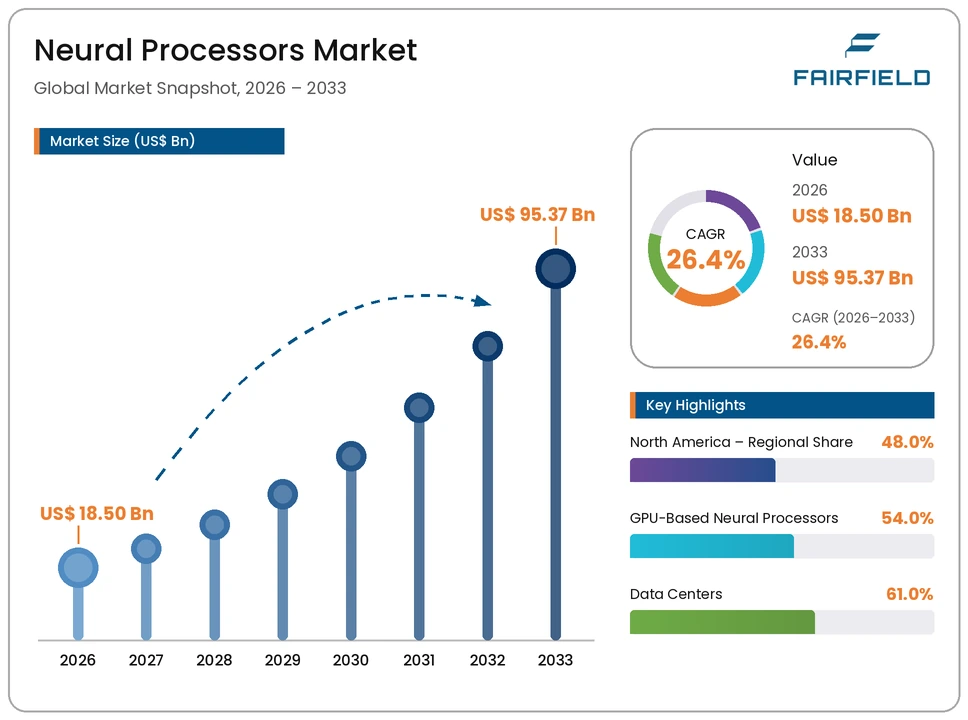
The market is valued at USD 18.50 Billion in 2026, with chip developers directing substantial investment toward improved processing efficiency and architectural specialization that addresses the rapidly evolving computational demands of advanced AI models. By 2033, the market is forecast to reach USD 95.37 Billion, reflecting rapid growth across established data center applications alongside accelerating edge device and smartphone adoption. Given the exceptionally rapid pace of AI infrastructure investment, this forecast applies a moderated compounding assumption relative to raw near-term growth trends, reflecting an expectation that growth rates will gradually normalize as the market matures across the forecast period.
Key Highlights
- The global neural processors market is valued at USD 18.50 Billion in 2026 and is projected to reach USD 95.37 Billion by 2033, expanding at a CAGR of 26.4% across the 2026-2033 forecast period.
- GPU-Based Neural Processors lead the type segment with a 54.0% share in 2026, equivalent to USD 9.99 Billion.
- Data Centers remain the dominant application, accounting for 61.0% of global demand, or USD 11.29 Billion, in 2026.
- North America commands the largest regional share at 48.0% of the global market in 2026.
- Edge devices and smartphone applications are emerging as the fastest-growing application through 2033.
Market Dynamics
- Key Growth Drivers
Growth in the neural processors market is driven primarily by explosive growth in artificial intelligence model training and inference workloads, as continued expansion of large-scale AI model development and deployment drives substantial and sustained demand for specialized neural processing hardware across cloud data center infrastructure.
A second driver is rapidly expanding edge AI deployment, as growing on-device AI processing requirements across smartphones, autonomous vehicles, and industrial applications drive demand for specialized neural processing capability beyond centralized cloud infrastructure.
- Key Restraints
Semiconductor manufacturing capacity constraints, particularly for the most advanced process nodes required for cutting-edge neural processor designs, create supply availability challenges relative to surging demand across the industry.
Additionally, intensifying competition among an expanding number of specialized neural processor developers creates margin pressure and rapid technology obsolescence risk, as continued architectural innovation quickly supersedes previous generation processing capability.
- Market Opportunities
The expansion of edge device and smartphone applications presents a substantial opportunity, as growing on-device AI processing requirements create demand for power-efficient neural processing capability beyond the market’s traditional data center focus.
A second opportunity lies in continued architectural specialization addressing specific AI workload requirements, improving processing efficiency relative to general-purpose computing architectures. Companies that successfully advance this workload-specific specialization stand to capture growing demand as AI model deployment continues to diversify across use cases.
Segmentation Analysis
- By Type
GPU-Based Neural Processors lead the type segment, accounting for 54.0% of global market value in 2026, equivalent to USD 9.99 Billion. Their leadership reflects GPU architecture’s established software ecosystem and broad compatibility with existing AI model development frameworks. FPGA-Based Neural Processors represent a smaller, established type category. ASIC-Based Neural Processors represent the fastest-growing type category through 2033, driven by growing demand for workload-specific processing efficiency at scale.
- By Application
Data Centers form the leading application segment, representing 61.0% of global demand in 2026, or USD 11.29 Billion, reflecting the substantial scale of cloud-based AI training and inference infrastructure investment. Autonomous Vehicles represents a significant, established application category. Edge Devices & Smartphones represents the fastest-growing application category, propelled by growing on-device AI processing requirements.
Regional Insights
- North America
North America holds the largest regional share, at 48.0% of the global market in 2026, equivalent to USD 8.88 Billion. The region’s dominance reflects substantial hyperscale cloud provider AI infrastructure investment and a concentrated neural processor design industry across the United States and Canada.
- Asia Pacific
Asia Pacific accounts for 30.0% of the global market in 2026, valued at USD 5.55 Billion. Demand is supported by expanding AI infrastructure investment and substantial semiconductor manufacturing capacity across China, Taiwan, and South Korea.
- Europe
Europe represents 16.0% of the global market in 2026, or USD 2.96 Billion. Growth is underpinned by expanding AI infrastructure investment and growing neural processor design activity across major European markets.
- Latin America
Latin America contributes 3.0% of the global market in 2026, equivalent to USD 0.56 Billion. Growth remains at an early stage, tied to gradual AI infrastructure investment in Brazil and Mexico.
- Middle East & Africa
Middle East & Africa holds 3.0% of the global market in 2026, valued at USD 0.56 Billion. Growth remains limited, tied to early-stage regional AI infrastructure investment.
Competitive Landscape
The global neural processors market is moderately concentrated, with a mix of large diversified semiconductor companies and specialized AI chip developers competing for cloud provider and device manufacturer adoption. Competition centers on processing performance and energy efficiency, software ecosystem breadth and developer support, and manufacturing scale supporting competitive supply availability. Companies are increasingly differentiating through expanded ASIC-based specialization rather than competing on general-purpose GPU architecture alone.
Key Market Players
- NVIDIA Corporation
- Intel Corporation
- Qualcomm Incorporated
- Advanced Micro Devices, Inc.
- Google LLC
- Apple Inc.
- Huawei Technologies Co., Ltd.
- Samsung Electronics Co., Ltd.
- Graphcore Limited
- Cerebras Systems, Inc.
Market Segmentation
By Type
- GPU-Based Neural Processors
- ASIC-Based Neural Processors
- FPGA-Based Neural Processors
- Others
By Application
- Data Centers
- Edge Devices & Smartphones
- Autonomous Vehicles
- Others
By End User
- Cloud Service Providers
- Device Manufacturers
By Geography
- North America
- Europe
- Asia Pacific
- Latin America
- Middle East & Africa
- Executive Summary
- Global Neural Processors Market Snapshot
- Future Projections
- Key Market Trends
- Regional Snapshot, by Value, 2026
- Analyst Recommendations
- Market Overview
- Market Definitions and Segmentations
- Market Dynamics
- Drivers
- Restraints
- Market Opportunities
- Value Chain Analysis
- COVID-19 Impact Analysis
- Porter's Five Forces Analysis
- Impact of Russia-Ukraine Conflict
- PESTLE Analysis
- Regulatory Analysis
- Price Trend Analysis
- Current Prices and Future Projections, 2025-2033
- Price Impact Factors
- Global Neural Processors Market Outlook, 2020 - 2033
- Global Neural Processors Market Outlook, by Type, Value (US$ Bn), 2020-2033
- GPU-Based Neural Processors
- ASIC-Based Neural Processors
- FPGA-Based Neural Processors
- Others
- Global Neural Processors Market Outlook, by Application, Value (US$ Bn), 2020-2033
- Data Centers
- Edge Devices & Smartphones
- Autonomous Vehicles
- Others
- Global Neural Processors Market Outlook, by End User, Value (US$ Bn), 2020-2033
- Cloud Service Providers
- Device Manufacturers
- Global Neural Processors Market Outlook, by Region, Value (US$ Bn), 2020-2033
- North America
- Europe
- Asia Pacific
- Latin America
- Middle East & Africa
- Global Neural Processors Market Outlook, by Type, Value (US$ Bn), 2020-2033
- North America Neural Processors Market Outlook, 2020 - 2033
- North America Neural Processors Market Outlook, by Type, Value (US$ Bn), 2020-2033
- GPU-Based Neural Processors
- ASIC-Based Neural Processors
- FPGA-Based Neural Processors
- Others
- North America Neural Processors Market Outlook, by Application, Value (US$ Bn), 2020-2033
- Data Centers
- Edge Devices & Smartphones
- Autonomous Vehicles
- Others
- North America Neural Processors Market Outlook, by End User, Value (US$ Bn), 2020-2033
- Cloud Service Providers
- Device Manufacturers
- North America Neural Processors Market Outlook, by Country, Value (US$ Bn), 2020-2033
- U.S. Neural Processors Market Outlook, by Type, 2020-2033
- U.S. Neural Processors Market Outlook, by Application, 2020-2033
- U.S. Neural Processors Market Outlook, by End User, 2020-2033
- Canada Neural Processors Market Outlook, by Type, 2020-2033
- Canada Neural Processors Market Outlook, by Application, 2020-2033
- Canada Neural Processors Market Outlook, by End User, 2020-2033
- BPS Analysis/Market Attractiveness Analysis
- North America Neural Processors Market Outlook, by Type, Value (US$ Bn), 2020-2033
- Europe Neural Processors Market Outlook, 2020 - 2033
- Europe Neural Processors Market Outlook, by Type, Value (US$ Bn), 2020-2033
- GPU-Based Neural Processors
- ASIC-Based Neural Processors
- FPGA-Based Neural Processors
- Others
- Europe Neural Processors Market Outlook, by Application, Value (US$ Bn), 2020-2033
- Data Centers
- Edge Devices & Smartphones
- Autonomous Vehicles
- Others
- Europe Neural Processors Market Outlook, by End User, Value (US$ Bn), 2020-2033
- Cloud Service Providers
- Device Manufacturers
- Europe Neural Processors Market Outlook, by Country, Value (US$ Bn), 2020-2033
- Germany Neural Processors Market Outlook, by Type, 2020-2033
- Germany Neural Processors Market Outlook, by Application, 2020-2033
- Germany Neural Processors Market Outlook, by End User, 2020-2033
- Italy Neural Processors Market Outlook, by Type, 2020-2033
- Italy Neural Processors Market Outlook, by Application, 2020-2033
- Italy Neural Processors Market Outlook, by End User, 2020-2033
- France Neural Processors Market Outlook, by Type, 2020-2033
- France Neural Processors Market Outlook, by Application, 2020-2033
- France Neural Processors Market Outlook, by End User, 2020-2033
- U.K. Neural Processors Market Outlook, by Type, 2020-2033
- U.K. Neural Processors Market Outlook, by Application, 2020-2033
- U.K. Neural Processors Market Outlook, by End User, 2020-2033
- Spain Neural Processors Market Outlook, by Type, 2020-2033
- Spain Neural Processors Market Outlook, by Application, 2020-2033
- Spain Neural Processors Market Outlook, by End User, 2020-2033
- Russia Neural Processors Market Outlook, by Type, 2020-2033
- Russia Neural Processors Market Outlook, by Application, 2020-2033
- Russia Neural Processors Market Outlook, by End User, 2020-2033
- Rest of Europe Neural Processors Market Outlook, by Type, 2020-2033
- Rest of Europe Neural Processors Market Outlook, by Application, 2020-2033
- Rest of Europe Neural Processors Market Outlook, by End User, 2020-2033
- BPS Analysis/Market Attractiveness Analysis
- Europe Neural Processors Market Outlook, by Type, Value (US$ Bn), 2020-2033
- Asia Pacific Neural Processors Market Outlook, 2020 - 2033
- Asia Pacific Neural Processors Market Outlook, by Type, Value (US$ Bn), 2020-2033
- GPU-Based Neural Processors
- ASIC-Based Neural Processors
- FPGA-Based Neural Processors
- Others
- Asia Pacific Neural Processors Market Outlook, by Application, Value (US$ Bn), 2020-2033
- Data Centers
- Edge Devices & Smartphones
- Autonomous Vehicles
- Others
- Asia Pacific Neural Processors Market Outlook, by End User, Value (US$ Bn), 2020-2033
- Cloud Service Providers
- Device Manufacturers
- Asia Pacific Neural Processors Market Outlook, by Country, Value (US$ Bn), 2020-2033
- China Neural Processors Market Outlook, by Type, 2020-2033
- China Neural Processors Market Outlook, by Application, 2020-2033
- China Neural Processors Market Outlook, by End User, 2020-2033
- Japan Neural Processors Market Outlook, by Type, 2020-2033
- Japan Neural Processors Market Outlook, by Application, 2020-2033
- Japan Neural Processors Market Outlook, by End User, 2020-2033
- South Korea Neural Processors Market Outlook, by Type, 2020-2033
- South Korea Neural Processors Market Outlook, by Application, 2020-2033
- South Korea Neural Processors Market Outlook, by End User, 2020-2033
- India Neural Processors Market Outlook, by Type, 2020-2033
- India Neural Processors Market Outlook, by Application, 2020-2033
- India Neural Processors Market Outlook, by End User, 2020-2033
- Southeast Asia Neural Processors Market Outlook, by Type, 2020-2033
- Southeast Asia Neural Processors Market Outlook, by Application, 2020-2033
- Southeast Asia Neural Processors Market Outlook, by End User, 2020-2033
- Rest of SAO Neural Processors Market Outlook, by Type, 2020-2033
- Rest of SAO Neural Processors Market Outlook, by Application, 2020-2033
- Rest of SAO Neural Processors Market Outlook, by End User, 2020-2033
- BPS Analysis/Market Attractiveness Analysis
- Asia Pacific Neural Processors Market Outlook, by Type, Value (US$ Bn), 2020-2033
- Latin America Neural Processors Market Outlook, 2020 - 2033
- Latin America Neural Processors Market Outlook, by Type, Value (US$ Bn), 2020-2033
- GPU-Based Neural Processors
- ASIC-Based Neural Processors
- FPGA-Based Neural Processors
- Others
- Latin America Neural Processors Market Outlook, by Application, Value (US$ Bn), 2020-2033
- Data Centers
- Edge Devices & Smartphones
- Autonomous Vehicles
- Others
- Latin America Neural Processors Market Outlook, by End User, Value (US$ Bn), 2020-2033
- Cloud Service Providers
- Device Manufacturers
- Latin America Neural Processors Market Outlook, by Country, Value (US$ Bn), 2020-2033
- Brazil Neural Processors Market Outlook, by Type, 2020-2033
- Brazil Neural Processors Market Outlook, by Application, 2020-2033
- Brazil Neural Processors Market Outlook, by End User, 2020-2033
- Mexico Neural Processors Market Outlook, by Type, 2020-2033
- Mexico Neural Processors Market Outlook, by Application, 2020-2033
- Mexico Neural Processors Market Outlook, by End User, 2020-2033
- Argentina Neural Processors Market Outlook, by Type, 2020-2033
- Argentina Neural Processors Market Outlook, by Application, 2020-2033
- Argentina Neural Processors Market Outlook, by End User, 2020-2033
- Rest of LATAM Neural Processors Market Outlook, by Type, 2020-2033
- Rest of LATAM Neural Processors Market Outlook, by Application, 2020-2033
- Rest of LATAM Neural Processors Market Outlook, by End User, 2020-2033
- BPS Analysis/Market Attractiveness Analysis
- Latin America Neural Processors Market Outlook, by Type, Value (US$ Bn), 2020-2033
- Middle East & Africa Neural Processors Market Outlook, 2020 - 2033
- Middle East & Africa Neural Processors Market Outlook, by Type, Value (US$ Bn), 2020-2033
- GPU-Based Neural Processors
- ASIC-Based Neural Processors
- FPGA-Based Neural Processors
- Others
- Middle East & Africa Neural Processors Market Outlook, by Application, Value (US$ Bn), 2020-2033
- Data Centers
- Edge Devices & Smartphones
- Autonomous Vehicles
- Others
- Middle East & Africa Neural Processors Market Outlook, by End User, Value (US$ Bn), 2020-2033
- Cloud Service Providers
- Device Manufacturers
- Middle East & Africa Neural Processors Market Outlook, by Country, Value (US$ Bn), 2020-2033
- GCC Neural Processors Market Outlook, by Type, 2020-2033
- GCC Neural Processors Market Outlook, by Application, 2020-2033
- GCC Neural Processors Market Outlook, by End User, 2020-2033
- South Africa Neural Processors Market Outlook, by Type, 2020-2033
- South Africa Neural Processors Market Outlook, by Application, 2020-2033
- South Africa Neural Processors Market Outlook, by End User, 2020-2033
- Egypt Neural Processors Market Outlook, by Type, 2020-2033
- Egypt Neural Processors Market Outlook, by Application, 2020-2033
- Egypt Neural Processors Market Outlook, by End User, 2020-2033
- Nigeria Neural Processors Market Outlook, by Type, 2020-2033
- Nigeria Neural Processors Market Outlook, by Application, 2020-2033
- Nigeria Neural Processors Market Outlook, by End User, 2020-2033
- Rest of Middle East Neural Processors Market Outlook, by Type, 2020-2033
- Rest of Middle East Neural Processors Market Outlook, by Application, 2020-2033
- Rest of Middle East Neural Processors Market Outlook, by End User, 2020-2033
- BPS Analysis/Market Attractiveness Analysis
- Middle East & Africa Neural Processors Market Outlook, by Type, Value (US$ Bn), 2020-2033
- Competitive Landscape
- Company Vs Segment Heatmap
- Company Market Share Analysis, 2025
- Competitive Dashboard
- Company Profiles
- NVIDIA Corporation
- Company Overview
- Product Portfolio
- Financial Overview
- Business Strategies and Developments
- Intel Corporation
- Qualcomm Incorporated
- Advanced Micro Devices, Inc.
- Google LLC
- Apple Inc.
- Huawei Technologies Co., Ltd.
- Samsung Electronics Co., Ltd.
- Graphcore Limited
- Cerebras Systems, Inc.
- NVIDIA Corporation
- Appendix
- Research Methodology
- Report Assumptions
- Acronyms and Abbreviations
By Type
- GPU-Based Neural Processors
- ASIC-Based Neural Processors
- FPGA-Based Neural Processors
- Others
By Application
- Data Centers
- Edge Devices & Smartphones
- Autonomous Vehicles
- Others
By End User
- Cloud Service Providers
- Device Manufacturers
By Geography
- North America
- Europe
- Asia Pacific
- Latin America
- Middle East & Africa
Our Research Methodology
Considering the volatility of business today, traditional approaches to strategizing a game plan can be unfruitful if not detrimental. True ambiguity is no way to determine a forecast. A myriad of predetermined factors must be accounted for such as the degree of risk involved, the magnitude of circumstances, as well as conditions or consequences that are not known or unpredictable. To circumvent binary views that cast uncertainty, the application of market research intelligence to strategically posture, move, and enable actionable outcomes is necessary.
View Methodology
Quality Assured
Rigorous Validation Process

Confidentiality Assured
End-to-end Data Security

Custom Research Services
Tailored To Your Objectives
FAQs
The global neural processors market is valued at USD 18.50 Billion in 2026, reflecting explosive growth in AI infrastructure investment.
The market is projected to grow at a CAGR of 26.4%, reaching USD 95.37 Billion by 2033, driven by AI model training and inference workload expansion.
GPU-Based Neural Processors lead with a 54.0% share in 2026, reflecting their established software ecosystem.
North America leads with a 48.0% share in 2026, reflecting substantial hyperscale cloud provider investment.
The largest opportunity lies in edge devices and smartphones, expanding alongside growing on-device AI processing demand.
Related Reports
Tunnel Construction Market Size, Share, Insights, Competitive Landscape, and Forecast 2026 to 2033
The global tunnel construction market is valued at US$29.52 billion in 2026, reaching US$47.09 billion by 2033, growing at a 6.9% CAGR
Sports Analytics Market Size, Share, Insights, Competitive Landscape, and Forecast 2026 to 2033
The global sports analytics market is valued at US$7.06 billion in 2026, reaching US$23.15 billion by 2033, growing at an 18.5% CAGR
Distributed Acoustic Sensing Market Size, Share, Insights, Competitive Landscape, and Forecast 2026 to 2033
The global distributed acoustic sensing market is valued at US$0.565 billion in 2026, reaching US$1.173 billion by 2033, growing at an 11.0% CAGR
Secure Flash Drive Market Size, Share, Insights, Competitive Landscape, and Forecast 2026 to 2033
The global secure flash drive market is valued at US$0.8 billion in 2026, reaching US$1.1 billion by 2033, growing at a 4.7% CAGR
Optical I/O for AI Chips Market Size, Share, Insights, Competitive Landscape, and Forecast 2026 to 2033
The global optical I/O for AI chips market is valued at US$1.6 billion in 2026, reaching US$14.5 billion by 2033, growing at a 37.01% CAGR
Foldable Drones Market Size, Share, Insights, Competitive Landscape, and Forecast 2026 to 2033
The global foldable drones market is valued at US$3.76 billion in 2026 and is projected to reach US$7.57 billion by 2033, growing at a 10.5% CAGR.