



Nickel Hydrogen Batteries Market
Nickel Hydrogen Batteries Market Size, Share, Insights, Competitive Landscape, and Forecast 2026 to 2033
Nickel Hydrogen Batteries Market Analysis, 2026–2033
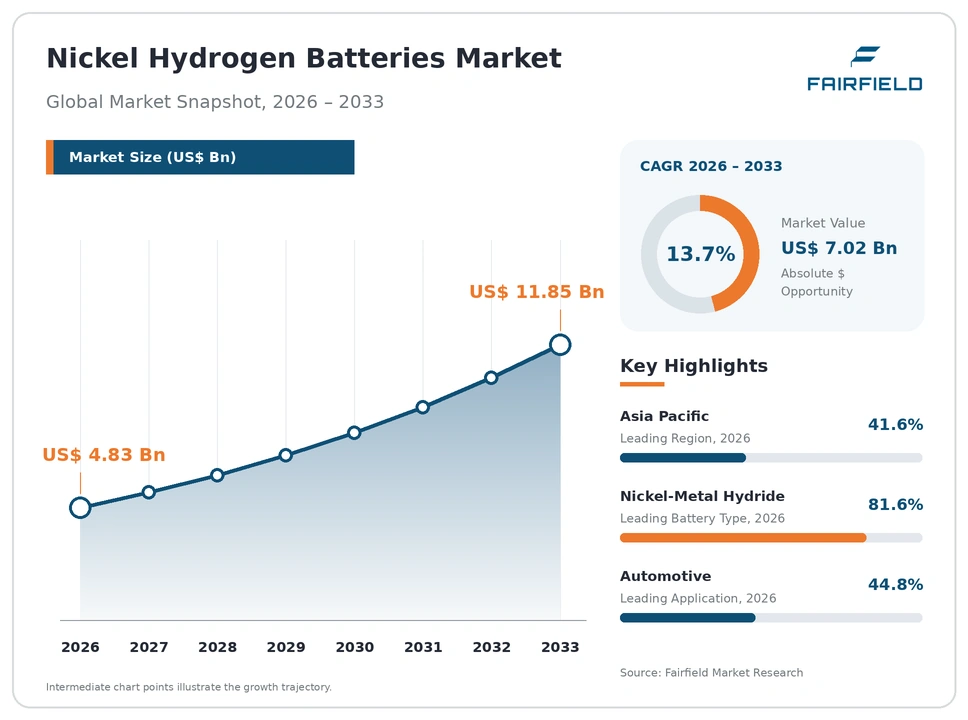
Nickel Hydrogen Batteries Market Size and Trend Analysis
How Fast Is the Nickel Hydrogen Batteries Market Growing?
The global nickel hydrogen batteries market size is expected to be valued at US$ 4.83 billion in 2026 and projected to reach US$ 11.85 billion by 2033, growing at a CAGR of 13.7% between 2026 and 2033.
Between 2020 and 2025, the market grew at a CAGR of about 7.9%, supported by steady hybrid vehicle production and aerospace demand, while lithium-ion batteries captured most new electric vehicle and grid storage growth. Three factors now drive growth: demand for long-life, non-flammable batteries for grid and industrial storage, continued use of nickel-metal hydride batteries in hybrid vehicles, and proven performance in satellites and space systems. The market is moving toward large pressurized nickel-hydrogen cells designed for 30,000 charge cycles in stationary storage. New factories in China are moving the technology from aerospace niches into commercial energy storage.
Key Report Takeaways
- By Battery Type: Nickel-Metal Hydride held 81.6% share in 2026, while Pressurized Nickel-Hydrogen is projected to expand at a 24.5% CAGR through 2033, driven by long-duration, 30,000-cycle stationary storage systems.
- By Application: Automotive held 44.8% share in 2026, while Stationary Energy Storage is projected to expand at a 21.3% CAGR through 2033, driven by renewable integration and fire-safe storage needs.
- By Form Factor: Cylindrical held 43.5% share in 2026, while Prismatic & Bipolar is projected to expand at a 16.8% CAGR through 2033, driven by higher power density in hybrid vehicle packs.
- By Region: Asia Pacific held 41.6% share in 2026, while China is projected to expand at a 15.9% CAGR through 2033, driven by new nickel-hydrogen factories and grid storage projects.
Global Nickel Hydrogen Batteries Market Trends and Insights
Drivers Impact Analysis
Two drivers carry the strongest influence on nickel hydrogen battery demand during the forecast period.
| Driver | Impact on CAGR Forecast | Geographic Relevance | Impact Timeline |
| Demand for long-life, fire-safe stationary energy storage | High | Asia Pacific, North America, Middle East & Africa | Medium term (2-4 years) |
| Hybrid vehicle production and aerospace reliability needs | Medium | Asia Pacific, North America, Europe | Long term (≥4 years) |
Long-life Stationary Storage Demand Is Driving Nickel Hydrogen Battery Adoption
Demand for long-life, fire-safe stationary storage is the strongest driver of nickel hydrogen battery adoption. Utilities, industrial sites, and renewable energy developers want batteries that last decades with little degradation and minimal fire risk.
The mechanism is the technology’s durability and safety. Pressurized nickel-hydrogen cells, used for decades on satellites and the International Space Station, can complete tens of thousands of charge cycles with low degradation. They use a water-based potassium hydroxide electrolyte instead of flammable organic solvents, reducing thermal runaway risk. EnerVenue adapted this technology for grid use with cells rated for 30,000 cycles and operation from -40°C to 50°C. These features suit renewable energy storage at solar farms, oilfields, data centers, and remote microgrids, where frequent cycling and harsh climates shorten lithium-ion battery life. Lower lifetime replacement and cooling costs improve total cost of ownership despite higher upfront prices.
Hybrid Vehicles and Space Systems Sustain Nickel Hydrogen Battery Demand
Hybrid vehicle production and space reliability needs sustain demand for nickel hydrogen batteries. These applications value proven safety, long life, and tolerance of demanding conditions over maximum energy density.
The cause is the continued popularity of hybrids and the strict requirements of space missions. Toyota uses nickel-metal hydride batteries, which store hydrogen in metal alloys, in many hybrid models, and introduced a bipolar nickel-hydrogen battery in its Aqua hybrid with higher output per cell. Hybrid sales have grown strongly in North America, Japan, and Europe as some buyers choose hybrids over fully electric vehicles. In space, nickel-hydrogen batteries powered the Hubble Space Telescope and many communications satellites for decades. Military aircraft, satellites, and backup power systems also use nickel-based chemistries. These established markets provide stable revenue while new stationary storage applications scale.
Restraints Impact Analysis
Two restraints limit how quickly nickel hydrogen batteries gain market share.
| Restraint | Impact on CAGR Forecast | Geographic Relevance | Impact Timeline |
| Low energy density and higher upfront cost versus lithium-ion | High | Global | Medium term (2-4 years) |
| Limited manufacturing scale and supply chain maturity | Medium | Global | Short term (≤2 years) |
Low Energy Density and High Upfront Cost Limit Nickel Hydrogen Battery Adoption
Low energy density and higher upfront cost limit nickel hydrogen battery adoption compared with lithium-ion batteries. Buyers often compare cost per kilowatt-hour at purchase, where lithium-ion has a strong advantage.
The specific causes are cell chemistry and design. Pressurized nickel-hydrogen cells store hydrogen gas in steel pressure vessels, which makes them larger and heavier per unit of energy than lithium-ion cells. They also have higher self-discharge, which can reduce efficiency for long storage periods. The cells use nickel, platinum-group catalysts, and pressure vessels, which raise manufacturing costs. Lithium iron phosphate battery prices fell sharply in 2024 and 2025 due to oversupply in China, widening the upfront cost gap. Space-constrained sites and electric vehicles therefore favor lithium-ion. Nickel hydrogen suppliers must convince buyers to evaluate lifetime cost rather than initial price.
Limited Manufacturing Scale Constrains Nickel Hydrogen Battery Supply
Limited manufacturing scale and supply chain maturity constrain nickel hydrogen battery supply. Production capacity for large stationary cells is small compared with the global battery industry.
The underlying causes are the technology’s niche history and capital requirements. For decades, pressurized nickel-hydrogen cells were made in small volumes for aerospace by specialized suppliers. Building commercial-scale factories requires large investment, automated production of pressure vessels and electrodes, and proven quality control. EnerVenue’s factory in Changzhou, China, started with 250 megawatt-hours of capacity, far smaller than lithium-ion gigafactories. Customers and financiers want long track records before committing to large projects, and banks may hesitate to finance new chemistries. Limited suppliers of specialized components such as pressure vessels and catalysts can also cause delays. These factors slow deployment even as interest grows.
Market Opportunities
Oilfield, Data Center, and Microgrid Storage Open a Fire-safe Revenue Pool
Oilfield, data center, and microgrid storage open a fire-safe revenue pool for nickel hydrogen batteries. These sites need durable storage that can cycle frequently and operate safely in extreme temperatures.
Suppliers with proven long-life cells can capture this demand. Oil and gas producers use batteries to integrate solar power and reduce diesel use at remote fields. In September 2026, EnerVenue won an 11 megawatt-hour storage order for an oilfield in northern China. Data centers seek non-flammable backup and peak-shaving storage near critical equipment. Mines, telecom towers, and island grids need batteries that last in hot or cold climates with minimal maintenance. Investors such as Aramco Ventures and the NEOM Investment Fund have backed the technology, signaling interest from the Middle East. These customers value lifetime cost and safety, supporting premium pricing.
Space and Defense Power Systems Create a High-reliability Revenue Pool
Space and defense power systems create a high-reliability revenue pool for nickel hydrogen batteries. Satellites, space stations, and military systems need batteries that operate reliably for many years without maintenance.
Aerospace battery makers and defense suppliers can capture this opportunity. Large satellite constellations, government spacecraft, and defense systems need satellite batteries that survive thousands of charge cycles in orbit. Nickel-hydrogen cells have flight heritage on the International Space Station and the Hubble Space Telescope. Defense agencies need safe, long-life batteries for bases, ships, and remote installations, where fire risk is a concern. Governments in the United States, Europe, and Asia Pacific are increasing space and defense budgets. Space agencies, satellite operators, and defense contractors are the main customers. High qualification requirements create strong barriers and premium pricing.
Segment Analysis
By Battery Type: Nickel-Metal Hydride Leads While Pressurized Nickel-Hydrogen Gains Momentum
Nickel-Metal Hydride held 81.6% share in 2026. These batteries store hydrogen in metal alloy electrodes and are widely used in hybrid vehicles, consumer rechargeable batteries, cordless tools, and medical devices. Panasonic, Primearth EV Energy, FDK Corporation, Corun, and GP Batteries are major producers.
Pressurized Nickel-Hydrogen is the fastest-growing battery type, expanding at a 24.5% CAGR through 2033. These cells store hydrogen gas in pressure vessels and offer extremely long cycle life and strong safety. EnerVenue is commercializing large cells for grid and industrial storage, and opened its Changzhou factory in 2026. Aerospace applications continue to use specialized cells. For the market, pressurized nickel-hydrogen growth opens stationary storage opportunities that conventional nickel-metal hydride cannot address.
By Application: Automotive Leads While Stationary Energy Storage Grows Fastest
Automotive held 44.8% share in 2026. Hybrid electric vehicle batteries from Toyota and other automakers are the largest application, valued for safety, durability, and lower cost than lithium-ion in small packs. Hybrid demand has risen in many markets.
Stationary Energy Storage is the fastest-growing application, expanding at a 21.3% CAGR through 2033. Solar farms, oilfields, data centers, microgrids, and industrial sites need long-life, fire-safe batteries that cycle daily. Nickel-hydrogen systems can operate in extreme temperatures without heavy cooling. Pilot projects and first commercial orders in China show growing acceptance. Aerospace and defense, consumer electronics, and industrial uses remain important applications. For the market, stationary storage growth shifts demand toward large cells and long-term service contracts.
By Form Factor: Cylindrical Leads While Prismatic & Bipolar Grows Fastest
Cylindrical held 43.5% share in 2026. Cylindrical cells are common in consumer rechargeable batteries, power tools, and some hybrid vehicle packs. Standard sizes and automated production keep costs low.
Prismatic & Bipolar is the fastest-growing form factor, expanding at a 16.8% CAGR through 2033. Bipolar designs stack electrodes to reduce internal resistance and increase power density. Toyota’s bipolar nickel-hydrogen battery offers higher output per cell and fits more cells in the same space. Large pressure vessels used in stationary nickel-hydrogen systems are another fast-growing format. Button and coin cells serve small devices such as hearing aids and memory backup. Recycling programs recover nickel and rare earth metals from used packs. For the market, prismatic and bipolar growth reflects demand for compact, high-power battery packs.
Geography Analysis
North America Advances Nickel Hydrogen Batteries in Space and Hybrid Vehicles
North America is a major nickel hydrogen batteries market driven by space, defense, and hybrid vehicles. The United States has a long history of nickel-hydrogen batteries on satellites, the International Space Station, and the Hubble Space Telescope. Hybrid vehicle sales have grown strongly as many consumers seek fuel savings. EnerVenue is headquartered in Fremont, California, and targets utility and industrial storage. Defense agencies value long-life, non-flammable batteries for bases and ships. Canada offers potential for remote northern community microgrids. One change shaping the region is interest in fire-safe storage near data centers.
Europe Uses Nickel Hydrogen Batteries in Hybrids and Industrial Applications
Europe is a mature nickel hydrogen batteries market where hybrid vehicles, industrial equipment, and space programs drive demand. Hybrid models from Toyota, Honda, and other brands are popular in the United Kingdom, France, Germany, and Spain. VARTA in Germany produces nickel-metal hydride batteries for industrial and consumer uses. The European Space Agency and satellite makers use space-qualified batteries. Strict battery safety, carbon footprint, and recycling rules under the EU Battery Regulation favor durable, recyclable chemistries with well-established recovery processes. One opportunity is fire-safe storage for dense urban buildings and industrial sites.
Which Region Is Leading the Nickel Hydrogen Batteries Market?
Asia Pacific is leading the nickel hydrogen batteries market with a 41.6% share in 2026. Japan hosts Toyota, Panasonic, Primearth EV Energy, and FDK Corporation, which produce nickel-metal hydride batteries for hybrids and consumer products. China has large producers such as Corun and Highpower International, and is home to EnerVenue’s new factory in Changzhou. Strong hybrid production, rare earth and nickel supply chains, and large consumer battery exports support regional leadership. South Korea and India add demand from hybrids and backup power. One change shaping the region is the scale-up of pressurized nickel-hydrogen cells for grid storage.
Which Country Is Growing Fastest in the Nickel Hydrogen Batteries Market?
China is growing fastest in the nickel hydrogen batteries market at a 15.9% CAGR through 2033. The country has massive solar and wind energy deployment and government targets for new-type energy storage. EnerVenue opened its Changzhou factory in 2026 with 250 megawatt-hours of capacity and plans to reach 1 gigawatt-hour. In May 2026, the company announced a pilot storage project in Jintan, Changzhou. Oil and gas producers seek durable long-duration storage for remote fields. Competition from cheap domestic lithium iron phosphate batteries remains strong. One opportunity is fire-safe storage for industrial parks.
Latin America Explores Nickel Hydrogen Batteries for Remote Energy Storage
Latin America is an emerging nickel hydrogen batteries market where hybrid vehicles and remote energy storage create opportunities. Brazil and Mexico have growing hybrid vehicle sales and local assembly plants. Mining operations in Chile and Peru and remote communities need durable storage paired with local solar power. Hot climates in mining regions favor batteries that tolerate high temperatures without heavy cooling systems. Brazil’s telecom networks also need reliable backup power in remote areas. Key barriers include limited awareness, higher upfront costs, and financing challenges for new technologies. One opportunity is solar-plus-storage microgrids for mines and isolated island grids.
Middle East & Africa Explores Nickel Hydrogen Batteries for Harsh Climates
Middle East & Africa is a developing nickel hydrogen batteries market where extreme heat and large solar projects create demand for durable storage. Saudi Arabia is building giga-projects such as NEOM and massive new solar capacity, and Aramco Ventures and the NEOM Investment Fund have invested in EnerVenue. The United Arab Emirates is rapidly expanding renewable energy and storage. In Africa, off-grid solar systems, clinics, and telecom towers need long-life batteries. Key barriers include high upfront costs, limited local supply, and unfamiliarity among project developers and lenders. One opportunity is solar storage in desert climates.
Competitive Landscape
The nickel hydrogen batteries market is moderately concentrated. Panasonic, Primearth EV Energy, FDK Corporation, Corun, GP Batteries, and GS Yuasa lead in nickel-metal hydride batteries for hybrids and consumer products. EnerVenue is the leading developer of large pressurized nickel-hydrogen cells for stationary storage, while aerospace suppliers produce space-qualified cells. VARTA, Energizer, and Highpower International compete in specific segments.
Companies compete on cycle life, safety, cost per cycle, temperature tolerance, reliability, and manufacturing scale. In stationary storage, nickel hydrogen suppliers compete mainly with lithium iron phosphate, sodium-ion, and flow batteries, emphasizing longevity and fire safety over upfront cost. In hybrids, nickel-metal hydride competes with small lithium-ion packs, and some automakers are shifting newer models to lithium-ion. Established producers rely on long-term supply agreements with automakers, while new entrants seek strategic investors and pilot projects to build credibility with utilities and lenders.
Strategic moves show how competition is changing. In April 2026, EnerVenue closed a US$ 300 million Series B extension to support manufacturing. In May 2026, it announced a pilot storage project in Jintan, China. In September 2026, EnerVenue opened its Changzhou factory and secured an 11 megawatt-hour order for a Chinese oilfield, its first multi-megawatt-hour commercial order. These moves show the technology moving from aerospace heritage into commercial grid storage.
Three themes shape vendor strategy. First, companies are scaling manufacturing to cut costs. Second, they are targeting harsh-climate and safety-critical sites. Third, they are emphasizing lifetime cost over upfront price.
Nickel Hydrogen Batteries Market Industry Leaders
- Panasonic
- Primearth EV Energy
- EnerVenue
- FDK Corporation
- Corun
Recent Industry Developments
- September 2026: EnerVenue opened its Changzhou factory and secured an 11 megawatt-hour oilfield storage order in China - first multi-megawatt-hour commercial deployment.
- May 2026: EnerVenue announced a pilot nickel-hydrogen storage project in Jintan, Changzhou - demonstrates grid storage performance.
- April 2026: EnerVenue closed a US$ 300 million Series B extension - funds manufacturing scale-up and international expansion.
Companies Covered in the Report
- Panasonic
- Primearth EV Energy
- EnerVenue
- FDK Corporation
- Corun
- GP Batteries International
- GS Yuasa
- VARTA
- Highpower International
- Energizer Holdings
- Huanyu Battery
- EPT Battery
Nickel Hydrogen Batteries Market Report Scope
This report covers nickel-based batteries that use hydrogen as the active negative material, including nickel-metal hydride batteries that store hydrogen in metal alloys and pressurized nickel-hydrogen batteries that store hydrogen gas, used in automotive, stationary storage, aerospace, consumer, and industrial applications. It excludes nickel-cadmium, lithium-ion, and hydrogen fuel cells. The base year is 2025, and the forecast period runs from 2026 to 2033. All values are expressed in US$ Billion.
Battery Type
- Nickel-Metal Hydride
- Pressurized Nickel-Hydrogen
Application
- Automotive
- Stationary Energy Storage
- Aerospace & Defense
- Consumer Electronics
- Industrial
Form Factor
- Cylindrical
- Prismatic & Bipolar
- Button & Coin
- Pressure Vessel
Regions
- North America
- Europe
- Asia Pacific
- Latin America
- Middle East & Africa
1. Executive Summary
1.1. Global Nickel Hydrogen Batteries Market Snapshot
1.2. Future Projections
1.3. Key Report Takeaways
1.4. Regional Snapshot
2. Market Overview
2.1. Market Definition and Report Scope
2.2. Historical Trends 2020–2025
2.3. Market Dynamics
2.3.1. Drivers
2.3.1.1. Long-life Stationary Storage Demand Is Driving Nickel Hydrogen Battery Adoption
2.3.1.2. Hybrid Vehicles and Space Systems Sustain Nickel Hydrogen Battery Demand
2.3.2. Restraints
2.3.2.1. Low Energy Density and High Upfront Cost Limit Nickel Hydrogen Battery Adoption
2.3.2.2. Limited Manufacturing Scale Constrains Nickel Hydrogen Battery Supply
2.3.3. Market Opportunities
2.3.3.1. Oilfield, Data Center, and Microgrid Storage Open a Fire-safe Revenue Pool
2.3.3.2. Space and Defense Power Systems Create a High-reliability Revenue Pool
3. Global Nickel Hydrogen Batteries Market Outlook, 2020-2033
3.1. Global Nickel Hydrogen Batteries Market Outlook, by Battery Type, Value (US$ Billion), 2020-2033
3.1.1. Nickel-Metal Hydride
3.1.2. Pressurized Nickel-Hydrogen
3.2. Global Nickel Hydrogen Batteries Market Outlook, by Application, Value (US$ Billion), 2020-2033
3.2.1. Automotive
3.2.2. Stationary Energy Storage
3.2.3. Aerospace & Defense
3.2.4. Consumer Electronics
3.2.5. Industrial
3.3. Global Nickel Hydrogen Batteries Market Outlook, by Form Factor, Value (US$ Billion), 2020-2033
3.3.1. Cylindrical
3.3.2. Prismatic & Bipolar
3.3.3. Button & Coin
3.3.4. Pressure Vessel
3.4. Global Nickel Hydrogen Batteries Market Outlook, by Region, Value (US$ Billion), 2020-2033
3.4.1. North America
3.4.2. Europe
3.4.3. Asia Pacific
3.4.4. Latin America
3.4.5. Middle East & Africa
4. North America Nickel Hydrogen Batteries Market Outlook, 2020-2033
4.1. North America Nickel Hydrogen Batteries Market Outlook, by Battery Type, Value (US$ Billion), 2020-2033
4.1.1. Nickel-Metal Hydride
4.1.2. Pressurized Nickel-Hydrogen
4.2. North America Nickel Hydrogen Batteries Market Outlook, by Application, Value (US$ Billion), 2020-2033
4.2.1. Automotive
4.2.2. Stationary Energy Storage
4.2.3. Aerospace & Defense
4.2.4. Consumer Electronics
4.2.5. Industrial
4.3. North America Nickel Hydrogen Batteries Market Outlook, by Form Factor, Value (US$ Billion), 2020-2033
4.3.1. Cylindrical
4.3.2. Prismatic & Bipolar
4.3.3. Button & Coin
4.3.4. Pressure Vessel
4.4. North America Nickel Hydrogen Batteries Market Outlook, by Country, Value (US$ Billion), 2020-2033
4.4.1. United States Nickel Hydrogen Batteries Market Outlook, by Battery Type, 2020-2033
4.4.2. United States Nickel Hydrogen Batteries Market Outlook, by Application, 2020-2033
4.4.3. United States Nickel Hydrogen Batteries Market Outlook, by Form Factor, 2020-2033
4.4.4. Canada Nickel Hydrogen Batteries Market Outlook, by Battery Type, 2020-2033
4.4.5. Canada Nickel Hydrogen Batteries Market Outlook, by Application, 2020-2033
4.4.6. Canada Nickel Hydrogen Batteries Market Outlook, by Form Factor, 2020-2033
5. Europe Nickel Hydrogen Batteries Market Outlook, 2020-2033
5.1. Europe Nickel Hydrogen Batteries Market Outlook, by Battery Type, Value (US$ Billion), 2020-2033
5.1.1. Nickel-Metal Hydride
5.1.2. Pressurized Nickel-Hydrogen
5.2. Europe Nickel Hydrogen Batteries Market Outlook, by Application, Value (US$ Billion), 2020-2033
5.2.1. Automotive
5.2.2. Stationary Energy Storage
5.2.3. Aerospace & Defense
5.2.4. Consumer Electronics
5.2.5. Industrial
5.3. Europe Nickel Hydrogen Batteries Market Outlook, by Form Factor, Value (US$ Billion), 2020-2033
5.3.1. Cylindrical
5.3.2. Prismatic & Bipolar
5.3.3. Button & Coin
5.3.4. Pressure Vessel
5.4. Europe Nickel Hydrogen Batteries Market Outlook, by Country, Value (US$ Billion), 2020-2033
5.4.1. United Kingdom Nickel Hydrogen Batteries Market Outlook, by Battery Type, 2020-2033
5.4.2. United Kingdom Nickel Hydrogen Batteries Market Outlook, by Application, 2020-2033
5.4.3. United Kingdom Nickel Hydrogen Batteries Market Outlook, by Form Factor, 2020-2033
5.4.4. France Nickel Hydrogen Batteries Market Outlook, by Battery Type, 2020-2033
5.4.5. France Nickel Hydrogen Batteries Market Outlook, by Application, 2020-2033
5.4.6. France Nickel Hydrogen Batteries Market Outlook, by Form Factor, 2020-2033
5.4.7. Germany Nickel Hydrogen Batteries Market Outlook, by Battery Type, 2020-2033
5.4.8. Germany Nickel Hydrogen Batteries Market Outlook, by Application, 2020-2033
5.4.9. Germany Nickel Hydrogen Batteries Market Outlook, by Form Factor, 2020-2033
5.4.10. Spain Nickel Hydrogen Batteries Market Outlook, by Battery Type, 2020-2033
5.4.11. Spain Nickel Hydrogen Batteries Market Outlook, by Application, 2020-2033
5.4.12. Spain Nickel Hydrogen Batteries Market Outlook, by Form Factor, 2020-2033
6. Asia Pacific Nickel Hydrogen Batteries Market Outlook, 2020-2033
6.1. Asia Pacific Nickel Hydrogen Batteries Market Outlook, by Battery Type, Value (US$ Billion), 2020-2033
6.1.1. Nickel-Metal Hydride
6.1.2. Pressurized Nickel-Hydrogen
6.2. Asia Pacific Nickel Hydrogen Batteries Market Outlook, by Application, Value (US$ Billion), 2020-2033
6.2.1. Automotive
6.2.2. Stationary Energy Storage
6.2.3. Aerospace & Defense
6.2.4. Consumer Electronics
6.2.5. Industrial
6.3. Asia Pacific Nickel Hydrogen Batteries Market Outlook, by Form Factor, Value (US$ Billion), 2020-2033
6.3.1. Cylindrical
6.3.2. Prismatic & Bipolar
6.3.3. Button & Coin
6.3.4. Pressure Vessel
6.4. Asia Pacific Nickel Hydrogen Batteries Market Outlook, by Country, Value (US$ Billion), 2020-2033
6.4.1. Japan Nickel Hydrogen Batteries Market Outlook, by Battery Type, 2020-2033
6.4.2. Japan Nickel Hydrogen Batteries Market Outlook, by Application, 2020-2033
6.4.3. Japan Nickel Hydrogen Batteries Market Outlook, by Form Factor, 2020-2033
6.4.4. China Nickel Hydrogen Batteries Market Outlook, by Battery Type, 2020-2033
6.4.5. China Nickel Hydrogen Batteries Market Outlook, by Application, 2020-2033
6.4.6. China Nickel Hydrogen Batteries Market Outlook, by Form Factor, 2020-2033
6.4.7. South Korea Nickel Hydrogen Batteries Market Outlook, by Battery Type, 2020-2033
6.4.8. South Korea Nickel Hydrogen Batteries Market Outlook, by Application, 2020-2033
6.4.9. South Korea Nickel Hydrogen Batteries Market Outlook, by Form Factor, 2020-2033
6.4.10. India Nickel Hydrogen Batteries Market Outlook, by Battery Type, 2020-2033
6.4.11. India Nickel Hydrogen Batteries Market Outlook, by Application, 2020-2033
6.4.12. India Nickel Hydrogen Batteries Market Outlook, by Form Factor, 2020-2033
7. Latin America Nickel Hydrogen Batteries Market Outlook, 2020-2033
7.1. Latin America Nickel Hydrogen Batteries Market Outlook, by Battery Type, Value (US$ Billion), 2020-2033
7.1.1. Nickel-Metal Hydride
7.1.2. Pressurized Nickel-Hydrogen
7.2. Latin America Nickel Hydrogen Batteries Market Outlook, by Application, Value (US$ Billion), 2020-2033
7.2.1. Automotive
7.2.2. Stationary Energy Storage
7.2.3. Aerospace & Defense
7.2.4. Consumer Electronics
7.2.5. Industrial
7.3. Latin America Nickel Hydrogen Batteries Market Outlook, by Form Factor, Value (US$ Billion), 2020-2033
7.3.1. Cylindrical
7.3.2. Prismatic & Bipolar
7.3.3. Button & Coin
7.3.4. Pressure Vessel
7.4. Latin America Nickel Hydrogen Batteries Market Outlook, by Country, Value (US$ Billion), 2020-2033
7.4.1. Brazil Nickel Hydrogen Batteries Market Outlook, by Battery Type, 2020-2033
7.4.2. Brazil Nickel Hydrogen Batteries Market Outlook, by Application, 2020-2033
7.4.3. Brazil Nickel Hydrogen Batteries Market Outlook, by Form Factor, 2020-2033
7.4.4. Mexico Nickel Hydrogen Batteries Market Outlook, by Battery Type, 2020-2033
7.4.5. Mexico Nickel Hydrogen Batteries Market Outlook, by Application, 2020-2033
7.4.6. Mexico Nickel Hydrogen Batteries Market Outlook, by Form Factor, 2020-2033
7.4.7. Chile Nickel Hydrogen Batteries Market Outlook, by Battery Type, 2020-2033
7.4.8. Chile Nickel Hydrogen Batteries Market Outlook, by Application, 2020-2033
7.4.9. Chile Nickel Hydrogen Batteries Market Outlook, by Form Factor, 2020-2033
7.4.10. Peru Nickel Hydrogen Batteries Market Outlook, by Battery Type, 2020-2033
7.4.11. Peru Nickel Hydrogen Batteries Market Outlook, by Application, 2020-2033
7.4.12. Peru Nickel Hydrogen Batteries Market Outlook, by Form Factor, 2020-2033
8. Middle East & Africa Nickel Hydrogen Batteries Market Outlook, 2020-2033
8.1. Middle East & Africa Nickel Hydrogen Batteries Market Outlook, by Battery Type, Value (US$ Billion), 2020-2033
8.1.1. Nickel-Metal Hydride
8.1.2. Pressurized Nickel-Hydrogen
8.2. Middle East & Africa Nickel Hydrogen Batteries Market Outlook, by Application, Value (US$ Billion), 2020-2033
8.2.1. Automotive
8.2.2. Stationary Energy Storage
8.2.3. Aerospace & Defense
8.2.4. Consumer Electronics
8.2.5. Industrial
8.3. Middle East & Africa Nickel Hydrogen Batteries Market Outlook, by Form Factor, Value (US$ Billion), 2020-2033
8.3.1. Cylindrical
8.3.2. Prismatic & Bipolar
8.3.3. Button & Coin
8.3.4. Pressure Vessel
8.4. Middle East & Africa Nickel Hydrogen Batteries Market Outlook, by Country, Value (US$ Billion), 2020-2033
8.4.1. Saudi Arabia Nickel Hydrogen Batteries Market Outlook, by Battery Type, 2020-2033
8.4.2. Saudi Arabia Nickel Hydrogen Batteries Market Outlook, by Application, 2020-2033
8.4.3. Saudi Arabia Nickel Hydrogen Batteries Market Outlook, by Form Factor, 2020-2033
8.4.4. United Arab Emirates Nickel Hydrogen Batteries Market Outlook, by Battery Type, 2020-2033
8.4.5. United Arab Emirates Nickel Hydrogen Batteries Market Outlook, by Application, 2020-2033
8.4.6. United Arab Emirates Nickel Hydrogen Batteries Market Outlook, by Form Factor, 2020-2033
9. Competitive Landscape
9.1. Market Concentration and Industry Leaders
9.2. Competitive Differentiation
9.3. Strategic Moves and Market Direction
9.4. Recent Industry Developments
9.5. Company Profiles
9.5.1. Panasonic
9.5.2. Primearth EV Energy
9.5.3. EnerVenue
9.5.4. FDK Corporation
9.5.5. Corun
9.5.6. GP Batteries International
9.5.7. GS Yuasa
9.5.8. VARTA
9.5.9. Highpower International
9.5.10. Energizer Holdings
9.5.11. Huanyu Battery
9.5.12. EPT Battery
10. Appendix
10.1. Research Methodology
10.2. Report Assumptions
10.3. Acronyms and Abbreviations
| Base Year | 2025 |
|---|---|
| Historical Data | 2020–2025 |
| Forecast Period | 2026–2033 |
| Units | Value: US$ Billion |
| Battery Type |
|
| Application |
|
| Form Factor |
|
| Regions |
|
| Companies Covered |
|
Our Research Methodology
Considering the volatility of business today, traditional approaches to strategizing a game plan can be unfruitful if not detrimental. True ambiguity is no way to determine a forecast. A myriad of predetermined factors must be accounted for such as the degree of risk involved, the magnitude of circumstances, as well as conditions or consequences that are not known or unpredictable. To circumvent binary views that cast uncertainty, the application of market research intelligence to strategically posture, move, and enable actionable outcomes is necessary.
View Methodology
Quality Assured
Rigorous Validation Process

Confidentiality Assured
End-to-end Data Security

Custom Research Services
Tailored To Your Objectives
FAQs
The nickel hydrogen batteries market is valued at US$ 4.83 billion in 2026, led by nickel-metal hydride batteries for hybrid vehicles.
The market is projected to reach US$ 11.85 billion by 2033, growing at a 13.7% CAGR and adding US$ 7.02 billion.
Stationary Energy Storage is growing fastest at a 21.3% CAGR through 2033, driven by renewable integration and fire-safe storage needs.
China is growing fastest at a 15.9% CAGR through 2033, driven by new nickel-hydrogen factories and grid storage projects.
Asia Pacific holds the largest share at 41.6% in 2026, supported by hybrid vehicle production and battery makers in Japan and China.
Related Reports
Steam Turbine Aftermarket Size, Share, Insights, Competitive Landscape, and Forecast 2026 to 2033
The Steam Turbine Aftermarket is projected to rise from US$ 4.56 billion in 2026 to US$ 6.29 billion by 2033 at a 4.7% CAGR. Explore key service trends.
Power EPC Market Size, Share, Insights, Competitive Landscape, and Forecast 2026 to 2033
Power EPC Market is projected to rise from US$ 780.56 billion in 2026 to US$ 1,220.97 billion by 2033 at a 6.6% CAGR. Explore generation and project trends.
Port Electrification Market Size, Share, Insights, Competitive Landscape, and Forecast 2026 to 2033
Explore the port electrification market, valued at US$ 6.8 billion in 2026 and forecast to reach US$ 16.4 billion by 2033, growing at a 13.4% CAGR.
Polycrystalline Solar Cell Market Size, Share, Insights, Competitive Landscape, and Forecast 2026 to 2033
Explore the polycrystalline solar cell market, valued at US$ 5.4 billion in 2026 and projected to reach US$ 6.6 billion by 2033, growing at 2.9% CAGR.
Synchronous Condenser Market Size, Share, Insights, Competitive Landscape, and Forecast 2026 to 2033
The global synchronous condenser market is valued at US$1.20 billion in 2026, reaching US$1.50 billion by 2033, growing at a 3.2% CAGR
Water and Wastewater Treatment Market Size, Share, Insights, Competitive Landscape, and Forecast 2026 to 2033
Water and wastewater treatment market to reach US$ 508.0 billion by 2033 from US$ 345.0 billion in 2026 at a 5.7% CAGR. Explore trends, segments and regions.