



Non-Hodgkin Lymphoma Therapeutics Market
Non-Hodgkin Lymphoma Therapeutics Market Insights, Competitive Landscape, and Market Forecast 2033
Market Overview
Non-Hodgkin lymphoma therapeutics encompass the diverse range of treatments used to manage this heterogeneous group of blood cancers, spanning established monoclonal antibody therapies, targeted small-molecule inhibitors including Bruton's tyrosine kinase inhibitors, and advanced cell-based therapies including chimeric antigen receptor (CAR) T-cell treatments. As understanding of non-Hodgkin lymphoma's molecular subtypes has advanced, treatment approaches have increasingly shifted toward targeted and personalized therapeutic strategies matched to specific lymphoma subtypes and patient characteristics.
Demand growth through the 2026-2033 window is closely tied to sustained non-Hodgkin lymphoma incidence across aging global populations, continued expansion of CAR T-cell therapy approval and adoption across broader lymphoma subtypes and treatment lines, and ongoing development of novel targeted therapies and bispecific antibodies addressing patients who progress on or are ineligible for existing treatment options. Growing clinical emphasis on precision medicine approaches matching specific molecular and genetic lymphoma characteristics to targeted therapies continues to drive treatment innovation across this heterogeneous disease category.
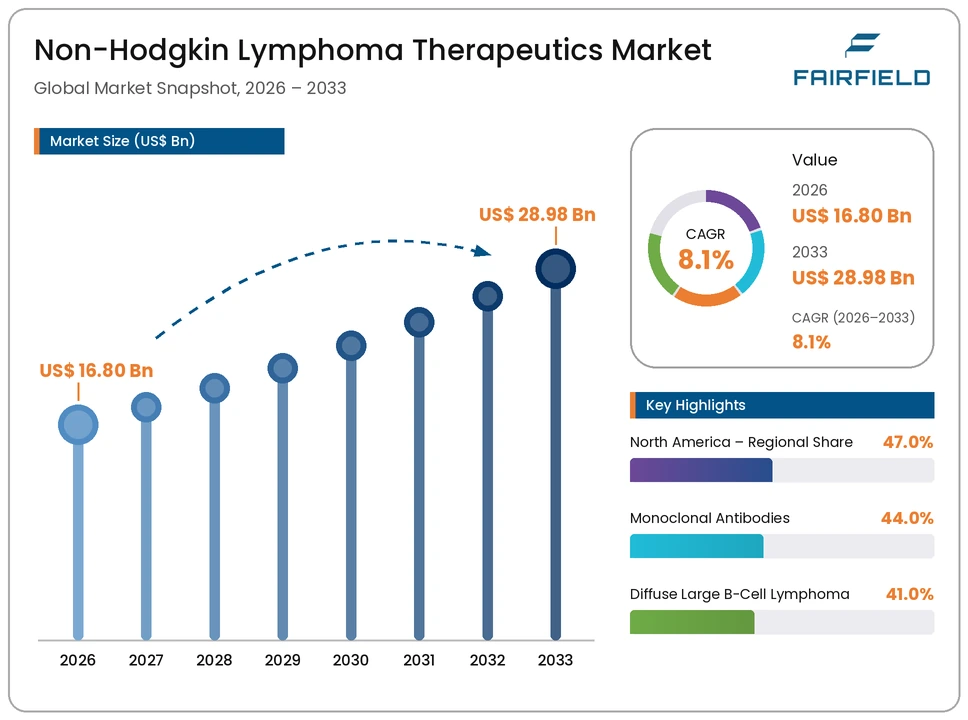
The market is valued at USD 16.80 Billion in 2026, with pharmaceutical companies directing substantial research investment toward novel cell-based therapies and bispecific antibody treatments that address patients with limited options following standard treatment failure. By 2033, the market is forecast to reach USD 28.98 Billion, reflecting steady growth across established DLBCL treatment applications alongside rapidly expanding follicular lymphoma therapeutic innovation.
Key Highlights
- The global non-Hodgkin lymphoma therapeutics market is valued at USD 16.80 Billion in 2026 and is projected to reach USD 28.98 Billion by 2033, expanding at a CAGR of 8.1% across the 2026-2033 forecast period.
- Monoclonal Antibodies lead the drug-class segment with a 44.0% share in 2026, equivalent to USD 7.39 Billion.
- Diffuse Large B-Cell Lymphoma (DLBCL) remains the dominant lymphoma subtype, accounting for 41.0% of global demand, or USD 6.89 Billion, in 2026.
- North America commands the largest regional share at 47.0% of the global market in 2026.
- Follicular lymphoma treatment is emerging as the fastest-growing lymphoma-subtype segment through 2033.
Market Dynamics
Key Growth Drivers
Growth in the non-Hodgkin lymphoma therapeutics market is driven primarily by sustained non-Hodgkin lymphoma incidence across aging global populations, as this cancer category's incidence rises with age, creating continued demand for effective treatment options across an expanding patient population in most major markets.
A second driver is continued expansion of CAR T-cell therapy approval and adoption, as this cell-based therapeutic approach has demonstrated significant efficacy in patients with relapsed or refractory disease, driving expanding regulatory approval into earlier treatment lines and broader lymphoma subtypes beyond its initial approved indications.
Key Restraints
The substantial cost of advanced therapies, particularly CAR T-cell treatments, creates significant access and reimbursement challenges across many healthcare systems, potentially limiting broader patient population access relative to established, lower-cost treatment approaches.
Additionally, the complex manufacturing and administration logistics associated with cell-based therapies, including specialized treatment center requirements and extended manufacturing timelines, create access barriers for patients outside major treatment centers with the necessary infrastructure and expertise.
Market Opportunities
The expansion of follicular lymphoma therapeutic innovation presents a substantial opportunity, as newer bispecific antibody therapies and other targeted treatment approaches offer improved efficacy and convenience for this common indolent lymphoma subtype, creating significant potential for treatment paradigm advancement.
A second opportunity lies in continued development of novel bispecific antibody and cell-based therapies addressing patients who progress on or are ineligible for existing treatment options. Companies that successfully advance this therapeutic innovation pipeline stand to address substantial unmet medical need across relapsed and refractory lymphoma patient populations.
Segmentation Analysis
By Drug Class
Monoclonal Antibodies lead the drug-class segment, accounting for 44.0% of global market value in 2026, equivalent to USD 7.39 Billion. Their leadership reflects monoclonal antibody therapy's long-established, foundational role across nearly all non-Hodgkin lymphoma subtype treatment regimens. BTK Inhibitors represent a significant, established drug-class category for specific lymphoma subtypes. CAR T-Cell Therapies represent the fastest-growing drug-class category through 2033, driven by expanding regulatory approval into broader lymphoma subtypes and earlier treatment lines.
By Lymphoma Subtype
Diffuse Large B-Cell Lymphoma (DLBCL) forms the leading lymphoma-subtype segment, representing 41.0% of global demand in 2026, or USD 6.89 Billion, reflecting DLBCL's status as the most common non-Hodgkin lymphoma subtype and the extensive treatment innovation directed toward this indication. Mantle Cell Lymphoma represents a significant, established lymphoma-subtype category. Follicular Lymphoma represents the fastest-growing lymphoma-subtype category, propelled by newer bispecific antibody and targeted therapy approvals for this indolent lymphoma type.
Regional Insights
North America
North America holds the largest regional share, at 47.0% of the global market in 2026, equivalent to USD 7.90 Billion. The region's leadership reflects strong oncology treatment infrastructure, rapid adoption of novel cell-based and targeted therapies, and substantial pharmaceutical research investment across the United States and Canada.
Europe
Europe accounts for 27.0% of the global market in 2026, valued at USD 4.54 Billion. Demand is supported by comprehensive healthcare systems and well-established oncology treatment protocols across major European markets.
Asia Pacific
Asia Pacific represents 18.0% of the global market in 2026, or USD 3.02 Billion. Growth is underpinned by rising cancer incidence and expanding access to advanced oncology therapies across China, Japan, and South Korea.
Latin America
Latin America contributes 5.0% of the global market in 2026, equivalent to USD 0.84 Billion. Growth is linked to gradually expanding oncology treatment access and infrastructure in Brazil and Mexico.
Middle East & Africa
Middle East & Africa holds 3.0% of the global market in 2026, valued at USD 0.50 Billion. Growth remains at an early stage, tied to gradual expansion of oncology treatment infrastructure across the region.
Competitive Landscape
The global non-Hodgkin lymphoma therapeutics market is moderately concentrated, with a limited number of large pharmaceutical and biotechnology companies holding strong positions supported by extensive oncology research and development investment and established treatment center relationships. Competition centers on clinical efficacy across lymphoma subtypes, breadth of treatment portfolio spanning multiple lines of therapy, and the ability to advance novel cell-based and bispecific antibody therapies through regulatory approval. Companies are increasingly differentiating through advanced cell-based therapy innovation rather than competing on established monoclonal antibody therapy pricing alone.
Key Market Players
- Roche Holding AG
- AbbVie Inc.
- Bristol Myers Squibb Company
- Gilead Sciences, Inc.
- Novartis AG
- Johnson & Johnson
- AstraZeneca plc
- Eli Lilly and Company
- Regeneron Pharmaceuticals, Inc.
- BeOne Medicines Ltd.
Market Segmentation
By Drug Class
- Monoclonal Antibodies
- CAR T-Cell Therapies
- BTK Inhibitors
- Others
By Lymphoma Subtype
- Diffuse Large B-Cell Lymphoma (DLBCL)
- Follicular Lymphoma
- Mantle Cell Lymphoma
- Others
By Route of Administration
- Intravenous
- Subcutaneous
By Geography
- North America
- Europe
- Asia Pacific
- Latin America
- Middle East & Africa
- Executive Summary
- Global Non-Hodgkin Lymphoma Therapeutics Market Snapshot
- Future Projections
- Key Market Trends
- Regional Snapshot, by Value, 2026
- Analyst Recommendations
- Market Overview
- Market Definitions and Segmentations
- Market Dynamics
- Drivers
- Restraints
- Market Opportunities
- Value Chain Analysis
- COVID-19 Impact Analysis
- Porter's Five Forces Analysis
- Impact of Russia-Ukraine Conflict
- PESTLE Analysis
- Regulatory Analysis
- Price Trend Analysis
- Current Prices and Future Projections, 2025-2033
- Price Impact Factors
- Global Non-Hodgkin Lymphoma Therapeutics Market Outlook, 2020 - 2033
- Global Non-Hodgkin Lymphoma Therapeutics Market Outlook, by Drug Class, Value (US$ Mn), 2020-2033
- Monoclonal Antibodies
- CAR T-Cell Therapies
- BTK Inhibitors
- Others
- Global Non-Hodgkin Lymphoma Therapeutics Market Outlook, by Lymphoma Subtype, Value (US$ Mn), 2020-2033
- Diffuse Large B-Cell Lymphoma (DLBCL)
- Follicular Lymphoma
- Mantle Cell Lymphoma
- Others
- Global Non-Hodgkin Lymphoma Therapeutics Market Outlook, by Route of Administration, Value (US$ Mn), 2020-2033
- Intravenous
- Subcutaneous
- Global Non-Hodgkin Lymphoma Therapeutics Market Outlook, by Region, Value (US$ Mn), 2020-2033
- North America
- Europe
- Asia Pacific
- Latin America
- Middle East & Africa
- Global Non-Hodgkin Lymphoma Therapeutics Market Outlook, by Drug Class, Value (US$ Mn), 2020-2033
- North America Non-Hodgkin Lymphoma Therapeutics Market Outlook, 2020 - 2033
- North America Non-Hodgkin Lymphoma Therapeutics Market Outlook, by Drug Class, Value (US$ Mn), 2020-2033
- Monoclonal Antibodies
- CAR T-Cell Therapies
- BTK Inhibitors
- Others
- North America Non-Hodgkin Lymphoma Therapeutics Market Outlook, by Lymphoma Subtype, Value (US$ Mn), 2020-2033
- Diffuse Large B-Cell Lymphoma (DLBCL)
- Follicular Lymphoma
- Mantle Cell Lymphoma
- Others
- North America Non-Hodgkin Lymphoma Therapeutics Market Outlook, by Route of Administration, Value (US$ Mn), 2020-2033
- Intravenous
- Subcutaneous
- North America Non-Hodgkin Lymphoma Therapeutics Market Outlook, by Country, Value (US$ Mn), 2020-2033
- U.S. Non-Hodgkin Lymphoma Therapeutics Market Outlook, by Drug Class, 2020-2033
- U.S. Non-Hodgkin Lymphoma Therapeutics Market Outlook, by Lymphoma Subtype, 2020-2033
- U.S. Non-Hodgkin Lymphoma Therapeutics Market Outlook, by Route of Administration, 2020-2033
- Canada Non-Hodgkin Lymphoma Therapeutics Market Outlook, by Drug Class, 2020-2033
- Canada Non-Hodgkin Lymphoma Therapeutics Market Outlook, by Lymphoma Subtype, 2020-2033
- Canada Non-Hodgkin Lymphoma Therapeutics Market Outlook, by Route of Administration, 2020-2033
- BPS Analysis/Market Attractiveness Analysis
- North America Non-Hodgkin Lymphoma Therapeutics Market Outlook, by Drug Class, Value (US$ Mn), 2020-2033
- Europe Non-Hodgkin Lymphoma Therapeutics Market Outlook, 2020 - 2033
- Europe Non-Hodgkin Lymphoma Therapeutics Market Outlook, by Drug Class, Value (US$ Mn), 2020-2033
- Monoclonal Antibodies
- CAR T-Cell Therapies
- BTK Inhibitors
- Others
- Europe Non-Hodgkin Lymphoma Therapeutics Market Outlook, by Lymphoma Subtype, Value (US$ Mn), 2020-2033
- Diffuse Large B-Cell Lymphoma (DLBCL)
- Follicular Lymphoma
- Mantle Cell Lymphoma
- Others
- Europe Non-Hodgkin Lymphoma Therapeutics Market Outlook, by Route of Administration, Value (US$ Mn), 2020-2033
- Intravenous
- Subcutaneous
- Europe Non-Hodgkin Lymphoma Therapeutics Market Outlook, by Country, Value (US$ Mn), 2020-2033
- Germany Non-Hodgkin Lymphoma Therapeutics Market Outlook, by Drug Class, 2020-2033
- Germany Non-Hodgkin Lymphoma Therapeutics Market Outlook, by Lymphoma Subtype, 2020-2033
- Germany Non-Hodgkin Lymphoma Therapeutics Market Outlook, by Route of Administration, 2020-2033
- Italy Non-Hodgkin Lymphoma Therapeutics Market Outlook, by Drug Class, 2020-2033
- Italy Non-Hodgkin Lymphoma Therapeutics Market Outlook, by Lymphoma Subtype, 2020-2033
- Italy Non-Hodgkin Lymphoma Therapeutics Market Outlook, by Route of Administration, 2020-2033
- France Non-Hodgkin Lymphoma Therapeutics Market Outlook, by Drug Class, 2020-2033
- France Non-Hodgkin Lymphoma Therapeutics Market Outlook, by Lymphoma Subtype, 2020-2033
- France Non-Hodgkin Lymphoma Therapeutics Market Outlook, by Route of Administration, 2020-2033
- U.K. Non-Hodgkin Lymphoma Therapeutics Market Outlook, by Drug Class, 2020-2033
- U.K. Non-Hodgkin Lymphoma Therapeutics Market Outlook, by Lymphoma Subtype, 2020-2033
- U.K. Non-Hodgkin Lymphoma Therapeutics Market Outlook, by Route of Administration, 2020-2033
- Spain Non-Hodgkin Lymphoma Therapeutics Market Outlook, by Drug Class, 2020-2033
- Spain Non-Hodgkin Lymphoma Therapeutics Market Outlook, by Lymphoma Subtype, 2020-2033
- Spain Non-Hodgkin Lymphoma Therapeutics Market Outlook, by Route of Administration, 2020-2033
- Russia Non-Hodgkin Lymphoma Therapeutics Market Outlook, by Drug Class, 2020-2033
- Russia Non-Hodgkin Lymphoma Therapeutics Market Outlook, by Lymphoma Subtype, 2020-2033
- Russia Non-Hodgkin Lymphoma Therapeutics Market Outlook, by Route of Administration, 2020-2033
- Rest of Europe Non-Hodgkin Lymphoma Therapeutics Market Outlook, by Drug Class, 2020-2033
- Rest of Europe Non-Hodgkin Lymphoma Therapeutics Market Outlook, by Lymphoma Subtype, 2020-2033
- Rest of Europe Non-Hodgkin Lymphoma Therapeutics Market Outlook, by Route of Administration, 2020-2033
- BPS Analysis/Market Attractiveness Analysis
- Europe Non-Hodgkin Lymphoma Therapeutics Market Outlook, by Drug Class, Value (US$ Mn), 2020-2033
- Asia Pacific Non-Hodgkin Lymphoma Therapeutics Market Outlook, 2020 - 2033
- Asia Pacific Non-Hodgkin Lymphoma Therapeutics Market Outlook, by Drug Class, Value (US$ Mn), 2020-2033
- Monoclonal Antibodies
- CAR T-Cell Therapies
- BTK Inhibitors
- Others
- Asia Pacific Non-Hodgkin Lymphoma Therapeutics Market Outlook, by Lymphoma Subtype, Value (US$ Mn), 2020-2033
- Diffuse Large B-Cell Lymphoma (DLBCL)
- Follicular Lymphoma
- Mantle Cell Lymphoma
- Others
- Asia Pacific Non-Hodgkin Lymphoma Therapeutics Market Outlook, by Route of Administration, Value (US$ Mn), 2020-2033
- Intravenous
- Subcutaneous
- Asia Pacific Non-Hodgkin Lymphoma Therapeutics Market Outlook, by Country, Value (US$ Mn), 2020-2033
- China Non-Hodgkin Lymphoma Therapeutics Market Outlook, by Drug Class, 2020-2033
- China Non-Hodgkin Lymphoma Therapeutics Market Outlook, by Lymphoma Subtype, 2020-2033
- China Non-Hodgkin Lymphoma Therapeutics Market Outlook, by Route of Administration, 2020-2033
- Japan Non-Hodgkin Lymphoma Therapeutics Market Outlook, by Drug Class, 2020-2033
- Japan Non-Hodgkin Lymphoma Therapeutics Market Outlook, by Lymphoma Subtype, 2020-2033
- Japan Non-Hodgkin Lymphoma Therapeutics Market Outlook, by Route of Administration, 2020-2033
- South Korea Non-Hodgkin Lymphoma Therapeutics Market Outlook, by Drug Class, 2020-2033
- South Korea Non-Hodgkin Lymphoma Therapeutics Market Outlook, by Lymphoma Subtype, 2020-2033
- South Korea Non-Hodgkin Lymphoma Therapeutics Market Outlook, by Route of Administration, 2020-2033
- India Non-Hodgkin Lymphoma Therapeutics Market Outlook, by Drug Class, 2020-2033
- India Non-Hodgkin Lymphoma Therapeutics Market Outlook, by Lymphoma Subtype, 2020-2033
- India Non-Hodgkin Lymphoma Therapeutics Market Outlook, by Route of Administration, 2020-2033
- Southeast Asia Non-Hodgkin Lymphoma Therapeutics Market Outlook, by Drug Class, 2020-2033
- Southeast Asia Non-Hodgkin Lymphoma Therapeutics Market Outlook, by Lymphoma Subtype, 2020-2033
- Southeast Asia Non-Hodgkin Lymphoma Therapeutics Market Outlook, by Route of Administration, 2020-2033
- Rest of SAO Non-Hodgkin Lymphoma Therapeutics Market Outlook, by Drug Class, 2020-2033
- Rest of SAO Non-Hodgkin Lymphoma Therapeutics Market Outlook, by Lymphoma Subtype, 2020-2033
- Rest of SAO Non-Hodgkin Lymphoma Therapeutics Market Outlook, by Route of Administration, 2020-2033
- BPS Analysis/Market Attractiveness Analysis
- Asia Pacific Non-Hodgkin Lymphoma Therapeutics Market Outlook, by Drug Class, Value (US$ Mn), 2020-2033
- Latin America Non-Hodgkin Lymphoma Therapeutics Market Outlook, 2020 - 2033
- Latin America Non-Hodgkin Lymphoma Therapeutics Market Outlook, by Drug Class, Value (US$ Mn), 2020-2033
- Monoclonal Antibodies
- CAR T-Cell Therapies
- BTK Inhibitors
- Others
- Latin America Non-Hodgkin Lymphoma Therapeutics Market Outlook, by Lymphoma Subtype, Value (US$ Mn), 2020-2033
- Diffuse Large B-Cell Lymphoma (DLBCL)
- Follicular Lymphoma
- Mantle Cell Lymphoma
- Others
- Latin America Non-Hodgkin Lymphoma Therapeutics Market Outlook, by Route of Administration, Value (US$ Mn), 2020-2033
- Intravenous
- Subcutaneous
- Latin America Non-Hodgkin Lymphoma Therapeutics Market Outlook, by Country, Value (US$ Mn), 2020-2033
- Brazil Non-Hodgkin Lymphoma Therapeutics Market Outlook, by Drug Class, 2020-2033
- Brazil Non-Hodgkin Lymphoma Therapeutics Market Outlook, by Lymphoma Subtype, 2020-2033
- Brazil Non-Hodgkin Lymphoma Therapeutics Market Outlook, by Route of Administration, 2020-2033
- Mexico Non-Hodgkin Lymphoma Therapeutics Market Outlook, by Drug Class, 2020-2033
- Mexico Non-Hodgkin Lymphoma Therapeutics Market Outlook, by Lymphoma Subtype, 2020-2033
- Mexico Non-Hodgkin Lymphoma Therapeutics Market Outlook, by Route of Administration, 2020-2033
- Argentina Non-Hodgkin Lymphoma Therapeutics Market Outlook, by Drug Class, 2020-2033
- Argentina Non-Hodgkin Lymphoma Therapeutics Market Outlook, by Lymphoma Subtype, 2020-2033
- Argentina Non-Hodgkin Lymphoma Therapeutics Market Outlook, by Route of Administration, 2020-2033
- Rest of LATAM Non-Hodgkin Lymphoma Therapeutics Market Outlook, by Drug Class, 2020-2033
- Rest of LATAM Non-Hodgkin Lymphoma Therapeutics Market Outlook, by Lymphoma Subtype, 2020-2033
- Rest of LATAM Non-Hodgkin Lymphoma Therapeutics Market Outlook, by Route of Administration, 2020-2033
- BPS Analysis/Market Attractiveness Analysis
- Latin America Non-Hodgkin Lymphoma Therapeutics Market Outlook, by Drug Class, Value (US$ Mn), 2020-2033
- Middle East & Africa Non-Hodgkin Lymphoma Therapeutics Market Outlook, 2020 - 2033
- Middle East & Africa Non-Hodgkin Lymphoma Therapeutics Market Outlook, by Drug Class, Value (US$ Mn), 2020-2033
- Monoclonal Antibodies
- CAR T-Cell Therapies
- BTK Inhibitors
- Others
- Middle East & Africa Non-Hodgkin Lymphoma Therapeutics Market Outlook, by Lymphoma Subtype, Value (US$ Mn), 2020-2033
- Diffuse Large B-Cell Lymphoma (DLBCL)
- Follicular Lymphoma
- Mantle Cell Lymphoma
- Others
- Middle East & Africa Non-Hodgkin Lymphoma Therapeutics Market Outlook, by Route of Administration, Value (US$ Mn), 2020-2033
- Intravenous
- Subcutaneous
- Middle East & Africa Non-Hodgkin Lymphoma Therapeutics Market Outlook, by Country, Value (US$ Mn), 2020-2033
- GCC Non-Hodgkin Lymphoma Therapeutics Market Outlook, by Drug Class, 2020-2033
- GCC Non-Hodgkin Lymphoma Therapeutics Market Outlook, by Lymphoma Subtype, 2020-2033
- GCC Non-Hodgkin Lymphoma Therapeutics Market Outlook, by Route of Administration, 2020-2033
- South Africa Non-Hodgkin Lymphoma Therapeutics Market Outlook, by Drug Class, 2020-2033
- South Africa Non-Hodgkin Lymphoma Therapeutics Market Outlook, by Lymphoma Subtype, 2020-2033
- South Africa Non-Hodgkin Lymphoma Therapeutics Market Outlook, by Route of Administration, 2020-2033
- Egypt Non-Hodgkin Lymphoma Therapeutics Market Outlook, by Drug Class, 2020-2033
- Egypt Non-Hodgkin Lymphoma Therapeutics Market Outlook, by Lymphoma Subtype, 2020-2033
- Egypt Non-Hodgkin Lymphoma Therapeutics Market Outlook, by Route of Administration, 2020-2033
- Nigeria Non-Hodgkin Lymphoma Therapeutics Market Outlook, by Drug Class, 2020-2033
- Nigeria Non-Hodgkin Lymphoma Therapeutics Market Outlook, by Lymphoma Subtype, 2020-2033
- Nigeria Non-Hodgkin Lymphoma Therapeutics Market Outlook, by Route of Administration, 2020-2033
- Rest of Middle East Non-Hodgkin Lymphoma Therapeutics Market Outlook, by Drug Class, 2020-2033
- Rest of Middle East Non-Hodgkin Lymphoma Therapeutics Market Outlook, by Lymphoma Subtype, 2020-2033
- Rest of Middle East Non-Hodgkin Lymphoma Therapeutics Market Outlook, by Route of Administration, 2020-2033
- BPS Analysis/Market Attractiveness Analysis
- Middle East & Africa Non-Hodgkin Lymphoma Therapeutics Market Outlook, by Drug Class, Value (US$ Mn), 2020-2033
- Competitive Landscape
- Company Vs Segment Heatmap
- Company Market Share Analysis, 2025
- Competitive Dashboard
- Company Profiles
- Roche Holding AG
- Company Overview
- Product Portfolio
- Financial Overview
- Business Strategies and Developments
- AbbVie Inc.
- Bristol Myers Squibb Company
- Gilead Sciences, Inc.
- Novartis AG
- Johnson & Johnson
- AstraZeneca plc
- Eli Lilly and Company
- Regeneron Pharmaceuticals, Inc.
- BeOne Medicines Ltd.
- Roche Holding AG
- Appendix
- Research Methodology
- Report Assumptions
- Acronyms and Abbreviations
By Drug Class
- Monoclonal Antibodies
- CAR T-Cell Therapies
- BTK Inhibitors
- Others
By Lymphoma Subtype
- Diffuse Large B-Cell Lymphoma (DLBCL)
- Follicular Lymphoma
- Mantle Cell Lymphoma
- Others
By Route of Administration
- Intravenous
- Subcutaneous
By Geography
- North America
- Europe
- Asia Pacific
- Latin America
- Middle East & Africa
Our Research Methodology
Considering the volatility of business today, traditional approaches to strategizing a game plan can be unfruitful if not detrimental. True ambiguity is no way to determine a forecast. A myriad of predetermined factors must be accounted for such as the degree of risk involved, the magnitude of circumstances, as well as conditions or consequences that are not known or unpredictable. To circumvent binary views that cast uncertainty, the application of market research intelligence to strategically posture, move, and enable actionable outcomes is necessary.
View Methodology
Quality Assured
Rigorous Validation Process

Confidentiality Assured
End-to-end Data Security

Custom Research Services
Tailored To Your Objectives
FAQs
The global non-Hodgkin lymphoma therapeutics market is valued at USD 16.80 Billion in 2026, reflecting sustained disease incidence and expanding treatment innovation.
The market is projected to grow at a CAGR of 8.1%, reaching USD 28.98 Billion by 2033, driven by expanding CAR T-cell therapy adoption and novel treatment development.
Monoclonal Antibodies lead with a 44.0% share in 2026, reflecting their long-established, foundational role across lymphoma treatment regimens.
North America leads with a 47.0% share in 2026, supported by strong oncology infrastructure and rapid adoption of novel therapies.
The largest opportunity lies in follicular lymphoma treatment, expanding alongside newer bispecific antibody and targeted therapy approvals.
Related Reports
Diagnostic Imaging Services Market Size, Share, Insights, Competitive Landscape, and Forecast 2026 to 2033
The diagnostic imaging services market is valued at US$600.05 billion in 2026 and is projected to reach US$908.23 billion by 2033, growing at a 6.1% CAGR.
TAVR (Transcatheter Aortic Valve Replacement) Market Size, Share, Insights, Competitive Landscape, and Forecast 2026 to 2033
The global TAVR market is valued at US$7.2 billion in 2026 and is projected to reach US$14 billion by 2033, growing at 9.97% CAGR
Specimen Collection Cards Market Size, Share, Insights, Competitive Landscape, and Forecast 2026 to 2033
The specimen collection cards market is valued at US$498.5 million in 2026 and is projected to reach US$687.5 million by 2033, growing at a 4.7% CAGR.
Point of Care CT Imaging Systems Market Size, Share, Insights, Competitive Landscape, and Forecast 2026 to 2033
The global point-of-care CT imaging systems market is valued at US$0.7 billion in 2026, reaching US$1.4 billion by 2033, growing at a 10.41% CAGR
Transcutaneous Oximetry Systems Market Size, Share, Insights, Competitive Landscape, and Forecast 2026 to 2033
The global transcutaneous oximetry systems market is projected to grow from US$0.4 billion in 2026 to US$0.6 billion by 2033, at a 5.96% CAGR
Healthcare Quality Management Software Market Size, Share, Insights, Competitive Landscape, and Forecast 2026 to 2033
The global healthcare quality management software market will reach US$ 3.80 Billion by 2033, growing at 12.2% CAGR from 2026-2033