



Paper & Pulp Enzymes Market
Paper & Pulp Enzymes Market Insights, Competitive Landscape, and Market Forecast 2033
Market Overview
Paper and pulp enzymes are biological catalysts used across pulping, bleaching, and paper finishing processes to improve fiber quality, reduce chemical consumption, and lower the environmental footprint of pulp and paper manufacturing. Enzymes such as cellulases, xylanases, and lipases act on specific components of wood fiber and pulp, enabling manufacturers to achieve desired brightness, strength, and runnability characteristics while reducing reliance on chlorine-based bleaching chemicals and mechanical energy input.
Demand growth through the 2026-2033 window is closely tied to tightening environmental regulations around chlorine-based bleaching byproducts, rising energy costs that make enzyme-assisted mechanical pulping more attractive, and growing manufacturer interest in improving fiber yield from increasingly variable wood and recycled fiber inputs. The expansion of recycled paper and packaging production is also reinforcing enzyme demand, since deinking and fiber modification enzymes help maintain product quality as manufacturers rely more heavily on recovered fiber streams.
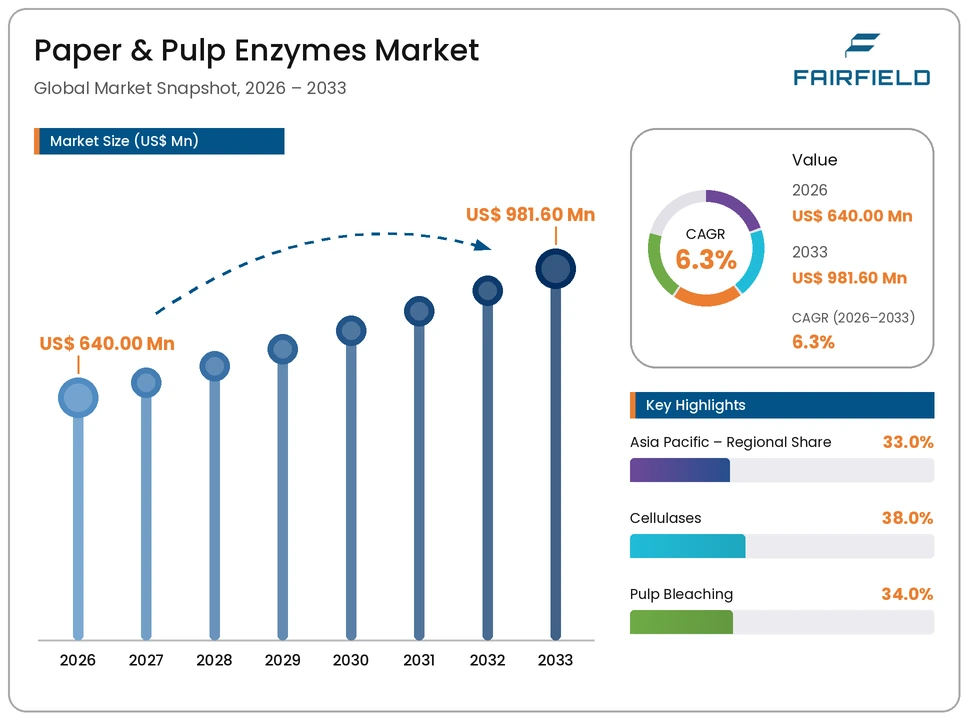
The market is valued at USD 640.00 Million in 2026, with enzyme producers directing investment toward strain optimization and application-specific formulations suited to varying pulp furnish types. By 2033, the market is forecast to reach USD 981.60 Million, reflecting steady adoption as enzyme-based processing becomes an increasingly standard component of pulp and paper manufacturing.
Key Highlights
- The global paper & pulp enzymes market is valued at USD 640.00 Million in 2026 and is projected to reach USD 981.60 Million by 2033, expanding at a CAGR of 6.3% across the 2026-2033 forecast period.
- Cellulases lead the enzyme-type segment with a 38.0% share in 2026, equivalent to USD 243.20 Million.
- Pulp Bleaching remains the dominant application, accounting for 34.0% of global demand, or USD 217.60 Million, in 2026.
- Asia Pacific commands the largest regional share at 33.0% of the global market in 2026.
- Fiber modification applications are emerging as the fastest-growing demand pocket through 2033.
Market Dynamics
Key Growth Drivers
Growth in the paper and pulp enzymes market is driven primarily by tightening environmental regulations on chlorine-based bleaching agents, which are prompting mills to adopt enzyme-assisted bleaching processes that reduce chemical oxygen demand and effluent toxicity while maintaining target brightness levels. This regulatory pressure is particularly pronounced in regions with stringent water discharge standards for industrial pulp and paper operations.
A second driver is rising energy costs associated with mechanical pulping, which has encouraged manufacturers to adopt enzyme pre-treatment processes that reduce the mechanical energy required to refine wood fiber into pulp. As energy represents a substantial share of mechanical pulping operating costs, enzyme-assisted processes offering measurable energy savings continue to gain adoption across cost-conscious mill operations.
Key Restraints
The relatively high cost of specialized enzyme formulations compared with conventional chemical processing agents limits adoption among smaller or cost-constrained pulp and paper producers, particularly in price-sensitive regional markets where chemical alternatives remain more economical on a per-ton basis. Producers must demonstrate clear operational savings to justify the incremental cost of enzyme adoption.
Additionally, variability in performance across different wood species, pulp furnish types, and processing conditions requires careful formulation and dosing adjustments, adding complexity to enzyme adoption relative to more standardized chemical treatment processes, which can slow uptake among mills without dedicated technical support resources.
Market Opportunities
The expansion of recycled fiber-based packaging production presents a substantial opportunity, as deinking and fiber modification enzymes help maintain paper quality and runnability as manufacturers increase their reliance on recovered fiber to meet sustainability and cost objectives in packaging applications.
A second opportunity lies in the development of enzyme formulations tailored to emerging pulp furnish types, including agricultural residue and alternative fiber sources being explored as wood fiber supply constraints grow in some regions. Enzyme producers that develop application-specific solutions for these non-traditional fiber inputs stand to capture demand as the industry diversifies its raw material base.
Segmentation Analysis
By Enzyme Type
Cellulases lead the enzyme-type segment, accounting for 38.0% of global market value in 2026, equivalent to USD 243.20 Million. Their leadership reflects broad use across mechanical pulping and fiber modification processes where breaking down cellulose structures improves processing efficiency. Xylanases hold the second-largest share, widely used in pulp bleaching to improve brightness while reducing chemical bleach requirements. Lipases and other specialty enzymes address niche applications such as pitch control, representing a smaller but steadily growing share of the market.
By Application
Pulp Bleaching forms the leading application segment, representing 34.0% of global demand in 2026, or USD 217.60 Million, driven by mill efforts to reduce chlorine-based chemical usage while meeting brightness targets. Deinking forms the second-largest application, supported by growing recycled paper production. Fiber Modification represents the fastest-growing application category, propelled by manufacturer interest in improving fiber properties across both virgin and recycled furnish streams.
Regional Insights
Asia Pacific
Asia Pacific holds the largest regional share, at 33.0% of the global market in 2026, equivalent to USD 211.20 Million. The region's leadership reflects its large and expanding pulp and paper production base, led by China and Indonesia, alongside growing regulatory attention to industrial effluent management that is encouraging enzyme-assisted processing adoption.
North America
North America accounts for 28.0% of the global market in 2026, valued at USD 179.20 Million. Demand is supported by an established pulp and paper industry in the United States and Canada, alongside strict environmental discharge regulations that favor enzyme-based bleaching and processing approaches.
Europe
Europe represents 26.0% of the global market in 2026, or USD 166.40 Million. The region's stringent environmental standards and strong pulp production base in Scandinavian countries sustain steady demand for enzyme-based processing solutions across bleaching and fiber treatment applications.
Latin America
Latin America contributes 9.0% of the global market in 2026, equivalent to USD 57.60 Million. Brazil anchors regional demand, supported by its large-scale eucalyptus pulp production base and gradual adoption of enzyme-assisted processing to improve fiber yield and reduce chemical costs.
Middle East & Africa
Middle East & Africa holds 4.0% of the global market in 2026, valued at USD 25.60 Million. Growth remains limited given a comparatively small regional pulp and paper manufacturing base, with adoption concentrated among larger mills seeking to meet export market quality and environmental standards.
Competitive Landscape
The global paper and pulp enzymes market is moderately concentrated, with a small number of established industrial enzyme producers accounting for a substantial share of global supply, supported by significant research investment in strain development and application expertise. A broader base of regional and specialty enzyme producers serves local pulp and paper markets with tailored formulations. Competition centers on enzyme performance consistency, technical application support, and the ability to formulate products suited to varying regional fiber and processing conditions, with producers increasingly differentiating through application-specific enzyme blends rather than competing on price alone.
Market Segmentation
By Enzyme Type
- Cellulases
- Xylanases
- Lipases
- Others
By Application
- Pulp Bleaching
- Deinking
- Pitch Control
- Fiber Modification
- Others
By Source
- Bacterial
- Fungal
By Geography
- North America
- Europe
- Asia Pacific
- Latin America
- Middle East & Africa
- Executive Summary
- Global Paper & Pulp Enzymes Market Snapshot
- Future Projections
- Key Market Trends
- Regional Snapshot, by Value, 2026
- Analyst Recommendations
- Market Overview
- Market Definitions and Segmentations
- Market Dynamics
- Drivers
- Restraints
- Market Opportunities
- Value Chain Analysis
- COVID-19 Impact Analysis
- Porter's Five Forces Analysis
- Impact of Russia-Ukraine Conflict
- PESTLE Analysis
- Regulatory Analysis
- Price Trend Analysis
- Current Prices and Future Projections, 2025-2033
- Price Impact Factors
- Global Paper & Pulp Enzymes Market Outlook, 2020 - 2033
- Global Paper & Pulp Enzymes Market Outlook, by Enzyme Type, Value (US$ Mn), 2020-2033
- Cellulases
- Xylanases
- Lipases
- Lipases
- Global Paper & Pulp Enzymes Market Outlook, by Application, Value (US$ Mn), 2020-2033
- Pulp Bleaching
- Deinking
- Fiber Modification
- Others
- Global Paper & Pulp Enzymes Market Outlook, by Source, Value (US$ Mn), 2020-2033
- Bacterial
- Fungal
- Global Paper & Pulp Enzymes Market Outlook, by Region, Value (US$ Mn), 2020-2033
- North America
- Europe
- Asia Pacific
- Latin America
- Middle East & Africa
- Global Paper & Pulp Enzymes Market Outlook, by Enzyme Type, Value (US$ Mn), 2020-2033
- North America Paper & Pulp Enzymes Market Outlook, 2020 - 2033
- North America Paper & Pulp Enzymes Market Outlook, by Enzyme Type, Value (US$ Mn), 2020-2033
- Cellulases
- Xylanases
- Lipases
- Lipases
- North America Paper & Pulp Enzymes Market Outlook, by Application, Value (US$ Mn), 2020-2033
- Pulp Bleaching
- Deinking
- Fiber Modification
- Others
- North America Paper & Pulp Enzymes Market Outlook, by Source, Value (US$ Mn), 2020-2033
- Bacterial
- Fungal
- North America Paper & Pulp Enzymes Market Outlook, by Country, Value (US$ Mn), 2020-2033
- U.S. Paper & Pulp Enzymes Market Outlook, by Enzyme Type, 2020-2033
- U.S. Paper & Pulp Enzymes Market Outlook, by Application, 2020-2033
- U.S. Paper & Pulp Enzymes Market Outlook, by Source, 2020-2033
- Canada Paper & Pulp Enzymes Market Outlook, by Enzyme Type, 2020-2033
- Canada Paper & Pulp Enzymes Market Outlook, by Application, 2020-2033
- Canada Paper & Pulp Enzymes Market Outlook, by Source, 2020-2033
- BPS Analysis/Market Attractiveness Analysis
- North America Paper & Pulp Enzymes Market Outlook, by Enzyme Type, Value (US$ Mn), 2020-2033
- Europe Paper & Pulp Enzymes Market Outlook, 2020 - 2033
- Europe Paper & Pulp Enzymes Market Outlook, by Enzyme Type, Value (US$ Mn), 2020-2033
- Cellulases
- Xylanases
- Lipases
- Lipases
- Europe Paper & Pulp Enzymes Market Outlook, by Application, Value (US$ Mn), 2020-2033
- Pulp Bleaching
- Deinking
- Fiber Modification
- Others
- Europe Paper & Pulp Enzymes Market Outlook, by Source, Value (US$ Mn), 2020-2033
- Bacterial
- Fungal
- Europe Paper & Pulp Enzymes Market Outlook, by Country, Value (US$ Mn), 2020-2033
- Germany Paper & Pulp Enzymes Market Outlook, by Enzyme Type, 2020-2033
- Germany Paper & Pulp Enzymes Market Outlook, by Application, 2020-2033
- Germany Paper & Pulp Enzymes Market Outlook, by Source, 2020-2033
- Italy Paper & Pulp Enzymes Market Outlook, by Enzyme Type, 2020-2033
- Italy Paper & Pulp Enzymes Market Outlook, by Application, 2020-2033
- Italy Paper & Pulp Enzymes Market Outlook, by Source, 2020-2033
- France Paper & Pulp Enzymes Market Outlook, by Enzyme Type, 2020-2033
- France Paper & Pulp Enzymes Market Outlook, by Application, 2020-2033
- France Paper & Pulp Enzymes Market Outlook, by Source, 2020-2033
- U.K. Paper & Pulp Enzymes Market Outlook, by Enzyme Type, 2020-2033
- U.K. Paper & Pulp Enzymes Market Outlook, by Application, 2020-2033
- U.K. Paper & Pulp Enzymes Market Outlook, by Source, 2020-2033
- Spain Paper & Pulp Enzymes Market Outlook, by Enzyme Type, 2020-2033
- Spain Paper & Pulp Enzymes Market Outlook, by Application, 2020-2033
- Spain Paper & Pulp Enzymes Market Outlook, by Source, 2020-2033
- Russia Paper & Pulp Enzymes Market Outlook, by Enzyme Type, 2020-2033
- Russia Paper & Pulp Enzymes Market Outlook, by Application, 2020-2033
- Russia Paper & Pulp Enzymes Market Outlook, by Source, 2020-2033
- Rest of Europe Paper & Pulp Enzymes Market Outlook, by Enzyme Type, 2020-2033
- Rest of Europe Paper & Pulp Enzymes Market Outlook, by Application, 2020-2033
- Rest of Europe Paper & Pulp Enzymes Market Outlook, by Source, 2020-2033
- BPS Analysis/Market Attractiveness Analysis
- Europe Paper & Pulp Enzymes Market Outlook, by Enzyme Type, Value (US$ Mn), 2020-2033
- Asia Pacific Paper & Pulp Enzymes Market Outlook, 2020 - 2033
- Asia Pacific Paper & Pulp Enzymes Market Outlook, by Enzyme Type, Value (US$ Mn), 2020-2033
- Cellulases
- Xylanases
- Lipases
- Lipases
- Asia Pacific Paper & Pulp Enzymes Market Outlook, by Application, Value (US$ Mn), 2020-2033
- Pulp Bleaching
- Deinking
- Fiber Modification
- Others
- Asia Pacific Paper & Pulp Enzymes Market Outlook, by Source, Value (US$ Mn), 2020-2033
- Bacterial
- Fungal
- Asia Pacific Paper & Pulp Enzymes Market Outlook, by Country, Value (US$ Mn), 2020-2033
- China Paper & Pulp Enzymes Market Outlook, by Enzyme Type, 2020-2033
- China Paper & Pulp Enzymes Market Outlook, by Application, 2020-2033
- China Paper & Pulp Enzymes Market Outlook, by Source, 2020-2033
- Japan Paper & Pulp Enzymes Market Outlook, by Enzyme Type, 2020-2033
- Japan Paper & Pulp Enzymes Market Outlook, by Application, 2020-2033
- Japan Paper & Pulp Enzymes Market Outlook, by Source, 2020-2033
- South Korea Paper & Pulp Enzymes Market Outlook, by Enzyme Type, 2020-2033
- South Korea Paper & Pulp Enzymes Market Outlook, by Application, 2020-2033
- South Korea Paper & Pulp Enzymes Market Outlook, by Source, 2020-2033
- India Paper & Pulp Enzymes Market Outlook, by Enzyme Type, 2020-2033
- India Paper & Pulp Enzymes Market Outlook, by Application, 2020-2033
- India Paper & Pulp Enzymes Market Outlook, by Source, 2020-2033
- Southeast Asia Paper & Pulp Enzymes Market Outlook, by Enzyme Type, 2020-2033
- Southeast Asia Paper & Pulp Enzymes Market Outlook, by Application, 2020-2033
- Southeast Asia Paper & Pulp Enzymes Market Outlook, by Source, 2020-2033
- Rest of SAO Paper & Pulp Enzymes Market Outlook, by Enzyme Type, 2020-2033
- Rest of SAO Paper & Pulp Enzymes Market Outlook, by Application, 2020-2033
- Rest of SAO Paper & Pulp Enzymes Market Outlook, by Source, 2020-2033
- BPS Analysis/Market Attractiveness Analysis
- Asia Pacific Paper & Pulp Enzymes Market Outlook, by Enzyme Type, Value (US$ Mn), 2020-2033
- Latin America Paper & Pulp Enzymes Market Outlook, 2020 - 2033
- Latin America Paper & Pulp Enzymes Market Outlook, by Enzyme Type, Value (US$ Mn), 2020-2033
- Cellulases
- Xylanases
- Lipases
- Lipases
- Latin America Paper & Pulp Enzymes Market Outlook, by Application, Value (US$ Mn), 2020-2033
- Pulp Bleaching
- Deinking
- Fiber Modification
- Others
- Latin America Paper & Pulp Enzymes Market Outlook, by Source, Value (US$ Mn), 2020-2033
- Bacterial
- Fungal
- Latin America Paper & Pulp Enzymes Market Outlook, by Country, Value (US$ Mn), 2020-2033
- Brazil Paper & Pulp Enzymes Market Outlook, by Enzyme Type, 2020-2033
- Brazil Paper & Pulp Enzymes Market Outlook, by Application, 2020-2033
- Brazil Paper & Pulp Enzymes Market Outlook, by Source, 2020-2033
- Mexico Paper & Pulp Enzymes Market Outlook, by Enzyme Type, 2020-2033
- Mexico Paper & Pulp Enzymes Market Outlook, by Application, 2020-2033
- Mexico Paper & Pulp Enzymes Market Outlook, by Source, 2020-2033
- Argentina Paper & Pulp Enzymes Market Outlook, by Enzyme Type, 2020-2033
- Argentina Paper & Pulp Enzymes Market Outlook, by Application, 2020-2033
- Argentina Paper & Pulp Enzymes Market Outlook, by Source, 2020-2033
- Rest of LATAM Paper & Pulp Enzymes Market Outlook, by Enzyme Type, 2020-2033
- Rest of LATAM Paper & Pulp Enzymes Market Outlook, by Application, 2020-2033
- Rest of LATAM Paper & Pulp Enzymes Market Outlook, by Source, 2020-2033
- BPS Analysis/Market Attractiveness Analysis
- Latin America Paper & Pulp Enzymes Market Outlook, by Enzyme Type, Value (US$ Mn), 2020-2033
- Middle East & Africa Paper & Pulp Enzymes Market Outlook, 2020 - 2033
- Middle East & Africa Paper & Pulp Enzymes Market Outlook, by Enzyme Type, Value (US$ Mn), 2020-2033
- Cellulases
- Xylanases
- Lipases
- Lipases
- Middle East & Africa Paper & Pulp Enzymes Market Outlook, by Application, Value (US$ Mn), 2020-2033
- Pulp Bleaching
- Deinking
- Fiber Modification
- Others
- Middle East & Africa Paper & Pulp Enzymes Market Outlook, by Source, Value (US$ Mn), 2020-2033
- Bacterial
- Fungal
- Middle East & Africa Paper & Pulp Enzymes Market Outlook, by Country, Value (US$ Mn), 2020-2033
- GCC Paper & Pulp Enzymes Market Outlook, by Enzyme Type, 2020-2033
- GCC Paper & Pulp Enzymes Market Outlook, by Application, 2020-2033
- GCC Paper & Pulp Enzymes Market Outlook, by Source, 2020-2033
- South Africa Paper & Pulp Enzymes Market Outlook, by Enzyme Type, 2020-2033
- South Africa Paper & Pulp Enzymes Market Outlook, by Application, 2020-2033
- South Africa Paper & Pulp Enzymes Market Outlook, by Source, 2020-2033
- Egypt Paper & Pulp Enzymes Market Outlook, by Enzyme Type, 2020-2033
- Egypt Paper & Pulp Enzymes Market Outlook, by Application, 2020-2033
- Egypt Paper & Pulp Enzymes Market Outlook, by Source, 2020-2033
- Nigeria Paper & Pulp Enzymes Market Outlook, by Enzyme Type, 2020-2033
- Nigeria Paper & Pulp Enzymes Market Outlook, by Application, 2020-2033
- Nigeria Paper & Pulp Enzymes Market Outlook, by Source, 2020-2033
- Rest of Middle East Paper & Pulp Enzymes Market Outlook, by Enzyme Type, 2020-2033
- Rest of Middle East Paper & Pulp Enzymes Market Outlook, by Application, 2020-2033
- Rest of Middle East Paper & Pulp Enzymes Market Outlook, by Source, 2020-2033
- BPS Analysis/Market Attractiveness Analysis
- Middle East & Africa Paper & Pulp Enzymes Market Outlook, by Enzyme Type, Value (US$ Mn), 2020-2033
- Competitive Landscape
- Company Vs Segment Heatmap
- Company Market Share Analysis, 2025
- Competitive Dashboard
- Company Profiles
- Novozymes A/S
- Company Overview
- Product Portfolio
- Financial Overview
- Business Strategies and Developments
- International Flavors & Fragrances Inc.
- BASF SE
- AB Enzymes GmbH
- Advanced Enzyme Technologies Ltd.
- Amano Enzyme Inc.
- dsm-firmenich
- Sunson Industry Group Co., Ltd.
- Creative Enzymes
- Megazyme
- Novozymes A/S
- Appendix
- Research Methodology
- Report Assumptions
- Acronyms and Abbreviations
By Enzyme Type
- Cellulases
- Xylanases
- Lipases
- Others
By Application
- Pulp Bleaching
- Deinking
- Pitch Control
- Fiber Modification
- Others
By Source
- Bacterial
- Fungal
By Geography
- North America
- Europe
- Asia Pacific
- Latin America
- Middle East & Africa
Our Research Methodology
Considering the volatility of business today, traditional approaches to strategizing a game plan can be unfruitful if not detrimental. True ambiguity is no way to determine a forecast. A myriad of predetermined factors must be accounted for such as the degree of risk involved, the magnitude of circumstances, as well as conditions or consequences that are not known or unpredictable. To circumvent binary views that cast uncertainty, the application of market research intelligence to strategically posture, move, and enable actionable outcomes is necessary.
View Methodology
Quality Assured
Rigorous Validation Process

Confidentiality Assured
End-to-end Data Security

Custom Research Services
Tailored To Your Objectives
FAQs
The global paper & pulp enzymes market is valued at USD 640.00 Million in 2026, reflecting growing adoption of enzyme-assisted pulping and bleaching processes.
The market is projected to grow at a CAGR of 6.3%, reaching USD 981.60 Million by 2033, supported by tightening environmental regulations and rising energy costs.
Cellulases lead with a 38.0% share in 2026, favored for their broad use across mechanical pulping and fiber modification processes.
Asia Pacific leads with a 33.0% share in 2026, driven by its large and expanding pulp and paper production base.
The largest opportunity lies in enzyme formulations tailored to recycled and alternative fiber sources, supporting the industry's shift toward more diverse raw material inputs.
Related Reports
Automotive NVH Materials Market Size, Share, Insights, Competitive Landscape, and Forecast 2026 to 2033
The global automotive NVH materials market is valued at US$13.8 billion in 2026, reaching US$20.5 billion by 2033, growing at a 5.82% CAGR
Acrylonitrile Butadiene Styrene Market Size, Share, Insights, Competitive Landscape, and Forecast 2026 to 2033
The global acrylonitrile butadiene styrene market is valued at US$27.4 billion in 2026, reaching US$38.6 billion by 2033, growing at a 5.02% CAGR
Tank Mix Adjuvants Market Size, Share, Insights, Competitive Landscape, and Forecast 2026 to 2033
The global tank mix adjuvants market is valued at US$4.3 billion in 2026, reaching US$6.6 billion by 2033, growing at a 6.3% CAGR
Glass Flake Coatings Market Size, Share, Insights, Competitive Landscape, and Forecast 2026 to 2033
The glass flake coatings market is projected to grow from US$0.64 billion in 2026 to US$0.96 billion by 2033, at a 5.96% CAGR
Paint Protection Films Market Size, Share, Insights, Competitive Landscape, and Forecast 2026 to 2033
The global paint protection films market is valued at US$1.05 billion in 2026 and is projected to reach US$2.25 billion by 2033, growing at 11.5% CAGR
Electrical Steel Coatings Market Size, Share, Insights, Competitive Landscape, and Forecast 2026 to 2033
The electrical steel coatings market, valued at US$ 1.42 billion in 2026, and forecast to reach US$ 2.41 billion by 2033, growing at a 7.85% CAGR