



Probiotic Tea Market
Probiotic Tea Market Size, Share, Insights, Competitive Landscape, and Forecast 2026 to 2033
Probiotic Tea Market Size and Trend Analysis
What Shapes the Probiotic Tea Growth Outlook?
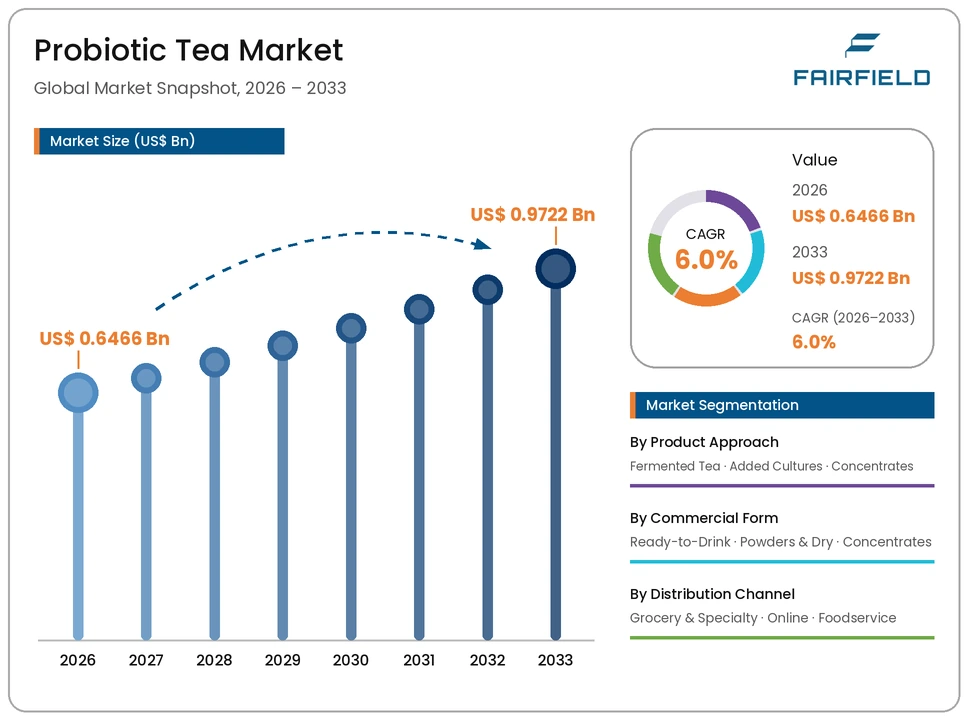
The global probiotic tea market size is expected to be valued at US$0.6466 billion in 2026 and projected to reach US$0.9722 billion by 2033, growing at a CAGR of 6.0% between 2026 and 2033. The outlook applies the published benchmark growth rate to the requested forecast window. The calculated endpoint represents a constant-growth projection, rather than a separately published estimate for that year. Commercial performance will depend on actual adoption and implementation.
The 2025 benchmark is US$0.6100 billion; a consistent historical CAGR for 2020–2025 is not established. The market covers commercial tea-based beverages or preparations carrying a defined live-culture or added probiotic proposition, including qualifying kombucha products. Its direction reflects familiar beverage routines and flavor and format accessibility. For beverage brands, distributors, retailers, and consumers, the investment case depends on taste, culture handling, shelf-life control, and repeat purchasing. Supply capability and practical qualification remain important as the category develops.
Key Report Takeaways
- By Product Approach: Fermented Tea Products include qualifying kombucha. Tea with Added Probiotic Cultures uses a defined addition approach. Concentrated Tea Preparations provide an alternative format where culture viability and use conditions are supported.
- By Commercial Form: Ready-to-Drink Products minimize preparation steps. Powders and Dry Preparations can offer different storage or serving arrangements. Liquid Concentrates require clear dilution and handling instructions. The format influences packaging and distribution, but does not independently establish probiotic efficacy.
- By Distribution Channel: Grocery and Specialty Retail provides shelf discovery. Direct and Marketplace Online Sales can offer product detail and replenishment. Foodservice connects products with prepared beverage occasions. Channel accounting should avoid counting wholesale shipments and final retail revenue together.
- By Storage Proposition: Refrigerated Products require suitable handling. Validated Ambient Products depend on formulation-specific evidence. Preparation-Dependent Products need instructions to preserve the intended proposition during use. These categories should follow actual supplier guidance rather than assumptions about fermentation.
- By Geography: North America, Europe, Asia Pacific, Latin America, and Middle East & Africa present distinct operating and purchasing conditions. Regional leadership is not assigned without comparable revenue evidence; country-specific support, market access, and implementation capability shape commercial opportunities.
Drivers Impact Analysis
Impact ratings are qualitative commercial assessments; they do not quantify additional CAGR contributions.
| Driver | Impact on CAGR Forecast | Geographic Relevance | Impact Timeline |
| Familiar Beverage Routines | High | All regions; relevance varies by application | Medium term 2–4 years |
| Flavor and Format Accessibility | Medium | All regions; relevance varies by application | Long term ≥4 years |
Probiotic Tea: Familiar Beverage Routines
Familiar beverage routines support probiotic tea demand when a consumer wants a functional drink rather than another supplement. Tea-based flavors and ready-to-drink formats can make the product approachable. Commercial performance depends on taste and repeat use, not simply a digestive-health statement on the packaging. For a purchasing decision, the relevant benefit is the problem removed from the customer's existing workflow. A supplier should identify the required output, the conditions under which it is achieved, and the resources needed to maintain it.
Health-Ade sells kombucha with a live-culture proposition, and GT’s Living Foods offers functional fermented beverages. These products demonstrate market participation. Probiotic kombucha should still be described accurately: fermented tea is not automatically evidence of a strain-specific clinical benefit, and product culture claims require attention to the stated measurement conditions.
Probiotic Tea: Flavor and Format Accessibility
Flavor and format development supports customer trial when acidity or unfamiliar fermentation notes create hesitation. Brands can introduce recognizable flavor combinations while retaining product stability and a clear culture proposition. Ready-to-drink probiotic beverages compete for everyday refreshment occasions as well as functional positioning. The effect on demand depends on whether the customer can incorporate the offering into an established routine. Additional capabilities are valuable when they address a real bottleneck and remain practical for the people responsible for implementation.
Brew Dr. introduced an iced tea and lemonade-inspired kombucha in 2025. Humm also announced a grapefruit flavor in 2024. These verified developments show practical attempts to broaden flavor appeal. A new flavor is commercially meaningful when consumers understand the product and retailers can manage the format consistently. Buyers should distinguish technical availability from successful deployment.
Restraints Impact Analysis
Impact ratings are qualitative commercial assessments; they do not quantify additional CAGR contributions.
| Restraint | Impact on CAGR Forecast | Geographic Relevance | Impact Timeline |
| Live-Culture Handling and Distribution | Medium | All regions; relevance varies by application | Medium term 2–4 years |
| Premium Pricing and Taste Acceptance | Medium | All regions; relevance varies by application | Long term ≥4 years |
Probiotic Tea: Live-Culture Handling and Distribution
Live-culture handling can restrain distribution when product quality changes during storage or delivery. Fermented tea formulations need controls for the actual product and package. Depending on the process, manufacturers may need to manage continued fermentation, taste drift, or culture viability. A generic shelf-stable statement cannot be transferred between brands. This limitation can extend the interval between first interest and a repeatable commercial relationship. Development budgets should include the work needed to resolve the problem rather than treating qualification as an incidental expense after supplier selection.
The cost sources include product testing, suitable storage, packaging, and control of distribution conditions. Brands should distinguish viable counts at bottling from counts supported through the stated shelf life. Retailers need clear handling instructions. Stability decisions affect logistics and the credibility of the functional proposition.
Probiotic Tea: Premium Pricing and Taste Acceptance
Premium pricing limits expansion when consumers compare functional tea beverages with ordinary refreshments. A strong marketing proposition may attract trial but cannot ensure repeat purchase if taste or affordability is unsuitable. Retail promotions also need to be evaluated against the contribution remaining after distribution and handling costs. The commercial consequence is a more selective purchasing process. Customers may defer adoption, narrow the intended use, or retain an alternative until the complete operating requirements are understood. A quotation should make those requirements visible before commitment.
The underlying issue is the fit between product value and consumption occasion. Brands must balance flavor, package size, and operating expenditure without weakening product quality. Testing repeat purchasing and retailer replenishment provides a more useful commercial signal than relying only on social media awareness or one-time promotional sales.
Market Opportunities
Impact ratings are qualitative commercial assessments; they do not quantify additional CAGR contributions.
| Opportunity | Impact on CAGR Forecast | Geographic Relevance | Impact Timeline |
| Foodservice and Convenient Pack Formats | Medium | All regions; relevance varies by application | Medium term 2–4 years |
| Transparent Culture and Ingredient Positioning | Medium | All regions; relevance varies by application | Long term ≥4 years |
Probiotic Tea: Foodservice and Convenient Pack Formats
Foodservice and convenient pack formats create opportunities beyond the established grocery shelf. A defined beverage can serve cafes, workplace refreshment, or other occasions where consumers already buy tea-based drinks. Suppliers need a practical service model that preserves product quality and makes the offering understandable to staff and customers. The attractive customer is one with a clearly defined unmet requirement and the resources to implement the solution. Sales development should begin with that requirement, rather than assume that a broad category trend converts automatically into an order.
Remedy Drinks describes a shelf-stable kombucha proposition, while other brands use different handling arrangements. The opportunity depends on the actual formulation, not a category-wide assumption. Foodservice partners should evaluate storage, serving, and replenishment needs before adding a live-culture tea product to a standard beverage program.
Probiotic Tea: Transparent Culture and Ingredient Positioning
Transparent positioning creates an opportunity for brands to distinguish live-culture tea from prebiotic soda and ordinary fermented beverages. Clear ingredient and culture descriptions can help consumers choose without relying on exaggerated health promises. The revenue pool comes from a credible, understandable product proposition supported by taste and consistent availability. This opportunity differs from general category expansion because it involves a new way to package technical or professional capability. The offer can address a customer group underserved by existing products, provided its practical requirements are explicitly considered.
Health-Ade explains its tea ingredients and culture declaration, while other suppliers describe their own formulations. Brands should state whether a claim refers to bottling or shelf life. Retail communication can make those distinctions accessible. Evidence-based messaging is a useful differentiator where adjacent beverage categories compete for the same digestive-health attention.
Segment Analysis
By Product Approach: Probiotic Kombucha Requires Application Fit
Fermented Tea Products include qualifying kombucha. Tea with Added Probiotic Cultures uses a defined addition approach. Concentrated Tea Preparations provide an alternative format where culture viability and use conditions are supported. Not every fermented or concentrated tea belongs automatically within the probiotic boundary.
Manufacturing approaches create different handling requirements. Buyers should check the actual culture proposition and preparation method. A product designed for cold consumption may not preserve its intended live-culture characteristics when prepared differently. The purchasing implication is to compare solutions against the required function. Buyers should document the conditions used for evaluation and consider the resources required to maintain performance. Supplier support is valuable when it helps the customer implement the chosen function consistently, rather than simply adding features to a quotation.
By Commercial Form: Functional Tea Beverages Requires Application Fit
Ready-to-Drink Products minimize preparation steps. Powders and Dry Preparations can offer different storage or serving arrangements. Liquid Concentrates require clear dilution and handling instructions. The format influences packaging and distribution, but does not independently establish probiotic efficacy.
Live-culture performance should be assessed under expected use conditions. Heat exposure or dilution can change the formulation environment. Suppliers need clear instructions and relevant stability data rather than broad claims that one form is suitable for every beverage occasion. This distinction helps commercial teams define a meaningful application boundary. The same offering can serve several tasks, but sales should be allocated consistently to avoid double counting. Suppliers can improve adoption through application guidance that explains the supported conditions and the limits of the available evidence.
By Distribution Channel: Live-Culture Tea Requires Application Fit
Grocery and Specialty Retail provides shelf discovery. Direct and Marketplace Online Sales can offer product detail and replenishment. Foodservice connects products with prepared beverage occasions. Channel accounting should avoid counting wholesale shipments and final retail revenue together.
Shipping and storage requirements can influence which channel is practical. Brands should evaluate repeat orders, handling losses, and retailer requirements when selecting distribution partners. The business implication is a differentiated sales and support model. Purchasing decisions can involve different budgets, approval processes, and expectations for ongoing assistance. A proposal should identify the party responsible for qualification or service oversight. Vendors should also distinguish first purchases from recurring use, since installation or enrollment alone does not establish sustained customer value or comparative market leadership.
By Storage Proposition: Ready-To-Drink Probiotic Beverages Requires Application Fit
Refrigerated Products require suitable handling. Preparation-Dependent Products need instructions to preserve the intended proposition during use. These categories should follow actual supplier guidance rather than assumptions about fermentation.
Storage design affects freight and channel access. Ambient convenience can offer commercial advantages only where supported by the product. Manufacturers should maintain consistency between package claims, technical data, and the conditions used in distribution. Commercial positioning should follow the customer's operating requirement rather than a generalized ranking. Buyers need transparent specifications, appropriate evidence, and a practical implementation route. Suppliers can compete by making those elements easier to assess. Bundled offerings require consistent revenue allocation, while optional functions should be explained separately so customers understand the actual basis of the proposed price and ongoing commitment.
Geography Analysis
- Which Region Leads the Probiotic Tea Market?
Comparable evidence does not establish a largest region; North America has identifiable customer and supplier activity. The United States and Canada provide visible kombucha and functional beverage channels. Health-Ade, Humm, Brew Dr., and GT’s Living Foods demonstrate commercial activity. Retail access and taste are practical adoption factors. Brand presence does not establish a measured regional share, and consumers need clear distinctions between fermentation and a specific probiotic claim. The regional sales approach should distinguish established customer requirements from prospective expansion. A useful entry proposal identifies the customer group, the delivery responsibilities, and the conditions under which the offering can remain dependable.
Europe: Probiotic Tea Depends on Local Delivery
The United Kingdom, Germany, and France provide potential retail and foodservice channels for functional tea. Product handling and local label requirements shape distribution. Familiar tea flavors can support trial, but the culture proposition should remain transparent. An opportunity is a clearly defined beverage that combines acceptable taste with realistic storage instructions. For fermented tea formulations, local support and clear documentation are practical priorities. A product or service available in one jurisdiction does not establish identical eligibility elsewhere. Suppliers can improve commercial fit through appropriate documentation, local application support, and a clear explanation of the functions included in the purchasing relationship.
- Which Region Grows Fastest in Probiotic Tea?
Comparable evidence does not establish the fastest-growing region; Asia Pacific needs country-specific commercial assessment. Japan, China, India, Australia, and South Korea have diverse tea and beverage traditions. Those routines can provide relevant consumption occasions, but do not automatically prove probiotic tea demand. Local flavor development and reliable culture handling are practical priorities. Distribution partnerships should reflect the specific formulation and channel requirements. The region should be evaluated through specific countries and customer groups rather than population size alone. Partners should confirm the implementation requirements and the capacity to sustain support before translating a promising development project into a wider market commitment.
Latin America: Probiotic Tea Depends on Local Delivery
Brazil and Mexico provide possible channels for functional beverages, with pricing and distribution as important constraints. Brands should test taste acceptance and practical storage needs before expanding. Local beverage partners can support manufacturing or replenishment. Imported product positioning should be adapted without exaggerating benefits or assuming universal consumer familiarity with kombucha. A workable regional strategy begins with a defined application and realistic ownership or service costs. Local partners can help with commissioning, communication, and replenishment, but responsibilities need to be explicit. Buyers should assess the whole operating proposition, including support continuity, instead of assuming that a low initial quotation resolves adoption barriers.
Middle East & Africa: Probiotic Tea Depends on Local Delivery
Saudi Arabia, the United Arab Emirates, and South Africa present possible specialty beverage and foodservice opportunities. Formulation and labeling need attention to fermentation-related product characteristics. Logistics and shelf-life control can limit adoption. A practical market entry begins with a verified product, clear handling guidance, and appropriate local distribution partners. Market development should be tied to functioning local delivery arrangements. Technical or professional support, suitable documentation, and reliable supply can determine whether initial interest becomes sustained use. Partners should begin with a bounded customer requirement and evaluate performance before expanding the offer across countries with different operating conditions. Local implementation requires dependable support.
Competitive Landscape
GT’s Living Foods, Health-Ade, Brew Dr., Humm Kombucha, and Remedy Drinks participate through tea-based fermented beverage offerings. Their culture, sugar, and storage propositions differ. Competition also comes from adjacent functional beverages, but prebiotic-only products should not be assigned to probiotic tea revenue without a qualifying live-culture proposition.
The competitive structure cannot be assigned a reliable concentration score without comparable revenue data for the defined boundary. A large corporate portfolio does not establish category leadership because reported sales can include unrelated products or services. Customers should compare the actual offering and its commercial support. Suppliers with broader capabilities may provide useful coordination, but the relevant advantage must be demonstrated for the specific application rather than inferred from company size.
Competition centers on the combination of performance, usable implementation, and ongoing cost. Buyers need evidence under representative conditions and a clear explanation of what the supplier provides. Digital interfaces, technical documentation, or service packages can influence selection when they reduce practical friction. An extensive feature list offers limited value if the core product or service cannot be delivered consistently within the agreed operating conditions.
Strategic direction favors clearer application boundaries and accountable delivery. Documented developments provide evidence of activity, while planned launches or partnerships remain different from completed commercialization. Suppliers can strengthen customer relationships through dependable support, transparent specifications, and communication that remains accurate as offerings change. The competitive question is whether the complete commercial proposition remains useful after the initial transaction, rather than whether a company appears prominently in general category discussions.
Recent Industry Developments
- September 2024: Humm Kombucha announced a Ruby Red Grapefruit product — familiar flavor development supported trial within its kombucha portfolio.
- August 2024: Remedy Drinks announced its Liquid Remedy identity for the United States — the brand clarified its positioning in a specific national market.
- April 2025: Brew Dr. announced Iced Tea Lemonade kombucha — tea-based flavor innovation expanded its beverage proposition.
Companies Covered in the Report
- GT’s Living Foods
- Health-Ade
- Brew Dr.
- Humm Kombucha
- Remedy Drinks
Probiotic Tea Market Report Scope
| Metric | Value |
| Study Period | 2020–2033 |
| Market Size 2026 | US$0.6466 billion — calculated from the 2025 benchmark |
| Market Size 2033 | US$0.9722 billion — calculated projection |
| CAGR 2026–2033 | 6.0%, applied compound-growth assumption |
| Absolute Dollar Opportunity | US$0.3256 billion |
| Largest Market (region) | Comparable regional revenue leadership not established |
| Fastest-Growing Market (region or country) | Comparative ranking for 2026–2033 not established |
| Market Concentration | Specialized participants; concentration not quantified |
| Major Players | GT’s Living Foods, Health-Ade, Brew Dr., Humm Kombucha, Remedy Drinks |
Market Segmentation
Product Approach
- Fermented Tea Products
- Tea with Added Probiotic Cultures
- Concentrated Tea Preparations
Commercial Form
- Ready-to-Drink Products
- Powders and Dry Preparations
- Liquid Concentrates
Distribution Channel
- Grocery and Specialty Retail
- Direct and Marketplace Online Sales
- Foodservice
Storage Proposition
- Refrigerated Products
- Validated Ambient Products
- Preparation-Dependent Products
Regions
- North America
- Europe
- Asia Pacific
- Latin America
- Middle East & Africa
- Executive Summary
- Global Market Snapshot
- Market Size and Trend Analysis 2026–2033
- Base Year Benchmark 2025
- Key Report Takeaways
- Market Overview
- Market Definition and Report Scope
- Market Dynamics
- Drivers Impact Analysis
- Probiotic Tea: Familiar Beverage Routines
- Probiotic Tea: Flavor and Format Accessibility
- Restraints Impact Analysis
- Probiotic Tea: Live-Culture Handling and Distribution
- Probiotic Tea: Premium Pricing and Taste Acceptance
- Market Opportunities
- Probiotic Tea: Foodservice and Convenient Pack Formats
- Probiotic Tea: Transparent Culture and Ingredient Positioning
- Drivers Impact Analysis
- Segment Analysis
- By Product Approach: Probiotic Kombucha Requires Application Fit
- By Commercial Form: Functional Tea Beverages Requires Application Fit
- By Distribution Channel: Live-Culture Tea Requires Application Fit
- By Storage Proposition: Ready-To-Drink Probiotic Beverages Requires Application Fit
- Global Probiotic Tea Market Outlook 2026–2033
- Global Probiotic Tea Market Outlook, by Product Approach, Value (US$ Billion), 2026–2033
- Fermented Tea Products
- Tea with Added Probiotic Cultures
- Concentrated Tea Preparations
- Global Probiotic Tea Market Outlook, by Commercial Form, Value (US$ Billion), 2026–2033
- Ready-to-Drink Products
- Powders and Dry Preparations
- Liquid Concentrates
- Global Probiotic Tea Market Outlook, by Distribution Channel, Value (US$ Billion), 2026–2033
- Grocery and Specialty Retail
- Direct and Marketplace Online Sales
- Foodservice
- Global Probiotic Tea Market Outlook, by Storage Proposition, Value (US$ Billion), 2026–2033
- Refrigerated Products
- Validated Ambient Products
- Preparation-Dependent Products
- Global Probiotic Tea Market Outlook, by Region, Value (US$ Billion), 2026–2033
- North America
- Europe
- Asia Pacific
- Latin America
- Middle East & Africa
- Global Probiotic Tea Market Outlook, by Product Approach, Value (US$ Billion), 2026–2033
- North America Probiotic Tea Market Outlook 2026–2033
- North America Market Activity and Implementation Conditions
- North America Probiotic Tea Market Outlook, by Product Approach, Value (US$ Billion), 2026–2033
- Fermented Tea Products
- Tea with Added Probiotic Cultures
- Concentrated Tea Preparations
- North America Probiotic Tea Market Outlook, by Commercial Form, Value (US$ Billion), 2026–2033
- Ready-to-Drink Products
- Powders and Dry Preparations
- Liquid Concentrates
- North America Probiotic Tea Market Outlook, by Distribution Channel, Value (US$ Billion), 2026–2033
- Grocery and Specialty Retail
- Direct and Marketplace Online Sales
- Foodservice
- North America Probiotic Tea Market Outlook, by Storage Proposition, Value (US$ Billion), 2026–2033
- Refrigerated Products
- Validated Ambient Products
- Preparation-Dependent Products
- North America Probiotic Tea Market Outlook, by Country, 2026–2033
- United States Probiotic Tea Market Outlook, by Product Approach, 2026–2033
- United States Probiotic Tea Market Outlook, by Commercial Form, 2026–2033
- United States Probiotic Tea Market Outlook, by Distribution Channel, 2026–2033
- United States Probiotic Tea Market Outlook, by Storage Proposition, 2026–2033
- Canada Probiotic Tea Market Outlook, by Product Approach, 2026–2033
- Canada Probiotic Tea Market Outlook, by Commercial Form, 2026–2033
- Canada Probiotic Tea Market Outlook, by Distribution Channel, 2026–2033
- Canada Probiotic Tea Market Outlook, by Storage Proposition, 2026–2033
- Europe Probiotic Tea Market Outlook 2026–2033
- Europe: Probiotic Tea Depends on Local Delivery
- Europe Probiotic Tea Market Outlook, by Product Approach, Value (US$ Billion), 2026–2033
- Fermented Tea Products
- Tea with Added Probiotic Cultures
- Concentrated Tea Preparations
- Europe Probiotic Tea Market Outlook, by Commercial Form, Value (US$ Billion), 2026–2033
- Ready-to-Drink Products
- Powders and Dry Preparations
- Liquid Concentrates
- Europe Probiotic Tea Market Outlook, by Distribution Channel, Value (US$ Billion), 2026–2033
- Grocery and Specialty Retail
- Direct and Marketplace Online Sales
- Foodservice
- Europe Probiotic Tea Market Outlook, by Storage Proposition, Value (US$ Billion), 2026–2033
- Refrigerated Products
- Validated Ambient Products
- Preparation-Dependent Products
- Europe Probiotic Tea Market Outlook, by Country, 2026–2033
- United Kingdom Probiotic Tea Market Outlook, by Product Approach, 2026–2033
- United Kingdom Probiotic Tea Market Outlook, by Commercial Form, 2026–2033
- United Kingdom Probiotic Tea Market Outlook, by Distribution Channel, 2026–2033
- United Kingdom Probiotic Tea Market Outlook, by Storage Proposition, 2026–2033
- Germany Probiotic Tea Market Outlook, by Product Approach, 2026–2033
- Germany Probiotic Tea Market Outlook, by Commercial Form, 2026–2033
- Germany Probiotic Tea Market Outlook, by Distribution Channel, 2026–2033
- Germany Probiotic Tea Market Outlook, by Storage Proposition, 2026–2033
- France Probiotic Tea Market Outlook, by Product Approach, 2026–2033
- France Probiotic Tea Market Outlook, by Commercial Form, 2026–2033
- France Probiotic Tea Market Outlook, by Distribution Channel, 2026–2033
- France Probiotic Tea Market Outlook, by Storage Proposition, 2026–2033
- Asia Pacific Probiotic Tea Market Outlook 2026–2033
- Asia Pacific Market Activity and Implementation Conditions
- Asia Pacific Probiotic Tea Market Outlook, by Product Approach, Value (US$ Billion), 2026–2033
- Fermented Tea Products
- Tea with Added Probiotic Cultures
- Concentrated Tea Preparations
- Asia Pacific Probiotic Tea Market Outlook, by Commercial Form, Value (US$ Billion), 2026–2033
- Ready-to-Drink Products
- Powders and Dry Preparations
- Liquid Concentrates
- Asia Pacific Probiotic Tea Market Outlook, by Distribution Channel, Value (US$ Billion), 2026–2033
- Grocery and Specialty Retail
- Direct and Marketplace Online Sales
- Foodservice
- Asia Pacific Probiotic Tea Market Outlook, by Storage Proposition, Value (US$ Billion), 2026–2033
- Refrigerated Products
- Validated Ambient Products
- Preparation-Dependent Products
- Asia Pacific Probiotic Tea Market Outlook, by Country, 2026–2033
- Japan Probiotic Tea Market Outlook, by Product Approach, 2026–2033
- Japan Probiotic Tea Market Outlook, by Commercial Form, 2026–2033
- Japan Probiotic Tea Market Outlook, by Distribution Channel, 2026–2033
- Japan Probiotic Tea Market Outlook, by Storage Proposition, 2026–2033
- China Probiotic Tea Market Outlook, by Product Approach, 2026–2033
- China Probiotic Tea Market Outlook, by Commercial Form, 2026–2033
- China Probiotic Tea Market Outlook, by Distribution Channel, 2026–2033
- China Probiotic Tea Market Outlook, by Storage Proposition, 2026–2033
- India Probiotic Tea Market Outlook, by Product Approach, 2026–2033
- India Probiotic Tea Market Outlook, by Commercial Form, 2026–2033
- India Probiotic Tea Market Outlook, by Distribution Channel, 2026–2033
- India Probiotic Tea Market Outlook, by Storage Proposition, 2026–2033
- Australia Probiotic Tea Market Outlook, by Product Approach, 2026–2033
- Australia Probiotic Tea Market Outlook, by Commercial Form, 2026–2033
- Australia Probiotic Tea Market Outlook, by Distribution Channel, 2026–2033
- Australia Probiotic Tea Market Outlook, by Storage Proposition, 2026–2033
- South Korea Probiotic Tea Market Outlook, by Product Approach, 2026–2033
- South Korea Probiotic Tea Market Outlook, by Commercial Form, 2026–2033
- South Korea Probiotic Tea Market Outlook, by Distribution Channel, 2026–2033
- South Korea Probiotic Tea Market Outlook, by Storage Proposition, 2026–2033
- Latin America Probiotic Tea Market Outlook 2026–2033
- Latin America: Probiotic Tea Depends on Local Delivery
- Latin America Probiotic Tea Market Outlook, by Product Approach, Value (US$ Billion), 2026–2033
- Fermented Tea Products
- Tea with Added Probiotic Cultures
- Concentrated Tea Preparations
- Latin America Probiotic Tea Market Outlook, by Commercial Form, Value (US$ Billion), 2026–2033
- Ready-to-Drink Products
- Powders and Dry Preparations
- Liquid Concentrates
- Latin America Probiotic Tea Market Outlook, by Distribution Channel, Value (US$ Billion), 2026–2033
- Grocery and Specialty Retail
- Direct and Marketplace Online Sales
- Foodservice
- Latin America Probiotic Tea Market Outlook, by Storage Proposition, Value (US$ Billion), 2026–2033
- Refrigerated Products
- Validated Ambient Products
- Preparation-Dependent Products
- Latin America Probiotic Tea Market Outlook, by Country, 2026–2033
- Brazil Probiotic Tea Market Outlook, by Product Approach, 2026–2033
- Brazil Probiotic Tea Market Outlook, by Commercial Form, 2026–2033
- Brazil Probiotic Tea Market Outlook, by Distribution Channel, 2026–2033
- Brazil Probiotic Tea Market Outlook, by Storage Proposition, 2026–2033
- Mexico Probiotic Tea Market Outlook, by Product Approach, 2026–2033
- Mexico Probiotic Tea Market Outlook, by Commercial Form, 2026–2033
- Mexico Probiotic Tea Market Outlook, by Distribution Channel, 2026–2033
- Mexico Probiotic Tea Market Outlook, by Storage Proposition, 2026–2033
- Middle East & Africa Probiotic Tea Market Outlook 2026–2033
- Middle East & Africa: Probiotic Tea Depends on Local Delivery
- Middle East & Africa Probiotic Tea Market Outlook, by Product Approach, Value (US$ Billion), 2026–2033
- Fermented Tea Products
- Tea with Added Probiotic Cultures
- Concentrated Tea Preparations
- Middle East & Africa Probiotic Tea Market Outlook, by Commercial Form, Value (US$ Billion), 2026–2033
- Ready-to-Drink Products
- Powders and Dry Preparations
- Liquid Concentrates
- Middle East & Africa Probiotic Tea Market Outlook, by Distribution Channel, Value (US$ Billion), 2026–2033
- Grocery and Specialty Retail
- Direct and Marketplace Online Sales
- Foodservice
- Middle East & Africa Probiotic Tea Market Outlook, by Storage Proposition, Value (US$ Billion), 2026–2033
- Refrigerated Products
- Validated Ambient Products
- Preparation-Dependent Products
- Middle East & Africa Probiotic Tea Market Outlook, by Country, 2026–2033
- Saudi Arabia Probiotic Tea Market Outlook, by Product Approach, 2026–2033
- Saudi Arabia Probiotic Tea Market Outlook, by Commercial Form, 2026–2033
- Saudi Arabia Probiotic Tea Market Outlook, by Distribution Channel, 2026–2033
- Saudi Arabia Probiotic Tea Market Outlook, by Storage Proposition, 2026–2033
- United Arab Emirates Probiotic Tea Market Outlook, by Product Approach, 2026–2033
- United Arab Emirates Probiotic Tea Market Outlook, by Commercial Form, 2026–2033
- United Arab Emirates Probiotic Tea Market Outlook, by Distribution Channel, 2026–2033
- United Arab Emirates Probiotic Tea Market Outlook, by Storage Proposition, 2026–2033
- South Africa Probiotic Tea Market Outlook, by Product Approach, 2026–2033
- South Africa Probiotic Tea Market Outlook, by Commercial Form, 2026–2033
- South Africa Probiotic Tea Market Outlook, by Distribution Channel, 2026–2033
- South Africa Probiotic Tea Market Outlook, by Storage Proposition, 2026–2033
- Competitive Landscape
- Supplier Participation and Commercial Boundaries
- Competitive Factors and Vendor Strategies
- Probiotic Tea Industry Leaders
- GT’s Living Foods
- Health-Ade
- Brew Dr.
- Humm Kombucha
- Remedy Drinks
- Recent Industry Developments
- Company Profiles
- GT’s Living Foods
- Health-Ade
- Brew Dr.
- Humm Kombucha
- Remedy Drinks
- Appendix
- Research Methodology
- Report Assumptions
- Acronyms and Abbreviations
Product Approach
- Fermented Tea Products
- Tea with Added Probiotic Cultures
- Concentrated Tea Preparations
Commercial Form
- Ready-to-Drink Products
- Powders and Dry Preparations
- Liquid Concentrates
Distribution Channel
- Grocery and Specialty Retail
- Direct and Marketplace Online Sales
- Foodservice
Storage Proposition
- Refrigerated Products
- Validated Ambient Products
- Preparation-Dependent Products
Regions
- North America
- Europe
- Asia Pacific
- Latin America
- Middle East & Africa
Our Research Methodology
Considering the volatility of business today, traditional approaches to strategizing a game plan can be unfruitful if not detrimental. True ambiguity is no way to determine a forecast. A myriad of predetermined factors must be accounted for such as the degree of risk involved, the magnitude of circumstances, as well as conditions or consequences that are not known or unpredictable. To circumvent binary views that cast uncertainty, the application of market research intelligence to strategically posture, move, and enable actionable outcomes is necessary.
View Methodology
Quality Assured
Rigorous Validation Process

Confidentiality Assured
End-to-end Data Security

Custom Research Services
Tailored To Your Objectives
FAQs
The 2026 market estimate is US$0.6466 billion, based on the published benchmark and any required base-year adjustment within the defined scope.
The calculated 2033 value is US$0.9722 billion, assuming 6.0% compound annual growth through the forecast window; the endpoint is a modeled projection.
Segment leadership is not assigned without comparable revenue evidence; the report evaluates product approach requirements and practical purchasing differences between the defined alternatives.
Comparative growth leadership is not established for the requested period; opportunities are assessed through application needs, delivery capability, and specific commercial requirements instead.
Competition centers on verified performance, implementation support, and ongoing cost; supplier size alone does not establish leadership within the defined market boundary.
Related Reports
Rice Bran Oil Market Size, Share, Insights, Competitive Landscape, and Forecast 2026 to 2033
The global rice bran oil market is valued at US$2.47 billion in 2026, reaching US$4.75 billion by 2033, growing at a 9.8% CAGR
Gum Arabic Market Size, Share, Insights, Competitive Landscape, and Forecast 2026 to 2033
The global gum arabic market is valued at US$0.516 billion in 2026, reaching US$0.791 billion by 2033, growing at a 6.3% CAGR
Guar Gum Market Size, Share, Insights, Competitive Landscape, and Forecast 2026 to 2033
The global guar gum market is valued at US$1.49 billion in 2026, reaching US$2.33 billion by 2033, growing at a 6.6% CAGR
Cheddar Cheese Market Size, Share, Insights, Competitive Landscape, and Forecast 2026 to 2033
The global cheddar cheese market is valued at US$17.33 billion in 2026, reaching US$24.70 billion by 2033, growing at a 5.2% CAGR
Algae Protein Market Size, Share, Insights, Competitive Landscape, and Forecast 2026 to 2033
The global algae protein market is valued at US$4.72 billion in 2026, reaching US$9.55 billion by 2033, growing at a 10.6% CAGR
Digestive Health Drinks Market Size, Share, Insights, Competitive Landscape, and Forecast 2026 to 2033
The global digestive health drinks market is valued at US$64.8 billion in 2026, reaching US$111.1 billion by 2033, growing at an 8.0% CAGR