



Reduced Fat Butter Market
Reduced Fat Butter Market Insights, Competitive Landscape, and Market Forecast - 2033
Market Overview
Reduced fat butter encompasses dairy spread products formulated with lower fat content than conventional butter while retaining butter flavor characteristics, spanning salted and unsalted variants alongside spreadable blends combining butter with vegetable oils for improved spreadability at refrigerator temperature. As consumer health consciousness has continued growing alongside sustained demand for butter's distinctive taste profile relative to margarine alternatives, reduced fat butter has carved out a durable market position bridging health-conscious consumer preferences with traditional butter flavor expectations.
Demand growth through the 2026-2033 window is closely tied to sustained consumer health consciousness driving demand for lower-fat dairy alternatives without sacrificing traditional butter flavor, growing consumer preference for spreadable, convenient butter formats supporting everyday use occasions, and continued product innovation improving reduced fat butter's taste and texture characteristics relative to full-fat butter. Growing retailer private label investment in reduced fat butter products continues to expand consumer accessibility across price points.
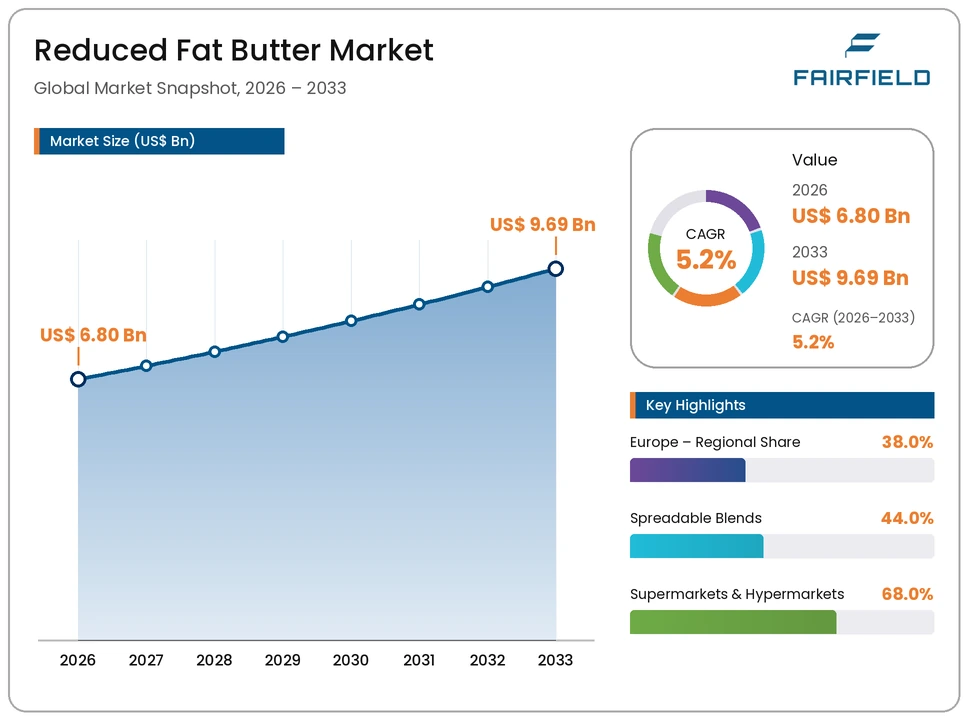
The market is valued at USD 6.80 Billion in 2026, with manufacturers directing investment toward improved formulation technology that narrows the taste and texture gap between reduced fat butter and full-fat butter alternatives. By 2033, the market is forecast to reach USD 9.69 Billion, reflecting steady growth across established spreadable blend applications alongside expanding online retail channel adoption.
Key Highlights
- The global reduced fat butter market is valued at USD 6.80 Billion in 2026 and is projected to reach USD 9.69 Billion by 2033, expanding at a CAGR of 5.2% across the 2026-2033 forecast period.
- Spreadable Blends lead the product-type segment with a 44.0% share in 2026, equivalent to USD 2.99 Billion.
- Supermarkets & Hypermarkets remain the dominant distribution channel, accounting for 68.0% of global demand, or USD 4.62 Billion, in 2026.
- Europe commands the largest regional share at 38.0% of the global market in 2026.
- Online retail is emerging as the fastest-growing distribution channel through 2033.
Key Growth Drivers
Growth in the reduced fat butter market is driven primarily by sustained consumer health consciousness, as continued consumer interest in reducing dietary fat and calorie intake supports demand for lower-fat butter alternatives that retain traditional butter flavor characteristics.
A second driver is growing consumer preference for spreadable, convenient butter formats, as busy consumer lifestyles continue to favor spreadable blend products offering greater convenience for everyday use relative to traditional hard butter requiring softening before use.
Key Restraints
Persistent consumer perception that reduced fat products sacrifice taste quality relative to full-fat alternatives creates an adoption barrier among consumers prioritizing flavor over health considerations, despite continued formulation improvements narrowing this gap.
Additionally, dairy commodity price volatility creates cost management challenges for manufacturers, as butterfat pricing fluctuations directly affect production economics and retail pricing across the reduced fat butter category.
Market Opportunities
The expansion of online retail distribution presents a substantial opportunity, as growing e-commerce grocery adoption creates a growing digital channel for reduced fat butter products beyond traditional physical retail distribution.
A second opportunity lies in continued formulation innovation that further improves reduced fat butter's taste and texture characteristics relative to full-fat alternatives. Companies that successfully advance this formulation technology stand to capture growing consumer demand as taste and health considerations continue to converge within consumer purchasing decisions.
Segmentation Analysis
- By Product Type
Spreadable Blends lead the product-type segment, accounting for 44.0% of global market value in 2026, equivalent to USD 2.99 Billion. Their leadership reflects spreadable blends' superior convenience and refrigerator-temperature spreadability relative to conventional butter formats. Salted Reduced Fat Butter represents a significant, established product-type category. Unsalted Reduced Fat Butter represents the fastest-growing product-type category through 2033, driven by growing consumer interest in baking and cooking applications favoring unsalted formulations.
- By Distribution Channel
Supermarkets & Hypermarkets form the leading distribution-channel segment, representing 68.0% of global demand in 2026, or USD 4.62 Billion, reflecting these channels' central role as the primary purchase point for dairy products globally. Online Retail represents the fastest-growing distribution-channel category, propelled by growing e-commerce grocery adoption expanding reduced fat butter accessibility.
Regional Insights
- Europe
Europe holds the largest regional share, at 38.0% of the global market in 2026, equivalent to USD 2.58 Billion. The region's leadership reflects substantial dairy consumption traditions and strong consumer health consciousness across major European markets.
- North America
North America accounts for 34.0% of the global market in 2026, valued at USD 2.31 Billion. Demand is supported by strong consumer health consciousness and established reduced fat dairy product category presence across the United States and Canada.
- Asia Pacific
Asia Pacific represents 18.0% of the global market in 2026, or USD 1.22 Billion. Growth is underpinned by expanding dairy consumption and growing health-conscious product category interest across China, Japan, and Australia.
- Latin America
Latin America contributes 6.0% of the global market in 2026, equivalent to USD 0.41 Billion. Growth is linked to expanding dairy product category development and health consciousness in Brazil and Mexico.
- Middle East & Africa
Middle East & Africa holds 4.0% of the global market in 2026, valued at USD 0.27 Billion. Growth remains gradual, tied to expanding dairy product accessibility across the region.
Competitive Landscape
The global reduced fat butter market is moderately concentrated, with a mix of large diversified dairy cooperatives and specialized branded dairy spread manufacturers competing for retail shelf space and consumer adoption. Competition centers on taste and texture formulation quality, brand trust and heritage, and the strength of mainstream retail distribution relationships. Companies are increasingly differentiating through expanded spreadable blend innovation rather than competing on conventional reduced fat butter alone.
Key Market Players
- Land O'Lakes, Inc.
- Arla Foods amba
- Groupe Lactalis
- Fonterra Co-operative Group Limited
- Ornua Co-operative Limited
- Dairy Farmers of America, Inc.
- Saputo Inc.
- FrieslandCampina
- Gujarat Cooperative Milk Marketing Federation
- Fromageries Bel S.A.
Market Segmentation
By Product Type
- Salted Reduced Fat Butter
- Unsalted Reduced Fat Butter
- Spreadable Blends
- Others
By Distribution Channel
- Supermarkets & Hypermarkets
- Online Retail
- Others
By Fat Content
- Light (Approx. 40% Fat)
- Extra Light (Below 25% Fat)
By Geography
- North America
- Europe
- Asia Pacific
- Latin America
- Middle East & Africa
- Executive Summary
- Global Reduced Fat Butter Market Snapshot
- Future Projections
- Key Market Trends
- Regional Snapshot, by Value, 2026
- Analyst Recommendations
- Market Overview
- Market Definitions and Segmentations
- Market Dynamics
- Drivers
- Restraints
- Market Opportunities
- Value Chain Analysis
- COVID-19 Impact Analysis
- Porter's Five Forces Analysis
- Impact of Russia-Ukraine Conflict
- PESTLE Analysis
- Regulatory Analysis
- Price Trend Analysis
- Current Prices and Future Projections, 2025-2033
- Price Impact Factors
- Global Reduced Fat Butter Market Outlook, 2020 - 2033
- Global Reduced Fat Butter Market Outlook, by Product Type, Value (US$ Bn), 2020-2033
- Salted Reduced Fat Butter
- Unsalted Reduced Fat Butter
- Spreadable Blends
- Global Reduced Fat Butter Market Outlook, by Distribution Channel, Value (US$ Bn), 2020-2033
- Supermarkets & Hypermarkets
- Online Retail
- Global Reduced Fat Butter Market Outlook, by Fat Content, Value (US$ Bn), 2020-2033
- Light (Approx. 40% Fat)
- Extra Light (Below 25% Fat)
- Global Reduced Fat Butter Market Outlook, by Region, Value (US$ Bn), 2020-2033
- North America
- Europe
- Asia Pacific
- Latin America
- Middle East & Africa
- Global Reduced Fat Butter Market Outlook, by Product Type, Value (US$ Bn), 2020-2033
- North America Reduced Fat Butter Market Outlook, 2020 - 2033
- North America Reduced Fat Butter Market Outlook, by Product Type, Value (US$ Bn), 2020-2033
- Salted Reduced Fat Butter
- Unsalted Reduced Fat Butter
- Spreadable Blends
- North America Reduced Fat Butter Market Outlook, by Distribution Channel, Value (US$ Bn), 2020-2033
- Supermarkets & Hypermarkets
- Online Retail
- North America Reduced Fat Butter Market Outlook, by Fat Content, Value (US$ Bn), 2020-2033
- Light (Approx. 40% Fat)
- Extra Light (Below 25% Fat)
- North America Reduced Fat Butter Market Outlook, by Country, Value (US$ Bn), 2020-2033
- U.S. Reduced Fat Butter Market Outlook, by Product Type, 2020-2033
- U.S. Reduced Fat Butter Market Outlook, by Distribution Channel, 2020-2033
- U.S. Reduced Fat Butter Market Outlook, by Fat Content, 2020-2033
- Canada Reduced Fat Butter Market Outlook, by Product Type, 2020-2033
- Canada Reduced Fat Butter Market Outlook, by Distribution Channel, 2020-2033
- Canada Reduced Fat Butter Market Outlook, by Fat Content, 2020-2033
- BPS Analysis/Market Attractiveness Analysis
- North America Reduced Fat Butter Market Outlook, by Product Type, Value (US$ Bn), 2020-2033
- Europe Reduced Fat Butter Market Outlook, 2020 - 2033
- Europe Reduced Fat Butter Market Outlook, by Product Type, Value (US$ Bn), 2020-2033
- Salted Reduced Fat Butter
- Unsalted Reduced Fat Butter
- Spreadable Blends
- Europe Reduced Fat Butter Market Outlook, by Distribution Channel, Value (US$ Bn), 2020-2033
- Supermarkets & Hypermarkets
- Online Retail
- Europe Reduced Fat Butter Market Outlook, by Fat Content, Value (US$ Bn), 2020-2033
- Light (Approx. 40% Fat)
- Extra Light (Below 25% Fat)
- Europe Reduced Fat Butter Market Outlook, by Country, Value (US$ Bn), 2020-2033
- Germany Reduced Fat Butter Market Outlook, by Product Type, 2020-2033
- Germany Reduced Fat Butter Market Outlook, by Distribution Channel, 2020-2033
- Germany Reduced Fat Butter Market Outlook, by Fat Content, 2020-2033
- Italy Reduced Fat Butter Market Outlook, by Product Type, 2020-2033
- Italy Reduced Fat Butter Market Outlook, by Distribution Channel, 2020-2033
- Italy Reduced Fat Butter Market Outlook, by Fat Content, 2020-2033
- France Reduced Fat Butter Market Outlook, by Product Type, 2020-2033
- France Reduced Fat Butter Market Outlook, by Distribution Channel, 2020-2033
- France Reduced Fat Butter Market Outlook, by Fat Content, 2020-2033
- U.K. Reduced Fat Butter Market Outlook, by Product Type, 2020-2033
- U.K. Reduced Fat Butter Market Outlook, by Distribution Channel, 2020-2033
- U.K. Reduced Fat Butter Market Outlook, by Fat Content, 2020-2033
- Spain Reduced Fat Butter Market Outlook, by Product Type, 2020-2033
- Spain Reduced Fat Butter Market Outlook, by Distribution Channel, 2020-2033
- Spain Reduced Fat Butter Market Outlook, by Fat Content, 2020-2033
- Russia Reduced Fat Butter Market Outlook, by Product Type, 2020-2033
- Russia Reduced Fat Butter Market Outlook, by Distribution Channel, 2020-2033
- Russia Reduced Fat Butter Market Outlook, by Fat Content, 2020-2033
- Rest of Europe Reduced Fat Butter Market Outlook, by Product Type, 2020-2033
- Rest of Europe Reduced Fat Butter Market Outlook, by Distribution Channel, 2020-2033
- Rest of Europe Reduced Fat Butter Market Outlook, by Fat Content, 2020-2033
- BPS Analysis/Market Attractiveness Analysis
- Europe Reduced Fat Butter Market Outlook, by Product Type, Value (US$ Bn), 2020-2033
- Asia Pacific Reduced Fat Butter Market Outlook, 2020 - 2033
- Asia Pacific Reduced Fat Butter Market Outlook, by Product Type, Value (US$ Bn), 2020-2033
- Salted Reduced Fat Butter
- Unsalted Reduced Fat Butter
- Spreadable Blends
- Asia Pacific Reduced Fat Butter Market Outlook, by Distribution Channel, Value (US$ Bn), 2020-2033
- Supermarkets & Hypermarkets
- Online Retail
- Asia Pacific Reduced Fat Butter Market Outlook, by Fat Content, Value (US$ Bn), 2020-2033
- Light (Approx. 40% Fat)
- Extra Light (Below 25% Fat)
- Asia Pacific Reduced Fat Butter Market Outlook, by Country, Value (US$ Bn), 2020-2033
- China Reduced Fat Butter Market Outlook, by Product Type, 2020-2033
- China Reduced Fat Butter Market Outlook, by Distribution Channel, 2020-2033
- China Reduced Fat Butter Market Outlook, by Fat Content, 2020-2033
- Japan Reduced Fat Butter Market Outlook, by Product Type, 2020-2033
- Japan Reduced Fat Butter Market Outlook, by Distribution Channel, 2020-2033
- Japan Reduced Fat Butter Market Outlook, by Fat Content, 2020-2033
- South Korea Reduced Fat Butter Market Outlook, by Product Type, 2020-2033
- South Korea Reduced Fat Butter Market Outlook, by Distribution Channel, 2020-2033
- South Korea Reduced Fat Butter Market Outlook, by Fat Content, 2020-2033
- India Reduced Fat Butter Market Outlook, by Product Type, 2020-2033
- India Reduced Fat Butter Market Outlook, by Distribution Channel, 2020-2033
- India Reduced Fat Butter Market Outlook, by Fat Content, 2020-2033
- Southeast Asia Reduced Fat Butter Market Outlook, by Product Type, 2020-2033
- Southeast Asia Reduced Fat Butter Market Outlook, by Distribution Channel, 2020-2033
- Southeast Asia Reduced Fat Butter Market Outlook, by Fat Content, 2020-2033
- Rest of SAO Reduced Fat Butter Market Outlook, by Product Type, 2020-2033
- Rest of SAO Reduced Fat Butter Market Outlook, by Distribution Channel, 2020-2033
- Rest of SAO Reduced Fat Butter Market Outlook, by Fat Content, 2020-2033
- BPS Analysis/Market Attractiveness Analysis
- Asia Pacific Reduced Fat Butter Market Outlook, by Product Type, Value (US$ Bn), 2020-2033
- Latin America Reduced Fat Butter Market Outlook, 2020 - 2033
- Latin America Reduced Fat Butter Market Outlook, by Product Type, Value (US$ Bn), 2020-2033
- Salted Reduced Fat Butter
- Unsalted Reduced Fat Butter
- Spreadable Blends
- Latin America Reduced Fat Butter Market Outlook, by Distribution Channel, Value (US$ Bn), 2020-2033
- Supermarkets & Hypermarkets
- Online Retail
- Latin America Reduced Fat Butter Market Outlook, by Fat Content, Value (US$ Bn), 2020-2033
- Light (Approx. 40% Fat)
- Extra Light (Below 25% Fat)
- Latin America Reduced Fat Butter Market Outlook, by Country, Value (US$ Bn), 2020-2033
- Brazil Reduced Fat Butter Market Outlook, by Product Type, 2020-2033
- Brazil Reduced Fat Butter Market Outlook, by Distribution Channel, 2020-2033
- Brazil Reduced Fat Butter Market Outlook, by Fat Content, 2020-2033
- Mexico Reduced Fat Butter Market Outlook, by Product Type, 2020-2033
- Mexico Reduced Fat Butter Market Outlook, by Distribution Channel, 2020-2033
- Mexico Reduced Fat Butter Market Outlook, by Fat Content, 2020-2033
- Argentina Reduced Fat Butter Market Outlook, by Product Type, 2020-2033
- Argentina Reduced Fat Butter Market Outlook, by Distribution Channel, 2020-2033
- Argentina Reduced Fat Butter Market Outlook, by Fat Content, 2020-2033
- Rest of LATAM Reduced Fat Butter Market Outlook, by Product Type, 2020-2033
- Rest of LATAM Reduced Fat Butter Market Outlook, by Distribution Channel, 2020-2033
- Rest of LATAM Reduced Fat Butter Market Outlook, by Fat Content, 2020-2033
- BPS Analysis/Market Attractiveness Analysis
- Latin America Reduced Fat Butter Market Outlook, by Product Type, Value (US$ Bn), 2020-2033
- Middle East & Africa Reduced Fat Butter Market Outlook, 2020 - 2033
- Middle East & Africa Reduced Fat Butter Market Outlook, by Product Type, Value (US$ Bn), 2020-2033
- Salted Reduced Fat Butter
- Unsalted Reduced Fat Butter
- Spreadable Blends
- Middle East & Africa Reduced Fat Butter Market Outlook, by Distribution Channel, Value (US$ Bn), 2020-2033
- Supermarkets & Hypermarkets
- Online Retail
- Middle East & Africa Reduced Fat Butter Market Outlook, by Fat Content, Value (US$ Bn), 2020-2033
- Light (Approx. 40% Fat)
- Extra Light (Below 25% Fat)
- Middle East & Africa Reduced Fat Butter Market Outlook, by Country, Value (US$ Bn), 2020-2033
- GCC Reduced Fat Butter Market Outlook, by Product Type, 2020-2033
- GCC Reduced Fat Butter Market Outlook, by Distribution Channel, 2020-2033
- GCC Reduced Fat Butter Market Outlook, by Fat Content, 2020-2033
- South Africa Reduced Fat Butter Market Outlook, by Product Type, 2020-2033
- South Africa Reduced Fat Butter Market Outlook, by Distribution Channel, 2020-2033
- South Africa Reduced Fat Butter Market Outlook, by Fat Content, 2020-2033
- Egypt Reduced Fat Butter Market Outlook, by Product Type, 2020-2033
- Egypt Reduced Fat Butter Market Outlook, by Distribution Channel, 2020-2033
- Egypt Reduced Fat Butter Market Outlook, by Fat Content, 2020-2033
- Nigeria Reduced Fat Butter Market Outlook, by Product Type, 2020-2033
- Nigeria Reduced Fat Butter Market Outlook, by Distribution Channel, 2020-2033
- Nigeria Reduced Fat Butter Market Outlook, by Fat Content, 2020-2033
- Rest of Middle East Reduced Fat Butter Market Outlook, by Product Type, 2020-2033
- Rest of Middle East Reduced Fat Butter Market Outlook, by Distribution Channel, 2020-2033
- Rest of Middle East Reduced Fat Butter Market Outlook, by Fat Content, 2020-2033
- BPS Analysis/Market Attractiveness Analysis
- Middle East & Africa Reduced Fat Butter Market Outlook, by Product Type, Value (US$ Bn), 2020-2033
- Competitive Landscape
- Company Vs Segment Heatmap
- Company Market Share Analysis, 2025
- Competitive Dashboard
- Company Profiles
- Land O'Lakes, Inc.
- Company Overview
- Product Portfolio
- Financial Overview
- Business Strategies and Developments
- Arla Foods amba
- Groupe Lactalis
- Fonterra Co-operative Group Limited
- Ornua Co-operative Limited
- Dairy Farmers of America, Inc.
- Saputo Inc.
- FrieslandCampina
- Gujarat Cooperative Milk Marketing Federation
- Fromageries Bel S.A.
- Land O'Lakes, Inc.
- Appendix
- Research Methodology
- Report Assumptions
- Acronyms and Abbreviations
By Product Type
- Salted Reduced Fat Butter
- Unsalted Reduced Fat Butter
- Spreadable Blends
- Others
By Distribution Channel
- Supermarkets & Hypermarkets
- Online Retail
- Others
By Fat Content
- Light (Approx. 40% Fat)
- Extra Light (Below 25% Fat)
By Geography
- North America
- Europe
- Asia Pacific
- Latin America
- Middle East & Africa
Our Research Methodology
Considering the volatility of business today, traditional approaches to strategizing a game plan can be unfruitful if not detrimental. True ambiguity is no way to determine a forecast. A myriad of predetermined factors must be accounted for such as the degree of risk involved, the magnitude of circumstances, as well as conditions or consequences that are not known or unpredictable. To circumvent binary views that cast uncertainty, the application of market research intelligence to strategically posture, move, and enable actionable outcomes is necessary.
View Methodology
Quality Assured
Rigorous Validation Process

Confidentiality Assured
End-to-end Data Security

Custom Research Services
Tailored To Your Objectives
FAQs
The global reduced fat butter market is valued at USD 6.80 Billion in 2026, reflecting sustained consumer demand for lower-fat dairy alternatives.
The market is projected to grow at a CAGR of 5.2%, reaching USD 9.69 Billion by 2033, driven by health consciousness and spreadable format convenience.
Spreadable Blends lead with a 44.0% share in 2026, reflecting their superior convenience and spreadability.
Europe leads with a 38.0% share in 2026, reflecting substantial dairy consumption traditions and health consciousness.
The largest opportunity lies in online retail, expanding alongside growing e-commerce grocery adoption.
Related Reports
Rice Bran Oil Market Size, Share, Insights, Competitive Landscape, and Forecast 2026 to 2033
The global rice bran oil market is valued at US$2.47 billion in 2026, reaching US$4.75 billion by 2033, growing at a 9.8% CAGR
Gum Arabic Market Size, Share, Insights, Competitive Landscape, and Forecast 2026 to 2033
The global gum arabic market is valued at US$0.516 billion in 2026, reaching US$0.791 billion by 2033, growing at a 6.3% CAGR
Guar Gum Market Size, Share, Insights, Competitive Landscape, and Forecast 2026 to 2033
The global guar gum market is valued at US$1.49 billion in 2026, reaching US$2.33 billion by 2033, growing at a 6.6% CAGR
Cheddar Cheese Market Size, Share, Insights, Competitive Landscape, and Forecast 2026 to 2033
The global cheddar cheese market is valued at US$17.33 billion in 2026, reaching US$24.70 billion by 2033, growing at a 5.2% CAGR
Algae Protein Market Size, Share, Insights, Competitive Landscape, and Forecast 2026 to 2033
The global algae protein market is valued at US$4.72 billion in 2026, reaching US$9.55 billion by 2033, growing at a 10.6% CAGR
Digestive Health Drinks Market Size, Share, Insights, Competitive Landscape, and Forecast 2026 to 2033
The global digestive health drinks market is valued at US$64.8 billion in 2026, reaching US$111.1 billion by 2033, growing at an 8.0% CAGR