



SDHI Fungicide Market
SDHI Fungicide Market Insights, Competitive Landscape, and Market Forecast 2033
Market Overview
Succinate dehydrogenase inhibitor (SDHI) fungicides represent a class of crop protection chemistry that disrupts fungal cellular respiration by inhibiting the succinate dehydrogenase enzyme complex, offering effective control against a broad range of fungal pathogens across cereal, fruit, vegetable, and oilseed crops. As one of the most important fungicide mode-of-action classes introduced in recent decades, SDHI chemistry has become a cornerstone of integrated fungicide resistance management programs across global agriculture.
Demand growth through the 2026-2033 window is closely tied to sustained global demand for effective fungal disease control amid growing food production requirements, increasing farmer adoption of SDHI chemistry within resistance management programs that rotate or combine multiple fungicide modes of action, and continued product innovation introducing new SDHI active ingredients and formulations addressing evolving pathogen resistance patterns. Growing recognition of SDHI fungicides' broad-spectrum efficacy and favorable application flexibility continues to support expanding adoption across diverse crop applications.
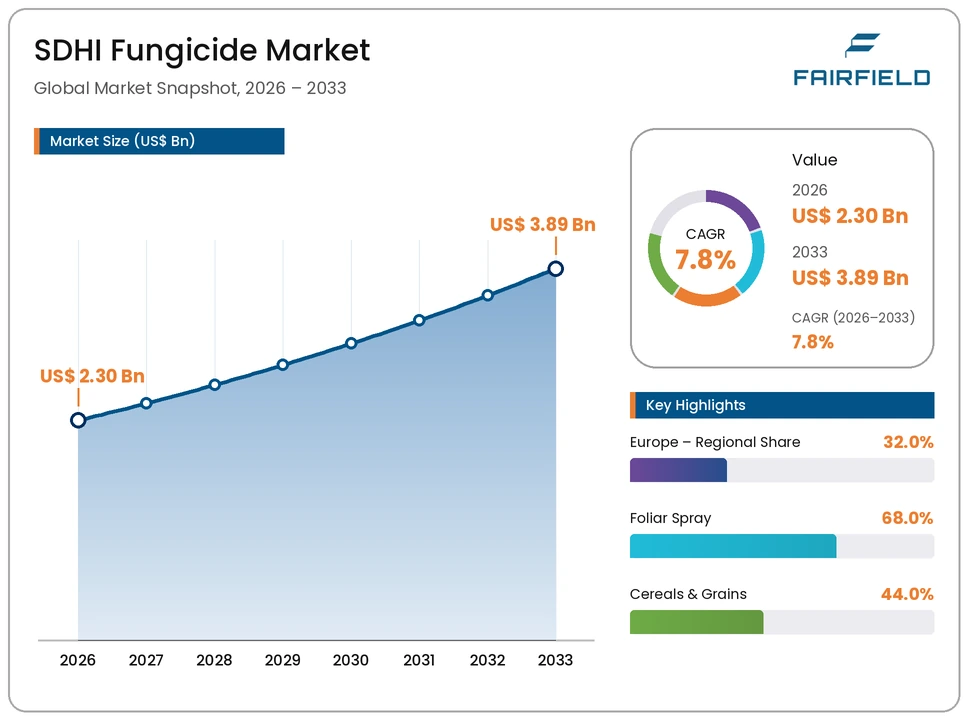
The market is valued at USD 2.30 Billion in 2026, with manufacturers directing investment toward new active ingredient development and combination formulations that extend SDHI chemistry's resistance management value across an expanding range of crop and pathogen combinations. By 2033, the market is forecast to reach USD 3.89 Billion, reflecting steady growth across established foliar spray applications alongside expanding seed treatment adoption.
Key Highlights
- The global SDHI fungicide market is valued at USD 2.30 Billion in 2026 and is projected to reach USD 3.89 Billion by 2033, expanding at a CAGR of 7.8% across the 2026-2033 forecast period.
- Foliar Spray leads the application segment with a 68.0% share in 2026, equivalent to USD 1.56 Billion.
- Cereals & Grains remain the dominant crop-type segment, accounting for 44.0% of global demand, or USD 1.01 Billion, in 2026.
- Europe commands the largest regional share at 32.0% of the global market in 2026.
- Seed treatment applications are emerging as the fastest-growing application through 2033.
Key Growth Drivers
Growth in the SDHI fungicide market is driven primarily by sustained global demand for effective fungal disease control, as growing global food production requirements continue to drive farmer investment in high-performance crop protection technology, with SDHI chemistry offering broad-spectrum efficacy across numerous economically significant fungal pathogens.
A second driver is increasing farmer adoption of SDHI chemistry within integrated resistance management programs, as agricultural extension services and manufacturers increasingly emphasize rotating and combining multiple fungicide modes of action to preserve long-term efficacy, supporting sustained SDHI fungicide inclusion within comprehensive disease management programs.
Key Restraints
Growing concern regarding fungal pathogen resistance development to SDHI chemistry itself, following documented resistance cases in certain pathogen populations, requires manufacturers and growers to carefully manage application practices and rotation strategies to preserve long-term product efficacy.
Additionally, increasing regulatory scrutiny of certain fungicide active ingredients in some markets, driven by environmental and non-target organism impact considerations, creates registration and reformulation compliance costs that can affect product availability across different regional markets.
Market Opportunities
The expansion of seed treatment applications presents a substantial opportunity, as SDHI chemistry's efficacy profile increasingly supports its incorporation into seed treatment formulations, extending disease protection to the critical early growth stage beyond the traditionally dominant foliar spray application method.
A second opportunity lies in the continued development of new SDHI active ingredients and combination formulations that address emerging resistance patterns while expanding efficacy across a broader range of crop and pathogen combinations. Manufacturers that successfully advance this innovation pipeline stand to capture growing demand for effective, sustainable disease management solutions.
Segmentation Analysis
By Application
Foliar Spray leads the application segment, accounting for 68.0% of global market value in 2026, equivalent to USD 1.56 Billion. Its leadership reflects foliar application's established role as the primary delivery method for SDHI fungicides across major row crop and specialty crop disease management programs. Soil Treatment represents a smaller, specialized application category. Seed Treatment represents the fastest-growing application category through 2033, driven by expanding formulation development extending SDHI chemistry to early-stage crop protection.
By Crop Type
Cereals & Grains form the leading crop-type segment, representing 44.0% of global demand in 2026, or USD 1.01 Billion, reflecting the scale of global cereal production and well-established SDHI fungicide use against major cereal disease pathogens. Oilseeds & Pulses represent a significant, established crop-type category. Fruits & Vegetables represent the fastest-growing crop-type category, propelled by expanding SDHI product registration and adoption across specialty crop disease management programs.
Regional Insights
Europe
Europe holds the largest regional share, at 32.0% of the global market in 2026, equivalent to USD 0.74 Billion. The region's leadership reflects extensive cereal production and well-established integrated fungicide resistance management practices across major European agricultural markets.
North America
North America accounts for 28.0% of the global market in 2026, valued at USD 0.64 Billion. Demand is supported by large-scale row crop and specialty crop production requiring effective fungal disease management across the United States and Canada.
Asia Pacific
Asia Pacific represents 24.0% of the global market in 2026, or USD 0.55 Billion. Growth is underpinned by expanding modern agricultural practices and rising fungicide adoption across China, Japan, and India.
Latin America
Latin America contributes 11.0% of the global market in 2026, equivalent to USD 0.25 Billion. Growth is linked to substantial row crop and specialty crop production in Brazil and Argentina increasingly adopting advanced fungicide chemistry.
Middle East & Africa
Middle East & Africa holds 5.0% of the global market in 2026, valued at USD 0.12 Billion. Growth remains gradual, tied to gradual modernization of agricultural practices across the region.
Competitive Landscape
The global SDHI fungicide market is moderately concentrated, with a limited number of large multinational agrochemical companies holding strong positions supported by extensive research and development investment and established active ingredient patent portfolios. Competition centers on active ingredient efficacy breadth, resistance management program integration, and the ability to develop combination formulations addressing evolving pathogen resistance patterns. Companies are increasingly differentiating through expanded seed treatment formulation development rather than competing on foliar spray product pricing alone.
Key Market Players
- BASF SE
- Syngenta Group
- Bayer AG
- Corteva, Inc.
- Sumitomo Chemical Co., Ltd.
- Kumiai Chemical Industry Co., Ltd.
- Mitsui Chemicals, Inc.
- Ishihara Sangyo Kaisha, Ltd.
- Nissan Chemical Corporation
- UPL Limited
Market Segmentation
By Application
- Foliar Spray
- Seed Treatment
- Soil Treatment
By Crop Type
- Cereals & Grains
- Fruits & Vegetables
- Oilseeds & Pulses
- Others
By Formulation
- Suspension Concentrate
- Wettable Granules
By Geography
- North America
- Europe
- Asia Pacific
- Latin America
- Middle East & Africa
- Executive Summary
- Global SDHI Fungicide Market Snapshot
- Future Projections
- Key Market Trends
- Regional Snapshot, by Value, 2026
- Analyst Recommendations
- Market Overview
- Market Definitions and Segmentations
- Market Dynamics
- Drivers
- Restraints
- Market Opportunities
- Value Chain Analysis
- COVID-19 Impact Analysis
- Porter's Five Forces Analysis
- Impact of Russia-Ukraine Conflict
- PESTLE Analysis
- Regulatory Analysis
- Price Trend Analysis
- Current Prices and Future Projections, 2025-2033
- Price Impact Factors
- Global SDHI Fungicide Market Outlook, 2020 - 2033
- Global SDHI Fungicide Market Outlook, by Application, Value (US$ Bn), 2020-2033
- Foliar Spray
- Seed Treatment
- Soil Treatment
- Global SDHI Fungicide Market Outlook, by Crop Type, Value (US$ Bn), 2020-2033
- Cereals & Grains
- Fruits & Vegetables
- Oilseeds & Pulses
- Others
- Global SDHI Fungicide Market Outlook, by Formulation, Value (US$ Bn), 2020-2033
- Suspension Concentrate
- Wettable Granules
- Global SDHI Fungicide Market Outlook, by Region, Value (US$ Bn), 2020-2033
- North America
- Europe
- Asia Pacific
- Latin America
- Middle East & Africa
- Global SDHI Fungicide Market Outlook, by Application, Value (US$ Bn), 2020-2033
- North America SDHI Fungicide Market Outlook, 2020 - 2033
- North America SDHI Fungicide Market Outlook, by Application, Value (US$ Bn), 2020-2033
- Foliar Spray
- Seed Treatment
- Soil Treatment
- North America SDHI Fungicide Market Outlook, by Crop Type, Value (US$ Bn), 2020-2033
- Cereals & Grains
- Fruits & Vegetables
- Oilseeds & Pulses
- Others
- North America SDHI Fungicide Market Outlook, by Formulation, Value (US$ Bn), 2020-2033
- Suspension Concentrate
- Wettable Granules
- North America SDHI Fungicide Market Outlook, by Country, Value (US$ Bn), 2020-2033
- U.S. SDHI Fungicide Market Outlook, by Application, 2020-2033
- U.S. SDHI Fungicide Market Outlook, by Crop Type, 2020-2033
- U.S. SDHI Fungicide Market Outlook, by Formulation, 2020-2033
- Canada SDHI Fungicide Market Outlook, by Application, 2020-2033
- Canada SDHI Fungicide Market Outlook, by Crop Type, 2020-2033
- Canada SDHI Fungicide Market Outlook, by Formulation, 2020-2033
- BPS Analysis/Market Attractiveness Analysis
- North America SDHI Fungicide Market Outlook, by Application, Value (US$ Bn), 2020-2033
- Europe SDHI Fungicide Market Outlook, 2020 - 2033
- Europe SDHI Fungicide Market Outlook, by Application, Value (US$ Bn), 2020-2033
- Foliar Spray
- Seed Treatment
- Soil Treatment
- Europe SDHI Fungicide Market Outlook, by Crop Type, Value (US$ Bn), 2020-2033
- Cereals & Grains
- Fruits & Vegetables
- Oilseeds & Pulses
- Others
- Europe SDHI Fungicide Market Outlook, by Formulation, Value (US$ Bn), 2020-2033
- Suspension Concentrate
- Wettable Granules
- Europe SDHI Fungicide Market Outlook, by Country, Value (US$ Bn), 2020-2033
- Germany SDHI Fungicide Market Outlook, by Application, 2020-2033
- Germany SDHI Fungicide Market Outlook, by Crop Type, 2020-2033
- Germany SDHI Fungicide Market Outlook, by Formulation, 2020-2033
- Italy SDHI Fungicide Market Outlook, by Application, 2020-2033
- Italy SDHI Fungicide Market Outlook, by Crop Type, 2020-2033
- Italy SDHI Fungicide Market Outlook, by Formulation, 2020-2033
- France SDHI Fungicide Market Outlook, by Application, 2020-2033
- France SDHI Fungicide Market Outlook, by Crop Type, 2020-2033
- France SDHI Fungicide Market Outlook, by Formulation, 2020-2033
- U.K. SDHI Fungicide Market Outlook, by Application, 2020-2033
- U.K. SDHI Fungicide Market Outlook, by Crop Type, 2020-2033
- U.K. SDHI Fungicide Market Outlook, by Formulation, 2020-2033
- Spain SDHI Fungicide Market Outlook, by Application, 2020-2033
- Spain SDHI Fungicide Market Outlook, by Crop Type, 2020-2033
- Spain SDHI Fungicide Market Outlook, by Formulation, 2020-2033
- Russia SDHI Fungicide Market Outlook, by Application, 2020-2033
- Russia SDHI Fungicide Market Outlook, by Crop Type, 2020-2033
- Russia SDHI Fungicide Market Outlook, by Formulation, 2020-2033
- Rest of Europe SDHI Fungicide Market Outlook, by Application, 2020-2033
- Rest of Europe SDHI Fungicide Market Outlook, by Crop Type, 2020-2033
- Rest of Europe SDHI Fungicide Market Outlook, by Formulation, 2020-2033
- BPS Analysis/Market Attractiveness Analysis
- Europe SDHI Fungicide Market Outlook, by Application, Value (US$ Bn), 2020-2033
- Asia Pacific SDHI Fungicide Market Outlook, 2020 - 2033
- Asia Pacific SDHI Fungicide Market Outlook, by Application, Value (US$ Bn), 2020-2033
- Foliar Spray
- Seed Treatment
- Soil Treatment
- Asia Pacific SDHI Fungicide Market Outlook, by Crop Type, Value (US$ Bn), 2020-2033
- Cereals & Grains
- Fruits & Vegetables
- Oilseeds & Pulses
- Others
- Asia Pacific SDHI Fungicide Market Outlook, by Formulation, Value (US$ Bn), 2020-2033
- Suspension Concentrate
- Wettable Granules
- Asia Pacific SDHI Fungicide Market Outlook, by Country, Value (US$ Bn), 2020-2033
- China SDHI Fungicide Market Outlook, by Application, 2020-2033
- China SDHI Fungicide Market Outlook, by Crop Type, 2020-2033
- China SDHI Fungicide Market Outlook, by Formulation, 2020-2033
- Japan SDHI Fungicide Market Outlook, by Application, 2020-2033
- Japan SDHI Fungicide Market Outlook, by Crop Type, 2020-2033
- Japan SDHI Fungicide Market Outlook, by Formulation, 2020-2033
- South Korea SDHI Fungicide Market Outlook, by Application, 2020-2033
- South Korea SDHI Fungicide Market Outlook, by Crop Type, 2020-2033
- South Korea SDHI Fungicide Market Outlook, by Formulation, 2020-2033
- India SDHI Fungicide Market Outlook, by Application, 2020-2033
- India SDHI Fungicide Market Outlook, by Crop Type, 2020-2033
- India SDHI Fungicide Market Outlook, by Formulation, 2020-2033
- Southeast Asia SDHI Fungicide Market Outlook, by Application, 2020-2033
- Southeast Asia SDHI Fungicide Market Outlook, by Crop Type, 2020-2033
- Southeast Asia SDHI Fungicide Market Outlook, by Formulation, 2020-2033
- Rest of SAO SDHI Fungicide Market Outlook, by Application, 2020-2033
- Rest of SAO SDHI Fungicide Market Outlook, by Crop Type, 2020-2033
- Rest of SAO SDHI Fungicide Market Outlook, by Formulation, 2020-2033
- BPS Analysis/Market Attractiveness Analysis
- Asia Pacific SDHI Fungicide Market Outlook, by Application, Value (US$ Bn), 2020-2033
- Latin America SDHI Fungicide Market Outlook, 2020 - 2033
- Latin America SDHI Fungicide Market Outlook, by Application, Value (US$ Bn), 2020-2033
- Foliar Spray
- Seed Treatment
- Soil Treatment
- Latin America SDHI Fungicide Market Outlook, by Crop Type, Value (US$ Bn), 2020-2033
- Cereals & Grains
- Fruits & Vegetables
- Oilseeds & Pulses
- Others
- Latin America SDHI Fungicide Market Outlook, by Formulation, Value (US$ Bn), 2020-2033
- Suspension Concentrate
- Wettable Granules
- Latin America SDHI Fungicide Market Outlook, by Country, Value (US$ Bn), 2020-2033
- Brazil SDHI Fungicide Market Outlook, by Application, 2020-2033
- Brazil SDHI Fungicide Market Outlook, by Crop Type, 2020-2033
- Brazil SDHI Fungicide Market Outlook, by Formulation, 2020-2033
- Mexico SDHI Fungicide Market Outlook, by Application, 2020-2033
- Mexico SDHI Fungicide Market Outlook, by Crop Type, 2020-2033
- Mexico SDHI Fungicide Market Outlook, by Formulation, 2020-2033
- Argentina SDHI Fungicide Market Outlook, by Application, 2020-2033
- Argentina SDHI Fungicide Market Outlook, by Crop Type, 2020-2033
- Argentina SDHI Fungicide Market Outlook, by Formulation, 2020-2033
- Rest of LATAM SDHI Fungicide Market Outlook, by Application, 2020-2033
- Rest of LATAM SDHI Fungicide Market Outlook, by Crop Type, 2020-2033
- Rest of LATAM SDHI Fungicide Market Outlook, by Formulation, 2020-2033
- BPS Analysis/Market Attractiveness Analysis
- Latin America SDHI Fungicide Market Outlook, by Application, Value (US$ Bn), 2020-2033
- Middle East & Africa SDHI Fungicide Market Outlook, 2020 - 2033
- Middle East & Africa SDHI Fungicide Market Outlook, by Application, Value (US$ Bn), 2020-2033
- Foliar Spray
- Seed Treatment
- Soil Treatment
- Middle East & Africa SDHI Fungicide Market Outlook, by Crop Type, Value (US$ Bn), 2020-2033
- Cereals & Grains
- Fruits & Vegetables
- Oilseeds & Pulses
- Others
- Middle East & Africa SDHI Fungicide Market Outlook, by Formulation, Value (US$ Bn), 2020-2033
- Suspension Concentrate
- Wettable Granules
- Middle East & Africa SDHI Fungicide Market Outlook, by Country, Value (US$ Bn), 2020-2033
- GCC SDHI Fungicide Market Outlook, by Application, 2020-2033
- GCC SDHI Fungicide Market Outlook, by Crop Type, 2020-2033
- GCC SDHI Fungicide Market Outlook, by Formulation, 2020-2033
- South Africa SDHI Fungicide Market Outlook, by Application, 2020-2033
- South Africa SDHI Fungicide Market Outlook, by Crop Type, 2020-2033
- South Africa SDHI Fungicide Market Outlook, by Formulation, 2020-2033
- Egypt SDHI Fungicide Market Outlook, by Application, 2020-2033
- Egypt SDHI Fungicide Market Outlook, by Crop Type, 2020-2033
- Egypt SDHI Fungicide Market Outlook, by Formulation, 2020-2033
- Nigeria SDHI Fungicide Market Outlook, by Application, 2020-2033
- Nigeria SDHI Fungicide Market Outlook, by Crop Type, 2020-2033
- Nigeria SDHI Fungicide Market Outlook, by Formulation, 2020-2033
- Rest of Middle East SDHI Fungicide Market Outlook, by Application, 2020-2033
- Rest of Middle East SDHI Fungicide Market Outlook, by Crop Type, 2020-2033
- Rest of Middle East SDHI Fungicide Market Outlook, by Formulation, 2020-2033
- BPS Analysis/Market Attractiveness Analysis
- Middle East & Africa SDHI Fungicide Market Outlook, by Application, Value (US$ Bn), 2020-2033
- Competitive Landscape
- Company Vs Segment Heatmap
- Company Market Share Analysis, 2025
- Competitive Dashboard
- Company Profiles
- BASF SE
- Company Overview
- Product Portfolio
- Financial Overview
- Business Strategies and Developments
- Syngenta Group
- Bayer AG
- Corteva, Inc.
- Sumitomo Chemical Co., Ltd.
- Kumiai Chemical Industry Co., Ltd.
- Mitsui Chemicals, Inc.
- Ishihara Sangyo Kaisha, Ltd.
- Nissan Chemical Corporation
- UPL Limited
- BASF SE
- Appendix
- Research Methodology
- Report Assumptions
- Acronyms and Abbreviations
By Application
- Foliar Spray
- Seed Treatment
- Soil Treatment
By Crop Type
- Cereals & Grains
- Fruits & Vegetables
- Oilseeds & Pulses
- Others
By Formulation
- Suspension Concentrate
- Wettable Granules
By Geography
- North America
- Europe
- Asia Pacific
- Latin America
- Middle East & Africa
Our Research Methodology
Considering the volatility of business today, traditional approaches to strategizing a game plan can be unfruitful if not detrimental. True ambiguity is no way to determine a forecast. A myriad of predetermined factors must be accounted for such as the degree of risk involved, the magnitude of circumstances, as well as conditions or consequences that are not known or unpredictable. To circumvent binary views that cast uncertainty, the application of market research intelligence to strategically posture, move, and enable actionable outcomes is necessary.
View Methodology
Quality Assured
Rigorous Validation Process

Confidentiality Assured
End-to-end Data Security

Custom Research Services
Tailored To Your Objectives
FAQs
The global SDHI fungicide market is valued at USD 2.30 Billion in 2026, reflecting sustained demand for broad-spectrum fungal disease control.
The market is projected to grow at a CAGR of 7.8%, reaching USD 3.89 Billion by 2033, driven by resistance management adoption and expanding crop applications.
Foliar Spray leads with a 68.0% share in 2026, reflecting its established role as the primary SDHI delivery method.
Europe leads with a 32.0% share in 2026, supported by extensive cereal production and established resistance management practices.
The largest opportunity lies in seed treatment applications, expanding as formulation development extends SDHI chemistry to early-stage crop protection.
Related Reports
Automotive NVH Materials Market Size, Share, Insights, Competitive Landscape, and Forecast 2026 to 2033
The global automotive NVH materials market is valued at US$13.8 billion in 2026, reaching US$20.5 billion by 2033, growing at a 5.82% CAGR
Acrylonitrile Butadiene Styrene Market Size, Share, Insights, Competitive Landscape, and Forecast 2026 to 2033
The global acrylonitrile butadiene styrene market is valued at US$27.4 billion in 2026, reaching US$38.6 billion by 2033, growing at a 5.02% CAGR
Tank Mix Adjuvants Market Size, Share, Insights, Competitive Landscape, and Forecast 2026 to 2033
The global tank mix adjuvants market is valued at US$4.3 billion in 2026, reaching US$6.6 billion by 2033, growing at a 6.3% CAGR
Glass Flake Coatings Market Size, Share, Insights, Competitive Landscape, and Forecast 2026 to 2033
The glass flake coatings market is projected to grow from US$0.64 billion in 2026 to US$0.96 billion by 2033, at a 5.96% CAGR
Paint Protection Films Market Size, Share, Insights, Competitive Landscape, and Forecast 2026 to 2033
The global paint protection films market is valued at US$1.05 billion in 2026 and is projected to reach US$2.25 billion by 2033, growing at 11.5% CAGR
Electrical Steel Coatings Market Size, Share, Insights, Competitive Landscape, and Forecast 2026 to 2033
The electrical steel coatings market, valued at US$ 1.42 billion in 2026, and forecast to reach US$ 2.41 billion by 2033, growing at a 7.85% CAGR