



Seed Treatment Fungicides Market
Seed Treatment Fungicides Market Insights, Competitive Landscape, and Market Forecast 2033
Market Overview
Seed treatment fungicides are chemical or biological compounds applied directly to seeds prior to planting to protect germinating seedlings from soil-borne and seed-borne fungal pathogens during the critical early growth stage. By concentrating fungicide application precisely at the seed level rather than broadcast field spraying, seed treatments offer targeted disease protection with substantially reduced overall chemical application volumes relative to foliar fungicide programs.
Demand growth through the 2026-2033 window is closely tied to sustained global demand for crop protection technology supporting yield optimization amid growing food production requirements, increasing farmer adoption of seed treatment as a precise, resource-efficient alternative to broader foliar fungicide application, and continued product innovation combining multiple active ingredients and modes of action to address evolving fungal resistance patterns. Growing regulatory and market emphasis on reduced overall pesticide application volumes continues to favor seed treatment's targeted application approach relative to broadcast field spraying methods.
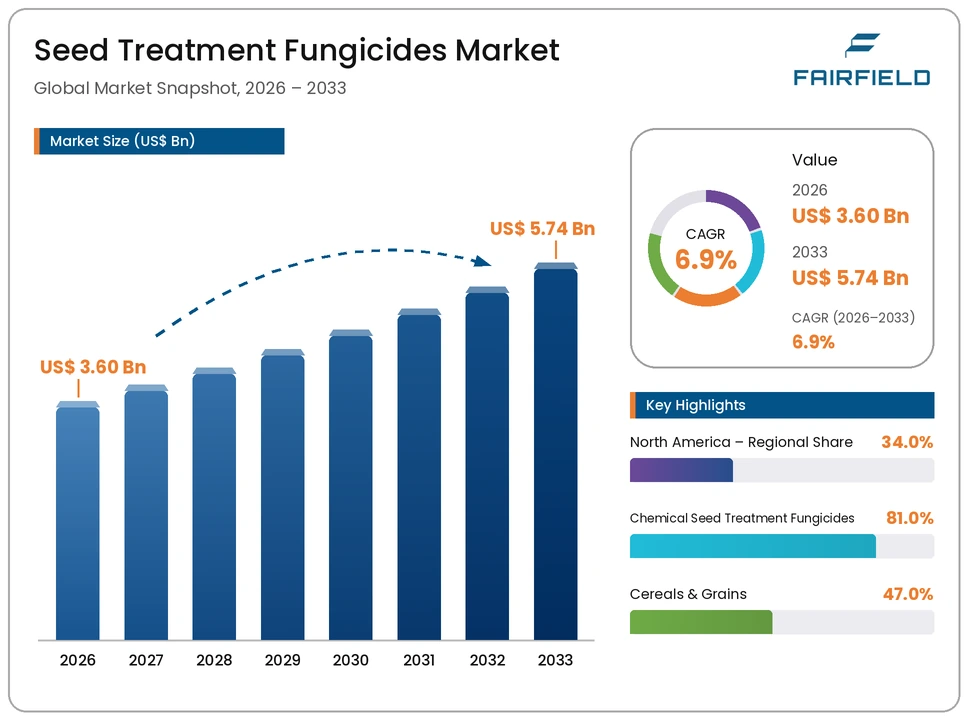
The market is valued at USD 3.60 Billion in 2026, with manufacturers directing investment toward biological seed treatment formulations that complement or partially replace conventional chemical fungicides amid growing sustainability considerations. By 2033, the market is forecast to reach USD 5.74 Billion, reflecting steady growth across established cereal and grain applications alongside expanding fruit and vegetable crop adoption.
Key Highlights
- The global seed treatment fungicides market is valued at USD 3.60 Billion in 2026 and is projected to reach USD 5.74 Billion by 2033, expanding at a CAGR of 6.9% across the 2026-2033 forecast period.
- Chemical Seed Treatment Fungicides lead the type segment with an 81.0% share in 2026, equivalent to USD 2.92 Billion.
- Cereals & Grains remain the dominant crop-type segment, accounting for 47.0% of global demand, or USD 1.69 Billion, in 2026.
- North America commands the largest regional share at 34.0% of the global market in 2026.
- Fruits and vegetables applications are emerging as the fastest-growing crop-type segment through 2033.
Key Growth Drivers
Growth in the seed treatment fungicides market is driven primarily by sustained global demand for crop protection technology, as growing global food production requirements continue to drive farmer investment in yield-protecting technologies, with seed treatment fungicides representing a cost-effective, targeted approach to protecting crops during the vulnerable early growth stage.
A second driver is increasing farmer adoption of seed treatment as a precise, resource-efficient alternative to broader foliar fungicide application, as seed treatment's targeted application approach delivers effective disease protection while substantially reducing the overall chemical volume applied relative to broadcast spraying methods.
Key Restraints
Growing fungal pathogen resistance to established seed treatment active ingredients requires continued research and development investment in new modes of action, creating ongoing cost pressure for manufacturers seeking to maintain product efficacy against evolving resistance patterns.
Additionally, increasing regulatory scrutiny of certain chemical fungicide active ingredients in some markets, driven by environmental and health considerations, creates product reformulation and registration compliance costs that can affect product availability and manufacturer economics.
Market Opportunities
The expansion of biological seed treatment fungicides presents a substantial opportunity, as growing sustainability considerations and consumer preference for reduced synthetic chemical use in food production create demand for biological alternatives that complement or partially replace conventional chemical treatments.
A second opportunity lies in the expansion of seed treatment adoption in fruit and vegetable crops, an application area that has historically received less seed treatment product development attention than cereals and grains. Manufacturers that successfully develop crop-specific formulations for this segment stand to capture significant incremental demand.
Segmentation Analysis
By Type
Chemical Seed Treatment Fungicides lead the type segment, accounting for 81.0% of global market value in 2026, equivalent to USD 2.92 Billion. Their leadership reflects chemical fungicides' well-established efficacy and broad-spectrum disease protection across major row crop applications. Biological Seed Treatment Fungicides represent the fastest-growing type category through 2033, driven by growing sustainability considerations and expanding biological product efficacy validation.
By Crop Type
Cereals & Grains form the leading crop-type segment, representing 47.0% of global demand in 2026, or USD 1.69 Billion, reflecting the scale of global cereal and grain production and long-established seed treatment adoption in these row crop categories. Oilseeds & Pulses represent a significant, established crop-type category. Fruits & Vegetables represent the fastest-growing crop-type category, propelled by expanding manufacturer development of crop-specific seed treatment formulations for this segment.
Regional Insights
North America
North America holds the largest regional share, at 34.0% of the global market in 2026, equivalent to USD 1.22 Billion. The region's leadership reflects large-scale, technologically advanced row crop farming across the United States and Canada with high seed treatment adoption rates.
Latin America
Latin America accounts for 27.0% of the global market in 2026, valued at USD 0.97 Billion. Brazil and Argentina anchor regional demand, supported by substantial soybean and other row crop production requiring effective seed-level disease protection.
Europe
Europe represents 22.0% of the global market in 2026, or USD 0.79 Billion. Steady demand is supported by established cereal and grain production and growing adoption of resource-efficient crop protection approaches across major European markets.
Asia Pacific
Asia Pacific contributes 12.0% of the global market in 2026, equivalent to USD 0.43 Billion. Growth is linked to expanding modern agricultural practices and rising seed treatment awareness across China and India.
Middle East & Africa
Middle East & Africa holds 5.0% of the global market in 2026, valued at USD 0.18 Billion. Growth remains gradual, tied to gradual modernization of agricultural practices across the region.
Competitive Landscape
The global seed treatment fungicides market is moderately concentrated, with a limited number of large multinational agrochemical companies holding strong positions supported by extensive research and development capability and established relationships with seed companies and distributors. Competition centers on active ingredient efficacy and resistance management, breadth of crop-specific formulation portfolios, and the ability to combine seed treatment fungicides with complementary insecticide and biostimulant technologies. Companies are increasingly differentiating through expanded biological product portfolios rather than competing on conventional chemical fungicide pricing alone.
Key Market Players
- Bayer AG
- Syngenta Group
- BASF SE
- Corteva, Inc.
- UPL Limited
- FMC Corporation
- Nufarm Limited
- Sumitomo Chemical Co., Ltd.
- ADAMA Ltd.
- Certis USA L.L.C.
Market Segmentation
By Type
- Chemical Seed Treatment Fungicides
- Biological Seed Treatment Fungicides
By Crop Type
- Cereals & Grains
- Oilseeds & Pulses
- Fruits & Vegetables
- Others
By Application Technique
- Seed Coating
- Seed Dressing
By Geography
- North America
- Europe
- Asia Pacific
- Latin America
- Middle East & Africa
- Executive Summary
- Global Seed Treatment Fungicides Market Snapshot
- Future Projections
- Key Market Trends
- Regional Snapshot, by Value, 2026
- Analyst Recommendations
- Market Overview
- Market Definitions and Segmentations
- Market Dynamics
- Drivers
- Restraints
- Market Opportunities
- Value Chain Analysis
- COVID-19 Impact Analysis
- Porter's Five Forces Analysis
- Impact of Russia-Ukraine Conflict
- PESTLE Analysis
- Regulatory Analysis
- Price Trend Analysis
- Current Prices and Future Projections, 2025-2033
- Price Impact Factors
- Global Seed Treatment Fungicides Market Outlook, 2020 - 2033
- Global Seed Treatment Fungicides Market Outlook, by Type, Value (US$ Bn), 2020-2033
- Chemical Seed Treatment Fungicides
- Biological Seed Treatment Fungicides
- Global Seed Treatment Fungicides Market Outlook, by Crop Type, Value (US$ Bn), 2020-2033
- Cereals & Grains
- Oilseeds & Pulses
- Fruits & Vegetables
- Others
- Global Seed Treatment Fungicides Market Outlook, by Application Technique, Value (US$ Bn), 2020-2033
- Seed Coating
- Seed Dressing
- Global Seed Treatment Fungicides Market Outlook, by Region, Value (US$ Bn), 2020-2033
- North America
- Europe
- Asia Pacific
- Latin America
- Middle East & Africa
- Global Seed Treatment Fungicides Market Outlook, by Type, Value (US$ Bn), 2020-2033
- North America Seed Treatment Fungicides Market Outlook, 2020 - 2033
- North America Seed Treatment Fungicides Market Outlook, by Type, Value (US$ Bn), 2020-2033
- Chemical Seed Treatment Fungicides
- Biological Seed Treatment Fungicides
- North America Seed Treatment Fungicides Market Outlook, by Crop Type, Value (US$ Bn), 2020-2033
- Cereals & Grains
- Oilseeds & Pulses
- Fruits & Vegetables
- Others
- North America Seed Treatment Fungicides Market Outlook, by Application Technique, Value (US$ Bn), 2020-2033
- Seed Coating
- Seed Dressing
- North America Seed Treatment Fungicides Market Outlook, by Country, Value (US$ Bn), 2020-2033
- U.S. Seed Treatment Fungicides Market Outlook, by Type, 2020-2033
- U.S. Seed Treatment Fungicides Market Outlook, by Crop Type, 2020-2033
- U.S. Seed Treatment Fungicides Market Outlook, by Application Technique, 2020-2033
- Canada Seed Treatment Fungicides Market Outlook, by Type, 2020-2033
- Canada Seed Treatment Fungicides Market Outlook, by Crop Type, 2020-2033
- Canada Seed Treatment Fungicides Market Outlook, by Application Technique, 2020-2033
- BPS Analysis/Market Attractiveness Analysis
- North America Seed Treatment Fungicides Market Outlook, by Type, Value (US$ Bn), 2020-2033
- Europe Seed Treatment Fungicides Market Outlook, 2020 - 2033
- Europe Seed Treatment Fungicides Market Outlook, by Type, Value (US$ Bn), 2020-2033
- Chemical Seed Treatment Fungicides
- Biological Seed Treatment Fungicides
- Europe Seed Treatment Fungicides Market Outlook, by Crop Type, Value (US$ Bn), 2020-2033
- Cereals & Grains
- Oilseeds & Pulses
- Fruits & Vegetables
- Others
- Europe Seed Treatment Fungicides Market Outlook, by Application Technique, Value (US$ Bn), 2020-2033
- Seed Coating
- Seed Dressing
- Europe Seed Treatment Fungicides Market Outlook, by Country, Value (US$ Bn), 2020-2033
- Germany Seed Treatment Fungicides Market Outlook, by Type, 2020-2033
- Germany Seed Treatment Fungicides Market Outlook, by Crop Type, 2020-2033
- Germany Seed Treatment Fungicides Market Outlook, by Application Technique, 2020-2033
- Italy Seed Treatment Fungicides Market Outlook, by Type, 2020-2033
- Italy Seed Treatment Fungicides Market Outlook, by Crop Type, 2020-2033
- Italy Seed Treatment Fungicides Market Outlook, by Application Technique, 2020-2033
- France Seed Treatment Fungicides Market Outlook, by Type, 2020-2033
- France Seed Treatment Fungicides Market Outlook, by Crop Type, 2020-2033
- France Seed Treatment Fungicides Market Outlook, by Application Technique, 2020-2033
- U.K. Seed Treatment Fungicides Market Outlook, by Type, 2020-2033
- U.K. Seed Treatment Fungicides Market Outlook, by Crop Type, 2020-2033
- U.K. Seed Treatment Fungicides Market Outlook, by Application Technique, 2020-2033
- Spain Seed Treatment Fungicides Market Outlook, by Type, 2020-2033
- Spain Seed Treatment Fungicides Market Outlook, by Crop Type, 2020-2033
- Spain Seed Treatment Fungicides Market Outlook, by Application Technique, 2020-2033
- Russia Seed Treatment Fungicides Market Outlook, by Type, 2020-2033
- Russia Seed Treatment Fungicides Market Outlook, by Crop Type, 2020-2033
- Russia Seed Treatment Fungicides Market Outlook, by Application Technique, 2020-2033
- Rest of Europe Seed Treatment Fungicides Market Outlook, by Type, 2020-2033
- Rest of Europe Seed Treatment Fungicides Market Outlook, by Crop Type, 2020-2033
- Rest of Europe Seed Treatment Fungicides Market Outlook, by Application Technique, 2020-2033
- BPS Analysis/Market Attractiveness Analysis
- Europe Seed Treatment Fungicides Market Outlook, by Type, Value (US$ Bn), 2020-2033
- Asia Pacific Seed Treatment Fungicides Market Outlook, 2020 - 2033
- Asia Pacific Seed Treatment Fungicides Market Outlook, by Type, Value (US$ Bn), 2020-2033
- Chemical Seed Treatment Fungicides
- Biological Seed Treatment Fungicides
- Asia Pacific Seed Treatment Fungicides Market Outlook, by Crop Type, Value (US$ Bn), 2020-2033
- Cereals & Grains
- Oilseeds & Pulses
- Fruits & Vegetables
- Others
- Asia Pacific Seed Treatment Fungicides Market Outlook, by Application Technique, Value (US$ Bn), 2020-2033
- Seed Coating
- Seed Dressing
- Asia Pacific Seed Treatment Fungicides Market Outlook, by Country, Value (US$ Bn), 2020-2033
- China Seed Treatment Fungicides Market Outlook, by Type, 2020-2033
- China Seed Treatment Fungicides Market Outlook, by Crop Type, 2020-2033
- China Seed Treatment Fungicides Market Outlook, by Application Technique, 2020-2033
- Japan Seed Treatment Fungicides Market Outlook, by Type, 2020-2033
- Japan Seed Treatment Fungicides Market Outlook, by Crop Type, 2020-2033
- Japan Seed Treatment Fungicides Market Outlook, by Application Technique, 2020-2033
- South Korea Seed Treatment Fungicides Market Outlook, by Type, 2020-2033
- South Korea Seed Treatment Fungicides Market Outlook, by Crop Type, 2020-2033
- South Korea Seed Treatment Fungicides Market Outlook, by Application Technique, 2020-2033
- India Seed Treatment Fungicides Market Outlook, by Type, 2020-2033
- India Seed Treatment Fungicides Market Outlook, by Crop Type, 2020-2033
- India Seed Treatment Fungicides Market Outlook, by Application Technique, 2020-2033
- Southeast Asia Seed Treatment Fungicides Market Outlook, by Type, 2020-2033
- Southeast Asia Seed Treatment Fungicides Market Outlook, by Crop Type, 2020-2033
- Southeast Asia Seed Treatment Fungicides Market Outlook, by Application Technique, 2020-2033
- Rest of SAO Seed Treatment Fungicides Market Outlook, by Type, 2020-2033
- Rest of SAO Seed Treatment Fungicides Market Outlook, by Crop Type, 2020-2033
- Rest of SAO Seed Treatment Fungicides Market Outlook, by Application Technique, 2020-2033
- BPS Analysis/Market Attractiveness Analysis
- Asia Pacific Seed Treatment Fungicides Market Outlook, by Type, Value (US$ Bn), 2020-2033
- Latin America Seed Treatment Fungicides Market Outlook, 2020 - 2033
- Latin America Seed Treatment Fungicides Market Outlook, by Type, Value (US$ Bn), 2020-2033
- Chemical Seed Treatment Fungicides
- Biological Seed Treatment Fungicides
- Latin America Seed Treatment Fungicides Market Outlook, by Crop Type, Value (US$ Bn), 2020-2033
- Cereals & Grains
- Oilseeds & Pulses
- Fruits & Vegetables
- Others
- Latin America Seed Treatment Fungicides Market Outlook, by Application Technique, Value (US$ Bn), 2020-2033
- Seed Coating
- Seed Dressing
- Latin America Seed Treatment Fungicides Market Outlook, by Country, Value (US$ Bn), 2020-2033
- Brazil Seed Treatment Fungicides Market Outlook, by Type, 2020-2033
- Brazil Seed Treatment Fungicides Market Outlook, by Crop Type, 2020-2033
- Brazil Seed Treatment Fungicides Market Outlook, by Application Technique, 2020-2033
- Mexico Seed Treatment Fungicides Market Outlook, by Type, 2020-2033
- Mexico Seed Treatment Fungicides Market Outlook, by Crop Type, 2020-2033
- Mexico Seed Treatment Fungicides Market Outlook, by Application Technique, 2020-2033
- Argentina Seed Treatment Fungicides Market Outlook, by Type, 2020-2033
- Argentina Seed Treatment Fungicides Market Outlook, by Crop Type, 2020-2033
- Argentina Seed Treatment Fungicides Market Outlook, by Application Technique, 2020-2033
- Rest of LATAM Seed Treatment Fungicides Market Outlook, by Type, 2020-2033
- Rest of LATAM Seed Treatment Fungicides Market Outlook, by Crop Type, 2020-2033
- Rest of LATAM Seed Treatment Fungicides Market Outlook, by Application Technique, 2020-2033
- BPS Analysis/Market Attractiveness Analysis
- Latin America Seed Treatment Fungicides Market Outlook, by Type, Value (US$ Bn), 2020-2033
- Middle East & Africa Seed Treatment Fungicides Market Outlook, 2020 - 2033
- Middle East & Africa Seed Treatment Fungicides Market Outlook, by Type, Value (US$ Bn), 2020-2033
- Chemical Seed Treatment Fungicides
- Biological Seed Treatment Fungicides
- Middle East & Africa Seed Treatment Fungicides Market Outlook, by Crop Type, Value (US$ Bn), 2020-2033
- Cereals & Grains
- Oilseeds & Pulses
- Fruits & Vegetables
- Others
- Middle East & Africa Seed Treatment Fungicides Market Outlook, by Application Technique, Value (US$ Bn), 2020-2033
- Seed Coating
- Seed Dressing
- Middle East & Africa Seed Treatment Fungicides Market Outlook, by Country, Value (US$ Bn), 2020-2033
- GCC Seed Treatment Fungicides Market Outlook, by Type, 2020-2033
- GCC Seed Treatment Fungicides Market Outlook, by Crop Type, 2020-2033
- GCC Seed Treatment Fungicides Market Outlook, by Application Technique, 2020-2033
- South Africa Seed Treatment Fungicides Market Outlook, by Type, 2020-2033
- South Africa Seed Treatment Fungicides Market Outlook, by Crop Type, 2020-2033
- South Africa Seed Treatment Fungicides Market Outlook, by Application Technique, 2020-2033
- Egypt Seed Treatment Fungicides Market Outlook, by Type, 2020-2033
- Egypt Seed Treatment Fungicides Market Outlook, by Crop Type, 2020-2033
- Egypt Seed Treatment Fungicides Market Outlook, by Application Technique, 2020-2033
- Nigeria Seed Treatment Fungicides Market Outlook, by Type, 2020-2033
- Nigeria Seed Treatment Fungicides Market Outlook, by Crop Type, 2020-2033
- Nigeria Seed Treatment Fungicides Market Outlook, by Application Technique, 2020-2033
- Rest of Middle East Seed Treatment Fungicides Market Outlook, by Type, 2020-2033
- Rest of Middle East Seed Treatment Fungicides Market Outlook, by Crop Type, 2020-2033
- Rest of Middle East Seed Treatment Fungicides Market Outlook, by Application Technique, 2020-2033
- BPS Analysis/Market Attractiveness Analysis
- Middle East & Africa Seed Treatment Fungicides Market Outlook, by Type, Value (US$ Bn), 2020-2033
- Competitive Landscape
- Company Vs Segment Heatmap
- Company Market Share Analysis, 2025
- Competitive Dashboard
- Company Profiles
- Bayer AG
- Company Overview
- Product Portfolio
- Financial Overview
- Business Strategies and Developments
- Syngenta Group
- BASF SE
- Corteva, Inc.
- UPL Limited
- FMC Corporation
- Nufarm Limited
- Sumitomo Chemical Co., Ltd.
- ADAMA Ltd.
- Certis USA L.L.C.
- Bayer AG
- Appendix
- Research Methodology
- Report Assumptions
- Acronyms and Abbreviations
By Type
- Chemical Seed Treatment Fungicides
- Biological Seed Treatment Fungicides
By Crop Type
- Cereals & Grains
- Oilseeds & Pulses
- Fruits & Vegetables
- Others
By Application Technique
- Seed Coating
- Seed Dressing
By Geography
- North America
- Europe
- Asia Pacific
- Latin America
- Middle East & Africa
Our Research Methodology
Considering the volatility of business today, traditional approaches to strategizing a game plan can be unfruitful if not detrimental. True ambiguity is no way to determine a forecast. A myriad of predetermined factors must be accounted for such as the degree of risk involved, the magnitude of circumstances, as well as conditions or consequences that are not known or unpredictable. To circumvent binary views that cast uncertainty, the application of market research intelligence to strategically posture, move, and enable actionable outcomes is necessary.
View Methodology
Quality Assured
Rigorous Validation Process

Confidentiality Assured
End-to-end Data Security

Custom Research Services
Tailored To Your Objectives
FAQs
The global seed treatment fungicides market is valued at USD 3.60 Billion in 2026, reflecting sustained demand for targeted, resource-efficient crop protection.
The market is projected to grow at a CAGR of 6.9%, reaching USD 5.74 Billion by 2033, driven by yield optimization needs and growing biological product adoption.
Chemical Seed Treatment Fungicides lead with an 81.0% share in 2026, reflecting their well-established efficacy across major row crop applications.
North America leads with a 34.0% share in 2026, supported by large-scale, technologically advanced row crop farming.
The largest opportunity lies in fruit and vegetable crop applications, an area historically underserved relative to cereals and grains.
Related Reports
Automotive NVH Materials Market Size, Share, Insights, Competitive Landscape, and Forecast 2026 to 2033
The global automotive NVH materials market is valued at US$13.8 billion in 2026, reaching US$20.5 billion by 2033, growing at a 5.82% CAGR
Acrylonitrile Butadiene Styrene Market Size, Share, Insights, Competitive Landscape, and Forecast 2026 to 2033
The global acrylonitrile butadiene styrene market is valued at US$27.4 billion in 2026, reaching US$38.6 billion by 2033, growing at a 5.02% CAGR
Tank Mix Adjuvants Market Size, Share, Insights, Competitive Landscape, and Forecast 2026 to 2033
The global tank mix adjuvants market is valued at US$4.3 billion in 2026, reaching US$6.6 billion by 2033, growing at a 6.3% CAGR
Glass Flake Coatings Market Size, Share, Insights, Competitive Landscape, and Forecast 2026 to 2033
The glass flake coatings market is projected to grow from US$0.64 billion in 2026 to US$0.96 billion by 2033, at a 5.96% CAGR
Paint Protection Films Market Size, Share, Insights, Competitive Landscape, and Forecast 2026 to 2033
The global paint protection films market is valued at US$1.05 billion in 2026 and is projected to reach US$2.25 billion by 2033, growing at 11.5% CAGR
Electrical Steel Coatings Market Size, Share, Insights, Competitive Landscape, and Forecast 2026 to 2033
The electrical steel coatings market, valued at US$ 1.42 billion in 2026, and forecast to reach US$ 2.41 billion by 2033, growing at a 7.85% CAGR