



Smart Medication Management Market
Smart Medication Management Market Insights, Competitive Landscape, and Market Forecast - 2033
Market Overview
Smart medication management encompasses connected devices and software applications designed to improve medication adherence through automated dispensing, reminders, and tracking, spanning smart pill dispensers, mobile adherence applications, and connected smart packaging solutions. As medication non-adherence remains a persistent and costly healthcare challenge, particularly among patients managing multiple chronic conditions, smart medication management technology has gained increasing attention from healthcare providers, payers, and individual patients seeking to improve treatment outcomes.
Demand growth through the 2026-2033 window is closely tied to aging global populations increasingly managing complex, multi-medication regimens requiring adherence support, growing healthcare payer and provider recognition of medication non-adherence as a significant driver of avoidable healthcare costs and poor outcomes, and continued technology innovation improving the reliability, connectivity, and user experience of medication management devices and applications. Expanding integration between smart medication management platforms and broader care coordination systems continues to support adoption across both home care and institutional care settings.
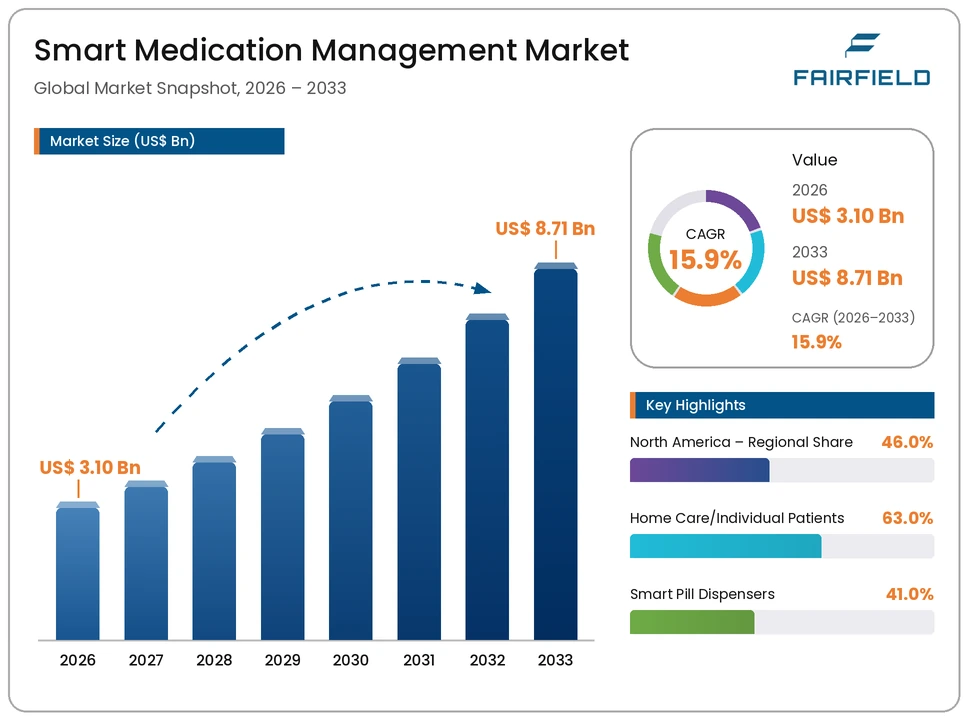
The market is valued at USD 3.10 Billion in 2026, with manufacturers directing investment toward improved device reliability and expanded connectivity that supports care team visibility into patient medication adherence patterns. By 2033, the market is forecast to reach USD 8.71 Billion, reflecting steady growth across established home care applications alongside expanding hospital and long-term care facility adoption.
Key Highlights
- The global smart medication management market is valued at USD 3.10 Billion in 2026 and is projected to reach USD 8.71 Billion by 2033, expanding at a CAGR of 15.9% across the 2026-2033 forecast period.
- Smart Pill Dispensers lead the product-type segment with a 41.0% share in 2026, equivalent to USD 1.27 Billion.
- Home Care/Individual Patients remain the dominant end-user segment, accounting for 63.0% of global demand, or USD 1.95 Billion, in 2026.
- North America commands the largest regional share at 46.0% of the global market in 2026.
- Hospitals and long-term care facilities are emerging as the fastest-growing end-user segment through 2033.
Key Growth Drivers
Growth in the smart medication management market is driven primarily by aging global populations, as older adults increasingly manage complex, multi-medication regimens for chronic conditions, creating substantial demand for adherence support technology that reduces the risk of missed doses and medication errors.
A second driver is growing healthcare payer and provider recognition of medication non-adherence as a significant driver of avoidable healthcare costs, as poor adherence contributes substantially to hospital readmissions and disease complications, creating direct financial incentive for payers and providers to invest in adherence support technology.
Key Restraints
The recurring cost of smart medication management devices and platform subscriptions creates an affordability barrier for some patients, particularly those managing chronic conditions on fixed incomes without comprehensive insurance coverage for adherence technology.
Additionally, technology adoption barriers among elderly patients, who represent a substantial share of the target user population, require thoughtful, accessible device design to ensure the target population can effectively use these adherence support tools.
Market Opportunities
The expansion of hospital and long-term care facility adoption presents a substantial opportunity, as institutional care settings increasingly seek smart medication management technology to improve medication administration accuracy and reduce staff workload, extending demand beyond the traditionally dominant home care segment.
A second opportunity lies in continued integration of smart medication management platforms with broader care coordination and electronic health record systems, providing care teams with comprehensive visibility into patient adherence patterns. Companies that successfully advance this care team integration stand to capture growing institutional demand as healthcare systems prioritize coordinated chronic disease management.
Segmentation Analysis
- By Product Type
Smart Pill Dispensers lead the product-type segment, accounting for 41.0% of global market value in 2026, equivalent to USD 1.27 Billion. Their leadership reflects smart dispensers' comprehensive adherence support, combining automated dosing with reminder and tracking functionality. Smart Packaging & Blister Packs represent a significant, established product-type category. Medication Adherence Apps represent the fastest-growing product-type category through 2033, driven by growing smartphone-based adherence tracking adoption as a lower-cost alternative to dedicated hardware devices.
- By End User
Home Care/Individual Patients form the leading end-user segment, representing 63.0% of global demand in 2026, or USD 1.95 Billion, reflecting strong demand among patients managing chronic conditions independently at home. Hospitals & Long-Term Care Facilities represent the fastest-growing end-user category, propelled by institutional adoption seeking to improve medication administration accuracy and reduce staff workload.
Regional Insights
- North America
North America holds the largest regional share, at 46.0% of the global market in 2026, equivalent to USD 1.43 Billion. The region's leadership reflects aging population trends and strong healthcare payer investment in medication adherence technology across the United States and Canada.
- Europe
Europe accounts for 28.0% of the global market in 2026, valued at USD 0.87 Billion. Demand is supported by aging populations and comprehensive healthcare systems increasingly prioritizing medication adherence across major European markets.
- Asia Pacific
Asia Pacific represents 19.0% of the global market in 2026, or USD 0.59 Billion. Growth is underpinned by rapidly aging populations and expanding healthcare technology adoption across Japan, China, and South Korea.
- Latin America
Latin America contributes 4.0% of the global market in 2026, equivalent to USD 0.12 Billion. Growth remains at an early stage, tied to gradual healthcare technology adoption in Brazil and Mexico.
- Middle East & Africa
Middle East & Africa holds 3.0% of the global market in 2026, valued at USD 0.09 Billion. Growth remains gradual, tied to the expansion of healthcare technology infrastructure across the region.
Competitive Landscape
The global smart medication management market is moderately fragmented, with a mix of established healthcare technology companies, specialized medication adherence device makers, and pharmacy-affiliated platforms competing for patient and institutional adoption. Competition centers on device reliability and ease of use, breadth of connectivity and care team integration capability, and the ability to demonstrate measurable adherence and outcome improvements. Companies are increasingly differentiating through expanded care coordination integration rather than competing on basic reminder functionality alone.
Key Market Players
- Koninklijke Philips N.V.
- Omnicell, Inc.
- Cardinal Health, Inc.
- Hero Health, Inc.
- MedMinder Systems, Inc.
- Pillsy, Inc.
- Tabsafe Medical Devices, Inc.
- McKesson Corporation
- Becton, Dickinson and Company
- PillPack, LLC
Market Segmentation
By Product Type
- Smart Pill Dispensers
- Medication Adherence Apps
- Smart Packaging & Blister Packs
- Others
By End User
- Home Care/Individual Patients
- Hospitals & Long-Term Care Facilities
- Others
By Connectivity
- Bluetooth/Wi-Fi Connected
- Cellular-Connected
By Geography
- North America
- Europe
- Asia Pacific
- Latin America
- Middle East & Africa
- Executive Summary
- Global Smart Medication Management Market Snapshot
- Future Projections
- Key Market Trends
- Regional Snapshot, by Value, 2026
- Analyst Recommendations
- Market Overview
- Market Definitions and Segmentations
- Market Dynamics
- Drivers
- Restraints
- Market Opportunities
- Value Chain Analysis
- COVID-19 Impact Analysis
- Porter's Five Forces Analysis
- Impact of Russia-Ukraine Conflict
- PESTLE Analysis
- Regulatory Analysis
- Price Trend Analysis
- Current Prices and Future Projections, 2025-2033
- Price Impact Factors
- Global Smart Medication Management Market Outlook, 2020 - 2033
- Global Smart Medication Management Market Outlook, by Product Type, Value (US$ Bn), 2020-2033
- Smart Pill Dispensers
- Medication Adherence Apps
- Smart Packaging & Blister Packs
- Others
- Global Smart Medication Management Market Outlook, by End User, Value (US$ Bn), 2020-2033
- Home Care/Individual Patients
- Hospitals & Long-Term Care Facilities
- Others
- Global Smart Medication Management Market Outlook, by Connectivity, Value (US$ Bn), 2020-2033
- Bluetooth/Wi-Fi Connected
- Cellular-Connected
- Global Smart Medication Management Market Outlook, by Region, Value (US$ Bn), 2020-2033
- North America
- Europe
- Asia Pacific
- Latin America
- Middle East & Africa
- Global Smart Medication Management Market Outlook, by Product Type, Value (US$ Bn), 2020-2033
- North America Smart Medication Management Market Outlook, 2020 - 2033
- North America Smart Medication Management Market Outlook, by Product Type, Value (US$ Bn), 2020-2033
- Smart Pill Dispensers
- Medication Adherence Apps
- Smart Packaging & Blister Packs
- Others
- North America Smart Medication Management Market Outlook, by End User, Value (US$ Bn), 2020-2033
- Home Care/Individual Patients
- Hospitals & Long-Term Care Facilities
- Others
- North America Smart Medication Management Market Outlook, by Connectivity, Value (US$ Bn), 2020-2033
- Bluetooth/Wi-Fi Connected
- Cellular-Connected
- North America Smart Medication Management Market Outlook, by Country, Value (US$ Bn), 2020-2033
- U.S. Smart Medication Management Market Outlook, by Product Type, 2020-2033
- U.S. Smart Medication Management Market Outlook, by End User, 2020-2033
- U.S. Smart Medication Management Market Outlook, by Connectivity, 2020-2033
- Canada Smart Medication Management Market Outlook, by Product Type, 2020-2033
- Canada Smart Medication Management Market Outlook, by End User, 2020-2033
- Canada Smart Medication Management Market Outlook, by Connectivity, 2020-2033
- BPS Analysis/Market Attractiveness Analysis
- North America Smart Medication Management Market Outlook, by Product Type, Value (US$ Bn), 2020-2033
- Europe Smart Medication Management Market Outlook, 2020 - 2033
- Europe Smart Medication Management Market Outlook, by Product Type, Value (US$ Bn), 2020-2033
- Smart Pill Dispensers
- Medication Adherence Apps
- Smart Packaging & Blister Packs
- Others
- Europe Smart Medication Management Market Outlook, by End User, Value (US$ Bn), 2020-2033
- Home Care/Individual Patients
- Hospitals & Long-Term Care Facilities
- Others
- Europe Smart Medication Management Market Outlook, by Connectivity, Value (US$ Bn), 2020-2033
- Bluetooth/Wi-Fi Connected
- Cellular-Connected
- Europe Smart Medication Management Market Outlook, by Country, Value (US$ Bn), 2020-2033
- Germany Smart Medication Management Market Outlook, by Product Type, 2020-2033
- Germany Smart Medication Management Market Outlook, by End User, 2020-2033
- Germany Smart Medication Management Market Outlook, by Connectivity, 2020-2033
- Italy Smart Medication Management Market Outlook, by Product Type, 2020-2033
- Italy Smart Medication Management Market Outlook, by End User, 2020-2033
- Italy Smart Medication Management Market Outlook, by Connectivity, 2020-2033
- France Smart Medication Management Market Outlook, by Product Type, 2020-2033
- France Smart Medication Management Market Outlook, by End User, 2020-2033
- France Smart Medication Management Market Outlook, by Connectivity, 2020-2033
- U.K. Smart Medication Management Market Outlook, by Product Type, 2020-2033
- U.K. Smart Medication Management Market Outlook, by End User, 2020-2033
- U.K. Smart Medication Management Market Outlook, by Connectivity, 2020-2033
- Spain Smart Medication Management Market Outlook, by Product Type, 2020-2033
- Spain Smart Medication Management Market Outlook, by End User, 2020-2033
- Spain Smart Medication Management Market Outlook, by Connectivity, 2020-2033
- Russia Smart Medication Management Market Outlook, by Product Type, 2020-2033
- Russia Smart Medication Management Market Outlook, by End User, 2020-2033
- Russia Smart Medication Management Market Outlook, by Connectivity, 2020-2033
- Rest of Europe Smart Medication Management Market Outlook, by Product Type, 2020-2033
- Rest of Europe Smart Medication Management Market Outlook, by End User, 2020-2033
- Rest of Europe Smart Medication Management Market Outlook, by Connectivity, 2020-2033
- BPS Analysis/Market Attractiveness Analysis
- Europe Smart Medication Management Market Outlook, by Product Type, Value (US$ Bn), 2020-2033
- Asia Pacific Smart Medication Management Market Outlook, 2020 - 2033
- Asia Pacific Smart Medication Management Market Outlook, by Product Type, Value (US$ Bn), 2020-2033
- Smart Pill Dispensers
- Medication Adherence Apps
- Smart Packaging & Blister Packs
- Others
- Asia Pacific Smart Medication Management Market Outlook, by End User, Value (US$ Bn), 2020-2033
- Home Care/Individual Patients
- Hospitals & Long-Term Care Facilities
- Others
- Asia Pacific Smart Medication Management Market Outlook, by Connectivity, Value (US$ Bn), 2020-2033
- Bluetooth/Wi-Fi Connected
- Cellular-Connected
- Asia Pacific Smart Medication Management Market Outlook, by Country, Value (US$ Bn), 2020-2033
- China Smart Medication Management Market Outlook, by Product Type, 2020-2033
- China Smart Medication Management Market Outlook, by End User, 2020-2033
- China Smart Medication Management Market Outlook, by Connectivity, 2020-2033
- Japan Smart Medication Management Market Outlook, by Product Type, 2020-2033
- Japan Smart Medication Management Market Outlook, by End User, 2020-2033
- Japan Smart Medication Management Market Outlook, by Connectivity, 2020-2033
- South Korea Smart Medication Management Market Outlook, by Product Type, 2020-2033
- South Korea Smart Medication Management Market Outlook, by End User, 2020-2033
- South Korea Smart Medication Management Market Outlook, by Connectivity, 2020-2033
- India Smart Medication Management Market Outlook, by Product Type, 2020-2033
- India Smart Medication Management Market Outlook, by End User, 2020-2033
- India Smart Medication Management Market Outlook, by Connectivity, 2020-2033
- Southeast Asia Smart Medication Management Market Outlook, by Product Type, 2020-2033
- Southeast Asia Smart Medication Management Market Outlook, by End User, 2020-2033
- Southeast Asia Smart Medication Management Market Outlook, by Connectivity, 2020-2033
- Rest of SAO Smart Medication Management Market Outlook, by Product Type, 2020-2033
- Rest of SAO Smart Medication Management Market Outlook, by End User, 2020-2033
- Rest of SAO Smart Medication Management Market Outlook, by Connectivity, 2020-2033
- BPS Analysis/Market Attractiveness Analysis
- Asia Pacific Smart Medication Management Market Outlook, by Product Type, Value (US$ Bn), 2020-2033
- Latin America Smart Medication Management Market Outlook, 2020 - 2033
- Latin America Smart Medication Management Market Outlook, by Product Type, Value (US$ Bn), 2020-2033
- Smart Pill Dispensers
- Medication Adherence Apps
- Smart Packaging & Blister Packs
- Others
- Latin America Smart Medication Management Market Outlook, by End User, Value (US$ Bn), 2020-2033
- Home Care/Individual Patients
- Hospitals & Long-Term Care Facilities
- Others
- Latin America Smart Medication Management Market Outlook, by Connectivity, Value (US$ Bn), 2020-2033
- Bluetooth/Wi-Fi Connected
- Cellular-Connected
- Latin America Smart Medication Management Market Outlook, by Country, Value (US$ Bn), 2020-2033
- Brazil Smart Medication Management Market Outlook, by Product Type, 2020-2033
- Brazil Smart Medication Management Market Outlook, by End User, 2020-2033
- Brazil Smart Medication Management Market Outlook, by Connectivity, 2020-2033
- Mexico Smart Medication Management Market Outlook, by Product Type, 2020-2033
- Mexico Smart Medication Management Market Outlook, by End User, 2020-2033
- Mexico Smart Medication Management Market Outlook, by Connectivity, 2020-2033
- Argentina Smart Medication Management Market Outlook, by Product Type, 2020-2033
- Argentina Smart Medication Management Market Outlook, by End User, 2020-2033
- Argentina Smart Medication Management Market Outlook, by Connectivity, 2020-2033
- Rest of LATAM Smart Medication Management Market Outlook, by Product Type, 2020-2033
- Rest of LATAM Smart Medication Management Market Outlook, by End User, 2020-2033
- Rest of LATAM Smart Medication Management Market Outlook, by Connectivity, 2020-2033
- BPS Analysis/Market Attractiveness Analysis
- Latin America Smart Medication Management Market Outlook, by Product Type, Value (US$ Bn), 2020-2033
- Middle East & Africa Smart Medication Management Market Outlook, 2020 - 2033
- Middle East & Africa Smart Medication Management Market Outlook, by Product Type, Value (US$ Bn), 2020-2033
- Smart Pill Dispensers
- Medication Adherence Apps
- Smart Packaging & Blister Packs
- Others
- Middle East & Africa Smart Medication Management Market Outlook, by End User, Value (US$ Bn), 2020-2033
- Home Care/Individual Patients
- Hospitals & Long-Term Care Facilities
- Others
- Middle East & Africa Smart Medication Management Market Outlook, by Connectivity, Value (US$ Bn), 2020-2033
- Bluetooth/Wi-Fi Connected
- Cellular-Connected
- Middle East & Africa Smart Medication Management Market Outlook, by Country, Value (US$ Bn), 2020-2033
- GCC Smart Medication Management Market Outlook, by Product Type, 2020-2033
- GCC Smart Medication Management Market Outlook, by End User, 2020-2033
- GCC Smart Medication Management Market Outlook, by Connectivity, 2020-2033
- South Africa Smart Medication Management Market Outlook, by Product Type, 2020-2033
- South Africa Smart Medication Management Market Outlook, by End User, 2020-2033
- South Africa Smart Medication Management Market Outlook, by Connectivity, 2020-2033
- Egypt Smart Medication Management Market Outlook, by Product Type, 2020-2033
- Egypt Smart Medication Management Market Outlook, by End User, 2020-2033
- Egypt Smart Medication Management Market Outlook, by Connectivity, 2020-2033
- Nigeria Smart Medication Management Market Outlook, by Product Type, 2020-2033
- Nigeria Smart Medication Management Market Outlook, by End User, 2020-2033
- Nigeria Smart Medication Management Market Outlook, by Connectivity, 2020-2033
- Rest of Middle East Smart Medication Management Market Outlook, by Product Type, 2020-2033
- Rest of Middle East Smart Medication Management Market Outlook, by End User, 2020-2033
- Rest of Middle East Smart Medication Management Market Outlook, by Connectivity, 2020-2033
- BPS Analysis/Market Attractiveness Analysis
- Middle East & Africa Smart Medication Management Market Outlook, by Product Type, Value (US$ Bn), 2020-2033
- Competitive Landscape
- Company Vs Segment Heatmap
- Company Market Share Analysis, 2025
- Competitive Dashboard
- Company Profiles
- Koninklijke Philips N.V.
- Company Overview
- Product Portfolio
- Financial Overview
- Business Strategies and Developments
- Omnicell, Inc.
- Cardinal Health, Inc.
- Hero Health, Inc.
- MedMinder Systems, Inc.
- Pillsy, Inc.
- Tabsafe Medical Devices, Inc.
- McKesson Corporation
- Becton, Dickinson and Company
- PillPack, LLC
- Koninklijke Philips N.V.
- Appendix
- Research Methodology
- Report Assumptions
- Acronyms and Abbreviations
By Product Type
- Smart Pill Dispensers
- Medication Adherence Apps
- Smart Packaging & Blister Packs
- Others
By End User
- Home Care/Individual Patients
- Hospitals & Long-Term Care Facilities
- Others
By Connectivity
- Bluetooth/Wi-Fi Connected
- Cellular-Connected
By Geography
- North America
- Europe
- Asia Pacific
- Latin America
- Middle East & Africa
Our Research Methodology
Considering the volatility of business today, traditional approaches to strategizing a game plan can be unfruitful if not detrimental. True ambiguity is no way to determine a forecast. A myriad of predetermined factors must be accounted for such as the degree of risk involved, the magnitude of circumstances, as well as conditions or consequences that are not known or unpredictable. To circumvent binary views that cast uncertainty, the application of market research intelligence to strategically posture, move, and enable actionable outcomes is necessary.
View Methodology
Quality Assured
Rigorous Validation Process

Confidentiality Assured
End-to-end Data Security

Custom Research Services
Tailored To Your Objectives
FAQs
The global smart medication management market is valued at USD 3.10 Billion in 2026, reflecting growing demand for technology-supported medication adherence.
The market is projected to grow at a CAGR of 15.9%, reaching USD 8.71 Billion by 2033, driven by aging populations and healthcare payer adherence investment.
Smart Pill Dispensers lead with a 41.0% share in 2026, reflecting their comprehensive adherence support combining dosing and tracking.
North America leads with a 46.0% share in 2026, supported by aging population trends and strong payer investment.
The largest opportunity lies in hospitals and long-term care facilities, expanding as institutions seek improved medication administration accuracy.
Related Reports
Bio-Based Extrusion Aids Market Size, Share, Insights, Competitive Landscape, and Forecast 2026 to 2033
Bio-Based Extrusion Aids Market is valued at US$1.42 Bn in 2026 and projected to reach US$2.72 Bn by 2033, growing at a 9.73% CAGR.
Halogen-Free Process Aids Market Size, Share, Insights, Competitive Landscape, and Forecast 2026 to 2033
Halogen-Free Process Aids Market is valued at US$2.38 Bn in 2026 and projected to reach US$4.28 Bn by 2033, growing at a CAGR of 8.75%.
Particle-Engineered Probiotic Stabilizers Market Size, Share, Insights, Competitive Landscape, and Forecast 2026 to 2033
The global particle-engineered probiotic stabilizers market is projected to reach US$ 2.98 Billion by 2033, growing at an 11.4% CAGR during 2026–2033
Probiotic Stability Excipients Market Size, Share, Insights, Competitive Landscape, and Forecast 2026 to 2033
The global probiotic stability excipients market is projected to reach US$ 2.8 Bn by 2033, growing at an 11.6% CAGR , driven by stable probiotic formulations
GLP-1 Telehealth Platforms Market Size, Share, Insights, Competitive Landscape, and Forecast 2026 to 2033
GLP-1 Telehealth Platforms Market is valued at US$0.7638 Billion in 2026 and projected to reach US$2.1199 Billion by 2033, growing at 15.7% CAGR.
GLP-1 Nutrition Coaching Market Size, Share, Insights, Competitive Landscape, and Forecast 2026 to 2033
GLP-1 Nutrition Coaching Market is projected to reach US$0.4095 billion by 2033 from US$0.1248 billion in 2026, growing at a CAGR of 18.5%.