



Smart Watch and Smart Ring LED Market
Smart Watch and Smart Ring LED Market Size, Share, Insights, Competitive Landscape, and Forecast 2026 to 2033
Smart Watch and Smart Ring LED Market Size and Trend Analysis
What Is the Growth Outlook for Wearable LED Components?
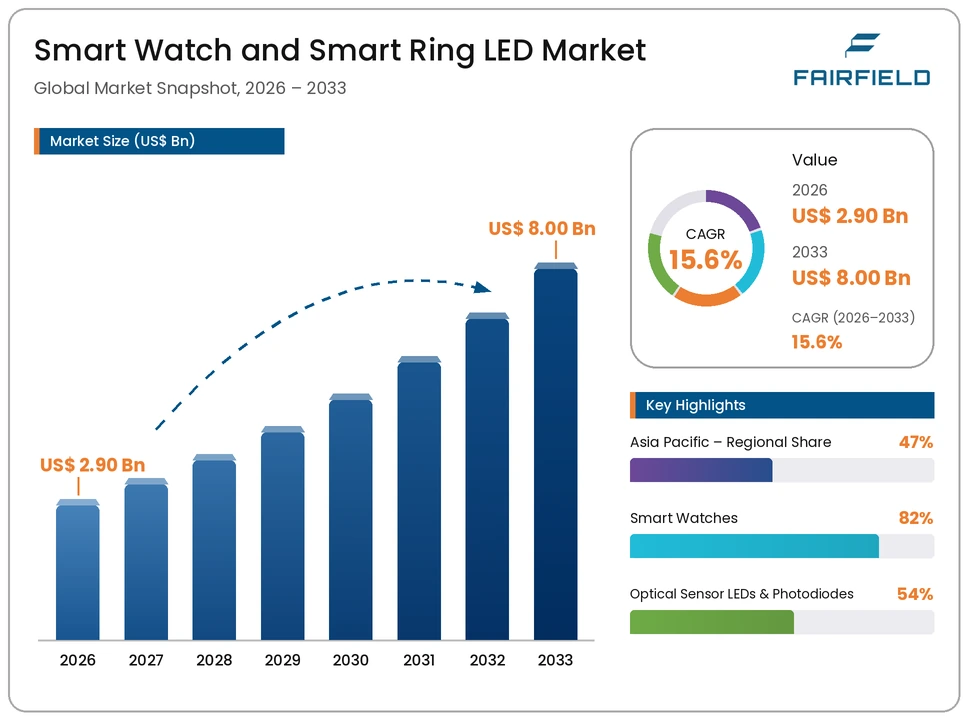
The global Smart Watch and Smart Ring LED market size is expected to be valued at US$ 2.90 billion in 2026 and projected to reach US$ 8.00 billion by 2033, growing at a CAGR of 15.6% between 2026 and 2033.
This study sizes both halves of the component opportunity: light-emitting diodes and matched photodiodes used for optical biosensing, and micro-LED and mini-LED emitters used for display illumination inside wrist and finger wearables. Between 2020 and 2025 the component pool grew at about 17.0% CAGR, from roughly US$ 1.15 billion to US$ 2.52 billion. Growth came from three places: rising wearable unit shipments, a jump in the number of emitters fitted to each device as multi-wavelength sensing replaced single-colour heart rate reading, and the arrival of the smart ring as a separate product category. Component value per device is now rising faster than device shipments.
Key Report Takeaways
- By LED Type: Optical Sensor LEDs and Photodiodes held 54% share in 2026, while Micro-LED Display Emitters are projected to expand at a 18.9% CAGR through 2033, helped by falling mass-transfer defect rates on small-area panels.
- By Wavelength: Green held 31% share in 2026, while Infrared is projected to expand at a 17.4% CAGR through 2033, as deeper tissue penetration becomes necessary for overnight blood oxygen and perfusion measurement.
- By Device Type: Smart Watches held 82% share in 2026, while Smart Rings are projected to expand at a 19.6% CAGR through 2033, because a ring sits on a thinner tissue site that favours continuous optical sampling.
- By Application: Heart Rate Monitoring held 36% share in 2026, while Blood Oxygen Sensing is projected to expand at a 17.2% CAGR through 2033, driven by sleep-tracking features that run sensors through the whole night.
- By Geography: Asia Pacific held 47% share in 2026, while Latin America is projected to expand at a 19.8% CAGR through 2033, reflecting a low installed base and rapid growth in mid-priced wearable ownership.
Global Smart Watch and Smart Ring LED Market Trends and Insights
Drivers Impact Analysis
Two documented shifts explain most of the additional emitter content being designed into wearables.
| Driver | Impact on CAGR Forecast | Geographic Relevance | Impact Timeline |
| Multi-wavelength biosensing raising emitter and photodiode count per device | High | Asia Pacific and North America | Short term ≤2 years |
| Battery-life pressure pushing displays toward higher-efficacy micro-LED and mini-LED emitters | Medium | Global | Medium term 2–4 years |
Multi-Wavelength Sensing Multiplies the LED Count Inside Every Wearable
Component demand is rising faster than device shipments because each new wearable carries more emitters than the one it replaces. An early wrist tracker used one or two green diodes. Current designs pair green, red and infrared emitters with several matched photodiodes arranged around the sensor window, so a single device can hold eight or more optical components.
The mechanism is physiological. Green light measures pulse well at the skin surface but says little about oxygen saturation, which needs the contrast between red and infrared absorption. Skin temperature and perfusion features need yet another wavelength and a reference detector. Each feature a manufacturer adds to the specification sheet therefore adds silicon, and the value of the optical bill of materials grows even where the device price does not.
Battery Life Pressure Moves Watch Displays Toward Mini-LED and Micro-LED Emitters
Display power consumption has become the binding constraint on wearable feature sets, and that is redirecting display spend toward more efficient emitters. Always-on screens, brighter outdoor modes and larger watch faces all draw from a battery that cannot grow, so designers pay for luminous efficacy rather than for panel area.
The causal path runs through thermal and optical physics. Inorganic gallium nitride emitters deliver more light per watt and hold brightness under sunlight better than organic alternatives, and they do not suffer differential ageing on static watch-face elements. Mini-LED arrays deliver part of that benefit today as a backlight, while micro-LED moves the emitter into the pixel itself. Restrictions on hazardous substances under Directive 2011/65/EU, adopted on 8 June 2011, further favour inorganic emitter chemistries that avoid restricted materials.
Restraints Impact Analysis
Two constraints hold back the pace at which component value per device can rise.
| Restraint | Impact on CAGR Forecast | Geographic Relevance | Impact Timeline |
| Mass-transfer yield and cost keep micro-LED confined to premium wearables | High | Asia Pacific | Long term ≥4 years |
| Medical device rules raise the qualification cost of health-claim sensing hardware | Medium | Europe and North America | Medium term 2–4 years |
Micro-LED Mass Transfer Yield Keeps the Technology in Premium Watches Only
Micro-LED remains a small share of display emitter revenue because the assembly step, not the diode, sets the price. A watch-sized panel requires millions of individual emitters to be moved from a growth wafer onto a backplane, and every missed or misplaced die must be found and repaired before the panel can ship.
The cost sits in three specific places. Transfer equipment throughput is measured in dies per hour against a requirement measured in millions per panel. Inspection and repair add a second pass that organic panels never need. Finally, red emitters built on different material systems age and bin differently from blue and green, so colour uniformity across a finished panel demands tight sorting. Until transfer yield improves, device makers will reserve the technology for flagship models and keep organic panels in mainstream watches.
Health Claim Rules Lengthen Qualification Cycles for Optical Sensing Modules
Regulatory boundaries limit how quickly sensing hardware improvements reach the market. A smart watch or smart ring is normally placed on sale as a general wellness product, and its LED and photodiode components are not medical devices in themselves. The moment a manufacturer makes a diagnostic or therapeutic claim for a feature, that feature requires separate authorisation, and the hardware behind it must be documented accordingly.
The cost driver is documentation and traceability rather than the diode. In the single market, Regulation (EU) 2017/745 on medical devices, adopted on 5 April 2017 and in force from 26 May 2018, sets conformity and technical file duties, and Regulation (EU) 2023/607, adopted on 15 March 2023, extended the transitional provisions. Component suppliers must then hold stable bills of material, fixed optical specifications and long-term supply commitments, which slows part revisions.
Market Opportunities
Smart Ring Sensor Sockets Open a Design Pool With No Incumbent Supplier
The smart ring creates an optical socket that did not exist five years ago, and no supplier holds an entrenched position in it. Ring interiors offer a few cubic millimetres for emitters, detectors and optics, which rules out standard wrist-sensor packages and rewards suppliers that can deliver ultra-compact, low-current parts with tight angular control.
Specialist optoelectronics houses with chip-scale packaging capability are best placed to capture this pool, because the constraint is package height rather than die performance. Demand comes from consumer electronics brands adding rings alongside watches, and from sleep and recovery platforms that need multi-night battery life from a cell smaller than a hearing aid battery. Each socket win locks a supplier into a multi-year platform, since requalifying an optical path inside a sealed ring is costly.
Validated Optical Modules Create a Higher-Margin Component Tier for Regulated Features
A second revenue pool is opening above the commodity diode: pre-characterised optical modules supplied with the documentation a device maker needs when pursuing regulated health features. Selling a qualified module rather than a loose emitter moves the supplier up the value chain and changes the basis of the contract from unit price to assurance.
Component makers with calibration laboratories and quality systems can capture this tier. Demand comes from wearable brands building features that go beyond general wellness, and from digital health platforms that must evidence data provenance. The European Union adopted Regulation (EU) 2024/1860 on 13 June 2024 to phase in the EUDAMED database, and Regulation (EU) 2025/327 on the European Health Data Space on 11 February 2025, both of which raise the documentation burden that a validated module can absorb.
Segment Analysis
- By LED Type: Sensor Emitters Carry Revenue Today While Micro-LED Scales Fastest
Optical Sensor LEDs and Photodiodes led with 54% share in 2026, a result that surprises readers who assume displays dominate. Most smart watch screens use organic panels that fall outside this component definition, so sensing accounts for the larger share of true LED content. Micro-LED Display Emitters are the fastest-growing type at an 18.9% CAGR through 2033, as transfer yields improve on the small panel areas a watch needs. Mini-LED Backlight Arrays serve rugged and outdoor models that need sustained high brightness, while Indicator LEDs remain a small, stable category. The implication for suppliers is that near-term revenue growth depends on winning sensor sockets, while display emitters represent a longer-dated position that requires sustained capital investment in transfer and inspection equipment.
- By Wavelength: Green Holds the Installed Base as Infrared Gains Share
Green emitters accounted for 31% of wavelength demand in 2026 because green light gives the strongest pulse signal at the skin surface and tolerates motion better than longer wavelengths. Every wrist device fits at least one. Infrared is the fastest-growing wavelength at a 17.4% CAGR to 2033, since blood oxygen estimation depends on the absorption contrast between infrared and red light, and overnight measurement favours deeper tissue penetration. Red emitters pair with infrared in those measurements, while White and Visible Display emitters cover illumination duties. Wavelength mix matters commercially because infrared and red parts carry different wafer processes and binning requirements from green, so a shift in mix changes which fabrication lines a supplier needs to keep loaded.
- By Device Type: Smart Watches Supply the Volume While Smart Rings Grow Quickly
Smart Watches represented 82% of component demand in 2026, simply because annual watch shipments remain an order of magnitude larger than ring shipments and each watch carries both display and sensor emitters. Smart Rings are the fastest-growing device type at a 19.6% CAGR through 2033. The finger offers thinner tissue and a more stable optical path than the wrist, which allows reliable readings at lower drive current and makes continuous overnight sampling practical. Rings also avoid display power draw entirely, freeing the battery for sensing. For component suppliers the two devices demand different products: watches reward breadth and cost control across a large bill of materials, while rings reward extreme miniaturisation and current efficiency in a handful of parts.
- By Application: Heart Rate Monitoring Leads and Blood Oxygen Sensing Expands Fastest
Heart Rate Monitoring held 36% share in 2026, the baseline function present in essentially every wearable and the reason green emitters ship in such volume. Blood Oxygen Sensing is the fastest-growing application at a 17.2% CAGR through 2033, driven by sleep tracking features that run the optical front end for seven or eight hours each night rather than in short samples. Sleep and Skin Temperature Tracking, Display Illumination, and Gesture and Proximity Sensing make up the balance, with temperature features typically reusing the same emitter array rather than adding one. The business consequence is duty cycle. Continuous overnight sensing raises both the reliability specification and the efficiency requirement for emitters, which favours suppliers able to guarantee output stability over years of near-constant operation. It also shifts the purchasing conversation from unit price toward measured performance across a full product lifetime, since a drifting emitter degrades every downstream health metric the device reports.
Geography Analysis
North America Sets the Feature Agenda That Component Specifications Follow
North America holds 24% share in 2026 and is forecast to grow at 13.9% CAGR through 2033, the slowest of the five regions from the largest per-capita base. The United States dominates, with Canada and Mexico adding assembly and distribution volume. The region’s influence exceeds its share because the brands that define wearable feature sets are headquartered there, and their sensor specifications propagate through the supply chain. Health feature ambition is high, but the regulatory boundary between general wellness products and devices making diagnostic claims is enforced, so manufacturers carry the cost of separate authorisation for the latter. The clearest change ahead is the spread of sleep and metabolic features that keep optical front ends running overnight, raising reliability requirements on every emitter specified into these platforms.
Europe Converts Regulatory Rigour Into Demand for Documented Components
Europe accounts for 18% share in 2026, with a forecast 14.3% CAGR to 2033. Germany, the United Kingdom, France, Italy and the Nordic countries drive demand, and the region’s distinguishing feature is documentation rather than volume. Device makers selling here must navigate conformity duties under the medical devices framework when features move beyond general wellness, and the phased EUDAMED obligations introduced by Regulation (EU) 2024/1860 add registration work. That environment rewards component suppliers who can provide stable optical specifications and long-term availability commitments. Several significant optoelectronics manufacturers are based in the region, giving local device makers close engineering support. The main constraint is manufacturing cost, which keeps high-volume packaging work offshore even where design and validation stay local.
Which Region Is Leading the Smart Watch and Smart Ring LED Market?
Asia Pacific leads with 47% share in 2026 and is forecast to grow at 16.1% CAGR through 2033, a position that reflects supply as much as demand. China, Japan, South Korea and Taiwan hold most of the world’s epitaxy, chip fabrication and optoelectronic packaging capacity, and final assembly of wearables is concentrated in the same economies. Japan and South Korea contribute materials and emitter technology, Taiwan supplies transfer and backplane expertise relevant to micro-LED, and China provides both packaging scale and a very large domestic wearable market. India adds fast-growing consumption at mid-range price points. The region’s risk is concentration: a disruption in a single packaging cluster affects global supply, and buyers are beginning to ask for qualified second sources.
Which Region Is Growing Fastest in the Smart Watch and Smart Ring LED Market?
Latin America is growing fastest at a 19.8% CAGR between 2026 and 2033, from a small 6% share in 2026. Brazil, Mexico, Argentina and Colombia drive the increase, and the arithmetic of a low installed base explains much of it. Wearable ownership is rising quickly as mid-priced watches and rings reach affordable price points and as instalment retail widens access. Public health campaigns around hypertension and diabetes have also raised interest in continuous monitoring features. Barriers remain real: import duties and currency movement raise landed cost, local component manufacturing is minimal, and after-sales service networks are thin outside major cities. The clearest opportunity is in lower-cost sensing platforms that use fewer emitters while keeping credible heart rate and sleep functionality.
Middle East & Africa Grows From a Narrow Premium Base
Middle East & Africa holds 5% share in 2026, with a forecast 18.2% CAGR through 2033. The United Arab Emirates, Saudi Arabia, Israel and South Africa account for most demand, concentrated in affluent urban buyers and in corporate wellness programmes. Government health digitisation initiatives in the Gulf states have put preventive monitoring on the policy agenda, which supports adoption of continuous sensing wearables. Barriers are structural: component manufacturing is absent, distribution depends on imports, and high ambient temperatures shorten battery life and stress optical adhesives in sealed devices. Price sensitivity across much of the continent also limits devices to entry-level sensor configurations. The notable change is the growth of locally operated digital health services, which gives wearable data a destination and strengthens the purchase rationale.
Competitive Landscape
The market is moderately concentrated. A small group of optoelectronics specialists controls most emitter supply, because epitaxy, wafer processing and chip-scale packaging all require capital that newer entrants struggle to raise. ams-OSRAM, Nichia, Lumileds and Seoul Semiconductor each hold established positions across emitter families, while Samsung Electronics participates both as a component manufacturer and as a device maker. Concentration is tighter in sensor-grade emitters than in indicator LEDs, where commodity suppliers compete freely. Vertical integration by device brands, which increasingly design their own optical front ends, is the main structural change.
Vendors compete on four factors that buyers can measure: radiant efficiency at the drive currents a wearable can afford, package height and footprint, wavelength and output binning consistency across production lots, and long-term supply commitment. Reliability over years of continuous operation now carries as much weight as peak performance, because overnight sensing leaves emitters on for a third of their service life. New entrants come mainly from display and sensor adjacencies rather than from start-ups.
Strategic activity concentrates on capacity, qualification and standards compliance rather than on acquisitions. Suppliers are investing in chip-scale packaging lines for miniature sensor modules, in transfer and inspection capability for micro-LED, and in the documentation systems that regulated health features demand. Regulatory milestones such as the phased EUDAMED roll-out and the adoption of the European Health Data Space regulation have made traceable component documentation a commercial requirement rather than a courtesy.
Strategic direction across the field points toward integrated optical modules. Rather than selling discrete diodes, suppliers increasingly offer emitter, detector, optics and reference channel as one characterised assembly, which shortens device development and deepens the customer relationship.
Recent Industry Developments
- June 2024: The European Parliament and the Council of the European Union adopted Regulation (EU) 2024/1860 on 13 June 2024, setting a gradual roll-out of EUDAMED – gave wearable makers pursuing regulated health features a defined registration pathway.
- June 2024: The European Union adopted Regulation (EU) 2024/1689, the Artificial Intelligence Act, on 13 June 2024 – brought the algorithms that interpret optical sensor signals inside a formal compliance framework.
- January 2025: Regulation (EU) 2024/1860 entered into force on 10 January 2025 – started the phased database duties that shape how sensing modules must be documented by component suppliers.
- February 2025: The European Union adopted Regulation (EU) 2025/327 on the European Health Data Space on 11 February 2025 – created rules for sharing wellness data generated by optical wearable sensors.
Companies Covered in the Report
- ams-OSRAM AG
- Nichia Corporation
- Lumileds Holding B.V.
- Seoul Semiconductor Co., Ltd.
- Samsung Electronics Co., Ltd.
- Everlight Electronics Co., Ltd.
- ROHM Co., Ltd.
- Vishay Intertechnology, Inc.
Smart Watch and Smart Ring LED Market Segmentation
LED Type
- Optical Sensor LEDs and Photodiodes
- Micro-LED Display Emitters
- Mini-LED Backlight Arrays
- Indicator LEDs
Wavelength
- Green
- Red
- Infrared
- White and Visible Display
Device Type
- Smart Watches
- Smart Rings
Application
- Heart Rate Monitoring
- Blood Oxygen Sensing
- Sleep and Skin Temperature Tracking
- Display Illumination
- Gesture and Proximity Sensing
Regions
- North America
- Europe
- Asia Pacific
- Latin America
- Middle East & Africa
Smart Watch and Smart Ring LED Market Report Scope
| Metric | Value |
| Study Period (2020–2033) | Base year 2025, forecast 2026–2033 |
| Market Size 2026 | US$ 2.90 Billion |
| Market Size 2033 | US$ 8.00 Billion |
| CAGR 2026–2033 | 15.6% |
| Absolute Dollar Opportunity | US$ 5.10 Billion |
| Largest Market (region) | Asia Pacific (47% share in 2026) |
| Fastest-Growing Market (region) | Latin America (19.8% CAGR) |
| Market Concentration (Low / Medium / High) | Medium |
| Major Players | ams-OSRAM, Nichia, Lumileds, Seoul Semiconductor, Samsung Electronics |
- Executive Summary
- Global Smart Watch and Smart Ring LED Market Snapshot
- Market Size and Trend Analysis 2020–2033
- Historical Growth 2020–2025
- Base Year 2025
- Forecast Outlook 2026–2033
- Key Report Takeaways
- Market Overview
- Market Definition and Report Scope
- Market Dynamics
- Drivers
- Multi-Wavelength Sensing Multiplies the LED Count Inside Every Wearable
- Battery Life Pressure Moves Watch Displays Toward Mini-LED and Micro-LED Emitters
- Restraints
- Micro-LED Mass Transfer Yield Keeps the Technology in Premium Watches Only
- Health Claim Rules Lengthen Qualification Cycles for Optical Sensing Modules
- Market Opportunities
- Smart Ring Sensor Sockets Open a Design Pool With No Incumbent Supplier
- Validated Optical Modules Create a Higher-Margin Component Tier for Regulated Features
- Drivers
- Segment Analysis
- By LED Type: Sensor Emitters Carry Revenue Today While Micro-LED Scales Fastest
- By Wavelength: Green Holds the Installed Base as Infrared Gains Share
- By Device Type: Smart Watches Supply the Volume While Smart Rings Grow Quickly
- By Application: Heart Rate Monitoring Leads and Blood Oxygen Sensing Expands Fastest
- Global Smart Watch and Smart Ring LED Market Outlook, 2020–2033
- Global Smart Watch and Smart Ring LED Market Outlook, by LED Type, Value (US$ Billion), 2020–2033
- Optical Sensor LEDs and Photodiodes
- Micro-LED Display Emitters
- Mini-LED Backlight Arrays
- Indicator LEDs
- Global Smart Watch and Smart Ring LED Market Outlook, by Wavelength, Value (US$ Billion), 2020–2033
- Green
- Red
- Infrared
- White and Visible Display
- Global Smart Watch and Smart Ring LED Market Outlook, by Device Type, Value (US$ Billion), 2020–2033
- Smart Watches
- Smart Rings
- Global Smart Watch and Smart Ring LED Market Outlook, by Application, Value (US$ Billion), 2020–2033
- Heart Rate Monitoring
- Blood Oxygen Sensing
- Sleep and Skin Temperature Tracking
- Display Illumination
- Gesture and Proximity Sensing
- Global Smart Watch and Smart Ring LED Market Outlook, by Region, Value (US$ Billion), 2020–2033
- North America
- Europe
- Asia Pacific
- Latin America
- Middle East & Africa
- Global Smart Watch and Smart Ring LED Market Outlook, by LED Type, Value (US$ Billion), 2020–2033
- North America Smart Watch and Smart Ring LED Market Outlook, 2020–2033
- North America Sets the Feature Agenda That Component Specifications Follow
- North America Smart Watch and Smart Ring LED Market Outlook, by LED Type, Value (US$ Billion), 2020–2033
- Optical Sensor LEDs and Photodiodes
- Micro-LED Display Emitters
- Mini-LED Backlight Arrays
- Indicator LEDs
- North America Smart Watch and Smart Ring LED Market Outlook, by Wavelength, Value (US$ Billion), 2020–2033
- Green
- Red
- Infrared
- White and Visible Display
- North America Smart Watch and Smart Ring LED Market Outlook, by Device Type, Value (US$ Billion), 2020–2033
- Smart Watches
- Smart Rings
- North America Smart Watch and Smart Ring LED Market Outlook, by Application, Value (US$ Billion), 2020–2033
- Heart Rate Monitoring
- Blood Oxygen Sensing
- Sleep and Skin Temperature Tracking
- Display Illumination
- Gesture and Proximity Sensing
- North America Smart Watch and Smart Ring LED Market Outlook, by Country, Value (US$ Billion), 2020–2033
- United States Smart Watch and Smart Ring LED Market Outlook, by LED Type, 2020–2033
- United States Smart Watch and Smart Ring LED Market Outlook, by Wavelength, 2020–2033
- United States Smart Watch and Smart Ring LED Market Outlook, by Device Type, 2020–2033
- United States Smart Watch and Smart Ring LED Market Outlook, by Application, 2020–2033
- Canada Smart Watch and Smart Ring LED Market Outlook, by LED Type, 2020–2033
- Canada Smart Watch and Smart Ring LED Market Outlook, by Wavelength, 2020–2033
- Canada Smart Watch and Smart Ring LED Market Outlook, by Device Type, 2020–2033
- Canada Smart Watch and Smart Ring LED Market Outlook, by Application, 2020–2033
- Mexico Smart Watch and Smart Ring LED Market Outlook, by LED Type, 2020–2033
- Mexico Smart Watch and Smart Ring LED Market Outlook, by Wavelength, 2020–2033
- Mexico Smart Watch and Smart Ring LED Market Outlook, by Device Type, 2020–2033
- Mexico Smart Watch and Smart Ring LED Market Outlook, by Application, 2020–2033
- Europe Smart Watch and Smart Ring LED Market Outlook, 2020–2033
- Europe Converts Regulatory Rigour Into Demand for Documented Components
- Europe Smart Watch and Smart Ring LED Market Outlook, by LED Type, Value (US$ Billion), 2020–2033
- Optical Sensor LEDs and Photodiodes
- Micro-LED Display Emitters
- Mini-LED Backlight Arrays
- Indicator LEDs
- Europe Smart Watch and Smart Ring LED Market Outlook, by Wavelength, Value (US$ Billion), 2020–2033
- Green
- Red
- Infrared
- White and Visible Display
- Europe Smart Watch and Smart Ring LED Market Outlook, by Device Type, Value (US$ Billion), 2020–2033
- Smart Watches
- Smart Rings
- Europe Smart Watch and Smart Ring LED Market Outlook, by Application, Value (US$ Billion), 2020–2033
- Heart Rate Monitoring
- Blood Oxygen Sensing
- Sleep and Skin Temperature Tracking
- Display Illumination
- Gesture and Proximity Sensing
- Europe Smart Watch and Smart Ring LED Market Outlook, by Country, Value (US$ Billion), 2020–2033
- Germany Smart Watch and Smart Ring LED Market Outlook, by LED Type, 2020–2033
- Germany Smart Watch and Smart Ring LED Market Outlook, by Wavelength, 2020–2033
- Germany Smart Watch and Smart Ring LED Market Outlook, by Device Type, 2020–2033
- Germany Smart Watch and Smart Ring LED Market Outlook, by Application, 2020–2033
- United Kingdom Smart Watch and Smart Ring LED Market Outlook, by LED Type, 2020–2033
- United Kingdom Smart Watch and Smart Ring LED Market Outlook, by Wavelength, 2020–2033
- United Kingdom Smart Watch and Smart Ring LED Market Outlook, by Device Type, 2020–2033
- United Kingdom Smart Watch and Smart Ring LED Market Outlook, by Application, 2020–2033
- France Smart Watch and Smart Ring LED Market Outlook, by LED Type, 2020–2033
- France Smart Watch and Smart Ring LED Market Outlook, by Wavelength, 2020–2033
- France Smart Watch and Smart Ring LED Market Outlook, by Device Type, 2020–2033
- France Smart Watch and Smart Ring LED Market Outlook, by Application, 2020–2033
- Italy Smart Watch and Smart Ring LED Market Outlook, by LED Type, 2020–2033
- Italy Smart Watch and Smart Ring LED Market Outlook, by Wavelength, 2020–2033
- Italy Smart Watch and Smart Ring LED Market Outlook, by Device Type, 2020–2033
- Italy Smart Watch and Smart Ring LED Market Outlook, by Application, 2020–2033
- Nordic Countries Smart Watch and Smart Ring LED Market Outlook, by LED Type, 2020–2033
- Nordic Countries Smart Watch and Smart Ring LED Market Outlook, by Wavelength, 2020–2033
- Nordic Countries Smart Watch and Smart Ring LED Market Outlook, by Device Type, 2020–2033
- Nordic Countries Smart Watch and Smart Ring LED Market Outlook, by Application, 2020–2033
- Asia Pacific Smart Watch and Smart Ring LED Market Outlook, 2020–2033
- Regional Market Leadership
- Asia Pacific Smart Watch and Smart Ring LED Market Outlook, by LED Type, Value (US$ Billion), 2020–2033
- Optical Sensor LEDs and Photodiodes
- Micro-LED Display Emitters
- Mini-LED Backlight Arrays
- Indicator LEDs
- Asia Pacific Smart Watch and Smart Ring LED Market Outlook, by Wavelength, Value (US$ Billion), 2020–2033
- Green
- Red
- Infrared
- White and Visible Display
- Asia Pacific Smart Watch and Smart Ring LED Market Outlook, by Device Type, Value (US$ Billion), 2020–2033
- Smart Watches
- Smart Rings
- Asia Pacific Smart Watch and Smart Ring LED Market Outlook, by Application, Value (US$ Billion), 2020–2033
- Heart Rate Monitoring
- Blood Oxygen Sensing
- Sleep and Skin Temperature Tracking
- Display Illumination
- Gesture and Proximity Sensing
- Asia Pacific Smart Watch and Smart Ring LED Market Outlook, by Country, Value (US$ Billion), 2020–2033
- China Smart Watch and Smart Ring LED Market Outlook, by LED Type, 2020–2033
- China Smart Watch and Smart Ring LED Market Outlook, by Wavelength, 2020–2033
- China Smart Watch and Smart Ring LED Market Outlook, by Device Type, 2020–2033
- China Smart Watch and Smart Ring LED Market Outlook, by Application, 2020–2033
- Japan Smart Watch and Smart Ring LED Market Outlook, by LED Type, 2020–2033
- Japan Smart Watch and Smart Ring LED Market Outlook, by Wavelength, 2020–2033
- Japan Smart Watch and Smart Ring LED Market Outlook, by Device Type, 2020–2033
- Japan Smart Watch and Smart Ring LED Market Outlook, by Application, 2020–2033
- South Korea Smart Watch and Smart Ring LED Market Outlook, by LED Type, 2020–2033
- South Korea Smart Watch and Smart Ring LED Market Outlook, by Wavelength, 2020–2033
- South Korea Smart Watch and Smart Ring LED Market Outlook, by Device Type, 2020–2033
- South Korea Smart Watch and Smart Ring LED Market Outlook, by Application, 2020–2033
- Taiwan Smart Watch and Smart Ring LED Market Outlook, by LED Type, 2020–2033
- Taiwan Smart Watch and Smart Ring LED Market Outlook, by Wavelength, 2020–2033
- Taiwan Smart Watch and Smart Ring LED Market Outlook, by Device Type, 2020–2033
- Taiwan Smart Watch and Smart Ring LED Market Outlook, by Application, 2020–2033
- India Smart Watch and Smart Ring LED Market Outlook, by LED Type, 2020–2033
- India Smart Watch and Smart Ring LED Market Outlook, by Wavelength, 2020–2033
- India Smart Watch and Smart Ring LED Market Outlook, by Device Type, 2020–2033
- India Smart Watch and Smart Ring LED Market Outlook, by Application, 2020–2033
- Latin America Smart Watch and Smart Ring LED Market Outlook, 2020–2033
- Regional Growth Outlook
- Latin America Smart Watch and Smart Ring LED Market Outlook, by LED Type, Value (US$ Billion), 2020–2033
- Optical Sensor LEDs and Photodiodes
- Micro-LED Display Emitters
- Mini-LED Backlight Arrays
- Indicator LEDs
- Latin America Smart Watch and Smart Ring LED Market Outlook, by Wavelength, Value (US$ Billion), 2020–2033
- Green
- Red
- Infrared
- White and Visible Display
- Latin America Smart Watch and Smart Ring LED Market Outlook, by Device Type, Value (US$ Billion), 2020–2033
- Smart Watches
- Smart Rings
- Latin America Smart Watch and Smart Ring LED Market Outlook, by Application, Value (US$ Billion), 2020–2033
- Heart Rate Monitoring
- Blood Oxygen Sensing
- Sleep and Skin Temperature Tracking
- Display Illumination
- Gesture and Proximity Sensing
- Latin America Smart Watch and Smart Ring LED Market Outlook, by Country, Value (US$ Billion), 2020–2033
- Brazil Smart Watch and Smart Ring LED Market Outlook, by LED Type, 2020–2033
- Brazil Smart Watch and Smart Ring LED Market Outlook, by Wavelength, 2020–2033
- Brazil Smart Watch and Smart Ring LED Market Outlook, by Device Type, 2020–2033
- Brazil Smart Watch and Smart Ring LED Market Outlook, by Application, 2020–2033
- Mexico Smart Watch and Smart Ring LED Market Outlook, by LED Type, 2020–2033
- Mexico Smart Watch and Smart Ring LED Market Outlook, by Wavelength, 2020–2033
- Mexico Smart Watch and Smart Ring LED Market Outlook, by Device Type, 2020–2033
- Mexico Smart Watch and Smart Ring LED Market Outlook, by Application, 2020–2033
- Argentina Smart Watch and Smart Ring LED Market Outlook, by LED Type, 2020–2033
- Argentina Smart Watch and Smart Ring LED Market Outlook, by Wavelength, 2020–2033
- Argentina Smart Watch and Smart Ring LED Market Outlook, by Device Type, 2020–2033
- Argentina Smart Watch and Smart Ring LED Market Outlook, by Application, 2020–2033
- Colombia Smart Watch and Smart Ring LED Market Outlook, by LED Type, 2020–2033
- Colombia Smart Watch and Smart Ring LED Market Outlook, by Wavelength, 2020–2033
- Colombia Smart Watch and Smart Ring LED Market Outlook, by Device Type, 2020–2033
- Colombia Smart Watch and Smart Ring LED Market Outlook, by Application, 2020–2033
- Middle East & Africa Smart Watch and Smart Ring LED Market Outlook, 2020–2033
- Middle East & Africa Grows From a Narrow Premium Base
- Middle East & Africa Smart Watch and Smart Ring LED Market Outlook, by LED Type, Value (US$ Billion), 2020–2033
- Optical Sensor LEDs and Photodiodes
- Micro-LED Display Emitters
- Mini-LED Backlight Arrays
- Indicator LEDs
- Middle East & Africa Smart Watch and Smart Ring LED Market Outlook, by Wavelength, Value (US$ Billion), 2020–2033
- Green
- Red
- Infrared
- White and Visible Display
- Middle East & Africa Smart Watch and Smart Ring LED Market Outlook, by Device Type, Value (US$ Billion), 2020–2033
- Smart Watches
- Smart Rings
- Middle East & Africa Smart Watch and Smart Ring LED Market Outlook, by Application, Value (US$ Billion), 2020–2033
- Heart Rate Monitoring
- Blood Oxygen Sensing
- Sleep and Skin Temperature Tracking
- Display Illumination
- Gesture and Proximity Sensing
- Middle East & Africa Smart Watch and Smart Ring LED Market Outlook, by Country, Value (US$ Billion), 2020–2033
- United Arab Emirates Smart Watch and Smart Ring LED Market Outlook, by LED Type, 2020–2033
- United Arab Emirates Smart Watch and Smart Ring LED Market Outlook, by Wavelength, 2020–2033
- United Arab Emirates Smart Watch and Smart Ring LED Market Outlook, by Device Type, 2020–2033
- United Arab Emirates Smart Watch and Smart Ring LED Market Outlook, by Application, 2020–2033
- Saudi Arabia Smart Watch and Smart Ring LED Market Outlook, by LED Type, 2020–2033
- Saudi Arabia Smart Watch and Smart Ring LED Market Outlook, by Wavelength, 2020–2033
- Saudi Arabia Smart Watch and Smart Ring LED Market Outlook, by Device Type, 2020–2033
- Saudi Arabia Smart Watch and Smart Ring LED Market Outlook, by Application, 2020–2033
- Israel Smart Watch and Smart Ring LED Market Outlook, by LED Type, 2020–2033
- Israel Smart Watch and Smart Ring LED Market Outlook, by Wavelength, 2020–2033
- Israel Smart Watch and Smart Ring LED Market Outlook, by Device Type, 2020–2033
- Israel Smart Watch and Smart Ring LED Market Outlook, by Application, 2020–2033
- South Africa Smart Watch and Smart Ring LED Market Outlook, by LED Type, 2020–2033
- South Africa Smart Watch and Smart Ring LED Market Outlook, by Wavelength, 2020–2033
- South Africa Smart Watch and Smart Ring LED Market Outlook, by Device Type, 2020–2033
- South Africa Smart Watch and Smart Ring LED Market Outlook, by Application, 2020–2033
- Competitive Landscape
- Market Concentration and Supplier Participation
- Competitive Factors and Strategic Direction
- Recent Industry Developments
- EU Regulation 2024/1860 Adoption June 2024
- EU Artificial Intelligence Act Adoption June 2024
- EUDAMED Database Milestone January 2025
- European Health Data Space Regulation Adoption February 2025
- Company Profiles
- ams-OSRAM AG
- Nichia Corporation
- Lumileds Holding B.V.
- Seoul Semiconductor Co., Ltd.
- Samsung Electronics Co., Ltd.
- Everlight Electronics Co., Ltd.
- ROHM Co., Ltd.
- Vishay Intertechnology, Inc.
- Appendix
- Research Methodology
- Report Assumptions
- Acronyms and Abbreviations
LED Type
- Optical Sensor LEDs and Photodiodes
- Micro-LED Display Emitters
- Mini-LED Backlight Arrays
- Indicator LEDs
Wavelength
- Green
- Red
- Infrared
- White and Visible Display
Device Type
- Smart Watches
- Smart Rings
Application
- Heart Rate Monitoring
- Blood Oxygen Sensing
- Sleep and Skin Temperature Tracking
- Display Illumination
- Gesture and Proximity Sensing
Regions
- North America
- Europe
- Asia Pacific
- Latin America
- Middle East & Africa
Our Research Methodology
Considering the volatility of business today, traditional approaches to strategizing a game plan can be unfruitful if not detrimental. True ambiguity is no way to determine a forecast. A myriad of predetermined factors must be accounted for such as the degree of risk involved, the magnitude of circumstances, as well as conditions or consequences that are not known or unpredictable. To circumvent binary views that cast uncertainty, the application of market research intelligence to strategically posture, move, and enable actionable outcomes is necessary.
View Methodology
Quality Assured
Rigorous Validation Process

Confidentiality Assured
End-to-end Data Security

Custom Research Services
Tailored To Your Objectives
FAQs
The component market is valued at US$ 2.90 billion in 2026, covering optical biosensing emitters, photodiodes and micro-LED and mini-LED display emitters.
Revenue is projected to reach US$ 8.00 billion by 2033 at a 15.6% CAGR, an absolute dollar opportunity of US$ 5.10 billion.
Optical Sensor LEDs and Photodiodes lead with 54% share in 2026, because most watch displays use organic panels outside this component definition.
Micro-LED Display Emitters grow fastest at 18.9% CAGR, while Latin America is the fastest-expanding region at 19.8% CAGR through 2033.
Asia Pacific leads with 47% share in 2026, and concentration is medium, with a few optoelectronics specialists controlling most sensor-grade emitter supply.
Related Reports
Plastic Transistors Market Size, Share, Insights, Competitive Landscape, and Forecast 2026 to 2033
The global plastic transistors market is valued at US$0.4 billion in 2026, reaching US$0.9 billion by 2033, growing at a 12.3% CAGR
Multi-Access Edge Computing Market Size, Share, Insights, Competitive Landscape, and Forecast 2026 to 2033
Explore the multi-access edge computing market, valued at US$ 4.2 billion in 2026 and projected to reach US$ 9.8 billion by 2033 at a 12.9% CAGR.
M-commerce Payment Market Size, Share, Insights, Competitive Landscape, and Forecast 2026 to 2033
Explore the m-commerce payment market, valued at US$ 10.05 billion in 2026 and forecast to reach US$ 22.70 billion by 2033, growing at a 12.3% CAGR.
Irrigation Automation Market Size, Share, Insights, Competitive Landscape, and Forecast 2026 to 2033
Irrigation automation market to grow from US$ 6.2 billion in 2026 to US$ 18.5 billion by 2033 at a 16.9% CAGR. Explore components, end users and regional trends.
Underwater LiDAR Market Size, Share, Insights, Competitive Landscape, and Forecast 2026 to 2033
Explore the underwater LiDAR market, projected to reach US$0.9 billion by 2033 at 12.3% CAGR, with platform, application and regional insights.
Aerial Imaging Market Size, Share, Insights, Competitive Landscape, and Forecast 2026 to 2033
The global aerial imaging market is valued at US$3.83 billion in 2026, reaching US$8.13 billion by 2033, growing at an 11.4% CAGR