



Sports Digital Twin Market
Sports Digital Twin Market Insights, Competitive Landscape, and Market Forecast - 2033
Market Overview
Sports digital twins are dynamic, data-driven virtual representations of athletes, teams, stadiums, or events that integrate real-time sensor, tracking, and biometric data to support performance analysis, injury prevention, and venue operations optimization. As professional sports organizations have continued investing heavily in data-driven decision-making across athlete development and venue management, digital twin technology has emerged as an increasingly sophisticated tool bridging real-world sports operations with predictive, simulation-based analytics.
Demand growth through the 2026-2033 window is closely tied to rapidly growing professional sports team investment in data-driven athlete performance and injury prevention technology, expanding stadium and venue operator interest in simulation-based operational optimization, and continued sensor and tracking technology advancement improving data granularity and real-time modeling accuracy. Given the market’s early-stage development alongside genuinely rapid near-term professional sports technology investment, this forecast applies a moderated compounding assumption relative to raw near-term growth trends, reflecting an expectation that adoption will gradually normalize as the digital twin category matures across the forecast period.
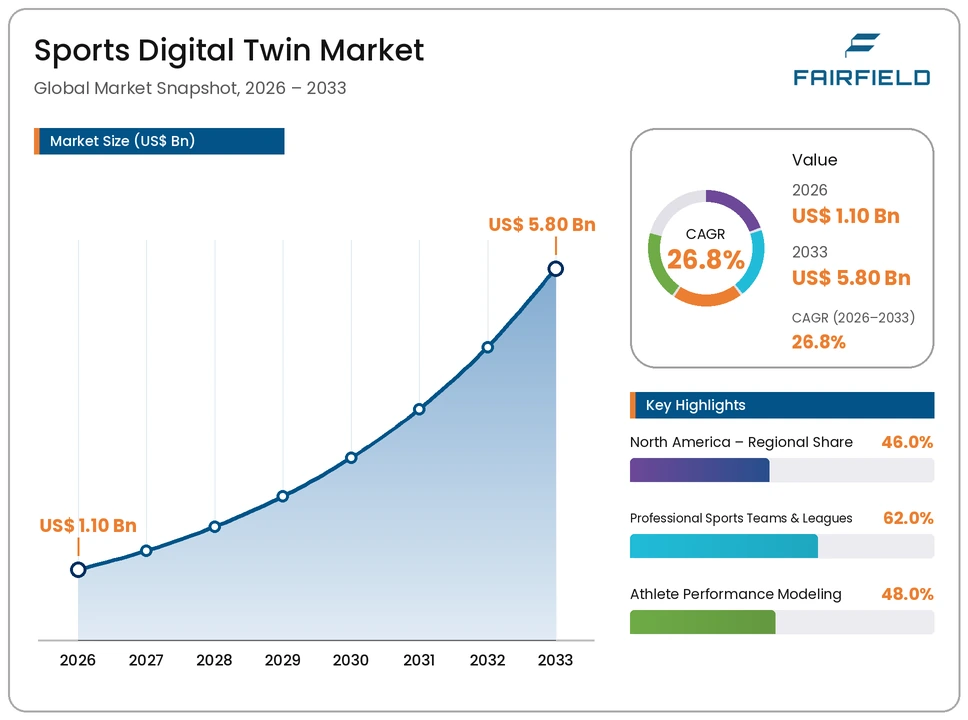
The market is valued at USD 1.10 Billion in 2026, with technology providers directing substantial investment toward improved sensor integration and real-time modeling capability that supports increasingly sophisticated performance and venue analytics. By 2033, the market is forecast to reach USD 5.80 Billion, reflecting rapid growth across established athlete performance modeling applications alongside accelerating stadium and venue simulation adoption.
Key Highlights
- The global sports digital twin market is valued at USD 1.10 Billion in 2026 and is projected to reach USD 5.80 Billion by 2033, expanding at a CAGR of 26.8% across the 2026-2033 forecast period.
- Athlete Performance Modeling leads the application segment with a 48.0% share in 2026, equivalent to USD 0.53 Billion.
- Professional Sports Teams & Leagues remain the dominant end-user segment, accounting for 62.0% of global demand, or USD 0.68 Billion, in 2026.
- North America commands the largest regional share at 46.0% of the global market in 2026.
- Stadium and venue simulation is emerging as the fastest-growing application category through 2033.
Key Growth Drivers
Growth in the sports digital twin market is driven primarily by rapidly growing professional sports team investment in data-driven athlete performance technology, as teams increasingly rely on digital twin modeling to inform training load management and injury prevention strategies.
A second driver is expanding stadium and venue operator interest in simulation-based operational optimization, as venues increasingly adopt digital twin technology to model crowd flow, energy usage, and other operational considerations.
Key Restraints
The substantial technology and sensor infrastructure investment required for comprehensive digital twin implementation creates budget barriers, particularly for smaller sports organizations and venues with limited technology budgets.
Additionally, data integration complexity across disparate sensor, tracking, and biometric data sources creates technical implementation challenges for organizations building comprehensive digital twin models.
Market Opportunities
The expansion of stadium and venue simulation applications presents a substantial opportunity, as growing venue operator interest in operational optimization continues to expand digital twin technology demand beyond traditional athlete performance applications.
A second opportunity lies in continued sensor and tracking technology advancement that improves data granularity and modeling accuracy. Companies that successfully advance this technology stand to capture growing demand as sports organizations continue prioritizing increasingly sophisticated, data-driven decision-making.
Segmentation Analysis
- By Application
Athlete Performance Modeling leads the application segment, accounting for 48.0% of global market value in 2026, equivalent to USD 0.53 Billion. Its leadership reflects professional sports teams’ substantial investment in performance and injury prevention analytics. Stadium & Venue Simulation represents the fastest-growing application category through 2033, driven by growing venue operator interest in operational optimization technology.
- By End User
Professional Sports Teams & Leagues form the leading end-user segment, representing 62.0% of global demand in 2026, or USD 0.68 Billion, reflecting these organizations’ substantial technology investment supporting competitive performance advantages. Sports Technology Vendors represents the fastest-growing end-user category, propelled by expanding third-party analytics platform development.
Regional Insights
- North America
North America holds the largest regional share at 46.0% of the global market in 2026, equivalent to USD 0.51 Billion. The region’s dominance reflects substantial professional sports team technology investment and a well-established sports analytics ecosystem across the United States and Canada.
- Europe
Europe accounts for 26.0% of the global market in 2026, valued at USD 0.29 Billion. Demand is supported by strong professional football and other sports league technology investment across major European markets.
- Asia Pacific
Asia Pacific represents 20.0% of the global market in 2026, equivalent to USD 0.22 Billion. Growth is underpinned by expanding professional sports technology investment across Japan, China, and Australia.
- Latin America
Latin America contributes 5.0% of the global market in 2026, equivalent to USD 0.06 Billion. Growth is linked to expanding professional sports technology investment in Brazil and Mexico.
- Middle East & Africa
Middle East & Africa holds 3.0% of the global market in 2026, valued at USD 0.03 Billion. Growth remains gradual, supported by expanding regional sports technology investment.
Competitive Landscape
The global sports digital twin market is moderately fragmented, with a mix of large diversified technology companies and specialized sports analytics and tracking technology providers competing for professional sports team and venue adoption. Competition centers on sensor integration and data modeling sophistication, real-time analytics performance, and the strength of relationships with professional sports teams and leagues. Companies are increasingly differentiating through expanded venue simulation capability rather than competing on athlete performance modeling alone.
Key Market Players
- Microsoft Corporation
- IBM Corporation
- Catapult Group International Ltd.
- Stats Perform Limited
- Zebra Technologies Corporation
- SAP SE
- Kinexon GmbH
- Sportlogiq Inc.
- Second Spectrum, Inc.
- Hawk-Eye Innovations Ltd.
Market Segmentation
By Application
- Athlete Performance Modeling
- Stadium & Venue Simulation
- Others
By End User
- Professional Sports Teams & Leagues
- Sports Technology Vendors
- Others
By Data Source
- Wearable Sensors & Trackers
- Optical & Camera-based Tracking
By Geography
- North America
- Europe
- Asia Pacific
- Latin America
- Middle East & Africa
- Executive Summary
- Global Sports Digital Twin Market Snapshot
- Future Projections
- Key Highlights
- Regional Snapshot by Value 2026
- Market Overview
- Market Definition and Segmentation
- Market Dynamics
- Key Growth Drivers
- Key Restraints
- Market Opportunities
- Global Sports Digital Twin Market Outlook 2026–2033
- Global Sports Digital Twin Market Outlook, by Application, Value (USD Billion), 2026–2033
- Athlete Performance Modeling
- Stadium & Venue Simulation
- Others
- Global Sports Digital Twin Market Outlook, by End User, Value (USD Billion), 2026–2033
- Professional Sports Teams & Leagues
- Sports Technology Vendors
- Others
- Global Sports Digital Twin Market Outlook, by Data Source, Value (USD Billion), 2026–2033
- Wearable Sensors & Trackers
- Optical & Camera-based Tracking
- Global Sports Digital Twin Market Outlook, by Region, Value (USD Billion), 2026–2033
- North America
- Europe
- Asia Pacific
- Latin America
- Middle East & Africa
- Global Sports Digital Twin Market Outlook, by Application, Value (USD Billion), 2026–2033
- North America Sports Digital Twin Market Outlook 2026–2033
- North America Sports Digital Twin Market Outlook, by Application, Value (USD Billion), 2026–2033
- Athlete Performance Modeling
- Stadium & Venue Simulation
- Others
- North America Sports Digital Twin Market Outlook, by End User, Value (USD Billion), 2026–2033
- Professional Sports Teams & Leagues
- Sports Technology Vendors
- Others
- North America Sports Digital Twin Market Outlook, by Data Source, Value (USD Billion), 2026–2033
- Wearable Sensors & Trackers
- Optical & Camera-based Tracking
- North America Sports Digital Twin Market Outlook, by Country and Subregion, Value (USD Billion), 2026–2033
- United States Sports Digital Twin Market Outlook, by Application, 2026–2033
- United States Sports Digital Twin Market Outlook, by End User, 2026–2033
- United States Sports Digital Twin Market Outlook, by Data Source, 2026–2033
- Canada Sports Digital Twin Market Outlook, by Application, 2026–2033
- Canada Sports Digital Twin Market Outlook, by End User, 2026–2033
- Canada Sports Digital Twin Market Outlook, by Data Source, 2026–2033
- North America Sports Digital Twin Market Outlook, by Application, Value (USD Billion), 2026–2033
- Europe Sports Digital Twin Market Outlook 2026–2033
- Europe Sports Digital Twin Market Outlook, by Application, Value (USD Billion), 2026–2033
- Athlete Performance Modeling
- Stadium & Venue Simulation
- Others
- Europe Sports Digital Twin Market Outlook, by End User, Value (USD Billion), 2026–2033
- Professional Sports Teams & Leagues
- Sports Technology Vendors
- Others
- Europe Sports Digital Twin Market Outlook, by Data Source, Value (USD Billion), 2026–2033
- Wearable Sensors & Trackers
- Optical & Camera-based Tracking
- Europe Sports Digital Twin Market Outlook, by Application, Value (USD Billion), 2026–2033
- Asia Pacific Sports Digital Twin Market Outlook 2026–2033
- Asia Pacific Sports Digital Twin Market Outlook, by Application, Value (USD Billion), 2026–2033
- Athlete Performance Modeling
- Stadium & Venue Simulation
- Others
- Asia Pacific Sports Digital Twin Market Outlook, by End User, Value (USD Billion), 2026–2033
- Professional Sports Teams & Leagues
- Sports Technology Vendors
- Others
- Asia Pacific Sports Digital Twin Market Outlook, by Data Source, Value (USD Billion), 2026–2033
- Wearable Sensors & Trackers
- Optical & Camera-based Tracking
- Asia Pacific Sports Digital Twin Market Outlook, by Country and Subregion, Value (USD Billion), 2026–2033
- Japan Sports Digital Twin Market Outlook, by Application, 2026–2033
- Japan Sports Digital Twin Market Outlook, by End User, 2026–2033
- Japan Sports Digital Twin Market Outlook, by Data Source, 2026–2033
- China Sports Digital Twin Market Outlook, by Application, 2026–2033
- China Sports Digital Twin Market Outlook, by End User, 2026–2033
- China Sports Digital Twin Market Outlook, by Data Source, 2026–2033
- Australia Sports Digital Twin Market Outlook, by Application, 2026–2033
- Australia Sports Digital Twin Market Outlook, by End User, 2026–2033
- Australia Sports Digital Twin Market Outlook, by Data Source, 2026–2033
- Asia Pacific Sports Digital Twin Market Outlook, by Application, Value (USD Billion), 2026–2033
- Latin America Sports Digital Twin Market Outlook 2026–2033
- Latin America Sports Digital Twin Market Outlook, by Application, Value (USD Billion), 2026–2033
- Athlete Performance Modeling
- Stadium & Venue Simulation
- Others
- Latin America Sports Digital Twin Market Outlook, by End User, Value (USD Billion), 2026–2033
- Professional Sports Teams & Leagues
- Sports Technology Vendors
- Others
- Latin America Sports Digital Twin Market Outlook, by Data Source, Value (USD Billion), 2026–2033
- Wearable Sensors & Trackers
- Optical & Camera-based Tracking
- Latin America Sports Digital Twin Market Outlook, by Country and Subregion, Value (USD Billion), 2026–2033
- Brazil Sports Digital Twin Market Outlook, by Application, 2026–2033
- Brazil Sports Digital Twin Market Outlook, by End User, 2026–2033
- Brazil Sports Digital Twin Market Outlook, by Data Source, 2026–2033
- Mexico Sports Digital Twin Market Outlook, by Application, 2026–2033
- Mexico Sports Digital Twin Market Outlook, by End User, 2026–2033
- Mexico Sports Digital Twin Market Outlook, by Data Source, 2026–2033
- Latin America Sports Digital Twin Market Outlook, by Application, Value (USD Billion), 2026–2033
- Middle East & Africa Sports Digital Twin Market Outlook 2026–2033
- Middle East & Africa Sports Digital Twin Market Outlook, by Application, Value (USD Billion), 2026–2033
- Athlete Performance Modeling
- Stadium & Venue Simulation
- Others
- Middle East & Africa Sports Digital Twin Market Outlook, by End User, Value (USD Billion), 2026–2033
- Professional Sports Teams & Leagues
- Sports Technology Vendors
- Others
- Middle East & Africa Sports Digital Twin Market Outlook, by Data Source, Value (USD Billion), 2026–2033
- Wearable Sensors & Trackers
- Optical & Camera-based Tracking
- Middle East & Africa Sports Digital Twin Market Outlook, by Application, Value (USD Billion), 2026–2033
- Competitive Landscape
- Competitive Positioning and Differentiation
- Company Profiles
- Microsoft Corporation
- IBM Corporation
- Catapult Group International Ltd.
- Stats Perform Limited
- Zebra Technologies Corporation
- SAP SE
- Kinexon GmbH
- Sportlogiq Inc.
- Second Spectrum, Inc.
- Hawk-Eye Innovations Ltd.
- Appendix
- Research Methodology
- Report Assumptions
- Acronyms and Abbreviations
By Application
- Athlete Performance Modeling
- Stadium & Venue Simulation
- Others
By End User
- Professional Sports Teams & Leagues
- Sports Technology Vendors
- Others
By Data Source
- Wearable Sensors & Trackers
- Optical & Camera-based Tracking
By Geography
- North America
- Europe
- Asia Pacific
- Latin America
- Middle East & Africa
Our Research Methodology
Considering the volatility of business today, traditional approaches to strategizing a game plan can be unfruitful if not detrimental. True ambiguity is no way to determine a forecast. A myriad of predetermined factors must be accounted for such as the degree of risk involved, the magnitude of circumstances, as well as conditions or consequences that are not known or unpredictable. To circumvent binary views that cast uncertainty, the application of market research intelligence to strategically posture, move, and enable actionable outcomes is necessary.
View Methodology
Quality Assured
Rigorous Validation Process

Confidentiality Assured
End-to-end Data Security

Custom Research Services
Tailored To Your Objectives
FAQs
The global sports digital twin market is valued at USD 1.10 Billion in 2026, reflecting growing professional sports investment in data-driven analytics.
The market is projected to grow at a CAGR of 26.8%, reaching USD 5.80 Billion by 2033, driven by venue simulation adoption and sensor technology advancement.
Athlete Performance Modeling leads with a 48.0% share in 2026, reflecting substantial team investment in performance analytics.
North America leads with a 46.0% share in 2026, reflecting substantial professional sports technology investment.
The largest opportunity lies in stadium and venue simulation, expanding alongside operational optimization interest.
Related Reports
2D Barcode Reader Market Size, Share, Insights, Competitive Landscape, and Forecast 2026 to 2033
The global 2D barcode reader market is valued at US$4.8 billion in 2026, reaching US$8.6 billion by 2033, growing at an 8.7% CAGR
Tunnel Construction Market Size, Share, Insights, Competitive Landscape, and Forecast 2026 to 2033
The global tunnel construction market is valued at US$29.52 billion in 2026, reaching US$47.09 billion by 2033, growing at a 6.9% CAGR
Sports Analytics Market Size, Share, Insights, Competitive Landscape, and Forecast 2026 to 2033
The global sports analytics market is valued at US$7.06 billion in 2026, reaching US$23.15 billion by 2033, growing at an 18.5% CAGR
Distributed Acoustic Sensing Market Size, Share, Insights, Competitive Landscape, and Forecast 2026 to 2033
The global distributed acoustic sensing market is valued at US$0.565 billion in 2026, reaching US$1.173 billion by 2033, growing at an 11.0% CAGR
Secure Flash Drive Market Size, Share, Insights, Competitive Landscape, and Forecast 2026 to 2033
The global secure flash drive market is valued at US$0.8 billion in 2026, reaching US$1.1 billion by 2033, growing at a 4.7% CAGR
Optical I/O for AI Chips Market Size, Share, Insights, Competitive Landscape, and Forecast 2026 to 2033
The global optical I/O for AI chips market is valued at US$1.6 billion in 2026, reaching US$14.5 billion by 2033, growing at a 37.01% CAGR