



Textile Colors Market
Textile Colors Market
Market Overview
Textile colors encompass the reactive dyes, disperse dyes, and pigments used to color fabrics and fibers across apparel, home textile, and industrial textile applications, supporting the global textile manufacturing industry’s coloration and finishing processes. As global textile production has continued concentrating within major Asian manufacturing hubs and sustainability considerations have gained increasing importance across the textile value chain, dye and pigment manufacturers have faced growing pressure to balance cost competitiveness with environmental compliance.
Demand growth through the 2026-2033 window is closely tied to sustained global textile and apparel manufacturing production growth, particularly across Asia Pacific manufacturing hubs, growing home textile and industrial textile application demand supporting diversified end-use growth beyond apparel alone, and continued dye technology advancement improving colorfastness, environmental compliance, and application efficiency. Growing sustainability and environmental regulation governing textile dye production and wastewater treatment continues to shape manufacturer investment priorities across the industry.
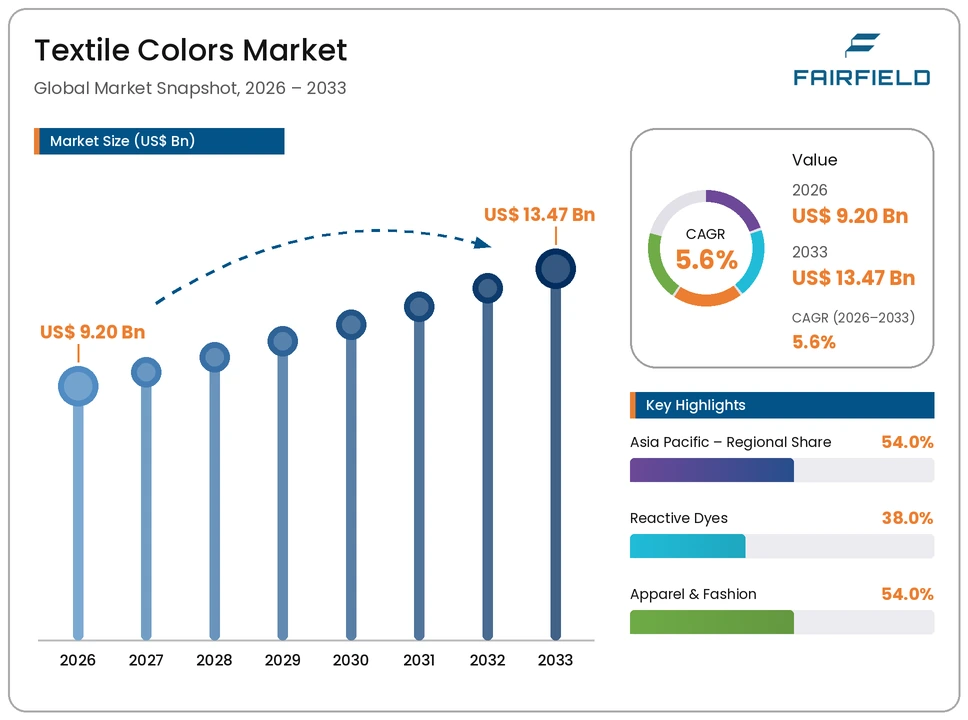
The market is valued at USD 9.20 Billion in 2026, with manufacturers directing investment toward improved environmental compliance and sustainable dye technology that addresses intensifying regulatory and brand sustainability requirements across the global textile supply chain. By 2033, the market is forecast to reach USD 13.47 Billion, reflecting steady growth across established apparel and fashion applications alongside expanding industrial textile adoption.
Key Highlights
- The global textile colors market is valued at USD 9.20 Billion in 2026 and is projected to reach USD 13.47 Billion by 2033, expanding at a CAGR of 5.6% across the 2026-2033 forecast period.
- Reactive Dyes lead the product-type segment with a 38.0% share in 2026, equivalent to USD 3.50 Billion.
- Apparel & Fashion remains the dominant application, accounting for 54.0% of global demand, or USD 4.97 Billion, in 2026.
- Asia Pacific commands the largest regional share at 54.0% of the global market in 2026.
- Industrial textile applications are emerging as the fastest-growing application through 2033.
Market Dynamics
Key Growth Drivers
Growth in the textile colors market is driven primarily by sustained global textile and apparel manufacturing production growth, as continued expansion of textile manufacturing capacity, particularly across Asia Pacific production hubs, drives corresponding demand for dyes and pigments supporting fabric coloration processes.
A second driver is growing home textile and industrial textile application demand, as diversifying textile end-use applications beyond conventional apparel create additional demand streams for textile coloration products across a broader range of fabric types and applications.
Key Restraints
Intensifying environmental regulation governing textile dye production and wastewater discharge creates substantial compliance investment requirements, particularly within major textile manufacturing regions facing growing environmental scrutiny.
Additionally, price competition among textile dye manufacturers, particularly within commoditized product categories, creates margin pressure that can affect manufacturers’ ability to sustain research and development investment in sustainable dye technology.
Market Opportunities
The expansion of industrial textile applications presents a substantial opportunity, as growing technical and industrial textile production, including applications in automotive, construction, and protective equipment, creates demand for specialized textile coloration products beyond conventional apparel applications.
A second opportunity lies in continued development of sustainable, environmentally compliant dye technology addressing intensifying brand and regulatory sustainability requirements. Companies that successfully advance this sustainable dye technology stand to capture growing demand as textile brands increasingly prioritize supply chain environmental compliance.
Segmentation Analysis
By Product Type
Reactive Dyes lead the product-type segment, accounting for 38.0% of global market value in 2026, equivalent to USD 3.50 Billion. Their leadership reflects reactive dyes’ broad applicability across cotton and cellulosic fiber coloration, the dominant fiber category within global textile production. Disperse Dyes represent a significant, established product-type category. Pigments represent the fastest-growing product-type category through 2033, driven by growing demand for pigment-based coloration in technical and industrial textile applications.
By Application
Apparel & Fashion forms the leading application segment, representing 54.0% of global demand in 2026, or USD 4.97 Billion, reflecting apparel manufacturing’s substantial scale within global textile production. Home Textiles represents a significant, established application category. Industrial Textiles represents the fastest-growing application category, propelled by growing technical textile production across automotive, construction, and protective equipment applications.
Regional Insights
Asia Pacific
Asia Pacific holds the largest regional share, at 54.0% of the global market in 2026, equivalent to USD 4.97 Billion. The region’s dominance reflects the concentration of global textile manufacturing production across China, India, and Bangladesh.
Europe
Europe accounts for 22.0% of the global market in 2026, valued at USD 2.02 Billion. Demand is supported by a sophisticated textile industry and strong environmental compliance dye technology adoption across major European markets.
North America
North America represents 14.0% of the global market in 2026, or USD 1.29 Billion. Growth is underpinned by domestic technical textile manufacturing and specialized industrial textile coloration demand across the United States and Canada.
Latin America
Latin America contributes 6.0% of the global market in 2026, equivalent to USD 0.55 Billion. Growth is linked to expanding textile manufacturing activity in Brazil and Mexico.
Middle East & Africa
Middle East & Africa holds 4.0% of the global market in 2026, valued at USD 0.37 Billion. Growth remains gradual, tied to expanding textile manufacturing capacity across the region.
Competitive Landscape
The global textile colors market is moderately concentrated, with a mix of large diversified specialty chemical companies and specialized textile dye manufacturers competing for textile mill and manufacturer adoption. Competition centers on manufacturing scale and cost efficiency, environmental compliance and sustainable dye technology capability, and the strength of relationships with major textile manufacturing hubs. Companies are increasingly differentiating through expanded sustainable, low-impact dye technology rather than competing on conventional dye manufacturing alone.
Key Market Players
- Archroma Management LLC
- Huntsman Corporation
- DyStar Group
- Kiri Industries Limited
- Lanxess AG
- Atul Ltd.
- Colourtex Industries Private Limited
- Sumitomo Chemical Co., Ltd.
- Jay Chemical Industries LLP
- Clariant AG
Market Segmentation
By Product Type
- Reactive Dyes
- Disperse Dyes
- Pigments
- Others
By Application
- Apparel & Fashion
- Home Textiles
- Industrial Textiles
- Others
By Fiber Type
- Cotton & Cellulosic Fibers
- Synthetic Fibers
By Geography
- North America
- Europe
- Asia Pacific
- Latin America
- Middle East & Africa
- Executive Summary
- Global Textile Colors Market Snapshot
- Future Projections
- Key Market Trends
- Regional Snapshot, by Value, 2026
- Analyst Recommendations
- Market Overview
- Market Definitions and Segmentations
- Market Dynamics
- Drivers
- Restraints
- Market Opportunities
- Value Chain Analysis
- COVID-19 Impact Analysis
- Porter's Five Forces Analysis
- Impact of Russia-Ukraine Conflict
- PESTLE Analysis
- Regulatory Analysis
- Price Trend Analysis
- Current Prices and Future Projections, 2025-2033
- Price Impact Factors
- Global Textile Colors Market Outlook, 2020 - 2033
- Global Textile Colors Market Outlook, by Product Type, Value (US$ Bn), 2020-2033
- Reactive Dyes
- Disperse Dyes
- Pigments
- Others
- Global Textile Colors Market Outlook, by Application, Value (US$ Bn), 2020-2033
- Apparel & Fashion
- Home Textiles
- Industrial Textiles
- Others
- Global Textile Colors Market Outlook, by Fiber Type, Value (US$ Bn), 2020-2033
- Cotton & Cellulosic Fibers
- Synthetic Fibers
- Global Textile Colors Market Outlook, by Region, Value (US$ Bn), 2020-2033
- North America
- Europe
- Asia Pacific
- Latin America
- Middle East & Africa
- Global Textile Colors Market Outlook, by Product Type, Value (US$ Bn), 2020-2033
- North America Textile Colors Market Outlook, 2020 - 2033
- North America Textile Colors Market Outlook, by Product Type, Value (US$ Bn), 2020-2033
- Reactive Dyes
- Disperse Dyes
- Pigments
- Others
- North America Textile Colors Market Outlook, by Application, Value (US$ Bn), 2020-2033
- Apparel & Fashion
- Home Textiles
- Industrial Textiles
- Others
- North America Textile Colors Market Outlook, by Fiber Type, Value (US$ Bn), 2020-2033
- Cotton & Cellulosic Fibers
- Synthetic Fibers
- North America Textile Colors Market Outlook, by Country, Value (US$ Bn), 2020-2033
- U.S. Textile Colors Market Outlook, by Product Type, 2020-2033
- U.S. Textile Colors Market Outlook, by Application, 2020-2033
- U.S. Textile Colors Market Outlook, by Fiber Type, 2020-2033
- Canada Textile Colors Market Outlook, by Product Type, 2020-2033
- Canada Textile Colors Market Outlook, by Application, 2020-2033
- Canada Textile Colors Market Outlook, by Fiber Type, 2020-2033
- BPS Analysis/Market Attractiveness Analysis
- North America Textile Colors Market Outlook, by Product Type, Value (US$ Bn), 2020-2033
- Europe Textile Colors Market Outlook, 2020 - 2033
- Europe Textile Colors Market Outlook, by Product Type, Value (US$ Bn), 2020-2033
- Reactive Dyes
- Disperse Dyes
- Pigments
- Others
- Europe Textile Colors Market Outlook, by Application, Value (US$ Bn), 2020-2033
- Apparel & Fashion
- Home Textiles
- Industrial Textiles
- Others
- Europe Textile Colors Market Outlook, by Fiber Type, Value (US$ Bn), 2020-2033
- Cotton & Cellulosic Fibers
- Synthetic Fibers
- Europe Textile Colors Market Outlook, by Country, Value (US$ Bn), 2020-2033
- Germany Textile Colors Market Outlook, by Product Type, 2020-2033
- Germany Textile Colors Market Outlook, by Application, 2020-2033
- Germany Textile Colors Market Outlook, by Fiber Type, 2020-2033
- Italy Textile Colors Market Outlook, by Product Type, 2020-2033
- Italy Textile Colors Market Outlook, by Application, 2020-2033
- Italy Textile Colors Market Outlook, by Fiber Type, 2020-2033
- France Textile Colors Market Outlook, by Product Type, 2020-2033
- France Textile Colors Market Outlook, by Application, 2020-2033
- France Textile Colors Market Outlook, by Fiber Type, 2020-2033
- U.K. Textile Colors Market Outlook, by Product Type, 2020-2033
- U.K. Textile Colors Market Outlook, by Application, 2020-2033
- U.K. Textile Colors Market Outlook, by Fiber Type, 2020-2033
- Spain Textile Colors Market Outlook, by Product Type, 2020-2033
- Spain Textile Colors Market Outlook, by Application, 2020-2033
- Spain Textile Colors Market Outlook, by Fiber Type, 2020-2033
- Russia Textile Colors Market Outlook, by Product Type, 2020-2033
- Russia Textile Colors Market Outlook, by Application, 2020-2033
- Russia Textile Colors Market Outlook, by Fiber Type, 2020-2033
- Rest of Europe Textile Colors Market Outlook, by Product Type, 2020-2033
- Rest of Europe Textile Colors Market Outlook, by Application, 2020-2033
- Rest of Europe Textile Colors Market Outlook, by Fiber Type, 2020-2033
- BPS Analysis/Market Attractiveness Analysis
- Europe Textile Colors Market Outlook, by Product Type, Value (US$ Bn), 2020-2033
- Asia Pacific Textile Colors Market Outlook, 2020 - 2033
- Asia Pacific Textile Colors Market Outlook, by Product Type, Value (US$ Bn), 2020-2033
- Reactive Dyes
- Disperse Dyes
- Pigments
- Others
- Asia Pacific Textile Colors Market Outlook, by Application, Value (US$ Bn), 2020-2033
- Apparel & Fashion
- Home Textiles
- Industrial Textiles
- Others
- Asia Pacific Textile Colors Market Outlook, by Fiber Type, Value (US$ Bn), 2020-2033
- Cotton & Cellulosic Fibers
- Synthetic Fibers
- Asia Pacific Textile Colors Market Outlook, by Country, Value (US$ Bn), 2020-2033
- China Textile Colors Market Outlook, by Product Type, 2020-2033
- China Textile Colors Market Outlook, by Application, 2020-2033
- China Textile Colors Market Outlook, by Fiber Type, 2020-2033
- Japan Textile Colors Market Outlook, by Product Type, 2020-2033
- Japan Textile Colors Market Outlook, by Application, 2020-2033
- Japan Textile Colors Market Outlook, by Fiber Type, 2020-2033
- South Korea Textile Colors Market Outlook, by Product Type, 2020-2033
- South Korea Textile Colors Market Outlook, by Application, 2020-2033
- South Korea Textile Colors Market Outlook, by Fiber Type, 2020-2033
- India Textile Colors Market Outlook, by Product Type, 2020-2033
- India Textile Colors Market Outlook, by Application, 2020-2033
- India Textile Colors Market Outlook, by Fiber Type, 2020-2033
- Southeast Asia Textile Colors Market Outlook, by Product Type, 2020-2033
- Southeast Asia Textile Colors Market Outlook, by Application, 2020-2033
- Southeast Asia Textile Colors Market Outlook, by Fiber Type, 2020-2033
- Rest of SAO Textile Colors Market Outlook, by Product Type, 2020-2033
- Rest of SAO Textile Colors Market Outlook, by Application, 2020-2033
- Rest of SAO Textile Colors Market Outlook, by Fiber Type, 2020-2033
- BPS Analysis/Market Attractiveness Analysis
- Asia Pacific Textile Colors Market Outlook, by Product Type, Value (US$ Bn), 2020-2033
- Latin America Textile Colors Market Outlook, 2020 - 2033
- Latin America Textile Colors Market Outlook, by Product Type, Value (US$ Bn), 2020-2033
- Reactive Dyes
- Disperse Dyes
- Pigments
- Others
- Latin America Textile Colors Market Outlook, by Application, Value (US$ Bn), 2020-2033
- Apparel & Fashion
- Home Textiles
- Industrial Textiles
- Others
- Latin America Textile Colors Market Outlook, by Fiber Type, Value (US$ Bn), 2020-2033
- Cotton & Cellulosic Fibers
- Synthetic Fibers
- Latin America Textile Colors Market Outlook, by Country, Value (US$ Bn), 2020-2033
- Brazil Textile Colors Market Outlook, by Product Type, 2020-2033
- Brazil Textile Colors Market Outlook, by Application, 2020-2033
- Brazil Textile Colors Market Outlook, by Fiber Type, 2020-2033
- Mexico Textile Colors Market Outlook, by Product Type, 2020-2033
- Mexico Textile Colors Market Outlook, by Application, 2020-2033
- Mexico Textile Colors Market Outlook, by Fiber Type, 2020-2033
- Argentina Textile Colors Market Outlook, by Product Type, 2020-2033
- Argentina Textile Colors Market Outlook, by Application, 2020-2033
- Argentina Textile Colors Market Outlook, by Fiber Type, 2020-2033
- Rest of LATAM Textile Colors Market Outlook, by Product Type, 2020-2033
- Rest of LATAM Textile Colors Market Outlook, by Application, 2020-2033
- Rest of LATAM Textile Colors Market Outlook, by Fiber Type, 2020-2033
- BPS Analysis/Market Attractiveness Analysis
- Latin America Textile Colors Market Outlook, by Product Type, Value (US$ Bn), 2020-2033
- Middle East & Africa Textile Colors Market Outlook, 2020 - 2033
- Middle East & Africa Textile Colors Market Outlook, by Product Type, Value (US$ Bn), 2020-2033
- Reactive Dyes
- Disperse Dyes
- Pigments
- Others
- Middle East & Africa Textile Colors Market Outlook, by Application, Value (US$ Bn), 2020-2033
- Apparel & Fashion
- Home Textiles
- Industrial Textiles
- Others
- Middle East & Africa Textile Colors Market Outlook, by Fiber Type, Value (US$ Bn), 2020-2033
- Cotton & Cellulosic Fibers
- Synthetic Fibers
- Middle East & Africa Textile Colors Market Outlook, by Country, Value (US$ Bn), 2020-2033
- GCC Textile Colors Market Outlook, by Product Type, 2020-2033
- GCC Textile Colors Market Outlook, by Application, 2020-2033
- GCC Textile Colors Market Outlook, by Fiber Type, 2020-2033
- South Africa Textile Colors Market Outlook, by Product Type, 2020-2033
- South Africa Textile Colors Market Outlook, by Application, 2020-2033
- South Africa Textile Colors Market Outlook, by Fiber Type, 2020-2033
- Egypt Textile Colors Market Outlook, by Product Type, 2020-2033
- Egypt Textile Colors Market Outlook, by Application, 2020-2033
- Egypt Textile Colors Market Outlook, by Fiber Type, 2020-2033
- Nigeria Textile Colors Market Outlook, by Product Type, 2020-2033
- Nigeria Textile Colors Market Outlook, by Application, 2020-2033
- Nigeria Textile Colors Market Outlook, by Fiber Type, 2020-2033
- Rest of Middle East Textile Colors Market Outlook, by Product Type, 2020-2033
- Rest of Middle East Textile Colors Market Outlook, by Application, 2020-2033
- Rest of Middle East Textile Colors Market Outlook, by Fiber Type, 2020-2033
- BPS Analysis/Market Attractiveness Analysis
- Middle East & Africa Textile Colors Market Outlook, by Product Type, Value (US$ Bn), 2020-2033
- Competitive Landscape
- Company Vs Segment Heatmap
- Company Market Share Analysis, 2025
- Competitive Dashboard
- Company Profiles
- Archroma Management LLC
- Company Overview
- Product Portfolio
- Financial Overview
- Business Strategies and Developments
- Huntsman Corporation
- DyStar Group
- Kiri Industries Limited
- Lanxess AG
- Atul Ltd.
- Colourtex Industries Private Limited
- Sumitomo Chemical Co., Ltd.
- Jay Chemical Industries LLP
- Clariant AG
- Archroma Management LLC
- Appendix
- Research Methodology
- Report Assumptions
- Acronyms and Abbreviations
By Product Type
- Reactive Dyes
- Disperse Dyes
- Pigments
- Others
By Application
- Apparel & Fashion
- Home Textiles
- Industrial Textiles
- Others
By Fiber Type
- Cotton & Cellulosic Fibers
- Synthetic Fibers
By Geography
- North America
- Europe
- Asia Pacific
- Latin America
- Middle East & Africa
Our Research Methodology
Considering the volatility of business today, traditional approaches to strategizing a game plan can be unfruitful if not detrimental. True ambiguity is no way to determine a forecast. A myriad of predetermined factors must be accounted for such as the degree of risk involved, the magnitude of circumstances, as well as conditions or consequences that are not known or unpredictable. To circumvent binary views that cast uncertainty, the application of market research intelligence to strategically posture, move, and enable actionable outcomes is necessary.
View Methodology
Quality Assured
Rigorous Validation Process

Confidentiality Assured
End-to-end Data Security

Custom Research Services
Tailored To Your Objectives
FAQs
The global textile colors market is valued at USD 9.20 Billion in 2026, reflecting sustained global textile manufacturing production.
The market is projected to grow at a CAGR of 5.6%, reaching USD 13.47 Billion by 2033, driven by textile production growth and diversifying end-use applications.
Reactive Dyes lead with a 38.0% share in 2026, reflecting their broad applicability across cotton and cellulosic fiber coloration.
Asia Pacific leads with a 54.0% share in 2026, reflecting the concentration of global textile manufacturing production.
The largest opportunity lies in industrial textiles, expanding alongside growing technical textile production across multiple industries.
Related Reports
2D Materials Market Size, Share, Insights, Competitive Landscape, and Forecast 2026 to 2033
The global 2D materials market is valued at US$3.65 billion in 2026, reaching US$10.20 billion by 2033, growing at a 15.8% CAGR
2,4-Dichloro-5-Fluorobenzoic Acid Market Size, Share, Insights, Competitive Landscape, and Forecast 2026 to 2033
The global 2,4-dichloro-5-fluorobenzoic acid market is valued at US$0.09 billion in 2026, reaching US$0.12 billion by 2033, at a 4.2% CAGR
1,5-Hexadiene Market Size, Share, Insights, Competitive Landscape, and Forecast 2026 to 2033
The global 1,5-hexadiene market is valued at US$0.14 billion in 2026, reaching US$0.22 billion by 2033, growing at a 6.7% CAGR
Automotive NVH Materials Market Size, Share, Insights, Competitive Landscape, and Forecast 2026 to 2033
The global automotive NVH materials market is valued at US$13.8 billion in 2026, reaching US$20.5 billion by 2033, growing at a 5.82% CAGR
Acrylonitrile Butadiene Styrene Market Size, Share, Insights, Competitive Landscape, and Forecast 2026 to 2033
The global acrylonitrile butadiene styrene market is valued at US$27.4 billion in 2026, reaching US$38.6 billion by 2033, growing at a 5.02% CAGR
Tank Mix Adjuvants Market Size, Share, Insights, Competitive Landscape, and Forecast 2026 to 2033
The global tank mix adjuvants market is valued at US$4.3 billion in 2026, reaching US$6.6 billion by 2033, growing at a 6.3% CAGR