



Upstream Bioprocessing Market
Upstream Bioprocessing Market Size, Share, Insights, Competitive Landscape, and Forecast 2026 to 2033
Upstream Bioprocessing Market Analysis, 2026–2033
Upstream Bioprocessing Market
Upstream Bioprocessing Market Size, Share, Insights, Competitive Landscape, and Forecast 2026 to 2033
Upstream Bioprocessing Market Size and Trend Analysis
How Fast Is the Upstream Bioprocessing Market Growing?
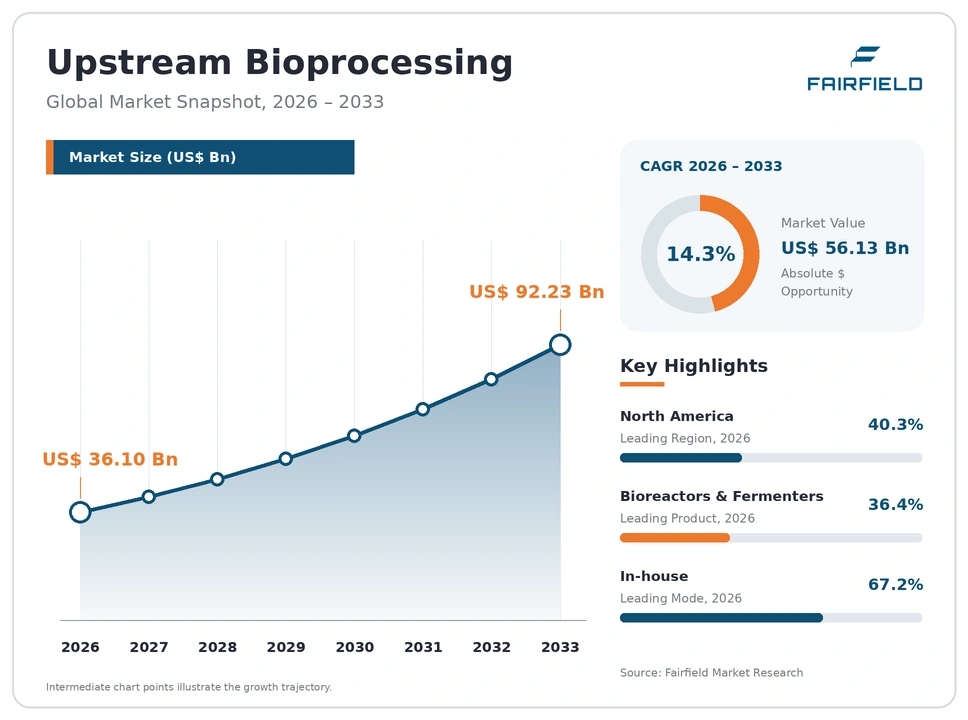
The global upstream bioprocessing market size is expected to be valued at US$ 36.10 billion in 2026 and projected to reach US$ 92.23 billion by 2033, growing at a CAGR of 14.3% between 2026 and 2033.
Between 2020 and 2025, the market grew at a CAGR of about 11.4%, as COVID-19 vaccine and antibody production created a demand surge in 2020 and 2021, followed by an inventory correction in 2023 and a recovery in 2024 and 2025. Three factors now drive growth: the rising number of biologics and biosimilars in development, rapid adoption of single-use bioreactors, and new demand from cell and gene therapies. The market is shifting from fed-batch to perfusion and continuous processes, toward chemically defined cell culture media, and toward digital monitoring that improves biologics manufacturing productivity.
Key Report Takeaways
- By Product: Bioreactors & Fermenters held 36.4% share in 2026, while Cell Culture Products are projected to expand at a 15.8% CAGR through 2033, driven by demand for optimized media, supplements, and reagents.
- By Use Type: Multi-use held 53.8% share in 2026, while Single-use is projected to expand at a 16.9% CAGR through 2033, driven by flexible facilities and lower contamination risk.
- By Mode: In-house held 67.2% share in 2026, while Outsourced is projected to expand at a 16.4% CAGR through 2033, driven by biotech companies relying on CDMOs.
- By Region: North America held 40.3% share in 2026, while Asia Pacific is projected to expand at a 17.1% CAGR through 2033, driven by biologics manufacturing growth in China, India, and South Korea.
Global Upstream Bioprocessing Market Trends and Insights
Drivers Impact Analysis
Two drivers carry the strongest influence on upstream bioprocessing demand during the forecast period.
| Driver | Impact on CAGR Forecast | Geographic Relevance | Impact Timeline |
| Growth of biologics, biosimilars, and new modalities | High | North America, Europe, Asia Pacific | Long term (≥4 years) |
| Adoption of single-use and intensified processes | High | North America, Asia Pacific, Europe | Medium term (2-4 years) |
Biologics Growth Is Driving the Upstream Bioprocessing Market
The growth of biologics, biosimilars, and new modalities is the strongest driver of the upstream bioprocessing market. Upstream processing covers cell line development, media preparation, cell culture, and harvest, the steps that produce a biologic drug.
The mechanism is a growing pipeline and larger production volumes. Monoclonal antibodies, bispecific antibodies, fusion proteins, vaccines, and GLP-1-related biologics require large-scale cell culture. Biosimilars for major antibodies such as adalimumab, ustekinumab, and denosumab increase production volumes as patents expire. Cell and gene therapies need specialized culture systems for viral vectors and patient cells. Pharmaceutical companies have announced large new manufacturing investments in the United States and Europe, partly in response to tariff policies. Each new facility needs bioreactors, media, sensors, and consumables. These trends create strong, recurring demand for upstream equipment and supplies.
Single-use and Intensified Processes Are Expanding the Upstream Bioprocessing Market
The adoption of single-use and intensified processes is expanding the upstream bioprocessing market. Manufacturers want faster, more flexible, and more productive production.
The cause is cost, speed, and flexibility needs. Single-use bioreactors use pre-sterilized plastic bags instead of stainless steel tanks, reducing cleaning, validation, and changeover time and lowering contamination risk. They let facilities switch between products quickly, which suits multiproduct CDMOs and smaller batches. Perfusion processes continuously feed fresh media and remove waste, keeping cells productive longer and increasing output from smaller bioreactors. Thermo Fisher Scientific launched a 5L DynaDrive single-use bioreactor in April 2025 for process development. Process analytical technology, in-line sensors, and digital twins improve control and reduce batch failures. These trends raise spending on consumables and advanced equipment across development and commercial sites.
Restraints Impact Analysis
Two restraints limit how quickly the upstream bioprocessing market grows.
| Restraint | Impact on CAGR Forecast | Geographic Relevance | Impact Timeline |
| High capital costs and skilled labor shortages | High | Global | Medium term (2-4 years) |
| Supply chain risks, plastic waste, and regulatory complexity | Medium | North America, Europe | Short term (≤2 years) |
High Costs and Labor Shortages Slow the Upstream Bioprocessing Market
High capital costs and skilled labor shortages slow the upstream bioprocessing market. Building and running biologics facilities is expensive and requires specialized staff.
The specific causes are costly equipment and limited talent. A large biologics plant can cost hundreds of millions of dollars, and bioreactors, media systems, and sensors are major costs. Single-use consumables add ongoing expenses, and media for high-titer processes can be costly. Biotech funding has been volatile, causing some companies to delay or cancel projects. Skilled bioprocess engineers, scientists, and operators are in short supply in North America, Europe, and Asia Pacific. Training takes years, and competition for staff raises wages. Smaller companies struggle to justify in-house capacity. These factors slow investment and push some companies to outsource production to contract manufacturers.
Supply and Regulatory Challenges Restrict the Upstream Bioprocessing Market
Supply chain risks, plastic waste, and regulatory complexity restrict the upstream bioprocessing market. Upstream processes depend on reliable supplies and strict quality control.
The underlying causes are concentrated suppliers and sustainability concerns. The pandemic exposed shortages of single-use bags, filters, and media, delaying production. Many critical materials come from a small number of suppliers, creating risk if one site fails. Single-use systems generate plastic waste that is difficult to recycle, raising sustainability concerns. Changing suppliers or processes requires regulatory approval, which can take months. Trade tensions and proposals such as the BIOSECURE Act in the United States create uncertainty for companies using Chinese suppliers and CDMOs. Suppliers are adding dual sourcing and regional production to reduce risk, but this takes time. These factors restrict flexibility and add cost for manufacturers.
Market Opportunities
Cell and Gene Therapy Manufacturing Opens a Specialized Revenue Pool
Cell and gene therapy manufacturing opens a specialized revenue pool in the upstream bioprocessing market. These therapies need new types of culture systems and materials.
Suppliers with specialized products can capture this opportunity. Viral vector production for gene therapies uses suspension cell culture, transfection reagents, and specialized bioreactors. Cell therapies such as CAR-T require closed, automated systems for expanding patient cells. Merck KGaA agreed to acquire Bio-Techne in June 2026, partly to strengthen its position in cell and gene therapy materials and analytics. GMP-grade growth factors, cytokines, and serum-free media are in high demand. Automation reduces labor costs, batch variability, and the risk of human error. Companies offering closed, scalable systems and high-quality materials can capture premium prices and long-term supply agreements with therapy developers.
CDMO Expansion and Emerging Market Capacity Create a Volume Revenue Pool
CDMO expansion and emerging market capacity create a volume revenue pool in the upstream bioprocessing market. Many biotech companies outsource production rather than build plants.
Equipment and consumable suppliers can capture this opportunity. CDMOs such as Lonza, Samsung Biologics, WuXi Biologics, Fujifilm Diosynth Biotechnologies, and Cytovance Biologics are expanding capacity and services. Cytovance Biologics added perfusion process development in July 2026. India, China, and South Korea are building biologics and biosimilar plants with government support. New facilities need complete upstream systems, from media to bioreactors. Long-term supply agreements for consumables create recurring revenue. Suppliers with local service and manufacturing in Asia Pacific can win share, while technical training services help new facilities start up faster and build long-term customer relationships.
Segment Analysis
By Product: Bioreactors & Fermenters Lead While Cell Culture Products Grow Fastest
Bioreactors & Fermenters held 36.4% share in 2026. Bioreactors are the core equipment for growing cells and microbes, ranging from bench-scale systems for development to 2,000-liter and larger production units. Thermo Fisher Scientific, Cytiva, Sartorius, and Eppendorf are leading suppliers. Sensors, probes, filters, and bags form other product segments, and demand for in-line sensors is rising as plants automate.
Cell Culture Products are the fastest-growing product segment, expanding at a 15.8% CAGR through 2033. Cell culture media, supplements, and reagents are consumed in every batch, creating recurring demand. Chemically defined and animal-origin-free media improve consistency and regulatory compliance. High-titer processes and perfusion use more media per batch. Thermo Fisher Scientific, Merck KGaA, and Cytiva lead media supply. For the market, cell culture products growth adds steady, recurring revenue.
By Use Type: Multi-use Leads While Single-use Grows Fastest
Multi-use held 53.8% share in 2026. Stainless steel bioreactors and equipment remain common in large commercial plants producing high-volume antibodies and vaccines, where scale and long-term cost efficiency matter. Large manufacturers such as Roche, Amgen, and Samsung Biologics operate large stainless steel facilities. These systems last decades and offer low cost per gram at very large scale.
Single-use is the fastest-growing use type, expanding at a 16.9% CAGR through 2033. Single-use bioreactors, bags, and tubing reduce cleaning and validation, speed changeovers, and lower contamination risk. They suit clinical production, CDMOs, and smaller commercial products, and their scale now reaches 2,000 liters and above. Hybrid facilities combine single-use and stainless steel. For the market, single-use growth increases recurring consumable sales.
By Mode: In-house Leads While Outsourced Grows Fastest
In-house held 67.2% share in 2026. Large pharmaceutical and biotech companies operate their own upstream facilities to protect know-how, ensure supply, and control costs. Many companies have announced new in-house plants in the United States and Europe. In-house operations buy equipment and consumables directly from suppliers, often under multi-year supply agreements that secure pricing and priority delivery.
Outsourced is the fastest-growing mode, expanding at a 16.4% CAGR through 2033. Small and mid-sized biotech companies rely on CDMOs for cell line development, process development, and manufacturing. Lonza, Samsung Biologics, WuXi Biologics, Fujifilm Diosynth Biotechnologies, and smaller CDMOs are expanding capacity. Outsourcing reduces capital needs and speeds time to clinic. For the market, outsourcing growth concentrates demand among large CDMOs, which buy equipment and consumables in large volumes.
Geography Analysis
Which Region Is Leading the Upstream Bioprocessing Market?
North America is leading the upstream bioprocessing market with a 40.3% share in 2026. The United States has the largest biologics pipeline, leading drug developers, and major suppliers such as Thermo Fisher Scientific, Danaher, and Corning. Pharmaceutical companies have announced billions of dollars in new U.S. manufacturing investments, partly in response to tariff policies, increasing demand for upstream equipment. CDMOs such as Cytovance Biologics are adding perfusion services. Canada has growing vaccine production. Venture capital and public funding support new biotech companies that need clinical supply. One change shaping the region is onshoring of biologics manufacturing.
Europe Advances the Upstream Bioprocessing Market Through Supplier Leadership
Europe is a major upstream bioprocessing market with strong suppliers and manufacturers. Germany hosts Sartorius, Merck KGaA, and Eppendorf, while Switzerland hosts Lonza and Roche. Ireland, Belgium, and Denmark have large biologics plants. The European Union supports biomanufacturing through its life sciences strategy. France, Italy, and the Netherlands add vaccine and biologics production. Strong regulation from the European Medicines Agency raises quality requirements for materials and processes. High energy costs affect operations, and sustainability rules encourage less plastic waste. One opportunity is sustainable single-use systems and recycling programs for bioprocess plastics.
Which Region Is Growing Fastest in the Upstream Bioprocessing Market?
Asia Pacific is growing fastest in the upstream bioprocessing market at a 17.1% CAGR through 2033. China has a large biologics industry and CDMOs such as WuXi Biologics, and local suppliers produce bioreactors and media. South Korea hosts Samsung Biologics and Celltrion, while India has biosimilar makers such as Biocon Biologics and Intas. Japan and Singapore attract investment from global drug makers and CDMOs, and Fujifilm Diosynth Biotechnologies has large operations in the region. Government programs in China and India support biologics and biosimilar production for domestic and export markets. One challenge is trade policy uncertainty for Chinese CDMOs. One opportunity is local supply of media and single-use products that shortens delivery times.
Latin America Grows the Upstream Bioprocessing Market Through Vaccine and Biosimilar Production
Latin America is a developing upstream bioprocessing market. Brazil has vaccine producers such as Butantan Institute and Bio-Manguinhos, which expanded capacity during the pandemic. Argentina and Mexico have biosimilar producers, including mAbxience in Argentina, which make antibodies for regional and export markets. Governments in the region aim to reduce reliance on imported vaccines and biologics, and the Pan American Health Organization supports regional mRNA vaccine production. Colombia and Chile are building biotech capacity. Key barriers include funding, import costs, currency swings, and limited skilled staff. One opportunity is regional vaccine and biosimilar production supported by technology transfer partnerships.
Middle East & Africa Builds the Upstream Bioprocessing Market Through New Plants
Middle East & Africa is an emerging upstream bioprocessing market. Saudi Arabia and the United Arab Emirates invest in local vaccine and biologics manufacturing. In Africa, South Africa, Rwanda, and Senegal are building vaccine plants with support from international partners and development banks. Egypt and Morocco are expanding vaccine fill-finish and production, and the African Union aims to make more of the continent’s vaccines locally. BioNTech has built modular mRNA facilities in Rwanda. Key barriers include limited skilled staff, high costs, unreliable power supply, and dependence on imported equipment. One opportunity is regional vaccine supply.
Competitive Landscape
The upstream bioprocessing market is highly concentrated. Thermo Fisher Scientific, Danaher, through Cytiva, Sartorius, Merck KGaA, and Lonza lead the market, while Corning, Eppendorf, Repligen, Getinge, PBS Biotech, and Chinese suppliers compete in specific segments.
Companies compete on product performance, scalability, quality, supply reliability, and integrated workflows. Customers prefer suppliers that offer complete systems from media to bioreactors, because integrated workflows reduce validation work and supply risk. Long qualification cycles make customers reluctant to switch suppliers once a process is approved, creating stable recurring revenue for consumables. Chinese suppliers compete on price in their home market, while specialists such as Repligen focus on perfusion and process intensification tools.
Service and training capabilities also matter, since many new plants lack experienced staff and need help with start-up, validation, and scale-up. Large suppliers run customer training centers in North America, Europe, and Asia Pacific.
Strategic moves show how competition is changing. In April 2025, Thermo Fisher Scientific launched its 5L DynaDrive single-use bioreactor. In June 2026, Merck KGaA agreed to acquire Bio-Techne for about US$ 11.3 billion. In July 2026, Cytovance Biologics added perfusion process development. These moves show competition shifting toward scale, integration, and process intensification.
Three themes shape vendor strategy. First, companies are expanding single-use portfolios. Second, they are acquiring companies to build integrated workflows across upstream, analytics, and cell therapy. Third, they are adding manufacturing and service capacity in key regions.
Upstream Bioprocessing Market Industry Leaders
- Thermo Fisher Scientific
- Danaher (Cytiva)
- Sartorius
- Merck KGaA
- Lonza
Recent Industry Developments
- July 2026: Cytovance Biologics added perfusion capabilities to its upstream process development services - expands options beyond fed-batch.
- June 2026: Merck KGaA agreed to acquire Bio-Techne for about US$ 11.3 billion - strengthens its cell and gene therapy and analytics portfolio.
- April 2025: Thermo Fisher Scientific launched the 5L DynaDrive Single-Use Bioreactor - expands single-use scale-up options for process development.
Companies Covered in the Report
- Thermo Fisher Scientific
- Danaher (Cytiva)
- Sartorius
- Merck KGaA
- Lonza
- Corning
- Eppendorf
- Repligen
- Getinge
- PBS Biotech
- Samsung Biologics
- WuXi Biologics
Upstream Bioprocessing Market Report Scope
This report covers upstream bioprocessing products and services, including bioreactors and fermenters, cell culture products, bags and containers, sensors and probes, and filters, in multi-use and single-use formats, used for cell culture, media preparation, and cell separation for biologics, vaccines, and cell and gene therapies. It excludes downstream purification. The base year is 2025, and the forecast period runs from 2026 to 2033. All values are expressed in US$ Billion.
Product
- Bioreactors & Fermenters
- Cell Culture Products
- Bags & Containers
- Sensors & Probes
- Filters
- Others
Use Type
- Multi-use
- Single-use
Mode
- In-house
- Outsourced
Regions
- North America
- Europe
- Asia Pacific
- Latin America
- Middle East & Africa
Key Questions Answered in the Report
How big is the upstream bioprocessing market in 2026?
The upstream bioprocessing market is valued at US$ 36.10 billion in 2026, led by bioreactors and fermenters for biologics production.
What is the upstream bioprocessing market forecast to 2033?
The market is projected to reach US$ 92.23 billion by 2033, growing at a 14.3% CAGR and adding US$ 56.13 billion.
Which use type is growing fastest in upstream bioprocessing?
Single-use is growing fastest at a 16.9% CAGR through 2033, driven by flexible facilities and lower contamination risk in manufacturing.
Which region is growing fastest in the upstream bioprocessing market?
Asia Pacific is growing fastest at a 17.1% CAGR through 2033, driven by biologics manufacturing growth in China and India.
Which region holds the largest upstream bioprocessing market share?
North America holds the largest share at 40.3% in 2026, supported by the largest biologics pipeline in the United States.
1. Executive Summary
1.1. Global Upstream Bioprocessing Market Snapshot
1.2. Future Projections
1.3. Key Report Takeaways
1.4. Regional Snapshot
2. Market Overview
2.1. Market Definition and Report Scope
2.2. Historical Trends 2020–2025
2.3. Market Dynamics
2.3.1. Drivers
2.3.1.1. Biologics Growth Is Driving the Upstream Bioprocessing Market
2.3.1.2. Single-use and Intensified Processes Are Expanding the Upstream Bioprocessing Market
2.3.2. Restraints
2.3.2.1. High Costs and Labor Shortages Slow the Upstream Bioprocessing Market
2.3.2.2. Supply and Regulatory Challenges Restrict the Upstream Bioprocessing Market
2.3.3. Market Opportunities
2.3.3.1. Cell and Gene Therapy Manufacturing Opens a Specialized Revenue Pool
2.3.3.2. CDMO Expansion and Emerging Market Capacity Create a Volume Revenue Pool
3. Global Upstream Bioprocessing Market Outlook, 2020-2033
3.1. Global Upstream Bioprocessing Market Outlook, by Product, Value (US$ Billion), 2020-2033
3.1.1. Bioreactors & Fermenters
3.1.2. Cell Culture Products
3.1.3. Bags & Containers
3.1.4. Sensors & Probes
3.1.5. Filters
3.1.6. Others
3.2. Global Upstream Bioprocessing Market Outlook, by Use Type, Value (US$ Billion), 2020-2033
3.2.1. Multi-use
3.2.2. Single-use
3.3. Global Upstream Bioprocessing Market Outlook, by Mode, Value (US$ Billion), 2020-2033
3.3.1. In-house
3.3.2. Outsourced
3.4. Global Upstream Bioprocessing Market Outlook, by Region, Value (US$ Billion), 2020-2033
3.4.1. North America
3.4.2. Europe
3.4.3. Asia Pacific
3.4.4. Latin America
3.4.5. Middle East & Africa
4. North America Upstream Bioprocessing Market Outlook, 2020-2033
4.1. North America Upstream Bioprocessing Market Outlook, by Product, Value (US$ Billion), 2020-2033
4.1.1. Bioreactors & Fermenters
4.1.2. Cell Culture Products
4.1.3. Bags & Containers
4.1.4. Sensors & Probes
4.1.5. Filters
4.1.6. Others
4.2. North America Upstream Bioprocessing Market Outlook, by Use Type, Value (US$ Billion), 2020-2033
4.2.1. Multi-use
4.2.2. Single-use
4.3. North America Upstream Bioprocessing Market Outlook, by Mode, Value (US$ Billion), 2020-2033
4.3.1. In-house
4.3.2. Outsourced
4.4. North America Upstream Bioprocessing Market Outlook, by Country, Value (US$ Billion), 2020-2033
4.4.1. United States Upstream Bioprocessing Market Outlook, by Product, 2020-2033
4.4.2. United States Upstream Bioprocessing Market Outlook, by Use Type, 2020-2033
4.4.3. United States Upstream Bioprocessing Market Outlook, by Mode, 2020-2033
4.4.4. Canada Upstream Bioprocessing Market Outlook, by Product, 2020-2033
4.4.5. Canada Upstream Bioprocessing Market Outlook, by Use Type, 2020-2033
4.4.6. Canada Upstream Bioprocessing Market Outlook, by Mode, 2020-2033
5. Europe Upstream Bioprocessing Market Outlook, 2020-2033
5.1. Europe Upstream Bioprocessing Market Outlook, by Product, Value (US$ Billion), 2020-2033
5.1.1. Bioreactors & Fermenters
5.1.2. Cell Culture Products
5.1.3. Bags & Containers
5.1.4. Sensors & Probes
5.1.5. Filters
5.1.6. Others
5.2. Europe Upstream Bioprocessing Market Outlook, by Use Type, Value (US$ Billion), 2020-2033
5.2.1. Multi-use
5.2.2. Single-use
5.3. Europe Upstream Bioprocessing Market Outlook, by Mode, Value (US$ Billion), 2020-2033
5.3.1. In-house
5.3.2. Outsourced
5.4. Europe Upstream Bioprocessing Market Outlook, by Country, Value (US$ Billion), 2020-2033
5.4.1. Germany Upstream Bioprocessing Market Outlook, by Product, 2020-2033
5.4.2. Germany Upstream Bioprocessing Market Outlook, by Use Type, 2020-2033
5.4.3. Germany Upstream Bioprocessing Market Outlook, by Mode, 2020-2033
5.4.4. Switzerland Upstream Bioprocessing Market Outlook, by Product, 2020-2033
5.4.5. Switzerland Upstream Bioprocessing Market Outlook, by Use Type, 2020-2033
5.4.6. Switzerland Upstream Bioprocessing Market Outlook, by Mode, 2020-2033
5.4.7. Ireland Upstream Bioprocessing Market Outlook, by Product, 2020-2033
5.4.8. Ireland Upstream Bioprocessing Market Outlook, by Use Type, 2020-2033
5.4.9. Ireland Upstream Bioprocessing Market Outlook, by Mode, 2020-2033
5.4.10. Belgium Upstream Bioprocessing Market Outlook, by Product, 2020-2033
5.4.11. Belgium Upstream Bioprocessing Market Outlook, by Use Type, 2020-2033
5.4.12. Belgium Upstream Bioprocessing Market Outlook, by Mode, 2020-2033
5.4.13. Denmark Upstream Bioprocessing Market Outlook, by Product, 2020-2033
5.4.14. Denmark Upstream Bioprocessing Market Outlook, by Use Type, 2020-2033
5.4.15. Denmark Upstream Bioprocessing Market Outlook, by Mode, 2020-2033
5.4.16. France Upstream Bioprocessing Market Outlook, by Product, 2020-2033
5.4.17. France Upstream Bioprocessing Market Outlook, by Use Type, 2020-2033
5.4.18. France Upstream Bioprocessing Market Outlook, by Mode, 2020-2033
5.4.19. Italy Upstream Bioprocessing Market Outlook, by Product, 2020-2033
5.4.20. Italy Upstream Bioprocessing Market Outlook, by Use Type, 2020-2033
5.4.21. Italy Upstream Bioprocessing Market Outlook, by Mode, 2020-2033
5.4.22. Netherlands Upstream Bioprocessing Market Outlook, by Product, 2020-2033
5.4.23. Netherlands Upstream Bioprocessing Market Outlook, by Use Type, 2020-2033
5.4.24. Netherlands Upstream Bioprocessing Market Outlook, by Mode, 2020-2033
6. Asia Pacific Upstream Bioprocessing Market Outlook, 2020-2033
6.1. Asia Pacific Upstream Bioprocessing Market Outlook, by Product, Value (US$ Billion), 2020-2033
6.1.1. Bioreactors & Fermenters
6.1.2. Cell Culture Products
6.1.3. Bags & Containers
6.1.4. Sensors & Probes
6.1.5. Filters
6.1.6. Others
6.2. Asia Pacific Upstream Bioprocessing Market Outlook, by Use Type, Value (US$ Billion), 2020-2033
6.2.1. Multi-use
6.2.2. Single-use
6.3. Asia Pacific Upstream Bioprocessing Market Outlook, by Mode, Value (US$ Billion), 2020-2033
6.3.1. In-house
6.3.2. Outsourced
6.4. Asia Pacific Upstream Bioprocessing Market Outlook, by Country, Value (US$ Billion), 2020-2033
6.4.1. China Upstream Bioprocessing Market Outlook, by Product, 2020-2033
6.4.2. China Upstream Bioprocessing Market Outlook, by Use Type, 2020-2033
6.4.3. China Upstream Bioprocessing Market Outlook, by Mode, 2020-2033
6.4.4. South Korea Upstream Bioprocessing Market Outlook, by Product, 2020-2033
6.4.5. South Korea Upstream Bioprocessing Market Outlook, by Use Type, 2020-2033
6.4.6. South Korea Upstream Bioprocessing Market Outlook, by Mode, 2020-2033
6.4.7. India Upstream Bioprocessing Market Outlook, by Product, 2020-2033
6.4.8. India Upstream Bioprocessing Market Outlook, by Use Type, 2020-2033
6.4.9. India Upstream Bioprocessing Market Outlook, by Mode, 2020-2033
6.4.10. Japan Upstream Bioprocessing Market Outlook, by Product, 2020-2033
6.4.11. Japan Upstream Bioprocessing Market Outlook, by Use Type, 2020-2033
6.4.12. Japan Upstream Bioprocessing Market Outlook, by Mode, 2020-2033
6.4.13. Singapore Upstream Bioprocessing Market Outlook, by Product, 2020-2033
6.4.14. Singapore Upstream Bioprocessing Market Outlook, by Use Type, 2020-2033
6.4.15. Singapore Upstream Bioprocessing Market Outlook, by Mode, 2020-2033
7. Latin America Upstream Bioprocessing Market Outlook, 2020-2033
7.1. Latin America Upstream Bioprocessing Market Outlook, by Product, Value (US$ Billion), 2020-2033
7.1.1. Bioreactors & Fermenters
7.1.2. Cell Culture Products
7.1.3. Bags & Containers
7.1.4. Sensors & Probes
7.1.5. Filters
7.1.6. Others
7.2. Latin America Upstream Bioprocessing Market Outlook, by Use Type, Value (US$ Billion), 2020-2033
7.2.1. Multi-use
7.2.2. Single-use
7.3. Latin America Upstream Bioprocessing Market Outlook, by Mode, Value (US$ Billion), 2020-2033
7.3.1. In-house
7.3.2. Outsourced
7.4. Latin America Upstream Bioprocessing Market Outlook, by Country, Value (US$ Billion), 2020-2033
7.4.1. Brazil Upstream Bioprocessing Market Outlook, by Product, 2020-2033
7.4.2. Brazil Upstream Bioprocessing Market Outlook, by Use Type, 2020-2033
7.4.3. Brazil Upstream Bioprocessing Market Outlook, by Mode, 2020-2033
7.4.4. Argentina Upstream Bioprocessing Market Outlook, by Product, 2020-2033
7.4.5. Argentina Upstream Bioprocessing Market Outlook, by Use Type, 2020-2033
7.4.6. Argentina Upstream Bioprocessing Market Outlook, by Mode, 2020-2033
7.4.7. Mexico Upstream Bioprocessing Market Outlook, by Product, 2020-2033
7.4.8. Mexico Upstream Bioprocessing Market Outlook, by Use Type, 2020-2033
7.4.9. Mexico Upstream Bioprocessing Market Outlook, by Mode, 2020-2033
7.4.10. Colombia Upstream Bioprocessing Market Outlook, by Product, 2020-2033
7.4.11. Colombia Upstream Bioprocessing Market Outlook, by Use Type, 2020-2033
7.4.12. Colombia Upstream Bioprocessing Market Outlook, by Mode, 2020-2033
7.4.13. Chile Upstream Bioprocessing Market Outlook, by Product, 2020-2033
7.4.14. Chile Upstream Bioprocessing Market Outlook, by Use Type, 2020-2033
7.4.15. Chile Upstream Bioprocessing Market Outlook, by Mode, 2020-2033
8. Middle East & Africa Upstream Bioprocessing Market Outlook, 2020-2033
8.1. Middle East & Africa Upstream Bioprocessing Market Outlook, by Product, Value (US$ Billion), 2020-2033
8.1.1. Bioreactors & Fermenters
8.1.2. Cell Culture Products
8.1.3. Bags & Containers
8.1.4. Sensors & Probes
8.1.5. Filters
8.1.6. Others
8.2. Middle East & Africa Upstream Bioprocessing Market Outlook, by Use Type, Value (US$ Billion), 2020-2033
8.2.1. Multi-use
8.2.2. Single-use
8.3. Middle East & Africa Upstream Bioprocessing Market Outlook, by Mode, Value (US$ Billion), 2020-2033
8.3.1. In-house
8.3.2. Outsourced
8.4. Middle East & Africa Upstream Bioprocessing Market Outlook, by Country, Value (US$ Billion), 2020-2033
8.4.1. Saudi Arabia Upstream Bioprocessing Market Outlook, by Product, 2020-2033
8.4.2. Saudi Arabia Upstream Bioprocessing Market Outlook, by Use Type, 2020-2033
8.4.3. Saudi Arabia Upstream Bioprocessing Market Outlook, by Mode, 2020-2033
8.4.4. United Arab Emirates Upstream Bioprocessing Market Outlook, by Product, 2020-2033
8.4.5. United Arab Emirates Upstream Bioprocessing Market Outlook, by Use Type, 2020-2033
8.4.6. United Arab Emirates Upstream Bioprocessing Market Outlook, by Mode, 2020-2033
8.4.7. South Africa Upstream Bioprocessing Market Outlook, by Product, 2020-2033
8.4.8. South Africa Upstream Bioprocessing Market Outlook, by Use Type, 2020-2033
8.4.9. South Africa Upstream Bioprocessing Market Outlook, by Mode, 2020-2033
8.4.10. Rwanda Upstream Bioprocessing Market Outlook, by Product, 2020-2033
8.4.11. Rwanda Upstream Bioprocessing Market Outlook, by Use Type, 2020-2033
8.4.12. Rwanda Upstream Bioprocessing Market Outlook, by Mode, 2020-2033
8.4.13. Senegal Upstream Bioprocessing Market Outlook, by Product, 2020-2033
8.4.14. Senegal Upstream Bioprocessing Market Outlook, by Use Type, 2020-2033
8.4.15. Senegal Upstream Bioprocessing Market Outlook, by Mode, 2020-2033
8.4.16. Egypt Upstream Bioprocessing Market Outlook, by Product, 2020-2033
8.4.17. Egypt Upstream Bioprocessing Market Outlook, by Use Type, 2020-2033
8.4.18. Egypt Upstream Bioprocessing Market Outlook, by Mode, 2020-2033
8.4.19. Morocco Upstream Bioprocessing Market Outlook, by Product, 2020-2033
8.4.20. Morocco Upstream Bioprocessing Market Outlook, by Use Type, 2020-2033
8.4.21. Morocco Upstream Bioprocessing Market Outlook, by Mode, 2020-2033
9. Competitive Landscape
9.1. Market Concentration and Industry Leaders
9.2. Competitive Differentiation
9.3. Strategic Moves and Market Direction
9.4. Recent Industry Developments
9.5. Company Profiles
9.5.1. Thermo Fisher Scientific
9.5.2. Danaher (Cytiva)
9.5.3. Sartorius
9.5.4. Merck KGaA
9.5.5. Lonza
9.5.6. Corning
9.5.7. Eppendorf
9.5.8. Repligen
9.5.9. Getinge
9.5.10. PBS Biotech
9.5.11. Samsung Biologics
9.5.12. WuXi Biologics
10. Appendix
10.1. Research Methodology
10.2. Report Assumptions
10.3. Acronyms and Abbreviations
| Segment | Categories |
|---|---|
| Product | Bioreactors & Fermenters, Cell Culture Products, Bags & Containers, Sensors & Probes, Filters, Others |
| Use Type | Multi-use, Single-use |
| Mode | In-house, Outsourced |
| Regions | North America, Europe, Asia Pacific, Latin America, Middle East & Africa |
Our Research Methodology
Considering the volatility of business today, traditional approaches to strategizing a game plan can be unfruitful if not detrimental. True ambiguity is no way to determine a forecast. A myriad of predetermined factors must be accounted for such as the degree of risk involved, the magnitude of circumstances, as well as conditions or consequences that are not known or unpredictable. To circumvent binary views that cast uncertainty, the application of market research intelligence to strategically posture, move, and enable actionable outcomes is necessary.
View Methodology
Quality Assured
Rigorous Validation Process

Confidentiality Assured
End-to-end Data Security

Custom Research Services
Tailored To Your Objectives
FAQs
The upstream bioprocessing market is valued at US$ 36.10 billion in 2026, led by bioreactors and fermenters for biologics production.
The market is projected to reach US$ 92.23 billion by 2033, growing at a 14.3% CAGR and adding US$ 56.13 billion.
Single-use is growing fastest at a 16.9% CAGR through 2033, driven by flexible facilities and lower contamination risk in manufacturing.
Asia Pacific is growing fastest at a 17.1% CAGR through 2033, driven by biologics manufacturing growth in China and India.
North America holds the largest share at 40.3% in 2026, supported by the largest biologics pipeline in the United States.
Related Reports
Pharmaceutical Temperature Controlled Packaging Solutions Market Size, Share, Insights, Competitive Landscape, and Forecast 2026 to 2033
Pharmaceutical temperature controlled packaging solutions market to grow from US$ 6.86 billion in 2026 to US$ 13.98 billion by 2033 at a 10.7% CAGR.
Dermatology CRO Market Size, Share, Insights, Competitive Landscape, and Forecast 2026 to 2033
Explore the dermatology CRO market, projected to reach US$ 9.7 billion by 2033 at a 6.6% CAGR, with service, indication and regional insights.
Acetaminophen Market Size, Share, Insights, Competitive Landscape, and Forecast 2026 to 2033
The global acetaminophen market is valued at US$11.70 billion in 2026, reaching US$15.93 billion by 2033, growing at a 4.5% CAGR
Allergy Diagnostics and Therapeutics Market Size, Share, Insights, Competitive Landscape, and Forecast 2026 to 2033
The global allergy diagnostics and therapeutics market is valued at US$41.50 billion in 2026, reaching US$88.30 billion by 2033, growing at an 11.4% CAGR
Homeopathic Products Market Size, Share, Insights, Competitive Landscape, and Forecast 2026 to 2033
The global homeopathic products market is valued at US$59.45 billion in 2026, reaching US$169.21 billion by 2033, growing at a 16.1% CAGR
Nanoparticle Formulation Market Size, Share, Insights, Competitive Landscape, and Forecast 2026 to 2033
The nanoparticle formulation market is projected to grow from US$6.80 billion in 2026 to US$12.67 billion by 2033, at a 9.3% CAGR, driven by RNA therapies.