



Vehicle as a Service Market
Vehicle as a Service Market Insights, Competitive Landscape, and Market Forecast - 2033
Market Overview
Vehicle as a service encompasses mobility models that provide consumers and businesses access to vehicles without traditional ownership, spanning ride-hailing platforms, car subscription services, peer-to-peer and station-based car sharing, and fleet-as-a-service arrangements for business customers. This model reflects a broader shift in consumer mobility preferences toward flexible, on-demand vehicle access rather than the fixed costs and long-term commitment associated with vehicle ownership or traditional leasing.
Demand growth through the 2026-2033 window is closely tied to continued urbanization that reduces the practicality of personal vehicle ownership in dense metropolitan areas, growing consumer comfort with subscription-based access models across many categories of consumption, and expanding automaker interest in direct-to-consumer mobility services as a complement to traditional vehicle sales. The parallel growth of electric vehicle adoption is also reshaping the vehicle as a service landscape, as subscription and sharing models offer a lower-commitment way for consumers to experience electric vehicles before considering ownership.
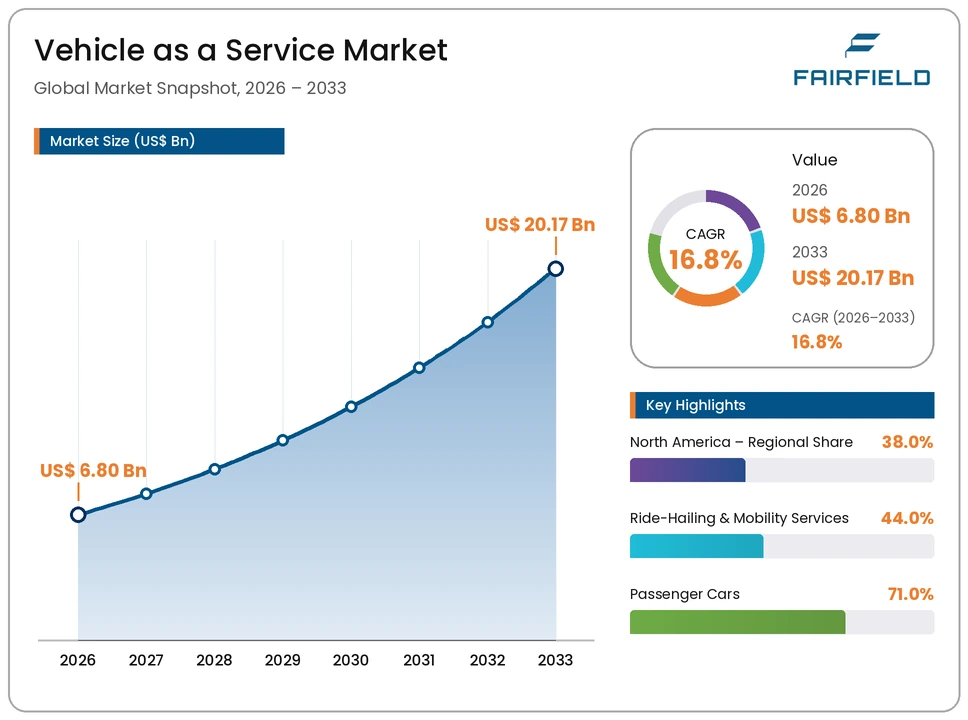
The market is valued at USD 6.80 Billion in 2026, with service providers directing investment toward improved fleet utilization technology, seamless digital booking experiences, and expanding electric vehicle fleet integration. By 2033, the market is forecast to reach USD 20.17 Billion, reflecting rapid growth as flexible mobility models continue to gain mainstream consumer and business adoption.
Key Highlights
- The global vehicle as a service market is valued at USD 6.80 Billion in 2026 and is projected to reach USD 20.17 Billion by 2033, expanding at a CAGR of 16.8% across the 2026-2033 forecast period.
- Ride-Hailing & Mobility Services lead the service-type segment with a 44.0% share in 2026, equivalent to USD 2.99 Billion.
- Passenger Cars remain the dominant vehicle-type segment, accounting for 71.0% of global demand, or USD 4.83 Billion, in 2026.
- North America commands the largest regional share at 38.0% of the global market in 2026.
- Electric vehicle-based services are emerging as the fastest-growing vehicle-type segment through 2033.
Key Growth Drivers
Growth in the vehicle as a service market is driven primarily by continued urbanization, which is reducing the practicality and cost-effectiveness of personal vehicle ownership in dense metropolitan areas where parking scarcity and traffic congestion make on-demand mobility access an increasingly attractive alternative to ownership.
A second driver is growing consumer comfort with subscription-based access models across many categories of consumption, which is extending naturally to vehicle access as consumers increasingly value flexibility and reduced long-term commitment over the traditional ownership model, particularly among younger demographic groups entering the vehicle-using population.
Key Restraints
Fleet utilization economics remain a persistent operational challenge for vehicle as a service providers, since idle vehicle time directly erodes profitability, requiring sophisticated demand forecasting and fleet allocation systems that add operational complexity relative to traditional vehicle sales or leasing models.
Additionally, regulatory frameworks governing ride-hailing, car sharing, and vehicle subscription services vary considerably across different jurisdictions and continue to evolve, creating compliance complexity and occasional market access uncertainty for providers operating across multiple regulatory environments.
Market Opportunities
The integration of electric vehicles into vehicle as a service fleets presents a substantial opportunity, as subscription and sharing models offer consumers a lower-commitment way to experience electric vehicles, potentially accelerating broader electric vehicle market adoption while creating a differentiated service offering for providers.
A second opportunity lies in expanding fleet-as-a-service offerings for business customers, as companies increasingly prefer flexible vehicle access models over traditional fleet ownership or long-term leasing, particularly for businesses with variable or uncertain future fleet size requirements. Providers that successfully address this business-to-business segment stand to capture growing corporate mobility spending.
Segmentation Analysis
- By Service Type
Ride-Hailing & Mobility Services lead the service-type segment, accounting for 44.0% of global market value in 2026, equivalent to USD 2.99 Billion. Their leadership reflects the scale and maturity of on-demand ride services across major global markets. Car Sharing Services and Fleet-as-a-Service hold meaningful secondary shares. Car Subscription Services represent the fastest-growing service-type category through 2033, driven by growing consumer interest in flexible, all-inclusive vehicle access without long-term ownership commitment.
- By Vehicle Type
Passenger Cars form the leading vehicle-type segment, representing 71.0% of global demand in 2026, or USD 4.83 Billion, reflecting their central role across ride-hailing, subscription, and sharing service categories. Commercial Vehicles represent a smaller, steady segment tied to fleet-as-a-service offerings. Electric Vehicles represent the fastest-growing vehicle-type category, propelled by expanding electric vehicle fleet integration across service providers.
Regional Insights
- North America
North America holds the largest regional share, at 38.0% of the global market in 2026, equivalent to USD 2.58 Billion. The region's leadership reflects mature ride-hailing platform adoption, growing car subscription service availability, and strong consumer interest in flexible mobility models across the United States and Canada.
- Europe
Europe accounts for 29.0% of the global market in 2026, valued at USD 1.97 Billion. Demand is supported by strong urban mobility service adoption and growing automaker-backed subscription service offerings across major European markets.
- Asia Pacific
Asia Pacific represents 25.0% of the global market in 2026, or USD 1.70 Billion. Growth is underpinned by rapid urbanization and expanding ride-hailing and car sharing platform adoption across China, India, and Southeast Asian markets.
- Latin America
Latin America contributes 5.0% of the global market in 2026, equivalent to USD 0.34 Billion. Growth is linked to expanding ride-hailing platform penetration in Brazil and Mexico alongside gradual subscription service market development.
- Middle East & Africa
Middle East & Africa holds 3.0% of the global market in 2026, valued at USD 0.20 Billion. Growth remains at an early stage, tied to expanding ride-hailing platform availability across Gulf Cooperation Council countries and other regional markets.
Competitive Landscape
The global vehicle as a service market is moderately fragmented, with a mix of established ride-hailing and car sharing platform operators holding strong positions across major metropolitan markets, alongside automaker-backed subscription services extending manufacturer relationships directly to consumers. Competition centers on fleet utilization efficiency, digital user experience, and the ability to offer competitive pricing while maintaining profitability across variable demand patterns. Companies are increasingly differentiating through electric vehicle fleet integration and expanded service flexibility rather than pricing alone.
Key Market Players
- Uber Technologies, Inc.
- Lyft, Inc.
- Avis Budget Group, Inc.
- Turo Inc.
- Getaround, Inc.
- Fair.com
- Volvo Car Corporation
- Porsche AG
- Stellantis N.V.
- Enterprise Holdings, Inc.
Market Segmentation
By Service Type
- Ride-Hailing & Mobility Services
- Car Subscription Services
- Car Sharing Services
- Fleet-as-a-Service
- Others
By Vehicle Type
- Passenger Cars
- Electric Vehicles
- Commercial Vehicles
By End User
- Individual Consumers
- Business & Corporate Users
By Geography
- North America
- Europe
- Asia Pacific
- Latin America
- Middle East & Africa
- Executive Summary
- Global Vehicle as a Service Market Snapshot
- Future Projections
- Key Market Trends
- Regional Snapshot, by Value, 2026
- Analyst Recommendations
- Market Overview
- Market Definitions and Segmentations
- Market Dynamics
- Drivers
- Restraints
- Market Opportunities
- Value Chain Analysis
- COVID-19 Impact Analysis
- Porter's Five Forces Analysis
- Impact of Russia-Ukraine Conflict
- PESTLE Analysis
- Regulatory Analysis
- Price Trend Analysis
- Current Prices and Future Projections, 2025-2033
- Price Impact Factors
- Global Vehicle as a Service Market Outlook, 2020 - 2033
- Global Vehicle as a Service Market Outlook, by Service Type, Value (US$ Bn), 2020-2033
- Ride-Hailing & Mobility Services
- Car Subscription Services
- Car Sharing Services
- Fleet-as-a-Service
- Others
- Global Vehicle as a Service Market Outlook, by Vehicle Type, Value (US$ Bn), 2020-2033
- Passenger Cars
- Electric Vehicles
- Commercial Vehicles
- Global Vehicle as a Service Market Outlook, by End User, Value (US$ Bn), 2020-2033
- Individual Consumers
- Business & Corporate Users
- Global Vehicle as a Service Market Outlook, by Region, Value (US$ Bn), 2020-2033
- North America
- Europe
- Asia Pacific
- Latin America
- Middle East & Africa
- Global Vehicle as a Service Market Outlook, by Service Type, Value (US$ Bn), 2020-2033
- North America Vehicle as a Service Market Outlook, 2020 - 2033
- North America Vehicle as a Service Market Outlook, by Service Type, Value (US$ Bn), 2020-2033
- Ride-Hailing & Mobility Services
- Car Subscription Services
- Car Sharing Services
- Fleet-as-a-Service
- Others
- North America Vehicle as a Service Market Outlook, by Vehicle Type, Value (US$ Bn), 2020-2033
- Passenger Cars
- Electric Vehicles
- Commercial Vehicles
- North America Vehicle as a Service Market Outlook, by End User, Value (US$ Bn), 2020-2033
- Individual Consumers
- Business & Corporate Users
- North America Vehicle as a Service Market Outlook, by Country, Value (US$ Bn), 2020-2033
- U.S. Vehicle as a Service Market Outlook, by Service Type, 2020-2033
- U.S. Vehicle as a Service Market Outlook, by Vehicle Type, 2020-2033
- U.S. Vehicle as a Service Market Outlook, by End User, 2020-2033
- Canada Vehicle as a Service Market Outlook, by Service Type, 2020-2033
- Canada Vehicle as a Service Market Outlook, by Vehicle Type, 2020-2033
- Canada Vehicle as a Service Market Outlook, by End User, 2020-2033
- BPS Analysis/Market Attractiveness Analysis
- North America Vehicle as a Service Market Outlook, by Service Type, Value (US$ Bn), 2020-2033
- Europe Vehicle as a Service Market Outlook, 2020 - 2033
- Europe Vehicle as a Service Market Outlook, by Service Type, Value (US$ Bn), 2020-2033
- Ride-Hailing & Mobility Services
- Car Subscription Services
- Car Sharing Services
- Fleet-as-a-Service
- Others
- Europe Vehicle as a Service Market Outlook, by Vehicle Type, Value (US$ Bn), 2020-2033
- Passenger Cars
- Electric Vehicles
- Commercial Vehicles
- Europe Vehicle as a Service Market Outlook, by End User, Value (US$ Bn), 2020-2033
- Individual Consumers
- Business & Corporate Users
- Europe Vehicle as a Service Market Outlook, by Country, Value (US$ Bn), 2020-2033
- Germany Vehicle as a Service Market Outlook, by Service Type, 2020-2033
- Germany Vehicle as a Service Market Outlook, by Vehicle Type, 2020-2033
- Germany Vehicle as a Service Market Outlook, by End User, 2020-2033
- Italy Vehicle as a Service Market Outlook, by Service Type, 2020-2033
- Italy Vehicle as a Service Market Outlook, by Vehicle Type, 2020-2033
- Italy Vehicle as a Service Market Outlook, by End User, 2020-2033
- France Vehicle as a Service Market Outlook, by Service Type, 2020-2033
- France Vehicle as a Service Market Outlook, by Vehicle Type, 2020-2033
- France Vehicle as a Service Market Outlook, by End User, 2020-2033
- U.K. Vehicle as a Service Market Outlook, by Service Type, 2020-2033
- U.K. Vehicle as a Service Market Outlook, by Vehicle Type, 2020-2033
- U.K. Vehicle as a Service Market Outlook, by End User, 2020-2033
- Spain Vehicle as a Service Market Outlook, by Service Type, 2020-2033
- Spain Vehicle as a Service Market Outlook, by Vehicle Type, 2020-2033
- Spain Vehicle as a Service Market Outlook, by End User, 2020-2033
- Russia Vehicle as a Service Market Outlook, by Service Type, 2020-2033
- Russia Vehicle as a Service Market Outlook, by Vehicle Type, 2020-2033
- Russia Vehicle as a Service Market Outlook, by End User, 2020-2033
- Rest of Europe Vehicle as a Service Market Outlook, by Service Type, 2020-2033
- Rest of Europe Vehicle as a Service Market Outlook, by Vehicle Type, 2020-2033
- Rest of Europe Vehicle as a Service Market Outlook, by End User, 2020-2033
- BPS Analysis/Market Attractiveness Analysis
- Europe Vehicle as a Service Market Outlook, by Service Type, Value (US$ Bn), 2020-2033
- Asia Pacific Vehicle as a Service Market Outlook, 2020 - 2033
- Asia Pacific Vehicle as a Service Market Outlook, by Service Type, Value (US$ Bn), 2020-2033
- Ride-Hailing & Mobility Services
- Car Subscription Services
- Car Sharing Services
- Fleet-as-a-Service
- Others
- Asia Pacific Vehicle as a Service Market Outlook, by Vehicle Type, Value (US$ Bn), 2020-2033
- Passenger Cars
- Electric Vehicles
- Commercial Vehicles
- Asia Pacific Vehicle as a Service Market Outlook, by End User, Value (US$ Bn), 2020-2033
- Individual Consumers
- Business & Corporate Users
- Asia Pacific Vehicle as a Service Market Outlook, by Country, Value (US$ Bn), 2020-2033
- China Vehicle as a Service Market Outlook, by Service Type, 2020-2033
- China Vehicle as a Service Market Outlook, by Vehicle Type, 2020-2033
- China Vehicle as a Service Market Outlook, by End User, 2020-2033
- Japan Vehicle as a Service Market Outlook, by Service Type, 2020-2033
- Japan Vehicle as a Service Market Outlook, by Vehicle Type, 2020-2033
- Japan Vehicle as a Service Market Outlook, by End User, 2020-2033
- South Korea Vehicle as a Service Market Outlook, by Service Type, 2020-2033
- South Korea Vehicle as a Service Market Outlook, by Vehicle Type, 2020-2033
- South Korea Vehicle as a Service Market Outlook, by End User, 2020-2033
- India Vehicle as a Service Market Outlook, by Service Type, 2020-2033
- India Vehicle as a Service Market Outlook, by Vehicle Type, 2020-2033
- India Vehicle as a Service Market Outlook, by End User, 2020-2033
- Southeast Asia Vehicle as a Service Market Outlook, by Service Type, 2020-2033
- Southeast Asia Vehicle as a Service Market Outlook, by Vehicle Type, 2020-2033
- Southeast Asia Vehicle as a Service Market Outlook, by End User, 2020-2033
- Rest of SAO Vehicle as a Service Market Outlook, by Service Type, 2020-2033
- Rest of SAO Vehicle as a Service Market Outlook, by Vehicle Type, 2020-2033
- Rest of SAO Vehicle as a Service Market Outlook, by End User, 2020-2033
- BPS Analysis/Market Attractiveness Analysis
- Asia Pacific Vehicle as a Service Market Outlook, by Service Type, Value (US$ Bn), 2020-2033
- Latin America Vehicle as a Service Market Outlook, 2020 - 2033
- Latin America Vehicle as a Service Market Outlook, by Service Type, Value (US$ Bn), 2020-2033
- Ride-Hailing & Mobility Services
- Car Subscription Services
- Car Sharing Services
- Fleet-as-a-Service
- Others
- Latin America Vehicle as a Service Market Outlook, by Vehicle Type, Value (US$ Bn), 2020-2033
- Passenger Cars
- Electric Vehicles
- Commercial Vehicles
- Latin America Vehicle as a Service Market Outlook, by End User, Value (US$ Bn), 2020-2033
- Individual Consumers
- Business & Corporate Users
- Latin America Vehicle as a Service Market Outlook, by Country, Value (US$ Bn), 2020-2033
- Brazil Vehicle as a Service Market Outlook, by Service Type, 2020-2033
- Brazil Vehicle as a Service Market Outlook, by Vehicle Type, 2020-2033
- Brazil Vehicle as a Service Market Outlook, by End User, 2020-2033
- Mexico Vehicle as a Service Market Outlook, by Service Type, 2020-2033
- Mexico Vehicle as a Service Market Outlook, by Vehicle Type, 2020-2033
- Mexico Vehicle as a Service Market Outlook, by End User, 2020-2033
- Argentina Vehicle as a Service Market Outlook, by Service Type, 2020-2033
- Argentina Vehicle as a Service Market Outlook, by Vehicle Type, 2020-2033
- Argentina Vehicle as a Service Market Outlook, by End User, 2020-2033
- Rest of LATAM Vehicle as a Service Market Outlook, by Service Type, 2020-2033
- Rest of LATAM Vehicle as a Service Market Outlook, by Vehicle Type, 2020-2033
- Rest of LATAM Vehicle as a Service Market Outlook, by End User, 2020-2033
- BPS Analysis/Market Attractiveness Analysis
- Latin America Vehicle as a Service Market Outlook, by Service Type, Value (US$ Bn), 2020-2033
- Middle East & Africa Vehicle as a Service Market Outlook, 2020 - 2033
- Middle East & Africa Vehicle as a Service Market Outlook, by Service Type, Value (US$ Bn), 2020-2033
- Ride-Hailing & Mobility Services
- Car Subscription Services
- Car Sharing Services
- Fleet-as-a-Service
- Others
- Middle East & Africa Vehicle as a Service Market Outlook, by Vehicle Type, Value (US$ Bn), 2020-2033
- Passenger Cars
- Electric Vehicles
- Commercial Vehicles
- Middle East & Africa Vehicle as a Service Market Outlook, by End User, Value (US$ Bn), 2020-2033
- Individual Consumers
- Business & Corporate Users
- Middle East & Africa Vehicle as a Service Market Outlook, by Country, Value (US$ Bn), 2020-2033
- GCC Vehicle as a Service Market Outlook, by Service Type, 2020-2033
- GCC Vehicle as a Service Market Outlook, by Vehicle Type, 2020-2033
- GCC Vehicle as a Service Market Outlook, by End User, 2020-2033
- South Africa Vehicle as a Service Market Outlook, by Service Type, 2020-2033
- South Africa Vehicle as a Service Market Outlook, by Vehicle Type, 2020-2033
- South Africa Vehicle as a Service Market Outlook, by End User, 2020-2033
- Egypt Vehicle as a Service Market Outlook, by Service Type, 2020-2033
- Egypt Vehicle as a Service Market Outlook, by Vehicle Type, 2020-2033
- Egypt Vehicle as a Service Market Outlook, by End User, 2020-2033
- Nigeria Vehicle as a Service Market Outlook, by Service Type, 2020-2033
- Nigeria Vehicle as a Service Market Outlook, by Vehicle Type, 2020-2033
- Nigeria Vehicle as a Service Market Outlook, by End User, 2020-2033
- Rest of Middle East Vehicle as a Service Market Outlook, by Service Type, 2020-2033
- Rest of Middle East Vehicle as a Service Market Outlook, by Vehicle Type, 2020-2033
- Rest of Middle East Vehicle as a Service Market Outlook, by End User, 2020-2033
- BPS Analysis/Market Attractiveness Analysis
- Middle East & Africa Vehicle as a Service Market Outlook, by Service Type, Value (US$ Bn), 2020-2033
- Competitive Landscape
- Company Vs Segment Heatmap
- Company Market Share Analysis, 2025
- Competitive Dashboard
- Company Profiles
- Uber Technologies, Inc.
- Company Overview
- Product Portfolio
- Financial Overview
- Business Strategies and Developments
- Lyft, Inc.
- Avis Budget Group, Inc.
- Turo Inc.
- Getaround, Inc.
- Fair.com
- Volvo Car Corporation
- Porsche AG
- Stellantis N.V.
- Enterprise Holdings, Inc.
- Uber Technologies, Inc.
- Appendix
- Research Methodology
- Report Assumptions
- Acronyms and Abbreviations
By Service Type
- Ride-Hailing & Mobility Services
- Car Subscription Services
- Car Sharing Services
- Fleet-as-a-Service
- Others
By Vehicle Type
- Passenger Cars
- Electric Vehicles
- Commercial Vehicles
By End User
- Individual Consumers
- Business & Corporate Users
By Geography
- North America
- Europe
- Asia Pacific
- Latin America
- Middle East & Africa
Our Research Methodology
Considering the volatility of business today, traditional approaches to strategizing a game plan can be unfruitful if not detrimental. True ambiguity is no way to determine a forecast. A myriad of predetermined factors must be accounted for such as the degree of risk involved, the magnitude of circumstances, as well as conditions or consequences that are not known or unpredictable. To circumvent binary views that cast uncertainty, the application of market research intelligence to strategically posture, move, and enable actionable outcomes is necessary.
View Methodology
Quality Assured
Rigorous Validation Process

Confidentiality Assured
End-to-end Data Security

Custom Research Services
Tailored To Your Objectives
FAQs
The global vehicle as a service market is valued at USD 6.80 Billion in 2026, reflecting rapid growth in flexible, ownership-alternative mobility models.
The market is projected to grow at a CAGR of 16.8%, reaching USD 20.17 Billion by 2033, driven by urbanization and growing subscription-based consumption preferences.
Ride-Hailing & Mobility Services lead with a 44.0% share in 2026, reflecting the scale and maturity of on-demand ride services globally.
North America leads with a 38.0% share in 2026, driven by mature platform adoption and strong consumer interest in flexible mobility.
The largest opportunity lies in fleet-as-a-service offerings for business customers seeking flexible vehicle access over traditional fleet ownership.
Related Reports
Automotive Alternator and Starter Motor Market Size, Share, Insights, Competitive Landscape, and Forecast 2026 to 2033
The global automotive alternator and starter motor market is valued at US$32.0 billion in 2026, reaching US$38.0 billion by 2033, at a 2.5% CAGR
Automotive Start-Stop Battery Market Size, Share, Insights, Competitive Landscape, and Forecast 2026 to 2033
Hybrid Electric Vehicle (EV) Conversion Kit Market Size, Share, Insights, Competitive Landscape, and Forecast 2026 to 2033
The global hybrid EV conversion kit market will reach US$ 1.42 Bn by 2033, growing at 11.09% CAGR from 2026-2033, driven by cost-effective electrification
Passenger Vehicles HVAC Services Market Size, Share, Insights, Competitive Landscape, and Forecast 2026 to 2033
The passenger vehicles HVAC services market, valued at US$ 48.6 billion in 2026, and projected to reach US$ 73.4 billion by 2033, growing at 6.1% CAGR
Automotive 48-Volt Electronic Junction Box and Power Distribution Center Market Size, Share, Insights, Competitive Landscape, and Forecast 2026 to 2033
The global automotive 48-volt junction box and power distribution center market will reach US$ 4.55 Bn by 2033, growing at 11.68% CAGR from 2026-2033
Ultra-Fast EV Charging (350kW+) Systems Market Size, Share, Insights, Competitive Landscape, and Forecast 2026 to 2033
The global Ultra-Fast EV charging systems market will grow from US$ 7.1 billion in 2026 to US$ 34.5 billion by 2033, at a 25.3% CAGR. Discover key trends