



Vinyl Acetate Monomer (VAM) Market
Vinyl Acetate Monomer (VAM) Market Insights, Competitive Landscape, and Market Forecast - 2033
Market Overview
Vinyl acetate monomer, commonly abbreviated as VAM, is a key petrochemical intermediate produced primarily from ethylene and acetic acid, serving as the building block for polyvinyl acetate, ethylene-vinyl acetate copolymers, and polyvinyl alcohol used across adhesives, paints and coatings, packaging films, and textile applications. As a versatile monomer feeding into diverse downstream polymer chemistries, VAM demand closely tracks activity across construction, packaging, and consumer goods manufacturing sectors that rely on its derivative polymers.
Demand growth through the 2026-2033 window is closely tied to sustained global construction activity requiring adhesive and coating products derived from VAM-based polymers, expanding solar panel manufacturing that relies on ethylene-vinyl acetate encapsulant film, and steady packaging film demand across food and consumer goods applications. Growing renewable energy infrastructure investment, particularly solar photovoltaic manufacturing, has introduced a meaningful new demand driver for VAM-derived ethylene-vinyl acetate copolymers beyond the market's traditional adhesive and coating applications.
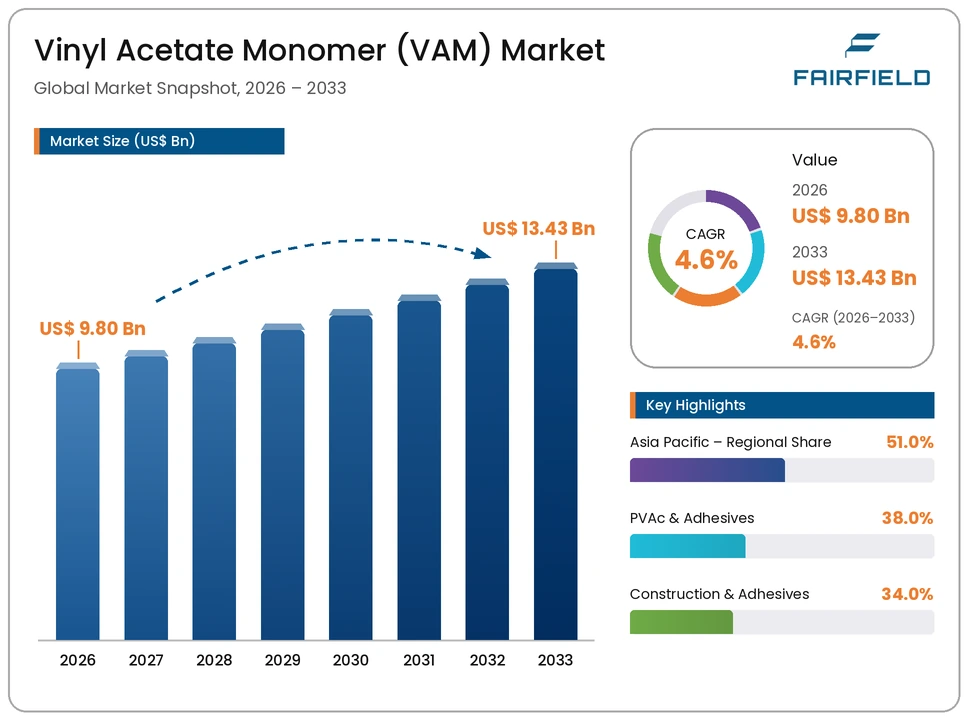
The market is valued at USD 9.80 Billion in 2026, with producers directing investment toward capacity expansion to serve growing downstream polymer demand, particularly in Asia Pacific where both VAM production and downstream polymer manufacturing capacity continue to expand. By 2033, the market is forecast to reach USD 13.43 Billion, reflecting steady growth across established adhesive and coating applications alongside expanding solar encapsulant film demand.
Key Highlights
- The global VAM market is valued at USD 9.80 Billion in 2026 and is projected to reach USD 13.43 Billion by 2033, expanding at a CAGR of 4.6% across the 2026-2033 forecast period.
- Polyvinyl Acetate (PVAc) & Adhesives lead the application segment with a 38.0% share in 2026, equivalent to USD 3.72 Billion.
- Construction & Adhesives remains the dominant end-use industry, accounting for 34.0% of global demand, or USD 3.33 Billion, in 2026.
- Asia Pacific commands the largest regional share at 51.0% of the global market in 2026.
- Packaging and film applications are emerging as the fastest-growing end-use segment through 2033.
Market Dynamics
Key Growth Drivers
Growth in the VAM market is driven primarily by sustained global construction activity, which supports demand for polyvinyl acetate-based adhesives and paints used extensively in building and construction applications, creating consistent baseline demand tied closely to global construction sector activity levels.
A second driver is expanding solar photovoltaic panel manufacturing, which relies on ethylene-vinyl acetate copolymer film as a standard encapsulant material protecting solar cells within panel assemblies. As global solar panel production capacity continues to expand to meet renewable energy deployment targets, this application has become an increasingly significant driver of VAM-derived polymer demand.
Key Restraints
Price volatility in ethylene and acetic acid feedstocks, both derived from petrochemical processing, creates cost uncertainty for VAM producers, since fluctuations in these upstream petrochemical markets directly affect VAM production economics and can compress margins during periods of feedstock cost inflation.
Additionally, VAM production and handling require careful safety management given the monomer's flammability and reactivity characteristics, adding regulatory compliance and safety infrastructure costs that represent a meaningful component of overall production economics for VAM manufacturers.
Market Opportunities
The continued expansion of solar panel manufacturing capacity presents a substantial opportunity, as global renewable energy deployment targets drive sustained growth in ethylene-vinyl acetate encapsulant film demand, an application area that has grown considerably faster than the market's traditional adhesive and coating base.
A second opportunity lies in expanding polyvinyl alcohol applications across textile sizing, paper coating, and specialty packaging film uses, particularly as water-soluble packaging film gains attention as a potential solution for reducing single-use plastic packaging waste in specific applications.
Segmentation Analysis
By Application
Polyvinyl Acetate (PVAc) & Adhesives lead the application segment, accounting for 38.0% of global market value in 2026, equivalent to USD 3.72 Billion. Their leadership reflects extensive use across construction, woodworking, and packaging adhesive applications. Polyvinyl Alcohol (PVOH) holds a significant secondary share across textile and paper applications. EVA Copolymers represent the fastest-growing application category through 2033, driven by expanding solar panel encapsulant film demand.
By End-Use Industry
Construction & Adhesives forms the leading end-use segment, representing 34.0% of global demand in 2026, or USD 3.33 Billion, reflecting sustained global construction activity requiring VAM-derived adhesive and coating products. Paints & Coatings and Textiles represent significant, established end-use segments. Packaging & Films represents the fastest-growing end-use category, supported by both traditional packaging film demand and expanding solar encapsulant applications.
Regional Insights
Asia Pacific
Asia Pacific holds the largest regional share, at 51.0% of the global market in 2026, equivalent to USD 5.00 Billion. The region's dominance reflects its large VAM production capacity and downstream polymer manufacturing base, led by China, alongside substantial solar panel manufacturing capacity driving EVA copolymer demand.
North America
North America accounts for 22.0% of the global market in 2026, valued at USD 2.16 Billion. Demand is supported by established construction and adhesive manufacturing activity across the United States and Canada.
Europe
Europe represents 18.0% of the global market in 2026, or USD 1.76 Billion. The region's mature construction and coatings industry sustains steady VAM-derived polymer demand, though regional production capacity trends shape long-term supply dynamics.
Latin America
Latin America contributes 5.0% of the global market in 2026, equivalent to USD 0.49 Billion. Growth is linked to expanding construction and packaging activity in Brazil and Mexico.
Middle East & Africa
Middle East & Africa holds 4.0% of the global market in 2026, valued at USD 0.39 Billion. Growth remains gradual, tied to limited regional VAM production and downstream polymer manufacturing capacity relative to other regions.
Competitive Landscape
The global VAM market is moderately concentrated, with a limited number of large-scale integrated petrochemical producers holding substantial production capacity supported by backward integration into ethylene and acetic acid feedstocks. Competition centers on production cost efficiency, feedstock integration, and the ability to serve downstream polymer manufacturers reliably at scale. Producers are increasingly directing capacity investment toward regions with growing downstream demand, particularly Asia Pacific, rather than competing purely on price in mature markets.
Key Market Players
- Celanese Corporation
- LyondellBasell Industries N.V.
- The Dow Chemical Company
- Wacker Chemie AG
- China Petroleum & Chemical Corporation (Sinopec)
- Chang Chun Petrochemical Co., Ltd.
- Kuraray Co., Ltd.
- Sipchem
- INEOS Group Holdings S.A.
- Jiangsu Sopo Chemical Co., Ltd.
Market Segmentation
By Application
- Polyvinyl Acetate (PVAc) & Adhesives
- EVA Copolymers
- Polyvinyl Alcohol (PVOH)
- Others
By End-Use Industry
- Construction & Adhesives
- Packaging & Films
- Textiles
- Paints & Coatings
- Others
By Production Process
- Ethylene-Based Process
- Acetylene-Based Process
By Geography
- North America
- Europe
- Asia Pacific
- Latin America
- Middle East & Africa
- Executive Summary
- Global Vinyl Acetate Monomer (VAM) Market Snapshot
- Future Projections
- Key Market Trends
- Regional Snapshot, by Value, 2026
- Analyst Recommendations
- Market Overview
- Market Definitions and Segmentations
- Market Dynamics
- Drivers
- Restraints
- Market Opportunities
- Value Chain Analysis
- COVID-19 Impact Analysis
- Porter's Five Forces Analysis
- Impact of Russia-Ukraine Conflict
- PESTLE Analysis
- Regulatory Analysis
- Price Trend Analysis
- Current Prices and Future Projections, 2025-2033
- Price Impact Factors
- Global Vinyl Acetate Monomer (VAM) Market Outlook, 2020 - 2033
- Global Vinyl Acetate Monomer (VAM) Market Outlook, by Application, Value (US$ Mn), 2020-2033
- Polyvinyl Acetate (PVAc) & Adhesives
- EVA Copolymers
- Polyvinyl Alcohol (PVOH)
- Others
- Global Vinyl Acetate Monomer (VAM) Market Outlook, by End-Use Industry, Value (US$ Mn), 2020-2033
- Construction & Adhesives
- Packaging & Films
- Textiles
- Paints & Coatings
- Others
- Global Vinyl Acetate Monomer (VAM) Market Outlook, by Production Process, Value (US$ Mn), 2020-2033
- Ethylene-Based Process
- Acetylene-Based Process
- Global Vinyl Acetate Monomer (VAM) Market Outlook, by Region, Value (US$ Mn), 2020-2033
- North America
- Europe
- Asia Pacific
- Latin America
- Middle East & Africa
- Global Vinyl Acetate Monomer (VAM) Market Outlook, by Application, Value (US$ Mn), 2020-2033
- North America Vinyl Acetate Monomer (VAM) Market Outlook, 2020 - 2033
- North America Vinyl Acetate Monomer (VAM) Market Outlook, by Application, Value (US$ Mn), 2020-2033
- Polyvinyl Acetate (PVAc) & Adhesives
- EVA Copolymers
- Polyvinyl Alcohol (PVOH)
- Others
- North America Vinyl Acetate Monomer (VAM) Market Outlook, by End-Use Industry, Value (US$ Mn), 2020-2033
- Construction & Adhesives
- Packaging & Films
- Textiles
- Paints & Coatings
- Others
- North America Vinyl Acetate Monomer (VAM) Market Outlook, by Production Process, Value (US$ Mn), 2020-2033
- Ethylene-Based Process
- Acetylene-Based Process
- North America Vinyl Acetate Monomer (VAM) Market Outlook, by Country, Value (US$ Mn), 2020-2033
- U.S. Vinyl Acetate Monomer (VAM) Market Outlook, by Application, 2020-2033
- U.S. Vinyl Acetate Monomer (VAM) Market Outlook, by End-Use Industry, 2020-2033
- U.S. Vinyl Acetate Monomer (VAM) Market Outlook, by Production Process, 2020-2033
- Canada Vinyl Acetate Monomer (VAM) Market Outlook, by Application, 2020-2033
- Canada Vinyl Acetate Monomer (VAM) Market Outlook, by End-Use Industry, 2020-2033
- Canada Vinyl Acetate Monomer (VAM) Market Outlook, by Production Process, 2020-2033
- BPS Analysis/Market Attractiveness Analysis
- North America Vinyl Acetate Monomer (VAM) Market Outlook, by Application, Value (US$ Mn), 2020-2033
- Europe Vinyl Acetate Monomer (VAM) Market Outlook, 2020 - 2033
- Europe Vinyl Acetate Monomer (VAM) Market Outlook, by Application, Value (US$ Mn), 2020-2033
- Polyvinyl Acetate (PVAc) & Adhesives
- EVA Copolymers
- Polyvinyl Alcohol (PVOH)
- Others
- Europe Vinyl Acetate Monomer (VAM) Market Outlook, by End-Use Industry, Value (US$ Mn), 2020-2033
- Construction & Adhesives
- Packaging & Films
- Textiles
- Paints & Coatings
- Others
- Europe Vinyl Acetate Monomer (VAM) Market Outlook, by Production Process, Value (US$ Mn), 2020-2033
- Ethylene-Based Process
- Acetylene-Based Process
- Europe Vinyl Acetate Monomer (VAM) Market Outlook, by Country, Value (US$ Mn), 2020-2033
- Germany Vinyl Acetate Monomer (VAM) Market Outlook, by Application, 2020-2033
- Germany Vinyl Acetate Monomer (VAM) Market Outlook, by End-Use Industry, 2020-2033
- Germany Vinyl Acetate Monomer (VAM) Market Outlook, by Production Process, 2020-2033
- Italy Vinyl Acetate Monomer (VAM) Market Outlook, by Application, 2020-2033
- Italy Vinyl Acetate Monomer (VAM) Market Outlook, by End-Use Industry, 2020-2033
- Italy Vinyl Acetate Monomer (VAM) Market Outlook, by Production Process, 2020-2033
- France Vinyl Acetate Monomer (VAM) Market Outlook, by Application, 2020-2033
- France Vinyl Acetate Monomer (VAM) Market Outlook, by End-Use Industry, 2020-2033
- France Vinyl Acetate Monomer (VAM) Market Outlook, by Production Process, 2020-2033
- U.K. Vinyl Acetate Monomer (VAM) Market Outlook, by Application, 2020-2033
- U.K. Vinyl Acetate Monomer (VAM) Market Outlook, by End-Use Industry, 2020-2033
- U.K. Vinyl Acetate Monomer (VAM) Market Outlook, by Production Process, 2020-2033
- Spain Vinyl Acetate Monomer (VAM) Market Outlook, by Application, 2020-2033
- Spain Vinyl Acetate Monomer (VAM) Market Outlook, by End-Use Industry, 2020-2033
- Spain Vinyl Acetate Monomer (VAM) Market Outlook, by Production Process, 2020-2033
- Russia Vinyl Acetate Monomer (VAM) Market Outlook, by Application, 2020-2033
- Russia Vinyl Acetate Monomer (VAM) Market Outlook, by End-Use Industry, 2020-2033
- Russia Vinyl Acetate Monomer (VAM) Market Outlook, by Production Process, 2020-2033
- Rest of Europe Vinyl Acetate Monomer (VAM) Market Outlook, by Application, 2020-2033
- Rest of Europe Vinyl Acetate Monomer (VAM) Market Outlook, by End-Use Industry, 2020-2033
- Rest of Europe Vinyl Acetate Monomer (VAM) Market Outlook, by Production Process, 2020-2033
- BPS Analysis/Market Attractiveness Analysis
- Europe Vinyl Acetate Monomer (VAM) Market Outlook, by Application, Value (US$ Mn), 2020-2033
- Asia Pacific Vinyl Acetate Monomer (VAM) Market Outlook, 2020 - 2033
- Asia Pacific Vinyl Acetate Monomer (VAM) Market Outlook, by Application, Value (US$ Mn), 2020-2033
- Polyvinyl Acetate (PVAc) & Adhesives
- EVA Copolymers
- Polyvinyl Alcohol (PVOH)
- Others
- Asia Pacific Vinyl Acetate Monomer (VAM) Market Outlook, by End-Use Industry, Value (US$ Mn), 2020-2033
- Construction & Adhesives
- Packaging & Films
- Textiles
- Paints & Coatings
- Others
- Asia Pacific Vinyl Acetate Monomer (VAM) Market Outlook, by Production Process, Value (US$ Mn), 2020-2033
- Ethylene-Based Process
- Acetylene-Based Process
- Asia Pacific Vinyl Acetate Monomer (VAM) Market Outlook, by Country, Value (US$ Mn), 2020-2033
- China Vinyl Acetate Monomer (VAM) Market Outlook, by Application, 2020-2033
- China Vinyl Acetate Monomer (VAM) Market Outlook, by End-Use Industry, 2020-2033
- China Vinyl Acetate Monomer (VAM) Market Outlook, by Production Process, 2020-2033
- Japan Vinyl Acetate Monomer (VAM) Market Outlook, by Application, 2020-2033
- Japan Vinyl Acetate Monomer (VAM) Market Outlook, by End-Use Industry, 2020-2033
- Japan Vinyl Acetate Monomer (VAM) Market Outlook, by Production Process, 2020-2033
- South Korea Vinyl Acetate Monomer (VAM) Market Outlook, by Application, 2020-2033
- South Korea Vinyl Acetate Monomer (VAM) Market Outlook, by End-Use Industry, 2020-2033
- South Korea Vinyl Acetate Monomer (VAM) Market Outlook, by Production Process, 2020-2033
- India Vinyl Acetate Monomer (VAM) Market Outlook, by Application, 2020-2033
- India Vinyl Acetate Monomer (VAM) Market Outlook, by End-Use Industry, 2020-2033
- India Vinyl Acetate Monomer (VAM) Market Outlook, by Production Process, 2020-2033
- Southeast Asia Vinyl Acetate Monomer (VAM) Market Outlook, by Application, 2020-2033
- Southeast Asia Vinyl Acetate Monomer (VAM) Market Outlook, by End-Use Industry, 2020-2033
- Southeast Asia Vinyl Acetate Monomer (VAM) Market Outlook, by Production Process, 2020-2033
- Rest of SAO Vinyl Acetate Monomer (VAM) Market Outlook, by Application, 2020-2033
- Rest of SAO Vinyl Acetate Monomer (VAM) Market Outlook, by End-Use Industry, 2020-2033
- Rest of SAO Vinyl Acetate Monomer (VAM) Market Outlook, by Production Process, 2020-2033
- BPS Analysis/Market Attractiveness Analysis
- Asia Pacific Vinyl Acetate Monomer (VAM) Market Outlook, by Application, Value (US$ Mn), 2020-2033
- Latin America Vinyl Acetate Monomer (VAM) Market Outlook, 2020 - 2033
- Latin America Vinyl Acetate Monomer (VAM) Market Outlook, by Application, Value (US$ Mn), 2020-2033
- Polyvinyl Acetate (PVAc) & Adhesives
- EVA Copolymers
- Polyvinyl Alcohol (PVOH)
- Others
- Latin America Vinyl Acetate Monomer (VAM) Market Outlook, by End-Use Industry, Value (US$ Mn), 2020-2033
- Construction & Adhesives
- Packaging & Films
- Textiles
- Paints & Coatings
- Others
- Latin America Vinyl Acetate Monomer (VAM) Market Outlook, by Production Process, Value (US$ Mn), 2020-2033
- Ethylene-Based Process
- Acetylene-Based Process
- Latin America Vinyl Acetate Monomer (VAM) Market Outlook, by Country, Value (US$ Mn), 2020-2033
- Brazil Vinyl Acetate Monomer (VAM) Market Outlook, by Application, 2020-2033
- Brazil Vinyl Acetate Monomer (VAM) Market Outlook, by End-Use Industry, 2020-2033
- Brazil Vinyl Acetate Monomer (VAM) Market Outlook, by Production Process, 2020-2033
- Mexico Vinyl Acetate Monomer (VAM) Market Outlook, by Application, 2020-2033
- Mexico Vinyl Acetate Monomer (VAM) Market Outlook, by End-Use Industry, 2020-2033
- Mexico Vinyl Acetate Monomer (VAM) Market Outlook, by Production Process, 2020-2033
- Argentina Vinyl Acetate Monomer (VAM) Market Outlook, by Application, 2020-2033
- Argentina Vinyl Acetate Monomer (VAM) Market Outlook, by End-Use Industry, 2020-2033
- Argentina Vinyl Acetate Monomer (VAM) Market Outlook, by Production Process, 2020-2033
- Rest of LATAM Vinyl Acetate Monomer (VAM) Market Outlook, by Application, 2020-2033
- Rest of LATAM Vinyl Acetate Monomer (VAM) Market Outlook, by End-Use Industry, 2020-2033
- Rest of LATAM Vinyl Acetate Monomer (VAM) Market Outlook, by Production Process, 2020-2033
- BPS Analysis/Market Attractiveness Analysis
- Latin America Vinyl Acetate Monomer (VAM) Market Outlook, by Application, Value (US$ Mn), 2020-2033
- Middle East & Africa Vinyl Acetate Monomer (VAM) Market Outlook, 2020 - 2033
- Middle East & Africa Vinyl Acetate Monomer (VAM) Market Outlook, by Application, Value (US$ Mn), 2020-2033
- Polyvinyl Acetate (PVAc) & Adhesives
- EVA Copolymers
- Polyvinyl Alcohol (PVOH)
- Others
- Middle East & Africa Vinyl Acetate Monomer (VAM) Market Outlook, by End-Use Industry, Value (US$ Mn), 2020-2033
- Construction & Adhesives
- Packaging & Films
- Textiles
- Paints & Coatings
- Others
- Middle East & Africa Vinyl Acetate Monomer (VAM) Market Outlook, by Production Process, Value (US$ Mn), 2020-2033
- Ethylene-Based Process
- Acetylene-Based Process
- Middle East & Africa Vinyl Acetate Monomer (VAM) Market Outlook, by Country, Value (US$ Mn), 2020-2033
- GCC Vinyl Acetate Monomer (VAM) Market Outlook, by Application, 2020-2033
- GCC Vinyl Acetate Monomer (VAM) Market Outlook, by End-Use Industry, 2020-2033
- GCC Vinyl Acetate Monomer (VAM) Market Outlook, by Production Process, 2020-2033
- South Africa Vinyl Acetate Monomer (VAM) Market Outlook, by Application, 2020-2033
- South Africa Vinyl Acetate Monomer (VAM) Market Outlook, by End-Use Industry, 2020-2033
- South Africa Vinyl Acetate Monomer (VAM) Market Outlook, by Production Process, 2020-2033
- Egypt Vinyl Acetate Monomer (VAM) Market Outlook, by Application, 2020-2033
- Egypt Vinyl Acetate Monomer (VAM) Market Outlook, by End-Use Industry, 2020-2033
- Egypt Vinyl Acetate Monomer (VAM) Market Outlook, by Production Process, 2020-2033
- Nigeria Vinyl Acetate Monomer (VAM) Market Outlook, by Application, 2020-2033
- Nigeria Vinyl Acetate Monomer (VAM) Market Outlook, by End-Use Industry, 2020-2033
- Nigeria Vinyl Acetate Monomer (VAM) Market Outlook, by Production Process, 2020-2033
- Rest of Middle East Vinyl Acetate Monomer (VAM) Market Outlook, by Application, 2020-2033
- Rest of Middle East Vinyl Acetate Monomer (VAM) Market Outlook, by End-Use Industry, 2020-2033
- Rest of Middle East Vinyl Acetate Monomer (VAM) Market Outlook, by Production Process, 2020-2033
- BPS Analysis/Market Attractiveness Analysis
- Middle East & Africa Vinyl Acetate Monomer (VAM) Market Outlook, by Application, Value (US$ Mn), 2020-2033
- Competitive Landscape
- Company Vs Segment Heatmap
- Company Market Share Analysis, 2025
- Competitive Dashboard
- Company Profiles
- Celanese Corporation
- Company Overview
- Product Portfolio
- Financial Overview
- Business Strategies and Developments
- LyondellBasell Industries N.V.
- The Dow Chemical Company
- Wacker Chemie AG
- China Petroleum & Chemical Corporation (Sinopec)
- Chang Chun Petrochemical Co., Ltd.
- Kuraray Co., Ltd.
- Sipchem
- INEOS Group Holdings S.A.
- Jiangsu Sopo Chemical Co., Ltd.
- Celanese Corporation
- Appendix
- Research Methodology
- Report Assumptions
- Acronyms and Abbreviations
By Application
- Polyvinyl Acetate (PVAc) & Adhesives
- EVA Copolymers
- Polyvinyl Alcohol (PVOH)
- Others
By End-Use Industry
- Construction & Adhesives
- Packaging & Films
- Textiles
- Paints & Coatings
- Others
By Production Process
- Ethylene-Based Process
- Acetylene-Based Process
By Geography
- North America
- Europe
- Asia Pacific
- Latin America
- Middle East & Africa
Our Research Methodology
Considering the volatility of business today, traditional approaches to strategizing a game plan can be unfruitful if not detrimental. True ambiguity is no way to determine a forecast. A myriad of predetermined factors must be accounted for such as the degree of risk involved, the magnitude of circumstances, as well as conditions or consequences that are not known or unpredictable. To circumvent binary views that cast uncertainty, the application of market research intelligence to strategically posture, move, and enable actionable outcomes is necessary.
View Methodology
Quality Assured
Rigorous Validation Process

Confidentiality Assured
End-to-end Data Security

Custom Research Services
Tailored To Your Objectives
FAQs
The global vinyl acetate monomer market is valued at USD 9.80 Billion in 2026, reflecting sustained demand across adhesive, coating, and film applications.
The market is projected to grow at a CAGR of 4.6%, reaching USD 13.43 Billion by 2033, supported by construction demand and expanding solar encapsulant film use.
Polyvinyl Acetate (PVAc) & Adhesives lead with a 38.0% share in 2026, reflecting extensive use across construction and packaging adhesive applications.
Asia Pacific leads with a 51.0% share in 2026, driven by its large production capacity and downstream polymer manufacturing base.
The largest opportunity lies in ethylene-vinyl acetate encapsulant film for solar panel manufacturing, growing alongside global renewable energy deployment.
Related Reports
Electrical Steel Coatings Market Size, Share, Insights, Competitive Landscape, and Forecast 2026 to 2033
The electrical steel coatings market, valued at US$ 1.42 billion in 2026, and forecast to reach US$ 2.41 billion by 2033, growing at a 7.85% CAGR
Self-repairing Polymers Market Size, Share, Insights, Competitive Landscape, and Forecast 2026 to 2033
The global self-repairing polymers market is projected to grow from US$ 0.42 billion in 2026 to US$ 1.18 billion by 2033, at a CAGR of 15.90%
Biomass Coating Additives Market Size, Share, Insights, Competitive Landscape, and Forecast 2026 to 2033
The Biomass Coating Additives Market is projected to reach US$3.48 billion by 2033, growing at 9.36% CAGR from US$1.86 billion in 2026.
Oxygen-Barrier Compostable Films Market Size, Share, Insights, Competitive Landscape, and Forecast 2026 to 2033
The global oxygen-barrier compostable films market is projected to reach US$2.34 billion by 2033, growing at an 11.1% CAGR from 2026 to 2033
Dielectric Ester Fluids Market Size, Share, Insights, Competitive Landscape, and Forecast 2026 to 2033
The global Dielectric Ester Fluids market is projected to grow from US$1.62 billion in 2026 to US$3.16 billion by 2033, at a CAGR of 10.02%.
CO2-Derived Chemicals Market Size, Share, Insights, Competitive Landscape, and Forecast 2026 to 2033
The global CO2-derived chemicals market is projected to reach US$22.8 billion by 2033, growing from US$9.4 billion in 2026 at a 13.5% CAGR